No early signs to alert people to kidney disease

By New York Times

Kidney disease doesn’t get the attention, funding or concern associated with cancers of the breast or prostate. But it actually kills more Americans – 90,000 a year – than both malignancies combined.

Even when it is not fatal, the cost of treating end-stage kidney disease through dialysis or a kidney transplant is astronomical, more than fivefold what Medicare pays annually for the average patient over age 65. The charges do not include the inestimable costs to quality of life among patients with advanced kidney disease.

Much is known about who faces the greatest risks of developing chronic kidney disease and how it can be prevented, detected in its early stages, and treated to slow or halt its progression. But unless people at risk are tested, they are unlikely to know they have kidney disease; it produces no symptoms until it is quite advanced.

Perhaps no one knows this better than Duane Sunwold, 55, a culinary arts instructor at Spokane Community College in Spokane, whose compromised kidney function was not uncovered until a blood pressure crisis landed him in the hospital. A physician assistant found that abnormal amounts of protein were spilling out in his urine.

Sunwold, then only 43, was referred to a nephrologist, who diagnosed a condition called minimal-change disease: damage to the tiny blood vessels within the kidney that filter wastes from the blood to make urine. Protein is not supposed to be among those wastes. Although Sunwold’s personal physician was treating him for high blood pressure, a leading cause of kidney failure, the doctor never checked to see how well his vital organs were functioning.

Such a lapse is not uncommon. Kidney disease often is not on the medical radar, and in as many as three-fourths of patients with risk factors for poor kidney function, physicians fail to use a simple, inexpensive test to check for urinary protein.

This fact has turned Sunwold into a proselytizer with a potentially lifesaving message for 26 million Americans who have kidney disease (many of whom don’t yet know it) and an additional 76 million at high risk of developing it: Make sure your doctor checks the protein level in your urine at least once a year.

After his diagnosis, Sunwold brought all his risk factors under control and succeeded in improving his kidney function. He offers tips and recipes online for good kidney health, which are also good for the heart, diabetes and weight control.

A study published in April online in the American Journal of Kidney Disease demonstrated how common lifestyle factors can harm the kidneys. Researchers led by Dr. Alex Chang of Johns Hopkins University followed more than 2,300 young adults for 15 years. Participants were more likely to develop kidney disease if they smoked, were obese or had diets high in red and processed meats, sugar-sweetened drinks and sodium, but low in fruit, legumes, nuts, whole grains and low-fat dairy.

Only 1 percent of participants with no lifestyle-related risk factors developed protein in their urine, an early indicator of kidney damage, while 13 percent of those with three unhealthy factors developed the condition, known medically as proteinuria. Obesity alone doubled a person’s risk of developing kidney disease; an unhealthy diet raised the risk even when weight and other lifestyle factors were taken into account.

Overall, the risk was highest among African Americans; those with diabetes, high blood pressure or a family history of kidney disease; and those who consumed more soft drinks, red meat and fast food.

In commenting on the study, Dr. Beth Piraino, president of the National Kidney Foundation, said, “We need to shift the focus from managing chronic kidney disease to preventing it in the first place.”

Which is exactly the approach Sunwold has adopted. “I had been feeling like I had the flu – bone-tired, exhausted all the time,” he said. “I’m now a wannabe vegan. Meat makes up less than 5 percent of my diet. In just two weeks after changing my diet to one that is plant-based, I really felt much better.”

He also swims laps every day and maintains his 6-foot frame at 180 pounds. His kidney function, which is now normal, is checked every three months, and he religiously takes medication to control his blood pressure.

Dr. Leslie Spry, director of the Dialysis Center of Lincoln in Nebraska and another online proselytizer for a kidney-healthy lifestyle, noted that people with high blood pressure, Type 2 diabetes or obesity who manage to avoid a heart attack or stroke remain at risk for kidney disease, which he likened to the third rail.

Having just one risk factor raises the chances of developing kidney disease from 1 in 10 to 1 in 3, Spry said.

A family history of kidney disease is not the only genetic risk. In addition to African Americans, Latinos, Asian Americans and American Indians are more likely than white Americans to develop kidney disease.

“People can’t change their genetics,” Spry said. “But I wouldn’t have to work so hard if they didn’t smoke, reduced their salt intake, ate more fresh fruits and vegetables, and increased their physical activity. These are things people can do for themselves. They involve no medication.”

He also urges everyone with any risk factor for kidney disease to be screened annually with inexpensive urine and blood tests. That includes everyone 65 and older, for whom the cost is covered by Medicare. Free testing is also provided by the National Kidney Foundation for people with diabetes.

The urine test can pick up abnormal levels of protein, which is supposed to stay in the body, compared with the amount of creatinine, a waste product that should be excreted. The blood test, called an eGFR (for estimated glomerular filtration rate), measures how much blood the kidneys filter each minute, indicating how effectively they are functioning.

Anyone found to have kidney disease should be referred to a nephrologist, a specialist who can work with the family physician to control the disease.

Two medications commonly used to treat high blood pressure can often halt or delay the progression of kidney disease in people with diabetes: angiotensin-converting enzyme (ACE) inhibitors and angiotensin receptor blockers (ARBs). Careful control of blood sugar levels also protects the kidneys from further damage.





Kids need to learn early about managing money

By Karen Cheney, CNN Money

As they regularly remind us, teens know everything. Money is no exception.

In a recent Capital One 360 poll, 87 percent of 12- to 17-year-olds reported knowing at least an average amount about managing finances. Or not. That study also found that 24 percent of them think a debit card is used to borrow cash.

And a Charles Schwab poll found that fewer than a third of teens understand how credit card interest works and four in 10 can’t budget.

Parents’ money talks with high schoolers tend to start and end with “How much do you need?”

“The more you teach your kids before they go off on their own, the better prepared they are,” says Daniel Hebert of Jump$tart, a coalition promoting financial literacy.

The most critical skills to impart:

Managing on a limited budget

The key word is limited. “Teens need to know that money is finite,” says Anton Simunovic, founder of ThreeJars.com, a money-management site for kids.

How to build the skill. Figure out what you’re spending for junior’s clothing, entertainment, and gifts for friends. “Then give that amount to your kid and let him pay for those things,” says Jayne Pearl, author of a series of books on kids and money.

Set teens up with a checking account and debit card, and when they mess up, resist the urge to bail them out.

“It is important to make them responsible for their financial actions while the consequences are not serious,” says Jeffrey Arnett, a psychology professor at Clark University and co-author of “When Will My Grown-Up Kid Grow Up?”

Paying yourself first

“You want to get your child in the habit of putting something aside,” says Stephanie Bell, spokesperson for Junior Achievement USA.

A good goal is to stash 10 percent of every allowance, paycheck, and birthday check. And nothing provides better motivation than an understanding of how money makes money — a.k.a. compound interest.

Use an online calculator to show your teen how compounding works, says Beth Kobliner, author of Get a Financial Life. (Try the Simple Savings Calculator at Bankrate.com.) You might also sweeten the pot by offering to match her with, say, $25 for every $100 she banks.

Just 9 percent of college kids pay their credit cards off every month, a study in the International Journal of Business and Social Science found. Help your child understand the value of being in that minority.

The next time you pay with plastic in your child’s presence, point out that it’s borrowed money and that compounding works against you when you carry a balance. Later, show her your bill, specifically the box illustrating how long it will take to pay off and how much it will cost if you fork over only the minimum.

Make sure she understands, too, that you’re “graded” on your use of credit; regularly paying late, for example, could result in a higher rate on a car loan. When she’s ready for her own card — around age 21 — “ask for a $500 limit,” says Hebert. Well prepared as your child may be, it never hurts to use training wheels the first time out.


Phelps a winner with fans; not on the links

STATELINE — Don’t be surprised if Michael Phelps has a hard time holding a golf club today.

A spectator on Friday said he had been signing autographs for more than an hour.

While most of his peers had called it a day, Phelps was walking the long line that had formed outside the practice putting area. He signed whatever was put in front of him. He posed for pictures. He chatted a bit.

Michael Phelps -- a fan favorite at the ACC. Photo/Kathryn Reed

Michael Phelps — a fan favorite at the Tahoe celebrity golf tournament at Edgwood Tahoe. Photo/Kathryn Reed

Phelps even had a Douglas County sheriff’s deputy keeping guard.

With the popularity of this swimming sensation, it may not matter that Michael Jordan skipped this year’s American Century Championship celebrity golf tournament.

Phelps is one of four Olympians participating in this year’s event. But he’s the one who holds the record for most medals won – 22.

However, even with a wingspan greater than an eagle and a flutter kick like a dolphin, the transition from water to land was not easy for him July 19. Out of the 85 players, Phelps was at 82 after the first of three days.

He spent some time practicing his putts after signing all the autographs. While he could sink a few 15-footers, he remarked that he couldn’t do that earlier when it counted.

Asked what else he would be doing in Tahoe, Phelps said he didn’t know – that he was pretty tired after playing 18 holes. He has 36 more to go.

Phelps will tee off Saturday at 9:45am with Emmitt Smith and Chipper Jones.

— Kathryn Reed


Motorcycle ride recognizes fallen soldiers

The Tribute to Fallen Soldiers Memorial Torch Motorcycle Ride will come through the South Shore on July 31.

The eight-day ride through Washington, Oregon, California and Nevada is to honor and pay tribute to America’s fallen soldiers.

The Fallen Soldiers Memorial Torch will be lighted in Seattle on July 23 and then travel more than 1,800 miles to Stateline where the ride will end.

On the final day, the torch will depart Carson City Harley-Davidson at approximately 11am. It will arrive at the Horizon casino between noon and 12:30pm.

There will be a ceremony that includes a military bell ringing at the casino, and recognition of gold star families.


McGraw flexes his music muscle in Tahoe

Tm McGraw belts out a hit during his July 16 show at Harveys. Photos/Kathryn Reed

Tm McGraw belts out a hit during his July 16 show at Harveys. Photos/Kathryn Reed

By Kathryn Reed

STATELINE – Tim McGraw knows how to get women to scream – and he doesn’t even have to sing. Tight jeans, biceps flexing and that smile are all it takes.

He was showing off his muscles at Anytime Fitness in Zephyr Cove before his concert Tuesday night at Harvey’s outdoor arena. But he clearly didn’t use up all of his energy.

Oh, and there were plenty of hoots and hollers for his music as well.

Tim McGraw walks through an aisle to get to the stage.

Tim McGraw walks through an aisle to get to the stage.

McGraw knows this stage well – with July 16 being his third time to the Lake Tahoe venue. He played here in 2002 – the inaugural year of the concert series – and in 2010.

With a nearly nonstop two-hour-plus show, the three-time Grammy winner did not disappoint.

Country music has long been a favorite among fans in and around Lake Tahoe. Merle Haggard, Johnny Cash, Loretta Lynn and others used to easily fill Harrah’s South Shore Room.

“In the last 15 years country has crossed over to rock. It’s the new rock in a way because there is so much production involved and so many electric guitars. It veered away from traditional country,” Harveys-Harrah’s entertainment guru John Packer told Lake Tahoe News.

McGraw’s stage set up proved this to be true. The video playing behind him at times was of the audience, other times of him larger than life, sometimes scenery, or special effects to go with the music. The eight-member band, while featured in solos, blended in well in what looked like glass cubicles for the grand piano, keyboard and drums.

Each year the Harveys Outdoor Concert Series tries to have three country acts. Packer said with the right show, the series could handle four, but he doesn’t want it to become a country-only venue.

On a few songs, Tim McGraw plays guitar.

On a few songs, Tim McGraw plays guitar.

“Over the years the venue has developed a reputation to be a great place to play and really good audiences, which any artist responds to a good crowd,” Packer said.

Tuesday was no exception. Much of the audience was singing right along with McGraw. This is more typical of country fans than those of other genres. They even know the B side.

As one fan put it, most country is pretty easy to memorize.

McGraw held the mic into the audience during several songs because they knew the lyrics as well as he did.

Packer said in the 1960s and ’70s country had a more regional following, whereas now it’s widespread with American country being an international sensation.

Country fans are loyal and will travel great distances to see someone they like.

McGraw showed his appreciation from the start by walking through the audience to get to the stage. Then he sat down on the stage, singing to the swooning women. Mostly, though, he was a bundle of energy who rarely paused for a sip of water.

“What is fun about the country acts is they bring up-and-coming bands. If they are really strong, they end up the following year or two as the headliner,” Packer said.

Kip Moore, who opened for McGraw, had plenty of fans in the audience and likely gained some new ones. The Georgia-native said he doesn’t get to the West often, so he promised to sign autographs after McGraw was done until the last person left. The line was long as he was starting.

Tim McGraw has no problem connecting with the Lake Tahoe audience.

Tim McGraw has no problem connecting with the crowd.

In 2010, Lady Antebellum opened for Tim McGraw – the same year the trio took home several Grammys. Last year Lady Antebellum headlined in Tahoe.

Sugar Land and Miranda Lambert used to be opening acts, too, but have both headlined at Harveys.

The Band Perry opens for Rascal Flatts on Friday and that group is already the lead act at some venues.

But the venue, while popular, isn’t going to get the artist who only wants a stadium-size crowd to play to. The Harveys venue seats about 7,000, depending on how it’s configured. For a general admission show with no chairs it can hold about 10,000 people.

—-

Upcoming country concerts:

• July 19 – Rascal Flatts with The Band Perry

• Aug. 30 – Brad Paisley with Chris Young, Lee Brice

• More information may be found online.


Mix of local, out-of-town bands playing in Kings Beach

The North Tahoe Business Association’s weekly Music on the Beach free concert series is under way at the Kings Beach State Recreation Area every Friday from 6-8:30pm through Aug. 30.

On July 19, Tracorum will take the stage.

The Bay Area band has released three studio albums to date – the 2006 “Rock n Soul,” 2011’s “The Lesson,” and 2013’s “Tricked,” released in January and already in rotation on over 150 college and AAA radio stations.

Local band Mojo Green will showcase their heavy horn funk and soul play on July 26.

New this year at Music on the Beach, food is available from Souper Wagon and Cable Car Ice Cream. The North Tahoe Business Association, producers of the music series, also have Sierra Nevada beer, wine and non-alcoholic beverages available for purchase. Attendees are invited to bring their own low-back beach chairs and blankets.

For more information, call (530) 546.9000.


Some people are mosquito magnets

By Lisa Collier Cool, Healthline

If you feel as if every mosquito in a 50-mile radius has you locked in its sights, while your friends are rarely bitten, you could be right. Up to 20 percent of us are highly alluring to mosquitoes—and scientists have discovered some surprising reasons.

“Both your metabolism and your unique body chemistry — which is as distinctive as a fingerprint — play an important role in determining whether or not you’re a mosquito magnet,” says University of Florida entomology professor Phil Koehler. “Also, there’s evidence that your degree of attractiveness to mosquitoes can change over time.”

Here are some intriguing discoveries about why some of us are particularly tasty targets for the tiny vampires:

In their quest for a meal, mosquitoes are nearly twice as likely to land on people with type 0 blood than those with type A, according to a Japanese study. Indeed, the biting pests consider type 0 more delectable than any other blood type, the researchers reported. Most people secrete substances that allow mosquitoes to identify blood type before they bite.

Swigging just one bottle of beer can significantly boost your risk of being bitten, according to a study published in Journal of the American Mosquito Control Association. The researchers reported that, “Mosquito landing on volunteers significantly increased after beer ingestion compared with before ingestion.”

The tiny bloodsuckers are 500 times more active when the moon is full, reports the American Mosquito Control Association (AMCA). Overall, the highest risk times for mosquito bites are dusk and dawn, with the females of some species migrating up to 40 miles in pursuit of a meal. (Male mosquitoes don’t bite.)

The pungent aroma of dirty feet is apparently irresistible to mosquitoes, as a brave scientist, Bart Knols, discovered when he sat in a lab in his underwear to find out which parts of the body the pests are most likely to target. He found that 75 percent of the bugs homed in on his feet, but after he washed them with deodorant soap, the mosquitoes bit randomly. His team also reported that stinky cheeses, such as Limburger — which has the same odoriferous compound responsible for foot odor—also draws mosquitoes.

Moms-to-be get bitten about twice as often as women who aren’t pregnant, increasing their risk for bug-borne diseases, according to a study conducted in Gambia. The researchers hypothesized that since women in the later stages of pregnancy exhale 21 percent more volume, mosquitoes were drawn in by the moisture and carbon dioxide in their breath. They also found that pregnant women’s abdomens are nearly 1 degree warmer, which may cause more volatile substances — released in sweat and attractive to mosquitos—to be present on their skin. Not only do several other studies have similar findings, says Koehler, but “there’s also evidence that women are more attractive to mosquitoes during certain phases of the ovulation cycle.” Studies have mixed results as to whether men or women are more likely to get bitten, he adds.

Both the carbon dioxide we exhale and substances in sweat, such as lactic acid, help mosquitoes home in on their prey. As a result, Koehler reports, “You’re more likely to be bitten if you’re running or exercising than when you’re at rest, since you’re breathing harder and sweating more.” In fact, physical activity ups risk for bites by as much as 50 percent, according to AMCA.

Dark-colored clothing can increase your risk of falling victim to the little bloodsuckers, compared to lighter-colored garments, says Koehler. In one study comparing the appeal of various hues to mosquitoes, the researchers reported the following results: black (most attractive); red (very attractive); grey and blue (neutral); khaki, green, light khaki, and yellow (less attractive).


Tahoe Tails — Adoptable Pets in South Lake Tahoe

Sequoia

Sequoia

Sequoia is a very nice little rat terrier-chihuahua mix, about 6-months-old. She is friendly and sweet.

She is great with kids and other dogs and wants to play with cats (her feelings get hurt when they hiss at her) and would do well in any kind of home who gives her attention.

Sequoia is spayed, microchipped, and vaccinated. She is at the El Dorado County Animal Services shelter in Meyers, along with many other dogs and cats who are waiting for their new homes. (The shelter continues to have many kittens available for adoption).

Go online to see photos and descriptions of all pets at the shelter.

Call (530) 573.7925 for directions, hours, and other information on adopting a pet.

For spay-neuter assistance for South Tahoe residents, go online.

— Karen Kuentz


Cannabis farmers markets proposed in Colo.

By Eleazar David Melendez, Huffington Post

A Colorado entrepreneur is pushing to make buying marijuana nearly as easy as shopping for heirloom tomatoes.

Justin Hartfield, the CEO of a Denver-based website that maps and collects reviews on marijuana dispensaries, is currently shepherding an initiative that would allow “organic cannabis farmers markets” in the city of Boulder.

Colorado legalized recreational weed in 2012, and regulators at the state level are working out the rules that brick-and-mortar recreational pot shops will have to follow when they open their doors next year. Hartfield wants local officials in Boulder to push even further, allowing the creation of markets like the ones now used to haggle over white asparagus and organic lavender.

“I got news for you: Marijuana is legal in Colorado,” Hartfield, a longtime marijuana activist, said. “It’s no longer a drug in a sense. It’s a plant. It’s a commodity. There’s no reason not to allow trade in it openly.”

Marijuana remains illegal under federal law, but federal authorities have mostly allowed medical marijuana dispensaries to exist in states where the drug has been legalized for that purpose. Now that Colorado and Washington have legalized the drug for recreational use, how federal authorities will respond is unclear.

Hartfield admits his idea — first reported on by Boulder’s Daily Camera newspaper — is likely to be “controversial,” but says it’s nothing more than a logical extension of the movement to make pot legal. His proposal envisions plots within agricultural areas in Boulder set up as secure spaces where cannabis growers would “showcase their products, introduce their customers to the growing operation, demonstrate their practices, and host community-oriented events that provide marketing opportunities.” From 26 to 99 vendors would be allowed.

Hartfield wants weed farmers markets to be legal in zoned agricultural areas in the city.

“It really is very similar to any other organic market,” Hartfield said. “The only difference is this plant has certain peculiarities that, say, a tomato doesn’t. Boulder has a rich history of organic markets, and Boulder is also a city in a state where cannabis is legal. It just makes sense.”


Garden tour grows into colorful celebration

By Kathryn Reed

A 95-year-old house with a garden that had been certified by the National Wildlife Federation as a wildlife habitat and is on the national registry, a garden that flows into a golf course, one full of veggies, another with antiques that have become yard art to house flowers, some in full shade, others in full sun. A kaleidoscope of colors. A sea of green.

“Eye candy” is how one garden is described. “What is her secret?” someone asks about all those peonies.

One homeowner admits the slope of her yard means it’s 20 degrees cooler at the bottom – just one of her dilemmas. Two owners each have to contend with maintaining an acre of land – and not in a wild, Tahoe pinecone kind of way.

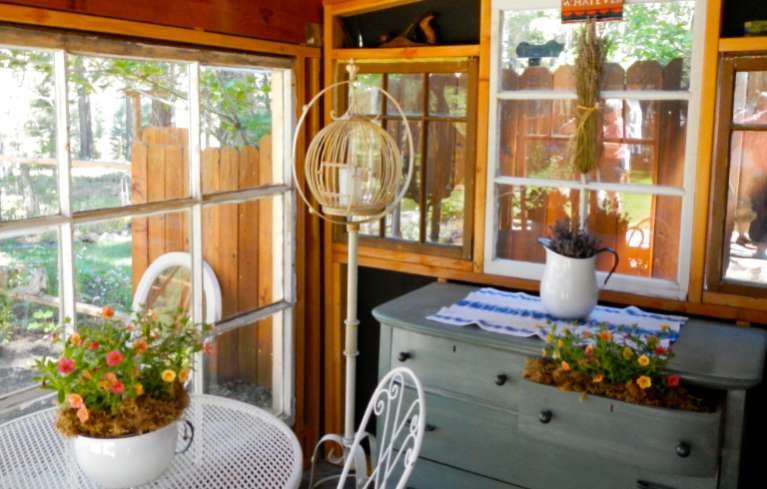
Known as the Tallac Shack because of the view of the mountain, this morning coffee or afternoon wine spot even has flowers in a dresser drawer. Photos/Kathryn Reed

Known as the Tallac Shack because of the view of the mountain, this morning coffee or afternoon wine spot even has flowers in a dresser drawer. Photos/Kathryn Reed

These nine gardens that will be featured July 27 on the Lake Tahoe Historical Society’s garden tour are some of the best ones from the past 10 years. All have been showcased once before. This is the 10-year anniversary edition of the tour.

Homeowners got to see the other gardens on Saturday, while organizers checked things out to make sure everything is ready for the annual event. This tour is the historical society’s No. 1 fundraiser. The 300 $25 tickets sell out each year.

It’s a mix of locals and out-of-towners who come each year. Locals like to see what is able to grow in Tahoe, and visitors make this the reason they come to town this time of year.

What grows is so much more than the native plants and wildflowers agencies talk about. Weeping cherry trees, Japanese maples, meadow rue and grapes are some of the less common items found along the tour.

“For our anniversary tour we tried to pick ones that were all a little different,” Catherine Whelan with the historical society told Lake Tahoe News. Her home, which was first on the tour in 2006, is one of the first houses to visit this year.

She grew up coming to Tahoe to visit her grandparents, and eventually the house became hers. Whelan said her grandmother would keep trying different things to see what would work. Now it’s like walking through a gate into a lush, shade-filled oasis.

Ann Rasmussen said when her home was on the tour in 2003 it was just after she and her husband, Gene, had remodeled. The yard had basically been a construction site. Today, it’s all about maintenance.

She points to the rock work on the house that is covered by the green in the garden. Now she wonders why they thought the rock was a good idea.

Each garden is unique, but many on this tour have views of Mount Tallac. And the owners – they all seem fit – which might prove gardening is a form of exercise. Even so, most gardens have multiple places to sit and enjoy the surroundings – proving it’s not all about working.

—

Notes:

• Tickets are $25; available at the museum (3058 Lake Tahoe Blvd., South Lake Tahoe) and at Aspen Hollow, Nels, Sunbasin and Tahoe Outdoor Living.

• Event is July 27, 10am-4pm.

• Barton Memorial Hospital’s gardens are the final stop.

ngg_shortcode_0_placeholder (Click on photos to enlarge.)