Language, ecological diversity in Calif. linked

By Melissa Pandika, Los Angeles Times

Anthropologists have puzzled for decades over why a complex patchwork of languages emerged in California thousands of years ago, but not in other parts of North America. New research now traces California’s linguistic diversity to its ecological diversity.

A study published Monday in the Proceedings of the National Academy of Sciences found that the migrating tribes first settled along the state’s lush Pacific coast, then moved into progressively drier habitats farther inland, resulting in an array of language groups living alongside one another. Prehistoric California was home to speakers of about 64 distinct languages, according to the California Department of Parks and Recreation.

Earlier studies have shown an association between ecological and linguistic diversity, but anthropologists Brian Codding from the University of Utah and Terry Jones from Cal Poly San Luis Obispo wanted to understand how this diversity developed over time.

To that end, they tested a model of how people colonize landscapes, which behavioral ecologists first proposed around the 1970s. The model predicts that the greenest habitats will be settled first and have the densest populations, because of their ability to support more people. Later waves of migrants will settle in less suitable areas.

Read the whole story


Plot out what you’ll spend in retirement

By Jeff Gorton

Age 85 is a bad time to go broke. Personal savings, various investments and, yes, Social Security may prove to be short of what you’d expected.

Budgeting how you spend money before retirement can often be a misleading measurement of how you’ll actually spend it during retirement.

Spending 40 hours a week at work not only earns you a paycheck, it also keeps you from spending money on more vacations, matinee screenings at the movie theater, extra trips to the mall or shopping online. You need to be exceedingly realistic in your planning, and the five years before retirement are actually the most crucial in solidifying post-employment stability.

To prevent a rude awakening during retirement, start with a written income plan. Here are some benefits and the importance of this “living document”:

• A comprehensive list of life expenses paints a clearer picture. For a 65-year-old married couple today, there is a 72 percent chance that at least one spouse will live to age 85; a 45 percent chance that one will live to age 90, and an 18 percent chance that one will reach age 95, according a recent study from the CDC National Center for Health Statistics. You may not think of listing things like pet care, yard maintenance, and regular visits to salons or spas. But if you enjoy those services now, you may want them during retirement, and you might find that you underestimated the real cost of maintaining your desired lifestyle. And, that’s not including gifts to children and grandchildren.

• The forecast of a two-legged stool. A WIP helps you appreciate the reliability of retirement income. What sources of income do you anticipate having? Traditionally, retirement funding has been viewed as a “three-legged stool,” implying a balance between Social Security, retirement plans and savings/investments. As the baby boom generation ages, Social Security benefits may decrease — and the age at which an individual can collect benefits may increase. Changes in employment may affect retirement plans. As a result, the third leg of the stool, savings/investments, may become even more important.

• Who is authoring your WIP? As with all written documents, you must always consider the source. What you may not realize is that a financial planner is liable to have a stake in selling you a financial product. Just like a retailer may have an incentive to move certain brands of products, many planners are incentivized to have you invest in specific financial vehicles from major institutions. What plan works best for you? Seek advice from an expert who isn’t trying to sell you something, such as an independent firm.

If you don’t have a written income plan, then you’re just hoping things will work out.

Jeff Gorton is a certified public accountant and a certified financial planner specializing in individual tax and retirement planning.


El Dorado offering flu shots

El Dorado County Health and Human Services Agency, Public Health Division will conduct low-cost community flu vaccination clinics starting Sept. 19, with additional clinics offered through mid-November.

The seasonal influenza vaccine will be available in nasal mist and flu shot forms at the clinics.

This season’s nasal flu vaccine is quadrivalent, which means that it offers protection against four strains of influenza. The vaccine can be given to healthy, non-pregnant individuals that are 2 through 49 years of age.

The cost of the vaccine is $10, but no one will be denied service due to inability to pay; cash or check accepted. Parents should bring their child’s immunization records. Updated information on the community flu clinics will be posted online and on the County Flu Hotline at (530) 621.6188.


Labor Day weekend expected to be full of travelers

People are expected to be on the move Labor Day weekend.

AAA Travel projects 34.1 million Americans will venture 50 miles or more, a 4.2 percent increase from the 32.7 million people who traveled last year. The anticipated increase in holiday travel is predominantly due to increased consumer spending and the improving housing market.

“AAA is forecasting a lift in Labor Day travel this year due to the increasingly positive economic outlook and optimism in the housing market,” said AAA President and CEO Robert L. Darbelnet. “For many Americans, their home is also their biggest asset, as home prices improve in many parts of the country more families are feeling comfortable about traveling this Labor Day holiday.”

Some predictions by AAA:

• Eighty-five percent of travelers (29.2 million) will travel by automobile, an increase of 4.3 percent from 28 million last year

• Holiday air travel expected to increase nearly 3 percent to 2.61 million.

• The largest share of travelers (46 percent) will depart on Aug. 30.

• That Monday is the most popular date of return for holiday trips with 43 percent planning to return that day.

• The average traveler is expected to travel a round-trip distance of 594 miles and spend $804.


5 groups to vie for South Shore’s Best Sunset Band

The Cash Only band is going to defend its title of South Shore’s Best Sunset Band on Aug. 23 at Lakeview Commons in South Lake Tahoe. The local band will take the stage between 7 and 7:40pm.

However, the competition will begin at 3pm with Black Star Safari, followed by Little Town at 4pm, Deep Fried Mojo at 5pm, and 4 Piece Puzzle at 6pm.

This is the 2nd annual South Shore’s Best Sunset Band Fundraiser for CASA El Dorado.

But it costs nothing to listen. The money raised comes from people voting with their wallets to determine the winning the band. The cash collected then goes to CASA.

There will also be a live auction, raffle, beer and wine, and food.

Bike valet and parking at the recreation center are all free.


James A. Federico — 1920-2013

By Robert D. Dávila, Sacramento Bee

James A. Federico, a barber who built a family business into a well-known chain of Northern California beauty schools, died July 25 of Alzheimer’s disease, his family said. He was 93.

James A. Federico

James A. Federico

Mr. Federico spent 41 years as owner and president of Federico College of Hairstyling, which grew to three schools in the Sacramento area and one in South Lake Tahoe. He led the company, which became a top training ground for thousands of students in the cosmetology field, from a Federico’s school at Florin Road and 24th Street.

Mr. Federico was an industry leader in efforts to improve standards for beauty schools. He traveled around the United States as a member of an early national accreditation team. In 1966, he was the first Californian to be elected president of the National Association of Cosmetology Schools.

Read the whole story


Tahoe Tails — Adoptable Pets in South Lake Tahoe

Larry

Larry

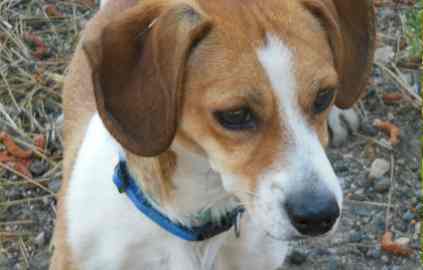
Larry is quite the little character, with loads of personality. And he’s quite the mix — Dachshund? Jack Russell? Maybe with some beagle?

In any case, he’s a lively and small bundle of happiness and energy, probably about 3 years old. Larry came to Tahoe from a Central Valley shelter looking for his new home, and will fit into just about any household.

Larry is neutered, microchipped, and vaccinated. He is at the El Dorado County Animal Services shelter in Meyers, along with many other dogs and cats who are waiting for their new homes.

Go online to see photos and descriptions of all pets at the shelter.

Call (530) 573.7925 for directions, hours, and other information on adopting a pet.

— Karen Kuentz


Celios keep Tahoe heritage alive on private ranch

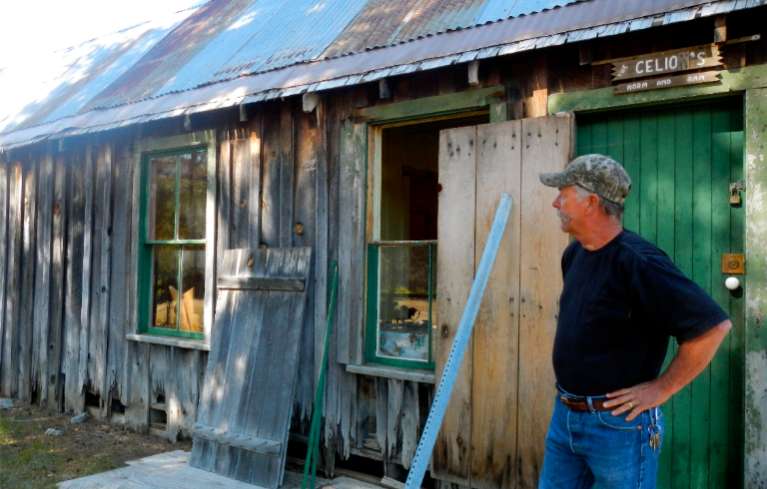
Tom Celio outside the home where his grandparents lived, which is part of the 103 acres he owns. Photos/Kathryn Reed

Tom Celio outside the home where his grandparents lived, which is part of the 103 acres he owns. Photos/Kathryn Reed

By Kathryn Reed

MEYERS – Not everyone struck it rich during the Gold Rush. Many of the men who came to California in search of gold ended up returning to work they knew.

Carlo Guiseppi Celio was one of those men.

He came to the United States from Switzerland. When he didn’t strike gold, he began a dairy farm in Placerville.

In 1863 he homesteaded on property in what was known as the Upper Lake Valley area of the South Shore. The valley with its towering granite walls reminded him of his home in the Old World. Celio’s first 160 acres on the South Shore were bought for $300, which he paid for in gold.

At one point the Celio stake in Lake Tahoe was about 4,000 acres, making them one of the largest landowners. They ran 500 head of beef cattle from Meyers into Meiss, Big and Freel meadows. During the fall cowboys drove the cattle on horseback to the West Slope of El Dorado County. It was a five-day journey.

Today, the Celios own 103 acres on both sides of South Upper Truckee Road, to the center of the Upper Truckee River, and crossing the Old Meyers Grade twice.

On Aug. 24-25 the property is going to be the site of a 150-year celebration of the ranch. This is one of the largest private property holdings in the Lake Tahoe Basin. Tours of some of the outbuildings will be available, stories of what life was like years ago will be told, and an old-fashioned cowboy barbecue will take place.

Recent history

Cattle no longer roam the property, but a handful of horses do.

Tom and Chris Celio in 2011 were deeded the property from Shirley Taylor. Taylor and Tom Celio are second cousins.

Taylor inherited the property from her mother, Hazel Taylor, who was a Celio. This was in 1985.

Taylor spent years refurbishing much of what had gone into disrepair. She inherited what she calls “13 old buildings and three outhouses.” The house had always been a summer home. Taylor winterized it so starting in 1988 she could live there year-round.

Since Tom and Chris Celio moved in full time they have put in a picture window above the sink that looks up to Echo Summit. Sitting at the kitchen table it’s hard to have eye contact with the people on the other side of the table with that view just above their heads. They have also taken out a wall that divided the kitchen and living room to open up the area more.

In 1986, Taylor was granted Timberland Preservation Zoning from the state Department of Forestry. This zoning restricts development and preserves the timberland. Selling wood was one way she could pay to bring the ranch back to life in at least a habitable manner.

In 1991, Taylor received the Forestland Stewardship Sward. Five years later she was honored with the California Tree Farmer of the Year award.

Through the 1990s many of the old buildings were reroofed, resided, and two foundations were reinforced.

But it was never going to be what it was based on the number of acres and environmental regulations that bind private property owners.

“My goal was to preserve the Celio ranch property as a tribute to the pioneering Celio family and hope that is continued in the future,” Taylor told Lake Tahoe News. “The Celio mural on the Meeks building (in Meyers) scheduled for a September completion, is my last effort to recognize the family.”

Various members of the nine generations of Celios who are in the United States have spent time at the ranch. Tom and Chris Celio are continuing that tradition with their children, grandchildren and great-grandchild.

There will even be Celios at the celebration next weekend who haven’t met each other.

What it used to be like

In 1903, the Celios bought the town of Meyers, which consisted of a variety of businesses occupying 22 buildings. They were the largest employer at the time in this area.

The 125-head of dairy cattle required five people to milk them twice a day. Butter was made on site, which was then sold to locations as far away as San Francisco.

The family incorporated in 1905 and established a lumber company.

Lumber from the first mill built in 1910 provided the lumber for the house where Tom and Chris Celio live today. It was built in 1914.

But Carlo Guiseppi Celio knew better than to clear-cut the forest area, even though others were doing so.

The slaughterhouse was built in 1912. Beef was sold to the various resorts around the lake and at stores in Meyers.

Tom Celio points to how the circular metal contraption in the ceiling would hold the cattle upside down after they were shot and killed. The blood drained into a catch area that flowed into a bathtub on wheels that was under the building. The carcasses stayed there chilled for a couple weeks before being sold for eating.

The room was chilled from ice blocks that had been cut the previous winter from area creeks and lakes, and even from a pond at Tahoe Paradise Golf Course.

A stone’s throw from the main house is the house Norm and Ann Celio lived in when they were first married. They are Tom Celio’s grandparents and Taylor’s uncle and aunt.

Celio recalls the story of when his grandmother found out there was no indoor toilet. She nearly lost it and was ready to leave. Norm Celio had been a bachelor at the lake and he was fine without that modern convenience. Still, he quickly added a bathroom to accommodate his new bride.

Today the house needs some work. Remnants from the past remain – old appliances, dishes and handmade furniture.

But the Celios were a clan of practical workers. Fancy antiques are not to be found here.

The Depression took its toll on the Celio operations. There wasn’t as much family to keep things going, so some of the businesses were leased out.

By the 1950s developers were taking an interest in Lake Tahoe. That is when much of the property that became Tahoe Paradise and Christmas Valley was sold off. They were given those names by developers to entice people to buy houses in the area.

A series of gifting-inheritance-gifting transactions have kept the current 103 acres in the Celio family.

“This is one of the last pieces of old Tahoe,” Tom Celio said with pride looking at the ranch.

—

Notes:

• Tickets for the 150-year celebration are $35 for Lake Tahoe Historical Society members, $40 for non-members. They may be purchased at the museum – 3058 Lake Tahoe Blvd., South Lake Tahoe, or call (530) 541.5458.

• Tours are Aug. 24 from 10:30am-1pm, Aug. 24 1:30-4pm, Aug. 25 10am-1pm, and Aug. 25 1:30-4pm.

• Proceeds benefit the Lake Tahoe Historical Society.

ngg_shortcode_0_placeholder (Click on photos to enlarge.)


Dogs gather for play day in S. Lake Tahoe

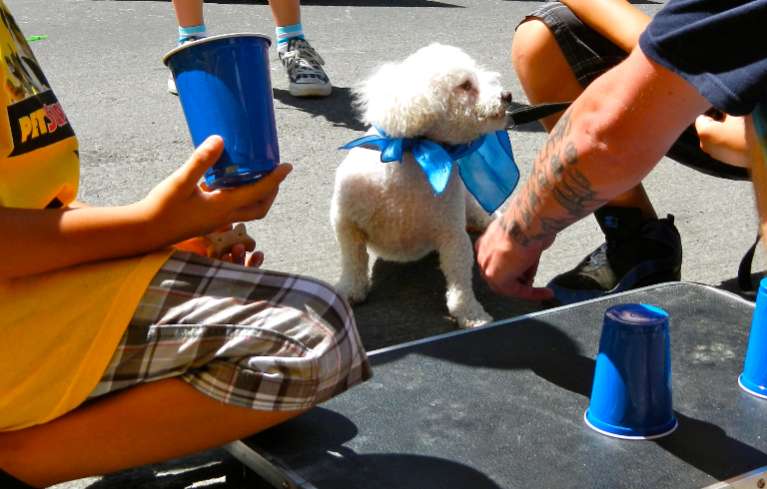
Bear's humans help find the treat on the cup. Photos/Kathryn Reed

Bear’s humans help him find the treat under the correct cup. Photos/Kathryn Reed

By Kathryn Reed

A whole lot of sniffing was going on Saturday on Ski Run Boulevard in South Lake Tahoe. And plenty of tail wagging, too.

It’s a good bet many of the dogs who attended the second annual Dawgs on the Run on Aug. 17 weren’t going to need dinner. Every booth seemed to have treats, and then there were also the food contests.

One event had owners put the handle of a spoon in their mouth. Their dog was practically in their face licking off the peanut butter on the other end.

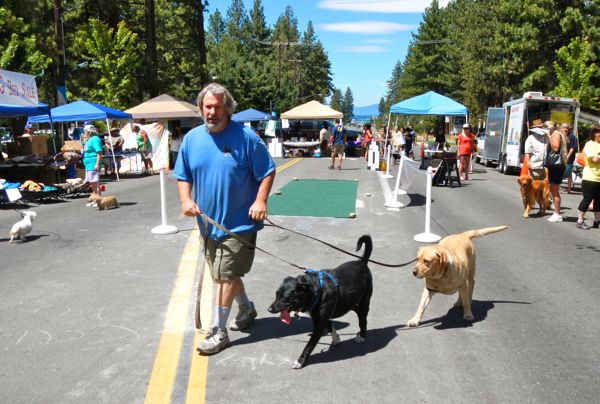
Howie Nave take Mo and Brody to Dawg on the Run on Aug. 17.

Howie Nave takes Mo and Brody to the various booths at Dawgs on the Run in South Lake Tahoe on Aug. 17.

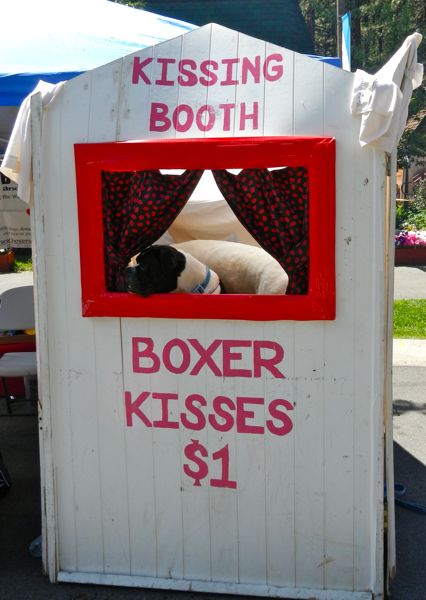
And if being up-close-and-personal with your dog wasn’t enough, for a buck a boxer would give you seemingly endless kisses. The money went to a rescue foundation.

“The primary purpose is to educate people about how to be better pet owners and be responsible,” Mireya Ortega, one of the organizers, told Lake Tahoe News.

Lake Tahoe Humane Society along with dog boarders, dog trainers and dog groomers all had information to give out.

But Ortega also knew to get people to listen and to attend it had to be fun. That’s why it turned into a canine carnival of sorts.

Other activities included bobbing for tennis balls, playing dead, agility course, best costume, best trick and karaoke for dogs.

Kisses worth more than a dollar.

Kisses worth more than a dollar.

There was a dog treat contest with Après Win’s Tahoe Kokanee Krunch Dog Treats the winner. (See recipe below.) Nepheles entered Peanut Butter and Bacon, Apple-Cheddar, and Puppy Pumpkin Molasses doggie treats.

Five testers, all on four legs, decided the winning treat. The four treats were placed in front of each judge. The treat that the dogs went to first was the winner. The Kokanee won 3-2.

Tahoe Kokanee Krunch Dog Treats by Après Wine

2 medium Kokanee, pan-fried, filleted and finned, skins on (or substitute one 15-ounce can of salmon)

¼ C chicken broth (omit if using canned salmon)

2 C flour

2 eggs

Parchment paper and cooking oil spray

Preheat oven to 350 degrees. If using canned salmon, open but don’t drain. Put salmon and juices into a large mixing bowl.

Crack and add two eggs. Flake Kokanee, including skin and mix in with the eggs and broth.

Take the flour and mix it into the salmon-egg-broth mixture. You may add more or less flour than recommended to get a consistency similar to human biscuit dough.

Line a baking sheet with parchment paper and spray with no-stick cooking oil. Dump the dough onto the sheet. Sprinkle some flour on top of the dough and flour your hands to keep the dough from sticking as you press it flat.

Press the dough out until it about ¼ inch thick. For moist Kokanee Krunch, make it thicker. For crunchy treats, make it thinner. You don’t need to make perfect corners, as this will later be broken into small pieces for the dog. Just flatten it out into any shape. With a knife, makes lines in the dough about the size of small treats so it will be easier to break.

Place the baking sheet in the center of the oven. Cook for 25-35 minutes, depending on whether your dog prefers moist or crunchy treats.

Use a spatula to lift your treat off the parchment before cooling, otherwise it may stick. You can let it cool on a rack or in the cookie sheet.

Once cooled, divide into desired portions, bag and freeze.


Fire safety more critical as people age

By Teri Mizuhara

There are an estimated 75 million baby boomers in the United States who began turning 65 at the rate of one every 10 seconds in 2011. They make up 13 percent of the U.S. population.

Boomers have redefined what a senior is. They are physically active, healthier, focused on their futures with the same passion and energy they had 30 or 40 years ago. Life is good until you talk about seniors and their risk of injury or death due to fire.

Hard facts:

• If you are between the ages of 65 and 74, your risk of dying in a fire is two times that of the general population.

• If you are between the ages of 75 and 84, your risk of dying in a fire is three times that of the general population.

• If you are 85 years or older, your risk of dying in a fire is 4.4 times that of the general population.

• In 2007, seniors represented 13 percent of the population, but were 30 percent of those were killed in fires.

As we age, our vision, hearing, sense of smell-taste, and even our response to pain change. We may have mobility challenges, and because of medications, our mental and physical abilities can be affected.

The fix:

Think about what you are doing. So often we do things by rote or autopilot; we do it the way we have been doing it for decades or longer. We don’t focus our attention on what we do every day and that is where trouble can occur.

Here are some pointers:

• Never leave food cooking on the stove, in the oven, or on the barbecue because cooking fires are the No. 1 cause of house fires. If you must leave, take a timer (they are now made with belt clips or lanyards) or your cooking implement such as a spoon or spatula with you to remind yourself you left food cooking.

• If you smoke, do so outside and have a pail of water or sand to put out your cigarette or cigar. Never smoke in bed or sitting on a sofa or recliner; the risk of falling asleep is too great.

• If you are on oxygen therapy, do not smoke. Last year in Oroville a woman caught herself on fire because she was smoking while on oxygen. People living nearby heard her screams and found her fully engulfed in flames.

• If you use space heaters, make sure they are in good working condition and those flammable materials such as curtains or blankets are a minimum of 3 feet away.

• Do not burn candles or incense, they are too easily forgotten and can quickly cause a deadly fire. There are battery-operated candles and fragrance sticks that do not require fire and they can be found at local discount dollar stores.

• Make sure your smoke detectors and carbon monoxide alarms are placed properly in your home (bedrooms, hallways and on every level) and that they are replaced every 10 years. They should be linked and there are detectors for those that have vision or hearing issues. Remember to have your smoke detector and carbon monoxide alarm batteries once a year.

Taking a minute or two to seriously consider what you are doing, the risks associated with that activity and maybe changing the way you do it, could be lifesaving. Finding a fresh approach to an old habit may not only make that activity safer, but it may also breathe some new life into something you took for granted.

Seniors are a treasured population and we need to help keep them safe. With a little time and energy, we can all make sure that is a reality.

Teri Mizuhara is with the El Dorado-Amador unit of CalFire.