Tahoe Tails — Adoptable Pets in South Lake Tahoe

Pecan

Pecan

Pecan is the last remaining kitten at the shelter from this past summer. He is 6 months old and has been waiting for a home for several months.

He is a beautiful gray shorthair boy who will fit into just about any home.

Pecan is neutered, microchipped, and vaccinated. He is at the El Dorado County Animal Services shelter in Meyers, along with many other dogs and cats who are waiting for their new homes.

Go online to see photos and descriptions of all pets at the shelter.

Call (530) 573.7925 for directions, hours, and other information on adopting a pet.

For spay-neuter assistance for South Tahoe residents, go online.

— Karen Kuentz


STHS sports medicine instructor brings real-world experience to classroom

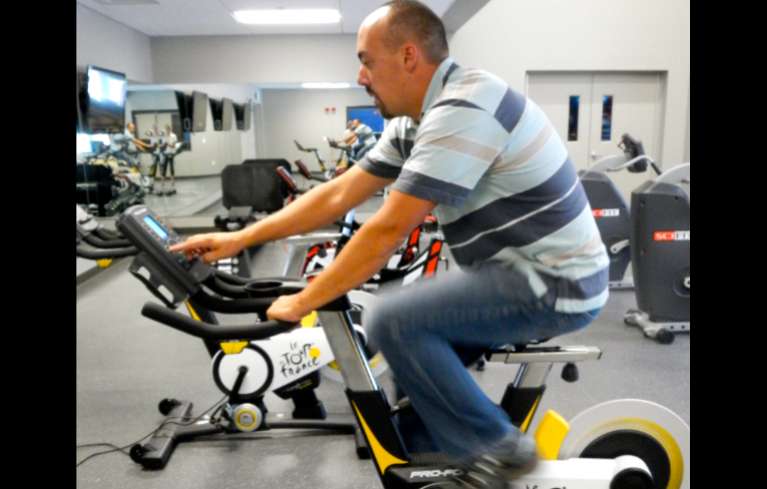
Isaiah Tannaci demonstrates what the equipment in the Sports Medicine Center at STHS is used for. Photo/Kathryn Reed

Isaiah Tannaci demonstrates what the equipment in the Sports Medicine Center at STHS is used for. Photos/Kathryn Reed

By Kathryn Reed

Isaiah Tannaci doesn’t have to rely on a textbook to answer a student’s questions. There’s a good chance whatever is asked he has the answer from personal experience.

Tannaci is not the ordinary high school instructor. His goal was never to be a teacher. And he’s just starting to work on his credential. But none of that stopped Lake Tahoe Unified School District from hiring him to start this school year.

“We are thrilled to have someone with such a strong background and passion to launch our new Sports Medicine Center at South Tahoe High School,” Principal Ivone Larson told Lake Tahoe News.

Students are excited too. The maximum — 90 students — signed up for this semester and for next semester.

Tannaci was a paramedic in Mount Shasta City when he got a call from a friend about the director job for the sports med program at STHS. He was blown away when he saw the facility. More equipment keeps arriving. It is state-of-the-art. Some of it is so new to the market Tannaci has only read about it.

While Tannaci was going to Southern Oregon State in Ashland, Ore., he became interested in athletic training. He has been a certified athletic trainer since 1998, has a bachelor’s in exercise physiology and a master’s in sports medicine. After he left Tahoe Fracture he went to paramedic school.

Exam tables for sports med students.

Exam tables for sports med students.

Tannaci has a million ideas for what he would like to do with the sports medicine facility. “Give it time” is the approach his superiors tell him to take.

One goal is to have students trained so there would be medical coverage at all school athletic practices and games. They would work under a certified athletic trainer in a similar manner to what goes on at the college level.

Through the emergency medicine side of the curriculum at STHS students could get enough education so they could volunteer for the National Ski Patrol. The minimum age to do so is 15. Between what STHS and Lake Tahoe Community College offer, students could become an emergency medical technician. Minimum age to do so is 18.

With this being the first semester for the program, intro to sports medicine is being taught multiple times so students have the basics. The program will grow to deal with emergency medicine, sports medicine and being a physical trainer.

As with most career and technical education programs, sports med has something for those who are college-bound, those who want a skill that will lead to a job, and those who want to dabble in something different.

The education is designed to flow into LTCC’s offerings where this fall it’s possible to obtain an associate of art’s degree in kinesiology. It could also be a feeder program for Barton Health.

“I am excited about the uniqueness of this program and the opportunities it presents to the students of STHS. I think it matches well with the internship program that Barton Health has, and that the exposure to sports medicine will foster more students to choose a career in medicine,” orthopedist Terry Orr said.

Even though Tannaci grew up a ski racer in Mount Shasta City, he is very familiar with Lake Tahoe.

He worked for Orr from 2002-08 when he was part of Tahoe Fracture. The two had met when both were working for the U.S. Ski Team. Tannaci was the athletic trainer for the team from 1998-2002. He was the men’s ski team’s head trainer during the Salt Lake City Olympics in 2002. (The traveling is what made him want to stop being involved with the ski team.)

“He was involved in all aspects of treatment of world-class athletes ranging from emergency triage on the race course to recovery from surgery. Isaiah has seen it all and lived it. The experiences he has had in the treatment of our nation’s best athletes brings a relevance to his teaching that would be hard to match,” Orr told Lake Tahoe News.


Scientists find link between achy joints, weather

By Melinda Beck, Wall Street Journal

The Wolff family of Paramus, N.J., was eyeing the gathering clouds and debating whether to cancel a planned park trip when 6-year-old Leora piped up with an idea: “Let’s call Grandma. Her knees always know when it’s going to rain!”

Leora’s grandmother, Esther Polatsek, says she started being sensitive to the weather in her 20s, when a fracture in her foot would ache whenever a snowstorm approached. Now 66 and plagued by rheumatoid arthritis, Polatsek says she suffers flare-ups whenever the weather is about to change.

“It’s just uncanny. Sometimes it’ll be gorgeous out, but I’ll have this awful pain. And sure enough, the next morning it rains,” she says. “It may be just a few drops, but it makes my body crazy.”

Do weather conditions really aggravate physical pain?

It is one of the longest running controversies in medicine.

Hippocrates in 400 B.C. noticed that some illnesses were seasonal. The traditional Chinese medicine term for rheumatism (fengshi bing) translates to “wind-damp disease.”

But modern scholars have gotten inconsistent results in studies that tried to match weather patterns to reported pain symptoms—leading some to dismiss the connection as highly subjective or all in sufferers’ minds.

“People’s beliefs about arthritis pain and the weather may tell more about the workings of the mind than of the body,” concluded the late Stanford psychologist Amos Tversky in the mid-1990s, after comparing the pain reports of 18 rheumatoid-arthritis patients with local weather conditions for a year and finding no connection.

Still, other studies have linked changes in temperature, humidity or barometric pressure to worsening pain from rheumatoid arthritis and osteoarthritis, as well as headaches, tooth aches, jaw pain, scar pain, low-back pain, pelvic pain, fibromyalgia, trigeminal neuralgia (a searing pain in the face), gout and phantom-limb pain.

Scientists don’t understand all the mechanisms involved in weather-related pain, but one leading theory holds that the falling barometric pressure that frequently precedes a storm alters the pressure inside joints. Those connections between bones, held together with tendons and ligaments, are surrounded and cushioned by sacs of fluid and trapped gasses.

Read the whole story


Students give back by helping animals

Two Incline Village students are taking part in Dance in the Sun for Animals, a nonprofit organization that helps kids help animals in need.

Rowan and Mary Jane Hatchett

Rowan and Mary Jane Hatchett

Teacher Heidi Timinsky founded DSA with the goal of empowering children to realize that they can make a positive difference in the world through helping animals in need.

DSA is set up to run as a completely kid-powered organization. Children can take a hobby, interest, or event that affected them and an animal they care about, then set goals and make a plan to help. Once goals are completed, kids can download a certificate. Their stories, photos and artwork are uploaded to the website’s Kids in Action page.

Rowan and Mary Jane Hatchett, students at Lake Tahoe School in Inlcine, recently launched DSA. Other students immediately began planning ways they could help animals. Ideas included a bake sale to raise money for a tiger sanctuary; having a garage sale and sending the proceeds to help snowy owls; volunteering at the local humane society; and using their allowance to help animals in the rainforest.

More info is online.


Study: Sitting all day is unhealthy

By Michael J. Joyner, Outside

We all know that sitting around is bad for your health, and that exercising is good for you. But what happens to people who exercise regularly and then sit around all day?

This is one of the hot new topics in exercise and public health research. The idea is that sitting around all day limits the positive effects of your workout or other forms of non-structured physical activity you might be getting.

In a large study from Australia more than 200,000 people.

For the 150,000 healthy people in the study (including those who didn’t exercise), there was a dose response relationship between more sitting and all-cause mortality. This simply means more sitting was associated with more mortality. The sitting mortality relationship was also blunted in the people who got any exercise during the week—a little bit of activity can stop some, but not all, of the negative effects of a lot of sitting.

Read the whole story


Study: Blame biology for unempathetic adolescents

By Sue Shellenbarger, Wall Street Journal

The teen years are often fraught with door-slamming, eye-rolling and seeming insensitivity, even by kids who behaved kindly before. Some parents worry that they’re doing something wrong, or that their children will never think of anyone but themselves.

New research shows that biology, not parenting, is to blame.

In adolescence, critical social skills that are needed to feel concern for other people and understand how they think are undergoing major changes. Adolescence has long been known as prime time for developing cognitive skills for self-control, or executive function.

“Cognitive empathy,” or the mental ability to take others’ perspective, begins rising steadily in girls at age 13, according to a six-year study published recently in Developmental Psychology. But boys don’t begin until age 15 to show gains in perspective-taking, which helps in problem-solving and avoiding conflict.

Adolescent males actually show a temporary decline, between ages 13 and 16, in a related skill—affective empathy, or the ability to recognize and respond to others’ feelings, according to the study, co-authored by Jolien van der Graaff, a doctoral candidate in the Research Centre Adolescent Development at Utrecht University in the Netherlands. Fortunately, the boys’ sensitivity recovers in the late teens. Girls’ affective empathy remains relatively high and stable through adolescence.

Read the whole story


Children’s art to raise money for N. Shore schools

The North Lake Tahoe Visitor Information Center is hosting a fundraiser for the art programs of local schools. The center is displaying hand-crafted pieces from classrooms in North Lake Tahoe and Truckee.

The pieces on display, all made from recycled materials, are part of the Ironman Lake Tahoe 2013 Children’s Mural Project.

The public is invited to cast votes for their favorite murals. To cast a vote for a mural purchase a $1 vote. All proceeds are donated the art program that produced the piece.

The North Lake Tahoe Visitor Information Center, located at 100 North Lake Blvd. (at the Y) in Tahoe City, will house the murals until Nov. 15, when voting will end.

Additionally, four winning tickets will be drawn for the public to win one of the murals.

Students were asked to create pieces inspired by the dedication and strength of the Ironman athletes. The organizations with pieces on display are the Boys & Girls Club of North Lake Tahoe, Lake Tahoe School in Incline Village, Tahoe-Truckee High School and the Sierra Expeditionary Learning School in Truckee.


Motivation and inspiration are critical to success

By Mitchell Levy

Inspiration and motivation are two completely different concepts, but a majority of managers still make the mistake of interchanging the two.

It’s easy to get lost in the semantics, but the difference can be boiled down to one simple observation: motivation can be manufactured, inspiration needs to be instilled.

Money, job security and career advancement are all effective means of motivation, but they’re also solutions that can be delivered on a piece of paper. Salaries can be increased, contracts can be lengthened and staff can be promoted.

Inspiration, however, is a much more organic concept. An inspired employee is not only more engaged, but they are more empowered and more productive than their uninspired counterparts. They are more inclined to strive for excellence, most notably because they equate the triumphs of their organization to their own personal success. In other words, employees can be motivated because they are inspired.

Leadership expert and author Simon Sinek has long been known for his theories on how inspiration correlates to proper leadership. His mantra is simple. “People don’t buy what we do, but why we do it.”

It’s a strange, if not counterintuitive assertion, but it’s also an assertion grounded in truth. A customer will buy a product not simply because of what it does, but because they believe in what it does. The most recognizable brands in the world aren’t simply successful because of their products, but because of our belief in those products.

Sinek meant his words in the context of customers, but it’s easy to see how his insight can be translated in the context of leadership. When a leader nurtures a working environment that is motivated by inspiration, they foster a team that isn’t afraid to act.

Inspired employees take the initiative to make great work not because their jobs depend on it, but because they believe in the importance of what they do. This, in turn, is a far more effective tool than any raise, or any job promotion.

Inspiration is the direct result of instilling power and purpose into your employees. One can’t be done without the other.

Purpose is the rationale behind one’s work, but it goes far beyond salary and formal job titles. It is the whats and whys of your organization. Why is what you do so important? Why is it important that you excel at your job?

Power, on the other hand, is not a characteristic of authority, but a characteristic of ability. For someone to be inspired, they need to know that they have the power to act on their purpose. They need to feel that their decisions and their actions have impact on the organization.

It’s through the combination of both purpose and power that an employee becomes truly inspired. It is leadership without micromanagement, an organization fueled by initiative. When purpose and power come together, an employee realizes that they have the reason and the ability to excel at their job. They are motivated to decide, act and take initiative, not because they have to, but because they want to.

Mitchell Levy is the CEO at THiNKaha.



Improv returns to LTCC

Lake Tahoe Community College’s theater arts department is gearing up for another night of laughter and comedy provided by the department’s improvisation group, Random Acts of Improv.

This performance is Oct. 25 at 7:30pm in the Duke Theatre.

Cots is $5.

This family-friendly show will feature seasoned improvisation performers, as well as a few fresh faces.

For more information, call (530) 541.4660, ext. 240.


Smoke alarms can save lives

By Teri Mizuhara

Smoke alarms save lives. It is your first line of defense in a structure fire especially since most home fires start in the middle of the night when you are sleeping.

According to the National Fire Protection Association, every 82 seconds a fire department somewhere in this country responds to a home fire. For as little as $8 you can buy a smoke alarm and sleep soundly knowing your family is protected.

Annually about 3,000 people die in house fires and about two-thirds of these victims did not have a smoke alarm or their smoke alarm was not working.

Some facts about smoke alarms:

  • Always have a working smoke alarm. Consider interconnecting your smoke alarms. Although this is more expensive, this allows one smoke alarm to “talk” to the others by a hardwired system or wireless technology. If one alarm senses smoke it will relay the information and all the alarms in the home will go off. This way everyone is aware of a problem and can safely exit the home. Never disable a smoke alarm.
  • For households with hearing impaired family members, there are smoke alarms designed to meet the needs of these individuals. The systems utilize extra loud (90dB) signaling combined with a bright strobe light to alert sleeping individuals and/or vibrating pager systems that transmit to hardware placed on bed frames, under pillows, or to specialized wrist watches. Search “fire protection services” to purchase this specialized equipment. Make sure this specialized equipment contains the California State Fire Marshal approval label. Be sure to get competitive bids.
  • Photoelectric Smoke Alarms are better at sensing “smoldering fires” because smoldering fires produce large smoke particles. A smoldering fire may burn for hours before bursting into a flaming fire. ften these fires are caused by a cigarette, dropped match or stick of incense burning in a couch or in bedding.
  • Ionization Smoke Alarms are better at sensing small smoke particles which are usually produced by a flaming fire that is burning items fast and spreading throughout an area very quickly. This may be a grease fire or a garbage can fire.
  • If your household includes children, some studies suggest that smoke alarms that allow a parent to record their voice instead of the common “beep” alarm work better at rousing children from stage 4 deep sleep. Although they are more expensive, it is cheap insurance in the event of a house fire.

In closing, the best scenario is to make sure you have a smoke alarm in each bedroom, outside the sleeping areas and on each level of the home. Follow the manufacturer’s instructions for installing and testing the smoke alarm. Don’t forget to vacuum the smoke alarms since dust and bugs can cause nuisance alarms. Don’t forget to replace the smoke alarm a minimum of every 10 years; just because the light is on does not mean it will work properly.

Teri Mizuhara works for the El Dorado-Amador unit of CalFire.