Precautions help when it comes to identity theft

By Scott A. Merritt

At least 110 million consumers were affected by the hack involving Target and Neiman Marcus retailers. Whether or not millions more will have their identities manipulated and finances ruined within the coming months due to more breaches of security at other stores is anyone’s guess.

By necessity, I became an expert on identity theft. My information was stolen in 2006, and in repairing the damage, I learned some not-so-obvious ways we can all protect against identity theft in the first place.

My problems began quickly. While disputing financial charges and dealing with resulting business problems, in 2007 I was stopped for a traffic violation and arrested on a false outstanding felony warrant. I immediately knew why.

I had to enlist my U.S. congressman and convince the state police, NCIC, FBI and Secret Service that I didn’t commit the felonies. For a few years, I had to prove that the prints did not match the false record in question. After legal action, however, I was able to have this corrected.

Unfortunately, the millions affected by the recent hacks may be dealing with similar repercussions in the years ahead.

Before you become a victim of identity theft, here are seven ways to guard against it.

• Understand how and where it happens. Identity theft is like being robbed when you are away from home; most thefts occur in places where you do business every day. Either a place of business is robbed, a bad employee acts improperly or a hacker breaches the office through the computer.

• Secure your wallet’s information. Photocopy everything in your wallet: photos, credit cards (front and back), membership cards – everything. Put the copies in the order the cards are arranged in your wallet, staple the pictures and place them in a strong box or safe.

• Make sure your information is consistent. For all of your identity and financial documents, make absolutely sure, to the smallest detail, that all of your personal information is accurate and consistent. Discrepancies such as using your middle initial on some documents, and not others, or having different addresses, can wreck havoc in proving your identity, and can compromise your credit score.

• Secure your digital habits and data. Change your passwords at least twice a year on a non-scheduled basis – don’t be predictable. Have a strong firewall if you shop online, and only access sites that are protected by a strong firewall and high industry standards. Access accounts of a financial nature only from your personal computer.

• Protect your banking information. While in the bank, keep account numbers and other data out of sight, and avoid stating account numbers, Social Security numbers and similar information out loud. When planning a bank visit, have items such as deposits and withdrawal slips prepared in advance.

• Account for your interactions with vendors. Every time you speak to someone with whom you do business, write down the time, date, name and the purpose or outcome of the call. If an identity theft occurs on the vendor’s end, you will be able to reference these prior conversations effectively. Be sure to note any animosity or reluctance from the vendor.

• Don’t carry around your birth certificate or Social Security card. Unless it’s necessary, keep those vital items in a safe, or at least a firebox. If you know someone is going to need a copy of your tax returns or your driver’s license, for example, make the copies ahead of time. This avoids the need for a firm’s employee to leave the room with such information.

Of course, you can greatly reduce being a victim of such recent hacks that occurred at the major retailers by using cash more often. But if you’re going to use credit, use a card from a national bank or a national credit union and never a debit card, no exceptions.

Scott A. Merritt is the CEO of Merritt Ventures Inc. and author of “Identity Theft Do’s and Don’ts.”



Learn how new laws affect Calif. businesses

The Truckee Donner Chamber of Commerce and the North Lake Tahoe Chamber/CVB/Resort Association in partnership with the Sierra Human Resources Association are offering 2014 Legal Update for California Business Leaders and Managers on Jan. 31 from 9am to noon.

The event will be at the Hampton Inn, 10918 Brockway Road, Truckee.

Attendees will be taught about laws that take effect in 2014 and how they impact employers; the California legislative update and California law updates; important U.S. Supreme Court and California rulings; significant agency regulations, opinions and trends to watch in 2014; and best practices and practical advice to prepare your organization for employment law compliance in the New Year and beyond.

The workshop will be lead by Walter Stella of the Miller Law Group in San Francisco. Stella has more than 20 years of experience representing companies in all aspects of employment law and related litigation, including wage and hour class action suits involving trade secret theft, wrongful termination, discrimination, retaliation and harassment.

Attendees are able to submit a specific question in advance in confidence so it can be addressed anonymously by the attorney once registered.

Early bird registration is $50/person for SHRA and SHRM members, $55/person for chamber members and $65/person for non-members. Walk-in registration is $65/person for chamber and $70/person for non-members. To register and for more information about the workshop, call Laura Moriarty at (530) 573.0224 or Patricia Barrett at (530) 587.8808. Attendees may register by credit card online.


Airbnb’s sharing economy threatens traditional lodging

By Andy Kessler, Wall Street Journal

San Francisco’s Radius Cafe is one of those places where “local” is the rule — all the food is sourced within a 100-mile radius of the restaurant. So it’s a touch ironic to meet there with Brian Chesky, the hoodie-wearing 32-year-old co-founder of Airbnb, whose game plan is global.

Airbnb is a Web service that lets travelers book couches, beds, rooms, houses, boats and even castles on a nightly basis. In six years Airbnb has become a company valued at $2.5 billion, with 500,000 properties available in more than 190 countries — a stand out in what is often called the sharing economy. Airbnb could do to hotels what Amazon has done to bricks-and-mortar bookstores. By year’s end, Airbnb says it will have booked more overnight stays than the Hilton and InterContinental hotel chains.

As might be expected, hoteliers and hospitality-industry regulators are suspicious of the Airbnb model. In October, New York state sued the company for violating a law passed in 2010 — just when Airbnb was picking up steam—barring private citizens from renting an entire apartment for less than 30 days.

Read the whole story


OMG — texting is so not today’s technology

By NPR

If you have teenagers in your house, you may find this hard to believe, but texting is on the decline.

For the first time ever, traditional texting — the kind you do through your cell phone provider — has dropped in Britain. That’s according to annual technology predictions report from Deloitte, which reported that the number of text messages passed around by Brits decreased by 7 billion last year.

Instead, the company predicts, people in the U.K. will send around 300 billion instant messages in 2014. That’s the kind of messaging that requires an app and uses the Internet. Old-fashioned texting is only expected to account for about 140 billion messages.

Read the whole story


Tahoe Maritime Museum looking for artists

The Tahoe Maritime Museum is partnering with Placer Arts and NCArts to host the juried art exhibit Sunken Treasures.

The goal of the exhibit is to showcase work by local artists that explores the unseen world at the bottom of Lake Tahoe. The art exhibit will coincide with TMM’s history exhibit Ghost Ships opening on Memorial Weekend and running until April 19, 2015. There will be $300 in prize money awarded to artists in various categories.

Works submitted for Sunken Treasures need to imply or connote a sunken vessel or artifact, but this does not need to be the main focus of the piece. This exhibit is open to all artists from Lake Tahoe and its surrounding communities.

The entry deadline is March 14. Email Christine@tahoemaritime.org with questions or to requests= an artist’s information packets.


Tahoe Tails — Adoptable Pets in South Lake Tahoe

Goofy

Goofy

Goofy is one of those true mutts. There are many guesses as to his breed – he could be part Whippet, part Miniature Pinscher – but we do know he is a well-mannered boy who does not live up to his name.

He is quiet in the shelter, and gets along well with dogs and cats. He is about 2 years old, walks very nicely on the leash, and is quite affectionate. Goofy weighs only about 20 pounds, and could use another 5 pounds.

Goofy is neutered, microchipped, tested for heartworm, and vaccinated. He is at the El Dorado County Animal Services shelter in Meyers, along with many other dogs and cats who are waiting for their new homes.

Go online to see photos and descriptions of all pets at the shelter.

Call (530) 573.7925 for directions, hours, and other information on adopting a pet.

For spay-neuter assistance for South Tahoe residents, go online.

— Karen Kuentz


Cal band brings music to Sierra’s slopes

By Susan Wood

TWIN BRIDGES – Call it a prelude of things to come at Sierra-at-Tahoe ski resort.

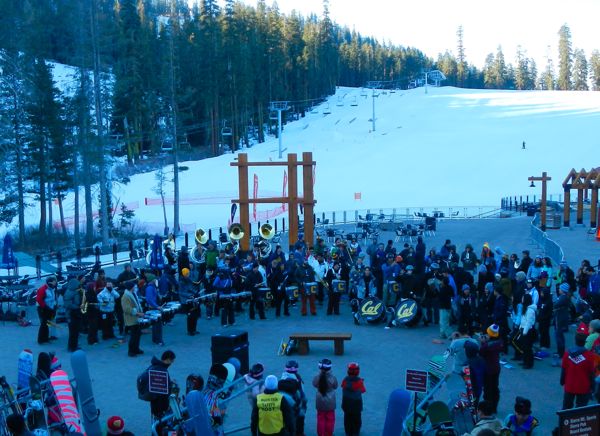
The century-plus-old Cal band showed up for the 10th time to play and dance in its signature, animated style at the ski resort’s expansive, new plaza outside the main lodge this Martin Luther King, Jr. holiday weekend. Then, the members of the playful UC Berkeley band got on skis and snowboards to navigate the Broadway run with instruments in hand.

Members of the Cal band ski and play down the slopes at Sierra-at-Tahoe. Photo/Steven Hemphill

Members of the Cal band ski and play down the slopes at Sierra-at-Tahoe. Photo/Steven Hemphill

The exceptional eye-hand coordination would make the Winter Olympians the ski resort has spawned proud.

If the band can overcome a losing football season last fall, it can certainly negotiate the sparse snow of the Sierra Nevada this winter.

“It’s not too bad. The tuba is a well-balanced instrument,” tuba player Naddav Paran said after Saturday’s morning performance. Of course, it might help that he started skiing at age 4. And band members are instructed to take it slow.

Upon success of the midday ride, the tubas become the stars at the end of the day for their dancing rendition of “Lights Out.”

On skis and boards or not, the student-run Cal Band knows how to entertain. When the Bears band marches out of Memorial Stadium’s North Tunnel for football pre-games, the display is referred to as the “pacesetter of college marching bands” – or, “the pride of California.” Band members take over the streets when the team wins at home in Berkeley.

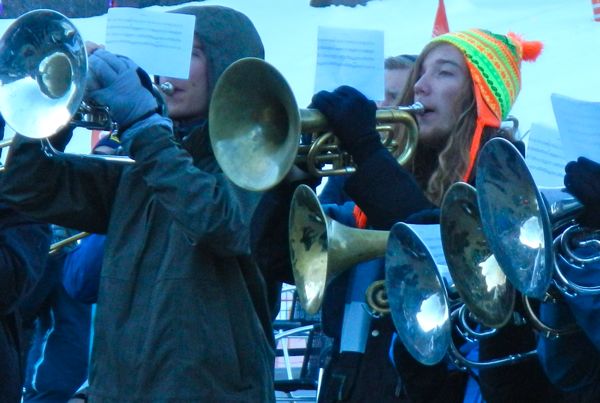
Stephen Ramaley is bundled up to play in below freezing temps. Photo/Kathryn Reed

Stephen Ramaley is bundled up to play in below freezing temps. Photo/Kathryn Reed

Guests and staffers of the ski resort located 12 miles west of Meyers were rocking out for the morning session near Tahoe, a non school-sanctioned event scheduled to wrap up the end of winter break.

“This is awesome,” ski school instructor Jen Gilardi screamed. The employee, who followed the band when she lived in Berkeley, was texting friends to join her for the day to see the band.

Guests of the resort, the Mayali family of Kensington, were all smiles while watching. Dad Xavier went to Cal, and he and his wife, Michelle’s, two children play band instruments – Emma, 8, saxophone and Max, 10, trumpet. The Cal Band, in one of its several appearances at games, reunions, weddings and birthday parties, staged a performance at Max’s school.

“We make a point of coming up here for this weekend,” the Mayali matriarch said.

Before the sun comes over the ridge, the band welcomes skiers to Sierra.

Before the sun comes over the ridge, the band welcomes skiers to Sierra.

Even the parents of the band members enjoy the venue.

“This is the only time I get to see him,” Doug Greer said of his piccolo-playing son, Ross.

Steps away, Kevin King of Folsom swayed and danced to the band’s repertoire of 150 songs ranging from the proverbial marching band tune “The Big C” to more contemporary hits such as “Carry On” by the rock band Kansas.

“I went to Davis, but the Cal Band is the best,” King said, adding he enjoyed the paving-stone plaza area Sierra installed this season.

The new area expands the base lodge space and seating, and resort management expects to stage many events there – particularly in the spring and summer. King’s alma mater band may play at the resort’s grand opening of the plaza.

Many people from all walks of life have connections to the Cal Band. Alumni musicians are invited at any time to join the band for the Tahoe-area weekend event, which continued on Sunday at Squaw Valley.

Keeping the cadence.

Keeping the cadence.

Despite the 19-degree temperatures early Saturday morning, most band members played without gloves, and at least one rotating conductor, a drummer, stripped off his hat and jacket upon taking the platform. Another percussionist rolled up his sleeves. The musicians have played in all sorts of weather conditions – even in a snowstorm a few years ago.

Senior manager Carolyn Richter recalled a time when she forgot to separate and defrost her mouthpiece one cold morning and paid for it with part of her lip sticking to the mouthpiece of her trombone. Still, she considers Sierra-at-Tahoe one of the more fun events the band puts on.

“It’s as much about the dancing as the playing,” Richter told Lake Tahoe News.

That’s one way to stay warm in the mountains.

“Our band (members) who come out for this also love to ski and snowboard, and Tahoe’s not too far away,” she added.

Agreeing was Richter’s No. 2 man up for the manager job next year, Stephen Stapleton. The trumpet player made a point of declaring the ski weekend as one of his favorites, and he’s apparently not alone. About 140 members of the 200-person band showed up to take part.

Playing without the assistance of gloves.

Playing without the warmth of gloves.

“The Cal Band brings great energy to the resort. It’s so fun to have them skiing down Broadway and playing music at the base,” Sierra General Manager John Rice said.

The Cal Band has made a variety of performances, including the San Francisco Symphony’s Black and White Ball and even the Ed Sullivan show years ago. More recently, the high-energy band led the San Francisco Giants downtown victory parade when the team won the World Series after a half-century drought.


TOCCATA readies for Winter MusicFest

Tahoe Symphony Orchestra and Chorus continues its 9th annual Winter MusicFest with the “Paul Guttman Piano Competition Winner” concert series Feb. 9, 11, 13 and 14.

The program opens with Bach’s choral masterpiece Magnificat, featuring vocal soloists Anna Helwing, Joy Strotz and Katharine DeBoer, sopranos, Albert Lee and Sherman Modeste, tenors and Chris Langton and Stuart Duke, baritones. Jacob Warnick, the 16-year-old winner of the 2013 Guttman Piano Competition, will perform Saint Saens Piano Concerto Op. 22 in G minor, but the February 9 opening concert will feature Tony Xie, the 2013 Piano Competition runner. Finalizing the concert will be Elizabeth Pitcairn, guest violinist, performing Max Bruch’s Violin Concerto in G minor, on the legendary Red Stradivarius Violin. Maestro James Rawie will conduct all performances.

The performances are Feb. 9 at 3pm at St. Theresa Church in South Lake Tahoe (1041 Lyons Ave.); Feb. 11 at 7pm at Shepherd of the Sierra Church in Carson City (3680 Highway 395); Feb. 13 at 7pm at St. Patrick’s Episcopal Church in Incline Village (341 Village Blvd.); and Feb. 14, 7pm at Good Shepherd Lutheran Church in Reno, (501 California Ave.).

A special soiree musicale fundraiser will take place at a private home in Incline Village on Feb. 15 at 2pm. Tickets are $100 per person. Elizabeth Pitcairn will perform, as well as several singers accompanied by Donna Axton on piano. For more details, call (787) 602.2121.

Tickets are available at the door or online, or at Tahoe City Visitor Center and Potlatch in Incline Village. General admission to all concerts is $30 adults, $25 seniors (advance purchase only), and $5 students aged 19 to 23 with valid ID. Preferred seating is $40 and $15 for youth/students. Youth under 19 years of age are admitted free, in non-reserved seating.


Book details ways to be smart about water use

By Bill Keep, Record Searchlight

In California prisons, inmates flush toilets to communicate, to warn each other, and to flood their cells in protest. Wasteful? Yes, but compared to 2,500 gallons of water to raise a pound of beef? Or snow machines eating 10,000 gallons hourly to ensure skiers’ pleasure during a dry winter?

The most difficult thing about a water crisis, says Robert Glennon in “Unquenchable: America’s Water Crisis and What to Do About It” (445 pages, Island Press, 2009) is convincing folks there’s a crisis.

Besides the Colorado and the Rio Grande, almost 30 American rivers dry up before reaching their outlets. Thirty-five of the lower 48 states are engaged in water conflicts. Householders routinely haul water in Arizona, Tennessee and California, having none in their taps. Lakes Michigan and Huron have dropped 2 feet (the Great Lakes hold 95 percent of our fresh water supply). Groundwater levels have sunk 200-900 feet countrywide. Resulting subsidence affects 17,000 square miles of the U.S. — 40 feet from 19251970 in the San Joaquin Valley. And we drill 800,000 new unregulated wells a year.

Read the whole story


Calling 911 can be a life-saving decision

By Dale Hemstalk

Each year, about 600,000 Americans – one in four deaths — in the United States are from heart disease, according to the Centers for Disease Control and Prevention.

Of the 715,000 Americans who have a heart attack each year, about 525,000 are first-timers, says the CDC, and those individuals may not know what’s happening. Sadly, many people do not get to the hospital on time.

If someone is having a heart attack, for example, they should get to the hospital without delay upon the initial onset of symptoms.

We live in an age in which we should be taking greater advantage of our technology for health purposes – but you have to call for help first..

Here are warning signs that it’s time dial 911:

• Symptoms for a heart attack: Men and women frequently report different symptoms. Men tend to have the “classic” signs, such as pressure, fullness, squeezing or pain in the center of the chest that goes away and comes back; pain that spreads to the shoulders, neck or arms; chest discomfort with light headedness, fainting, sweating, nausea or shortness of breath.

For women, symptoms tend to be back or jaw pain; difficulty breathing; nausea or dizziness; unexplainable anxiety or fatigue; mild flu-like symptoms; palpitations, cold sweats or dizziness. Triggers tend to be different between the sexes, too. In women, it’s often stress; in men, it’s physical exertion.

• Symptoms for a stroke: There are clear, telltale characteristics of a stroke, including sagging on one side of the face, an arm that’s drifting down and garbled speech. But there are also more subtle signs from the onset, such as sudden numbness of one side of the body, including an arm, leg and part of the face; sudden confusion, trouble speaking and understanding; sudden trouble seeing in one or both eyes; sudden loss of balance; sudden headache for no apparent reason. Risk factors include diabetes, tobacco use, hypertension, heart disease, a previous stroke, irregular heartbeat, obesity, high cholesterol and heavy alcohol use.

• Symptoms for heart failure: This is not the same as a heart attack, which occurs when a vessel supplying the heart muscle with oxygen and nutrients becomes completely blocked. Heart failure is a chronic condition where the heart can’t pump properly, which may be due to fluid in the lungs. Warning signs include shortness of breath, fatigue, swollen ankles, chest congestion and an overall limitation on activities. Just one of these symptoms may not be cause for alarm; but more than one certainly is. Risk factors include various heart problems, serious viral infections, drug or alcohol abuse, severe lung disease and chemotherapy.

At no point should anyone be discouraged from calling 911; the bottom line is, if you feel it’s an emergency and you need to call 911.

There are many reasons to seek assistance from emergency responders, and they are not limited to those that I’ve mentioned.

Dale Hemstalk is an Air Force veteran and career firefighter paramedic who has been providing emergency care for over 20 years.