Mark A. Smith — 1927-2014

By Robert D. Dávila, Sacramento Bee

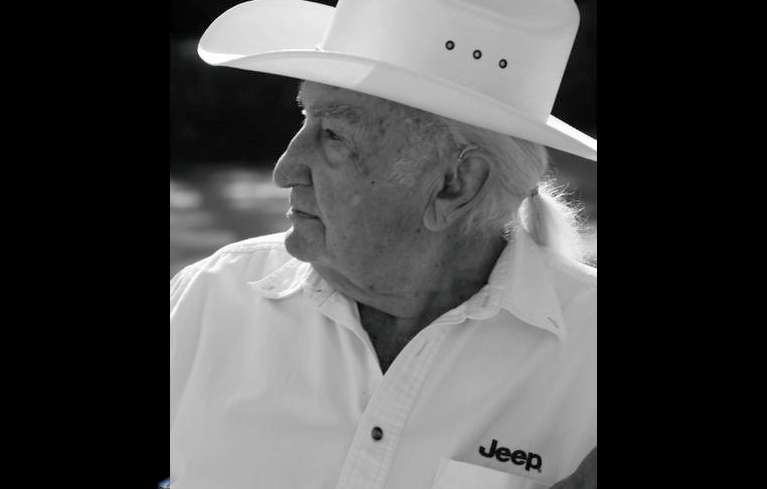
Mark A. Smith, a world-class adventurer and 4×4 motorsports pioneer who organized the first gathering of Jeep owners for an off-road trek along the torturous Rubicon Trail over the Sierra Nevada, died June 9 at 87.

The cause was a stroke, said Pearse Umlauf, vice president of Jeep Jamboree USA.

Mark A. Smith

Mark A. Smith

Mr. Smith was a legendary outdoorsman who was widely credited with launching 4×4 off-roading as a sport more than 60 years ago and popularizing Jeeps as recreational vehicles. After settling in Georgetown in 1951, he worked with the local Rotary Club on a plan to bring visitors to the rugged El Dorado County community for an outing in Jeeps to boost the economy.

In 1953, he launched the Jeepers Jamboree, which drew more than four dozen 4×4 vehicles and 155 revelers for camping and driving along the Rubicon Trail, an old wagon route between Georgetown and Lake Tahoe. Today, the annual event draws enthusiasts from all over the world in Jeep Wranglers – and Jeep-like Toyota Cruisers and British Land Rovers – that crawl over granite slabs and boulders to Rubicon Springs.

Read the whole story


Book details where farm-to-fork fell short

By Chris Macias, Sacramento Bee

The feel-good nature of farm-to-fork is hard to deny.

But imagine a time when tomatoes aren’t grown every year, or a spring that passes with no strawberries at the downtown farmers market – all so secondary crops flourish and the area can retain the richest possible soils.

This sounds like sacrilege, but for Dan Barber, author of “The Third Plate: Field Notes on the Future of Food,” (Penguin Press, $29.95, 496 pages) this scenario brings the farm-to-fork ethos to its proper fruition.

Despite the good intentions of farm-to-table, Barber writes that the movement “celebrates a kind cherry-picking of ingredients that are often ecologically demanding and expensive to grow. … It makes good agriculture difficult to sustain.”

Barber knows what it is to be a locavore cheerleader, and he still is in many ways. Barber’s the chef/co-owner of Blue Hill, a Michelin-starred New York City restaurant that’s been tagged as “farm-to-table” for more than a decade. He also oversees Blue Hill at Stone Barns, an educational center and nonprofit farm in Pocantico Hills, N.Y. But he explores a much more nuanced take on farm-to-fork in “The Third Plate,” one that challenges the movement for enabling farming practices that value consumerism over the best use of the land.

Read the whole story


‘Edge of Tomorrow’ — the summer blockbuster

movie ledeBy Jeremy Miller

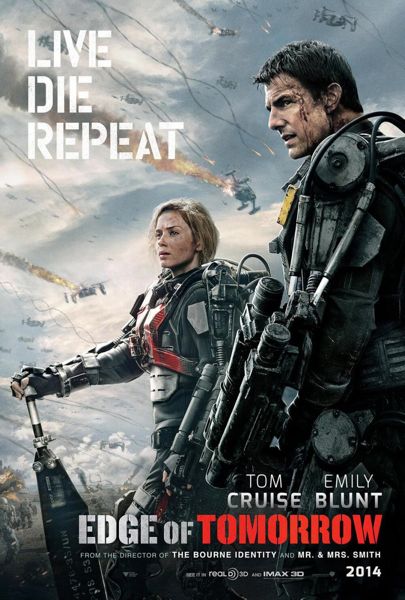
“Edge of Tomorrow” is the first blowout blockbuster of the summer. It stars Tom Cruise, Emily Blunt, Bill Paxton and Brendan Gleeson.

Earth has been invaded by a relentless alien race referred to as “mimics” and they’re a seemingly undefeatable force. Man unites and wins one battle against them via superstar soldier Rita Vrataski (Blunt). With their recent victory, our armed forces decide to attack again in an all-out assault to end the war once and for all.

Maj. William Cage (Cruise) is a PR rep for the military, spinning the stories in the news to give society some hope that we’ve got a shot against them. He is called upon by Gen. Brigham (Gleeson) to give the people a first-hand depiction of battle by storming the front lines in combat. Of course Cage refuses, due to his lack of experience and even less courage, which of course doesn’t fly with the general.

Next thing he knows, Cage wakes up at an outpost preparing for battle. Unable to convince the cutthroat Master Sgt. Farell (Paxton) of his true identity, Cage winds up in an airship heading to battle. He lands on the beach and has no clue how to use his weapon riddled mechanical suit and ends up dying within minutes; only to wake up once again at the base he was at earlier. He relives this several times; when finally he realizes that no matter what he does he relives that day over and over.

In battle he sees the heroic Rita and attempts to save her. After living the battle so many times he comes to know what’s coming and ends up saving her life. She catches on to what’s happening and tells him to find her when he wakes up.

Easier said than done.

Each time he wakes up again, he maneuvers himself through the day figuring out how he can land a conversation with the illustrious heroine. He finds that like him, she once relived the same day over and over, dying each time to wake up again at the beginning.movie

In order to outsmart the enemy they form an alliance and relive the day over and over getting closer to victory each time.

The plot of this flick is what really caught me. The story is edgy and more fun than I’ve had in a sci-fi flick in a long time. The dialogue was spot on, it never got cheesy, it never lost me, and it was complex enough to keep me focused without totally spinning me out either. Tom Cruise made the movie. It’s really nice to see him in his element again. He made the character totally believable and proved once again why he’ll go down as one of the great action heroes of our time. Much of his power came from his co-star. Emily Blunt was the meat and potatoes of the story. She gave it the touches it needed to be perfect. She brought comfort, sex appeal and at times some much needed comic relief to an otherwise dark story. She played her part perfectly.

I loved that it never became solely about love, nor was it solely based on defeating the enemy. It was a perfect balance of comradery, desperation and love. One could expect that director Doug Liman would really pull out all the stops following his success with the “Bourne” franchise and he did exactly that. The special effects were mind blowing.

It was as if “Elysium” and “Battle LA” met, fell in love, and had a baby that grew to be a success its parents only dreamed of being. The cinematography was gripping and only a few times did it move too fast to follow. The battle scenes were adrenaline fueled and epic every single time.

Anytime an action movie has soldiers storming a beach I’m excited. There’s just something about it. This one was great because we got to relive it a few times with different angles and more progress made each time. It’s easy to assume that reliving the same day over and over again would get rote for an audience, but it never did, which is pretty impressive.

An absolutely killer cast with explosive chemistry, amazing special effects and battle sequences, perfect cinematography and a refreshingly original premise land this one a five on the Miller Meter.

South Lake Tahoe resident Jeremy Miller has more movie reviews online.


Bona Fide creating new works with old presses

Bona Fide HQ becomes a print shop twice a month. Photos/Kim Wyatt

Bona Fide HQ becomes a print shop twice a month. Photos/Kim Wyatt

By Liberty Zikos

MEYERS – It all started with the word “Handglovery” painted in black on a plain white wall. It’s a word that designers used in the past when creating new font or typeface, and ever since Kim Wyatt, owner and publisher of Bona Fide Books, put it up in her office last fall, special things have happened.

Bona Fide HQ’s atmosphere is inviting and peaceful, with shelves stocked with books and handmade zines and plenty of comfortable seats covered in bright animal patterns. But these days a visitor’s attention is more likely to be directed to the print shop.
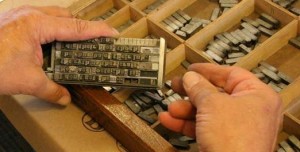
Composing stick

Composing stick

Bona Fide Books is an independent press that started in 2009 and publishes three to four books a year. It’s also home to the Center for Wayward Writers, a public space for creative people that is well used by local writers and artists.

By way of donations a print shop was born in summer 2013, when painter and Wyatt’s friend Ken McNutt pulled up to the office and said, “You gotta look at this.” Inside his car was a book press that he had rescued from a friend’s barn. The compact piece of machinery was so heavy that it took two strong twentysomethings to wrestle it inside. But the timing was right. A monthly print club began with community members creating Christmas cards and later fine art. Now they are experimenting with wood block prints.

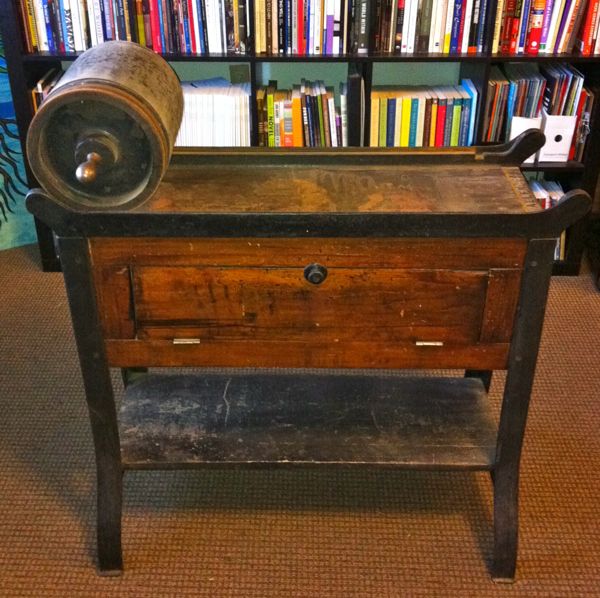
The arrival of the book press was followed closely by an etching press, and then a proof press was donated in January. It was used from the mid- to late 1950s at the Tahoe Daily Tribune. The proof press found its home at Bona Fide when Del Laine, who was once a columnist for the Tribune, donated it.

“When Kim showed interest in the hand presses it seemed that it was the home for it [the proof press]. We were happy to know that Kim had it and would be using it as much we had,” Laine said. It wasn’t just the space that compelled Laine to entrust the proof press to Bona Fide. “The fact that Kim sees the value of the printing press shows the value that she brings to this community – more than just a printed page, but the crafted printed page.
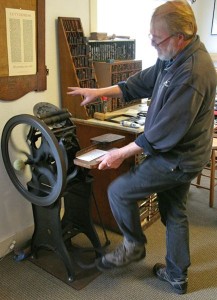
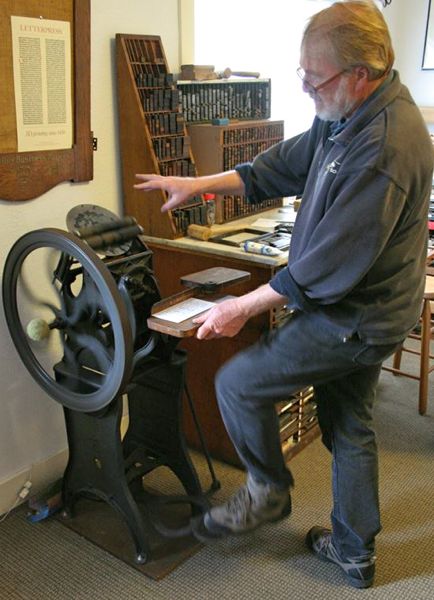
Steve Robison at the letterpress.

Steve Robison at the letterpress.

Wyatt, whose great-grandmother was a typesetter for a West Virginia newspaper in the 1900s, started Bona Fide to promote new voices and to build community through storytelling. Although the space typically hosts writing workshops and art receptions, a new sort of creative expression has developed. Letterpress printer Steve Robison found his way to Bona Fide through his wife, Karen Cutter, a book arts artist. The couple moved from the Bay Area to be closer to their Meyers family, and Cutter dropped into Bona Fide one afternoon. After talking with Wyatt, she brought in her husband. Robison had his first printing press experience at 7 years old, and has been hooked ever since.

“I talked to Kim and said, ‘If you’re interested in equipment I can bring some up. Maybe we could create a little space for that.’ I told her I’d teach classes,” Robison said.

Bona Fide now hosts a twice-monthly book arts club led by Cutter, and recently started offering letterpress classes taught by Robison.

Three of the seven presses date to the 1800s. Wyatt said she would welcome more.

In the age of information, what is the appeal of a heavy, time-consuming printing press?

“The presses, to me, represent the intersection of democracy, writing, and art —there’s nothing better,” said Wyatt, citing the long tradition of print to change the world. Johannes Gutenberg’s innovations in movable type and printing made information widely available to people of all social classes, and beyond borders.

“Those who embrace [the printing press] embrace a hands-on form of communication, one that has been replaced by fast communication,” Laine said. “The printing press takes time and it’s checked and rechecked before it hits the public. It’s a thoughtful form of communication.”

Many people are also seeking ways to build relationships away from social media and text messaging, and the community that has started gathering at Bona Fide wants connection – with materials and with each other. People come to Bona Fide to work with their hands, to learn a craft and also for camaraderie.
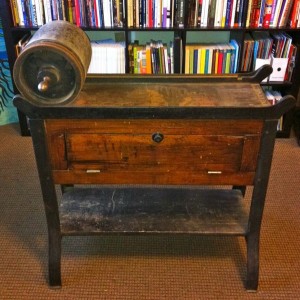
Ed and Del Laine's proof press.

Ed and Del Laine’s proof press.

“It’s like the church of ink,” Wyatt said.

Robison believes the hands-on experience is part of the draw to letterpress printing. “When people get involved in the craft of it – I know for me it’s something I get lost in – the pressures of the day disappear.”

Bona Fide’s print shop gives people the chance to slow down and put some time into a well thought-out project while learning to set type.

“Letterpress is crisper, clearer. It has a tactile feel to it. It’s sort of otherworldly and like finding an artifact, and people are drawn to that,” Robison said. Drawing on problem solving abilities and creativity, the process requires attention to detail, and in the end you make something exceptional, one-of-a-kind. Robison says, “With letterpress you can see every single step of the way, and there’s no mystery at all. It’s just honest.”

——

Notes:

• Bona Fide Books is located at 1069 Magua St., No. 4, Meyers.

• For more information about the Bona Fide print club, book arts club and letterpress class, go online or call 530.573.1513.

Liberty Zikos is a student at UNR working on her undergrad in English writing.


Books to teach kids about outdoors

Using children’s books, Lahontan State Recreation Area in Fallon is putting on events to inspire an appreciation for nature through literature, nature walks, activities and crafts.

Once Upon a Trail will be the second and fourth Saturday this summer.

The cost for this program is free and park admission fees will be waived for those participating. Sturdy footwear, water, and sunscreen are recommended for nature hike activities. The trail is not ADA accessible nor stroller friendly. Note: some of the crafts can be a little messy.

Events include:

June 14: Learn about birds by listening to the reading of the book “Feathers for Lunch” by L. Ehlert.

June 28: Learn about animals that live in the woods by listening to the reading of the book “The Mitten” by Jan Brett.

July 12: Learn about animals that live in the water by listening to the reading of the book “Box Turtle at Long Pond” by William T. George and Lindsay Barrett George.

July 26: Learn about the kind of tracks animals leave behind by listening to the reading of the book “Whose Tracks are These?” by Jim Nail.

Aug. 9: Learn about animals that change as they grow by listening to the reading of the book “The Caterpillar and the Polliwog” by Jack Kent.

Aug. 23: Learn what animals eat by listening to the reading of the book “A Fly Went By” by Mike McClintock.

For more info, contact Tabitha Coughlin at 775.867.3500.


SummerFest features nationally known musicians

Metropolitan Opera Star Matthew Polenzani and U.S. Billboard Classical Chart best-selling pianist Simone Dinnerstein will be the soloists for the 2014 Lake Tahoe SummerFest.

Performed the first three weekends in August, the classical concert series will offer two evening concerts, Friday and Saturday at 7pm, and a new chamber music series called Meet the Music on Sundays at 4pm. The festival runs weekends Aug. 1-17.

Polenzani will headline the classical music festival, Aug. 1-3 and Dinnerstein will be featured Aug. 7-9.

The individual musicians’ home symphonies include the Metropolitan Opera Orchestra, the Los Angeles Philharmonic, the symphonies of San Francisco, Seattle, and Vancouver, among others.

Now in its third season, the 40-member orchestra performs in a 500-seat acoustical tent pavilion on the campus of Sierra Nevada College in Incline Village.

Repertoire highlights this season include Beethoven’s 4th Symphony; the rarely-heard Britten’s Serenade for tenor, horn and strings; Mozart Symphony No. 40; Beethoven Piano Concerto No. 2; Strauss Concertino for clarinet, bassoon, strings and harp; a newly-orchestrated Concerto for timpani and orchestra; and Mendelssohn’s Scottish Symphony.

For tickets and season subscriptions information, go online.


‘Saving Lake Tahoe’ not the easiest read

By Kathryn Reed

Sometimes I read a book and I’m left wondering who the author thought was going to read it.

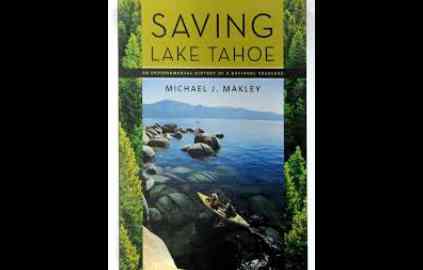
Such was the case with “Saving Lake Tahoe: An Environmental History of a National Treasure” by Michael J. Makley.

Usually history and environmental books can captivate me. This, in some ways, felt like reading a regurgitation of facts, at times like a textbook.

For people who have lived the story, I can’t see them wanting to read this because that’s how I felt about the last half the book. I want to read something I don’t already know so I can learn.

saving lake tahoeAnd for those who don’t know this aspect of Tahoe’s past, I think they would likely become overwhelmed with all the facts.

I know the book was not completely factual because I found errors. When this happens in a book I am then left questioning what else is not accurate.

For instance, Makley said the day the Angora Fire started in June 2007 there was a controlled burn. This is completely wrong. There were no controlled burns that day on the South Shore because it was a “red flag” day.

He also said the area was reseeded via hydromulch. Hydromulching did occur to stabilize the soil. Seeds and fertilizer were not part of the mix.

Then Makley references Lake Tahoe News for a May 2009 article. LTN didn’t launch until September of that year.

Where were the editors and fact checkers at the University of Nevada Press? Yes, authors get things wrong. But they should not be the last line of defense.

Makley would have been better served to have taken on a narrower topic and developed it in more detail.

It was a bit alarming to read how much development was proposed and how what is here got approved. It’s easy to see why environmental groups don’t trust local governments to protect the environment, which includes the lake.

Part of the book was like reading a history of the Tahoe Regional Planning Agency. With that in mind, you know Makley could write many sequels. And the agency’s history is interesting. It’s certainly tied to the philosophy of the two states.

The book showed how the dispute between California and Nevada has been going on for what seems like forever – at least to the early 1900s as documented by Makley. It has been an unstable relationship for most of that time.

One can only wonder what the Lake Tahoe Basin would be like today had the scientists had a louder voice.

“The scientists’ recommendations conflicted with pressure to continue economic growth, stemming from gambling, real estate, and recreation. This emphasized the fact that the State of California, as represented by the restructured CTRPA, tended to back the scientists, while local governments and the State of Nevada generally supported the economic interests,” Makley wrote.

Plus, it was in the 1980s that scientists said fine sediment is a problem for lake clarity. More than 30 years later and we still haven’t fixed that issue.

The sad part is that history just seems to keep repeating itself. And this includes the fact that those with money can save or destroy Lake Tahoe – with an acknowledgement that “save” and “destroy” are defined differently by people. I do have new respect for William Hewlett – of Hewlett-Packard fame — after reading the book.


Artist to give talk, demonstration at LTCC

Artist Avery Palmer will give a talk on his artwork and a demonstration on his ceramic techniques at Lake Tahoe Community College on June 20.

The 6pm event will be in Room F101. It is free an open to the public. Palmer will present slides and discuss his ceramic sculptures, paintings and drawings.

On June 21 from 9-11am in F104 Palmer will demonstrate various ceramic building and texturing techniques, as well as surface painting applications. The demonstration is open to all current LTCC students, staff and faculty.

Space is limited for both presentations.


Canines’ cancer-sniffing snouts show 90%-plus accuracy

By Angela Zimm, Bloomberg

Which is better at detecting cancer, a laboratory or a Labrador retriever?

Consider the talents of Tsunami, a regal-looking dog with attentive eyes and an enthusiastic tail wag for her trainer friends. University of Pennsylvania researchers say she is more than 90 percent successful in identifying the scent of ovarian cancer in tissue samples, opening a new window on a disease with no effective test for early detection that kills 14,000 Americans a year. When found early, there’s a five-year survival rate of over 90 percent.

With 220 million olfactory cells in a canine snout, compared with 50 million for humans, dogs have long helped on search-and-rescue. Now, a growing body of evidence supports the possible use of canines by clinicians. The largest study ever done on cancer-sniffing dogs found they can detect prostate cancer by smelling urine samples with 98 percent accuracy. At least one application is in the works seeking U.S. approval of a kit using breath samples to find breast cancer.

“Our study demonstrates the use of dogs might represent in the future a real clinical opportunity if used together with common diagnostic tools,” said Gian Luigi Taverna, the author of the prostate cancer research reported yesterday at the American Urological Association in Boston.

Read the whole story


Put safety at the top of your summer to-do list

By Jane Brody, New York Times

Heeding some basic safety tips this summer could help to keep you and your companions in the game and out of the emergency room.

As an emergency room physician in Southern California, Brady Pregerson has seen or heard it all. He incorporates many of the resulting insights in a helpful little book, “Think Twice: More Lessons from the ER,” a sequel to “Don’t Try This at Home: Lessons From the Emergency Department.”

I’ve selected those lessons that are especially relevant for the coming months. But many of the tips can help at other times of the year, especially for those living in the warmer states.

Want some fresh air? Don’t push on the glass when opening windows. “I’ve seen many terrible hand and forearm lacerations from this mistake,” Dr. Pregerson writes. To which I will add: If there are children under age 10 in the house, install window guards. It takes but a moment for a young child to fall out of an open window.

If you work or play in the dirt, be sure your tetanus immunization is up to date. The deadly bacterium Clostridium tetani lives in soil, and it can enter the body through even a small cut or splinter, Pregerson said in an interview. Children require a vaccine series called DTaP, and adults need a booster every 10 years.

Read the whole story