Tahoe Tails — Adoptable Pets in South Lake Tahoe

Marbles

Marbles

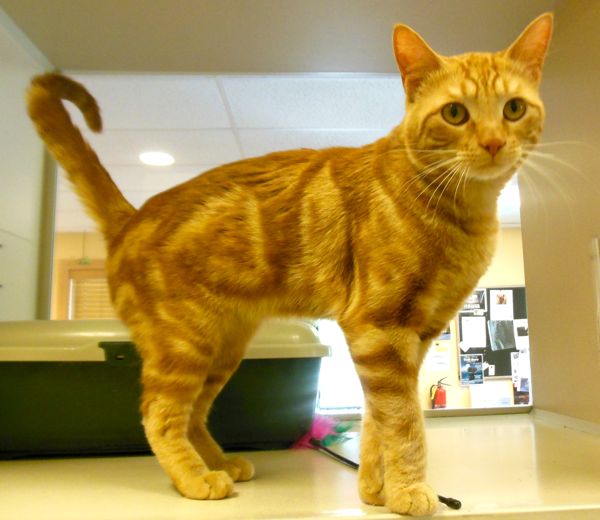
Marbles is a young cat (about a year old) who has unusual fur – beautiful shades of orange.

He is a nice boy, very playful and full of personality. He will do well in just about any home.

Marbles is neutered, microchipped, tested for heart worm, and vaccinated. He is at the El Dorado County Animal Services shelter in Meyers, along with many other dogs and cats who are waiting for their new homes. Go to the Tahoe animal shelter’s Facebook page to see photos and descriptions of all pets at the shelter.

Call (530) 573.7925 for directions, hours, and other information on adopting a pet.

For spay-neuter assistance for South Tahoe residents, go online.

— Karen Kuentz


Pioneer spirit rests in El Dorado County

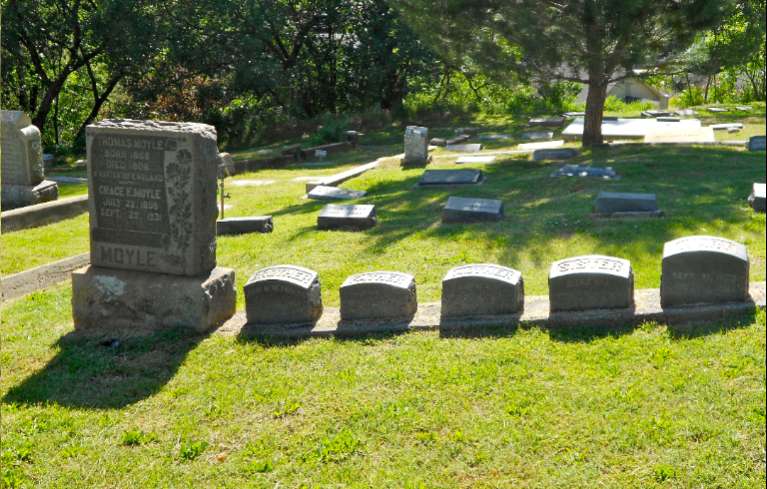
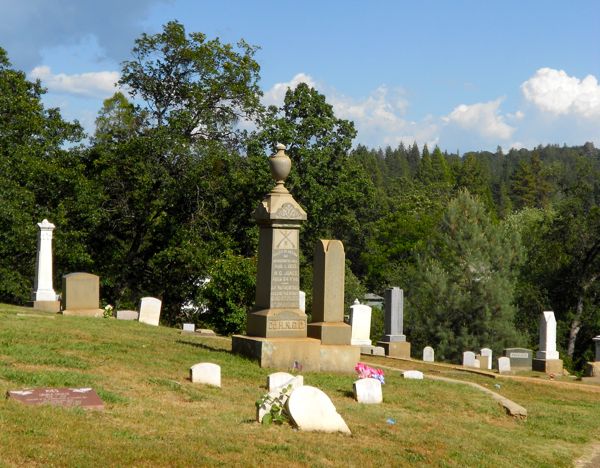
An entire family is buried next to each other at the Placerville Union Cemetery. Photos/Joann Eisenbrandt

An entire family is buried next to each other at the Placerville Union Cemetery. Photos/Joann Eisenbrandt

Publisher’s note: This is the first of two stories about El Dorado County’s pioneer cemeteries.

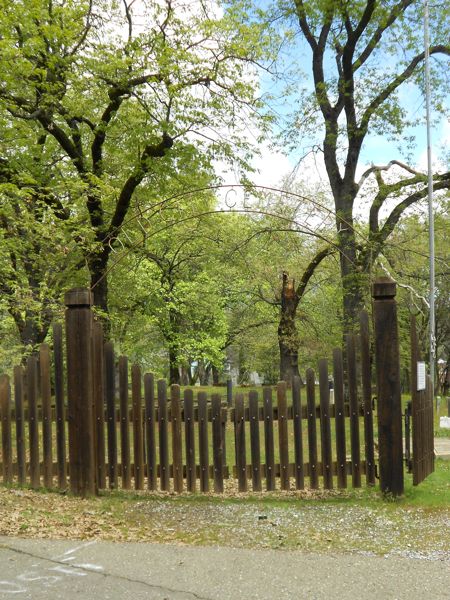
I first moved to South Lake Tahoe in 1979, and lived there off and on for more than three decades. Seven months ago, I moved to Placerville, where I now live near the top of Sacramento Hill, which rises steeply up from Main Street. For a month or so, I drove carefully up and down my narrow, winding driveway that dead ends onto Chamberlain Street, focused only on not sliding off. One day, as I stopped to get the mail out of my box on Chamberlain, I looked across the street and realized there was a cemetery there. I’d driven past Happy Homestead in South Lake Tahoe thousands of times, but never had the occasion to go in. From Johnson Boulevard it seemed neat and well tended, with cropped green grass in summer and tidy flowers at the gravesites. This cemetery was different. There was a wooden fence across the front and an arched wrought iron sign with the words “Old City Cemetery” in delicate capital letters. I walked across the street and looked over a low part of the fence. There was a weather-beaten gravestone carved from variegated white marble just two feet away. I went inside the open gate and saw the burial date on it – 1856. I had to know more.

— Joann Eisenbrandt

By Joann Eisenbrandt

PLACERVILLE — Those who live in Placerville and the Sierra foothills of El Dorado County are surrounded by reminders of Gold Rush history, often without knowing it. The area is dotted with more than 100, some say closer to 200, Pioneer Cemeteries dating back to the 1850s. Eighteen of these cemeteries are formally operated by El Dorado County, two by the city of Placerville, and others by family or nonprofit groups or rural cemetery associations. Some have been lost to history, with older graves buried over, unmarked, or partially hidden under modern parking lots or buildings. Some are well cared for. Others have been severely vandalized or remain largely untended and overgrown with weeds and broken gravestones.

These pioneer cemeteries tell the history of Placerville and El Dorado County.

The rush to find fortune

After the discovery of gold in 1848 at Sutter’s Mill in Coloma, estimates say that from 100,000 to 200,000 gold seekers rushed to what is now El Dorado County in hopes of making their fortunes. Early on, gold was plentiful, much of it right on the surface. Mining camps formed their own basic laws. There was little conflict, as there was enough gold to go around.
Who are the people buried at the pioneer cemeteries?     Lizzie Baldwin: Buried in Old City Cemetery, she died in 1866 at 15. The Mountain Democrat obituary says, “Deceased was a resident of Georgetown, but had been for a considerable time, an attendant of the Placerville Academy, and during her sojourn here, by her gentle disposition and winning manners, made for herself a circle of warm friends. The loss of one so suddenly stricken down in the bloom of youth, is sincerely mourned by her class-mates and companions, who paid their last tribute of respect by following the body in procession to its final resting place.”     Joseph Brindley: Came over from England, was living in Greenwood, but had been a Placerville blacksmith with a shop on Sacramento Street. He was one of many pioneers who were termed in their obituaries to have “died suddenly.” The February 1877 Mountain Democrat obituary goes on, “For some time his health had been in a precarious condition, and last Wednesday he came over on the Auburn stage to see if he could not have something done to improve his physical condition. When the stage drew up to the Ohio House and he had to get out of it, he fell forward upon the sidewalk, blood gushing from his mouth, and died in a few minutes.” He is buried in Old City Cemetery.     W.H. Bailey: Buried in an unmarked grave at Old City Cemetery, Bailey died in June of 1900 at the “advanced age” of 75. “W.H. Bailey arrived at the Ohio House Thursday noon from Amador,” the Mountain Democrat obituary of June 2, 1900, begins, “He ate lunch and took a seat on the porch in the shade and apparently fell asleep. Several hours passed and as he showed no sign of awakening, an attempt was made to arouse him when it was found that the man was paralyzed. Dr. Rantz was called in and everything possible done for the relief of the unfortunate man, but death ensued early the next morning.”     Peter Finsterwalter: A native of Germany, Finsterwalter, a railroad laborer, died at around age 30 in 1890 and is buried in Old City Cemetery, the victim of a runaway train accident. The Feb. 15, 1890, Mountain Democrat article entitled “A Ride To Death – A Wild Engine’s Awful Plunge,” spares no gruesome details. “It was about one o’clock, and the engineer was returning from Placerville, where it had been to take the crew ... to dinner. The engine crew were riding inside of the engine and five of the laborers were riding on the pilot. As the engine reached the top of the grade, near Krahner’s, she began to move faster, and as she started down a steep grade, the engineer lost control of it. Rounding a sharp curve in a deep cut, the engine and its human freight plunged into the caboose of the gravel train, and death came in its most sudden and horrible form to three of the unfortunate laborers in front of the engine. Peter Finsterwalter received the greater blow, as a car wheel seems to have struck him as the track went up. He was thrown to the side of the track, with an arm nearly severed, his breast laid open, and his head cut in two, one half of it just hanging to the trunk by a mere shred.”     Bernard Carlson: Also a native of Germany, Carlson died in November 1900 at around the age of 40. The Mountain Democrat obituary of Nov. 10, 1900, terms it “Accidentally Killed.” A laborer, Carlson “fell from the loft of his employers barn, Tuesday morning at 6 o’clock, injuring his spine which caused his death. What caused Carlson to fall is unknown. He had been drinking to some extent the night previous, but from appearances not enough to become intoxicated. The Coroner’s jury brought in a verdict of accidental death.” He was buried in Old City Cemetery.
Who are some of the people buried at the pioneer cemeteries?
Lizzie Baldwin: Buried in Old City Cemetery, she died in 1866 at 15. The Mountain Democrat obituary says, “Deceased was a resident of Georgetown, but had been for a considerable time, an attendant of the Placerville Academy, and during her sojourn here, by her gentle disposition and winning manners, made for herself a circle of warm friends. The loss of one so suddenly stricken down in the bloom of youth, is sincerely mourned by her class-mates and companions, who paid their last tribute of respect by following the body in procession to its final resting place.”
Joseph Brindley: Came over from England, was living in Greenwood, but had been a Placerville blacksmith with a shop on Sacramento Street. He was one of many pioneers who were termed in their obituaries to have “died suddenly.” The February 1877 Mountain Democrat obituary goes on, “For some time his health had been in a precarious condition, and last Wednesday he came over on the Auburn stage to see if he could not have something done to improve his physical condition. When the stage drew up to the Ohio House and he had to get out of it, he fell forward upon the sidewalk, blood gushing from his mouth, and died in a few minutes.” He is buried in Old City Cemetery.
W.H. Bailey: Buried in an unmarked grave at Old City Cemetery, Bailey died in June of 1900 at the “advanced age” of 75. “W.H. Bailey arrived at the Ohio House Thursday noon from Amador,” the Mountain Democrat obituary of June 2, 1900, begins, “He ate lunch and took a seat on the porch in the shade and apparently fell asleep. Several hours passed and as he showed no sign of awakening, an attempt was made to arouse him when it was found that the man was paralyzed. Dr. Rantz was called in and everything possible done for the relief of the unfortunate man, but death ensued early the next morning.”
Peter Finsterwalter: A native of Germany, Finsterwalter, a railroad laborer, died at around age 30 in 1890 and is buried in Old City Cemetery, the victim of a runaway train accident. The Feb. 15, 1890, Mountain Democrat article entitled “A Ride To Death – A Wild Engine’s Awful Plunge,” spares no gruesome details. “It was about one o’clock, and the engineer was returning from Placerville, where it had been to take the crew … to dinner. The engine crew were riding inside of the engine and five of the laborers were riding on the pilot. As the engine reached the top of the grade, near Krahner’s, she began to move faster, and as she started down a steep grade, the engineer lost control of it. Rounding a sharp curve in a deep cut, the engine and its human freight plunged into the caboose of the gravel train, and death came in its most sudden and horrible form to three of the unfortunate laborers in front of the engine. Peter Finsterwalter received the greater blow, as a car wheel seems to have struck him as the track went up. He was thrown to the side of the track, with an arm nearly severed, his breast laid open, and his head cut in two, one half of it just hanging to the trunk by a mere shred.”
Bernard Carlson: Also a native of Germany, Carlson died in November 1900 at around the age of 40. The Mountain Democrat obituary of Nov. 10, 1900, terms it “Accidentally Killed.” A laborer, Carlson “fell from the loft of his employers barn, Tuesday morning at 6 o’clock, injuring his spine which caused his death. What caused Carlson to fall is unknown. He had been drinking to some extent the night previous, but from appearances not enough to become intoxicated. The Coroner’s jury brought in a verdict of accidental death.” He was buried in Old City Cemetery.

Miners staked claims, each about 15 square feet, and when one was depleted they simply moved on to another. By 1849, most of the surface gold had been mined.

Women and children began arriving and larger settlements were built. The more labor-intensive “Placer Mining” began – digging gold out of the dirt and bedrock deposited at the bottom of streams and then washing it out.

El Dorado County was created by the Legislature in 1850, and by 1852 had a population of 40,000. The first county seat was in Coloma, and later transferred to Placerville in 1857. There were two main roads into the area, from Sacramento to Coloma and from Sacramento to Placerville. Roadhouses, small settlements and churches sprung up along these roads. As there became more miners but less gold, the increasingly frantic search for what remained brought crime, fighting, excessive drinking, sickness and death.

Life and death

Basic staples and necessities were in short supply. Fresh vegetables, fruit and meat were scarce. Lack of vitamin C led to scurvy. Many emigrants had arrived exhausted or ill from the long trip west. That and overindulgence in alcohol made the miners vulnerable to opportunistic diseases. Many of them lived in canvas tents with little protection from the elements.

Only a small number of the gold seekers actually “made their fortunes” from the often brutal work. Many remained poor and couldn’t afford medical care at the few existing medical facilities, or were fearful of entering hospitals and never leaving. Many people were dying all at once. Some reports indicate as many as 20 percent of those who came died within the first five years, often in remote locations near their mining claims.

Burying the dead in formally dedicated consecrated ground was often unworkable. Those who expired from diseases like cholera or smallpox were buried quickly, close to where they died.

Small cemeteries emerged on private property, or on hilltops near clusters of claims — “Boot Hills” — often without the knowledge of or permission from the landowner. One burial followed another and such sites soon became known as “public cemeteries.”

Coffins and grave markers, if they existed, were crude, often made of wood. The burial areas were rarely fenced off. Roadhouses and the small communities surrounding them along the main routes into gold country also had their own close-by cemeteries, watched over by local citizens or churches.

Formal cemeteries emerge

As easily accessible gold reserves dried up, many of the original claims and small encampments around the mining sites or roadhouses were abandoned and the local cemeteries that had served them became overgrown.

By the late 1850s, Placerville sought to centralize burials into two designated locations. An ordinance of the Placerville City Common Council from Feb. 12, 1859, states, “It shall be unlawful for any person or persons, to bury any corpse, or dead body of any human being, at any point or place within the corporate limits of the city of Placerville other than in the burial grounds now enclosed and used as such on the hill near the west line of said city, or in the burial grounds on Cedar Ravine, near the Methodist Church.”

The city created the office of city sexton to, “enter upon and take possession of the city burying ground, situated on the hill at the West end of said city, which ground shall hereafter be known as the City Cemetery. He shall keep the fence around the same in good repair and order, so as to exclude therefrom all domestic animals of every description. He shall keep and maintain the said ground in a good order, condition and repair as the same now are or may hereafter be put into.”

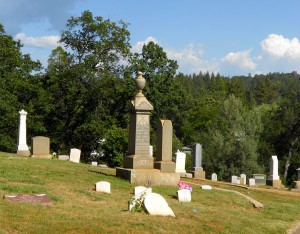
City Cemetery, now known as Old City Cemetery, is located on Rector and Chamberlain streets on Sacramento Hill just above Main Street and downtown Placerville.

In the mid-1850s, burials were occurring in what later became Placerville Union Cemetery, located up a steep hill on Bee Street several blocks above and north of Highway 50.

In 1871, a group of four fraternal organizations — the F. & A. Masons, Independent Order of Odd Fellows, Independent Order of Red Men, and the California Grove of United Ancient Order of Druids — purchased the land on which the cemetery had developed. Each fraternal organization managed an allotment of gravesites, some selling graves and others giving them to members. Over the years, the cemetery changed hands, eventually falling into disrepair, with the California Cemetery Board threatening to shut it down.

Although the cemetery is within Placerville city limits, the city and county reached an agreement to oversee it together, with the county being responsible for the grounds and maintenance, plus the sale of plots and interments, and the city for providing water and public safety. The land was deeded to the county in October 2006.
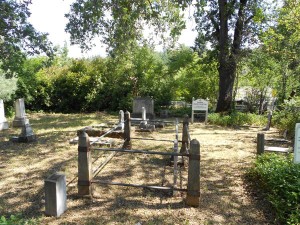
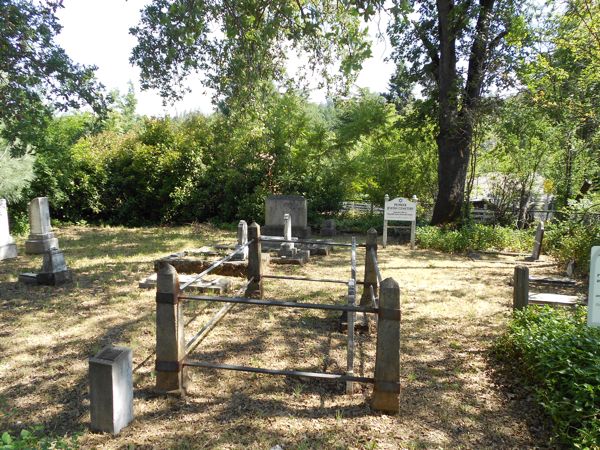
Jewish Pioneer Cemetery Photos/Joann Eisenbrandt

Jewish Pioneer Cemetery

Old City and Placerville Union cemeteries are two of the larger and best-known Gold Rush era cemeteries in Placerville, but many more exist within and outside the city limits. Some, like Pioneer Cemetery, established about 1850 above the current intersection of Main Street and Cedar Ravine, have been partly or fully-obliterated and lie under pavement. The graves in St. Patrick’s Catholic Cemetery on Sacramento Hill above downtown Placerville were built over when a church was constructed in the 1960s, with a marker now commemorating the site. Some, like the Pioneer Jewish Cemetery, are maintained by private groups. It is fenced, locked and inaccessible to the public.

Uppertown Cemetery, also owned by Placerville, was established about 1850 in what was then known as the distinct settlement of Upper Placerville, just east of downtown Main Street. Like the sites of many still existing pioneer cemeteries, its location is not obvious. The oldest marked grave at Uppertown dates to June 1850, although earlier burials may have occurred.

In the unincorporated areas of the county, many more cemeteries still exist at the sites of former roadhouses, rural settlements, churches, on private property, or outside the permanent communities that later took hold there.

A window into the past

Those buried in these pioneer cemeteries came from across the United States and the oceans. The death records for Old City Cemetery show burials of emigrants from at least 20 states and foreign countries including England, Ireland, Scotland, Prussia, Wales, Switzerland, Denmark, France, Peru, Italy and Brazil. The obituaries of those who came from America’s East Coast via a water route rather than overland, labeled them as “Argonauts.”

These obituaries, which appeared in the Mountain Democrat as early as 1854, offer a window into the pioneer past. Most striking is the fact that most of the gold seekers died young, and many of their children, very young. The report of City Sexton John Roy for interments in City Cemetery for 1861, lists 24 burials with ages ranging from 5 months to 47 years, almost half of them for those younger than 11. Those who survived into adulthood often died from what was called “the ravages of advanced age,” defined in obituaries as between 60 and 70 years.

A look at the death records from Old City Cemetery bears this out. August Hunger was 35 when he died in 1871. His four children had pre-deceased him, all before their ninth birthdays. Sisters Ella Mae and Fannie Page, buried next to each other at Old City, died in 1864 and 1865, respectively at the ages of 3 years, 9 months, 4 days and 1 year, 11 months and 4 days.

The headstones that do remain from such early family losses reflect the sadness. The parents of Mary Titus, who died in 1865 at age 4 years, 1 month and 11 days, inscribed her tombstone, “Rest our Darling Minnie.”

The obituaries, written in a style quite different from those of today, exuded a sense of familiarity and personal sadness, as the one for Lizzie Baldwin who died in 1866 at the age of 15. “By her gentle disposition and winning manners,” the Mountain Democrat obituary explains, “(she) made for herself a circle of warm friends. The loss of one so suddenly stricken down in the bloom of youth, is sincerely mourned by her class-mates and companions….”

Those who didn’t die in childhood often fell victim to the era’s limited medical knowledge. Causes of death from the 1861 City Cemetery interment report include: delirium tremens, consumption, congestion of brain, stillborn, putrid sore throat, diphtheria, inflammation of lungs, disease of heart and whooping cough. Many were said to have “died suddenly” without any further explanation, not because they just keeled over without warning, but more likely because the exact cause of death was not known.
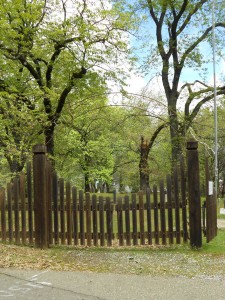
Old City Cemetery

Old City Cemetery

The pioneer lifestyle was hazardous. Those who now rest in the area’s pioneer cemeteries worked hard and often celebrated even harder. The search for gold, especially early on, was done largely by hand with simple tools or machines, as miners hacked the nuggets from beneath streambeds or from the sides of ravines that cut through Placerville. Lacking the safeguards of modern technology, accidents were common, and frequently fatal.

Crime and violence also took their toll, with the victims and perpetrators sometimes buried in the same cemetery. Joseph Staples, the first El Dorado County peace officer killed in the line of duty while trying to apprehend stage robbers, is buried in Placerville Union Cemetery. A plaque commemorating the event stands outside Placerville City Hall on Main Street.

Isaiah Zumwalt, infamous even in those times for the June 1900 murder of his son, grandson and former wife, is buried in an unmarked grave at Old City Cemetery.

There is also no lack of important local and statewide figures buried at Old City and elsewhere. Benjamin Franklin Keene, a physician and founder and first president of the California Medical Society, who died in 1856 at the age of 43 and is buried in Old City Cemetery.

The lifestyle of Placerville’s early pioneers is also revealed by what they left behind. Peyton Wright Benn died in 1896 at the age of 62, and was buried at Old City Cemetery. An inventory of the contents of his miner’s cabin included: one shot gun, one rifle, one Colt’s pistol, one stove and fixtures, 2 cross-cut saws, 1 hand saw, picks and a shovel, blacksmith tools, 1 Rabbit plane, hoe and sluice fork and one gold scale.

An announcement in the Sept. 10, 1887, Mountain Democrat for the public auction of personal property by the administrator of the estate of Joseph Keespe, also buried in Old City Cemetery, includes: 49 glass candy jars, 41 chairs, 5 children’s’ high chairs, 1 cider press, 1 cook stove, 1 guitar, 100 old school books, 38 jars of preserves, large lot of marbles, 142 pounds of candy, 118 pounds of peanuts, 26 pounds of almonds, 94 pounds of dried apples, 94 pounds of dried pears, 256 pounds of dried plums, 40 gallons vinegar, 20 empty barrels, 1 shotgun.
Study: Massage benefits athletes

By Amanda MacMillan, Outdoor

If you’re looking for an excuse to hit the massage table more frequently (or to justify the expense if you’re already doing it), you’re in luck. A recent study from the University of Illinois at Chicago backs up what we’ve long suspected: Massage therapy appears to eases muscle soreness after a hard workout.

Strenuous exercise causes a buildup of cell-damaging free radicals in the body, explains study author Nina Cherie Franklin. So she and her colleagues — supported by research grants from the Massage Therapy Foundation and the National Heart, Lung and Blood Institute— measured blood flow and perceived muscle pain of 25 study volunteers after they used a leg-press machine “to soreness” and half of them received lower-body Swedish-style massages.

All participants felt sore immediately after working out, but by about the 90-minute mark, the massage group reported no lingering effects. The non-massage group, on the other hand, still felt lasting soreness 24 hours later. The first group also showed improved blood flow throughout the body for up to three days post-massage, while the second group showed reduced circulation for about the same amount of time.

Read the whole story


Luggage can put heavy hit on wallet

By Tom Parsons, Los Angeles Times

Lots of people still carry on their bags, but a heavy, big bag more than likely will need to go down below.

And that’s going to cost you.

The overweight and oversize fees are in addition to your checked-bag fees. If your bag is overweight and oversize, you could pay as much as $325 for one checked bag, by the time you add up a checked-bag fee and maximum charges for overweight and oversize bags.

The overweight fee, in many cases, is now $100 for a bag weighing 51 to 70 pounds on American, US Airways, Delta and United. You pay that rate whether the bag is 55 pounds or 69 pounds, so if you have a bag that’s only slightly heavier, unpack a few heavy items, such as shoes, or bring a second bag because it can be cheaper to check two bags within the limits than one overweight bag.

Oversize luggage can also be expensive. If your bag is over 62 linear inches (length, plus width, plus depth), you will have to pay $200 on American, Delta, United and US Airways. On most airlines, the maximum size of bag you can check is 80 linear inches.

Read the whole story


Men struggling to have it all — family, work

By Lauren Weber and Joann S. Lublin, Wall Street Journal

Can working fathers have it all? Some of them are giving it a shot.

A new generation of fathers with corporate jobs is joining the debate about balancing work and family, a conversation long driven by working women. As the number of dual-earner couples grows and more men make sacrifices to support their wives’ careers, some fathers are asking employers for guidance and action or tapping flexible-workplace policies originally designed for working mothers. Others are curbing their career goals to spend more time at home.

Employers have been slow to recognize men’s role as caregivers, fathers and researchers say. And, as a younger generation brings new expectations for fatherhood into the office, they will have to challenge an assumption their female colleagues have faced for years: It is impossible to be both an involved parent and a star performer.

The shift comes at a time when more women are out-earning their husbands—a percentage that has risen steadily from 3.5 percent of families in 1960 to 15 percent of families in 2011, according to the Pew Research Center—and men are redefining what it means to be a dad. A study by the Boston College Center for Work & Family found that a majority of fathers, especially those under 40, are moving away from the traditional “breadwinner” role and see themselves as responsible for both the emotional and financial needs of their children.

Read the whole story


4 days of TOCCATA summer concerts

TOCCATA — Tahoe Symphony Orchestra and Chorus — kicks off its 9th Summer MusicFest with the Summer Solstice Serenade concert series June 19-24.

The program opens with Vivaldi’s Concerto for Two Flutes in C major, RV 533, with Josue Casillas and Carmella Cao as soloists, and continues with Mr. Casillas performing Vivaldi’s Concerto for Piccolo No. 443.

Organist David Brock will interpret Leo Sowerby’s Classic Concerto for Organ and Strings, and performs as continuo player for all other pieces. The concert concludes with J.S. Bach’s Cantata BWV 9 Es ist das Heil, featuring Anna Helwing and Jennie Tibben, sopranos and Stuart Duke, baritone, with Mike O’neill as concertmaster.

Maestro James Rawie will conduct all performances.

The performances are June 19 at 7pm at St. Patrick’s Episcopal Church in Incline Village; June 21 at 7pm at Shepherd of the Sierra Lutheran Church in Carson City; June 23 at 7pm at St. Theresa Church in South Lake Tahoe; and June 24, 7pm at Good Shepherd Lutheran Church in Reno.

Tickets are available at the door, online and the visitors’ center in Tahoe City. General admission is $25 adults, $20 seniors.


Being more connected opens up new consequences of being hacked

By Amy Thomson, Bloomberg

Come home to a hot iron and smoldering clothes this afternoon? Soon, it may not be a sign of forgetfulness, but rather evidence that you’ve been hacked.

In coming years, your smartphone will be able to lock your house, turn on the air conditioning, check whether the milk is out of date, or even heat up your iron. Great news, except that all that convenience could also let criminals open your doors, spy on your family or drive your connected car to their lair.

“As these technologies become more sophisticated, it opens up a broader spectrum of threats,” said Gunter Ollmann, chief technology officer of IOActive, a tech security firm in Seattle. A world of connected devices makes it possible “for the bad guys to have permanent entry into your household.”

What the industry calls “the Internet of things” has been heralded as the next wave of tech riches. By 2020, 26 billion such devices may be connected to the Internet, up from 3 billion today, researcher Gartner Inc. (IT) estimates. That’s almost four times the number of smartphones, tablets and PCs that will be in use.

Read the whole story


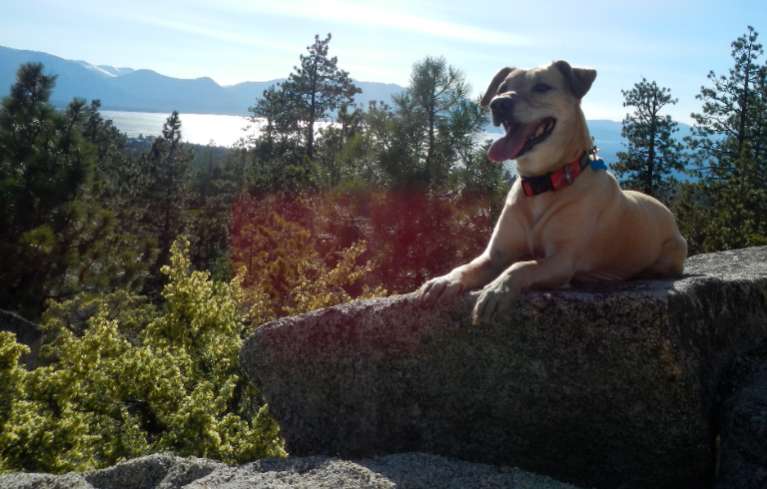
Pampered pooch on Tahoe weekend getaway

AJ on top of the boulders at the vista point in Van Sickle Bi-State Park. Photos/Kathryn Reed

AJ on top of the boulders at the vista point in Van Sickle Bi-State Park. Photos/Kathryn Reed

By AJ Rothschild-Reed

STATELINE – Mommy is letting some strange guy take my bed. I’m not sure about this.

Suddenly there’s a knock on the door. I must protect my person. Oh, but wait, what do we have here? Some other guy has my bed and mommy seems to be paying for it. That seems strange.

Wow, look at that view. The window comes down low enough that I can see Lake Tahoe to my left. And there’s a big stage. I might have to check that out, pretend like I’m a star. There looks like a lot of exploring to be had beyond these four walls.

But these four walls aren’t too shabby, either. Harveys is pretty cool with providing me snacks, matching bowls, a placemat of sorts and a nifty pouch full of poopy bags. This is better than at home. (Bet mommy the editor strikes that part out.) And that king-size bed. You know who is going to be lounging there when my peeps take off.

Harveys, for two years, has had 12 rooms designated for dogs. Stefan Humer, hotel manager, says special cleaning supplies are used, housekeeping receives extra training and rooms are vacuumed daily. Two dogs per room are allowed, with a 50-pound limit per dog.

Wow, mommy isn’t immediately sitting in front of the stupid computer. The leash is out – always a good sign. She tells me we are going to explore Van Sickle Bi-State Park. But I’m a little worried. Ken the bellhop said to watch out for coyotes. Then a guy in the parking lot says to beware of the homeless camp.

(We didn’t see either.)

Just get a whiff of that. Oh, never mind, but you are missing out. If you two-leggeds could smell what we four-leggeds smell, you would want to pee on everything, too. Sure it’s pretty – but the smells, really, that’s the best part of a hike.

Mommy can’t stop taking pictures from the vista point that was only about a half mile in from the trailhead. She’s babbling on about how pretty this would be at sunset. I can’t believe she just wants to sit on these boulders – how boring. They don’t smell.

We’re both getting hungry, but I overhear a conversation between the mommies that means I have to wait. We head back out the way we came in and never once see another person. Pretty cool to have the country’s only bi-state park all to ourselves.

But our solitude is quickly gone as we walk through the bustling Heavenly Village. We sit at a table at Base Camp Pizza waiting for the other mommy to arrive. The waiter brings three waters. I’m liking this kind of service. Talk about smells. There are crumbs all over the place from messy patrons sitting outside. I love it.

I see some of my own kind at other tables spread out between the two outdoor areas. We do our secret acknowledgement that our peeps don’t know about.

Mommy is clearly feeling guilty about not having fed me because I never get people food from the table. This pizza crust is pretty darn tasty. I’m going to put that on my list of people food to beg for.

After a good night’s sleep it’s time to head for the special area Harveys has outside for me to do my business.

My mommies say they are off to watch some horse race. Whatever. I’m part greyhound; they see me run all the time. But I’m not allowed to go.

At check in I saw mommy sign a waiver that said I would have to leave if I created a disturbance, went into the gaming area, lounged by the pool or went to one of the casino’s restaurants.

The hotel manager said some unruly dogs have been shown the door. Kennels are an option at Harrah’s Lake Tahoe for $10/day. Harveys charges $75/night for a dog.

Today we are going on another excursion that the bellhop recommended – Nevada Beach. Mommy likes the idea of not having to get in the Jeep all weekend.

The brochure provided by the hotel suggests outdoor play at Hawley Grade, Fallen Leaf Lake, Kiva Beach and Tallac Historic Site. These all require getting in a vehicle.

Lots of BS’ing here. That’s butt sniffing in our language. It’s flat, and apparently pretty, according to mommy lingo. I just know there is a lake at the end. Mommies perch themselves in the sand as I figure out how to tame these waves.

Later in the afternoon mommy takes me for a walk around outside. I ask about that stage I could see from the window. Mommy lets me get on stage. Pretty cool. I can hear the applause now. Just call me princess.

Dagnabit. Mommy interrupts my fantasy. It’s time to go back to the room.

I’m not too sure about escalators, but the elevators seem like some form of space travel.

The next morning the three of us head off to find breakfast. Well, I ate before we left. Still, I’m wondering what new people food I might indulge in.

We sit outside Driftwood Cafe. No table service, but they allow mommies to get food to go so the three of us can dine together. I’m not getting a scrap. What’s up with this? I am the reason we are on this mini trip. Why isn’t it all about me?

I guess we better get back and check out. But I could get used to this lifestyle of living on the 14th floor with a view of Lake Tahoe.

ngg_shortcode_0_placeholder (Click on photos to enlarge.)


Pre-planning critical before retiring

By Larry Roby

The start of football season may be months away, but the game’s on the minds of many after the NFL draft. Minicamps are gearing up and team personnel are organizing in preparation for the 2014-15 season.

Football is a big deal in the United States – and so is the surge of retirees – 10,000 baby boomers every day for the next 18 years. The last thing pre-retirees want to do at this stage of their lives is to fumble while in the red zone of their retirement date.

Only 23 percent of pre-retirees have calculated how much they’ll need to save for retirement, according to New Retirement Landscape; while three-quarters say they’re confident in the red zone of retirement, an equal amount of people haven’t even done the math yet.

Confidence in your retirement portfolio is good – if it’s justified. Otherwise, it can lull people into a false sense of security and lack of preparedness.

Having a diverse portfolio and understanding your options for life insurance, Social Security and 401(k) or other retirement accounts are staples for retirement planning. But there are also six crucial documents that are often either not in an individual’s playbook or are overlooked.

Here are the six documents you need for a solid red zone estate plan:

• Joint Ownership — Enables you to own property jointly with another person and upon the death of the joint tenant, the surviving joint tenant automatically becomes the owner of the property.

• Last Will and Testament – A legal document which expresses the wishes of a person concerning the disposition of their property after death and names the person who will manage the estate.

• Durable Power of Attorney – Grants authority to another individual to act on behalf of the person who executes the instrument and are commonly used for legal and financial purposes.

• Durable Health Care Power of Attorney – Grants authority to another individual to make health care decisions on your behalf should you be unable to make such decisions.

• Advance Care Directive – A set of written instructions in which a person specifies what actions should be taken for their health, if they are no longer able to make decisions due to illness or incapacity.

• Living Trust – Created during your lifetime. Assets are transferred to the trust while you are alive. Provides written instructions for the disbursement of the trust assets upon your death. These documents can play a vital role in the major plays during the fourth quarter of your life. Understanding how they work now can make the difference between a last-minute victory or loss.

Larry Roby is the founder and president of Senior Financial Advisors.


Writers’ conference in Zephyr Cove

The 2014 Zephyr Point Writers’ Conference will run July 20-25.

Each day will include a time of ecumenical Christian worship and inspirational words from a featured presenter.

The Zephyr Point Writers’ Conference is led each year by writer and poet Marilyn McEntyre, tenured professor at the UC Berkeley-UCSF Joint Medical Program. McEntyre is the author of numerous books of poetry and three nonfiction works.

Her teaching on writing is grounded in the conviction that writing can be a spiritual discipline, can fuel prayer, and, at its best, can leave the writer as well as the reader “surprised by joy.”

This year’s retreat topic focuses on six elements of writing as storytelling, posed as “Six Questions” that will be explored through daily group presentations:

• accurate description (WHAT)

• lively characterization (WHO)

• articulation of process (HOW)

• space and place as contexts of story (WHERE)

• the time dimension in storymaking (WHEN)

• explanation, reflection, and the contemplative moment (WHY)

Conference price of $549 includes all meals and free parking. For more information or to register, go online.