‘Boys in the Boat’ captures historic crew team

By Kathryn Reed

The United States in the early and mid-1930s wasn’t anything like it is today. People on the East Coast barely could find Seattle on a map. The Olympics truly were a contest of amateur athletes. And, of course, Hitler was creating a dictatorship few saw coming.

This is the backdrop for “The Boys in the Boat: Nine Americans and Their Epic Quest for Gold at the 1936 Berlin Olympics” by Daniel James Brown. It was published in 2013.

TheBoysintheBoatGrit, determination and camaraderie are what made this crew team so successful. Saying this group of young men from Washington was special is an understatement.

Brown is able to capture the intensity of their quest through storytelling that makes this a page-turner. While the team is front and center, it is Joe Rantz who is the main character. His struggles to survive when his family turned its back and to find the money to pay for college were not unique. But they made him the man he became.

Lessons of what it means to be part of a team were often learned the hard way for this University of Washington team.

“The Boys in the Boat” is a bit of a coming of age story, part sports, and a ton of history. But all the segments are woven together in a way that gives depth to their various stories within the main story and perspective about living in Seattle 80 years ago as well as the workings of the Nazi regime.

It doesn’t matter if you know the outcome of the various races, the words are enough to stimulate a bit of adrenaline. Brown’s delivery is like that of a good broadcaster who makes you envision what is going on without needing to actually attend the sporting event.

Brown does such a superb job making the reader care about these men that you can find yourself silently cheering during each race.

The movie rights have already been sold.


$1.6 mil. Truckee property bought with bitcoins

This vacant Martis Camp parcel was paid for in bitcoins. Photo/Martis Camp

This vacant Martis Camp parcel was paid for in bitcoins. Photo/Martis Camp

By Candace Jackson, Wall Street Journal

A Truckee property sold Thursday for $1.6 million—in bitcoins.

The property is one of just a handful of residential real estate transactions in months that have used virtual currency—and potentially a record in terms of price. The price in bitcoins was 2,739.

The 1.4-acre acre home site has views of the Pacific Crest, a surrounding mountain range. It is located in Martis Camp.

Brian Hull, Martis Camp’s director of sales, said the buyer was a “Silicon Valley entrepreneur,” but declined to disclose his name. He said the buyer purchased the land through a trust, and plans to build a home on the site.

The idea to pay for the property with bitcoins came from the buyer, said Hull. “When we originally heard the idea of bitcoin, everybody had a little pause,” he said. “We weren’t educated at how the transaction would go.”

Read the whole story


Tahoe Tails — Adoptable Pets in South Lake Tahoe

Shilo

Shilo

Shilo is a very sweet girl who is a bit subdued at the shelter. She is very quiet and mellow, but we think she will perk up once she gets into a good new home.

She is about 6 years old, house trained, and she walks very nicely on the leash. She is OK with other well-mannered dogs, and didn’t chase the cats that she met at the shelter. She is content to sit at your side or at your feet.

Shilo is possibly a border collie mix, a little skinny at about 45 pounds, who would be happy in just about any home.

Shilo is spayed, microchipped, tested for heart worm, and vaccinated. She is at the El Dorado County Animal Services shelter in Meyers, along with many other dogs and cats who are waiting for their new homes. Go to the Tahoe animal shelter’s Facebook page to see photos and descriptions of all pets at the shelter.

Call 530.573.7925 for directions, hours, and other information on adopting a pet.

For spay-neuter assistance for South Tahoe residents, go online.

— Karen Kuentz


Old S. Tahoe hotel gets much needed upgrades

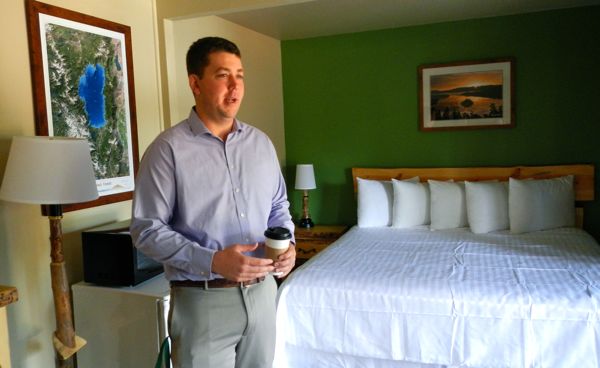
Chris Nielsen, general manager of the Trailhead, shows improvements to the rooms. Photos/Kathryn Reed

Chris Nielsen, general manager of the Trailhead, shows improvements to the rooms. Photos/Kathryn Reed

By Kathryn Reed

There is one less hotel in South Lake Tahoe renting by the week or month.

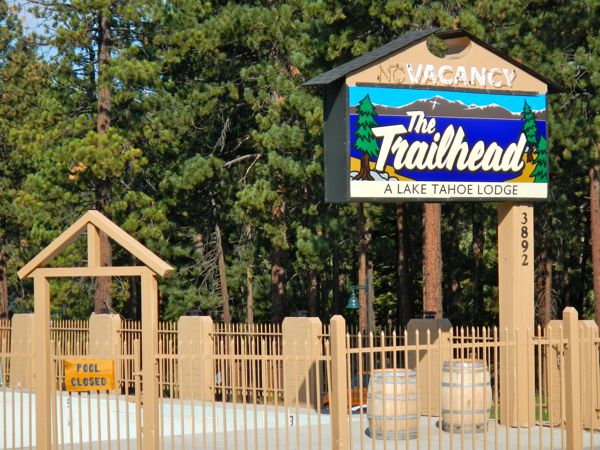
The Vagabond Inn on Highway 50 is now the Trailhead – A Lake Tahoe Lodge.

Owners from China took over at the first of the year, having paid $1.3 million for the property that is walking distance to the state line. The half a million dollar-remodel began after the ski season ended. Of the 34 rooms, five are deluxe. And more improvements are planned.

“I want the entrance and exit off Midway (Road) and I want to get rid of the pool. It’s from 1959,” Chris Nielsen, general manager of the property, told Lake Tahoe News. The pool is empty and unusable.

Rooming the empty pool near Highway 50 is a goal.

Removing the empty pool near Highway 50 is a goal.

The hotel was originally the Brooks Lodge in 1947. In 1959, it was remodeled to accommodate visitors coming to Lake Tahoe for the 1960 Squaw Valley Winter Olympics. In the 1980s it became a Vagabond – and remained that until June 1.

It had become rundown and was attracting a different clientele than it is today. Now the hotel wants to compete with the likes of Holiday Inn Express and 968 Park.

Every room has new beds. Nielsen was surprised when the mattresses from 1993 were being snatched up by other hoteliers in the neighborhood.

Gone, too, are the blue floral bedspreads from the 1990s, and 1980s-era televisions.

Tahoe Timber Uniques created all of the lamps. Like its name, each one is unique.

Cody’s Tree Service used locally sourced Jeffery pines to make the furniture, including headboards and towel holders.

The goal was to have the rooms feel like a guest is in Tahoe instead of Anyplace, USA. This was also accomplished with the array of old Tahoe photos on the walls.

Two rooms have a king bed plus a bunk bed. This is designed for families – whether it’s parents with kids, or three generations traveling together.

Nielsen has a ton of ideas about what he would like the property to evolve into. He said it’s just a matter of the investors cutting a check.

“I want to bulldoze the parking lot. I would like to have a restaurant,” Nielsen said standing on the walkway of the second floor.

He knows this would help with the slow off-seasons by being able to attract locals to the property. His vision is to have quick, good food to go that people could order ahead of time and take with them to the beach or wherever.

Bunk beds in two rooms allow for more sleeping options.

Bunk beds in two rooms allow for more sleeping options.

“We could have a mobile app where they put in their food order and have it ready when they get here,” Nielsen said.

Nielsen also envisions getting rid of the room closest to the office and possibly putting in a small wine and beer bar with a patio.

To build on the Trailhead name of the hotel, the office is stocked with maps from the U.S. Forest Service about where people can go exploring. Plus, Nielsen has been working in the hotel industry locally and knows what’s expected in terms of being able to direct people to restaurants and sightseeing destinations.

A continental breakfast is served each morning. Dogs are allowed for $20 per night. There is a grassy area out front for them.

The word is getting out about the transformation of the hotel. The Trailhead was sold-out Fourth of July and has been doing steady business all summer.


4 symphony performances in September

Tahoe Symphony Orchestra and Chorus concludes its summer season with a four-concert series.

The program includes the “Faure Requiem”, Liszt’s “Hungarian Fantasy for Piano and Orchestra”, and the Tchaikovsky “Violin Concerto in D Major” with featured guest artist Elizabeth Pitcairn playing the legendary Red Stradivarius.

Performances are Sept. 10, 12,* 14, and 16 in the Reno-Tahoe area. Contact TOCCATA for more information online, or call 775.313.9697, or email ToccataTahoe@gmail.com.

* The Sept. 12 performance is part of the Carson Valley Arts Council Concert Series, and tickets ($5-$28) must be purchased here.


Casinos banking on slot players

By Brad Plumer, Vox

The next time you find yourself in a casino, pause for a second to appreciate the architecture.

Casinos put an enormous amount of thought into their designs. The layout of the tables, the patterns on the carpet, the lighting — they’re all explicitly engineered to make gambling more seductive and get you to spend more money.

One surprising example are the curving hallways around the property. Many casinos try to avoid making you ever have to turn at a 90° angle. As Natasha Dow Schüll explains in her fascinating book, Addiction By Design: Machine Gambling in Las Vegas, a right-angle turn forces people to call upon the decision-making parts of their brain — to stop and reflect on what they’re doing. “Casinos don’t want that,” Schüll told me. “They want to curve you gently to where they want you to go.”

But as Schüll discovered, almost nothing in a modern-day casino is more carefully engineered than its slot machines.

Slot machines and video gambling were once marginal to the success of casinos — but nowadays, they account for up to 85 percent of the gaming industry’s profits. And casinos have devised a dizzying array of strategies to make these machines as addictive as possible, from the elaborate algorithms beneath the hood to the position of the armrests.

Schüll, a cultural anthropologist at MIT, spent 15 years in Las Vegas tracking the evolution of slot machines, exploring how and why they’ve become so addictive. We spoke recently by phone about how gambling has changed dramatically over time and how the gaming industry has drawn on psychological insights to make its games more addictive — often with tragic consequences.

Read the whole story


Complaints follow North Shore concert

North Shore residents were not happy with the noise, fire concerns, curfew, parking and trash problems in neighborhoods because of concerts in July.

North Tahoe Public Utility District, and concert promoter PR Entertainment, are taking steps now to reduce the impact on the surrounding neighborhoods during the August concert. Rebelution, Iration, The Green, and Stick Man will be at North Tahoe Regional Park on Aug. 13.

“This was the first time that the current staff has put on an event of this magnitude and while we acknowledge there are adjustments that need to be made, all things considered, we are pleased with the way things went,” Tracey Towner,  with North Tahoe Public Utility District, said in a statement. “We are implementing changes to lessen the impacts on our neighbors, the residents that live in the surrounding neighborhoods.”

The stage will be relocated to change the direction of the sound, the speakers will be turned more inward, and the natural surrounding will be used to help damp down the sound in the neighborhoods.

The district will be posting notices at the entrance to the neighborhoods surrounding the park the weekend prior to the concert alerting residents of the time/date of the event and who they can call for additional information. Days prior to the event the neighborhoods will be signed with “No Park Access” signs and “No Parking Signs”.

VIP parking prices will be reduced and the shuttle service will run from Northstar.

There will be a designated smoking area during the concerts and signs around the park indicating “No Smoking in the Forest Due to High Fire Danger.”


The truth about Internet slang

By Cameron Hunt McNabb, Salon

In 2007, BBC reporter and presenter John Humphrys wrote an essay pointedly titled: “I h8 txt msgs: How texting is wrecking our language.” In it, Humphyrs lamented that: “the relentless onward march of the texters, the SMS (Short Message Service) vandals who are doing to our language what Genghis Khan did to his neighbours eight hundred years ago. They are destroying it: pillaging our punctuation; savaging our sentences; raping our vocabulary. And they must be stopped.”

“Of course, texting and Internet slang are just the most recent object of such hyperbolic metaphors, and while Humphrys’ piece is an extreme example of this genre of opinion writing, his rhetoric is consistent with the battle cry of texting’s many adversaries.

However, eminent linguist David Crystal is far more nonchalant about texting’s impact on language, and responded directly to Humphrys’ alarms in his rebuttal, “2b or not 2b?,” arguing that “all the popular beliefs about texting are wrong” and that “texting has added a new dimension to language use, but its long-term impact is negligible. It is not a disaster.”

Whatever that impact may be — pure destruction or barely noticeable annoyance — texting’s use of various spellings, abbreviations and speech patterns is actually nothing new for English. There was no standard spelling for the first 1,000 years of the language’s development, giving rise to four or five spellings per word. When the Oxford English Dictionary admitted “OMG” and “FYI” into the official lexicon in 2011, many people were likely surprised to find that the first usages of these abbreviations predate the Internet age, with OMG first occurring in 1917 and FYI in 1941. Similarly, the popular “haha” of modern texting actually first appears in roughly 1,000 AD in Aelfric’s “Grammar.”

Read the whole story


Musician reflects on how S. Tahoe shaped her

Nikki G credits her Tahoe roots for her music success. Photo/Callie Giovanna

Nikki G credits her Tahoe roots for her music success. Photo/Callie Giovanna

By Jen Marchain

Henry David Thoreau said, “Go confidently in the direction of your dreams. Live the life you’ve always imagined” – a simple sentiment so often difficult to achieve in such a consumable world of distraction and strife. But for South Lake Tahoe native Nikki Grant, she is keeping it real and all in perspective.

A rare soul, Nikki G (as she is known) is an artist and powerhouse percussionist, performing in front of thousands of people in acts like Street Drum Corps, Katy Perry, 30 Seconds To Mars, Family Force Five and many more. She’s charged toward her dreams with wild abandon, successfully connecting her creative ideas to its intended target while all the while never losing sight on the foundation that got her there in the first place – her spirit of family and home.

Tell me about your first memory of playing music?
Nikki G: On the long stretch of California driving from Northern California to Southern California, my family would fill the eight-hour journey with car songs and show tunes. I had a part specifically designed for the young age of 1, 2, 3 and 4. I remembered by the age of 4 being excitably anxious as my family sang a capella harmonizing to songs like “Winter Wonderland” and waiting patiently to add my musical contribution.
As I entered the world of ensembles I remember my first elementary school concert, specifically the moment when the band director announced me as the youngest member. I was so small that when I was introduced I had to lift my mallet high above from behind the concert bass drum in order to be recognized.

Q: How influential was music in your family?
A: I was born straight into a musical family starting with the matriarchs, being my grandparents. Their children who would soon have children and then great-grandchildren made the musical family ignite. Even most of those married in were musicians; there was never a dull moment at family reunions. Some refer to my family as the new age, “Partridge Family.”

Q: What was it like growing up in Lake Tahoe?
A: The beauty that surrounds those who are born and raised in Lake Tahoe is immeasurable and somewhat distracting. In any upbringing it’s only a matter of time before you start to discover there’s an outside world. The enrichment that Tahoe provides from the education system, the outdoor education and the closeness of the community is part of the fuel that gave me, a small town girl, the courage to set out and capture the dream.

First and foremost my musical family gave me my foundation in music and in life but the Lake Tahoe Unified School District arts program further fostered my hopes and dreams. The music program gave the essential environment needed to not only prepare me for my future career but truly gave me an outlet that fostered my life’s dream. Not only did my family and friends support my musical likings but so did my band directors as did my peers. I was very fortunate to be known in my community as, “The Little Drummer Girl.”

I cannot emphasize enough on the importance of arts in the community of South Lake Tahoe. I know for a fact my life could have been drastically different and I can guarantee many of my musical/art program peers would feel the same. There are a handful of us out in the world making our musical dreams come true and I hope there are many generations after us that can state the same affirmation.

Q: Who were your earliest mentors?
A: My earliest and most important mentors were my family members, offering a vast variety of everything from classical pianists, musical directors, band directors, percussionists to DCI Drum/Bugle Corps.

My mother and father took great care to foster and nurture my musical journey, teaching me the foundations of music while doubling on piano and percussion. I was very fortunate to have the best of two worlds, my mother being a classical pianist and my father being a musical director/vocalist. I was not only able to receive a high education in music, but I had many outlets to express my art through recitals, festivals, musicals, and much more. In fact, my first experience on the road, at the age of seven, touring was with my parents performing in the musical “Godspell”.

As I branched out beyond my family, I was very fortunate to be able to work with many phenomenal musicians and instructors. Some of which were band directors JJ Clause, Linda Kurek and drum instructor Eric Hellberg who still provide richness in the arts to the community of South Lake Tahoe. I also had the rare opportunity to work under the direction of one of the greatest mentors of my musical life, Brian Farnon, who worked with many of the musical greats such as Spike Jones.

Every person, and many more, plays an important role in the community of South Lake Tahoe. They have all supplied generations with the vast knowledge of the arts that ended up to be the start of many musicians’ careers, including my own. With my mother and father reaching into their fourth decade of commitment to the community and many more who have dedicated with them and before them, South Lake Tahoe is a resource that will become a great example of the benefits of the arts not only in the education system but for all communities.

Q: What influences or inspirations (or experiences) did you gain in your childhood that pushed you forward in your career?
A: I can remember the very moment and the very place that I realized my dream. It was in the third grade on the playground at Tahoe Valley Elementary School, atop the metal igloo after school staring at the clear blue sky saying to myself, “I want to be a musician. I want to play in a band with all of my friends and help people feel happy.” Even though the definition was childlike and I didn’t have any knowledge of what that dream truly contained, my heart was set on sharing the healing powers I received daily from music with as many people as my lifetime would permit.

Q: What barriers have you faced in your career?
A: Coming from a small town I was able to have a lot of hands on experience through the arts, especially since Lake Tahoe was a hub for outside touring acts. I was surrounded by musicians two or three times my age, which became a very welcoming and fostering environment. Even though I was very blessed with an incredibly supportive family and community, nothing could have truly prepared me for the outside world. I had to merely experience stepping out of the safety bubble, called home, for myself.

I not only faced the change in culture, the realities of the industry, but the nature in which it stood, which wasn’t always a good nature.

Unfortunately the dream that shined so bright was being darkened by challenges I couldn’t have foreseen. As time went by, traveling city to city, I couldn’t have pre-determined the capacity of struggles, heartache and turmoil I was about to experience.

Every artist has a story, even when the media and the magic of Hollywood make someone seem like an overnight success, it’s usually not true. If you take the time to find the real story, you’ll see much more than the overnight magic; everyone has a story. I was on the road, making my story and having the highest highs and the lowest lows. I was adjusting being away from home, family and friends, which is still a hardship, but it’s because of the support of all of those aspects that I wasn’t beaten down by the, sometimes scary, outside world.

Even though the majority of the time I was faced with being the only female drummer, having to pass up amazing opportunities due to not being male, knowing no one, learning how to become street smart, facing fears daily, and feeling very overwhelmed; I truly believe my absolute love for music, the unwavering commitment of my supporters and my hometown brought me to where I am today, which is full of accomplished dreams. All of us have barriers in many different ways whether it’s an internal or external factor. But I truly believe that each of us has some passion, a desire, something that pulls at our heartstrings and we only have one life to embrace the dream. Tomorrow is never promised, so live your dream today.

Q: Your album “heART” seems profoundly tethered to your soul. As an artist, how do you prepare yourself to create something so personal and why is it important for you to share it broadly through art?
A: “heART” came about at a time of artistic struggle. I’d been experiencing a lull in my creative spark and I was coming to an age of realizing I had nothing to call my own. I wanted to tap into a part of musical soul, which had been left untouched. So I did what I thought was most beneficial, I took a summer off and went home.

Every time I would go home it would bring back so many memories from my past, especially since my parents left my childhood bedroom exactly the same. Going home for the summer not only put me in a supportive environment, but making my old room into a studio to compose was the best environment to feel safe enough to face my musical fears. Writing for any artist based on the naked truth within your soul is scary, especially when you have no idea what will come about. I had no clue; in fact I had trouble with the process for quite some time.

I’d worked so long in different groups, living in the Hollywood scene that I had somewhat been molded into what every different gig required and not allowed to flourish being just, me. At first I thought I’d write the next top hit or pop/rock song, well those were so forced that it made the process of composing got more frustrating. It wasn’t until I reached out to my parents that I started to truly tap into tethering my soul.

I remember my mom saying, “You can’t force yourself against what’s innately in you, if you just let the music naturally flow it will be perfect because you’ll be expressing the honest truth inside your heart.” My dad would sit down and make lyrics up, purposefully write a humorous song just to get me out of the boxed mindset and to instill one of the most important aspects of creating, which is the enjoyment of the process.

Without being home, without my parent’s guidance and my musical journey up until that point, “heART” wouldn’t have existed. It was proof that all good things take time; you can’t rush the real deal.

I put myself in a safe zone, surrounded by those who could help me thrive whether musically or spiritually and from there on out I made myself one promise; to be myself, to hold no bounds, and to let my heart be heard.

Q: You’ve had a lot of success with the Street Drum Corp project. What other things are you working on these days?
A: I’ve had the pleasure of working with Street Drum Corps for the past eight years; it’s been quite an adventure.

I never thought I’d be touring the world, playing for thousands, let alone being on television doing what I had been doing with close friends at South Tahoe High starting at the young age of 15. I created a Trash Can Trio at South Tahoe High and we quickly became the feature at rallies, games, concert and events. We also occasionally got in trouble for making loud music is how I would choose to describe our sound of metal trash cans, poles, fences, etc., around campus. I could have never foreseen making a living off of what was construed as ruckus, chaos, but all in the same, music.

In the music world I’m defined as an independent artist or freelance artist, which allows me to work in many different projects. I’ve played with many acts in and around the Los Angeles basin, have worked in the studio recording everything from albums to soundtracks, and have even had the privilege of composing and performing on the big screen for an internationally released commercial for the Starz Channel. All in all, I believe an artist’s life never stands still and as time progresses so will my projects. The artist never stops; it’s a blessing and a curse.

Q: What is the overall message you hope to convey in your music and your style of playing?
A: I have a deep passion for music, no matter what genre or what type of music I perform. My goal is to break the barrier we sometimes place between audience and performer because to me it’s not about the show, it’s about the story, it’s how the music makes you feel and the communication that has more power than you may realize, the power to unite. The message I’ve always tried to convey is the message of unity. Music is innate in each of us and I’ve experience and see the healing powers of music throughout my whole life.

Even as I stared up at the sky at Tahoe Valley Elementary School, with stars in my eyes, I could have never imagined all the dreams within a dream that have come true. I’ve learned that although you may have a dream, your perseverance and hard work will lead you toward the unimaginable. It happened to me it can most definitely happen to you. I feel very fortunate and proud to be from South Lake Tahoe and to be able to affirm that my dreams have come true, a dream that at one point seemed impossible. Coming from a small town one might think the possibilities are limited, but I hope that my life can be proof that no matter where you’re from life is limitless.



Doc causes controversy promoting vegan diet

By Anahad O’Connor, New York Times

Kim A. Williams, the president-elect of the American College of Cardiology, often sees patients who are overweight and struggling with hypertension, Type 2 diabetes and high cholesterol. One of the things he advises them to do is to change their diets.

Specifically, he tells them to go vegan.

Williams became a vegan in 2003 because he was concerned that his LDL cholesterol — the kind associated with an increased risk of heart disease — was too high. The doctor wrote about his reasons for going vegan and his belief in the cardiovascular benefits of a plant-based diet in a recent essay at MedPage Today.

Veganism has grown in popularity in recent years, reflected by the explosion of meat-free cookbooks and restaurants, and vegan-friendly products in grocery stores. But the endorsement by the man who is set to become the president of one of the country’s leading cardiology associations, which helps formulate health policies and guidelines, did not strike a totally positive chord.

One person suggested he was promoting a radical diet to his patients based on the experience of a single person: himself. Others accused him of trying to get the college of cardiology to encourage everyone to go vegan, which he dismissed. And some critics suggested that Williams and the college were “unduly influenced by industry,” which baffled him.

Read the whole story