Tahoe author to talk about his book

Local author John Hindmarsh will launch his new thriller “Mark Two” on Oct. 21 at the South Lake Tahoe Library.

Hindmarch’s  second book will be released  in November. It continues where “Mark One” left off.

He will give a free talk starting at 6pm about the art of writing and self-publishing. His book will be for sale and he will be signing the.

The library is at 1000 Rufus Allen Blvd.


Developer using robots to sell high-end properties

By Paul Hagey, Inman News

New technology is taking virtual tours a step further by letting buyers drive cameras mounted on remote-controlled vehicles through distant homes, venturing from room to room, peeking around corners and taking in near-360-degree views from multiple vantage points.

San Francisco-based luxury real estate developer JMA Ventures — which also owns Homewood Mountain Resort — is using a system developed by Suitable Technologies Inc. to let homebuyers roam through its properties and communicate with sales agents in real time from anywhere in the world.

The Beam Pro stands over 5 feet tall and can travel over 2 miles per hour.

Key to the experience is Suitable Technologies’ robot-like Beam Pro. The remote-controlled vehicle, which stands over 5 feet tall, transmits a video feed of homebuyers’ faces onto a 17-inch screen and broadcasts their voices through six speakers arrayed on both Beam’s front and back.

Buyers, in turn, see their surroundings through Beam’s wide-angle camera as they use a computer keyboard to guide it, tooling around at speeds that can exceed 2 miles per hour. Users can also hear the sounds it picks up with its two microphones, as information is transmitted to and from the device by a high-speed Wi-Fi network.

JMA Ventures has been using four Beam Pros for about a year to help sell properties near San Francisco’s iconic Ghirardelli Square, and also Lake Tahoe, to luxury buyers from around the world who don’t always have the time to tour homes in person.

Read the whole story


Tahoe Tails — Adoptable Pets in South Lake Tahoe

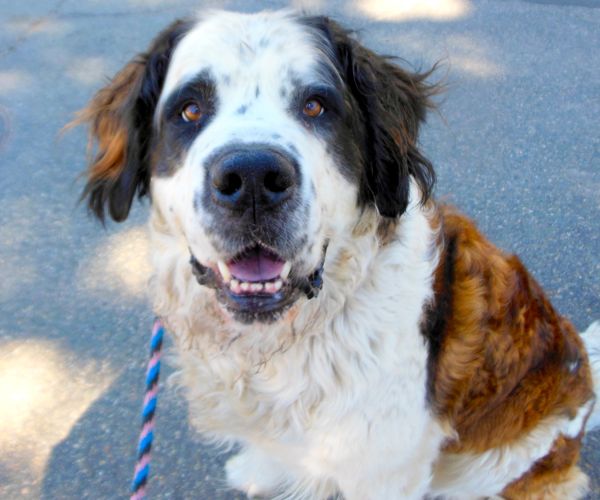
Bandit

Bandit

Bandit is a beautiful purebred St. Bernard. She is so youthful in appearance and behavior that it is hard to believe she is 8 years old.

She is tall, and seems to be at her ideal weight. Bandit has a beautiful coat and is very well behaved. She jumps tall fences and she will chase cats and possibly small dogs. Bandit loves children and sleeping in beds with her people.

Bandit is spayed, microchipped, tested for heartworm, and vaccinated. She is at the El Dorado County Animal Services shelter in Meyers, along with many other dogs and cats who are waiting for their new homes.

Go to the Tahoe animal shelter’s Facebook page to see photos and descriptions of all pets at the shelter.

Call 530.573.7925 for directions, hours, and other information on adopting a pet.

For spay-neuter assistance for South Tahoe residents, go online.

— Karen Kuentz


Ice bucket challenge may change nonprofit world

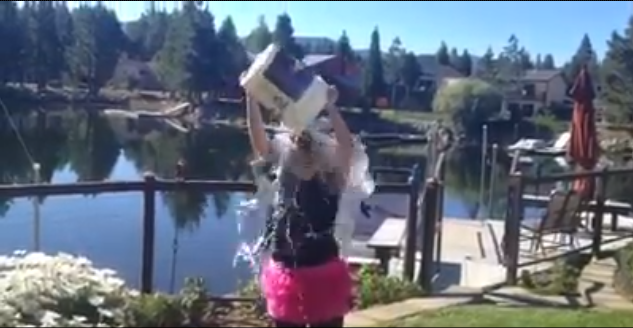
brandi bucket

Brandi Ledbetter Brown takes the ice bucket challenge in South Lake Tahoe. Photo/Provided

By Alicia Rancilio, AP

NEW YORK — The ice bucket challenge’s phenomenal success is making other charitable organizations rethink how they connect with a younger generation of potential donors.

Since the ALS Association began tracking the campaign’s progress on July 29, it has raised more than $53.3 million from 1.1 million new donors in what is one of the most viral philanthropic social media campaigns in history.

Thousands of people, including celebrities like Taylor Swift and Oprah Winfrey, have posted videos of themselves getting buckets of ice water dumped over their heads and challenging others to do the same — or donate money to the ALS Association, which raises money for Lou Gehrig’s disease research and assistance.

The ice bucket challenge has shown it’s OK to be silly for a good cause, says Brian Mittendorf, a professor at the Ohio State University Fisher College of Business, who teaches courses in nonprofit finance.

“Normally the model is to find people who are passionate about a cause and then ask for donations or to educate people and then seek out donations. (The ice bucket challenge is) something that’s fun that people can do … people are taking part in it and then taking the info and donating.”

The viral nature of the effort surprised even the ALS Association.

“This level of unprecedented giving is (something) I don’t think this country has seen before outside of a disaster or emergency,” said ALS Association spokesperson Carrie Munk. “We had no idea it would get to this point.”

Who should get credit for making this a viral sensation depends on whom you ask. Some say it began earlier this month when friends of a 29-year-old Boston man with ALS, a neurodegenerative disease that affects nerve cells in the brain and spinal cord, did a group challenge.

It’s also demonstrated that the average Joe or Jane can make waves.

“One of the big take-aways is the power of individuals who are so tightly connected to a cause can really make a difference,” Munk said. “I’m pretty sure that if any company or any nonprofit had all of the public relations dollars in the world to come up with a campaign, we never would’ve seen this kind of success.”

Lucretia Gilbert, executive director of The Pink Agenda, which raises money for breast cancer research and awareness, believes it will encourage other nonprofits to get creative on social media.

“It’s a very simple thing and that’s kind of the beauty of it. Everyone can do this challenge,” she said.

The effort comes at a time when private groups are searching for new ways to raise dollars in the wake of tighter federal government spending on basic medical research, including on diseases like ALS.

The National Institutes of Health is spending about $30 billion this year, money that is divided in a highly competitive process to scientists around the country, and the world, to pursue what are deemed the most promising leads to understand various diseases and to find new targets to fight them.

Congress cut government spending last year; in 2012, the NIH’s budget was $30.8 billion. And even before those cuts, the agency’s budget hadn’t kept pace with inflation for about a decade. As a result, the NIH is funding about one in six grant applications — down from about one in three a decade ago, director Francis Collins said earlier this year.

For Lou Gehrig’s disease, the NIH’s estimated budget this year is $40 million, down from $44 million in 2012.

Employing technology for fundraising campaigns, of course, isn’t a new idea: Perhaps one of the most enduring began in 1966 when the Muscular Dystrophy Association had its first annual Labor Day weekend telethon. Last year, it raised $59.6 million in contributions. Fundraisers have also embraced donating by text message in recent years.

But some fundraisers contend that one of their greatest challenges is asking the same people for money year after year — a challenge successful social media campaigns could solve.

Mindy Bailey, corporate and community development specialist for JDRF, a foundation that raises money to fight Type 1 diabetes, said volunteers want to come up with a similar idea to fuel donations.

“We have had a lot of people reach out to us and say, ‘Hey, we’re going to do the ice bucket challenge,'” Bailey said. “Recently we had a woman say, ‘I’m thinking of doing a pie-in-your-face idea.’ The wheels have been turning.”

However, not everyone is a fan of the public approach of the ice bucket challenge.

#NoIceBucketChallenge is a hashtag on Twitter that’s being used for a variety of reasons.

“I just think it seems hokey and far too gimmicky and a hot trend and part of the whole ‘me’ culture of ‘Oh look at me. Pay attention to me,'” said Cameron Mitchell of New York. “The charity part seems like an afterthought.”

Some even argue that it’s wasteful to dump water, even for a cause, especially in places like California, where there’s a drought.

The California Water Board offered a measured response.

“It doesn’t violate any of our regulations. People should always use good judgment whenever they use water while we’re in a drought. On the other hand, we understand that this is a charitable event,” said George N. Kostyroko, director of the California State Water Resources Control Board’s office of public affairs, in an email.

Annoyed, impressed or otherwise, the ice bucket challenge has people talking — and ALS’s Munk asserts that even if they don’t donate, the campaign has raised public awareness, a major focus of the organization that last year spent 32 percent of its annual budget on public and professional education and 27 percent on research.

Just a few years ago, she said, only about 50 percent of Americans knew what ALS is.

“We’re really looking forward to see how the needle moves,” she said.


River Ranch Lodge embraces laid-back

The River Ranch Lodge's patio is along the Truckee River. Photos/Kathryn Reed

The River Ranch Lodge’s patio is along the Truckee River. Photos/Kathryn Reed

By Susan Wood

ALPINE MEADOWS – There’s something about running water when it’s time to chill and go with the flow of life.

And that flow may involve a cold drink on a warm summer day with picturesque surroundings.

That’s a key reward involved in a stay at the River Ranch Lodge on Highway 89 about 3 miles north of Tahoe City. The small, 19-room cozy lodge is situated right on the Truckee River. It’s hard to imagine getting any closer.

And now is the time to go if one enjoys the experience of leaning over the short stone wall from a riverside table as if diving into the water. It’s not crowded now, which is unusual.

The bar and restaurant are inviting.

The bar and restaurant are inviting.

The Truckee River rafting companies have ceased operations because of the drought’s effects on the region’s iconic, windy river. The water level is low and getting lower to accommodate Lake Tahoe in the ebb and flow of the climate and environment.

So on a sunny, summer Sierra weekend afternoon, it’s actually easy to get a table on their famed bar deck.

“We’ve definitely felt the effect (of less guest traffic). Normally, you couldn’t come walking up to this bar and get served right away,” bartender Jake Clinton said.

Others have also witnessed the change.

“That’s the first thing we noticed when we got back to Tahoe. There were no rafts,” said Kristine Schug, as she was pouring her Sonoma County Winery’s Sauvignon Blanc for Homewood’s Farm-to-Peak dinner earlier this month.

On any given Tahoe summer weekend, hundreds of people end their Tahoe City raft floats on the River Ranch deck, cramming the outside bar and food stand known for its River Rum Punch and mountain of gooey nachos.

On the Sunday morning during our stay, a morning hike starting a few miles up the road near the Alpine Meadows Ski Resort brought us much bang-for-the-buck scenery. It whet our appetite for a few mojitos, a beer and French fries on the deck with friends Roni and Brenda. The drinks were refreshing and the fries hit the spot after having hiking snack food. (Of course, some would say French fries are a snack. To the four of us, they are a mandatory food group that’s become an after-exercise ritual.)

I noticed the mound of not-your-average cheesy nachos order whiz by and briefly schemed about ruining my upcoming dinner scheduled in the formal dining room.

The smell of Tahoe pines blended with the different scents coming from the kitchen. Glasses were clinking at the bar. And the sun glistened on the rapids rolling over the rocks on the river next to our table and in the calm swimming hole. The night before, the patio provided a beautiful super-moonlight evening when we had the place and the adjacent low docks to ourselves – AJ included.

Life is good at the River Ranch Lodge. It’s a perfect launching pad to many activities for those who want to do more than sit on the deck or docks, even though that’s an attractive option.

The Truckee River is calm and shallow just before the lodge.

The Truckee River is calm and shallow just before the lodge.

Location, location, location

Beyond the nearby hiking trails west in the rugged Granite Chief Wilderness that gives Squaw Valley one of its famed backdrops, the River Ranch is plopped right between the meandering bike trail that follows a historic railway and the river where many people take their own inner tubes or small rafts.

The recent closure of the commercial rafting operations has given the Truckee River Taxi Co. a boost in business because floaters need a ride back to their vehicles.

“We can even fit dogs in here,” shuttle driver Derek Watson pointed out, looking back in the van where he’s crammed up to 10 inner tubes. The cost is $15 a person. The service is filling a gap in a creative way, much the same way the River Ranch has planned events like pool parties to pique the interest of Tahoe summer enthusiasts.

“If anything, I think a lot of people are looking for a place to go swimming,” River Ranch Lodge General Manager Rob Curtis said of guests who stay or drop in to eat, drink and dunk in the adjacent watering hole.
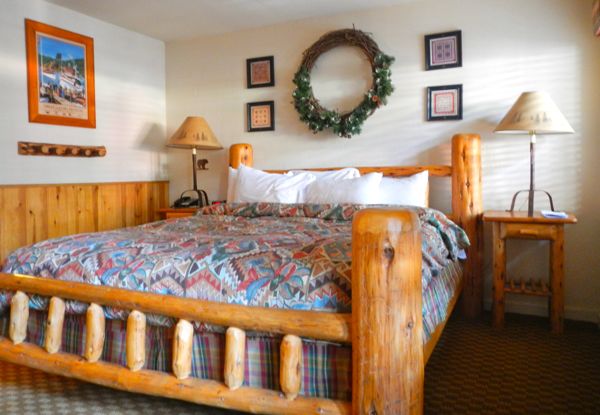
Rooms have a Tahoe-feel to them.

Rooms have a Tahoe-feel to them.

The inn, built in 1888, was once a stopping off point for railway traffic. A landmark sign is embedded on a rock next to the bike trail near the lodge to remind guests of its historic past. Once called the Deer Park Inn, the structure was demolished following its demise during the Great Depression and rebuilt in the 1950s to accommodate dignitaries during the 1960 Olympic Games at Squaw Valley about a mile away.

Through the years, some hints of its history remain intact. Ten tennis courts from more than a half-century ago are still situated behind a few monstrous summer homes across the river from the lodge.

Nowadays, rooms in the quaint lodge are not swank or polished – but that’s part of their charm. The evolving renovations and upgrades made by private owners since the 1970s have provided what is needed to truly relax and enjoy the surroundings. Each room is comfortable, spacious and comes with basic amenities, but be mindful the Internet is slow for those needing that service. The mountain motif such as the bedspread and chair upholstery, light pine wood paneling, old cross country skis on the wall, log-cabiny bed frame and coat hanger along with tasteful wood-framed pictures reminds guests where they are staying. (Note: collected pine cones and fake wreaths are a little over the top in being imitation cute.)

The bathroom is small, but serves its purpose. I especially enjoyed using the wall heater and imagined how comfortable this would be for a winter stay. (Another note of improvement for housekeeping: the towels are rough and smell chlorinated.)

That aside, the place has its own unique qualities. We laughed at the notion of opening our window at the cushy easy chair in the room to order drinks in Room 11. It butts up behind the bar. Modest guests may want a different room or run the risk of flashing people bellied up to the bar facing the windows. One of the busy bartenders smiled and pointed out the window screen as inhibiting that ordering idea.

But that was all in good, laid-back fun.

The staff at the River Ranch Lodge is extremely accommodating. One front desk clerk even printed out the hiking map I emailed to her when I failed to find mine.

The good service spans from the front to the back, where a friendly wait staff scurries around the elegant dining room. A giant stone fireplace behind the indoor bar was a reminder winter is not far away. The menu has been updated to include Skuna Bay salmon and Cervena elk, but vegetarians may want to partake in a mix of appetizers and sides. (I probably could have been satisfied with that plate of nachos earlier if not for enjoying the ambiance of the dining room with a river view.)

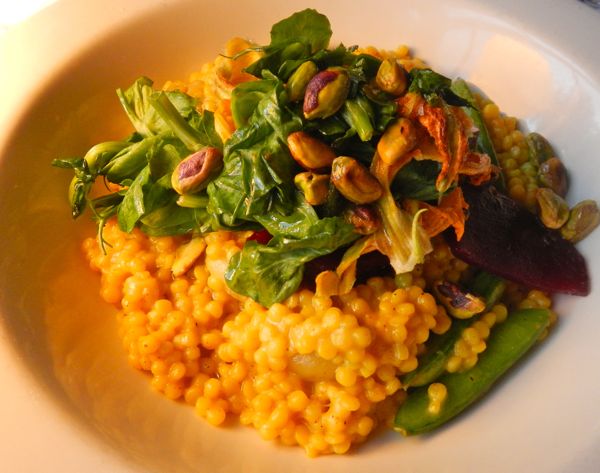
The couscous entrée is quite good.

The couscous  is quite good.

The tomato-bisque soup was not the best part of the meal, as it tasted like someone just poured a can of tomato sauce in a bowl. The couscous entrée with what seemed to be a hint of saffron was good, despite the squash blossoms being nothing special. Nonetheless, the beets were perfectly cooked. Plus, the wilted greens were a tasty accompaniment.

The heirloom tomato salad plate presentation was beautiful. The burrata cheese represented a nice creamy alternative to the usual mozzarella cheese. However, the tomatoes themselves didn’t seem as fresh or sweet as they could be in the height of their season. The friendly waitress returned to tell us the tomatoes came from Sacramento Valley, and not a farmers’ market. From that, it wasn’t surprising that the bread Kae and I really liked originated from “random food distributors”.

The wine list was vast, with some Sierra Nevada foothill varietals mixed with Napa and Sonoma favorites. We were pleased with a really good Zinfandel from Amador, the land of Zin.

It stands out when a hotel guest is able to stroll to a nice restaurant instead of a chain eatery or driving somewhere.

And here at the River Ranch as in many places in Tahoe, a diner may see a variety of people of different ages and attire. One man donned a tank top, while a family came in dressed for the occasion.

Dinner entrée prices range from $19 to $34. Room rates on the weekend start at $132 per night, with some accommodating dogs.
—
If you go:
River Ranch Lodge
2285 River Road (corner of Alpine Meadows Road and Highway 89)
530.583.4264.


Truckee hosting film festival

The Wild and Scenic Environmental Film Festival will be a weekend of adventure, activism and community in Truckee on Sept 26-27.

On that Friday there will be a special screening of the Patagonia sponsored film, “DamNation” at 6pm.

The Wild & Scenic Film Festival is a collection of films from the annual festival in January in Nevada City, which is now its 11th year. Wild & Scenic focuses on films which speak about the environmental concerns and celebrations of our planet.

For more information, call 530.582.2909 or ndorr@townoftruckee.com.


Women’s conference in Kings Beach

Rayona Sharpnack will be the keynote speaker at the inaugural Women as Change Makers: Leading and Thriving in the 21st Century conference in October.

Zawadisha, a Tahoe-based global women’s empowerment organization, is putting on the Oct. 3 event.

Sharpnack is the CEO of the Institute for Women’s Leadership. She has facilitated women’s leadership trainings for Fortune 500 companies such as Microsoft, Charles Schwab, and Hewlett Packard. She has also spoken about her trademarked approach to audiences at Harvard University, Stanford University School of Business, and UC Berkeley’s Hass School of Business.

“Women as Change Makers will bring together some of the most passionate, driven, and successful women in the Reno/Tahoe/Truckee area,” Sharpnack said in a statement. “It will create opportunities and provide resources for women to develop a deeper understanding of how to create breakthrough change with our money, time, and talent. The conversations we generate will change the way women think about their leadership, and enable them to scale their passion and skills beyond what they could have imagined, while simultaneously reconnecting with their inner needs.”

In addition to Sharpnack, the event will feature some of the most accomplished women entrepreneurs in the region as facilitators and speakers. Discussion topics will include Developing Transformational Leadership: Strategies To Enrich the Personal and Professional, and Creating Balance Through Health and Wellness.

The conference is from 8:30am-6pm at the North Tahoe Event Center in Kings Beach. Tickets may be purchased .


SNC hosting book in common author

Writers in the Woods brings acclaimed authors, poets and screenwriters to Incline Village’s four-year, private university for readings and workshops throughout the academic year. The college also annually adopts a book for its Common Read, which is read, discussed and interpreted throughout the curriculum. This year’s book is “Being Flynn” by Nick Flynn.

Flynn will speak on the campus at 7pm Sept. 5 in the Tahoe Center for Environmental Sciences building, Room 139. He will put on a workshop Sept. 6 from 9am-noon. Info about the workshop is online.

Flynn has published three memoirs, but is best known for his first memoir, “Another Bullshit Night in Suck City,” about reuniting at a homeless shelter with his estranged father, a narcissistic alcoholic. Both are struggling writers: the elder Flynn homeless and intensely dramatic, the younger Flynn employed at the shelter, yet battling his past. This book, now repackaged as “Being Flynn,” was made into a movie of the same name in 2012, starring Robert DeNiro as Flynn’s father, Paul Dano as Flynn and Julianne Moore, as his suicidal mother.

Other SNC literary events include:

Sept. 19 – Literary Lollapalooza
A gathering of writers, editors, publishers, book vendors and more to celebrate literature in the Tahoe region.

Oct. 17-18 – Terry Allen
Terry Allen, who has received both a Guggenheim Fellowship and a National Endowment of the Arts award, is a musician, visual artist, sculptor, painter and writer, blending the forms into museum/theater artworks that reference his Texas roots.

Nov. 7-8 – Kevin Fedarko
Kevin Fedarko’s work has appeared in Esquire, National Geographic Adventure and has been anthologized in The Best American Travel Writing of 2004 and 2006. His latest work, “Emerald Mile,” won the National Outdoor Book Award.

March 6-7 – Mark Maynard
Mark Maynard is the author of “Grind,” a collection of short stories set in Reno. His short fiction has been widely published, and he is the fiction editor of the literary journal, “The Meadow.”

April 10-11 – Gailmarie Pahmeier and David Lee
Poet Gailmarie Pahmeier has published the poetry collection, “The Rural Lives of Nice Girls,” as well as several other books. She teaches at the University of Nevada, Reno. David Lee was Utah’s first poet laureate and is the author of 15 volumes of poetry.


Family letters become Tahoe history book

By Kathryn Reed

For 30 years a treasure trove of Lake Tahoe area history sat in a closet unbeknownst to the owners.

The white wooden chest was in Mary K. Sonntag’s home in New Castle, Pa. Her mother, Myrtle McConahy Keefer, had sent it to her in 1962. In 1992, Sonntag’s daughter, Mary Jo Sonntag, said it was time to open it.

What they found were photographs and more than a century (1842-1962) worth of letters between family members in Vermont, Illinois, Pennsylvania and California. Those in California had settled in the Sierra.

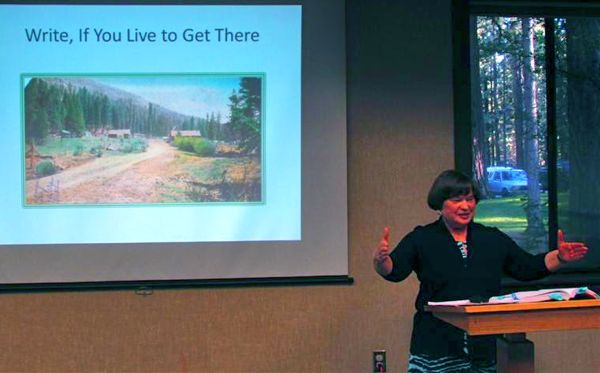
Mary Jo Sonntag speaks Aug. 13 at the South Lake Tahoe Library. Photo/Denise Haerr

Mary Jo Sonntag speaks Aug. 13 at South Lake Tahoe Library. Photo/Denise Haerr

Mary Jo Sonntag was in South Lake Tahoe last week talking about “Write If You Live to Get There”, the book she and her mom wrote from the letters and subsequent research.

In 1862, Sonntag ancestors bought 160 acres at what is now Phillips Station for $2,000. An old cabin is still inhabited there by family members. It’s on Highway 50 at the intersection of the road that leads to Sierra-at-Tahoe.

“Phillips burned down multiple times and they kept rebuilding,” Sonntag told the audience gathered at South Lake Tahoe Library.

The resort was rustic. Electricity didn’t exist. Icehouses were on the river. Meat came Placerville, vegetables from Gold Hill. It was a bit of a haul to get eggs and butter from Camp Richardson, which had been delivered there via train.

For $12 per week people could camp out at Phillips Station. Swimming, tennis and horseback riding filled days. Sitting by the bonfire was a ritual in the evening.

In the winter of 1952 most of the cabins collapsed from the weight of the snow in what turned out be an epic year.

Throughout her talk, Sonntag read passages of letters that are woven into the book.

The mother-daughter duo first came to California in 1993 to begin their research. Soon they discovered how their family had left quite a mark on the region.

Family is buried in Placerville and Truckee, as well as the private family cemetery at Phillips Station.

Meeks Bay Resort employees helped piece together facts. A curator at the El Dorado County Historical County Museum in Placerville said, “Sally must be thrilled you are here.” They didn’t know who Sally was.

Thus began the introduction to West Coast family. Those out here thought the Sonntag clan had long since perished. Mom Sonntag is now 94.

In addition to Phillips Station the family ran Meeks Bay Resort for the McKinneys and leased property at Rubicon Springs, where they ran another resort.

It was Joseph W. D. Phillips who started Phillips Station. His daughter, Sierra Nevada “Vade” Clark, took over. When she inquired with the Postal Service about what to call their post office because a Phillips already existed, she was told to call it Vade Post Office. At one point it was part of the Pony Express Trail.


TOCCATA putting on 2 limited-seating concerts

TOCCATA – Tahoe Symphony Orchestra and Chorus — presents a soiree musicale to support its 9/11 Memorial Concert Series.

Elizabeth Pitcairn, violinist, will be featured along with accompanist Donna Axton, Ann LaRose, piano soloist, and vocalists Anna Helwing and Joy Strotz, sopranos; Liudmila Mullin, Mezzo soprano; and Mark Williams, tenor.

The event takes place in a private home in Incline Village on Sept. 6 at 3pm.

Pitcairn will be featured along with David Brock, organist, in a private home in South Lake Tahoe on Sept. 15 at 5pm.

Seating is limited for each event. The cost is $125 for each performance.

Call 787.602.2121 or go online for information or tickets.