Sports betting v. the stock market

By Matt Egan, CNN Money

NEW YORK — Sports gamblers have lots in common with stock market investors.

They both believe they can predict the future, and they sometimes fall into the trap of making decisions with their hearts instead of their brains. And of course, they both hate to lose.

But don’t let those similarities fool you. Gambling on sports may be more fun, but it’s definitely a more risky use of money than putting it in the stock market.

In the long run, investors have the chance to make more money because there are fewer downside risks.

To put it another way, the stock market is a lot more forgiving than the MGM Grand (let alone your local sports bookie).

“A lot of people regard investing as gambling, but I frequently say no. Which casino in Atlantic City, Las Vegas or Macau pays the bettor 73 percent of the time?” said Sam Stovall, chief investment strategist at S&P Capital IQ.

That’s the percentage of time that Stovall’s research shows the S&P 500 — the gold standard in the stock market — has increased in value during the years since 1926.

Read the whole story


Pilgrimage to Tahoe plane crash site 50 years later

By Dave Nordstrand, Salinas Californian

One morning when Salinas’ Billy Harvey was a boy of 5 and still asleep, his parents arose.

Quietly as they could, they tiptoed to the front door and left the house.

“I never saw them again,” Harvey said.

Billy Harvey’s parents had put him and his two brothers in the care of an aunt. Then, they’d flown off to Lake Tahoe on what was supposed to be a fun-flight getaway, a day-long casino excursion. They planned to return home that night.

Only they, and many others, died in an airplane crash.

That was March 1, 1964, making this year the 50th anniversary of that disaster and its aftermath.

Billy Harvey is now 55. He drives a bus for special education children in the Salinas Union High School District.

In late July, Harvey, his wife and three children plus his brother, Jesse Harvey, and other family members headed for the Tahoe area.

First thing Harvey noticed was the crystal blue of the lake. He was stunned by the beauty of the setting. Harvey carried with him a wooden plaque, hand-painted and honoring his parents. “In Loving Memory of Billy and Patricia Harvey,” it said. He planned to leave it posted at the site where his parents had died 50 years ago.

At that site, Harvey found bits and pieces of the wreckage still scattered across the ground. “Shrapnel,” he called the fragments.

“I found pieces of the seat, pieces of the engine,” he said. “I took one piece back to Salinas. In a way, it was like bringing my mother and father home.

“Standing there on that site, I felt a peace that I hadn’t expected to feel,” Harvey said. “I cried. I would like to go again. It’s about keeping the memories alive now. It’s all about love.”

Read the whole story


Sunscreen alone not enough to prevent skin cancer

By Erin Beresini, Outside

In an 83-page call to action released last week, the Surgeon General declared war on skin cancer. Rates are on the rise faster than those of any other cancer, he says, though he doesn’t know exactly why. One thing is for certain: to avoid becoming one of his scary stats, you can’t rely on sunscreen.

Stanford University dermatologists found that people who relied solely on sunscreens for protection burned more than people who didn’t wear much sunscreen, but sought out shade, and wore a hat and long sleeves to guard against skin damage. As the Environmental Working Group, a non-profit environmental research organization based in Washington D.C., explains, scientists have conflicting opinions on whether or not sunscreen can help prevent melanoma.

Part of the problem is that sunscreens, especially in the U.S., do not protect equally against UVA and UVB rays. UVB rays cause sunburns, but UVA rays, which penetrate deeper into the skin can be equally damaging without leaving an obvious mark.

Currently in the U.S., many sunscreens may claim broad-spectrum protection without truly guarding users against both UVA and UVB rays. “The widespread marketing of sunscreens with SPF values of 50 to 100 means that consumers are increasingly (and unknowingly) selecting products with less proportional UVA protection,” EWG writes. “Newer, modern UVA-filtering ingredients developed for European sunscreens could remedy this problem.”

Read the whole story


Lecture to focus on prostate issues

Bradley Anderson, a doctor at Barton Urology, will be talking about cancer and benign diseases of the prostate on Sept. 10.

He will discuss different prostate cancer screenings available and the variety of treatment options.

The free lecture is from 6-7pm at Lake Tahoe Community College’s board room.


Tickets on sale for Nevada Day celebration events

A limited number of tickets are for the inaugural Nevada Day Steampunk Ball, a costume fundraiser (for ages 18-plus) at the Carson Nugget Ballroom on Oct. 31 from 7pm to midnight.

The event’s theme combines the formality of old-time nostalgia with a light-hearted science fiction twist, and includes dance music by Rock-N-Roll Rebels, a no-host bar, sweet treats, and costume contest with prizes. Tickets are $25 per person, on sale online.

Also new this year is the Nevada Day FamFest. It is a designated family-friendly fun zone which takes place from 11am-5pm on Parade Day at the Horseshoe Club parking lot on the corner of Proctor and Curry streets in Carson City.

The fourth annual Governors Banquet is the signature kickoff gala to the Nevada Day celebration. It is at the Grand Sierra’s Summit Pavilion in Reno on Oct. 28.

Carson City’s Lone Mountain Cemetery Tour (aka: “Friends In Low Places”) returns Oct. 31 at 2:30pm and 5:30pm.

For a complete listing of Nevada Day events, go online.


MontBleu to host comedy competition

Sixteen comedians will be in Lake Tahoe on Sept. 13 as part of the 39th annual San Francisco Comedy Competition.

They will have about 7 minutes to woo the audience and judges. The finals are Oct. 5 in San Francisco.

This year’s host is a past contestant Kris Tinkle. Tinkle’s lates album, “Maybe I Don’t Feel Like Smiling,” is in the top 10 on iTunes. He is also a regular on “The Artie Lange Show.”

The show at MontBleu in Stateline starts at 9pm.

Tickets are $30, plus a $3 facility fee, and available through Ticketmaster or by calling 888.829.7630.


State provides disabled access to Vikingsholm

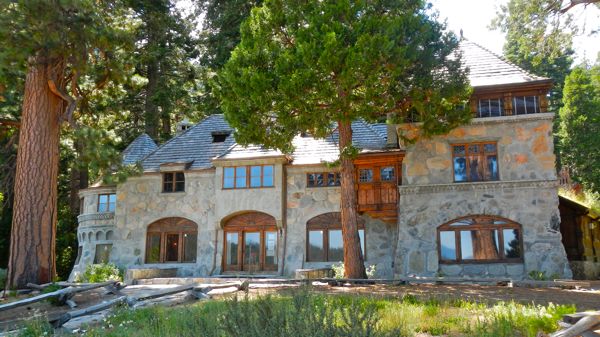
Vikingsholm is not accessible to people with disabilities. Photos/Kathryn Reed

Vikingsholm is now accessible to people with disabilities. Photos/Kathryn Reed

By Kathryn Reed

EMERALD BAY STATE PARK – While Lora Knight’s guests were always allowed to drive to her estate, that has not always been the case for California State Parks visitors.

This is the second year people with disabilities are allowed to drive to Vikingsholm at Emerald Bay State Park. Otherwise it’s a one-mile trek down that feels much longer going up.

Volunteers escort people to a parking area not far from the castle. Two guest cars are allowed per day. Everyone is in their own vehicle to avoid insurance issues.

The normal $10 parking fee is charged. The stay is for about two hours, which is long enough to tour the historic house.

Helen Smith, who summered at the estate when she was a child, is still involved with Vikingsholm. A section of the museum, which is separate from the house, is dedicated to her. Smith used to be a regular docent. Last week she was there for a fundraiser.
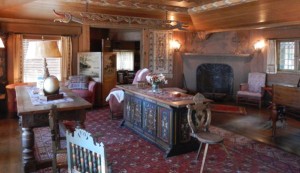
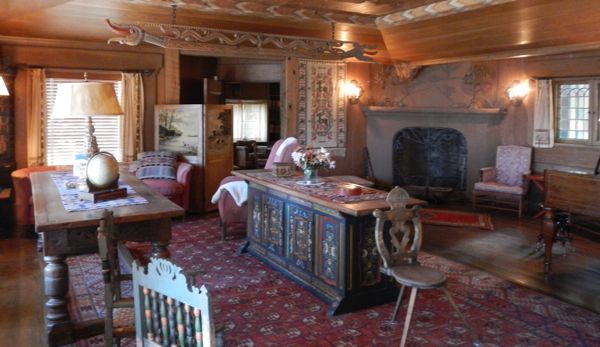
The main room as it was when Mrs. Knight owned the estate.

The main room as it was when Mrs. Knight owned the estate.

Fundraising is an ongoing endeavor for the nonprofit associated with Vikingsholm because the state does not provide enough money for all the repairs. Smith formed the Vikingsholm Project in 1999 to raise money for the estate where she spent 14 years as a child in the summer. This year the circular stone driveway was replaced. Next year planting wildflowers in the sod roof is the main project.

The state acquired the land – which now totals 282 acres – in 1953. It included the castle-like building and Fannette Island, where Mrs. Knight’s tea house sits in ruins.

In 1928, Mrs. Knight bought 250 acres at Emerald Bay for $250,000. That fall the foundation was laid for Vikingsholm, while it was finished in less than six months the following year. It was designed after Scandinavian castles.

Most of the materials came from the greater Lake Tahoe area. One condition of Mrs. Knight’s was that the trees at the bay not be harvested. The only things imported were the lead windows from Sweden.

Many of the furnishings in the home are original to Mrs. Knight. What she could not buy outright from Europe she had re-created by laborers in the States.
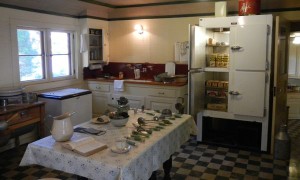
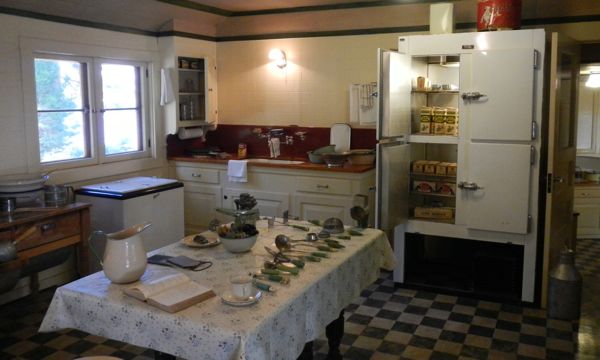
The kitchen at Vikingsholm.

The kitchen at Vikingsholm.

And while it only cost $125,000 to build the structure, the furnishings amounted to much more. The cashmere rug was $40,000. The Steinway piano is from 1929. The unusual thing about it is that it has six legs.

Fifteen servants were employed to cater to the summer guests. The top floor is where people stayed, while the bottom floor was for entertaining, including eating.

Today, visitors are able to see most of the rooms on the two main floors, but are not allowed to the third level where Mrs. Knight would sleep. All she had to do was turn her head to see Emerald Bay.

——-

Notes:
• Reservations for the ADA escort must be made 24 hours in advance by calling 530.525.9529.
• A disability placard is required.
• Dates are limited for when the service is provided. It is offered seasonally when the castle is open.
• Parking is $10; the tour is an additional $10 per adult.


‘Last Weekend’ could have been much better

By David Rooney, Hollywood Reporter

Imagine that Cate Blanchett’s “Blue Jasmine” character had been evicted from her bubble of complacent privilege not by calamity and public humiliation but by the veil of melancholy that descends with fraying family bonds and the encroaching awareness that the sun is setting on life’s most joyous moments. That more or less describes the character played with dry humor and complexity by Patricia Clarkson in “Last Weekend”.

Restrained and elegant to a fault, this first feature from co-directors Tom Dolby and Tom Williams is too muted in its catharsis and too overcrowded with superfluous characters to be fully satisfying, but the delicate central performance keeps it watchable.

Dolby’s screenplay wears its influences quite transparently, from Woody Allen through Chekhov. And with its fetishistic attention to sumptuous living — gastronomical pleasures, floral table arrangements, a dream house out of Architectural Digest, bursting with collectibles — “Last Weekend” could almost be the indie equivalent of Nancy Meyers lifestyle porn.

Clarkson plays Celia Green, the well-heeled wife of San Francisco fitness magnate Malcolm (Chris Mulkey). Looking to recapture her family’s carefree past, she painstakingly curates an idyllic Labor Day weekend for her adult sons, Theo (Zachary Booth) and Roger (Joseph Cross), to remember the gorgeous Lake Tahoe house where they grew up spending their summers. Rather than actually engage with their lives or give serious attention to their partners, however, Celia is more worried about finding the perfect sunflowers for the dinner table or whether she’s bought enough salmon. It’s a credit to Clarkson’s nuanced exploration of character that she can make this vaguely daffy, head-in-the-clouds aesthete sympathetic.

Read the whole story


Study: News on social media suffers a ‘spiral of silence’

By Chris Ip, Columbia Journalism Review

If social media users think their followers don’t share their opinion on the news, they are less likely to post those views on Facebook and Twitter, according to a new Pew Research Center report, released today. It showed Facebook and Twitter users posted less about Edward Snowden and his revelations of government surveillance if they felt their networks would disagree with their viewpoints, and were nearly twice as likely to share on Facebook if they felt their network agreed with them.

The authors connect these findings to the ‘spiral of silence,’ a phenomenon where people who think they hold a minority opinion don’t speak up for fear of social exclusion. “One of the possible theories [for this study] is that when people see diversity in opinion, they don’t want to challenge other people, or upset them, or risk losing a friendship,” said Keith Hampton of Rutgers University, one of the study’s authors, in a telephone interview. For the authors, the study implies that the long-documented suppression of minority opinion exists online just as in real life.

As every social media user becomes an amateur publisher, the Pew study also shows the consequence of depending on individuals to disseminate the news. Indeed, it shows 58 percent of their sample of 1,801 American adults got information about Snowden from TV or the radio while only 15 percent received it from Facebook and 3 percent from Twitter.

Further, the study found that while 86 percent of respondents wanted to discuss the Snowden story in real life, only 42 percent would post about it on social media. Here, the authors speculate that social networks increase awareness of different points of view, making users more hesitant to express their own.

Read the whole story


Pediatricians prescribe later school start

By Fred Barbash, Washington Post

Starting the school day before 8:30 in the morning is bad for kids. It’s bad for their physical health, their mental health and their academic performance.

So says the American Academy of Pediatrics, which issued a formal policy statement Monday recommending that middle and high schools do away with those 7:30 or 8am school bells and begin no later than 8:30.

“Chronic sleep loss in children and adolescents is one of the most common – and easily fixable – public health issues in the U.S. today,” said pediatrician Judith Owens, lead author of the policy statement. She added, “The research is clear that adolescents who get enough sleep have a reduced risk of being overweight or suffering depression, are less likely to be involved in automobile accidents, and have better grades, higher standardized test scores and an overall better quality of life. Studies have shown that delaying early school start times is one key factor that can help adolescents get the sleep they need to grow and learn.”

Read the whole story