CTC’s go-to guy saying goodbye after 25 years

Ray Lacey is retiring from the California Tahoe Conservancy after 25 years. Photos/Kathryn Reed

Ray Lacey is retiring from the California Tahoe Conservancy after 25 years. Photos/Kathryn Reed

By Kathryn Reed

Ray Lacey knew what job he wanted to have before it even existed. Now, after 25 years with the California Tahoe Conservancy, the deputy director is calling it quits.

Lacey earned an undergraduate and graduate degree from UC Berkeley and then a graduate degree in watershed planning from UC Davis. While at Davis he described the job he wanted to his advisor. That person informed him it didn’t exist. Five years later it did with the Conservancy.

The 58-year-old attended his last board meeting on Thursday – at least as a full-time employee. The South Shore resident isn’t going anywhere, so the board has said he will be tapped as a resource to train his successor and to work on projects. But officially his status as a regular employee ends latter this month.

“I think of myself as a community planner from an environment perspective. I tried to take the social and human interest as well and not just the ecological perspective,” Lacey told Lake Tahoe News. “This is not a preserve or reserve. This is a living, breathing community.”

Now he’ll be spending more time with family – his mom is 104, and traveling.

“I always thought of him as being the ideal employee. He has never not done what he was supposed to do. He never makes a mistake, always does what he says he’s going to, and is always on time. He’s the perfect person,” Larry Sevinson, chair of the CTC board, told Lake Tahoe News. “He has also been a friend to everybody. No matter what I throw at him he gets it resolved.”

Lacey’s fingerprints are on most of the Conservancy’s projects in the basin. But he describes what he does as putting the icing on the cake; that it was others who are not always recognized and the land acquisition folks who deserve credit for providing him a canvas to transform.

“His legacy is working with Tahoe City Public Utility District on Commons Beach and Lakeview Commons on the South Shore. They have become community gathering places largely because of his work,” Patrick Wright, CTC executive director, told Lake Tahoe News.

Community has been Lacey’s focus from Day 1 and continues to be. (The Conservancy was formed in 1984 and Lacey joined it in 1989.) His approach to projects has been to strive for the greater good – especially knowing it is taxpayer dollars that is paying for whatever improvements are being made.

He said listening to constituents is key to getting community projects in the ground.

Lacey reflected back on how in the 1980s Kings Beach was trying to figure out what to do with lakefront property. A common goal is to put things by the water that could not be put elsewhere. So when people wanted a basketball court the Conservancy’s thinking was this could go elsewhere. But meeting after meeting young people voiced the desire for the basketball court. That court got built. A few years latter he went by it and some young men were playing. It was in good shape. No graffiti or vandalism. They told him they were going to take care of it and did; and they thanked him for making their dream become a reality.

“That’s the power of listening to your constituency,” Lacey said.

Listening is one of the traits Lacey is known for – as well as having a vision.
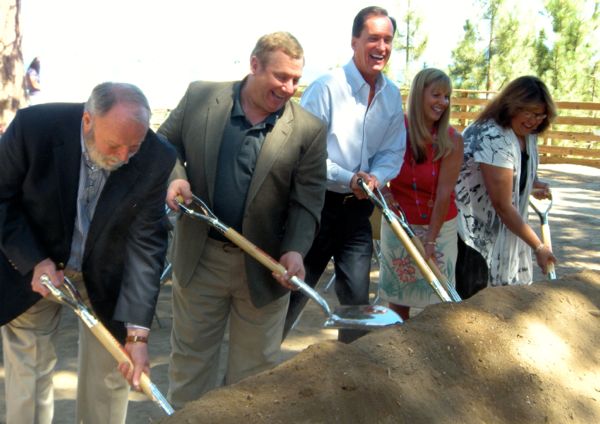
Ray Lacey, center, at the groundbreaking of Lakeview Commons with Jerry Birdwell, from right, Bruce Grego, Kathay Lovell and Norma Santiago.

Ray Lacey, center, at the groundbreaking of Lakeview Commons with Jerry Birdwell, from left, Bruce Grego, Kathay Lovell and Norma Santiago.

“He is insightful and very diplomatic. He has Conservancy in his blood and always will,” Bruce Eisner, longtime Conservancy employee, told Lake Tahoe News. “He’s always been someone people can talk to within the agency. He listens to what you have to say. People will miss that.”

He also joked how Lacey has always been better dressed than everyone else.

“Ray always set a dress standard the rest of us could only dream about … double and triple starched shirts. I’m sure John’s Cleansers will miss him as much as us,” Eisner said with a laugh.

At the Sept. 18 board meeting others also commented on the dapper Lacey.

Another thing he is known for is taking fabulous vacations. He’ll be doing that again as soon as he becomes a retiree. He’s headed for Spain.

“I admire his work ethic and diplomacy. But I also admire his long vacations. When he got away, he got away,” Cindy Gustafson said.

Gustafson, who is executive director of the Tahoe City Public Utility District, has worked with Lacey since the late 1980s when she was a planner with Placer County. She credits him for helping to bring $16 million in CTC funds to the TCPUD and another nearly $5 million in other state funding. Bike trails, river access, Commons Beach, and the 64-acres are the bigger projects on the North Shore that Lacey had a part in.

Lacey has a knack for getting people to envision an idea for a parcel they would have never imagined. Such was the case when he took then CTC members Kathay Lovell and Norma Santiago to see what he and Gustafson had created with Commons Beach in Tahoe City. They were convinced something similar could be done with El Dorado Beach.

“That epitomizes that you can do projects for enormous good, but are all about community,” Lacey said.

That’s not to say it was always easy to get things accomplished, especially in such a heavily regulated area like the Lake Tahoe Basin.
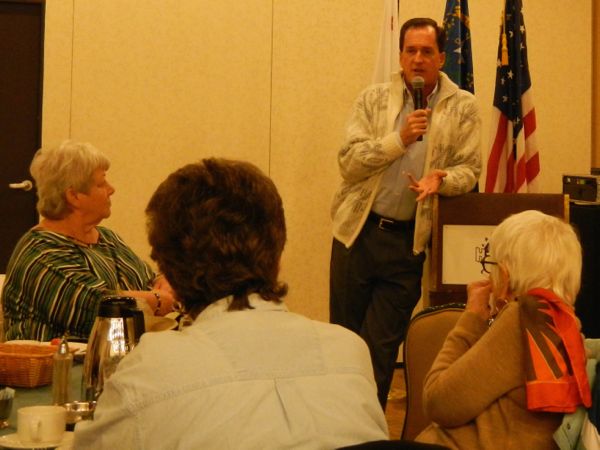
Ray Lacey speaking to a community group about Conservancy issues.

Ray Lacey speaking to a community group about Conservancy issues.

“He always managed to see the positive side. It was evident this was not a job for him. He truly loves Lake Tahoe and he wanted to do everything possible to enhance the ability for people to recreate in Lake Tahoe on the California side,” said Lovell, who spent six of her eight years as a South Lake Tahoe City Council member on the CTC board.

Gustafson said Lacey has an ability to listen to everyone’s concerns, be diplomatic, always be professional, problem-solve and build consensus, which made him stand out above others.

“He was always able to work through issues with folks and gain their respect, maybe not agreement,” Gustafson told Lake Tahoe News. “I never saw anyone walk away and be hurt by Ray.”

Through the years Lacey has had other job offers. But Tahoe has been in his blood since he was a young man, spending as much time during high school and college as he could at the lake. His college work also centered on Lake Tahoe. But more important to him is that sense of community. He doesn’t believe it’s possible to effect change without understanding the fabric of a community. That’s why community comes before environmental planning for him.

“You need to know how the community works, to have the pulse of it, and know what makes people feel connected to their environment,” Lacey said.

Former Harrah’s president dies

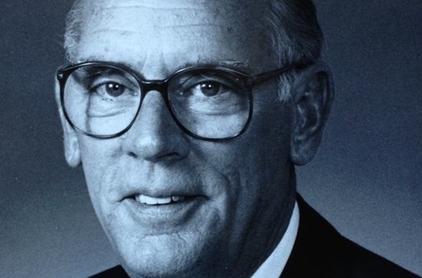
Lloyd T. Dyer

Lloyd T. Dyer

By Guy Clifton, Reno Gazette-Journal

Lloyd T. Dyer, and former president and CEO of Harrah’s and a longtime Reno civic leader, died Sunday night.

He was 87 and died after a brief battle with cancer, his son, Greg, said Monday.

Lloyd Dyer went to work for Harrah’s in 1957, starting in the cashier’s office and working his way up through the company. In 1971, while serving as vice president of finance, he was instrumental in making Harrah’s the first pure gaming company to be publicly traded, first on the Pacific Stock Exchange and then the New York Stock Exchange.

Read the whole story


Businesses compete for next generation’s spending

By Ashley Oñoz-Wright, Las Vegas Sun

The largest consumer group in history is entering the marketplace. Their wallets bulge with $1.68 trillion in buying power, and by 2020, they are expected to make up one-third of the adult population.

They’re the millennials, the generation generally defined as being born between the early 1980s and early 2000s.

Unlike Baby Boomers, who marketers typically target with print ads, billboards and television commercials, millennials get their messaging through social media. Facebook, Twitter and Instagram influence them to try a restaurant, visit a music venue or check out a nightclub. Recommendations can come from friends or total strangers.

Reaching a millennial audience demands new marketing sensibilities and approaches. Local public relations professionals have had to learn how to use social media as a promotional tool. It’s not as easy as it might sound.

Read the whole story


Millennials are saying no to credit cards

By Blake Ellis, CNN Money

NEW YORK — Debt-fearing millennials are saying no to credit cards.

More than six out of 10 millennials, or 63 percent, don’t have a single credit card, according to a Bankrate survey of 1,161 respondents. That compares to a mere 35 percent of Americans who are over the age of 30.

A tanking economy and mounting student loan debt have scared many millennials away from opening credit cards, says Jeanine Skowronski, an analyst at Bankrate.com. The CARD Act of 2009, legislation introduced to protect consumers from high interest and fees, also made it more difficult for younger Americans to get credit cards.

Instead, Millennials are turning to debit cards — especially prepaid debit cards, which are reloadable and often linked to bank accounts.

This credit card exodus is part of an ongoing trend. Last year, a report from credit scoring firm FICO found that the number of young Americans without credit cards had doubled between 2007 and 2012.

Read the whole stoy


Squaw to channel Bavaria for Oktoberfest

Fresh-baked pretzels from the Truckee Sourdough Company and a disc jockey are two additions to North Lake Tahoe’s largest Oktoberfest celebration in the Village at Squaw Valley.

The annual event will transform Squaw’s village into a miniature Bavaria on Sept. 27.

Squaw Valley’s event is modeled after the original Oktoberfest, a 16-day annual festival in Munich. Guests can enjoy traditional German entertainment including performances by Joe Smiell and his 20-piece Bavarian band with the Almenrauch Schuhplattler Bavarian Folk Dancers on the main stage. Additional music and dancing will take place on the First Street stage with the Alpentanzer Schuhplattler Austrian Dance Troop accompanied by the Alpentanz Kapelle band.

There will be a wide selection of authentic German brews. The first beer, sold in a commemorative festival mug, is $10. Additional beers will be available for $5, with all proceeds from beer sales benefiting the High Sierra Lacrosse Foundation.

In addition to the live music and beer tasting, event attendees can compete for prizes in the Oktoberfest Games, which include stein holding competition, keg-rolling race and the bratwurst toss.


Tahoe Tails — Adoptable Pets in South Lake Tahoe

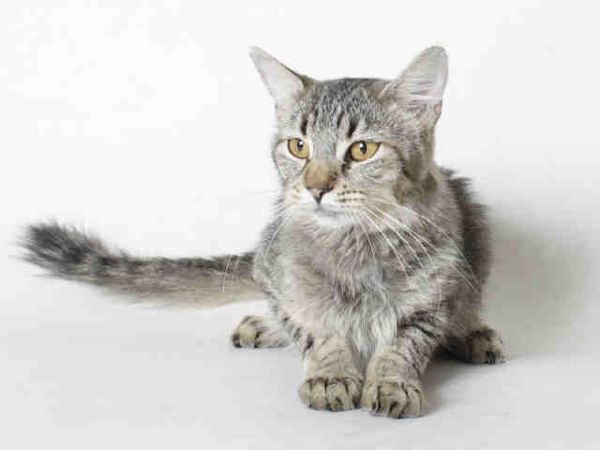
Cozy

Cozy

Cozy is 2 years old. She was left behind when her owners moved.

She loves to cuddle and get cozy on laps.

Her adoption fee and fees for all other adult cats at the shelter right now have been partially paid by a kind sponsor. She is at the El Dorado County Animal Services shelter in Meyers, along with many other dogs and cats who are waiting for their new homes.

Go to the Tahoe animal shelter’s Facebook page to see photos and descriptions of all pets at the shelter.

Call 530.573.7925 for directions, hours, and other information on adopting a pet.

For spay-neuter assistance for South Tahoe residents, go online.

– Susan B.


Sleep impacts worker reliability

By Tara Parker-Pope, New York Times

The most reliable workers are those who get seven to eight hours of sleep each night, a new study shows.

Researchers from Finland analyzed the sleep habits and missed work days among 3,760 men and women over about seven years. The workers ranged in age from 30 to 64 at the start of the study.

Read the whole story


Study: Younger generation doing plenty of reading

By Kathryn Zickuhr and Lee Rainie, Pew Research

Younger Americans — those ages 16-29 — especially fascinate researchers and organizations because of their advanced technology habits, their racial and ethnic diversity, their looser relationships to institutions such as political parties and organized religion, and the ways in which their social attitudes differ from their elders.

This report pulls together several years of research into the role of libraries in the lives of Americans and their communities with a special focus on Millennials, a key stakeholder group affecting the future of communities, libraries, book publishers and media makers of all kinds, as well as the tone of the broader culture.

Following are some of the noteworthy insights from this research.

There are actually three different “generations” of younger Americans with distinct book reading habits, library usage patterns, and attitudes about libraries. One “generation” is comprised of high schoolers (ages 16-17); another is college-aged (18-24), though many do not attend college; and a third generation is 25-29.

Millennials’ lives are full of technology, but they are more likely than their elders to say that important information is not available on the Internet. Some 98 percent of those under 30 use the Internet, and 90 percent of those Internet users say they use social networking sites. Over three-quarters (77 percent) of younger Americans have a smartphone, and many also have a tablet (38 percent) or e-reader (24 percent). Despite their embrace of technology, 62 percent of Americans under age 30 agree there is “a lot of useful, important information that is not available on the Internet,” compared with 53 percent of older Americans who believe that. At the same time, 79 percent of Millennials believe that people without Internet access are at a real disadvantage.

Read the whole story


Liking work correlates to how one performs

By Paul A. O’Keefe, New York Times

We have all had to work on tasks we detest: Calculus homework, for example, is boring and hard. As soon as we start, we feel mentally exhausted, and the quality of our work suffers.

Now imagine you are an aspiring architect. Learning how calculus can help you design more creative and ambitious structures could be fascinating. Instead of feeling exhausted by your homework, you might feel energized and could work on it all night. The same work, but with a very different psychological effect.

Mihaly Csikszentmihalyi, a psychologist at the Claremont Graduate University, has been studying this latter phenomenon for decades. He calls it flow: the experience we have when we’re “in the zone.” During a flow state, people are fully absorbed and highly focused; they lose themselves in the activity.

In our research, we asked a group of undergraduates to work on word puzzles. Before they began, we had them tell us how exciting and enjoyable they thought the task would be. Then they read a statement that framed the task as either personally valuable or of neutral value.

Those who read the first statement, and who also thought the task would be enjoyable, solved the most problems. Moreover, their work didn’t flag, meaning they did not perform best simply because their interest made them want to work on it longer, thereby causing them to solve more problems. Instead, their engagement was more efficient. In other words, they were “in the zone.”

Read the whole story


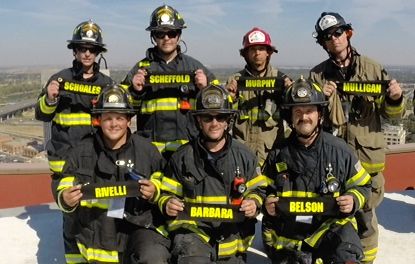
Tahoe firefighters make 9/11 memorial climb

Those who made the climb on Sept. 11, 2014: Top Row from left: Michael Taormina, FF SLTFD Daniel Vallejo, FF SLTFD Chuck Malone, Captain LVFPD Michael Anderson, FF LVFPD Bottom Row from left: Michael Mileski, FF SLTFD Brennen Davis, FF SLTFD Scott Blasser, FF SLTFD. Photo/Provided

Those who made the climb on Sept. 11, 2014, top row from left, Michael Taormina (firefighter SLTFD), Daniel Vallejo, (firefighter SLTFD), Chuck Malone (captain LVFPD), Michael Anderson (firefighter LVFPD); bottom row from left, Michael Mileski (firefighter SLTFD), Brennen Davis (firefighter SLTFD) and Scott Blasser (firefighter SLTFD). Photo/Provided

By Scott Blasser

On Sept. 11, 2001, our country was attacked. It forever changed our nation in countless ways. In 2009, four firefighters from the Sac Metro Fire Department established a 9/11 Memorial Climb to honor the 343 firefighters that gave their lives on 9/11. The climb is symbolic in nature: 343 died that day, 343 climb to remember.

I am a firefighter for the city of South Lake Tahoe. This year six of my fellow basin firefighters and myself had the honor to make this climb. We donned our turnouts and ascended the staircases of the Renaissance Tower in Sacramento four times to equal 110 floors (the journey
to the top of the once standing Twin Towers). The climb was hot and stifling. Some stopped for breaks to avoid passing out. Some of us poured water on our heads to avoid heat exhaustion.

Our final ascent placed us at the top of the building where we placed the name of the firefighter we carried in a memorial sculpture. We hung their names and stood for a moment contemplating  the sacrifice given. The memorial said simply: Never Forget.

On 9/11, 343 firefighters climbed toward one common goal of putting the fire out. The country watched in horror at the events. What I hope the country learned that day is there is no emergency the fire service will yield to.

I have the honor of working with some of the most generous, loyal and funny individuals I know. We love to serve the public. The best part of any shift has and always will be a community member approaching us and striking up conversation. We take complaints and praises alike.
More than anything, we want the public to know we are here for any reason to help. If we don’t have the answer, we will find it.

I believe the public appreciates what we do. We report to duty, train, maintain equipment, run calls and into the evening we wait. It appears simple. In many ways it is. In so many more ways it is not.

We see life and death up close. We see people lose all their possessions. Even worse we see them lose their loved ones. I believe this experience makes us unique. We see a side to life most are unfamiliar with. You might think this makes us callus, but it is very much an opposite effect. A shift that is physically and emotionally challenging sends us home thankful. Thankful we have the privilege to serve. Thankful we are alive. Thankful we could help.

Thirteen years ago tones went off in every fire station throughout New York — 343 firefighters answered that call. They gave their lives going into those towers. They went in with a simple goal: put the fire out.

The city of South Lake Tahoe Fire Department as well as Lake Valley Fire Protection District answers those same tones daily along with every other fire department across our nation. No matter the need we will be there. Further our brothers and sisters in law enforcement give just
as much. We thank the public for their trust.

To close, I would ask the following:

• Never forget the sacrifice given that day.
• Never forget we are here to serve this community 24-7-365.

It is our honor to serve the city of South Lake Tahoe. Know that when the tones go off we will be there to put the fire out.

Scott Blasser is a South Lake Tahoe firefighter.