Typewriters make a comeback

By Siobhan Lyons, Washington Post

In writing, music, photography and other areas, “outdated” technologies have initially been valued for their retro, nostalgic appeal in the hipster culture. Vinyl is one of the most notable technologies to have achieved a noticeable revival, not only for its retro value but also for its superior sound quality.

Now people are seeing the security benefits of returning to other so-called anachronistic technologies. Typewriters, for instance, are experiencing a revival in politics. Earlier this year, German politician Patrick Sensburg announced that Germany’s government officials might start using typewriters, as they are seen as being an “unhackable” technology.

While this move might be viewed as somewhat regressive, it’s actually progressive.

Read the whole story


Ensure Christmas trees don’t become a hazard

Here are Christmas tree fire safety tips.

Select a fresh tree with good color and firm, flexible needles that do not easily pull from the branches.

Place the tree in plain water immediately after recutting the trunk at least one-half inch above the old cut. The container you use for your tree should hold 2 to 4 quarts of water. The longer you wait to place your tree in water, the greater the chances are that it will lose the required moisture content to keep it fresh through the holiday season.

Never place your tree on a wooden stand.

Locate the tree away from sources of heat. Avoid placing the tree near heaters, wood stoves, fireplaces, large appliances, such as TVs, and direct sunlight.

Be careful not to block a door or other exit with the tree or rearranged furniture.

Use mini-lights on your tree and never place candles on or near your tree. Remove your Christmas tree as soon as possible after the holiday.

Never burn your Christmas tree or wrapping paper in the fireplace. The rapid burning and excessive heat can damage the firebox and chimney creating a serious fire hazard.

— Sallie Ross-Filgo, South Lake Tahoe Fire Department


Tahoe Tails — Adoptable Pets in South Lake Tahoe

Pilot

Pilot

Pilot is a 2-year old Yorkie-mini Schnauzer mix who is happy and friendly, social and cuddly.

He was brought to the shelter last week with several other small dogs from an overcrowded Central Valley shelter by Umbrella of Hope, a wonderful partner of the Meyers shelter. Pilot is a sweet little guy who loves to be held.

Pilot is neutered, microchipped, tested for heartworm, and vaccinated. He is at the El Dorado County Animal Services shelter in Meyers, along with many other dogs and cats who are waiting for their new homes. Go to the Tahoe animal shelter’s Facebook page to see photos and descriptions of all pets at the shelter.

Call 530.573.7925 for directions, hours, and other information on adopting a pet.

For spay-neuter assistance for South Tahoe residents, go online.

— Karen Kuentz


Tahoe Choir losing director, gaining singer

Linda Mitchell is stepping down as director of the Tahoe Choir after the Dec. 7 concert. Photo/Provided

Linda Mitchell is stepping down after 21 years as director of the Tahoe Choir. Photo/Provided

By Kathryn Reed

A voice that has been missing from the Tahoe Choir for the last 21 years will soon be returning. But it also means the choir will have a new director after Sunday’s concert.

This is the last season Linda Mitchell will be the choir’s director.

“The reason I’m leaving now is I feel like it is time. I feel like you need blood, new ideas, new music, new thoughts. So, I said I’m going to be stepping down,” Mitchell told Lake Tahoe News. “I’m really looking forward to being able to sing in the choir.”

It was in 1971 that Linda Madden Hughes started the choir. It’s a community choir – made up of about 50 men and women of all ages who like to sing. Most are from the South Shore, with some members from the Carson Valley and North Shore. They put on two performances a year – one in December, one in May.

The ability to sing, and the time to rehearse and perform are the requirements to join.

The community choir is tied to Lake Tahoe Community College’s choir. The two come together for the concerts. It’s possible to get college credit while singing. Those taking the fall class are part of this month’s concert, and those in the winter-spring classes perform in May.

Mitchell, 71, has been the instructor at LTCC as well; another job she is giving up at the end of this calendar year.

“Linda is not only a beautiful singer, but an inspiration to all of us as an excellent teacher – one who imparts to the Tahoe Choir a love of music and a desire to make beautiful sound. Her passion for music is obvious to all of us and she has taught us all so much,” Julie Frame, Tahoe Choir board member, told Lake Tahoe News.

A board runs the choir, but mostly it is the director who does the work.

“I come up with the idea for the program and I then run it by the board,” Mitchell said. “Sometimes people might look at me and say, ‘Are you sure?’ One board member looked at me when I wanted to do Disney cartoon music. Then I explained Disney movies. She understood then. That was one of our most popular ones.”

The Dec. 7 – as is tradition with all the December concerts – is more focused on Christmas music. There will be the sing-along type songs, as well as more serious pieces. Mitchell picked “Lord Nelson Mass” by Joseph Haydn because it was written for four-part harmony.

“A choir is made up of different voice parts – soprano, alto, tenor and bass – so you have melody and harmony,” Mitchell explained. “Some pieces can be just the song, but it might not lend itself being written out for four different parts.”

She found that to be true when the choir did music of the 1960’s. It was hard to come up with music to harmonize. Other than the Beatles, the choices were limited.

Mitchell tries to find music that lends itself to solos, duets and ensembles.

“I’ve grown into a singer and a better person under Linda’s direction. She’s a lion tamer and a fabulous teacher in front of the choir,” Catherine Schoen, Tahoe Choir board member, told Lake Tahoe News.

While the singers are performing for free, there is a cost associated with putting on the performances. All of the rights to the music must be bought. This covers copyright issues. Through the years it has gotten more expensive.

“We have saved enough money to buy music risers to perform on. They were several thousand dollars,” Mitchell said.

The choir also pays the accompanist. The Tahoe Choir gives Mitchell a small stipend, while the college pays her to teach.

While the choir has a vast music library, something new is always desirous.

Mitchell said last spring’s concert featuring music from Cole Porter and George Gershwin was one of the best-attended performances because people were so familiar with the songs.

“I tend to love whatever I’m working on at the particular moment because I’ve invested so much into it,” Mitchell said.

——

Notes:

• Tahoe Choir and Lake Tahoe Community College Chorus’ winter concert is Dec. 7 at 3pm at St. Theresa Catholic Church, 1041 Lyons Ave., South Lake Tahoe.

• Cost: $10 for adults, $8 for students and seniors, and free for children under 5.

• For more info, call 530.541.2635.

• A replacement for Mitchell has not been named.


‘Addicted To Life’ film coming to Squaw

The U.S. film premiere of “Addicted To Life” is Dec. 26 on the North Shore.

The movie will take people on a trip around the world to exotic locations while watching the best of the best wing suit base jumpers, skiers, surfers, BMX athletes, skateboarders, kayakers, and kite boarders on a quest to fulfill their “Addiction To Life.”

Chamonix based filmmaker Thierry Donard will participate in a Q&A after the show.

Tickets are $15 online. Food and beverages will be available for purchase.

The Squaw Valley Institute is putting on the Dec. 26 film at 5:30pm and 8pm at the Olympic Village Lodge.


10 ways to keep holiday hackers at bay

By Gary S. Miliefsky

We’ve all lost our identity at least three times, with more than 930 million records breached, lost or stolen to hackers and cyber criminals, says consumer advocacy non-profit Privacy Rights Clearinghouse.

Why don’t we do all we can to stay safer online?

According to StaySafeOnline.org, more than a quarter of Americans say they lack the information necessary.

So, here it is – everything you need to know to enjoy the Christmas shopping experience without losing your privacy and identity or putting your children’s safety at risk:

• Assume you’ve already been compromised. Whether it’s your baby monitor, your SmartTV, the Webcam on your laptop or apps you installed on your smartphone or tablet, your antivirus is not enough protection. It’s time to take those devices’ and apps’ privacy policies, and the permissions you grant them, much more seriously.

• Change your passwords – all of them. Change your passwords — all of them. Now. And do it as frequently as you can tolerate. Also, if you don’t want to change it often, then use any unique characters you can think of, such as a dollar sign or exclamation mark, or replace an “o” with a zero. This goes a long way in preventing attacks against your password.

• Turn off wireless and geolocation services. Protect your smartphones and tablets by turning off WiFi, Bluetooth, NFC and GPS, except when you need them. That way, if you are at a local coffee shop or in a shopping mall, no one can spy on you using nearby (proximity) hacking attacks and they can’t track where you were and where you are going on your GPS.

• Assume most of your apps are creepware. Assume most of your smartphone or tablet apps are creepware – malware that spies on you and your online behavior. Do you really need them? Delete all of the apps you aren’t using too often. Replace apps that ask for too many permissions and take advantage of too many of your privacy settings — like GPS, phone and sms logs, personal identity information – with similar apps that don’t.

• Opt out of sharing your information. Opt out of every advertising network that you can. Visit the National Do Not Call Registry and register your smartphone and home phone numbers at www.donotcall.gov. If you use a Google email account and have an Android phone, even with your GPS off, it’s tracking your every move. (Log in to maps.google.com/locationhistory/b/0 and see for yourself.) Go into your smartphone or tablet settings and turn this feature off. In your Android phone, go to Settings, then Location, select Google Location Reporting and set Location History to off. The same holds true for the Apple iPhone, iPad and iTunes. You need to find the location and privacy settings and turn off access under Settings, then Privacy then Location.

• Your browser is a double agent – keep it clean. It is spying on you for advertisers unless you block and remove cookies and delete the cache frequently. In your web browser settings, delete your history, all cookies and passwords and the cache. You should do this frequently so you don’t leave personal information sitting around on your computer, smartphone or tablet.

• Remove third-party Facebook plugins. Third-party plugins are mini applications designed to eavesdrop on your behavior in Facebook and possibly grab information about your habits within that social network. Some websites you visit will require you to log in using Facebook, and then you have to trust them to connect to your Facebook account. This is very risky. Read their privacy policy and make sure they are a legitimate business before you risk doing this.

• Only shop on the websites of companies you already trust. If you don’t know where the merchant is located, don’t shop online there. If they don’t have a corporate address or are located in another country, it is risky for you and you may never see the goods you think you purchased. Also, if their shopping cart experience is not an HTTPS browser session, then everything you type in, your name, address and credit card information, is going over the internet unencrypted — in plain view.

• Turn off geotagging – your photos are full of information. Twitter and Instagram as well as your iPhone will give away your location. Most people don’t realize Twitter and Instagram both use geotagging for everything you send out. Geotagging stores the latitude and longitude of your tweet or image. Pictures you take on an iPhone usually store geotagging information, as well. The less information you give out about where you are located, the safer you are.

• Don’t use cash or debit cards – use credit cards, wisely. Credit cards allow you to travel with less cash, and if you’re purchasing online, it’s safer to give your credit card than your debit card information. The same holds true when you visit your local retail outlet. The reason? If you experience identity theft, credit card laws allow you to keep all of your credit, with no responsibility during an investigation. With a debit card, your bank can tie up your money in the amount equivalent to the fraudulent transactions for up to 30 days.

Gary S. Miliefsky is CEO of SnoopWall and the inventor of SnoopWall spyware-blocking technology. He is a founding member of the U.S. Department of Homeland Security and serves on the advisory board of MITRE on the CVE Program, and is a founding board member of the National Information Security Group. 


Apple Hill Christmas trees survive drought

By Debbie Arrington, Sacramento Bee

Drought realities haven’t evaporated the holiday spirit on Apple Hill.

“Conifers are pretty drought-tolerant trees,” noted Dee Kobervig of the El Dorado County Christmas Tree Growers. “A lot of trees we grow up here don’t need that much water.”

That list includes Douglas firs, blue spruces, Scotch pines, Nordmann firs and native incense cedars; they’ve lived through the drought with their green needles intact.

“My silver tips and my red firs are doing really well,” Kobervig added. “The incense cedars are native to our area and very, very drought tolerant. This year, they’re beautiful trees.”

Recent rain came just in time to plump up the crop for prospective buyers.

Read the whole story


Sponsors may help kids see ‘Peanutcracker’

Each holiday season, through the Sponsor a Child Program, Sierra Nevada Ballet is able to invite hundreds of at-risk children to attend the school performances “Peanutcracker – The Story in A Nutshell” for free.

For most young students this community-sponsored performance is likely to be their first live theater experience.

The Sierra Nevada Ballet will present “Peanutcracker – The Story in A Nutshell” to schools throughout Northern Nevada on Dec. 5 at the Bob Boldrick Theater in the Carson City Community Center and on Dec. 16 at the Pioneer Center for the Performing Arts. Two performances are available each day at 10am and noon.

Based on Lev Ivanov’s original ballet “The Nutcracker,” “Peanutcracker” is a 45-minute narrated version that is designed to introduce children to the world of ballet.

Individuals or businesses interested in helping to sponsor free tickets for the Carson City or Reno performances for schools should contact Sierra Nevada Ballet’s company coordinator Elizabeth Cuff at 775.997.4252 or  elizabethcuff@yahoo.com.


Tree festival becomes student art project

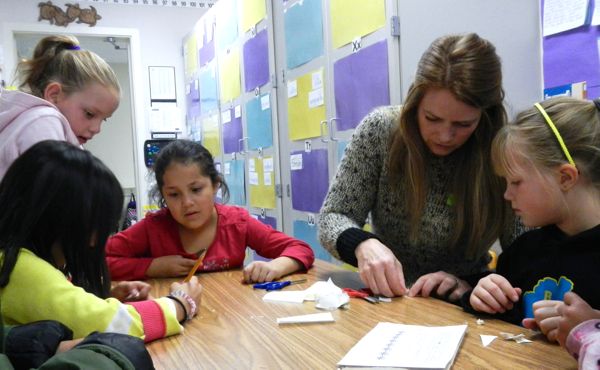
Katie Long shows students how to make snowflakes for Bijou's festival tree. Photos/Kathryn Reed

Katie Long shows students how to make snowflakes for Bijou’s festival tree. Photos/Kathryn Reed

By Kathryn Reed

Students gently take the special paper and fold it in triangles, then they make precise, delicate cuts like a surgeon.

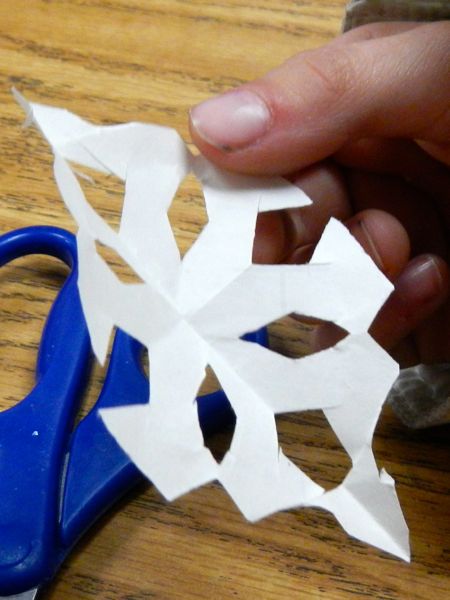
What they create proves no two snowflakes are alike.

“Let it Snow” is the theme of the school trees being created for this year’s Festival of Trees and Lights. Now in its sixth year, the festival is all about creating a winter wonderland.

Trees will fill Harrah’s Lake Tahoe convention center Dec. 3-7. Some are elaborately decorated, others are traditional, some are over the top, others are whimsical. The school trees are generally smaller than the designer trees, but shine through because of the creativity of youngsters.

“What’s fun is you get to fold and start cutting and it makes really cool designs,” Mia Koda told Lake Tahoe News.

She along with other students in Alana Cayabyab’s second-grade class at Bijou Community School is learning from Katie Long how to make the snowflakes. Long is a parent volunteer whose goal was to have about 600 snowflakes for Bijou’s tree. That would be one snowflake per student.

“Because of fire restrictions I ordered this special paper online so if the fire marshal tries to light it, it won’t,” Long told Lake Tahoe News.

Student Mia Koda shows off her snowflake.

Student Mia Koda shows off her snowflake.

The class is broken into groups, with Long working with a handful of students at a time. She explains how folding the paper into different triangles will result in a bigger or smaller snowflake. As the students finish their creations, she strings them together, creating a mini snowstorm effect.

And while it’s fun to decorate the trees, they are judged – so there are at least bragging rights to compete for among the South Shore schools.

Crystal Wolverton was surprised at what her snowflake looked like. What she liked best is how the cutting makes different shapes.

Student Davis Castles is a veteran of the festival, having gone in the past to have his picture taken with Santa and to adopt a teddy bear.

The festival is designed to be an event for all ages to embrace the season without any religious overtones. Each year the festival, which is put on by the Barton Foundation, raises money for a specific cause. This year Barton Health’s Hospice Programs & Services is the beneficiary.

—-

Notes:

• More info about the festival may be found online.

• The event is Dec. 3-7 at Harrah’s Lake Tahoe.


Winterize your home to save money

By Jeff Wuorio, Deseret News

Mention winterizing a house to most homeowners and the knee jerk responses are bound to begin flying: Time consuming, expensive, unnecessary.

Tackling the last comment first, it’s true that energy takes a smaller bite out of most homeowners’ budgets than it used to. According to the U.S. Energy Information Administration, energy now accounts for about 5 percent of disposable income, down from a high of 8 percent in the 1960s.

And a homeowner’s energy bill could be even less.

“Very few houses these days are as energy-efficient as they could be,” says TV home improvement expert Danny Lipford.

Nor does making your home as energy smart as possible mandate blocking out weeks free time or a carte blanche budget. Buttoning up your home for the winter can be relatively quick and inexpensive if you know where to put both your efforts and cash to the best use.

Read the whole story