Dumpster puppies find forever homes

By Colin Lygren, KOLO-TV

INCLINE VILLAGE — A month and a half ago a litter of puppies, all just barely over a day old, were abandoned in a Susanville dumpster. They were cold, hungry, and in need of love. Thursday, those dumpster puppies reached a milestone as they were all adopted into new homes.

“I was very fortunate in finding the perfect homes for them where they are going to have a happy and spoiled life,” said Melissa Shaw, who conducts adoptions at Pet Network Humane Society.

How this journey began is still unthinkable. Back on October 29th, 2014, the puppies were found in dumpster behind a Susanville store. Since then, volunteers at Pet Network Humane Society have been working around the clock, acting as surrogate moms, in hopes of keeping the dogs alive.

Read the whole story


Tahoe Tails — Adoptable Pets in South Lake Tahoe

Arco

Arco

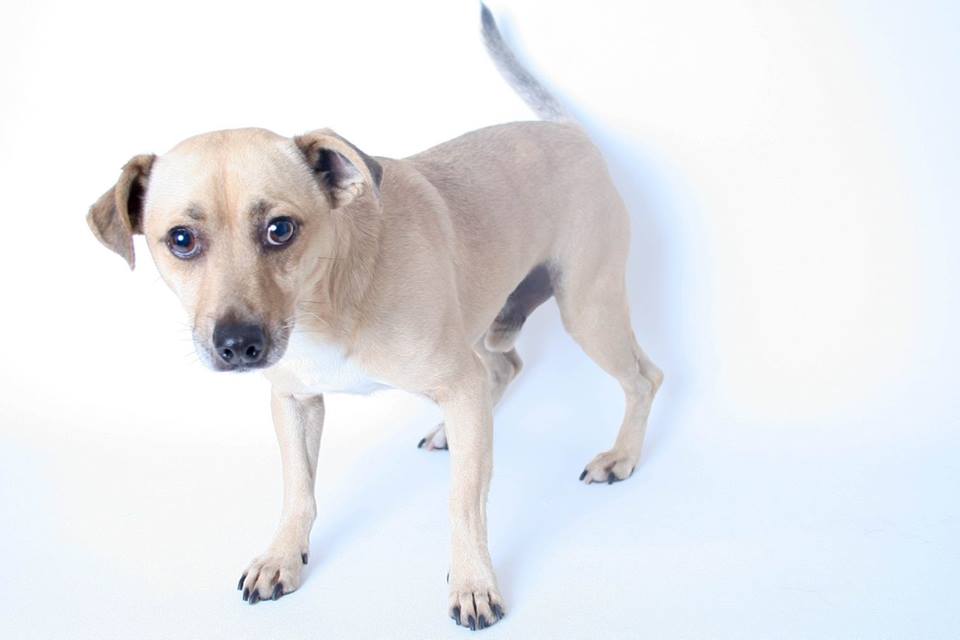
Arco is one of just two dogs at the shelter right now. It would be great to send both of them to new homes for the holidays.

Arco is a nice 4-year-old beagle-Chihuahua mix, maybe 20 pounds, who is one of the many dogs who have come to us from the Central Valley. He is house trained. Though he does OK with other dogs, he would rather be an only pet.

Arco is neutered, microchipped, tested for heart worm, and vaccinated. He is at the El Dorado County Animal Services shelter in Meyers, along with many other dogs and cats who are waiting for their new homes.

Go to the Tahoe animal shelter’s Facebook page to see photos and descriptions of all pets at the shelter.

Call 530.573.7925 for directions, hours, and other information on adopting a pet.

For spay-neuter assistance for South Tahoe residents, go online.

— Karen Kuentz


Artistic talent not a criteria at Paint and Sip

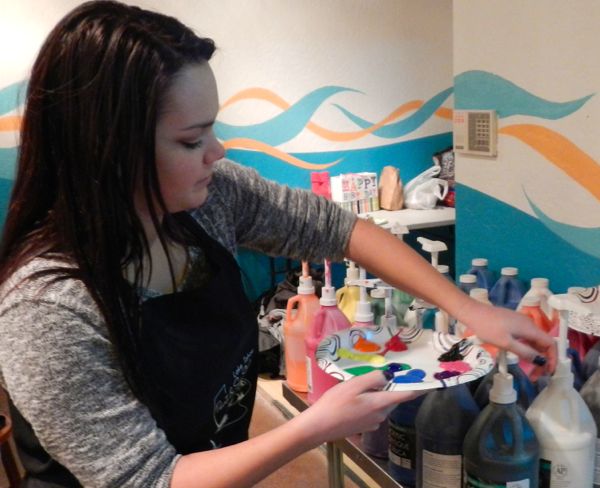
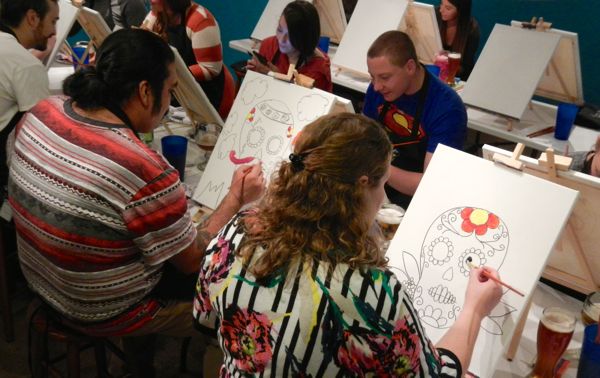
Theodore Scott and Morgan Garrity brought 10 friends together for a birthday celebration Paint and Sip this month. Photos/Kathryn Reed

Theodore Scott and Morgan Garrity brought 10 friends together for a birthday celebration at Paint and Sip this month. Photos/Kathryn Reed

By Kathryn Reed

Painting within the lines is not required. Colors – it’s OK to be bold and original. Having fun – that’s the ultimate goal.

“My favorite part is there is so much creativity,” Shalynn Swails tells Lake Tahoe News.

She gives the same direction to everyone, but no two paintings are alike.

On this particular night a private party has taken over Lake Tahoe Paint and Sip Studio at the Ski Run Marina in South Lake Tahoe.

These types of businesses have been around for several years, but are now becoming the rage. The South Shore entity opened in August.

Matt Kauffmann drawing the straight line for the horizon on the Emerald Bay  painting is the hardest for people.

Matt Kauffmann says drawing the straight line for the horizon on the Emerald Bay painting is the hardest part for people.

“We have visited here many times over the years. Every time we left we said ‘what can we do to live here?’,” Frank Slipher said. “We have a friend who opened a studio in a small town in New York about the size of South Lake Tahoe. We visited, got the fever and thought this is where we are going to try.”

He and his wife, Jill, are making it work. So far it’s a split between locals and tourists picking up a brush, but he foresees this being mostly a locals’ hangout. Slipher said people get addicted to it.

Walking in, blank 16-inch-by-20-inch canvases sit on easels. Multiple paintbrushes and a water glass are to the side. Aprons are on the stools.

With the first glass of beer or wine being included in the price, it helps ease tensions of budding artists.

“Usually after the second glass of wine folks don’t care and it becomes less intimidating,” Slipher said.
Shalynn Swails gets paint ready for people.

Shalynn Swails gets paint ready for people.

This isn’t an art class. It’s not a competition. No one is being graded. And even those who have problems drawing stick figures are encouraged to come paint.

“We say our business is about fun art, not fine art,” Slipher told Lake Tahoe News.

The artists have a finished painting to show the rookies what the end product should look like. Then there is a blank canvas. Step-by-step the artist shows the clients what to do, how different size brushes are important, that if the brush is wet, the paint will run, and how sometimes it’s OK to mix colors.

“We encourage people to come experiment with different colors and techniques – to not paint within the lines, so to speak,” Matt Kauffmann told Lake Tahoe News.

Kauffmann is one of the three artists who works at Paint and Sip.

While scenes of Lake Tahoe are popular, Van Gogh’s Starry Night is another favorite. Sip and Paint has a calendar on its website listing what the upcoming painting will be. For private parties, they may request something in particular or submit their own.

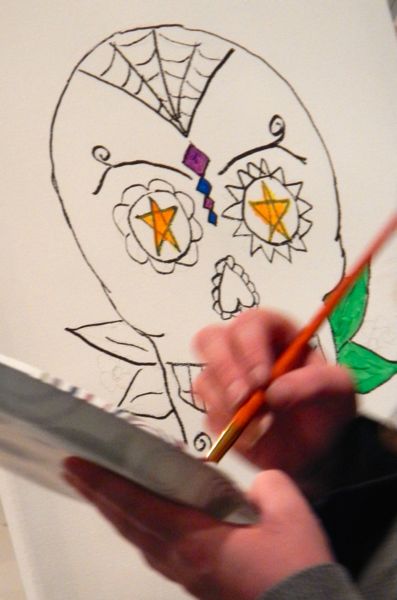
Theodore Scott Jr. wanted a Day of the Dead skull for his 34 birthday last week. He and 11 others from South Lake Tahoe sketched out what they were going to draw and then Swails, one of the artists, led them through ways to paint their creations.

Ashley Ratoni had done some research before arriving Dec. 17. She wanted a rose on top of her skull, so she copied a rendering on her phone to the canvas.

For Lizzy Kirkpatrick she started off by creating a multicolored background before outlining the skull.
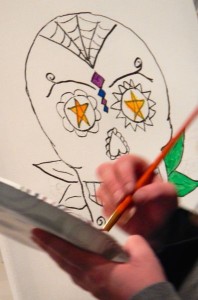
Individuality is encouraged.

Individuality is encouraged.

Scott’s girlfriend, Morgan Garrity, was introduced to Paint and Sip at a fundraiser this fall at Hard Rock Café. Then she and two friends did a session at the studio. She said Scott was a bit jealous of all the fun she was having, so that’s how the birthday bash came about.

“I like getting together with friends and doing something different,” Garrity told Lake Tahoe News of why she is a repeat Paint and Sipper.

Emerald Bay was the subject her first time, an owl the second. Garrity isn’t sure what she is going to do with her artwork, but they may turn into gifts.

A quiet fills the room as the painters work on their creations. Swails gives advice. Some ask for individual help. Others order another round.

It’s an interactive party. Each session lasts between 2 and 2½ hours. It depends on the speed of the participants and difficulty of the painting.

Sip and Paint last month took over an adjoining suite in the center.

“The main reason we expanded to the second studio is we wanted to have the capability to accommodate children,” Slipher said. “We couldn’t do it with the liquor license so we are in the process of building a secluded area just for kids.”

Sessions are at 7pm Tuesday-Saturday, and at 2pm Saturday-Sunday, or by appointment. Drop-ins are OK if space allows. One Monday a month Sip and Paint opens the doors to nonprofits as a fundraiser. The nonprofit sells the tickets and Sip and Paint donates half back to the group.

More info is online.


Pets seldom forgotten at the holidays

By Ellen Byron, Wall Street Journal

Since Neil, a 5½-inch-long tortoise, already donned a Santa hat and an elf cap for past holiday celebrations, this year Cindy Breninger, a legal secretary who lives in West Sacramento, made a 4½-inch-tall Christmas tree for him to wear over his shell on Christmas morning.

Neil — wearing his new tree — is featured in the family Christmas card. His Christmas stocking, stuffed with a new bag of lettuce, will be placed next to stockings for Breninger’s two children and their parakeet.

“Having our pets included at Christmas rounds out our little family,” she says.

During the holidays plenty of people shower their dogs and cats with treats, toys, costumes and even visits with Santa. Now, more families are trying to include other types of pets in their Christmas festivities, including guinea pigs, ferrets, hamsters and rabbits.

About 28 percent of owners of these “small animals” are expected to buy their pet a Christmas present this year, spending an average of $16 per gift, according to the trade group American Pet Products Association. An estimated 50 percent of dog owners will buy their dog a gift, spending an average of $10, and 36 percent of cat owners, spending $7.80 per gift, the group says.

Read the whole story


10 tips to safeguard your information

By Gary S. Miliefsky

We’ve all lost our identity at least three times, with more than 930 million records breached, lost or stolen to hackers and cyber criminals, says consumer advocacy non-profit Privacy Rights Clearinghouse.

Why don’t we do all we can to stay safer online?

According to StaySafeOnline.org, more than a quarter of Americans say they lack the information necessary.

So, here it is – everything you need to know to enjoy the shopping experience without losing your privacy and identity or putting your children’s safety at risk:

• Assume you’ve already been compromised. Whether it’s your baby monitor, your SmartTV, the Webcam on your laptop or apps you installed on your smartphone or tablet, your antivirus is not enough protection. It’s time to take those devices’ and apps’ privacy policies, and the permissions you grant them, much more seriously.

• Change your passwords – all of them. Now. And do it as frequently as you can tolerate. Also, if you don’t want to change it often, then use any unique characters you can think of, such as a dollar sign ($) or exclamation mark (!), or replace an “oh” with a “zero” (0). This goes a long way in preventing attacks against your password.

• Turn off wireless and geolocation services. Protect your smartphones and tablets by turning off WiFi, Bluetooth, NFC and GPS, except when you need them. That way, if you are at a local coffee shop or in a shopping mall, no one can spy on you using nearby (proximity) hacking attacks and they can’t track where you were and where you are going on your GPS.

• Assume most of your apps are creepware. Do you really need them? Delete all of the apps you aren’t using too often. Replace apps that ask for too many permissions and take advantage of too many of your privacy settings — like GPS, phone and sms logs, personal identity information – with similar apps that don’t.

• Opt out of sharing your information. Opt out of every advertising network that you can. Visit the National Do Not Call Registry and register your smartphone and home phone numbers at www.donotcall.gov. If you use a Google email account and have an Android phone, even with your GPS off, it’s tracking your every move. Go into your smartphone or tablet settings and turn this feature off. In your Android phone, go to Settings, then Location, select Google Location Reporting and set Location History to off. The same holds true for the Apple iPhone, iPad and iTunes. You need to find the location and privacy settings and turn off access under Settings, then Privacy then Location.

• Your browser is a double agent – keep it clean. It is spying on you for advertisers unless you block and remove cookies and delete the cache frequently. In your web browser settings, delete your history, all cookies and passwords and the cache. You should do this frequently so you don’t leave personal information sitting around on your computer, smartphone or tablet.

• Remove third-party Facebook plugins. Third-party plugins are mini applications designed to eavesdrop on your behavior in Facebook and possibly grab information about your habits within that social network. Some websites you visit will require you to log in using Facebook, and then you have to trust them to connect to your Facebook account. This is very risky. Read their privacy policy and make sure they are a legitimate business before you risk doing this.

• Only shop on the websites of companies you already trust. If you don’t know where the merchant is located, don’t shop online there. If they don’t have a corporate address or are located in another country, it is risky for you and you may never see the goods you think you purchased. Also, if their shopping cart experience is not an HTTPS browser session, then everything you type in, your name, address and credit card information, is going over the internet unencrypted — in plain view.

• Turn off geotagging – your photos are full of information. Twitter and Instagram as well as your iPhone will give away your location. Most people don’t realize Twitter and Instagram both use geotagging for everything you send out. Geotagging stores the latitude and longitude of your tweet or image. Pictures you take on an iPhone usually store geotagging information, as well. The less information you give out about where you are located, the safer you are.

• Don’t use cash or debit cards – use credit cards, wisely. Credit cards allow you to travel with less cash, and if you’re purchasing online, it’s safer to give your credit card than your debit card information. The same holds true when you visit your local retail outlet. The reason? If you experience identity theft, credit card laws allow you to keep all of your credit, with no responsibility during an investigation. With a debit card, your bank can tie up your money in the amount equivalent to the fraudulent transactions for up to 30 days.

Gary S. Miliefsky is CEO of SnoopWall and the inventor of SnoopWall spyware-blocking technology. 


Retirement essentials to follow in the new year

By Carl Edwards

Wow, what an amazing market ride over the last few years. Running on tracks laid by an unprecedented Federal Reserve monetary easing program, the market has once again run to new all-time highs and appears to still have some steam. Or does it?

While no one really knows the answer to this, it is important to remember history as a guide, and to think about the future — your future. It wasn’t all that long ago that the world’s financial system was shaken to its core, leaving many retirees running for shelter from the Ebola-like symptoms displayed by world financial systems. Fear over which institution or country would next display the almost certain deadly symptoms ran rampant.

I am certainly not echoing the calls of the past and screaming it’s time to get your guns and gold. I am, however, pointing out to consumers the recent and vivid reminders of the importance to get back to the basics with your financial planning this New Year. If we fail to remember the past, we repeat it. You have worked too hard preparing for this time in your life.

Let’s review three vital elements you should implement in your retirement plan this New Year.

• Get your annual financial check-up. How can we possibly forget to do this? Annual check-ups are the No. 1 preventative care tool at our disposal. While many individuals should be meeting more regularly with their financial advisor, everyone should have at least the minimum of an annual visit. Problems creep up and this is often the best way to catch them before it is too late.

• Don’t forget to diversify. Are you working with a broker who always wants to sell you mutual funds full of stocks and bonds? Does your annuity guy think every dime you have should be stuffed into insurance products? The reality is they are probably both wrong. Find an advisor this year who knows the benefits of each of these products, but who also knows the value of how they work together. Diversification is important and it may include each of these products along with other assets such as individual stocks and bonds, certificates of deposit (structured and fixed), business development companies, real estate investment trusts, precious metals, and numerous other investments.

• Rebalance, rebalance, rebalance. With the great equity run up we have encountered since the lows of March 2009, it is vital to remember that we must continue to evaluate our investment portfolios. While equity portfolios have risen significantly since that time, other areas of our portfolio may not have fared so well, leaving our risk levels in need of adjustment. It is often a good idea to capture some of those hard-earned gains. You never know — the next major pullback could be just around the corner. Be prudent, not greedy.

Carl Edwards is a chartered financial consultant and is the owner of C.E. Wealth Group.


Douglas W. Anderson — 1963-2014

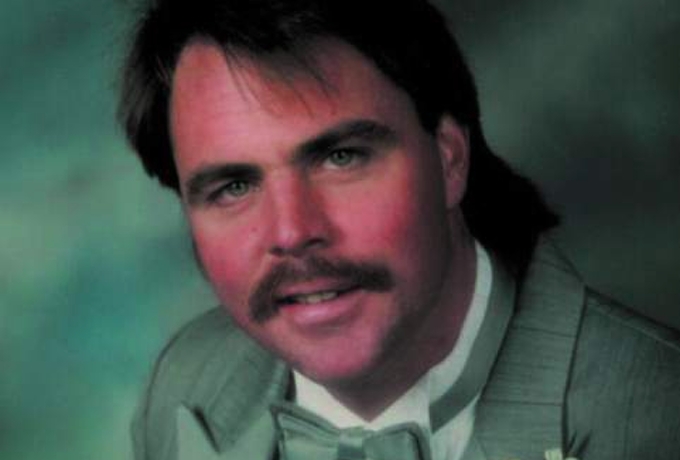
Doug Anderson

Doug Anderson

A memorial service and celebration of life for Douglas W. Anderson will be Dec. 20 at 10am at the First Baptist Church on Wildwood Avenue in South Lake Tahoe.

Doug died on Dec. 13. He was 51.

Doug was born July 16, 1963, to August William Anderson and Bridget Anderson.

Doug’s legacy is his unbelievable commitment to his family owned business — Anderson’s Bicycle Rental. For 36 years “The Man with the Straw Hat” could be seen standing at the lot at the corner of 13th Street and Emerald Bay Road. April through November you could depend on him being there from start to finish every day.

He was amazing at what he did and took great pride in always providing the best possible experience for every group that arrived. Doug can be proud going to heaven knowing that he made so many people happy while visiting Lake Tahoe. Groups come back to see Doug, they all remembered his name and he never forgot a face or name.

Last summer he was seeing third generations of customers who had become friends to him over the all the years.

Doug is loved very much and will be missed by not only his family and dedicated loyal friends and customers that will come to visit next summer, but the locals who also stopped on a daily basis to chat with him.

Doug has left behind his wife, Sue Swanson Anderson, of 20 years; and two children, Bailey Nichole Anderson and Daniel August Anderson. He is also survived by his four sisters, Alice Anderson Palmer and her son Hunter Busenlehner, Betsy Kelly, Kate Anderson and Maureen Walker.

In lieu of flowers, make contributions-donations to the young man who passed recently (Dejon Smith’s family) online.


Debunking the myths about flu

By Lance Orr

Flu season is under way. Misconceptions about the flu prevent people from taking the proper precautions. For example, being out in the cold does not cause the flu.

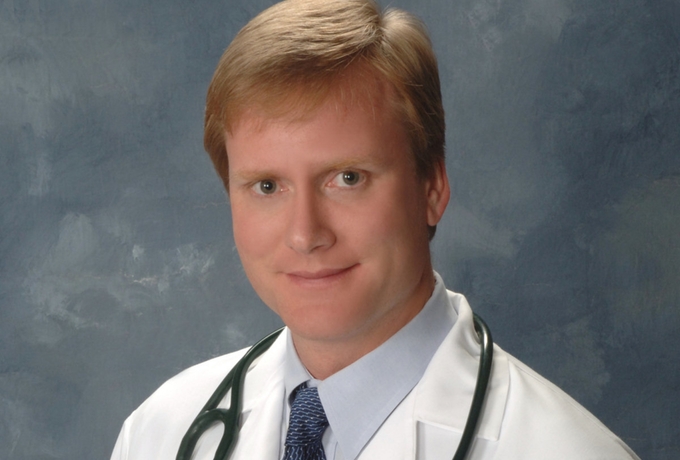
Lance Orr

Lance Orr

Here are a few more flu myths I hear and facts to help you stay healthy this winter.

Flu myths

Myth: If you think you have the flu, go to the doctor to get antibiotics.

Influenza is a virus and antibiotics, designed to kill bacteria, are not effective to treat flu. Some antiviral medicines, such as Tamiflu, could help and you should ask your doctor if it is right for you. The earlier the flu is detected, the more effective antiviral medicines can treat flu symptoms.

Myth: Mercury in the influenza vaccine will make you sick or give your child autism.

Thimerosal is a mercury-based preservative used to prevent contamination of influenza vaccine vials. Extensive research shows an extremely low dose of thimerosal in vaccines and has been found to be safe. If you are still concerned, thimerosal-free vaccines may be available. The nasal vaccine does not have thimerosal.

Myth: You can get the flu from the flu vaccine.

The flu vaccine is made from non-infectious, inactivated virus and cannot transmit the flu. Many mistake the vaccine’s side effects, which can sometimes give mild flu-like symptoms, with the flu.

Myth: Protection from the flu happens immediately after you get the vaccine.

It takes up to two weeks to get the vaccine’s immunity. If you are exposed before or during this wait period, you can still get sick.

Seeking medical care

Doctors are keeping a watchful eye on this year’s common flu strain, H3N2. The Centers for Disease Control and Prevention recommends if you have asthma, lung or heart problems, or diabetes, to see your doctor or go to urgent care at the first sign of the flu, as these conditions may worsen symptoms.

Most flu cases won’t need medical treatment, but in severe cases with the following symptoms, an emergency department visit is recommended.

Any child or adult who is short of breath, has return of fever and bad cough after starting to get well, has confusion or trouble waking up, or has the inability to take and keep down fluids should be seen by a physician.

Children with flu symptoms and a fever with rash, bluish or grayish lips or skin, or extreme irritability should visit the emergency department.

Babies who can’t eat or drink, have no tears when they cry or have a decrease in the number of wet diapers are showing signs of significant dehydration require medical attention.

Shoo the flu

Ask your primary care physician for a flu shot. If you don’t feel well and need to see a doctor, protect others and wear a flu mask, available at the emergency department or at a mask station located throughout the hospital. The flu vaccine, accompanied with frequent and thorough hand washing, are your best protections against the flu.

Lance Orr is the director of staff operations for the Barton Memorial Hospital Emergency Department.


SLTFD to train citizen volunteers

The South Lake Tahoe Fire Department is launching a program called STAT – South Tahoe Action Teams.

This program is designed to incorporate trained citizens in the field with the department and other first responders during times of crisis.

Classes will be taught in the fire stations and run approximately two hours per class. Four STAT training sessions will be conducted throughout the year.

The inaugural class will be begin Jan. 15 and run through Feb. 5. Classes will be every Thursday night from 6-8 in the Fire Department Training Center at 1100 Al Tahoe Blvd.

Curriculum will include eight hours of instruction taught by members of the South Lake Tahoe Fire Department. Applicants will be expected to commit their time and will be called upon in times of natural disaster, large scale emergencies and times of need in the South Lake Tahoe area. Due to staffing and equipment limitations the South Lake Tahoe Fire Department will be reliant on local citizens’ abilities to assist in their neighborhoods with basic first aid and triage.

If interested, contact Capt. Jim Drennan at 530.542.6161 or via email at jdrennan@cityofslt.us

More information is available online.

STAT Program Information and Application


Road beat: Mazda 3 top of its class

Mazda 3 stand out in its class of cars. Photos/Larry Weitzman

The Mazda 3 stands out in its class of cars. Photos/Larry Weitzman

By Larry Weitzman

Mazda has always made edgy, tight cars with class leading performance and handling. And with the all-new Mazda 3, Mazda has now combined those two qualities with class leading design.

While not the most powerful compact car, the 2.5L Mazda 3 now provides the best balance of performance and fuel economy of perhaps any car in current production. I understand that is a huge statement, but you will see it backed up with loads of data.

Mazda 3’s stunning styling is derived directly from a recent show car called the Takeri. From its clean, aggressive front end to its sculptured character lines, Mazda 3 speaks of an exhilarating driving experience once the lucky driver takes his place in the superbly designed driver’s seat. It is a few inches shorter than your average compact at just 176 inches, but its low, wide hood line and well proportioned cabin give the Mazda 3 the impression of having a sleek long powerful front end found on classics from the 1930s. Mazda’s co-efficient of drag is a very low 0.28 for the 5-door hatchback and just 0.26 for the sedan, numbers which contribute to its excellent highway fuel economy.

Specifications  Engine  DOHC, 16 valve inline 2.5L four 184 hp @ 5,700 rpm                                                          185 ft-lb of torque at 3,250 rpm Transmission Six Speed torque converter automatic, with paddle shifters Configuration Transverse mounted front engine/front wheel drive Dimensions Wheelbase 106.3 inches Length 175.6 inches Width 70.7 inches Height 57.3 inches Track (f/r) 61.2/61.4 inches Ground clearance 6.1 inches Weight 3,002 pounds Weight distribution (f/r) 60/40% Fuel capacity 13.2 gallons Cargo capacity (rear seats up/down) 20.2/47.1 cubic feet Steering lock to lock 2.57 turns Turning circle (curb to curb) 34.78 feet Turning circle (wall to wall) 37.07 feet Wheels 18X7 inch alloys Tires 215/45X18 all season radials Co-efficient of drag (sedan/hatchback) 0.26/0.28 Performance  0-60 mph 7.08 seconds 50-70 mph 3.91 seconds 50-70 mph uphill 5.74 seconds Top speed 130 mph electronically limited Fuel economy 28/38/32 mpg city/highway/combined. Expect 33-34 mpg in rural country driving and over 40 mpg on a level highway at legal speeds.

Specifications
Engine
DOHC, 16 valve inline 2.5L four 184 hp @ 5,700 rpm
185 ft-lb of torque at 3,250 rpm
Transmission
Six Speed torque converter automatic, with paddle shifters
Configuration
Transverse mounted front engine/front wheel drive
Dimensions
Wheelbase 106.3 inches
Length 175.6 inches
Width 70.7 inches
Height 57.3 inches
Track (f/r) 61.2/61.4 inches
Ground clearance 6.1 inches
Weight 3,002 pounds
Weight distribution (f/r) 60/40%
Fuel capacity 13.2 gallons
Cargo capacity (rear seats up/down) 20.2/47.1 cubic feet
Steering lock to lock 2.57 turns
Turning circle (curb to curb) 34.78 feet
Turning circle (wall to wall) 37.07 feet
Wheels 18X7 inch alloys
Tires 215/45X18 all season radials
Co-efficient of drag (sedan/hatchback) 0.26/0.28
Performance
0-60 mph 7.08 seconds
50-70 mph 3.91 seconds
50-70 mph uphill 5.74 seconds
Top speed 130 mph electronically limited
Fuel economy 28/38/32 mpg city/highway/combined. Expect 33-34 mpg in rural country driving and over 40 mpg on a level highway at legal speeds.

Matching its slick design and under the hood is a 2.5L DOHC, 16 valve normally aspirated inline four which pumps out 184 hp at a low 5,700 rpm plus 185 pounds of twist at a very low 3,250 rpm. Of course it is warm butter smooth. Its hooked up to a six-speed auto cog swapper (only choice, no manual offered with the 2.5L, but you can get a manual six-speed with the 155 hp 2.0L) that has real paddle shifters that do let you control what’s happening if you so desire. Some other 2.5L fours make maybe 10 more hp, but none of them make 184 hp at a low 5,700 rpm meaning the Mazda gets to its hp quicker than other 2.5L inline fours and that equates to better performance especially in everyday driving.

Where most compacts struggle to get to 60 mph is less than 9 seconds, this Mazda 3 will run 0-60 mph in just 7.08 seconds and it will light ’em up with ease if you stab the go pedal. It down right rocks. Passing times are also extremely quick with a 50-70 mph run taking just 3.91 seconds and a steep grade will only slow that time to 5.74 seconds making this the quickest, normally aspirated compact ever tested by the Road Beat and on average by a good margin and it is quicker than some compacts that are turbocharged.

But high performance need not mean that you can’t have excellent fuel economy. At a steady 70 mph on a level highway this Mazda 3 will return 43.4 mpg. Overall it averaged 33-34 mpg and on a trip from Placerville to South Lake Tahoe (a climb of 5,500 feet) and back it averaged 38.6 mpg and that included at least half a dozen full throttle passes on Highway 50. EPA says that you should expect 28/38/32 city/highway/combined. As with most every other compact car, the fuel tank is a modest 13.2 gallons. It must be an industry standard as Honda, Nissan and Toyota share the same fuel capacity. Hyundai and Ford compacts have even less tankage.

Perhaps helping its phenomenal performance is Mazda’s SKYACTIV-G technology and its i-ELOOP regenerative engine braking system. SKYACTIV-G relates to engine design (combustion technology and design) and direct injection. Mazda, because of its design and direct injection where fuel is injected directly into the cylinder (instead of behind the intake valve at the intake port), has a very high compression ratio of 13:1 on regular fuel which makes the engine more efficient and powerful. I-ELOOP regen braking isn’t a hybrid but reduces engine drag of a conventional alternator with a variable charging alternator by capturing electrical energy from braking in a capacitor which is then used for some of the Mazda’s electrical power needs instead of requiring the alternator to provide power and recharge the battery. You cannot feel it work, but it is there.

According to the EPA, i-ELOOP should give you one more mpg in the Hatchback five-door model. In the sedan EPA numbers are the same that leaves this writer with the question if the expense of the i-ELOOP system is worth the extra cost. If it improves, your fuel economy of 35 mpg by a half mpg and you drive 15,000 miles a year it might save you 6 gallons of gas or about $24. Mazda would not reveal the cost of the system, but you can bet it adds at least $300 to the cost of the car.

Aside from this nitpicking, Mazda also shows itself off with class leading handling. It comes with state of the art MacPherson struts up front and a multilink system in the rear and while other manufacturers may have a similar system, Mazda seems to have done it better. You can say the same thing about the steering with its electric power rack, not only is it tuned to perfection; it is the quickest of just about any car tested by the Road Beat, never mind any compact vehicle. It is just 2.57 turns lock to lock. And with the 3 S model you also get 18×7 inch alloys shod with wide 215/45 rubber.

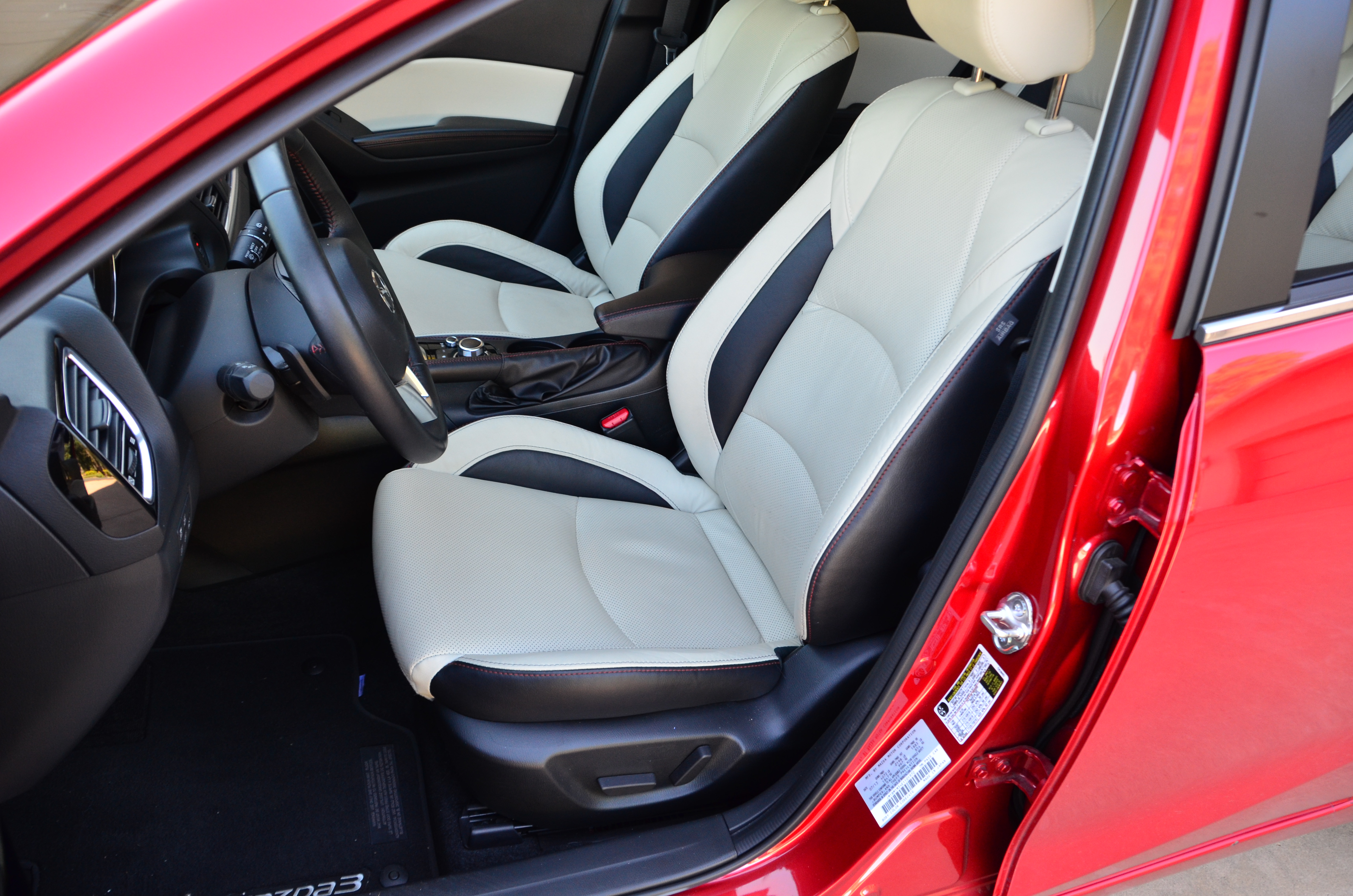
Leather seats add to the comfort.

Leather seats add to the comfort.

With its aforementioned superbly balanced suspension, super quick steering with natural feeling and feedback and extremely wide track of over 61 inches, not many cars change directions with the aplomb of a Mazda 3. In fact, on the track, it might give its MX-5 Miata sibling a good run for the money even with 500 extra pounds (The 3 S weighs 3,002 pounds). No other compact, except for perhaps a VW GTI, a Honda Si or a Focus ST can match the Mazda 3 when the road bends. The Mazda 3 is about as much fun as you can have while seated. If you have a mind like mine, the rear cargo area with the rear seats folded flat has over 47 cubes for Home Depot trips or camping.

Ride quality can best be described as firm supple. It is quiet on all but the coarsest roads when some road noise will intrude into the cabin. There is no wind noise. The engine spins a low 2,000 rpm at 70 mph. It is a terrific road car with superb ride control.

Braking with four-wheel discs, front ventilated, with about every acronym is excellent arresting forward progress from 40 mph in a benchmark 40 feet. It has blind spot monitoring and rear cross traffic alert plus stability and traction control and a host of other safety features and the usual inventory of airbags. Standard headlights were adaptive HID with a bright wide spread and sharp cut off but they could have used a bit more distance when on low beam.

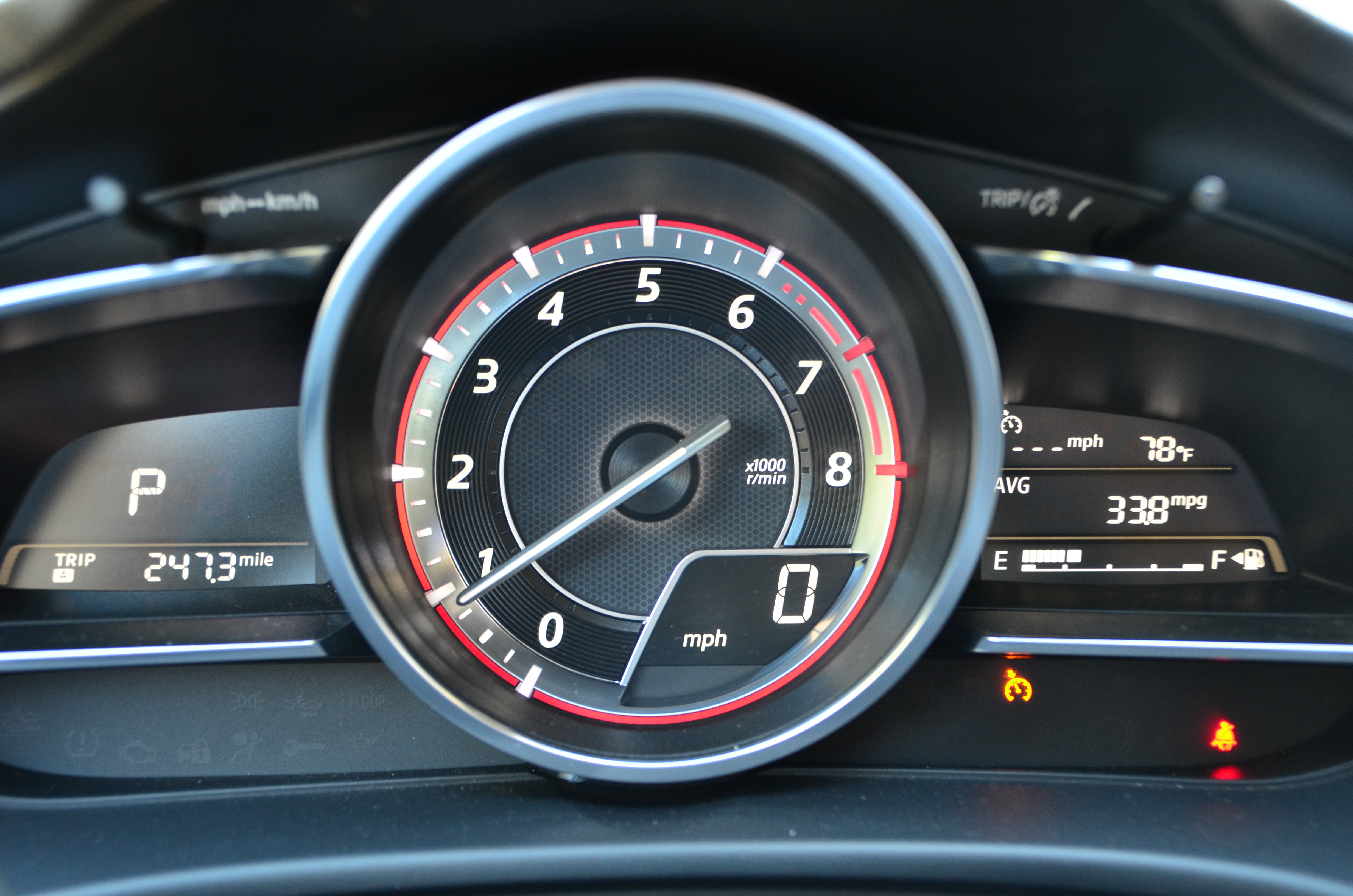
Not letting anything go without refinement, the quality Mazda 3 interior is near perfect with great looking leather seats that give you long haul comfort and perfect support and positioning. This loaded Mazda came with a heads-up display for the speedo plus a large central tach with another digital speedo located in the lower right quadrant of the tach. Quality abounds on every surface with sublime, soft touch materials. About the only personal knock is the central mounted, stand up screen for operating the GPS, radio and other systems. It just kind of sticks out from the top of the center of the instrument panel. You might think it would retract into the panel, but it doesn’t. One other nitpick is that the awesome sound system was hard to use, especially pre-selecting radio stations. Maybe there is a learning curve.

My top of the line tester stickered for $26,495, plus $795 for destination. It had the $1,800 technology package that included the i-ELOOP regen system that also included the Smart City Braking System, a boon for those who do other things while driving. I would take a pass. However, there is no question the new Mazda 3 is now at the top of the class for all compacts even if you purchased the $16,945 2.0L. No other compact offers the driving enjoyment and world class looks, notwithstanding its top of the class performance and fuel economy. It is the most rocking compact you can buy while being about as stable as you can get. The answer to the initial question is a resounding yes.

Larry Weitzman has been into cars since he was 5 years old. At 8 he could recite from memory the hp of every car made in the U.S. He has put in thousands of laps on racetracks all over the Western United States.