Renowned rock climber to talk at Squaw

Emily Harrington, one the top rock climbers in the world, continues the Alpenglow Sports Winter Film Series on Feb. 12 at 7pm at Squaw Valley’s Olympic Village Lodge.

Her show “The Long Way,” documents a National Geographic expedition of adventure, suffering, and ultimate reward in the remote jungles and high altitude peaks of Myanmar. Harrington is a professional rock climber and adventurer who has been a prominent and leading figure in the climbing community since she was a teenager.

She is perhaps best known for her five-time National Championships, two-time North American Championships, and numerous podiums on World Cup circuit.

The series is designed to inspire, motivate and educate. The event runs from November through March and showcases five famous athletes.

All shows are free and raffle prizes are used to raise funds for local nonprofits. Tahoe Institute for Natural Science is the beneficiary for Harrington’s show.


Tahoe Tails — Adoptable Pets in South Lake Tahoe

Reba

Reba

Reba is a beautiful Catahoula leopard dog-Lab mix who is 3-year- old and very sweet.

She is about 45 pounds, and has very soft, pretty fur. She gets along well with other dogs, but appears to be a little too interested in cats. Reba is an active girl who would like to get exercise each day.

Reba is spayed, microchipped, tested for heart worm, and vaccinated. She is at the El Dorado County Animal Services shelter in Meyers, along with many other dogs and cats who are waiting for their new homes. Go to the Tahoe animal shelter’s Facebook page to see photos and descriptions of all pets at the shelter.

Call 530.573.7925 for directions, hours, and other information on adopting a pet. For spay-neuter assistance for South Tahoe residents, go online.

— Karen Kuentz


Reno hotel proves gaming, smoking not needed

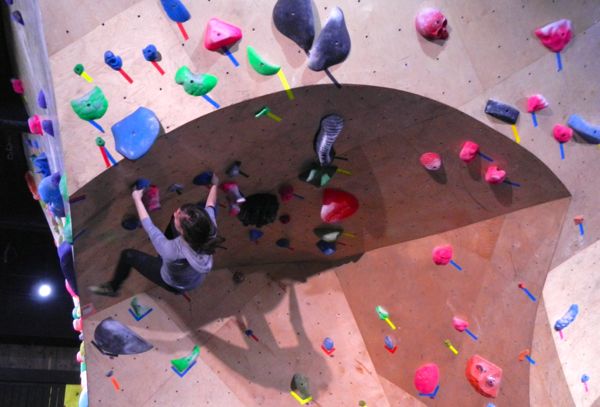
Brandy Mane tests her agility at the climbing gym inside Whitney Peak hotel. Photos/Kathryn Reed

Brandy Mane tests her agility at the climbing gym inside Whitney Peak hotel. Photos/Kathryn Reed

By Kathryn Reed

RENO – It’s hard to believe this is Reno. No stench of stale cigarettes. No casino. A restaurant that is a destination unto itself. A lobby like many boutique hotels; meaning modern, chic and upscale. And live music that rocks.

Whitney Peak Hotel isn’t what one would expect from any Nevada hotel.

It is the only non-gaming, non-smoking hotel in Reno.

But for those who want to partake in those activities, the hotel is steps from venues that allow those sorts of things. Whitney Peak is in the heart of downtown – right at the famous Reno arch and walking distance to the Truckee River area.

“It’s a hotel experience, not a casino experience,” Eli Gross, social media community manager, said. The goal, he said, is to provide a four star hotel.

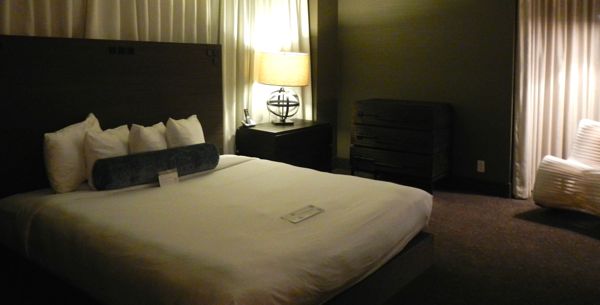
Hotel rooms look nothing like when this was the Fitzgerald.

Hotel rooms look nothing like when this was the Fitzgerald.

The ownership group out of Chicago took over the Fitzgerald, which closed in November 2008, and spent $10 million transforming this property into something unique. It opened in June 2014. But before it became Whitney Peak it was CommRow from Oct. 1, 2011, to Jan. 1, 2013. This is when the exterior climbing wall was built.

Improvements are not complete. Gross told Lake Tahoe News it’s possible a pool will be added in the future. But it won’t be the party scene Las Vegas is known for or the Hard Rock at Stateline wants to become.

This has to do with the hotel catering to a demographic that isn’t all about partying, getting drunk and being half naked.

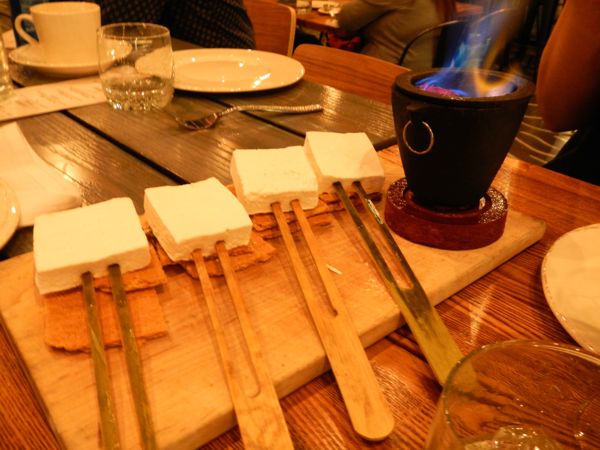
Food at Heritage is unique, fun and flavorful.

Food at Heritage is unique, fun and flavorful.

By April another $3 million will have been spent. This is to bring another 150 rooms online, upping the total to 300.

Most rooms average 300-square-feet, and are the same footprint of the old Fitzgerald that was built in 1976. Even so, it’s only the size of the bathroom – especially the tub – that indicates this is not a hotel built today from the ground floor up.

Whitney Peak, while it is chic upon entering, isn’t all about being high-end and sophisticated.

Rigorous Proof and Bryan Jones were playing in mid-January at Cargo, the nightclub on the first floor. It was a celebration of their album release “Moondog Matinee”.

Rigorous Proof and Bryan Jones at Cargo.

Rigorous Proof and Bryan Jones at Cargo.

There is an outside entrance to the 5,000-square-foot music venue that seats 400 or can accommodate more than 1,000 people if they are standing.

In some ways Whitney Peak is the antithesis of upscale luxury because there is no sense of pretentiousness. Employees at the front are in flannel shirts; at the bar workers are in jeans and grey button down shirts with their sleeves rolled up. It’s elegant without being over the top. Rooms are modern without being minimalist. Décor reflects the surroundings without being gaudy.

Service is at a level to be envied and emulated by others – except for at the climbing gym. Workers didn’t seem to care that a rookie was in the gym. It’s possible to take lessons to be more proficient at the indoor bouldering gym or to be Spiderman-like on the North America’s tallest outdoor climbing wall at 164 feet.

But the members, they were helpful to explain the pitches, the holds and how to swing a leg to stay anchored.

This rigorous play area is open to hotel guests for a small fee, and to the public for daily use or monthly membership. The owners invested $800,000 into the climbing facility.

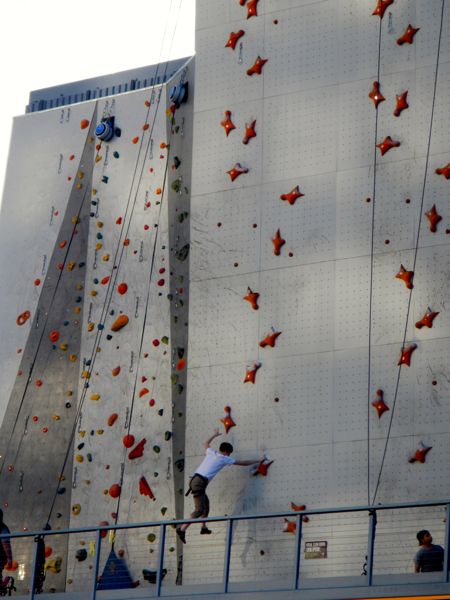
Whitney Peak has the largest outdoor climbing wall in the United States.

Whitney Peak has the largest outdoor climbing wall in the United States.

Outside there are numerous routes that Tommy Caldwell and Kevin Jorgeson of Yosemite’s Dawn Wall fame could tackle in seconds because the holds are built-in and not a work of Mother Nature. Here climbers are roped in, then rappel down as downtown Reno is in view. People on the street gawk at the scene.

All that climbing can stimulate an appetite. Heritage is Mark Estee’s seventh restaurant. The James Beard semifinalist and veteran of the Ahwahnee Chef’s Holidays at Yosemite National Park is putting his culinary stamp on Reno.

Estee is all about using locally sourced food in all of his restaurants.

The open kitchen allows diners to see their food being prepared. Breakfast, lunch and dinner are served here, plus there is a bar. There is no confusing what one is ordering when the menu has categories like Animals and Plants. There are plenty of offerings to satisfy those who prefer one of those to the other.

—–

Notes:

For more info, go online.


Workers take a stand against sitting

By Doni Bloomfield, Bloomberg

Tim Tyrrell’s bosses wouldn’t pay for a standing desk, so he took matters into his own hands.

The software engineer in Austin, Texas, used parts from Ikea for a makeshift desk to prop up his keyboard and monitor, letting him avoid the excessive sitting he had heard was bad for him. Other co-workers did the same. His employer at the time, HomeAway Inc., has since relented, converting the office’s more than 800 desks so they’re now adjustable.

Employers are under increasing pressure to give desk-bound workers more options to get out of their chairs as evidence mounts that sitting for long periods is unhealthy — even for people who are otherwise in good shape. While the desks can cost thousands of dollars apiece, companies have to weigh the expense against showing concern for employees’ health.

An analysis published this week in the Annals of Internal Medicine is likely to give concerned workers more ammunition. Researchers dug through data in 47 separate studies to conclude that longer sitting time was associated with higher risk for death, heart disease, cancer and type 2 diabetes. This can lead to life expectancies that are years shorter, according to David Alter, the paper’s lead author and a researcher at the Toronto Rehabilitation Institute.

Sitting for hours every day was correlated with bad health even for people who exercised frequently, he said. The study didn’t find that sitting caused people to die or get sick, and didn’t seek to explain why there was an association.

Read the whole story


Carl Thomas ‘Tom’ Ritchie — 1954-2015


Tom Ritchie

Tom Ritchie

Carl Thomas “Tom” Ritchie passed away at Renown Regional Medical Center on the morning of Jan. 1, 2015, after receiving fatal injuries in a fall. He was 60.

Tom was born Oct. 24, 1954, in Huntington Park and grew up in Pico Rivera in Southern California.

He moved to his beloved Lake Tahoe in 1979. He spent a lot of time hiking and enjoying the outdoors.

Tom also loved his music. Never taking lessons, he learned at a young age to sing and play the guitar by ear, and had been part of numerous garage bands. During his years in South Lake Tahoe he played with the local band Lightning Rose, and then as lead guitarist and singer for Thunder Rose.

Tom is survived by his children, Allyson Ritchie, Chelsea Ritchie and Christian Ritchie, all of South Lake Tahoe; and sister JoAnne Johnson of Sisters, Ore.

He was preceded in death by his beloved parents, Carl and Lauraine Ritchie, and his beloved sister, Judy Ritchie Renken Leach.

A memorial service is planned for summer 2015.


Don’t let medical issues decimate savings

By Jack Lowrey

People pondering their retirement years often conjure images of spending more time on a favorite pastime or traveling around the country or the world.

Health concerns can intrude on those idyllic scenes, though, not only affecting enjoyment of life but also punching a heavy dent in retirement savings.

As we age, usually our medical or long-term care expenses increase, sometimes depleting our assets to a level of crisis.

It’s important for retirees, and anyone planning for retirement, to become educated about what the pitfalls are and what they need to do to avoid losing their life savings.

Long-term care especially can burn a hole in savings accounts. In 2012, for example, nursing home care averaged $74,800 a year, according to a report by the Henry J. Kaiser Family Foundation.

Meanwhile, assisted living facilities averaged $39,500 per year, and home-health services averaged $21 per hour.

More than 10 million Americans need some sort of long-term care, the Kaiser report said. That number covers all ages, even children, but about half are people 65 and older.

Those older Americans had looked forward to enjoying their golden years. They should be able to have actual golden years instead of what can end up being scary years, both personally and financially.

Certainly, being able to maintain good health is a key factor in protecting savings and making retirement enjoyable and satisfying, he says.

But life doesn’t always work out that way. Fortunately, there are strategies seniors can use to lessen the impact of expenses brought on by long-term care needs. Those include:

• VA benefits. Military veterans may be able to offset nursing home or assisted-living expenses through benefits provided by the U.S. Department of Veteran Affairs. A veteran’s eligibility for long-term care services would be determined based on his or her need for ongoing treatment, personal care and assistance, as well as the availability of the service in the area where the person lives, according to the Department of Veteran Affairs.

Other factors, such as financial eligibility, a service-connected disability, insurance coverage, and/or ability to pay may also come into play.

• Medicaid compliant SPIAs. A SPIA is a single-premium immediate annuity. Typically, a SPIA is a contract with an insurance company where you pay the company a sum of money up front (the premium), and the company promises to pay you a certain amount of money periodically for the rest of your life.

A Medicaid compliant SPIA is a specially designed annuity that pays out over the person’s “life expectancy” and has other specific characteristics. A couple who put money in a Medicaid annuity are able to avoid having the income from that annuity count against the financial assistance a spouse receives for nursing home care.

• Setting up a trust. Trusts can help shelter wealth from the look-back periods in Medicaid requirements and assist in qualifying for VA programs, among other advantages.

Jake Lowrey is a financial consultant and president of Lowrey Financial Group.


South Lake Tahoe — a 50-year work in progress

South Lake Tahoe voters in November 1965 agreed   form an incorporated city.

South Lake Tahoe voters in November 1965 agreed to form an incorporated city.

slt 50th logoPublisher’s note: This is one in a series of stories Lake Tahoe News will be running leading up to the 50th anniversary of South Lake Tahoe on Nov. 30.

By Kathryn Reed

“The people of Lake Tahoe’s South Shore formally have taken steps to control and preserve the natural beauty of this area. The overwhelming vote for incorporation proves the people do care what happens to the lake. We now have local government control and do not have to rely on those from other areas to take care of our needs.”

– Wink Ames

Ames was one of the founding fathers of South Lake Tahoe and went on to serve on the City Council. The quote above was his official statement to the media after the votes were counted.

From dirt roads to a major federal highway. From just a few year-round residents, to thousands. From ranching to gaming’s housing hub to a recreation mecca. South Lake Tahoe has gone through a multitude of changes through the years.

Before the vote to incorporate took place in November 1965, the area was divided more into neighborhoods that still exist – Al Tahoe, Bijou, Bijou Park, Stateline, Tahoe Valley and Tallac Village.

There were 12,000 people who called South Lake Tahoe home in 1965. The vote to incorporate was 2,011-614. Voter turnout was 65 percent. With approval, South Lake Tahoe became the 398th city in California.

Norm Woos is the longest  serving member on the City Council. Photo/South Lake Tahoe

Norm Woods is the longest serving member on the City Council. Photo/South Lake Tahoe

The first council consisted of Brad Murphy who was the top vote getter at 1,377; Jerry Martin (1,194); Eugene Marshall (1,082); Norm Woods (996); and Donald Clarke (971).

What has changed through the years is not the number of votes, but the voter turnout. With the city having a population of about 21,500 people, a total of 9,414 votes were cast for City Council in November 2014 when voters could vote for three candidates. Wendy David received the most at 1,727.

Woods is the longest serving member at 21 years – 1965-70 and 1976-92. By the time current members Hal Cole and Tom Davis finish their terms, each will have served 20 years. Cole from 1994-2006 and 2008-16; and Davis from 1992-2004 and 2010-2018.

From 1965-68, all mayors served a six-month term. Today they serve a one-year stint.

Echo Motel on Highway 50 and Ski Run Boulevard comes down June, 26, 1989, for the first phase of redevelopment. Photo/South Lake Tahoe

Echo Motel on Highway 50 and Ski Run Boulevard comes down June 26, 1989, for the first phase of redevelopment. Photo/South Lake Tahoe

Pictures of everyone ever elected to the council are on a wall in the room where the five electeds meet, with the dates served posted as well.

Originally the council met in the basement of what was the Tahoe Savings & Loan Building. It is now El Dorado County offices on Takela Drive.

City offices have moved throughout the years, including being in what is now the senior center. Today they are at Lake Tahoe Airport and on Tata Lane.

Fire, police and snow removal were the three tenants upon which incorporation were sold to the public.

In 1966, the city took over Lake Valley Fire Protection District stations that were in the city limits.

The first police chief, Ray Lauritzen, was hired in April 1967. He then started hiring officers.

Plow drivers were adept enough by the end of 1966 to clear all city streets within 12 hours.

Not everyone was happy with the city being its own entity and no longer under complete control of El Dorado County. A move for disincorporation was put on the ballot in 1968 and was defeated.

John Williams served as the first city manager until 1969.

In 1966, Pioneer Trail was open year-round from Meyers to near the state line.

The base of the gondola was put in by American Ski Company. Photo/Heavenly Mountain Resort

The base of the gondola was put in by American Ski Company. Photo/Heavenly Mountain Resort

Planners in the early 1970s expected the city to one day have a population of more than 50,000 people. This was at a time when there was talk of Pioneer Trail being more like a freeway. Even Caltrans was going to build a bigger highway and had the right-of-way to do so.

When the Greenway Bike Path, which may start construction this summer, is completed, much of it will be along that former Caltrans right-of-way that goes from Meyers to almost the Nevada border.

Entertainment and recreation have long been integral to South Lake Tahoe’s economy and tourist draw. The Stateline casinos in some form have existed since the 1940s. With the opening of Lake Tahoe Hard Rock this week, there is another reason for people to visit.

While technically there isn’t a ski resort in the city limits, the 1960 Winter Olympics at Squaw Valley put all of Lake Tahoe on the map as a winter wonderland.

Heavenly Mountain Resort’s gondola opened for the 2000-01 season. It made it so skiers near the bulk of the hotel rooms could be whisked to the mountaintop without having to drive to one of the base lodges. Two years later Vail Resorts would own the gondola and ski resort. The village, anchored by two Marriott properties, continues to be the hub of tourist activity in South Lake Tahoe.

While the city has made considerable improvements through years, some things never change. The first talk of doing something with signs was in 1967. Regulations about billboards, neon, motif, color, type and style have been made ever since then. Even last year the council was still talking about what to do about sandwich boards. And signs are likely to continue as a topic when it comes to design standards in the Tahoe Valley Area Plan.

—–

Notes:

  • The city is planning open houses at various city building throughout June and July.

  • A time capsule unveiling and citywide treasure hunt will take place in September.

  • Homecoming and community parade is set for October.

  • The 50th anniversary dinner and gala at Lake Tahoe Resort Hotel is Nov. 7.



TRTA hosting trail talks

The Tahoe Rim Trail Association’s Trail Talk Series features diverse speakers and topics related to the 165-mile Tahoe Rim Trail.

These once a month presentations are free and open to the public.

The schedule:

  • Feb. 25, 6-8pm — Equine First Aid, Colic & Muscle Abnormalities Seminar: Two vets from Large Animal Veterinary Services will present on equine-specific topics regarding what every rider should consider when riding in the backcountry. Topic highlights include: Planning and preparing for your ride, equine first aid, common backcountry problems and treatment, vital signs, colic and muscle abnormalities. The talk is at Cabela’s Reno.
  • March 11, 6-8pm — Dogs on the Trail: Veterinarian Kathleen Fisher of Washoe Valley Veterinary Hospital will present on important information that all dog owners should consider when on the trail with their canine friends. She will touch on planning and preparing for your trail experience, canine first aid, and common backcountry problems and treatment. The talk is at Cabela’s Reno.
  • April 28, 6-8pm — Geology of the Tahoe Rim Trail: Friends of the Library of El Dorado County Library will be hosting a talk on the geology of the Tahoe Rim Trail. Local geologist and TRTA board member Dave Schnake will provide an informative, non-technical talk on the enormous geological forces which formed Lake Tahoe as well as virtually take people around the Tahoe Rim Trail and discover the geological variety which can be found around the trail. The talk is at the South Lake Tahoe Library.


Improv returns to LTCC campus

Random Acts of Improv returns to Lake Tahoe Community College’s Duke Theater on Feb. 6 at 7:30pm.

This family-friendly show will feature seasoned improvisation performers, along with a few fresh faces. Willing kids will be invited on stage to help the performers.

Random Acts of Improv is the resident improvisation company of the Theater Arts Department at the college.

Admission is $5 at the door. For more information, call 530.541.4660, ext. 240.


How casino games are created

By Andrea Domanick, Las Vegas Sun

Millions of people come to Las Vegas every year hoping to win big at a casino table. But gambling isn’t the only way to cash in on casino games.

Anyone with an idea for a new table game can submit it to Nevada’s Gaming Control Board to be approved for lease to casinos. Though the majority of design pitches come from major gaming companies and professional game inventors, concepts from hobbyists and Averages Joes can and do end up on casino floors.

“Someone literally might come to us with a concept drawn out on paper; they can be that rudimentary,” said Jonné Brunette, an agent with the Gaming Control Board enforcement division, which handles table game submissions. “People have pitched anything under the sun. It is amazing what has been submitted to us.”

The enforcement division can’t divulge details about the ideas it receives because of confidentiality agreements, but the majority of pitches tend to be game variations, such as side wagers on existing games such as blackjack. Entirely new game concepts are more rare.

The board approves seven to 10 new games and about 50 game variations per year.

Read the whole story