Tahoe first responders heat up Rotary event
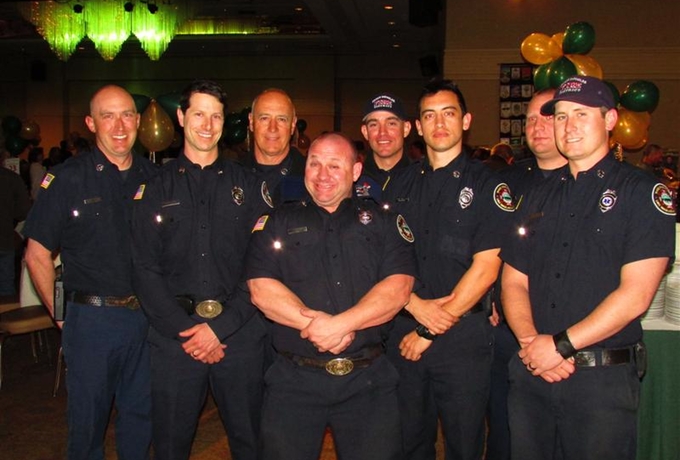
Tahoe Douglas firefighters were out in force March 13 supporting their colleague; form left, Nathan Johnson, Chris Lucas Bill Romanowitz, Ben Pratt, Nick Robidart, Juan Serrano, Scott Vandover and Chad Baker.

Tahoe Douglas firefighters were out in force March 13 supporting their colleague; from left are, Nathan Johnson, Chris Lucas, Bill Romanowitz, Ben Pratt, Nick Robidart, Juan Serrano, Scott Vandover and Chad Baker.                Photos/Denise Haerr

By Kathryn Reed

STATELINE – Service above self is the philosophy of Rotarians worldwide. Tahoe Douglas Rotary took that mantra a step further on March 13 by honoring those who embody that philosophy on a daily basis.

This was the first year the South Shore Rotary club honored first responders during the annual St. Patrick’s Day fundraiser in what was called the Community Hero Awards.

“We wanted to add more meaning to the night,” Rotarian Erik Watada told Lake Tahoe News. “A lot of people are familiar with Rotary, but are not sure what they do. We wanted to draw a better connection to what we do.”

In doing so, the club was able to sell out the event at Harrah’s Lake Tahoe for the first time in its 47-year history.

Leaders within the Tahoe Douglas Fire Protection District, Douglas County Sheriff’s Department, South Lake Tahoe Fire Department, Lake Valley Fire Protection District, South Lake Tahoe Police Department, and El Dorado County Sheriff’s Department selected one person from their department to honor. Videos of each of the recipients and their bosses were shown to the crowd during the dinner. The only disappointing aspect of the night was the disrespect shown by some attendees who talked during the entire presentation. Each honoree had $1,000 donated to a charity.
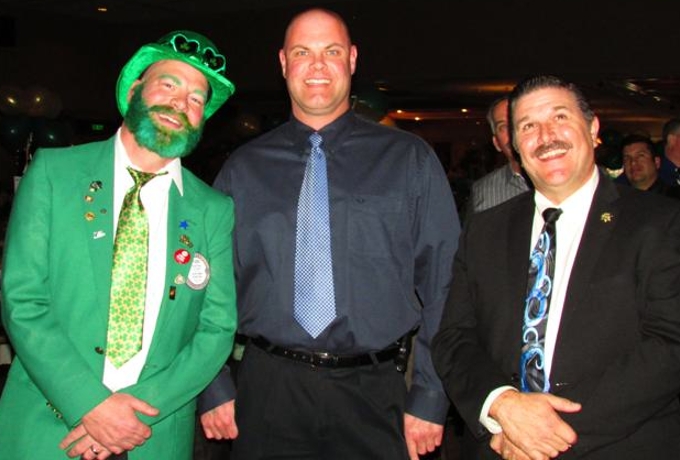
Rotarian Todd Poth, from left, with honoree Sgt. Greg Almos and El Dorado County Sheriff John D'Agostini.

Rotarian Todd Poth, from left, with honoree Sgt. Greg Almos and El Dorado County Sheriff John D’Agostini.

The outstanding honorees are:

• “Capt. Ralph Jones was selected because he has proven to be a highly professional, dedicated, and devoted firefighter and bomb technician. Throughout his career he has focused on serving the residents and visitors of our community.” – Tahoe Douglas Fire Chief Ben Sharit.

Charity recipient: Northern Nevada Children’s Cancer Foundation.

• “Our community is safer thanks to the hard work and leadership of Sgt. Ron Elges.” – Douglas County Sheriff Ron Pierini.

Charity: Douglas County Sheriff’s Advisory.

• “Al (Martinez) was selected by his peers based upon his outstanding efforts with public education. He is a caring employee who wants to educate the public in all facets of fire and life safety.” – South Lake Tahoe Fire Chief Jeff Meston.

Charity: H.E.R.O. Scholarship.

• “Michael (Anderson) exemplifies the fire district’s mission, vision and values in his performance as a firefighter/paramedic. He is well known for his positive, can-do attitude.” – Lake Valley Fire Chief Gareth Harris.

Charity: Live Violence Free.

• “Officer Ross Molesworth’s commitment to this community as a police officer, volunteer, and kids’ coach is commendable. He has demonstrated the ability to take actions that are beneficial to all in our community.” – South Lake Tahoe Police Chief Brian Uhler.

Charities: South Tahoe National Little League and South Lake Tahoe SWAT.

• “Deputy Greg Almos demonstrates a sincere commitment to serving the residents of our community. He devotes great attention to how to make the South Lake Tahoe Basin safer and more enjoyable.” – El Dorado County Sheriff John D’Agostini.

Charity: El Dorado Search and Rescue Council.

Besides adding the first responder honoree component to the night, the Rotary club also became the first nonprofit on the South Shore to have its silent auction be paperless. To participate people had to use their smart phone or a computer to bid on items. This allowed people who didn’t attend to bid on items and for bids to be made before the event.

It also meant not having to hover over a table and elbowing one’s competitor to get to the sheet. When someone was outbid on an item that person received a text and could then enter a higher bid.

Before the festivities began the Rotary club had more than $30,000 pledged in the silent auction.

This format also sped up the process for checking out at the end of the evening.

The total proceeds are still being calculated. Money raised is then returned to the community through various projects and scholarships.

Watada also said rotary is looking at possibly expanding first responder recipients in future years.
Art auction benefits LTCC Foundation, Rotary

Lake Tahoe Community College Foundation and Rotary Club of South Lake Tahoe are hosting the Off the Wall Art Auction in the Haldan Gallery/library building this month.

All of the art up for grabs is created and donated by local and regional artists. Proceeds support student scholarships and academic programs at LTCC, and will help the Rotary Club support its various charitable efforts.

The action starts March 23 with a free kickoff celebration from 5-7pm in the Haldan Gallery. Art viewings in the Haldan are available all that week from 3-6:30pm each day. The auction takes place March 28 in the Haldan Gallery with a live and silent auction. It’s $10 at the door to bid on the art.


Services on Sunday for Tahoe City’s Murnane

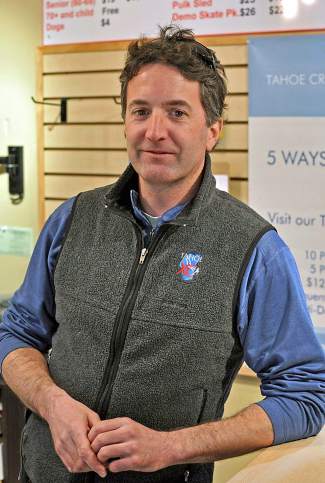
A celebration of life for Kevin Murnane will be March 15 at 1pm outdoors at Tahoe Cross Country in Tahoe City.

Seating is extremely limited; bring a chair. The service is expected to last about 45 minutes.

Kevin Murnane

Kevin Murnane

While street parking is allowed for this celebration, people are strongly encouraged to park at the high school, and take a shuttle bus to the Nordic Center.

A remembrance piece of organic material for Murnane has been started at Tahoe Cross Country in the area adjacent to the yurt; add a favorite rock, pine cone, flower or something else — creativity welcome and encouraged — with a message or a heart with a ‘K’, any item that means something to you.

Bring a bottle of wine to share. There will be lemonade, water and beer available.

A memory book is being compiled for Valli, Lily, and Kai. Write your favorite memories of Murnane on a piece of paper; photos or hand drawings can be included, too. All memory pages will be scanned and placed in an online book. Entries can be emailed to grockwell436@gmail.com; mailed to P.O. Box 1431, Tahoe City, CA 96145; or dropped off at the memorial.


Oceanography comes to life in children’s book

By Kathryn Reed

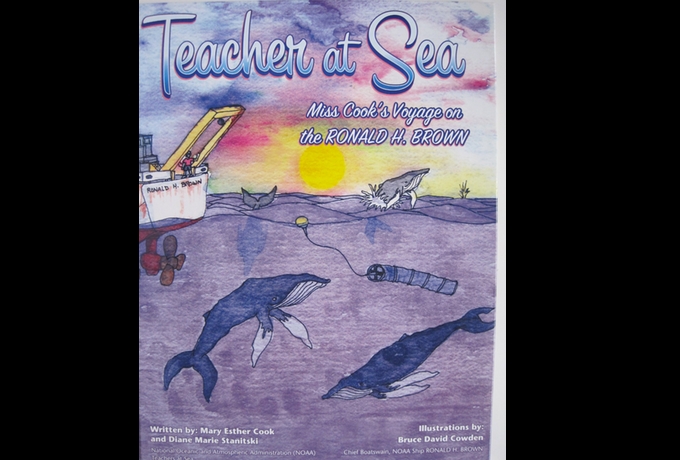
I may have never liked science, but if a book like “Teacher at Sea: Miss Cook’s Voyage on the Ronald H. Brown” had been around when I was a kid, maybe it would have piqued my interest.

What is so fun about this book is that Miss Cook is a real person. At least at the time when this was published in 2005 she taught eighth-grade Earth science in Arkansas.teacher at sea bookIn 2004 she was NOAA’s teacher at sea on board the agency’s ship Ronald H. Brown.

The beautifully illustrated (Bruce David Cowden) book is published by the National Oceanic and Atmospheric Administration. It follows Cook’s time while she was on the research vessel.

While this may not sound like a kids book, it is. The science contained in it is at the middle school level. The pictures could entertain much younger children, but the information will be over their heads.

I don’t know how well this book would go over with middle schoolers because it very much looks like a children’s book. Maybe it would be OK for sixth-graders. It definitely appealed to a middle-aged woman who never did well at science. And for little ones, the pictures will captivate them and might spur them to get excited about oceanography.

In the back is a glossary of scientific words that range from life vest to radiosonde to barnacle. There are also Internet resources listed for teachers, parents and students.

The book was co-written by Cook and Diane Marie Stanitski.


Tahoe celebrity home wins award

The former Howard Hughes estate is for sale. Photo/Eric Jarvis

The former Howard Hughes estate is for sale. Photo/Eric Jarvis

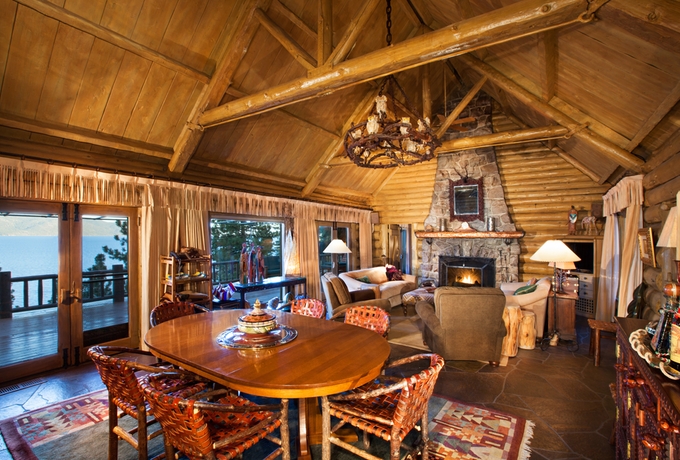
Howard Hughes’ former Lake Tahoe estate found its way back to the spotlight as a winner in HGTV’s 2014 Doory Awards.

The cabin received the most online votes in the Celebrity Homes category. The monthlong contest on HGTV’s FrontDoor.com attracted nearly 50 million views.

Billed as “The Ultimate House Hunt,” the Doory Awards present extraordinary homes for sale, allowing consumers to vote for the homes they find most appealing.

The Hughes property is a modest mountain home inspired by the great camps of the Adirondacks. The main home was built from locally sourced timber in 1934 and has five bedrooms, four baths and an office. A guest cottage was built in 1940. The 5.5-acre property was purchased from the Howard Hughes Corporation in 1995.


Road beat: ‘Four-wheel drive doesn’t negate laws of physics’

By Larry Weitzman

“Seventy-five percent of the accidents in snowy conditions are four-wheel drive vehicles” said Lee Aderlee, retired California Highway Patrol officer. That’s a telling statistic that all drivers of four-wheel drive vehicles should be aware of.

Aderlee went on to say, “Four-wheel drives don’t negate the laws of physics.”

“Many people who drive four-wheel drive vehicles develop a false sense of security and get themselves into trouble … four-wheel drives will not stop any faster than a two-wheel drive car,” Aderlee said. “Four-wheel drive cars accelerate better, but very few accidents occur when accelerating, they occur when they are going too fast for the conditions and are unable to slow down, steer and/or stop.”

Aderlee is absolutely correct.

A four-wheel drive is just what it says. With limited slip differentials, it can put torque or power to any or all of your vehicle’s wheels. Most cars today are front-wheel drives which means the drive wheels are only on the front axles. There is no power to the rear wheels. Rear-wheel drive is the opposite.

In four-wheel drives, if the rear wheels cannot obtain sufficient traction to accelerate the vehicle, then power is transferred to the front wheels or spreads the power to all wheels to obtain the necessary traction. With front wheel biased four-wheel drives, most power goes to the front wheels unless slippage is detected.

But four-wheel drive only helps in making you go in a straight line, it does nothing to help you stop and once front traction is lost, you have no effective steering. The only devise that helps you stop and maintain directional control are antilock brakes. In addition to ABS are electronic black boxes called stability control, which through throttle retardation, individual wheel braking, accelerometers, yaw sensors and steering input sensors attempt to keep the vehicle going in the intended direction. All of these new things should never lull you into as put by Aderlee “a false sense of security.”

Aderlee says there are two things to keep in mind when driving in snowy conditions, speed and anticipation. Any speed beyond the ability to react safely to a problem, such as another vehicle out of control, an animal or a road obstruction is too fast. Four-wheel drive will not help you in such a situation.

Aderlee says chains offer the most effective stopping action as well as significantly improved traction.

Four-wheel drive will help keep you going in mud or in slippery conditions, but it doesn’t remove the common sense necessary when driving in snowy or icy conditions.

When you see all those advertisements of four-wheel drive vehicles doing amazing things, there is a captioned which usually reads: “Professional driver on a closed course.” But even more important is that those professional drivers are in perfect conditions with the knowledge of anticipation. And as the advertisement says, they are professional drivers, drivers highly skilled and experienced in negotiating difficult conditions and who understand and can feel what the vehicle is doing. How successful would an off the street driver be in a NASCAR race? Most of the time all you do is turn left. How hard can that be? At the speeds they travel, extremely hard.

It’s fairly easy to go straight during snowy conditions. It’s when you need to slow down or alter your direction when you get into trouble. When that happens, and that can happen at any time, a four-wheel drive has no advantage over a comparably equipped two-wheel drive. Drive within your limits, the weather’s limits, the road condition’s limits and your vehicle’s limits. The braking ability of a four-wheel drive vehicle is no better than a two-wheel drive vehicle. A two-wheel drive vehicle with ABS and/or chains will outperform a 4 x 4 in braking during snowy conditions without ABS and/or chains.

When the CHP posts speed limits of 25 mph with chains, it’s a maximum safe speed. They are not kidding. The laws of physics are not repealed by four-wheel drive. When traction between the rubber and the road is reduced, so must the speed, as stopping distances are increase by the approximate square of the speed under the best of conditions.

Larry Weitzman has been into cars since he was 5 years old. At 8 he could recite from memory the hp of every car made in the U.S. He has put in thousands of laps on racetracks all over the Western United States.


Soroptimist honor those making a difference

By Kathryn Reed

STATELINE – “This is the time to uphold women’s achievements, recognize challenges, and focus greater attention on women’s rights and gender equality to mobilize all people to do their part.”

These are the words of Pat Papp, a district director for Soroptimist and member of Soroptimist International Tahoe Sierra.

While March 8 was International Women’s Day, on March 5 the two Soroptimist clubs on the South Shore came together to recognize women and high school students who are making a difference in the community.

“International Women’s Day is a time to reflect on progress made, to call for change and to celebrate acts of courage and determination by ordinary women who have played an extraordinary role in the history of their countries and communities,” Papp said.

The Live Your Dream award is about recognizing women who have overcome obstacles, but are still pursuing their education to make life better for themselves and their families. The two honorees, who both work for Barton Health, were given $2,000 to further their education.

Since the award was first given in 1972, nearly $30 million has been bestowed upon recipients worldwide.

Kathleen Dewing of Soroptimist International of South Lake Tahoe presented this year’s South Shore honorees. She said the people chosen this year are women who will set an example for their children, who will give back to their communities and who have already overcome so much.

Many who receive this award have endured some form of abuse, been challenged in ways that go beyond what would be considered normal and still find the good in what lies ahead.

Latosha Sanchez and Keyla Trejo were honored last week. Both are working toward their nursing degree. Sanchez has kids who are 6, 2 and 11 months. She a full-time mom and a full-time student.

“I had a troubled childhood. My mom had many men in and out of our lives,” Sanchez said. “I was the shoulder for her to cry on.” Sanchez’s husband is a rock for her to rely on – something she wasn’t used to.

For Trejo, she is a single mom with a 6- and 8-year-old.

“My parents never had the opportunity to purse their goals career-wise,” Trejo said. “The biggest hardship after becoming a single mom was deciding what to do with my life and for my kids.”

The Ruby award recognizes women who are helping to improve the lives of other women and children. Janey Roeser and Tere Tibbets are this year’s honorees.

Roeser is the club advisor for the S Club at South Tahoe High School. She’s paid to teach English at the school. She is described as having the spirit of volunteerism and the soul of someone who wants to make a difference.

“Selfishly, it has enriched my life,” Roeser said, “I don’t know if they know how much they’ve given to me.”

Tibbetts immigrated from Cuba with her family when she was 13. With her parents being educated, it helped the family survive. This helped Tibbetts learn early on that education makes a difference.

“The more educated your are, the freer you are,” Tibbetts said.

She worked for Lake Tahoe Unified School District for 20 years and then went to Lake Tahoe Community College as a counselor.

Today, her big emphasis is on her book club that she created for women whose first language is Spanish. It’s getting them to read, to meet others and become educated.

Honored with the Violet Richardson award were five South Tahoe High students and one Whittell High student. The award is in honor of the first president of the first Soroptimist award.

Each of the young women received $100. The involvement in school ranges from having grade point averages higher than a 4.0, to sports to extensive volunteer work to being involved in and starting clubs at their respective schools. And all are planning to go to college to enable them to pursue careers of their choice.

This year’s winners are Haley Chamarro, Kylee Lyons, Emma Sower, Sarah Novak and Joemae Santos from STHS and Kate Krolicki from WHS.


Tahoe Tails — Adoptable Pets in South Lake Tahoe

Sybil

Sybil

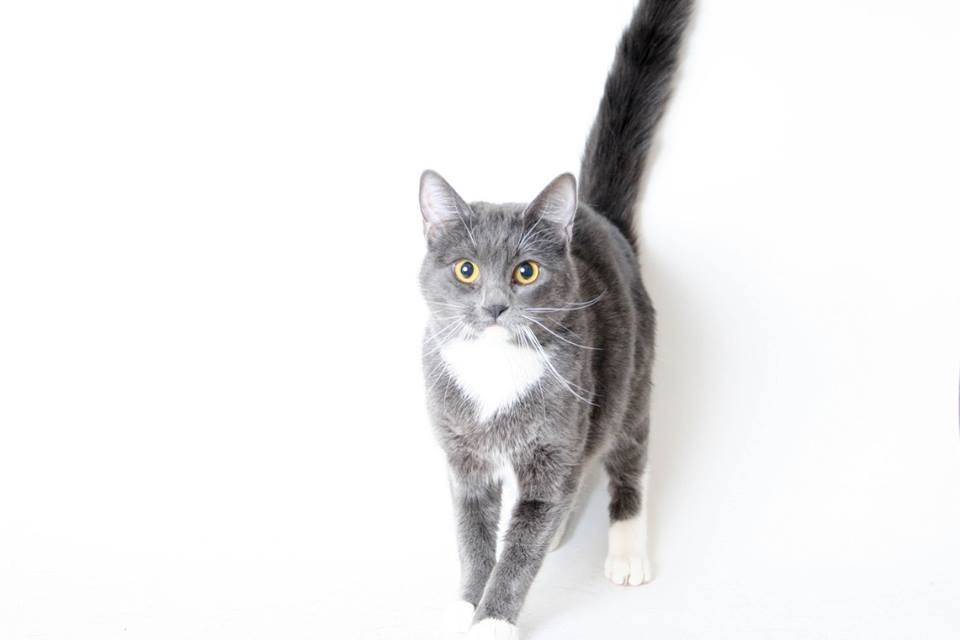
Sybil is beautiful 1-year-old domestic shorthair cat who is a lot of fun. She is a bit feisty and would make a great mouser. Sybil is one of seven cats at the shelter right now.

Sybil is spayed, microchipped, tested for FIV, and vaccinated. She is at the El Dorado County Animal Services shelter in Meyers, along with many other dogs and cats who are waiting for their new homes. Go to the Tahoe animal shelter’s Facebook page to see photos and descriptions of all pets at the shelter.

Call 530.573.7925 for directions, hours, and other information on adopting a pet.

For spay-neuter assistance for South Tahoe residents, go online.

— Karen Kuentz


Evolution of food not necessarily healthy

By Kathryn Reed

While humans have evolved for the better in so many ways, when it comes to what they eat – especially in the United States – it’s more like people have devolved.

“There weren’t many overweight or obese ancestors,” Lynn Norton, a registered dietician with Barton Health, told a group of nearly 60 people last week at Lake Tahoe Community College.

She reached back to the days of hunters and gathers to talk about how diets have changed through time. They were eating seeds, nuts, animals and had different protein sources. People ate what the land provided. In addition to this, they were active. Their quest to find food necessitated a certain nomadic lifestyle.

Today people hunt for food in grocery store aisles, gather items that are easy to prepare and have sedentary lives.

This has led to 75 percent of the people in the United States between the ages of 20 and 77 being obese or overweight.

“Today we are screening kids for fatty liver disease,” Norton said.

Farming took hold about 600 generations ago, with nearly all parts of the world having some sort of farming at least 300 generations. This led people to migrate less, but it also meant less diversity in diets.

Eventually, people were becoming deficient in certain vitamins because of the lack of varied foods. Lifestyle changes led to infectious diseases and epidemics becoming more prolific.

The Industrial Revolution of the 1800s began food processing on a massive scale. Additives became the norm – like sugar, fat and salt. Instant food was common. Convenience became more important and little attention was paid to how manufacturers made that happen.

“The meats of our ancestors was wild game and it was much leaner. Today we are fattening up cattle,” Norton said.

It was in 1970 that corn syrup, aka fructose, was introduced. Fructose can come from corn, sugar cane or sugar beets. Norton explained how the latest trend is for food companies to list fructose as beet sugar so it sounds healthier. She called it “a game” and that the consumer is unaware.

She went through a litany of ailments that are prevalent and common today that can be traced back to food choices. These are health issues that people didn’t have to contend with hundreds of years ago. Heart issues, clogged arteries, hypertension, some orthopedic injuries and others are what she calls “diseases of excess.”

“We need to balance the abundance from all the food choices,” Norton said.

She said the way to better health is to be active, minimize added sugars, avoid high calorie meals, eat slowly, ingest more plant foods, lose weight, reduce stress, get enough sleep and drink water.


Detter had lasting influence on Nevada’s history

By John L. Smith, Las Vegas Review-Journal

Black History Month came and went with the usual fitting tributes to iconic African-American leaders.

From Frederick Douglass and Harriet Tubman to Medgar Evers and Martin Luther King Jr., the black experience in America has no shortage of historical figures. Their stories and struggles are well known, and rightly so.

But what is rarely discussed, and to my mind far less appreciated, are the contributions African- Americans made to early Nevada as the territory and young state struggled — often against the march of progress — to become a civilized place to live for all races.

Thomas Detter’s name should be better known.

Read the whole story