Elton John, Brad Paisley added to Harveys lineup

Elton John and Brad Paisley are going to play at Harveys Outdoor Concert Series. This brings the number of summer concerts to 11 at this venue. More concerts are likely.

Elton John returns to the South Shore on Aug. 8 at 8pm. Tickets start at $99.50 and top out at $255.50.

Paisley will be in Stateline on June 11 at 6:30pm. Opening will be Justin Moore and Mickey Guyton. Tickets range from $69.50 to $135.50.

Other concerts are:

July 3, 7pm  — Aerosmith, $89.50 to $235.50

July 18, 8:30pm — Imagine Dragons, $89.50 to $179.50

July 21, 7pm — Train, $49.50 to $99.50; opening are The Fray/Matt Nathanson

July 22, 8pm — Kenny Chesney, $79.50 to $149.50; opening Chase Rice

Aug. 7, 8pm — Jackson Browne,  $39.50 to $89.50

Aug. 13, 6pm — Slightly Stoopid, $37.50; opening are Dirty Heads/Stick Figure

Aug. 23, 6:30pm — Dierks Bentley, $59.50 to $99.50; opening are Kip Moore/Maddie & Tae/Canaan Smith

Sept. 5, 7:30pm — Sammy Hagar and the Circle, $69.50 and $75 (door);  featuring Michael Anthony, Jason Bonham and Vic Johnson

Sept. 9, 7pm — Dave Matthews Band, $85.


Tahoe Tails — Adoptable Pets in South Lake Tahoe

Phoenix

Phoenix

Phoenix is a big fluffy boy who likes his tummy tickled. He is a flame point Himalayan with beautiful long hair that has been clipped because of matting. Phoenix is about 5 years old and he would like an owner who will brush him and give him lots of attention.

Phoenix is neutered, microchipped, tested for FIV, and vaccinated. He is at the El Dorado County Animal Services shelter in Meyers, along with many other dogs and cats who are waiting for their new homes. Go to the Tahoe animal shelter’s Facebook page to see photos and descriptions of all pets at the shelter.

Call 530.573.7925 for directions, hours, and other information on adopting a pet.

For spay-neuter assistance for South Tahoe residents, go online.

— Karen Kuentz


Authors to give talk, put on workshop at SNC

Sierra Nevada College’s next Writers in the Woods event features Gailmarie Pahmeier and David Lee.

Pahmeier’s most recent poetry collection, “The Rural Lives of Nice Girls”, was published by Black Rock Press. Other books include “With Respect for Distance”, “Shake It and It Snows”, and “The House on Breakaheart Road”. A Nevadan for nearly 30 years, Pahmeier is a faculty member for SNC Tahoe’s MFA in creative writing; she also teachers at UNR, where she received the distinguished teaching award.

Lee was Utah’s first poet laureate, and is the author of 15 volumes of poetry. A former seminary candidate, boxer, semi-pro baseball player, cotton mill worker, and hog farmer, he has a doctorate in literature with a concentration in John Milton and taught at Southern Utah University for three decades.

Readings are April 17 from 7-9pm and the workshop is April 18 from 9am-noon.

Workshops can be taken for credit and are free to students, $50 for community members. All events, Tahoe Center for Environmental Sciences at SNC Tahoe, Room 139, Incline Village.


Kids’ book explores science of hurricane chasers

By Kathryn Reed

Flying into the middle of a hurricane – on purpose – seems a little nutty. But that is exactly what scientists with the National Oceanic and Atmospheric Administration are paid to do.

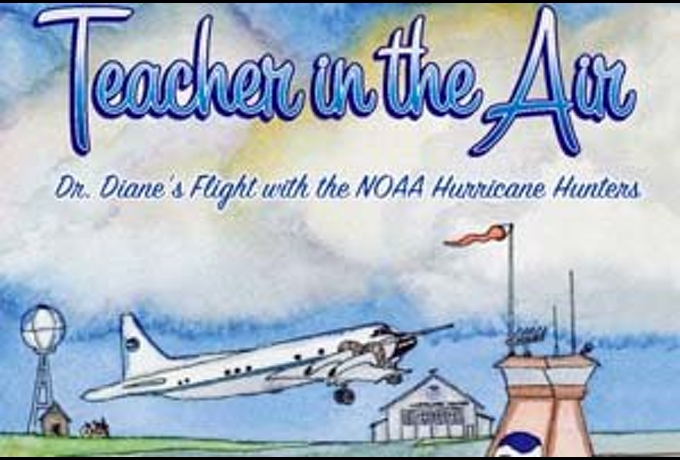
Diane Marie Stanitski and John J. Adler capture their work in a children’s book called “Teacher in the Air: Dr. Diane’s Flight with the NOAA Hurricane Hunters”.

teacher in the air bookStanitski, at least when the book was published in 2006, was a climatologist and associate professor at Shippensburg University in Pennsylvania. Adler at the time was a lieutenant commander in the NOAA Corps.

The book traces Stanitski’s flight aboard a tricked out plane whose purpose is to fly into hurricanes to gather data for scientists to study. The science involved in the book is geared toward middle school students. And that’s good because this can be an age where youngsters become enthralled with a subject matter that could become a career.

The books says, “Dr. Diane asked the scientists when they first became interested in weather. Many started observing weather patterns in middle school and sharpening their math and science skills in high school. They never realized that a degree studying science would lead to a career involving the excitement of flying into the eye of a hurricane!”

It is a well-illustrated book by Bruce David Cowden. This is what makes the book more child-like.

While the words are not overly technical, the subject matter is not that of an ordinary kids’ book. Words in bold are defined in a glossary in the back. It’s one of those books that is fun and educational at the same time.


Hard Rock to host music festivals

The third annual Lake Tahoe Reggae Festival opens the BaseJam Summer 2015 Outdoor Concert Series at Hard Rock Lake Tahoe.

The concert series runs from June 27-Labor Day weekend. It starts with the all-day reggae festival includes co-headliners Iration and Matisyahu. Also performing are the Green, Don Carlos, Fortunate Youth, Vokab Kompany and Squarefield Massive.

The inaugural Lake Tahoe Bluegrass Festival is July 11. The initial lineup includes: Greensky Bluegrass, the Del McCoury Band, Jerry Douglas’ Earls of Leicester, David Grisman Sextet and New Monsoon.

Doors for both festivals open at noon, with music starting at 12:30pm. Tickets to each are $45, with a limited number of VIP tickets are available for $90, which include access to a special front-of-stage viewing area, private bars and upgraded restrooms. Children 12 and under are $10 on the day of the show with proof of a full-price adult ticket. All children 6 and younger are free.

Tickets for the reggae festival are available online, and bluegrass tickets may be purchased on this website.

PR Entertainment Inc. is building and operating the temporary outdoor concert amphitheater that holds up to 7,500 people. The outdoor arena offers food concessions, full-service bars and a sponsor/vendor village to purchase retail items.


Starting seeds indoors speeds up growing process

By Melinda Myers

Get a jump on the growing season by starting your favorite or hard to find plants indoors from seeds. Starting hard to find plants, like many of the heirloom or newly introduced varieties, from seed may be the only way you will be able to add these to your garden. Plus, you’ll be extending the growing season and bringing the fun of gardening indoors.

All you need is a little space, a few supplies and of course seeds to get started. Check the back of your seed packets for planting directions. Most recommend when and how to start seeds indoors as well as any other special care the seedlings will need.

Purchase, recycle or make your own containers from newspaper. Sanitize used pots by dipping them in a one part bleach and nine parts water solution and then rinsing them with clean water.

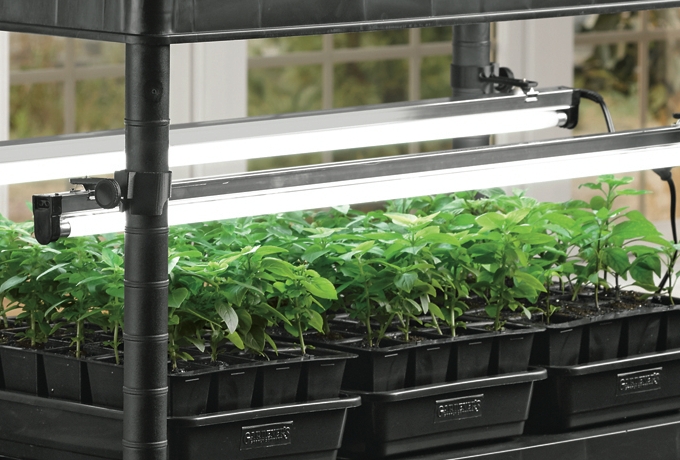
Indoor lights can bring seeds to life. Photo/Gardener’s Supply Company

Indoor lights can bring seeds to life. Photo/Gardener’s Supply Company

Fill the containers with a sterile well-drained potting mix or seed starting mix. Once the containers are filled, plant the seeds according to the seed packet directions.

For most seeds, plant them twice their diameter deep and gently water. Continue to water often enough to keep the soil slightly moist. Extend the time between watering and increase your seed starting success by covering the container with plastic. Or purchase a seed starting kit.

Move your containers to a sunny window as soon as the seedlings emerge from the soil. Turn plants often to encourage even growth. Or increase your success by growing seedlings under artificial lights. You can make your own light system or purchase tabletop, shelf units or easy to assemble light systems. Keep the lights four to six inches above the top of the seedlings for best results. As the seedlings grow, be sure to maintain this distance by simply raising the lights or lowering the containers.

Move overcrowded seedlings to larger containers once they have two sets of true leaves. The first leaves that appear are rather indistinct and are called seed leaves. The next set of leaves look more like the mature plant’s leaves and are called true leaves. Once the next set of true leaves forms, it is time to transplant overcrowded seedlings.

Use a fork or spoon to carefully lift out the seedling. Clusters of seedlings can be dug and carefully teased apart before planting in individual pots. Be careful not to pinch and damage the young tender stems.

Place seedlings in their own clean container filled with moist sterile potting mix. Plant the young plants at the same depth they were growing in the original container.

Thin seedlings started in individual containers as needed. If you planted several seeds in each small container remove all but the healthiest one. Prune the weaker seedlings to ground level, so the remaining seedling can develop into a strong transplant for the garden.

Continue to grow your plants in a sunny window or under artificial lights and water thoroughly and often enough to keep the soil slightly moist.

Soon it will be time to move your homegrown transplants into the garden.

Gardening expert, TV/radio host, author and columnist Melinda Myers has more than 30 years of horticulture experience and has written more than 20 gardening books.


Study: High altitude living-depression linked

By Kristen Moulton, Salt Lake Tribune

The loss of oxygen from living at high altitudes or with chronic health issues can lead to depression.

A study from the University of Utah found that female rats living for a week at simulated high altitudes of 10,000 feet, 20,000 feet and 4,500 feet showed signs of depression. Lake Tahoe is at 6,250 feet. Male rats showed no ill effects.

“The significance of this animal study is that it can isolate hypoxia as a distinct risk factor for depression in those living at altitude (hypobaric hypoxia) or with other chronic hypoxic conditions such as COPD, asthma or smoking, independent of other risk factors,” said Shami Kanekar, a research assistant professor of psychiatry at the university and lead author of the report.

In the study published last month in High Altitude Medicine and Biology online, researchers gauged the animals’ depression based on their persistence during a swim test.

Because rats do not respond to the same psychological and societal pressures as people, the research strengthens the argument that physiological changes from low oxygen can contribute to depression.

Read the whole story


Businesses turning customers into guests

By Hilary Stout, New York Times

The long line moves slowly. Clutching baskets of detergent, dental floss and such, the errand-running patrons of Walgreens assume their places with resignation, seeking only to pay and get out the door.

But when at last they reach the front, a cashier greets each one with a smile and the customer service salutation of our time:

“Following guest, please!”

It’s one of those head-scratchers of daily life that no one can explain. Somehow, at some point, the queued-up masses at drugstores, grocery checkouts, banks and retail establishments from Uniqlo to Staples became “guests” in the common service lexicon, instead of “customers.”

The linguistic turn has spawned eyebrow-raising and the occasional Twitter grumble or Internet rant over the years. One can easily imagine a “Seinfeld” discourse on the topic if the show were still in production.

We decided some reporting was in order get to the bottom of how this tic spread from the turndown service at a hotel to the pumps at a gas station.

Read the whole story


Nursing home, assisted-living expenses can decimate savings

By Jake Lowrey

People pondering their retirement years often conjure images of spending more time on a favorite pastime or traveling around the country or the world.

Health concerns can intrude on those idyllic scenes, though, not only affecting enjoyment of life but also punching a heavy dent in retirement savings.

As we age, usually our medical or long-term care expenses increase, sometimes depleting our assets to a level of crisis.

It’s important for retirees, and anyone planning for retirement, to become educated about what the pitfalls are and what they need to do to avoid losing their life savings.

Long-term care especially can burn a hole in savings accounts. In 2012, for example, nursing home care averaged $74,800 a year, according to a report by the Henry J. Kaiser Family Foundation.

Meanwhile, assisted living facilities averaged $39,500 per year, and home-health services averaged $21 per hour.

More than 10 million Americans need some sort of long-term care, the Kaiser report said. That number covers all ages, even children, but about half are people 65 and older.

Those older Americans had looked forward to enjoying their golden years. They should be able to have actual golden years instead of what can end up being scary years, both personally and financially.

Certainly, being able to maintain good health is a key factor in protecting savings and making retirement enjoyable and satisfying, he says.

But life doesn’t always work out that way. Fortunately, there are strategies seniors can use to lessen the impact of expenses brought on by long-term care needs.

Some of those include:

• VA benefits. Military veterans may be able to offset nursing home or assisted-living expenses through benefits provided by the U.S. Department of Veteran Affairs. A veteran’s eligibility for long-term care services would be determined based on his or her need for ongoing treatment, personal care and assistance, as well as the availability of the service in the area where the person lives, according to the Department of Veteran Affairs.

Other factors, such as financial eligibility, a service-connected disability, insurance coverage, and/or ability to pay may also come into play.

• Medicaid compliant SPIAs. A SPIA is a single-premium immediate annuity. Typically, a SPIA is a contract with an insurance company where you pay the company a sum of money up front (the premium), and the company promises to pay you a certain amount of money periodically for the rest of your life.

A Medicaid compliant SPIA is a specially designed annuity that pays out over the person’s “life expectancy” and has other specific characteristics. A couple who put money in a Medicaid annuity are able to avoid having the income from that annuity count against the financial assistance a spouse receives for nursing home care.

• Setting up a trust. Trusts can help shelter wealth from the look-back periods in Medicaid requirements and assist in qualifying for VA programs, among other advantages.

Jake Lowrey is a financial consultant and president of Lowery Financial Group, an ethical and professional firm that guides clients to retirement success, including planning for long-term care needs. 



Plein air expert to give talk in South Tahoe

Tahoe Art League is kicking off the plein air painting season with Dave Russo on April 8.

At the monthly meeting he will give a presentation and demonstration for the public. It begins at 6pm at the South Lake Tahoe Senior Center.

Working in oil and watercolor, Russo create landscapes that capture the beauty and essence of the Sierra with great detail. He developed his artistic talent at an early age and received the David Epstein Memorial Art Scholarship, which afforded him the opportunity to live with Picasso in France for a year. He later earned his master’s degree in art from San Francisco State University and then a doctorate from Stanford University, where he later taught.

Most recently he has been teaching at Lake Tahoe Community College.

Glen Alpine Falls, Cathedral Meadow, Sand Harbor and Blue Lakes are just a few of the sites the group will visit this season. The initial session will be April 12, with a visit to the historic ranch of Ida Glazier on Foothills Road in the Carson Valley, where it may be possible to see lilacs and apple trees in bloom.

The Tahoe Art League meets the second Wednesday of each month at 6pm at the South Lake Tahoe Senior Center, 3050 Lake Tahoe Blvd., South Lake Tahoe, California. For more info, go online.