The serious business of pulp fiction

By Paula Rabinowitz

Cheap paperback books are like sex: They claim attention, elicit memories good and bad, and get talked about endlessly. The mid-20th century was the era of pulp, which landed in America in 1939.

You could pick up these paper-bound books at the corner drugstore or bus station for a quarter. They had juicy covers featuring original (and sometimes provocative) art, blurring the lines between canonical literature (Emily Brontë and Honoré de Balzac) and the low genres of crime, romance, and Westerns. Even fairly tame cover images grabbed attention. “The Unexpected!”, Bennett Cerf’s 1948 collection of “high tension stories” for Bantam Books, featured a cover by artist Ed Grant of a woman and a man — both in proper suits, though hers is flaming red — standing horrified in front of an open trapdoor. It hints at the thrills within.

Paperbacks went beyond lurid fiction. They brought high culture and scholarly nonfiction to readers, covering every conceivable taste and topic, from anti-Semitism (James Parkes’ 1946 “An Enemy of the People”) to works by diplomats, philosophers, physicists, anthropologists, even Sigmund Freud and Stendhal.

At 25 to 35 cents a pop — wages for a night of babysitting or the cost of a pack of cigarettes — paperbacks could be had by anyone, and so enabled teenagers and poor and working people to enter fully into the cultural landscape. Irving Shulman’s “The Amboy Dukes” was passed among Brooklyn street kids who emulated the gangs rampaging through the novel; bored housewives whiled away hours in suburbia minding house and children by reading paperbacks they picked up at the grocery store. In the 1950s, these books created secret communities of readers who fashioned identities through ownership; women in rural America might come to recognize themselves as lesbians after finding “Women’s Barracks” by Tereska Torrès on a candy store rack; would-be intellectuals could glimpse William Gaddis’ postmodernism in the “New American Library’s New World Writing” collection.

Unlike other forms of mass media that could be consumed at home — radio and later, television — paperbacks offered more than ephemeral content. Compact enough to carry anywhere, they were total packages, providing content not only through the text in their pages and illustrations on their covers, but also as objects. The books’ shape, smell, feel, even the sound of their cracking bindings helped to create a rare sense of connection among readers, booksellers, publishers, and authors. E.L. Doctorow, who was an editor at New American Library before becoming a published author, remembers his first deep reading experience plowing through the first 10 Pocket Books published in 1939 while he languished in a hospital bed recovering from a near-fatal disease.

Paperbacks could be serious business. “In His Eye Is on the Sparrow” (1952), Ethel Waters told her story of fighting against racism, poverty, and abuse to become a breakthrough singer and actress on Broadway and in Hollywood. Declaring her birth, “October 31, 1900, was the date, Chester, Pennsylvania, the place, which makes me, I trust, an American citizen,” she connects her life to that of the century and the nation, making clear that by 1951, even before Brown v. Board of Education, a poor, black woman claimed full citizenship in this country. Daphne Rooke’s “”Mittee (1953) unveiled South African apartheid through an interracial love triangle involving a white man, a white woman, and her mixed race female servant. The book included a glossary of Afrikaans terminology for U.S. readers to enlarge their vocabulary and open their eyes to distant parts of the world.

Since the publication of my book “America Pulp: How Paperbacks Brought Modernism to Main Street”, I have had the moving (and somewhat bewildering) experience of hearing very personal stories that confirm my argument about how paperbacks permeated daily life. Dozens of people — total strangers, long-ago boyfriends, friends of friends, collectors, bibliographers — have written me emails and letters, and sent me packages containing pulp pulled from their shelves.

I recently received an email from one reader, who wrote about her relative, Jack Nemec, an immigrant who wrote a dozen kinky titles, including “Sin Caravan”, “The Spy Who Came to Bed”, and “The Darkest Urge”. She learned about these books after his death; some relatives are a “smidge embarrassed that we have a ‘porn’ writer in the family,” she wrote — in fact, they threw out all his books after he died. Nemec’s books are hard to come by these days; she has read only one, “Is She a Dyke?” Her email concluded that she is a “bit proud that we’re a part of this little part of Americana.”

Her pride zeroes in on the crux of what pulp meant in the middle of the 20th century — and how we might understand it now. These books are a little piece of Americana; they linked the midway to the bedroom. The plot of Nemec’s “Easy Sue” — there’s one copy available on eBay — features an enormous woman who finds fulfillment working in a carnival where she meets the human giant; he’s well endowed. And yet the book’s design — its sleazy cover and handy shape — resembled the cover of William Faulkner’s novel “The Unvanquished”. Appealing to every taste, paperbacks were (and still are) trafficked — bartered, bought, exchanged, sequestered, hidden, destroyed … and loved. Because they carry traces of both the illicit and aspirational, they figure as distillations of America’s various dreams.

Pulp elevated working people into writers and collectors and was a quirky means for immigrants to assimilate to American culture. A rural Midwesterner moved to New York City and found paperbacks were the vehicle for his social mobility. The man’s daughter, who lives in the Netherlands, sent me a copy of his memoir. Karl Zimmer became “a Johnny Appleseed from the Heartland [who] spread American books across three continents.” In the 1950s, he drummed Ian Ballantine’s paperbacks to booksellers up and down Manhattan while working “a night job operating a machine that extruded insulation onto electric cable at a factory in Brooklyn.”

Hawking paperbacks was an uncommon route out of the Midwest and into pulp; most entered as consumers, picking something off a rack. A New York artist described in an email how she remembered her parents’ bedroom side tables filled with paperbacks. They bought the books at Pete Bianchi’s soda fountain and tobacco store in Ohio, “where our father used to take us kids for comic books and treats, and where he could peruse the rotating shelves of pulp mysteries.” Those drugstore visits to find books that were unavailable at the local library still inhabit readers’ memories. Encountering pulp was a family affair, undertaken together, in plain view, not hidden in a plain brown wrapper as Nemec’s novels surely would have been. Those books were a part of the landscape of Smalltown, U.S.A. They made us who we are: a pocket-book nation.

Cheap paperbacks helped to forge modern ideas about race, sex, war, science, and much more. During their heyday from the late 1930s to the late 1950s, pulp spread the practice of everyday reading, bringing to a mass audience of avid readers — everything from smut to theology; from whodunits to “Macbeth”. Paperbacks ’R’ Us.

Paula Rabinowitz is professor of English at the University of Minnesota and author of “America Pulp: How Paperbacks Brought Modernism to Main Street”. She wrote this for What It Means to Be American, a national conversation hosted by the Smithsonian and Zócalo Public Square.

Poets to read at LTCC

National Poetry Month is being celebrated at Lake Tahoe Community College with two Nevada poets on April 21 at 7pm in the Roberta L. Mason Library.

Reno’s Poet Laureate, Gailmarie Pahmeier, and poet and teacher Shaun T. Griffin will read selections from their works, answer audience questions, and sign copies of their books, which will be available for sale.

Pahmeier, Reno’s first poet laureate, has been a Nevadan for more 30 years. She teaches creative writing and contemporary literature courses at the UNR, where she was honored with the Alan Bible Teaching Excellence Award and the University Distinguished Teacher Award.

Griffin is the co-founder and director of Community Chest, a rural social justice agency serving children and families in northwestern Nevada since 1991. For more than 20 years he has taught a poetry workshop at Northern Nevada Correctional Center and publishes a journal of their work.

The event is free.


Report: Burning Man population slightly richer than before

By Jenny Kane, Reno Gazette-Journal 

Burners have a little more change in their dusty pockets than they used to.

Burners of 2014 were about $5,000 wealthier per Burner than those of 2013, according to the Black Rock City census released Friday. Fewer of the Burners were first-timers, as well.

The Black Rock City census is an annual report that sheds light on any shifts in the Burning Man demographic, whether it be their income, gender, race, sexuality or how they experience the Burn.

Since 2001, Burning Man has asked Burners to share information about themselves in order to help Burning Man assess how it is changing.

Read the whole story


‘First Generation’ to be shown at LTCC

There will be a screening of the documentary “First Generation” at Lake Tahoe Community College’s Duke Theatre on April 10 from 6-8pm.

The film tells the stories of four California high school students who are trying to break out of the cycle of poverty they’re in by pursuing a college education.

LTCC’s TRiO-SSS program, which provides support services to first-generation students like those portrayed in the film, is sponsoring this free film.

There will be a post-film discussion led by LTCC TRiO-SSS Coordinator Anna Lee about how local TRiO programs help low-income, first-generation students avoid some of the pitfalls seen in the film.


Experts: Compulsive texting causing neck injuries

By Lily Dayton, Los Angeles Times

Dean Fishman, a chiropractor in Florida, was examining an X-ray of a 17-year-old patient’s neck in 2009 when he noticed something unusual. The ghostly image of her vertebral column showed a reversal of the curvature that normally appears in the cervical spine — a degenerative state he’d most often seen in middle-aged people who had spent several decades of their life in poor posture.

“That’s when I looked over at the patient,” Fishman says. She was slumped in her chair, head tilted downward, madly typing away on her cellphone. When he mentioned to the patient’s mother that the girl’s posture could be causing her headaches, he got what he describes as an “emotional response.” It seemed the teen spent much of her life in that position. Right then, Fishman says, “I knew I was on to something.”

He theorized that prolonged periods of tilting her head downward to peer into her mobile device had created excessive strain on the cervical spine, causing a repetitive stress injury that ultimately led to spinal degeneration. He began looking through all the recent X-rays he had of young people — many of whom had come in for neck pain or headaches — and he saw the same thing: signs of premature degeneration.

Read the whole story


North Shore honors community, business leaders

North Lake Tahoe honored local leaders and businesses at the 61st annual Community Awards Dinner at the Resort at Squaw Creek last month.

The winners are:

Large Business of the Year: Tahoe Restaurant Collection of Garwoods, Caliente and Bar of America.

Nonprofit Organization of the Year: North Lake Tahoe-Truckee Leadership Program.

Best Place to Work: Tahoe Donner Association.

Hospitality Business Award: Sunnyside Restaurant & Lodge.

Hospitality Super Star Award: JJ Beaty, Fire Sign Café.

Small Business of the Year: Andrew Laughlin, Tahoe City Kayak.

Regional Marketing Award: North Tahoe Business Association & Chamber Collaborative.

Public Servant Award: David Boesch, CEO of Placer County.

Tourism Professional of the Year: Rachael Woods, marketing manager, Northstar.

2014 Citizen of the Year: Stacy Caldwell, Tahoe Truckee Community Foundation.

Distinguished Community Service: Wally Auerbach, Auerbach Engineering.


Moms’ Morning Out — a day of pampering

Women of all ages are invited to attend the fourth annual Moms’ Morning Out on May 2.

Moms’ Morning Out was started by Barton Health as a health and wellness program for new moms. The program has grown and last year more than 200 women, not just moms, participated in the event.

The morning starts at 8 with attendees choosing between a yoga class by Studio Lake Tahoe or Jazzercise with Jodi Stewart.

Other activities, including coffee and brunch from Blue Angel Café, are scheduled from 9am-noon. At their own pace, women may browse wellness booths from local businesses and sign up for a variety of pampering activities, including massage, mini-facials, and hypnotherapy. Barton Health medical providers will also share informative wellness lectures. This year’s topics include Kegels & More – Power Your Pelvis, at 9:15am, Intimacy After Kids and Beyond, at 10:15am, and Identifying Teen (and Tween) Stress at 11:15am.

No reservation is required and all activities are free at Lake Tahoe Community College in the commons area. All attendees must be 12 or older to attend.


Road beat: Kia K900 is understated luxury

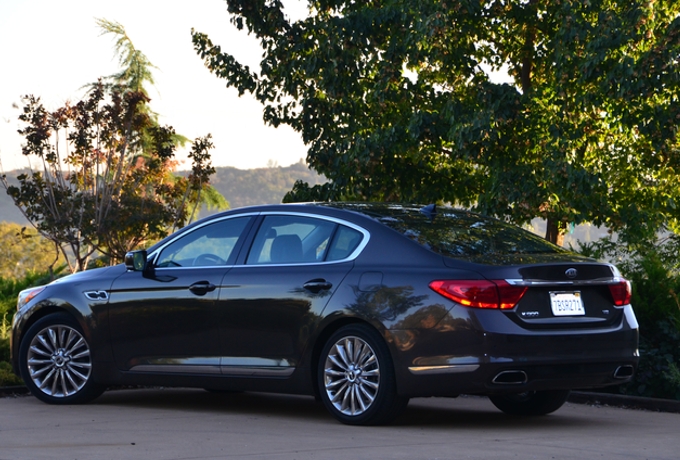
The Kia K900 is understated elegance. Photos/Larry Weitzman

The Kia K900 is elegance redefined. Photos/Larry Weitzman

By Larry Weitzman

Kia is now in the super luxury car business. First they blew us away with the Kia Cadenza, a near luxury/luxury car that the Road Beat was thoroughly impressed with. It had everything, ride, handling stellar performance, good fuel economy, superb quality and great looks. What was not to like? Now a year later Kia dropped another explosive car, the K900. Not much of a name, but oh, what a car.

As you know by now, Kia and Hyundai are effectively two brands owned by the same company so most everything is shared by respective models. It saves money for both. But unlike other manufactures, the exterior and interiors have no sharing. Sharing is in the chassis and powertrains. So while the K900 has mechanical similarities to the ultra luxury vehicle marketed under the name Hyundai Equus, they don’t look alike and have completely different identities.

Specifications Price $60,400 to $66,400 Engine 5.0L, DOHC, 32 Valve V-8 420 hp @6,400 rpm   376 lb.-ft. of torque @ 5,000 rpm Transmission 8 speed automatic Configuration Longitudinal front engine/rear wheel drive Dimensions Wheelbase 119.9 inches Length 200.6 inches Width 74.8 inches Height 58.7 inches Track (f/r) 63.8/64.1 inches Weight 4,555 pounds Fuel capacity 19.8 gallons Trunk capacity 15.9 gallons Steering lock to lock 2.96 turns Cabin volume 110.8 cubic feet Wheels 19X9 inch alloys Tires (f/r) 245/45/275/40 Performance  0-60 mph 5.32 seconds 50-70 mph 2.81 seconds 50-70 mph uphill 3.56 seconds Top speed Does anyone really care? Fuel economy EPA rated 15/23/18 mpg city/highway/combined. Expect 18-19 mpg in suburban, rural driving; 29 mpg on a level highway at 70 mph.

Specifications
Price $60,400 to $66,400
Engine 5.0L, DOHC, 32 Valve V-8 420 hp @6,400 rpm
376 lb.-ft. of torque @ 5,000 rpm
Transmission
8 speed automatic
Configuration
Longitudinal front engine/rear wheel drive
Dimensions
Wheelbase 119.9 inches
Length 200.6 inches
Width 74.8 inches
Height 58.7 inches
Track (f/r) 63.8/64.1 inches
Weight 4,555 pounds
Fuel capacity 19.8 gallons
Trunk capacity 15.9 gallons
Steering lock to lock 2.96 turns
Cabin volume 110.8 cubic feet
Wheels 19X9 inch alloys
Tires (f/r) 245/45/275/40
Performance
0-60 mph 5.32 seconds
50-70 mph 2.81 seconds
50-70 mph uphill 3.56 seconds
Top speed Does anyone really care?
Fuel economy EPA rated 15/23/18 mpg city/highway/combined. Expect 18-19 mpg in suburban, rural driving; 29 mpg on a level highway at 70 mph.

K900 has a cleaner look, with no swoops or extraneous lines. The front end is simple and clean with a wide mouth grille with an interior surround that has Kia’s trademark slight indentations. But what makes the K900 special are the super trick LED headlights. Well done, Kia. The understated and elegant body is pulled taught from the rear creating a muscular surface tension. In addition you can see the striking resemblance between the K900 and the Cadenza.

It is a large car with a 120-inch wheelbase and a length of 200.6 inches. While it looks low, K900 isn’t with a height of 59 inches. But width is a bit narrow at 75 inches making handling in tight places a bit easier. Interior dimensions are huge with nearly 111 cubic feet of cabin volume plus a 16 cubic foot trunk. Limousine proportions abound in the rear seating area.

K900 is so smooth and quiet the entire car feels like its two tons of creamy butter. And that goes for the entire vehicle, mechanicals and interior appointments. You need to experience this ride; it is special, very special.

Under the hood is a silky DOHC, 32 valve V-8 that cranks out 420 of the quietest and smoothest horses ever encountered by this cowboy (and I have had more than a few) at 6,400 rpm accompanied by 376 pounds of twist at 5,000 rpm, meaning this engine is making about 358 hp at that engine speed. The power is transferred to the rear wheels via a baby-butt smooth 8-speed automatic tranny, a tranny that sometimes seems slow to respond. Of course the systems have every piece of electronic wizardry available to mankind such as traction control, an Advanced Vehicle Safety Management system and probably the ability of direct communication with the International Space Station.

Performance is absolutely world-class with an average 0-60 mph elapsed time of 5.32 seconds. The acceleration seems to increase with speed. Catch the right gear at the right time; it almost gets scary quick. And it does it with an uncanny quiet and smoothness. Passing performance is equally exhilarating with 50-70 mph simulated passing times of 2.81 and up a 6 percent grade barely slowing that time to 3.56 seconds. The K900 rocks. Now here is the best part, the K900’s comparatively amazing fuel economy. EPA rates the K900 V-8 at a somewhat guilt ridden 15/23/18 mpg city/highway/combined. But during 400 miles of mostly suburban driving and only 40 miles of highway time, mostly driven for testing, the big K900 average between 18-19 mpg. The K900 averaged 24 mpg in a roundtrip from Placerville over the Sierra to South Lake Tahoe and back. On top of that in a two-way average the K900 averaged 29 mpg on a level highway at 70 mph. The engine spins a low 1,750 rpm at that speed. With its 20-gallon fuel tank, an easy 500 plus miles is doable nonstop.

Being a sophisticated, world-class automobile means a sophisticated world-class suspension that it has in the form of a refined MacPherson strut system upfront and a multilink system on the rear. It rides on 19 x 9 inch alloys with huge 245/45 series tires up front and superwide 275/40s in the rear. Track is also wide at 64 inches and steering is a reasonably quick 2.96 turns lock to lock. That should add up to fantastic handling, but it doesn’t and the reason is there is little feedback through the numb steering. That doesn’t mean the K900 doesn’t corner, it does. The cornering power with the wide track and big wheels and tires is tenacious, it just takes some attention and concentration to guide it when your speed is close to excessive and the road bends. Now we are talking here about racetrack like conditions, not normal driving where the K900 is an absolute pleasure to navigate.

Remember maneuvering in tight places? Well the K900 makes it easy with front and rear cameras, plus giving you a 360-degree vertical view of everything surrounding your car (Around view monitor) as you move. That system was a first for me and simply amazing. You should never bump into anything ever again.

By now you must think that the K900 rides beautifully and it does soaking up bumps like nobody’s business. And it does it in a very muted way. But it is not a floater; the ride is also very solid and controlled. The quiet of the K900 is deafening. There is no road, wind and engine noise, none. About the only time you get to hear it’s wonderful V-8 burble is at half throttle or more. Although it lets you know it’s there with a muted roar at full throttle.

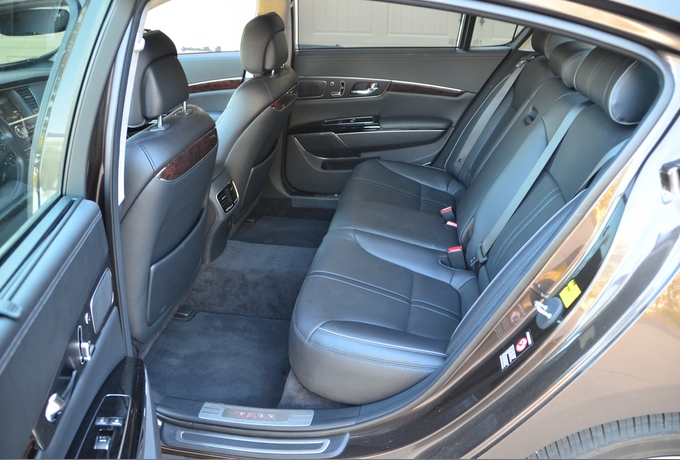
Plenty of room for passengers.

Plenty of room for passengers.

Braking is by four-wheel ventilated discs at all four corners and they are powerful stopping the big Kia in 42 feet from 40 mph. K900 has just about every conceivable system, TV screen display, and beeper warnings to attempt to keep you safe. It is a buffet of safety. Even the heads up display has a blind spot detection display and a lane departure warning system. The next thing will be a ballistic recovery system that will automatically deploy a parachute if you drive of a cliff or flotation devises beyond the multiple airbags if you took an inadvertent sea cruise. LED lighting is outstanding.

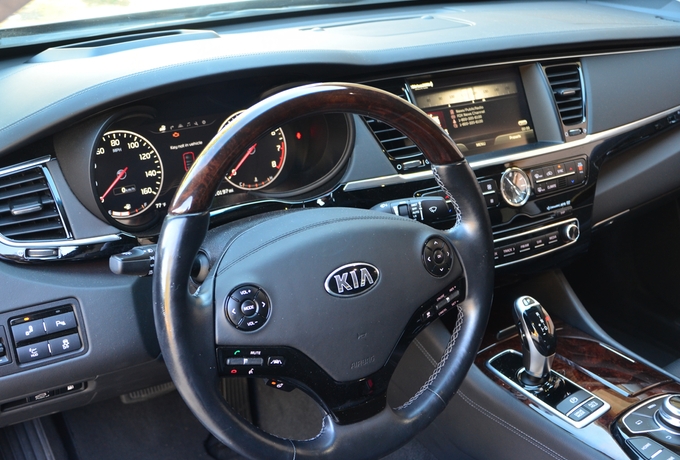
Soft Nappa leather covers the seats and most everything inside is soft touch materials. Rear seat leg room is about the most copious I have ever seen. Instrumentation is a complete TFT LCD cluster displaying an analog tach and speedo plus ancillary gauges and a trip computer. Good stuff. Kia claims 17 speakers for its Lexicon sound system. I often thought I was in a much nicer appointed Carnegie Hall.

Operating the basic sound system is fairly easy, but getting deeper into all its features does require some learning. It is a bit complex. Both seat controls are located conveniently on the doors. The trunk is a large 16 cubic feet and well shaped with the trunk hinges enclosed for protecting any cargo. The quality of the materials and fit and finish are second to none.

Pricing starts for the V-8 at $59,500 plus $900 for the boat from Korea. My tester had the $6,000 VIP package which contained the TFT instrument display, the Surround view monitor, head’s up display, Smart cruise control, Advanced Vehicle Safety Management System and some other items. Fancy carpeted embroidered floor mats are standard! Personally, I would go with the standard K900 without the VIP package. In value terms, K900 sets new standards. And a new 311 hp V-6 model is coming and will be thousands less.

Larry Weitzman has been into cars since he was 5 years old. At 8 he could recite from memory the hp of every car made in the U.S. He has put in thousands of laps on racetracks all over the Western United States.


Millennials changing the hotel market

By Hugo Martin, Los Angeles Times

At the latest breed of hotel, rooms are up to one-third smaller than traditional quarters, with furniture that looks fresh from an Ikea showroom.

The work desk is downsized and might double as a nightstand. The Internet speed is super fast. The Wi-Fi is free. Power outlets and USB ports dot the walls, especially near the bed to accommodate binge watching.

The target is the millennial traveler, ages 18 to 34, who likes to stay connected online, eat on the run and commune with other millennials.

Hotel giants, including Marriott International and Hilton Worldwide, are launching brands with names such as Moxy, AC, Edition, CitizenM and Canopy. Even billionaire Sir Richard Branson has a new millennial-oriented chain, dubbed Virgin Hotels.

Read the whole story


Healthy strategies key to dealing with stress

By Kathryn Reed

Getting rid of stress might not be possible, but how one deals with it can lead to a healthier outcome.

Money, work, health and relationships are the top stressors for people in the United States.

Identifying the stressors is the first step to being able to get rid of them.

Sonia Rupp with Barton Psychiatry last week shared ideas about how to cope with stress. Nearly 70 people gathered at Lake Tahoe Community College to hear the talk.

One of the problems is people often choose ways to cope with the stress that compound the problem. It could be chilling in front of the TV, overeating or choosing unhealthy food, or drinking alcohol.

Rupp said a drink at the end of the day to take the edge off is probably one of the worst things someone can do. This is because alcohol is a depressant. The booze also can lead to a poor night’s sleep.

“More and more women are using alcohol as an unhealthy strategy,” Rupp said.

Lack of sleep comes with its own set of issues, which can exacerbate the stress.

Bed is not the place to be reading, watching TV or working on a computer. Sleep and intimacy, Rupp said, are the only activities that should occur in bed.

Being active, getting quality sleep and not drinking are the better ways to handle the stress.

“When you can’t control the stress, it’s important to have healthy coping habits,” Rupp said.

She suggested taking a few minutes every day to breathe. It doesn’t have to be full-on meditation, but just enough time to let the brain turn off and not have the worrisome thoughts be all consuming.

Rupp also suggested mental exercises to divert attention to something other than what is causing the stress. Creative outlets are also encouraged, especially because they tend to provide a sense of accomplishment.