Study explains sugar-stress correlation

By Gabrielle Canon, Mother Jones

Here’s something that won’t come as a surprise to anyone who has ever devoured a pint of Rocky Road after a miserable day at work: Researchers at UC Davis recently found that 80 percent of people report eating more sweets when they are stressed.

Their study, published in the the Journal of Clinical Endocrinology & Metabolism, offers a possible explanation.

Sugar, the researchers found, can diminish physiological responses normally produced in the brain and body during stressful situations. With stress levels on the rise, this could explain why more people are reaching for sweets.

Read the whole story


Ethnicity of author changes readers’ perspective

By Sunili Govinnage, Washington Post

In 2014, I decided that for the entire year, I would not read books written by white authors. My goal was to address the reading practices I developed growing up in Australia, where white authors have dominated the literary world. My high school reading list was filled with the “classics” — Shakespeare, Austen, the Brontes, Euripides — and well-known modern writers such as Margaret Atwood and T.S. Eliot. After school, my pleasures came from bestseller lists, which also were filled with Anglo names: John Grisham, Peter Carey, Hilary Mantel. Then I read “Questions of Travel” by Sri Lanka-born Michelle de Kretser. It moved me so deeply that I decided to evaluate the literature I was reading. I quit my standard diet to expose myself to new perspectives.

But it was much harder than I expected to discover books by nonwhite authors. The resources most readers use to find good literature left me with all the usual suspects. White authors reign in book reviews, bestseller lists, literary awards and Amazon.com recommendations.

In a survey of New York Times articles published in 2011, author and cultural commentator Roxane Gay discovered that nearly 90 percent of the reviewed books were authored by white writers. Among Amazon editors’ top 20 picks of 2014, just three authors were minorities.

Read the whole story


Tahoe Tails — Adoptable Pets in South Lake Tahoe

Sir Cedric

Sir Cedric

Sir Cedric is a 3-year-old tabby and white shorthair cat with big pointy ears. Cedric also has extra toes on his huge front paws.

Plus, Cedric has a huge heart — he loves attention. He may get along with other cats given the right introduction and patience. Due to a kind donor, Cedric’s adoption fee is just $20.

Cedric is neutered, microchipped, tested for FIV, and vaccinated. He is at the El Dorado County Animal Services shelter in Meyers, along with many other dogs and cats who are waiting for their new homes. Go to the Tahoe animal shelter’s Facebook page to see photos and descriptions of all pets at the shelter.

Call 530.573.7925 for directions, hours, and other information on adopting a pet. For spay-neuter assistance for South Tahoe residents, go online.

— Karen Kuentz


Car rental insurance can make sense

By John Scarpinato, Outside

We’ve all been there, waiting at the car rental counter, exhausted from traveling, when the desk agent reels off a series of optional insurance coverage add-ons.

They all seem reasonably important, but they can leave you wondering if you’re being baited. The answer isn’t that simple, but these tips from insurance advisor Jenny McNeal, will help you make a more informed decision.

Whether the rental company describes this coverage as a collision or loss damage waiver (CDW or LDW), it’s essentially the same thing. Its purpose is to protect you from loss or damage to the car you are renting, regardless of whether you have your own insurance.

Most personal auto insurance plans cover this sort of damage even if you’re driving a rental vehicle, so people often opt out of the CDW. But McNeal says the policy can be worth the money. “Most people understand that their auto insurance already provides the type of coverage that an LDW does, but they don’t consider the deductible,” she says. If your deductible is higher than the LDW or CDW fee, it’s worth paying the extra fee for the protection — especially if you’re driving or parking in dangerous areas, tight streets, or in countries with notoriously poor drivers.

Read the whole story


Poetry is going extinct, government data show

By Christopher Ingraham, Washington Post 

Is verse a dying technique? How dead is poetry? Who killed poetry? Does anybody care?  Is poetry dead?  Is poetry dead? Is poetry dead?

Inquiries into the death of poetry comprise a tradition almost as rich and varied as American poetry itself. Earlier this month, a college literary magazine proposed a tidy solution to the evergreen problem: “if you have to keep declaring, over and over, that poetry is dead, it can’t actually be dead.”

Fair enough. Most of discussion around the question involves qualitative assessments that are inherently unsolvable. Is poetry too political, or not political enough? Is it too popular, or too elitist? Too pretentious or tooprofane?

I can’t answer any of these questions. But there are a number of facts about poetry that are knowable, and given that April is National Poetry Month(which I bet you didn’t know), now would be a good time to know them.

Read the whole story


A happy marriage is the ‘me’ marriage

By Tara Parker-Pope, New York Times

A lasting marriage does not always signal a happy marriage. Plenty of miserable couples have stayed together for children, religion or other practical reasons.

But for many couples, it’s just not enough to stay together. They want a relationship that is meaningful and satisfying. In short, they want a sustainable marriage.

“The things that make a marriage last have more to do with communication skills, mental health, social support, stress — those are the things that allow it to last or not,” says Arthur Aron, a psychology professor who directs the Interpersonal Relationships Laboratory at the State University of New York at Stony Brook. “But those things don’t necessarily make it meaningful or enjoyable or sustaining to the individual.”

The notion that the best marriages are those that bring satisfaction to the individual may seem counterintuitive. After all, isn’t marriage supposed to be about putting the relationship first?

Not anymore.

Read the whole story


Study: Too many vitamins may increase cancer risk

By Matt Keller, KGO-TV

Your mom always told you to take your vitamins, but that advice may be bad for your health.

Many studies show eating fruits and vegetables can reduce the risk of cancer and heart disease, but what about vitamins?

A new report reveals taking too many supplements can actually increase the risk of some cancers. “The idea was give people more vitamins and it would prevent cancer, but they find when they do a lot of these studies is it can do the exact opposite and it’s hard to know what’s safe,” ABC News Chief Health and Medical Editor Richard Besser said.

Read the whole story


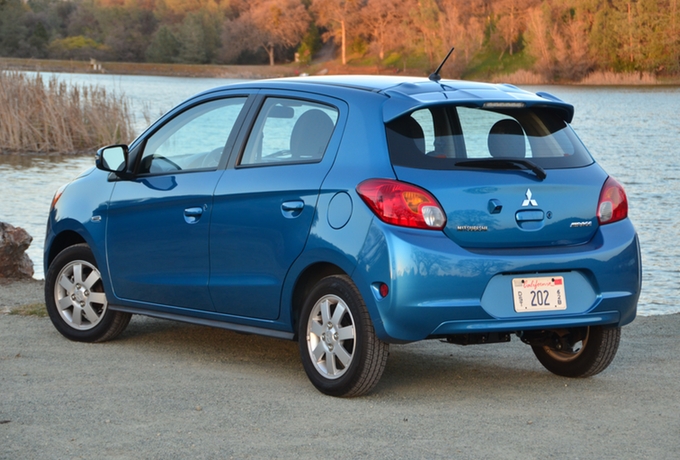
Road beat: Mirage gas mileage is impressive

The Mirage would make for a great commuter car. Photos/Larry Weitzman

The Mirage would make for a great commuter car. Photos/Larry Weitzman

By Larry Weitzman

Let’s get one thing straight from the beginning, the Mitsubishi Mirage makes gas stations a mere mirage as it is the highest mileage conventional car for sale in the United States. EPA rates the Mirage at 37/44/40 mpg and in fact it did a bit better in my testing. It also has one of the lowest acquisition costs of any new car for sale in the U.S., with a starting MSRP of $12,995.

And no, that doesn’t mean that the front seats are recycled orange crates. That price includes niceties such as keyless entry and power windows, locks and mirrors. Even seven airbags, ABS, a vehicle stability system, traction control, TPMS and a lot more are also standard. It is a well equipped car.

Mirage is a small car, a rounded two-box design to maximize its space efficiency. While devoid of lots of complex lines, the Mirage has a pleasant, softly rounded simple modern look with decent proportions. The slopping top line adds a dash of sport. It rides on a long 96.5-inch wheelbase, while its length is only 148.8 inches, making it about a hand longer than 12 feet. A Mini Cooper is slightly longer. Width is relatively wide at 66 inches while standing tall at 59 inches, dimensions almost fitting of a small SUV.
Specifications  Price Engine 1193 cc DOHC 12 valve inline three cylinder 74 hp @ 6,000       74 lb.-ft. of torque @ 4,000 Transmission Five speed manual CVT automatic Configuration Transverse front engine/front wheel drive Dimensions Wheelbase 96.5 inches Length 148.6 inches Width 65.6 inches Height 59.4 inches Ground Clearance 6.3 inches Track (f/r) 56.3/56.7 inches Fuel capacity 9.2 gallons Trunk capacity rear seats up/down 17.2/47.0 cubic feet Tires 165/65/14  Turning circle 32.1 feet Weight (ES CVT) 2,051 pounds  Performance 0-60 mph 10.52 seconds 50-70 mph 5.87 seconds 50-70 mph uphill (6%) 12.89 seconds Top speed beyond sanity Fuel economy EPA rated 37/44/40 mpg city/highway/combined Expect about 40-41 mpg in rural county driving; 44-45 on the highway at legal speeds

Specifications
Price
Engine 1193 cc DOHC 12 valve inline three cylinder 74 hp @ 6,000
74 lb.-ft. of torque @ 4,000
Transmission
Five speed manual
CVT automatic
Configuration Transverse front engine/front wheel drive
Dimensions
Wheelbase 96.5 inches
Length 148.6 inches
Width 65.6 inches
Height 59.4 inches
Ground Clearance 6.3 inches
Track (f/r) 56.3/56.7 inches
Fuel capacity 9.2 gallons
Trunk capacity rear seats up/down 17.2/47.0 cubic feet
Tires 165/65/14
Turning circle 32.1 feet
Weight (ES CVT) 2,051 pounds
Performance
0-60 mph 10.52 seconds
50-70 mph 5.87 seconds
50-70 mph uphill (6%) 12.89 seconds
Top speed beyond sanity
Fuel economy EPA rated 37/44/40 mpg city/highway/combined Expect about 40-41 mpg in rural county driving; 44-45 on the highway at legal speeds

Under the short hood is unique three-cylinder long stroking DOHC, 12 valve 1,200 cc engine (1.2 liters) cranking out all of 74 horses at 6,000 rpm and an equal amount of torque at 4,000 rpm. The rule of thumb for estimating an engine’s torque production is a pound per cubic inch. The 1,200 cc Mirage engine equates to about 74 cubes, the exact peak torque number for the Mirage. But remember the engine only has to deal with 2,051 pounds. Still not exactly a powerhouse as my Kawasaki ZRX motorcycle has 1,200 ccs in four cylinders and makes about 125 hp (at 10,000 rpm). Weighing 535 pounds the Kawi has the edge on performance. More on that later.

Power is transferred to the front wheels via a CVT tranny. A five-speed manual is standard.

Performance is about as you would expect in that this vehicle wasn’t designed with NASA in mind unless earthbound NASA employees wanted to save gas. Zero-60 mph times averaged 10.52 seconds which is about two seconds quicker than a 1955 Chevy V-8, a car once thought to be sort of a hot rod. Simulated passing times from 50-70 mph on a level road averaged 5.87 seconds and up a steep grade (6 percent) that time slows to 12.89 seconds. During a trip to South Lake Tahoe up Highway 50 I was able to make several passes in the many passing zones during the uphill climb; just do a little planning. For most people, especially flatlanders, the performance is more than adequate.

Throttle response is good, but one thing I noticed is the tranny keeps the rpms between 5,200 and 5,600 rpm during maximum performance which restricts hp by perhaps a few ponies. When you ask for flank speed the computer that controls the tranny should allow max hp which is 6,000 rpm. When you are at 6,000-7,000 feet and are already down 20 percent on max power an extra 5-7 hp would be nice.

Now to the raison d’être for the Mirage, fuel economy. You already know the EPA numbers, but what is it like in real life. The Mirage averaged 41 mpg in 350 miles of driving with only 20 miles on a level freeway during highway mileage testing when the Mirage averaged 44-45 mpg, about equal to your average small hybrid. In that 150-mile roundtrip from Rescue to South Lake Tahoe and back where speeds averaged about 60 mph even up the Western Slope, the Mirage averaged about 45.2 mpg. Remember that Kawasaki ZRX1200 motorcycle? It averaged about the same mpg during the same trip averaging the same speeds. While the Mirage engine spins a low 2,300 rpm at 70 mph, that Kawasaki spins about 3,800 at the same speed.

Mirage achieved the highest fuel economy numbers of any conventional car tested by the Road Beat (about 850 cars) and even beat most hybrids tested except for some later model Priuses. The Mirage not only outperformed the hybrid Honda Insight in acceleration, it returned overall better fuel economy by a couple mpg (Insight was tested in 2010).

Mirage’s biggest handling asset is that it is lightweight. Light cars change directions easier than heavier cars all else being equal. Suspension is a state of the art MacPherson strut up front plus a semi-independent torsion bean in the rear, pretty standard for most compact cars and smaller. Wheels and tires are rather small at 14 inches with 165/65 rubber. I’ve seen bigger glazed doughnuts. Actually, 14-inch wheels and tires were standard on most 1957 and later U.S. made cars for about 10-15 years. That means most full size GM, Ford and Chrysler products, like Chevy Impalas, Ford Crown Vics and Plymouth Furies. Even my 1972 Camaro SS came with 14 inch/70 series wheels and tires.

Handling because of its size, weight and front and rear track of 56 inches is nimble up to about seven-tenths cornering. Yes, there is some body roll, tire squirm and understeer going into a slight oversteer, but unless pushed beyond eight-tenths, drivers will say the Mirage is nimble. If you want more, spend $10K more for a Mini, lose a good 5-7 mpg plus the Mirage’s 100,000-mile powertrain warranty. Wall-to-wall turning circle is a dime sized 32 feet. Steering had excellent on center feel as if it were locked on a target. It is fun to drive.

You might think a small car like the Mirage would have a choppy ride and find every expansion joint on the freeway. But that is not the Mirage. It rides like most every good quality compact car, smooth on the highway and it can smooth out more severe road punishment. It really surprised me. About the only complaint is a bit of road noise on rougher surfaces, but going down the highway at 70 mph is a pleasure, smooth and reasonably quiet. Even the engine is unobtrusive.

And safety is not compromised as the front disc/rear drum brakes stop the Mirage in 41 feet from 40 mph, one foot off the benchmark 40 feet. Seven airbags are standard as well as all the safety acronyms. A buffet of safety.

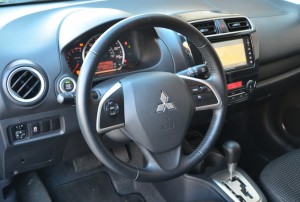
Now to the inside. It’s purposeful with a simple binnacle dash with a large speedo and smaller tach plus digital readouts for fuel, fuel economy, trip meters and alike. In the ES model, entry is push button as is the start, no key necessary but the fob in your pocket. Seats are done in an upscale cloth and are comfortable. I spent nearly two hours each way to Tahoe with no fatigue and good support. And the back seat is amazing considering how small this car is. It is comfortable for two good sized adults.

With the rear seats up there is 17 cubic feet of cargo capacity. Fold the seats flat and cargo volume expands to 47 cubic feet which is close to the size of a compact SUV. Mirage has one small issue; it only has a 9.2-gallon gas tank. Another half a cubic foot would give it 13 gallons and much more convenience.

While pricing starts at a fin below $13,000 plus $810 for the boat from Thailand, my loaded tester stickered at $15,395 plus $900 for the trick NAV system and backup camera plus destination. Even Bluetooth is standard. Mirage is inexpensive to buy, inexpensive to run and really inexpensive to maintain, never mind that five-year 60,000 mile bumper to bumper warranty plus Mirage’s 10-year 100,000-mile powertrain warranty. Even the tires for this Mirage are inexpensive, more than a large glazed doughnut, but probably about a quarter of the price of a full-size car or truck tire.

Larry Weitzman has been into cars since he was 5 years old. At 8 he could recite from memory the hp of every car made in the U.S. He has put in thousands of laps on racetracks all over the Western United States.




Plein air artist to display work in Meyers

Bona Fide Books will host an art reception for plein air painter Claudia A. Garza on May 1, 6:30-8:30pm at its shop in Meyers. This event is free and open to the public.

Raised in Chicago, Garza is a longtime art lover who began studying with Phyllis Shafer and Dave Russo at Lake Tahoe Community College when she moved to South Lake Tahoe in 2004.

Garza’s landscape collection, “Another Glorious Sierra Day . . . ”— named after the John Muir quote — will be at Bona Fide Books through May.

Bona Fide HQ is located at 1069 Magua St., No. 4, behind the Getaway Café in Meyers.

For more information, contact Publisher Kim Wyatt at editor@bonafidebooks.com or 530.573.1513.


Tahoe Tails — Adoptable Pets in South Lake Tahoe

Murray

Murray

Murray is one of several small, fluffy dogs that have just arrived at the Tahoe shelter to find new homes. He is a very sweet little poodle, 5 years old, who loves to go for walks and car rides.

If you are lucky enough to visit the shelter when all the little dogs are outside, go sit on the bench. All the dogs will swarm you, looking for attention. Murray will jump up on the bench and will be content to just lean up against your shoulder.

Murray is neutered, microchipped, tested for heart worm, and vaccinated. He is at the El Dorado County Animal Services shelter in Meyers, along with many other dogs and cats who are waiting for their new homes. Go to the Tahoe shelter’s Facebook page to see photos and descriptions of all pets at the shelter.

Call 530.573.7925 for directions, hours, and other information on adopting a pet.

For spay-neuter assistance for South Tahoe residents, go online.

— Karen Kuentz