Author to talk about characters of the Comstock

John Mackay and William Sharon were the wealthiest of the men to emerge from Nevada’s Comstock Lode. They were also the most influential.

Mackay, who rose from poverty, was the hero of Virginia City, respected by its miners and mine owners, idolized by its children. Sharon, the brains behind the “Bank Crowd,” was generally perceived as a villain: when Sharon ran for the U.S. Senate, Nevada’s leading newspaper, the Territorial Enterprise, characterized him as a “hyena.”

Michael Makley will talk about how these two Comstock kings battled each other, amassed their fortunes, and how they used their wealth on May 30 at 10am as part of the Ferris Family Speaker Series at the Dangberg Ranch in Minden.

Makley is the author of seven books on Western history.

This is a free outdoor event. The park is located at 1450 Highway 88, one-quarter mile north of the Carson Valley Veterinary Hospital. Visitors are encouraged to bring a lawn chair or use one of the park’s chairs. Dogs are not permitted in the park.


ABC newsman Woodruff to give talk

Award-winning television journalist Bob Woodruff will give a talk on the North Shore on June 6.

Woodruff is widely known as a past co-anchor of ABC News’ broadcast “World News Tonight”. In 2006, while reporting on U.S. and Iraqi security forces for ABC, he was critically wounded by a roadside bomb. The traumatic brain injury nearly killed him.

His recovery inspired his family to do one thing: Give injured heroes access to the high level of support and resources they deserve, for as long as they need it. In 2006, the Bob Woodruff Foundation — Helping heroes on the homefront was founded. More than $25 million for 110 programs nationwide have been funded.


Tickets to the Squaw Valley Institute event are $15 advance, students $10, children 9 and under and SVI Members and US Military personnel admitted free. Advance ticket reservations are recommended. Doors open at 5:30pm, the talk is at 6:30pm at the Olympic Village Lodge. A Q&A will follow the talk.


Elder orphans a growing social issue

By Carina Storrs, CNN

Recently a 76-year-old man known as HB, whose health had been deteriorating, tried to take his own life and was admitted to North Shore University Hospital on Long Island.

Doctors decided that HB would not be able to go back to living by himself because of his condition and complications while in the hospital. With his only family across the country and no social support in the area, the man was placed, possibly permanently, in a nursing home.

The experience of HB is not unusual. His story is a case study of the problem of “elder orphans.” These seniors are single or widowed; they have no children, at least in the area, and no support system. And they find themselves alone with no one to help care for them when they need it.

Although the problem of elder orphans has been known for a while, new research suggests just how bad it is. About 22 percent of Americans 65 years and older are in danger of becoming, or already are, in this situation. As of 2012, there were 43 million people over 65 in the U.S., up from 35 million in 2002.

Read the whole story


40-hour work week may be falling out of fashion

By JJ Feinauer, Deseret News

In 1938, Congress passed the Fair Labor Standards Act as part of then president Franklin D. Roosevelt’s New Deal. As a result, the 40-hour workweek (based on the eight-hour workday) became fully integrated, and legislated, as part of American corporate culture.

CNN Money’s Jeanne Sahadi argues that it may be time for change.

The 40-hour workweek, according to Sahadi, may actually be stunting worker productivity. But not because it stops employees from working more, but because it leads to too many instances of overwork.

According to Sahadi, the notion of a 40-hour workweek is, in general, a myth in the first place. Salaried employees, he argues while citing a Gallup poll from last year, typically work seven hours more than what’s required of them each week, and they feel pressure to work above and beyond the legislated limits.

Read the whole story


Tahoe Tails — Adoptable Pets in South Lake Tahoe

Sparky

Sparky

Sparky is a cute little boy who looks older in his photo than he actually is. He’s only 1 year old. Sparky is a spaniel mix, about the size of a large Chihuahua, with beautiful long fur.

He loves attention and is very affectionate, and is a little bundle of happy, friendly energy. Sparky loves to go for walks, but won’t object if you carry him part of the way.

Sparky is neutered, microchipped, tested for heart worm, and vaccinated. He is at the El Dorado County Animal Services shelter in Meyers, along with many other dogs and cats who are waiting for their new homes. Go to the Tahoe shelter’s Facebook page to see photos and descriptions of all pets at the shelter.

Call 530.573.7925 for directions, hours, and other information on adopting a pet.

For spay-neuter assistance for South Tahoe residents, go online.

— Karen Kuentz


Brilliant, brainy books to take to the beach

By Zócalo

Summer is a time of familiar comforts: the scent of sunscreen and the feeling of sand between toes, the taste of Bomb Pops and the sight of long, late, orange sunsets. But with the multiplexes filled with sequels, reboots, and retreads, and the beginning of a long election season crowded with familiar names, don’t you think something original is in order? In the spirit of getting out of our comfort zones this summer and taking a crack at something new, we asked recent Zócalo guests for the fresh and forthcoming nonfiction books they think curious people should bring to the beach, pool, bar, and porch this summer.

“Encounters at the Heart of the World: A History of the Mandan People” by Elizabeth A. Fenn

This book is for all readers who think that we don’t have enough evidence to tell the histories of Native American peoples. Fenn counteracts that view with a marvelously deft history that weaves together resources as disparate as textual evidence, folkloric traditions, and climate science. The book fills long-lived holes in our collective understanding of the experience of Native American peoples on this continent.

— Danielle Allen, author of “Our Declaration and Institute for Advanced Study”,political philosopher

“Ghettoside: A True Story of Murder in America” by Jill Leovy

This is what the best nonfiction should be, and why a great true story will always trump an amazing novel. There’s savage, whip-smart, acid prose, iconic characters, and a driving narrative, but underlying that is a deeply argued, impeccably researched, gut-wrenching look at the tragic and flawed injustice at the core of violence in black America. A must read, but also a thoroughly enjoyable one.

— David Sax, author of “The Tastemakers”

“The Wright Brothers” by David McCullough

As always, McCullough is terrific at describing the personal and social side of important historical events.

— Robert D. Putnam, author of “Our Kids” and “Bowling Alone”, and Harvard University political scientist

“Everything You Ever Wanted: A Memoir” by Jillian Lauren

“Everything You Ever Wanted” is, in brief, about an adoptee who adopts a baby herself, but like all the best memoirs, it’s both personal and universal. It expands outward to encompass so many experiences and feelings we all share: love, loyalty, struggles with the past, what it means to take a profound and longed-for risk. Lauren is fierce and funny and unsparingly frank, and this book crackles with pain, love, truth, joy, and an abundance of excellent writing.

— Kate Christensen, author of “Blue Plate Special”

“The Prize: Who’s in Charge of America’s Schools?” by Dale Russakoff

Russakoff offers a rare window inside urban school reform in an age of unprecedented investment — but precarious-at-best community support.

— Elizabeth Green, author of “Building a Better Teacher”

“It’s a Long Story: My Life” by Willie Nelson

As a music journalist, I’ve interviewed Willie Nelson a few times — and yes, one of those times was on his tour bus. He was a candid and captivating storyteller, a warm-hearted outlaw with a unique perspective on his life as a singer, songwriter, and activist. And so first on my list of summer beach reads is his new autobiography. We all know Willie’s music, but equally interesting are his musical journey and his boundary-pushing, from bucking the established Nashville Sound of the ’60s to his current crusade to legalize marijuana.

— Denise Quan, entertainment journalist and producer

“The Sixth Extinction: An Unnatural History” by Elizabeth Kolbert

This book should be required reading in schools, the U.N., the IMF, the Chinese Politburo, and everywhere else. Kolbert knows her stuff—hard-edged, data-driven science! — and she writes swimmingly well.

— Ann Louise Bardach, author of “Without Fidel”

“Even This I Get to Experience” by Norman Lear

It’s moving, funny, beautifully written, and it spans show biz, politics, history, and dysfunctional families. Bonus: If you get the audio version, Lear recorded it — and he’s a terrific performer.

— Marty Kaplan, USC communications scholar and Jewish Journal columnist

Spain: The Centre of the World 1519-1682 by Robert Goodwin

As an artist whose work is highly involved with Mexican history and culture, I have been trying to fill in my historical gaps on the history of Spain. After recently reading “Dogs of God: Columbus, the Inquisition, and the Defeat of the Moors“ by Edward Reston, I have been searching for another book that picks up the thread. I’ve already pre-ordered “Spain: The Center of the World 1519-1682” by Robert Goodwin, which will be published in July. The book picks by where Reston left off and examines the Golden Age of Spain and its supremacy in Transatlantic exploration.

— Judithe Hernández, muralist

“Pig Tales: An Omnivore’s Quest for Sustainable Meat” by Barry Estabrook

“The Chain: Farm, Factory and the Fate of Our Food” by Ted Genoways

“Every Twelve Seconds: Industrialized Slaughter and the Politics of Sight” by Timothy Pachirat

 These three books about meat/processing plants/pigs are wonderful reads (doesn’t sound like it, right?). In order of easier to take to gutsier (sorry):

In “Pig Tales”, Estabrook takes an engaging look at the pig — its wild and domestic origins and our relationship with it on small sustainable farms — and focuses a critical eye on our large industrial “factories.”

In the absorbing “The Chain”, Genoways focuses on five Hormel plants. It’s hard to underplay how riveting this tale of line workers, union leaders, hog farmers, local politicians, and activists is. You will never eat Spam again.

And in “Every Twelve Seconds“, which began as a doctoral thesis, Pachirat goes undercover as an employee in a large slaughterhouse to investigate how the workers are affected by the seen and the unseen. It’s a fantastic read.

— Evan Kleiman, host of KCRW’s “Good Food”



World War I’s heart is kept in the heartland

By James MacLeod

World War I was one of the most destructive events in human history, killing about 16 million soldiers and civilians worldwide, including 116,000 Americans. It did more than just destroy lives. It destroyed confidence in progress, prosperity, and the rationality of civilized society, perhaps the most treasured characteristic of the 19th century.

The Great War also arguably destroyed much of the next generation: those who would have provided leadership to Europe in the dark days of the 1920s and 1930s, when once again the continent began sliding towards annihilation.

World War I also happens to be the most spectacularly memorialized war in history. In Britain alone, there are more than 50,000 war memorials. What many may not know is that three of the greatest World War I memorials in the world are located in the Midwestern United States: in St Louis, Kansas City, and Indianapolis.

The Soldiers’ Memorial Museum, in the heart of downtown St. Louis, is a huge and deeply impressive building dedicated in 1936 by President Franklin D. Roosevelt as a memorial to the 1,075 men from St. Louis who died in World War I. The memorial is spectacular — all mosaics and marble, with terrazzo floors and four huge Bedford stone sculptures entitled Loyalty, Vision, Courage, and Sacrifice.

The memorial’s centerpiece is a vast black granite cenotaph – Greek for “empty tomb” – covered with names of the fallen, in neat row upon neat row. It is a classical temple in some ways, full of symbolic carved figures, symbols of victory, with a huge empty tomb at its core.

The second impressive World War I site in the Midwest is the Liberty Memorial in Kansas City, which broke ground in 1921 and was dedicated on Nov. 11 (Armistice Day), 1926. It was the result of a remarkable design competition, and an even-more remarkable fundraising campaign. In less than a year, $2.5 million had been raised through donations from more than 83,000 contributors.

The winner of the international design contest for the structure was Harold Van Buren Magonigle, a distinguished American architect. It is centered on a 268-foot-tall tower that dominated – and still dominates — the skyline of this part of the city. At the top of Van Buren’s structure are four symbolic “guardians,” each standing at 40 feet high, entitled Honor, Courage, Patriotism, and Sacrifice.

A “flame of inspiration” burns from the tower each evening. Below this is the “Great Frieze,” which depicts the optimistic story of humanity’s march from an era of war to an era of peace. The sculpture, created by Great War veteran Edmond Amateis, runs about 488 feet long and is 48 feet tall.

The names of the 441 Kansas City war dead are listed inside of one of the two temple-like buildings that sit on either side of the tower. Outside, we see Kansas City’s version of the cenotaph – two empty cinerary urns, which would in antiquity have contained the ashes of the dead, flank the entrance of both buildings. And there are also two huge sphinxes: “Memory,” which faces the east toward the battlefields of Europe, shields its eyes from the atrocities of war. “Future” faces the west, covering its eyes from a future that is unknown. The overall effect of this memorial is quite stunning, and it is wholly appropriate that is now home to the National World War I Museum.

The third noteworthy U.S. World War I memorial is in Indianapolis. Five downtown blocks were razed to make space for War Memorial Plaza, which is the biggest war memorial project ever undertaken in the United States. It has three distinct elements – a cenotaph, an obelisk, and a war memorial shrine, which itself contains a shrine within a shrine. The cenotaph – which memorializes James Bethel Gresham of Evansville, the first American casualty of the war – is surrounded by four columns, topped by eagles.

The 100-foot black granite obelisk was built in 1923, and the square was completed in 1930. Near its base are four-by-eight-foot panels to represent law, science, religion, and education – the sculptor said, “upon these four fundamentals are built the foundation of our nation, without any one of which it could not long survive.”

Gen. John Pershing laid the cornerstone of the memorial shrine on July 4, 1927. One of the biggest war memorials in the world, it is so packed with symbolism and references to the history of memorialization that it almost defies analysis. One of the highlights is the sculpture on the outside steps entitled Pro Patria; it is 24 feet high, weighs seven tons, and was the largest cast bronze sculpture in the United States.

And finally, there is the “shrine room.” A huge American flag hangs over an empty tomb, blue lights shine from above, with light coming from an ornate chandelier known as “Star of Destiny.” The massive ceiling is supported by dramatic, blood-red marble columns, and the empty tomb, sometimes referred to as the “Altar of the Flag,” is guarded by four fire urns. In the words of American historian Jared Mayo, “Among American war memorials, there is no equivalent to the shrine room. The craftsmanship and grand opulence of its interior has not been surpassed.”

Like all war memorials, these three represent a paradox – they are elaborate celebrations of nationalism, and of military success, yet by having at their core a focus on the dead, they are also a powerful reminder of the cost of war. For all their splendor, the real purpose of these war memorials, and of our Memorial Day commemoration, is to draw our minds back to the men and women who fight the wars, and who pay the price for our freedoms.

Mayor Bernard Dickmann of St. Louis made these remarks upon the public opening of the St. Louis Soldiers’ Memorial to the public in 1938: “We who live, because others have died, should make of this shrine a place of love and a monument of peace.”

These are fitting words for any Memorial Day.

James MacLeod is professor of history at the University of Evansville. He has researched, written and lectured on war memorials, and is currently completing a book – “Evansville in World War II: A City Transformed” – that will be published by the History Press later this year. He wrote this for What It Means to Be American a national conversation hosted by the Smithsonian and Zocalo Public Square.


Human rights activist-poet coming to LTCC

Poet, professor, and human rights activist Carolyn Forché will be at Lake Tahoe Community College on May 28.

Forché will read selections from her works, answer audience questions, and sign copies of her books, which will be available for sale.

Forché’s first poetry collection, “Gathering the Tribes” (1976), won the Yale Series of Younger Poets Competition, and was then published by Yale University Press. In 1977, she traveled to Spain to translate the work of Salvadoran-exiled poet Claribel Alegría. She then received a Guggenheim Fellowship, which enabled her to travel to El Salvador where she worked as a human rights advocate. Her second book, “The Country Between U”s (1981), received the Poetry Society of America’s Alice Fay di Castagnola Award, and was also the Lamont Poetry Selection of the Academy of American Poets. In 1998, Forché received the Edita and Ira Morris Hiroshima Foundation for Peace and Culture Award for her human rights advocacy and her work on the preservation of memory and culture.

Other books include a memoir, “The Horse on Our Balcony” (2010, HarperCollins); a book of essays (2011, HarperCollins); and a fifth collection of poems, “In the Lateness of the World” (Bloodaxe Books, due out this year). Forché is perhaps best known for her famed international anthology, “Against Forgetting” (1993), which was praised by Nelson Mandela as “a blow against tyranny, against prejudice, against injustice.”

LTCC’s Writers’ Series is committed to providing a cultural outlet for students and the community by hosting free readings, discussions, craft talks and workshops with nationally known, award-winning authors, as well as poetry slams, open mic nights and student readings.

The free event is at 7pm in the board room.


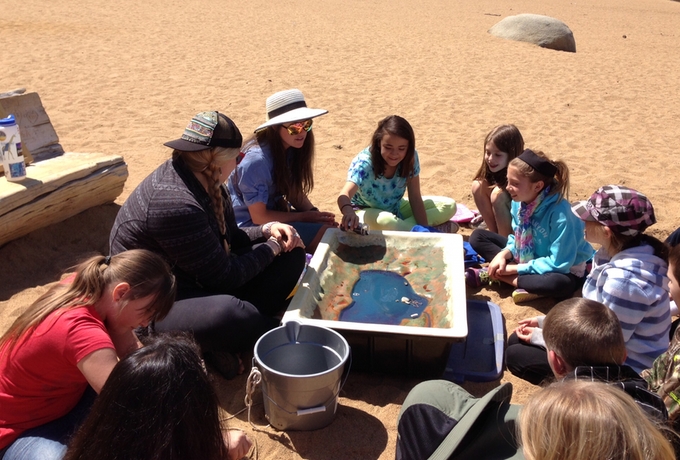
ZCES kids learn about water issues at the lake

Zephyr Cove Elementary School fourth-graders learn from their environment. Photo/Stella Roper

Zephyr Cove Elementary School fourth-graders learn from their environment. Photo/Stella Roper

By Malin Kennedy

The fourth-grade class at Zephyr Cove Elementary School attended a three-hour outdoor lesson that focused on teaching the impact of water quality on Lake Tahoe.

The lesson, directed by the Great Basin Outdoor School, is part of a program at ZCES this year that combines place-based education with Common Core curriculum.

Even with low lake levels, the research vessel Prophet was able to take the class out to test water clarity, oxygen saturation, and water temperature. Each group tested the clarity of the lake with a Secchi disc and discussed the properties of the scientific process and how the process is used in real work happing on the lake.

After the on-board experiments, the class went ashore to test and demonstrate the effects of pollution, construction and life on the clarity of Lake Tahoe. The children quickly linked the connection between water clarity and a healthy ecosystem.

“It was a great experience. We learned about keeping Lake Tahoe clean on the research vessel the Prophet, and at the beach at Zephyr Cove. Our favorite part was being on the beach and playing Bear, Salmon, Mosquito,” said fourth-graders Jena White and Lilly Dingman.

This lesson on Lake Tahoe created a hands-on experience that combined science, mathematics, geology and sociology.

One lesson on the beach visually demonstrated that very little of the earth’s water is usable to humans and the importance of water conservation.


S. Tahoe families struggle to find stable housing

By Nicole Zaborsky

Homelessness has many faces. Some are old, some are young. It affects all races, religions and sexes. It can be triggered by a poor economy, inconsistent work, a medical catastrophe, and death of a family member. In Lake Tahoe Unified School District there are 246 homeless students.

I recently sat down with one of those students to understand a day in the life of a homeless student.

For five months, Keira (not her real name) has been living in a one-room motel with four other family members and pets. The cost of a motel is $35 a night or $1,065 a month.

“We move weekly. Our homelessness is a result of inconsistent employment. In December of last year, we were living in a three-bedroom house. We had a kitchen, we each had a bed, and we had a proper place to do our homework,” she said.

Homeless takes on many forms in Lake Tahoe. Photo/Albert Bridge

Homelessness is a serious issue in South Lake Tahoe. Photo/Albert Bridge

While they are appreciative they have a roof over their heads, there is a desire to better their living situation.  At most motels, there is only a hot plate and no refrigerator, which can lead to families eating less healthy and more expensive meals. Many families eat prepared foods because of the lack of kitchen appliances, meal preparation space. And for Keira’s family, because they are moving each week.

“It’s overwhelming. Our family’s situation is like being in a hole and there is no movement. It’s hard to get up in the morning, and it’s hard to get to school, but I don’t give up. When I come to school, I leave my baggage at the door and focus on the progress in myself,” she said.

To cope with her five months of homelessness, Keira says, “I distract myself. I hang out with friends and we go on hikes. I try not to dwell on my situation. My pets help me cope.”

She can easily feel stuck, and overwhelmed that the family situation is not progressing.

“I focus on myself and my education to ensure I graduate from high school in June. I will be the first in my family to graduate,” Keira said.

LTUSD counselors and staff work with the homeless youth and their families. They assist families to connect to community resources such as food, apartment searches and job leads. Wait lists for Section 8 housing, credit and reference checks, and saving the money for the deposit are barriers to homeless families obtaining long-term housing.

Keira shares, “We have faced renter abuse. Our family has been given verbal promises that a house will be rented to us in exchange for cleaning it. Then the landlord never returns our calls.”

Keira has a job. Her income assists the family pay for food, rent and basic needs. Her story is one that many of our community members face.

There is a Warm Room Committee that has been meeting to develop multi-pronged options for families facing homelessness or unstable housing. The next Warm Room Facilities Advisory Group meeting is June 5, 10:30am at Live Violence Free. Volunteers are welcome to assist with tasks and actions.

Additionally, the St. Joseph Community Land Trust has begun to accept donations to assist LTUSD families transition from motel to long-term rental housing. Call 530.541.8930 for more information. Checks may be mailed to St. Joseph Community Land Trust, 1041 Lyons Ave., South Lake Tahoe, CA 96150. Mark the check “Motel to Housing Fund”.

Nicole Zaborsky is coordinator for the Lake Tahoe Collaborative and member of the Warm Room Committee.