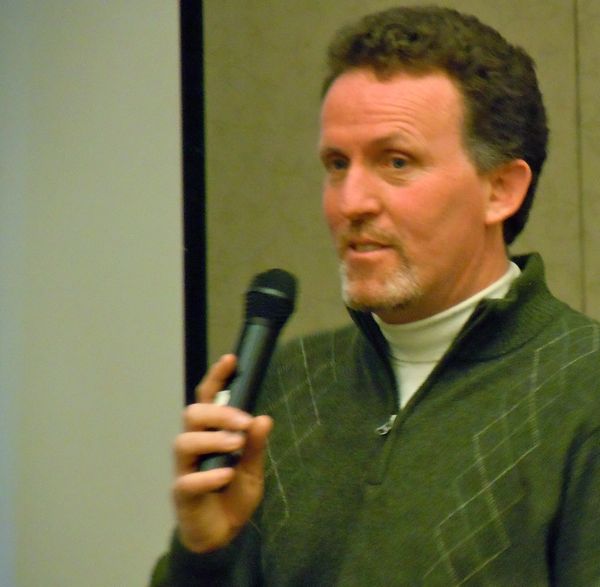
How a curmudgeonly old reporter exposed the FIFA scandal

By Michael E. Miller, Washington Post

The biggest news story of the year was breaking, but the journalist responsible was fast asleep.

It was just after dawn on May 27 when Andrew Jennings’s phone began ringing. Swiss police had just launched a startling raid on a luxury hotel in Zurich, arresting seven top FIFA officials and charging them and others with running a $150 million racket. The world was stunned.

The waking world, that is. If Jennings had bothered to climb out of bed, he wouldn’t have been surprised at the news. After all, he was the man who set the investigation in motion, with a book in 2006, “FOUL! The Secret World of FIFA: Bribes, Vote Rigging and Ticket Scandals,” followed by an exposé aired on the BBC’s “Panorama” program that same year, and then another book in 2014, called “Omerta: Sepp Blatter’s FIFA Organised Crime Family.”

“My phone started ringing at six in the morning,” Jennings said Tuesday from his farm in the hilly north of England. “I turned it off actually to get some more sleep, because whatever is happening at six in the morning is still going to be there at lunch time, isn’t it?”

If you can’t tell already, Jennings is an advocate of slow, methodical journalism. For half a century, the 71-year-old investigative reporter has been digging into complex, time-consuming stories about organized crime. In the 1980s, it was bad cops, the Thai heroin trade and the Italian mob. In the ’90s, he turned to sports, exposing corruption with the International Olympic Committee.

For the past 15 years, Jennings has focused on the Federation Internationale de Football Association (FIFA), international soccer’s governing body. As other journalists were ball watching — reporting scorelines or writing player profiles — Jennings was digging into the dirty deals underpinning the world’s most popular game.

Read the whole story


Road beat: IS 350 — best Lexus model

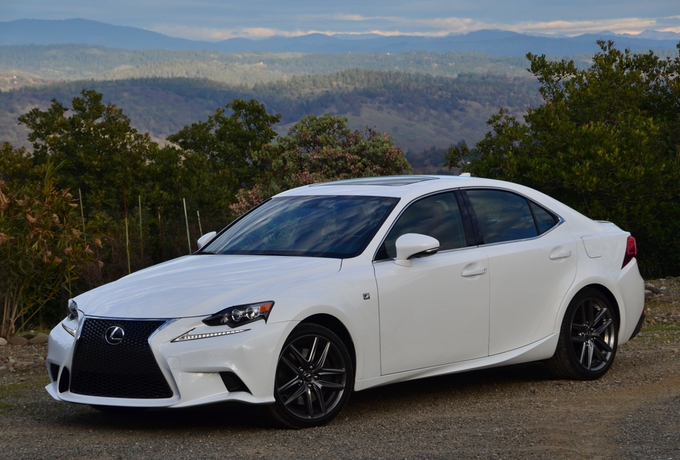
Lexus IS 350 continues to impress. Photos/Larry Weitzman

Lexus IS 350 continues to impress. Photos/Larry Weitzman

By Larry Weitzman

It’s been five long years since I last tested the Lexus IS 350 and not much has changed my opinion that this IS is dollar for dollar the best ride in the Lexus line up and perhaps the best Lexus model, although I haven’t tested the new RC coupe yet. As far as Lexus sedans go, it is the highest performing, best handling, best looking of the brand while being the smallest and yet extremely comfortable.

Since its introduction as a 2006 model there have been a few changes. Wheelbase has grown by about 3 inches to 110 inches and length is up by a corresponding amount to 184 inches, but height and width remain at 56 and 71 inches, respectively, as well as the very aggressive and pleasing design. Lexus has refreshed the front end to conform with its L’finnesse design theme while also sharpening the edgy theme that was already present in areas like the lower rocker panels. It is still the best looking Lexus sedan. But there are more improvements elsewhere.

Specifications Price $40,990 to about $49,000 Engines  3.5L, 24 valve, DOHC V-6 306 hp @ 6,400 rpm   277 lbs.-ft. of torque @ 4,800 rpm      	   Redline 6,600 rpm Transmission Eight speed automatic with paddle shifters Configuration Longitudinal front engine/rear wheel drive/all wheel drive (IS250 AWD) Dimensions Wheelbase 110.2 inches Length 183.7 inches Width 70.9 inches Height 56.3 inches Track (f/r) 60.4/60.6 inches  Weight 3,593 pounds ((IS350) Weight distribution 54/46 percent Trunk capacity 13.8 cubic feet Fuel capacity 17.4 gallons Steering lock to lock 2.58-3.493 turns Turning circle 34.2 feet Wheels (opt) 18X8/18X8.5 inch alloys Tires (f/r opt) 225/40X18/255/35X18 Brake diameter (f/r) 13.15/12.2 inches  Coefficient of drag 0.28 Performance 0-60 mph 5.05 seconds  50-70 mph 2.51 seconds 50-70 uphill 3.18 seconds Top speed Artificially limited at 143 mph and I believe them. Fuel economy EPA rated 19/28/22 mpg city/highway/combined (IS350).  Expect 20-21 mpg in rural country driving and 28 mpg on the highway in the IS350.

Specifications
Price $40,990 to about $49,000
Engines
3.5L, 24 valve, DOHC V-6 306 hp @ 6,400 rpm
277 lbs.-ft. of torque @ 4,800 rpm
Redline 6,600 rpm
Transmission
Eight speed automatic with paddle shifters
Configuration
Longitudinal front engine/rear wheel drive/all wheel drive (IS250 AWD)
Dimensions
Wheelbase 110.2 inches
Length 183.7 inches
Width 70.9 inches
Height 56.3 inches
Track (f/r) 60.4/60.6 inches
Weight 3,593 pounds ((IS350)
Weight distribution 54/46 percent
Trunk capacity 13.8 cubic feet
Fuel capacity 17.4 gallons
Steering lock to lock 2.58-3.493 turns
Turning circle 34.2 feet
Wheels (opt) 18X8/18X8.5 inch alloys
Tires (f/r opt) 225/40X18/255/35X18
Brake diameter (f/r) 13.15/12.2 inches
Coefficient of drag 0.28
Performance
0-60 mph 5.05 seconds
50-70 mph 2.51 seconds
50-70 uphill 3.18 seconds
Top speed Artificially limited at 143 mph and I believe them.
Fuel economy EPA rated 19/28/22 mpg city/highway/combined (IS350). Expect 20-21 mpg in rural country driving and 28 mpg on the highway in the IS350.

While this particular F-Sport optioned IS 350 gets significant handling upgrades, the powertrain is almost identical to the original 2006 model. It still sports the Lexus 306 hp (at 6,400 rpm) 3.5L V-6 which also knocks down 277 pounds of twist at 4,800 rpm (at 4,800 rpm the engine is making 253 hp). In the process, the IS 350 pick up a couple of speeds as it now sports an eight speed automatic instead of the six-speeder that drives the rear wheels. But if you opt for the AWD version, the tranny reverts to the prior six speed auto, not very significant as you will read.

Performance of the IS 350 is spectacular, but slightly off the prior IS 350 F-Sport test. Zero-60 mph required 5.05 seconds, which is world class. Passing performance is also extremely quick with a 50-70 mph run taking 2.51 seconds and the same run up a 6 percent grade slows that time to 3.18 seconds. On their face these are some of the quickest performance times ever recorded by the Road Beat, but are still slower than two other IS 350 tests (one of those tests also being an F-Sport model) which had average times of 4.55, 2.20 and 2.92 seconds respectively. And those prior tests had six speed trannies. Testing was also performed in the same place so I have no explanation.

Numbers were also down for fuel economy and what makes this so interesting is that window sticker numbers for this 2015 model are up from previous window sticker numbers. This new model was EPA rated 19/28/22 mpg city/highway/combined. My prior 2009 model was rated at 18/25 city/highway. The 2009 model returned in actual testing at 70 mph 31.9 mpg. This new 2015 model “only” averaged 28.0 mpg. Overall fuel economy was 20.0 mpg for the test while the 2009 model averaged 23.5 mpg.  I don’t have an answer as both cars weighed about 3,600 pounds.

F-Sport adds several important features to the IS 350 including Adaptive Variable Suspension, Variable Gear Ratio Steering, F Sport tuned suspension, twin projector LED headlights, 18 inch staggered wheels and 225/40 and 255/35 performance tires front and rear, heated and ventilated seats, high friction brake pads and more. The IS 350 was already the best handling Lexus, it’s a true BMW fighter, but with this additional F-Sport package, not only does it improve handling and cornering power, it rides beautifully. Handling is superb, great steering, super quick turn-in, great balance, body roll control, rotation and more. BMWs beware, big time.

Its ride quality as mentioned above is about the best the Road Beat has ever experienced. It is extremely supple, quiet and solid, like a bank vault. On the highway it is whisper quiet and very buttoned down. Not many cars surpass the IS 350 experience. The engine spins 2,050 rpm at 70 mph and is inaudible unless you ask for some power and then it speaks with an authoritative bark.

Braking with the upgraded four wheel discs are better than benchmark, stopping the IS 350 in 38 feet from 40 mph. Pedal and feel are outstanding. Of course the IS has about every safety acronym in the book. LED headlights with the F-Sport package are, outstanding, but standard with the IS 350 are also dazzling HID headlights.


Some of the controls are cumbersome.

Some of the controls are cumbersome.

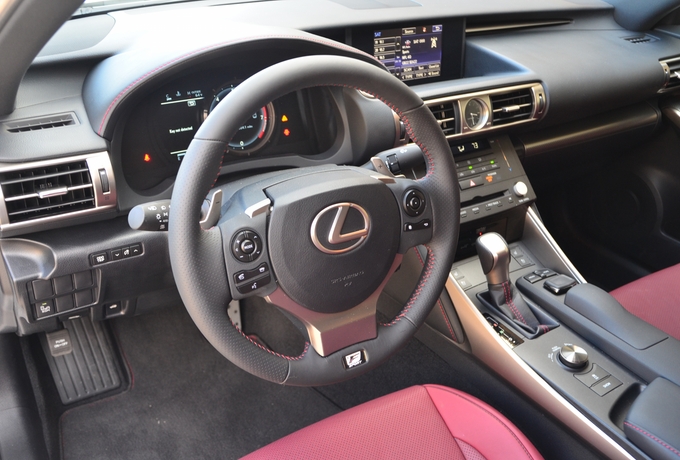
Now to perhaps the best part, the cockpit. While it may be a bit difficult for an old guy like me to get in and out, once ensconced you will be rewarded with some of the best seats in an automobile. Padding is perfect, the shape is totally supportive  and the comfort is extremely long distance. And on top of all that they are great to look at with their sporty design and soft leather.

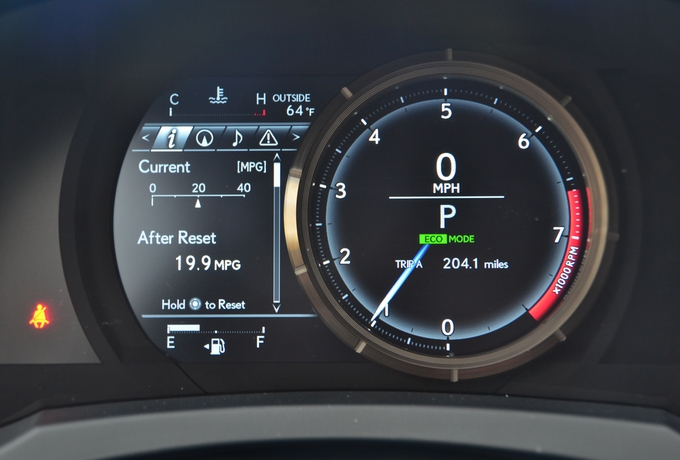
Instrumentation is supposedly taken from the Lexus supercar, the 553 hp, $400K Lexus LFA. It is a TFT screen and the instrumentation is complete with more emphasis on the analog tach than digital speedo.  It works, but I prefer traditional analog gauges for everything. The fit and finish of the rest of the interior is outstanding with soft touch and leather covering most surfaces. While rear seating is adequate for two, I certainly wouldn’t want to be the middle guy.

But all is not perfect. The radio control system which is controlled by a “mouse” as is the rest of the center stack, is difficult to operate. What happened to two round knobs and a few well identified push buttons. Why do manufacturers have to “fix” what isn’t broken? The system is terribly distracting to operate as well. It should be a rule that all mice belong in a trap.

The trunk is large at nearly 14 cubic feet.

Pricing starts for the IS 350 at $40,065 plus $925 from the boat from Japan. Funny how that works out to $40,990. The F Sport  package lists for $3,740 and if it were my purchase that would be part of it as would the $400 Variable Gear Ration power steering rack. However, I am not sure I would opt for the $2,995 Nav system and upgraded radio. The standard sound system which includes XM works for me. But my tester listed for $48,725 all in which also included the $600 blind spot monitor and cross traffic alert. The power moonroof is also standard. This is an extremely well equipped standard ride and compared to other vehicles in its class, it might be the bargain. If you are thinking BMW or alike, you need to drive this Lexus. AWD is also an option.

            Larry Weitzman has been into cars since he was 5 years old. At 8 he could recite from memory the hp of every car made in the U.S. He has put in thousands of laps on racetracks all over the Western United States.


Muir’s heir keeping naturalist’s legacy alive

By Linda Fine Conaboy

Many who live near or play in the Sierra are familiar with John Muir, but his great-great-grandson, not so much. However, Robert Hanna is a name to know for those with an interest in the outdoors.

Hanna, who works for California’s Assembly Republican Caucus, knows the woods and the mountains and the flowers and the trees. And he knows all about his great-great-granddad, although, of course, the two never met.

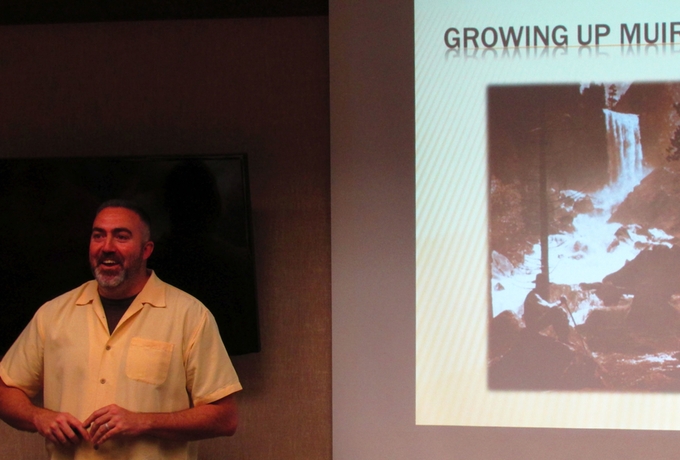
During a May 30 talk presented by the Friends of the Library to a full house at the South Lake Tahoe Library, Hanna gave an overview of all things Muir. Hanna offered more than what is usually presented about the famous Scottish naturalist. He painted an in-depth view of his family from Muir’s birth in 1838 in Dunbar, Scotland, to the present.
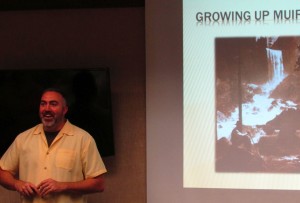
Robert Hanna has become an expert on all things John Muir. Photo/Denise Haerr

Robert Hanna has become an expert on all things John Muir. Photo/Denise Haerr

“I grew up learning about John Muir in a different way, from a family perspective,” he said. “I wanted to create a story of John and his legacy in-depth. I wanted to look at family history in a way that has not been seen before.”

And that’s what he did in his slide show, consisting of more than 100 images, displaying Muir’s sundry sides and personalities and introducing the audience to a no-nonsense, seemingly tough and resilient man and the large family, who throughout the years, have always supported him and his ideals. Hanna tossed out many vignettes and lots of narrative describing a large and boisterous group that he came to know through many family reunions staged mainly at the family’s large ranch holdings in Martinez.

“A lot of people think John Muir was born old,” Hanna laughed, referring to the often stern demeanor he presented in photographs.

However, when you learn about his early life in Scotland and later, in Wisconsin, perhaps there’s a reason for his unsmiling face. Muir was raised by a stern and religious father who mandated that he memorize and repeat nearly three-quarters of the Bible by the time he was 14. He also was required to perform myriad chores on the family farm; in fact, farming was, in his father’s mind, to be young John’s lot in life.

Little did he realize that his son was not destined to become a farmer. Turns out what young John loved most of all was books and machines — especially those machines he invented himself. Like the self-settling table saw and the barometer he constructed from a water clock powered by a stream on the family farm.

Then there was the clock desk, a contraption that not only rousted a student out of bed at a pre-set hour, but then automatically opened and closed various school books at designated times. He designed what he called a “loafer chair”, a device abhorred by any who might wish to slack off during the day. It soon became apparent that Muir was fascinated by clocks and incorporated them into many of his “timely” inventions.

He created some of these at the University of Wisconsin where they were discovered by Ezra Carr and his wife, Jeanne, who became his friend and encouraged him to put his ideas into print and were to play a pivotal role in his later life. The Carrs also introduced young John to Ralph Waldo Emerson, who also became his life-long friend.

The early adventures of John Muir were always interesting and always tempered with a distracting need to make enough money to feed himself. He left the university in 1863 for a foot tour of Wisconsin, Iowa, Illinois and Canada; a pivotal trek that Hanna said led to Muir’s devotion to and love of nature.

The loss of sight in both eyes and the eventual regaining of his vision led him to become extremely introspective. During this episode, he made a pact with God that if his sight returned, he would dedicate himself to nature, according to Hanna. He kept his word to God.

A 1,000-mile trek to Florida gained him a renewed closeness to Mother Nature and also, unfortunately, a raging bout of malaria. His recovery found him journeying to San Francisco — followed by a walking trip to Yosemite. The rest might be colloquially termed as history.

It is Hanna’s belief that time in nature can heal many ills and time spent with others in nature can bring about closeness and a bonding not to be gained elsewhere. For example, Muir cemented his relationship with Emerson during the poet’s brief visit to Yosemite; he was able to convince President Theodore Roosevelt to designate Yosemite a national park in 1890 after a rewarding trip throughout Yosemite’s vast wildness.

It is said that Roosevelt called his excursion with Muir, “some of the best three days in my life.”

Lest he become too much a hermit in the wilds, the Carr family lured Muir out of the woods and introduced him to Louie Strentzel, whom he married. He moved to the family farm in Martinez, made its orchard extremely profitable, thereby, finally becoming a man of money, and raised his two daughters there.

He was on his way back to Martinez, via train, when he developed pneumonia and died in Los Angeles in 1914 at age 76.

One issue Muir fought hardest for was the battle to save the glacial Hetch Hetchy Valley, which lies in the northeastern part of Yosemite National Park. Muir lost his fight and the O’Shaughnessy Dam was constructed 20 years after his death, in 1934, on the Tuolumne River, flooding the entire valley. The water stored there, to this day, travels 167 miles to San Francisco and remains The City’s main water source.

At the end of the fight Hetch Hetchy fight it is said that Muir weighed only 85 pounds. But in the end, he lost; however, now, his great-great-grandson is in the trenches, following his famous relative’s path, doing what he can to convince powerful lobbyists and anyone else who will listen, to drain the Hetch Hetchy Valley and store the water downstream.

“It’s political and it’s a big fight,” Hanna said. “It was wrong to destroy an icon within a national park. I’m going to keep fighting the good fight for as long as it takes.”

Hanna said that besides fighting some good fights, he’s happy now to be telling Muir stories and sharing Muir’s legacy. He closed his presentation with one of his favorite Muir quotes, said to be uttered after the defeat of the Hetch Hetchy project: “No matter, for I’ve had a grand life in these divine mountains and I may yet do something for those coming after me.”
Calif. contemplates microbead ban

By Julia Lurie, Mother Jones

California is the latest state to consider banning products with microbeads, the tiny pieces of plastic, often less than a millimeter wide, that have become a popular addition to cosmetics and personal care products. Usually made of polyethylene, microbeads primarily serve as exfoliants in face washes and body scrubs, but also add color and texture to toothpastes, lip balms, moisturizing creams, and makeup.

A single tube of face wash can contain more than 300,000 of the plastic beads, which are cheaper than other common natural exfoliants like apricot seeds, coconut husks, or diatomaceous earth.

Microbeads are so small that they aren’t caught by most water treatment plants, so they wind up in lakes, streams, and oceans. According to a report by New York’s attorney general, as many as 19 tons of microbeads could be discharged into the state’s waterways each year. Assuming all Americans are dumping microbeads at that rate, 300 tons per year end up in U.S. waterways.

Read the whole story


Lack of exercise can disrupt body’s rhythms

By Gretchen Reynolds, New York Times

Exercise may affect how and when we move, even when we aren’t exercising, according to a fascinating new study in mice. The findings suggest that, by influencing our built-in body clocks, exercise may help our bodies to recognize the optimal times we should be moving, and when we should be still.

Most of us have heard of circadian rhythms. Our heartbeats, hormones, hunger, alertness, digestion, fatigue and other bodily functions move through regular cycles on a schedule that is both predictable and syncopated, changing as circumstances demand.

But probably few of us realize that physical activity, both in people and most animals, likewise tends to follow a broad, circadian pattern.

Most obviously, we tend to sleep at night, hardly moving, and be active during the day.

Read the whole storyhike


Tahoe Tails — Adoptable Pets in South Lake Tahoe

Peluche

Peluche

Peluche is a sweet little 1-year-old Cockerpoo (cocker spaniel and poodle). He is quite playful, walks nicely on the leash, and is very affectionate. They don’t get much cuter than this!

Peluche, which means plush in Spanish, has beautiful fur that will need regular grooming and he likes other dogs.

Peluche is neutered, microchipped, tested for heart worm, and vaccinated. He is at the El Dorado County Animal Services shelter in Meyers, along with many other dogs and cats who are waiting for their new homes. Go to the Tahoe shelter’s Facebook page to see photos and descriptions of all pets at the shelter.

Call 530.573.7925 for directions, hours, and other information on adopting a pet.

For spay-neuter assistance for South Tahoe residents, go online.

— Karen Kuentz


Danger of concussions on memory and grades

By Mandy Morgan, Deseret News

Research has long shown that concussions are not healthy in any case, but a recent study finds children and teenagers who sustain a concussion while participating in sports could also be affected in their academic performance.

Student-athletes with concussions “may experience more problems concentrating, keeping up and paying attention in school,” Time reported about the study. “The symptoms are worse for students who have recently been injured, but remained significant even for those who had recovered.”

The study, published in the journal Pediatrics, focused on 349 students ages 5 to 18 who had sustained a concussion. Some were recovering, some no longer feeling effects and others still experiencing symptoms.

Read the whole story


Target-date funds proving to be profitable

By Ben Steverman, Bloomberg Business

For a decade, a new kind of mutual fund has been taking over Americans’ retirement portfolios.

The target-date fund is designed for people with no knowledge of investing. You pick the fund closest to the year you expect to retire—the Vanguard Target Retirement 2030, for example — and the fund does the rest. Containing a variety of stock and bond funds, the all-in-one funds gradually and automatically get less risky as retirement approaches.

There’s now evidence that target-date funds may be working. They’re giving investors solid returns, data from research firm Morningstar show. Just as importantly, they’re boosting those returns by protecting investors from their worst instincts.

Read the whole story


Study: Preschoolers more likely to sit around than run

By KJ Dell’Antonia, New York Times

Parents feel as if their young children are constantly in motion. But research suggests that children in preschool have few opportunities for active play and are often sedentary.

To learn more about how preschoolers spend their day, University of Washington researchers monitored the activities of 98 children attending 10 preschools in Seattle.

The scientists spent an average of seven hours a day for at least four days at each school. They tracked the amount of time children were given for active play, and students were equipped with accelerometers — wearable devices that measure movement — as a way to gauge the children’s level of physical activity during play time.

Read the whole story


UNR earthquake guru analyzes ‘San Andreas’

By Mike Wolterbeek

The latest disaster movie, “San Andreas”, has drawn considerable attention, especially when coupled with the real-life earthquake disaster that struck Nepal April 25 and the magnitude 4.8 gentle-reminder earthquake 100 miles north of Las Vegas that rattled homes and highways throughout the valley on May 22.

“As a couple of our graduate students can attest, after recently riding out the magnitude 7.3 earthquake ‘aftershock’ in Katmandu, even with their poor building standards, destruction in Nepal looked nothing like that seen in San Andreas,” Graham Kent, director of UNR’s Nevada Seismological Laboratory, said. “Predictably, for a disaster movie, ‘San Andreas’ exaggerates for the audience which, as a seismologist, can be a good thing, as it wakes people up to the real-life dangers facing those along fault lines.”

Graham Kent

Graham Kent

“San Andreas” doesn’t disappoint. With back-to-back disasters, starting in Nevada, the earthquake works its way from Southern Nevada’s Hoover Dam to Los Angeles then onto San Francisco.

Hollywood has decided to go “wall-to-wall” and depict a rupture of the entire San Andreas fault, which extends from near the Mexican border to almost Oregon. Kent notes that in reality this has not been seen before, and although nothing is ruled impossible, this is a highly unlikely scenario given the past records of both historic and paleo-earthquakes. And, based on this history, the magnitude would be closer to magnitude 8.3, not magnitude 9.6.

“Although criticism of ‘San Andreas’ from scientific circles is a certainty, as state seismologist for Nevada, with responsibility for monitoring Nevada and parts of Eastern California, I welcome this movie and hope it marks the beginning of a serious conversation regarding the real consequences of a large earthquake in modern America,” Kent said. “Whatever the scientific flaws of ‘San Andreas’, and they are plenty, the consequences of a large urban earthquake with up to billions of dollars of damage and thousands of deaths remain unnerving.”

Of course, Hollywood paints a bigger-than-life picture, and plays with the truth in order to entertain.

“Nevertheless, the action scenes kept us riveted, my wife was on the edge of her seat,” Kent said. “It was a great movie.”

Kent has separated fact from fiction by outlining five truths about the depictions in San Andreas:

The Trigger: Can a large earthquake in Nevada trigger the San Andreas fault or knock down Hoover Dam like in the movie? Western Nevada and Eastern California occupy the Walker Lane that has some fault lines that are capable of up to about magnitude 7.5 quakes (just not near Hoover Dam). Larger Nevada earthquakes can trigger other regional earthquakes as happened, in reverse, in 1992 when the magnitude 7.3 Landers quake in eastern California likely triggered the magnitude 5.7 Little Skull Mountain earthquake north of Las Vegas about a day later. But the San Andreas Fault? Not likely.

The Tsunami: Will a towering earthquake-generated tsunami inundate California? Most of the San Andreas fault is landlocked and when it heads offshore, it occupies shallow waters. In the 1906 earthquake a less than a half-meter wave was generated. Strong shaking could trigger landslides offshore that could spawn a tsunami, which appears to have happened after an 1812 earthquake near Santa Barbara, which resulted in a tsunami wave several meters in height. In either case, not a towering mega-tsunami that inundates coastlines and upends a container ship into a bridge.

The Crevasse: Most large earthquakes with ground rupture have associated tension cracks that can, at times, get large enough to place an arm into, a far cry from the chasm seen in “San Andreas”. The San Andreas fault will not swallow up cars, people or buildings.

East Coast Shakeup: Will the East Coast feel a West Coast earthquake as the movie ‘San Andreas’ portrays? The East Coast gets to sit out this event in terms of ground shaking from a large West Coast earthquake. But the “bill” from the next major San Andreas quake will shake up politicians as death tolls rise and damages estimated at $200 billion or more from a real major earthquake begin to roll in.

Nothing Left Standing: Will California’s skyscrapers collapse? Ian Buckle, a civil engineering professor in the university’s College of Engineering, shakes large structures for a living with huge shake tables in the world renowned Earthquake Engineering Laboratory. “The tall modern buildings, like the 50-story buildings built of steel, should do quite well,” Buckle said. “They will give a scary ride, they’ll move a lot but they should not collapse.”

Here’s a prediction from Kent: most fatalities, injuries and damage with future U.S. earthquakes will be focused on unreinforced masonry (URMs) buildings and soft-story structures. A far cry from scenes in the movie where cities are leveled.

“As a seismologist and director of the Nevada Seismological Laboratory, and a fan of really good movies, my hope is Dwayne Johnson, the actor known as ‘The Rock’ delivers a good blockbuster hit that does not resemble Hollywood’s 2003 science fiction flop ‘The Core’ in any way, shape or form,” Kent said. “After watching the movie, I’d say it has great potential, but as a seismologist, I try to stay away from most predictions.”

While the movie stretches the truth to nearly the breaking point, it serves a purpose for seismologists wanting to educate the public about the earthquake potential in their communities and how to prepare and respond in an earthquake.

“It was good to see the message of ‘drop, cover and hold-on,’ which we’ve been promoting for several years through the Great Shakeout, presented several times,” Kent said.

The Great ShakeOut is a national public earthquake drill that provides preparedness information and an opportunity to participate in the world’s largest earthquake drill. Kent spearheads the ShakeOut exercise in Nevada through the Great Nevada ShakeOut.

“We make a lot of headway in educating and preparing millions of people with the Great ShakeOut, but a movie like this can really help build awareness to earthquake hazards,” Kent said.

Mike Wolterbeek works for UNR.