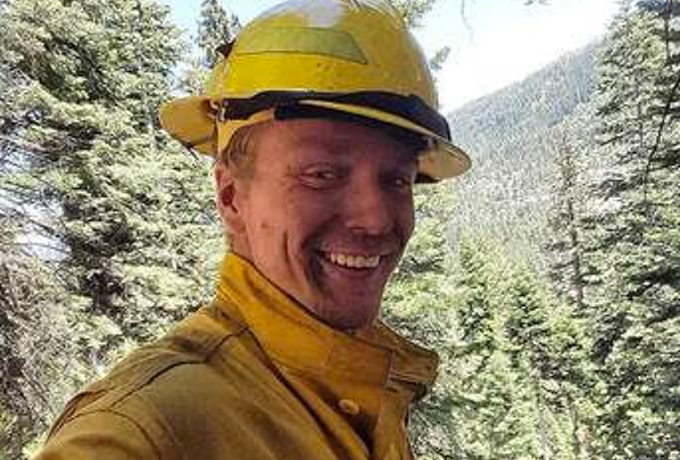
Sierra-at-Tahoe will be the site of a candlelight vigil for Michael Hallenbeck on Aug. 12 at 7pm.
Michael Hallenbeck
The 21-year-old U.S. Forest Service firefighter died Aug. 8 while fighting a lighting-caused fire south of Echo Summit.
Hallenbeck was a Sierra-at-Tahoe employee for the past two seasons and a firefighter for the Lake Tahoe Basin Management Unit.
During the 2015-16 ski season, an organized Ride for Mikey will take place on the slopes of Sierra.
Candles for the vigil will be lighted at sunset on the Solstice Plaza in the base area of Sierra-at-Tahoe. Candles will be provided.
South Tahoe parade application deadline approaching
South Lake Tahoe’s 50th Anniversary Parade is billed as a unique opportunity for organizations, service groups, athletic teams, schools to showcase what they have to offer while joining with the entire community to celebrate the city’s history.
The theme of the Sept. 19 parade is Past, Present and Future.
Applications are due Sept. 1. They are available online. There is no fee to participate. The parade is open to walking groups and vehicles with the route beginning at Al Tahoe Boulevard and concluding at the Y.
More information contact Tracy Franklin at 530.542.6093 or tfranklin@cityofslt.us.
Tahoe Tails — Adoptable Pets in South Lake Tahoe
Stella
Stella and Gemma are super cute, almost identical sisters and they would like to go home together. They are 10 weeks old, and very energetic, as you would expect.
Stella and Gemma are spayed, microchipped, tested for FIV, and vaccinated. They are at the El Dorado County Animal Services shelter in Meyers, along with many other dogs and cats who are waiting for their new homes.
Go to the Tahoe animal shelter’s Facebook page to see photos and descriptions of all pets at the shelter.
Call 530.573.7925 for directions, hours, and other information on adopting a pet.
For spay-neuter assistance for South Tahoe residents, go online.
— Karen Kuentz
EJ proves he’s ‘still standing’ after 5 decades
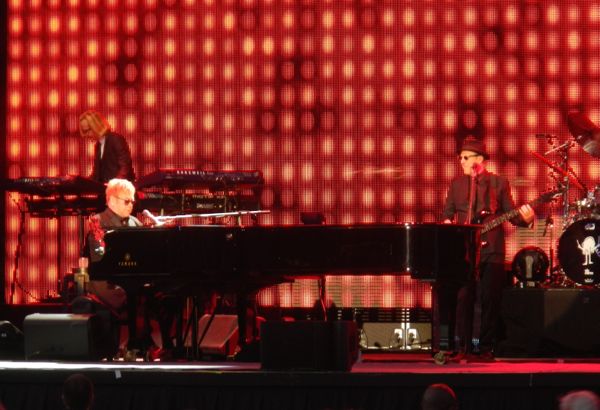
Elton John rarely took a break from cranking out the tunes on the piano Aug. 8 Photos/Kathryn Reed
By Susan Wood
STATELINE – When legendary performer Elton John launched into the “B itch is Back” on a warm Lake Tahoe night, the crowd sprang to its feet, and I was immediately transported into total nostalgia as my childhood took center stage in my mind.
Like many people (a cluster of them around me at the Harveys Summer Outdoor Concert Series Saturday night), I grew up with this rock icon who has sold more than 300 million records and become one of the best-selling artists in the world. Despite the shared experience with so many others, his performance seemed so personal to me.
I owned a handful of albums, and as an adolescent locked myself in my room for hours to listen to his music – even convincing myself “Captain Fantastic” and the “Brown Dirt Cowboy” (named after the 1975 album) represented real people. After all, the songs of EJ aren’t all about his catchy singing, masterful ease of piano playing and ideal sing-along melodies.
His lyricist since 1967, Bernie Taupin, partly spawned my desire to be a writer. His impression spanned beyond me in South Lake Tahoe. I sat next to well-known Realtor Carl Fair most of the evening, and we discussed the show as if we were record producers.
“One of Bernie’s best,” Fair said to a few songs, while I nodded in agreement.
In particular, Fair was patiently waiting for EJ, which the crowd yelled on occasion, to perform his favorite – “Daniel” off the “Don’t Shoot Me, I’m Only the Piano Player” album. John delivered the sentimental piece in more of an electric rock format than the recording. Still, it had an impact.
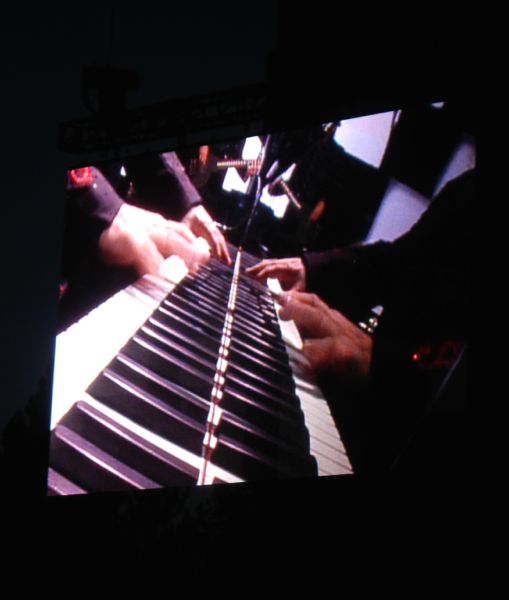
Elton John’s fingers fly across the ivory.
Since the song is about a brother, I thought of growing up with my late sister – and how music was so instrumental in our lives. The 1973 album came out the same year as one of his best-selling albums “Goodbye Yellow Brick Road.” Back then, albums had passages you could read, and I used to open this one to learn all I could about the English performer. On this song collection, he produced “Bennie and the Jets” – with its signature piano key pounding heard again Aug. 8, complete with the “ssssss” at the end of “Jets.” Also from “Goodbye,” he performed the title song – which everyone mouthed the words to – along with “Candle in the Wind.” The song written for actress Marilyn Monroe is the best-selling single of all time.
Dressed in a black pant suit with simple sequins on the sleeves and back (rather understated compared to when I saw him dance on the piano a few decades ago at the Irvine arena), John played hit after hit with no breaks to speak of except to stretch, bow and reach out to the audience. John provided little dialogue except near the end when he tipped his hat to the audience for supporting him.
“It’s been the most incredible journey. Through 47 years, there’s been one constant – the audience buying the records and the audience coming to these shows,” the 68-year-old said. “Thank you for all the loyalty and love.”
The message was appropriate from a performer who whole-heartedly admits to believing in love and even wrote and performed “Believe” to the enchanted crowd.
Many of John’s library of songs revolve around love, whether it’s the down-to-earth 1970 timeless hit “Your Song” that he also performed to the hushed Tahoe audience or something totally out of this world like his other blockbuster number “Rocket Man” off the “Honky Chateau” album.
As the crowd swayed and recited every word, I returned to my childhood recalling my feelings when I heard this song while moving to Virginia from Vermont. It was pouring down rain, and my mom could barely see as she followed my father in the truck. Still, I felt safe and confident that my world on Earth was going to pan out as I looked out the window in the pitch-black sky at age 12. Like the astronaut, I longed for a promising, adventurous life. I remember thinking what a genius Taupin was at capturing the human experience: “It’s just my job, five days a week.” I even bought a jean shirt because Taupin wore one on one of the album photos. I passed on the outrageous costumes and wild glasses John is known for, though a woman sitting behind me wore her glasses.
Through the years, John has slowed on his movement on stage and flashy costumes. His band – complete with original musicians Nigel Olsson on drums and Davey Johnstone on guitar – graced the stage with suits and ties. Even with the fresh, stylish look, a close glimpse of Johnstone’s experienced guitar playing showed aging, wrinkled hands. The long-time musicians were joined by bassist Matt Bissonette, Kim Bullard on keyboards and percussionist John Mahon, who was fun to watch as he brought out rattles, chimes and tambourines. John, who played in Tahoe five years ago, got personal pointing out how Mahon was celebrating his 35th wedding anniversary, delighting the mostly older Tahoe concert crowd.
Behind the band, a giant screen flashed images ranging from a checkerboard and psychedelic experience to photographs depicting memories and John’s various looks in more than four decades of making at least 50 Top 40 hits.
The music was full and solid – and I especially appreciated the hot vocals since many concert sound engineers tend to up the instruments, thus drowning out the vocals. Not so for a superstar like John, who has lost a slight bit of range, but still puts out a powerful performance.
The singer even overcame being hospitalized for an abnormal swelling of his leg playing tennis near his home in Nice, France, less than a week ago to make the Tahoe concert, according to a Daily Mail report.
Saturday’s show was Elton John’s second at Lake Tahoe.
Tennis is one of John’s favorite sports. Fans got a hint of this early on when he wrote with Taupin “Philadelphia Freedom” off “Captain Fantastic” in honor of the tennis team of his dear friend Billie Jean King, a legend in her own right on the courts. Patriotic images swirled across the giant screen during that song.
Other images came to mind when EJ started “Tiny Dancer,” the poignant tune off the 1971 album “Madman Across the Water.” That’s what the John-Taupin collaborations accomplished for decades, creating words that have an impact on listeners. We can all share the pain and anguish of “Sorry Seems to Be the Hardest Word” and “Don’t Let the Sun Go Down On Me,” which I stood up for amid a seated crowd.
Then there are the silly and jovial “Saturday Night’s Alright for Fighting” and “Crocodile Rock.” The latter was expected as the fun encore, and John delivered. And as a hint the night was coming to a close, John autographed records, shirts and CDs for the concert-goers up front. It was refreshing to see a middle-aged man in front of me yelling: “Rock on that piano, baby.”
—–
Notes: The Harveys concert series rocks on with the band Slightly Stoopid on Aug. 13; country act Dierks Bentley on Aug. 23; and Sammy Hagar on Sept. 5.
The buzz(kill) about caffeine
By Ariane Wu and Murray Carpenter, Reveal
There’s a slow but growing movement in the United States to ban the sale of caffeine – or certain kinds of it, at least.
In June, the Ohio Legislature passed a bill banning the retail sales of pure powdered caffeine. This comes on the heels of six U.S. senators urging the Food and Drug Administration to do the same.
These actions mystify some people because caffeine is often viewed as the beloved, mostly benign stimulant that gets us through the day. But it’s much more than that. It’s the essential ingredient in beverages worth more than $120 billion annually in the U.S. It’s a barometer of dietary trends and a mildly addictive food additive. It’s a neuroenhancer and a performance-enhancing drug. And it’s a regulatory mess.
Many Americans start their day with a cup of coffee … or two or three. And with the recent boom in gourmet coffee, from Starbucks and others, it seems like we’re drinking more coffee than ever. But we actually drink far less coffee than our grandparents did. U.S. coffee consumption peaked around 1950, then declined dramatically. Coffee was displaced, largely, by soft drinks. As coffee consumption declined, soft drink consumption spiked. Now we spend about $77 billion on soft drinks annually, twice what we spend on coffee. And caffeine is a key ingredient in eight of the 10 best-selling soft drinks.
The United States imported nearly 17 million pounds of caffeine powder in 2014. Most of that is blended into soft drinks – 34 milligrams per can of Coke, for example. Although some of this caffeine is extracted from naturally caffeinated products such as coffee or tea, most of it is synthesized from chemical precursors such as urea, in pharmaceutical plants in China, India and Germany.
In soft drinks, caffeine plays the same role as nicotine in cigarettes. Both nicotine and caffeine are harmless in small quantities and may even have health benefits, but they reinforce our cravings for unhealthy amounts. Sugar-sweetened soft drinks contribute to two of the most significant health problems in America: obesity and diabetes. Yet you can still buy soft drinks with food stamps, and The Coca-Cola Co. and other bottlers have lobbied vigorously against efforts to change this.
The soft drink industry also has opposed increased federal regulation of the caffeine blended into sodas and energy drinks. As it stands now, caffeine’s regulatory regime is a jumble. Sell caffeine in its pure form, as a powder, or in an energy shot, and the FDA considers it a dietary supplement.
Blend it into Coke or a Monster Energy drink, and it’s regulated as a food additive. Press it into NoDoz or Anacin tablets, and it’s an over-the-counter drug. And when it’s marketed as a migraine medication like Cafergot, the FDA regulates it as a prescription drug.
Consumer groups have been calling for better oversight of the many new caffeinated products on the market. Energy drinks, which are not required to display the amount of caffeine they contain, prompted more than20,000 U.S. emergency room visits in 2011, double the number in 2007. And pure caffeine powder – which is virtually unregulated and powerful enough that a tablespoon is fatal for an adult – caused the accidental overdose deaths of two young men in 2014.
Researchers constantly are learning more about how caffeine affects us. In many cases, it has significant benefits. Modest doses of caffeine improve vigilance and cognitive performance and decrease fatigue. Caffeine boosts athletic performance significantly and alleviates headaches. A 2015 studyshowed it is even associated with lower incidence of erectile dysfunction.
Although it is one of the best-studied compounds in the world, we still have much more to learn about caffeine, including the reasons it affects people so differently – making some people anxious and jittery, and others so happy and energetic that they feel as though they can’t function without it.
Browne delivers hope and steel guitar
Jackson Browne wows the crowd at Harveys on Aug. 7. Photos/Kim Wyatt
By Kim Wyatt
STATELINE — I had a whole review written in my mind comparing and contrasting Jackson Browne’s performance of his post-Watergate hit “The Pretender” to the previous evening’s Republican debate. And then he didn’t sing it. So this review will have to be simply about a master songwriter and the large, intimate crowd gathered Aug. 7 at the Lake Tahoe Outdoor Arena at Harveys.
I first saw Jackson Browne when I was 10 years old. It was my first concert, and my dad took me. (I think he couldn’t find a babysitter.) Between this and Buffalo Springfield always spinning in our house, you’d think my dad was trying to make a little radical. Browne’s Summer 2015 “Standing in the Breach” tour — so named for his 14th album inspired by events in Haiti — still amplifies his political mindset, but it was his intimate numbers that moved the crowd. Songs like “These Days” and “Fountain of Sorrow” sandwiched in between lyrics about fracking and corporate corruption, even a love song to the ocean, made for a weirdly satisfying emotional roller coaster — a cycle of hope and despair that fortunately ended on hope. Browne’s gift as a songwriter has always been to give voice to our most personal existential crises, to be our Everyman, yet in naming it, he makes us no longer alone. It’s a neat trick, and a wild, singular talent.
Jackson Browne is a singer, songwriter and musician.
The 20-song set plus two encores were anchored by Browne’s polished band. Greg Leisz delivered on lap and pedal steel guitar, and the electric guitar was handled deftly by Val McCallum. Bob Glaub (bass), Mauricio Lewak (drums) and Jeff Young (Hammond organ, piano) brought up the rhythm section. Alethea Mills offered harmony and the solo vocals that we were all waiting for, so familiar was this crowd with Browne’s oeuvre, an almost full house of former hippies, environmentalists and child radicals like myself, I suspect. (A portion of the proceeds from Browne’s concerts and sales goes to The Guacamole Fund, a group that supports grassroots social justice and environmental activities.)
From the first note, the audience knew almost every song. Browne’s usual tropes of love and despair, along with the signature steel guitar, were immediately in play: The first song, “The Barricades of Heaven,” left no doubt that Browne’s new tunes didn’t stray far from the old, and made me curious about the new album. His voice still strong and steady, Browne has a knack for making everything seem better and worse at the same time. “The Long Way Around” featured some sweet Allman-esque guitar from McCallum, who shone throughout the night, as did Leisz’s omnipresent steel guitar.
One cool surprise of the evening was the appearance of Nevada City’s Bob Schafer, one of Browne’s mentors, taking the stage for a tender rendition of Hank Williams Sr.’s “I’m So Lonesome I Could Cry” — a heart-tugging experience under the stars.
After a 10-minute break, the crew returned for the last set. The audience began shouting out Browne’s hits. Warm and friendly, he asked us to be patient. Well, maybe not so warm. His hair blowing in the chilly night wind, Browne, from Los Angeles, gave the Tahoe crowd a great compliment: “Thanks for having us, Tahoe. You’re hardy people.”
After a four-song set from his new album that focused largely on the environment — which got the audience fist pumping, this is Tahoe, after all — Browne yielded and gave the crowd what they wanted: “Doctor My Eyes” and a rousing “Running on Empty” that led to two encores: “Take It Easy,” — which Browne co-wrote with Glenn Frey — and the iconic sing-along “The Load Out/Stay.”
Browne left the crowd dancing, on their feet, flushed and happy. Yet the sentiment of the night might be wrapped in up this lyric from “Standing in the Breach”: “You don’t know why,/But you still try for the world you wish to see.”
So, idealism is alive and well and a little bit older. Despite modern life, its depredations and defeats, there is no room for apathy, Browne seems to say. We’ve made it through some dark and lonely times, but we’ve still got work to do: Let’s do it together.
Study: Most picky eating harmless, but it can signal emotional woes
By Lindsey Tanner, AP
Parents of picky eaters take heart: Research suggests the problem is rarely worth fretting over, although in a small portion of kids it may signal emotional troubles that should be checked out.
Preschool-aged children who are extremely selective about what they eat and dislike even being near certain foods are more likely than others to have underlying anxiety or depression, the study found. But only 3 percent of young children studied were that picky.
Less severe pickiness, dubbed “moderate selected eating” in the study, was found in about 18 percent of kids. These are children who will only eat a narrow range of foods. Kids with either level of pickiness were almost two times more likely than others to develop anxiety symptoms within two years, the study found.
More typical pickiness, including kids who just refuse to eat their vegetables, is probably merely “normal dislike,” said eating disorders specialist Nancy Zucker, the lead author and an associate psychiatry professor at Duke University’s medical school. These are the kids who typically outgrow their pickiness as they mature.
Zucker said young children with moderate pickiness are probably more likely to outgrow the problem than the severe group, although more research is needed to confirm that.
The study was published in the journal Pediatrics.
Arthur Lavin, a Cleveland pediatrician said picky eating is among the top concerns parents bring to his office, and that the study “helps us understand who we should be concerned about.”
“There’s more going on here than just not wanting to eat broccoli,” said Lavin, a member of an American Academy of Pediatrics committee on psycho-social issues. He was not involved in the research.
The study focused on about 900 children aged 2 through 5 who were recruited from primary care doctors affiliated with Duke’s medical center in Durham, N.C.
Researchers did in-home interviews with parents to evaluate kids’ eating habits and any mental health issues. Follow-up evaluations were done two years later in almost 200 children.
Compared with children who aren’t fussy eaters, depression and social anxiety were at least two times more common in kids with severe pickiness; attention deficit behavior and separation anxiety symptoms were more common in moderately selective kids.
Severe selective eating described in the study is akin to a condition called avoidant/restrictive food intake disorder, added in 2013 to the latest edition of a widely used psychiatric manual, the study authors said. It can occur in all ages; some of those affected are extra-sensitive to food tastes, smells and textures.
Zucker said severe pickiness may be the first clue for parents that a child is experiencing anxiety or depression and that they may want to seek help from a mental health specialist.
Moderate pickiness is less concerning but affected kids can make family meal-times a battleground, she said. To avoid that, Zucker suggests that parents try introducing new foods at random times during the day.
EDC explorers place at state competition
The El Dorado County Sheriff’s Office Explorer Post 457 brought back multiple awards from the 2015 Central Valley Explorer Competition.
The team was made up of Explorer Capt. Dylan Kammerer, Explorer Lt. Morgan Sears, Explorer Sgt. Nick Lawrence, Explorer Sgt. Zack Gallavan, Explorer Cpl. Richard Barney and Explorer Cpl. Grace Hunter.
They competed against 38 other teams July 17-19 in Manteca. They took third place in the Crime Scene Scenario. Partnered with the South Lake Tahoe Police Department Explorers, the combined team took third place in the Domestic Violence Situation Scenario and Hostage Negation Scenario.
The explorers also competed in 13 other scenarios including active shooter, traffic stop, bus assault, vehicle search, hostage rescue, burglary investigation, running the obstacle course, DUI investigation, a mental health situation, and a high risk traffic stop.
Sleep protects memories multiple ways
By Alena Hall, Huffington Post
A solid night’s sleep is known to protect your memories from bouts of forgetfulness — and now we know it’s making them more accessible, too.
New research from the University of Exeter and the Basque Centre for Cognition, Brain and Language is taking our understanding of the relationship between sleep and the brain’s memory functions to the next level, exploring the idea that memories could be enhanced andmade more available for use the following day.
“Sleep almost doubles our chances of remembering previously unrecalled material,” researcher Nicolas Dumay said in a statement. “The post-sleep boost in memory accessibility may indicate that some memories are sharpened overnight. This supports the notion that, while asleep, we actively rehearse information flagged as important.”
Ever wondered about the Angora Fire or the Hermit of Emerald Bay? Tahoe History Comix, sold in four-packs and individually, present historic topics in short, easy-to-read formats with detailed illustrations.
The coolest part of these comics is they were written by Kim Wyatt and illustrated by Jared Manninen of the Lake Tahoe Society for Storytelling & Enlightenment, which keeps history alive through storytelling. Released by Meyer’s Bona Fide Books (of which Wyatt is a publisher), the first round of comics includes five volumes, with three more in progress.
I read the first four volumes: “State Route 28”, “The Angora Fire”, “Trailblazing Women of Lake Tahoe”, and “Wild Men of Lake Tahoe”. “State Route 28” tours the 28-mile biking route from Tahoe City to Spooner Lake, while “The Angora Fire” details the tragic event and teaches wildfire prevention and fighting methods.