Dressing casually is all about freedom of choice

By Deirdre Clemente

I study one of the most profound cultural changes of the 20th century: the rise of casual dress — the “why” and “when” our sartorial standards went from collared to comfortable.

As Americans, our casual style uniformly stresses comfort and practicality. A hundred years ago, the closest thing to casual was sportswear — knitted golf dresses, tweed blazers, and oxford shoes. But as the century progressed, casual came to encompass everything from worker’s garb (jeans and lumberman jackets) to army uniforms (khakis). Americans’ quest for a low-key style has stomped on entire industries: millinery, hosiery, eveningwear, fur. It has infiltrated every space from the boardroom to the classroom to the courtroom.

Americans dress casual. Why? Because clothes are freedom — to choose how we present ourselves and to blur the lines between man and woman, old and young, rich and poor. The rise of casual style undermined millennia-old rules that dictated noticeable luxury for the rich and functioning work clothes for the poor. Until a little more than a century ago, there were few ways to disguise your social class. You wore it — literally — on your sleeve. Today, CEOs wear sandals to work.

Despite the diversity of choice in the clothing market today, so many of us tend toward that vast, beige zone between Jamie Foxx and the girl who wears pajama bottoms on the plane. Casual clothes are the uniform of the American middle class. T-shirts, jeans, and wrinkle-free shirts make “middle classness” available to anyone who choses to put it on. And in America, nearly everyone wants to put it on because nearly everyone considers himself or herself to be middle class.

Our country’s casual style is America’s calling card around the world — where people then make it their own. It is witnessed by the young boy on the Ivory Coast wearing a Steelers jersey and in the price of Levi’s on the black market in Russia. Casual is diverse and ever changing, but it was made in America.

The introduction of sportswear into the American wardrobe in the late 1910s and early 1920s redefined when and where certain clothes could be worn. The mass acceptance of sportswear coincided with the consolidation of the American fashion industry. By the end of the 1920s, firms produced designs, worked with manufacturers, and marketed specific kinds of garments to specific demographics.

A second milestone was the introduction of shorts into the American wardrobe. The popularity of bicycling in the late 1920s brought about a need for culottes and shorts. Shorts remained time-and-place specific for women (gardening, exercising, and hiking), until the Bermuda shorts craze of the late 1940s, when women turned plaid wool shorts into legit fashion.

At all-male Dartmouth College in May 1930, the editors of the student paper challenged their readers to “bring forth your treasured possession — be it tailored to fit or old flannels delegged” so that the men could “lounge forth to the supreme pleasure of complete leg freedom.” The Shorts Protest of 1930 brought out more than 600 students in old basketball uniforms, tweed walking shorts, and newly minted cutoffs, and introduced shorts into the American man’s wardrobe.

Americans moved into the 1950s with more options to self-create than ever before. Fundamental to this freedom is a “unisexing” of our wardrobe, a third milestone on our quest to go casual. Women didn’t really didn’t wear pants until the 1930s, and it was not until the early 1950s that pants made it mainstream. There were still discussions and regulations about women in pants well into the 1960s.

That decade saw seismic shifts in “unisexing.” Women adopted T-shirts, jeans, cardigans, button-down collared shirts, and for the first time in nearly 200 years, it was fashionable for men to have long hair.

To dress casual is quintessentially to dress as an American and to live, or to dream of living, fast and loose and carefree.

Deirdre Clemente is a scholar, public historian, and teacher. She is the author of “Dress Casual: How College Kids Redefined American Style” and served as a historical consultant for the Baz Luhrman film, “The Great Gatsby”. She wrote this for What It Means to Be American a national conversation hosted by the Smithsonian and Zocalo Public Square.


Tahoe boat racing history subject of talk

Randy Walker was born into racing. His family had competed in the Tahoe Yacht Club regattas since their inception and his father, Bob Walker, was commodore of the TYC in 1939 and 1940.

The younger walk will give a free talk Aug. 17 at 4:30pm a the Tahoe Maritime Museum in Homewood.

At 14 years old Walker started promoting the TYC boat races around the lake. A few years after this early start, he became a long time announcer for the regattas. For five years, Walker headed up the Club’s Trophy Committee and also served as commodore.

He was instrumental in making the TYC more family oriented and he started the Tahoe Yacht Club Junior Outboard races in 1954. These were races in which children as young as 7 and up to 21 years of age could compete in different classes of boats. Walker provided everything for these races, from the awards to the buoys and everything else necessary for the course. The junior races lasted until 1984.


Artists exhibiting plant formations at Reno show

Local artists capture the essence of plant form in an exhibition at the Wilbur D. May Museum in Reno. The Power of Plants art show and sale features dozens of paintings from the Sierra Watercolor Society.

All art on display is available for purchase.

An artist reception will be Aug. 16 from 1-3pm.

The free exhibit runs through Sept. 12. The Wilbur D. May Museum is at Rancho San Rafael Regional Park, 1595 N. Sierra St., Reno

The Sierra Watercolor Society is a non-profit organization made up of artists from Northern Nevada and Eastern California.


Touching goodbye to fallen firefighter

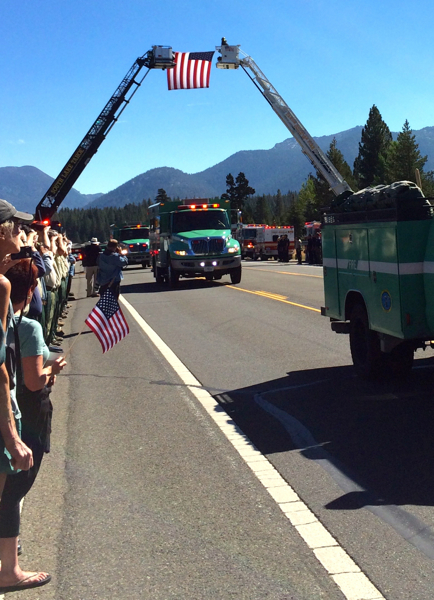
People line Highway 50 in Meyers to honor firefighter Michael Hallenbeck. Photos/Kim Wyatt

People line Highway 50 in Meyers on Aug. 13 to honor firefighter Michael Hallenbeck. Photos/LTN

First responders and the South Shore community pay their respects to Michael  Hallenbeck. Photos/Kim Wyatt

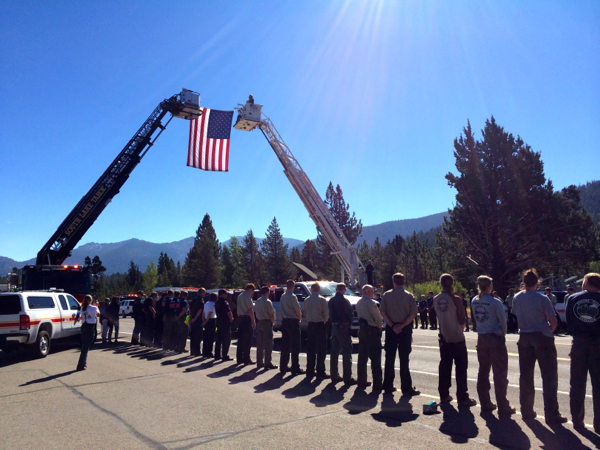
First responders and South Shore residents pay their respects.

It was a somber occasion that brought people on the South Shore to the curbside Thursday morning.

It was an opportunity to pay tribute to fallen U.S. Forest Service wildland firefighter Michael Hallenbeck. Hallenbeck died Aug. 8 after being struck by a tree while fighting the Sierra Fire that was burning outside the boundary line of Sierra-at-Tahoe.

The procession started in South Lake Tahoe and ended at Green Valley Mortuary in Rescue. U.S. flags were suspended from two ladder trucks in Meyers, under which the procession passed.

Private services for the 21-year-old will be Saturday.

“This tragedy reminds us of the dangers firefighters face every time they suit up. Anne and I are grateful for U.S. Forest Service Firefighter Mike Hallenbeck’s service and on behalf of all Californians, we extend our deepest condolences to his family, friends and colleagues,” Gov. Jerry Brown said in a statement.

Hallenbeck was stationed with the Lake Tahoe Basin Management Unit. This was his first fire. For the past couple winters the Shingle Springs man had worked at Sierra-at-Tahoe. The resort had a candlelight vigil for him on Aug. 12 and will have an event in his honor this winter.

— Lake Tahoe News staff report


How Americans fell in love with the open road

By Peter J. Blodgett  

Tens of millions of Americans have hit the road this summer. The all-American road trip has long been a signature adventure, but once upon a time the notion of your own motorized excursion of any length would have seemed impossible.

In 1900, Americans were hampered by wretched roads and limited by the speed and endurance of the horses that powered buckboards, coaches, and wagons. If they had an urge to travel far distances, they had to rely upon the steam locomotive.

As fantastic as it might have seemed at the turn of the 20th century, the idea of supplanting the iron horse with the horseless carriage did catch the fancy of some intrepid men and women. Eager to test the technological limits of their new contraptions, a few hardy souls set off upon far-reaching expeditions between 1900 and 1910.

Colorado attorney Philip Delany, recounting his 1903 excursion from Colorado Springs to Santa Fe observed: “and so the machine is conquering the old frontier, carrying the thudding of modern mechanics into the land of romance. . . .”  Such travel meant seeing “the wildest and most natural places on the continent,” encountering more than a few hints of danger on steep and rocky mountain roads, and reliving the exploits of American pioneers. “The trails of Kit Carson and Boone and Crockett, and the rest of the early frontiersmen,” he declared, “stretch out before the adventurous automobilist.”

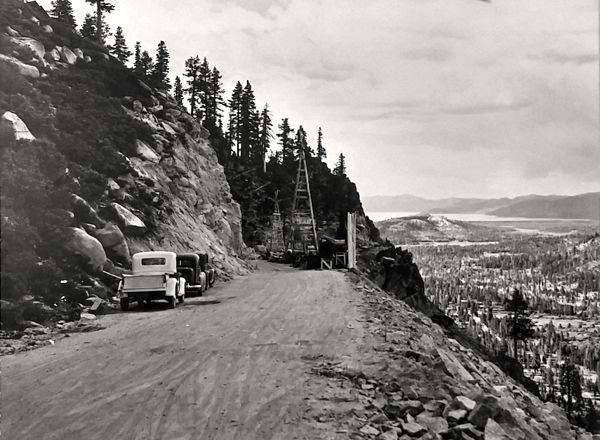
Four-wheel drive was not an options in the 1930s. Photo/Lake Tahoe Historical Society

Four-wheel drive was not an options in the 1930s. Photo/Lake Tahoe Historical Society

At the same time, some city dwellers simply sought an escape. Early 20th century urban environments had their drawbacks: sidewalks overflowing with scurrying pedestrians; streets crowded with unending waves of trolleys, delivery wagons, carriages, and pushcarts; the persistent stench rising from mounds of horse manure; raw sewage emptying into open gutters; rotting piles of uncollected garbage and dense clouds belching from factory smokestacks.

Upper-middle-class tourists motored through the countryside and then camped by the side of the road, finding the sentimentalized image of the gypsy or the tramp quite a compelling identity to assume. They reveled in their sense of independence from stodgy summer resorts and the tyranny of inflexible timetables set by railroads or steamship lines. They delighted in the beauty and serenity of unspoiled countryside. In the same article quoted above, Philip Delany observed that “when [the automobilist] is tired of the old, there are new paths to be made. He has no beaten track to follow, no schedule to meet, no other train to consider; but he can go with the speed of an express straight into the heart of an unknown land.”

In its infancy, however, an automobile could not deliver most Americans from their urban frustrations — for most Americans could not afford to own and operate one. At a time when average annual salaries might not reach $500, many automobiles might cost between $650 and $1,300, securely beyond the grasp of all but the wealthiest. Moreover, with few garages, filling stations, and dealerships outside of city limits, even the infrastructure required for the care and feeding of the automobile could be difficult to locate and could drain the motorist’s wallet. During their earliest years, neither automobiles nor auto touring could be considered within the reach of the masses. Automobility would only become pervasive over time, thanks to rising wages, falling prices for used cars, expanding opportunities to buy these machines on credit, and, especially, the introduction of Henry Ford’s revolutionary Model T in 1908.


Even for those Americans who could afford the first horseless carriages, to go off the few familiar paths in most parts of the country, especially in the great distances of the trans-Mississippi West, required a large measure of self-reliance. One motor traveler characterized the roads of his native Wyoming in 1909 as “deep ruts, high centers, rocks, loose and solid; steep grades, washouts, or gullies . . . ” He went on to note that, “unbridged streams; sand, alkali dust; gumbo; and plain mud, were some of the more common abominations.” Between the obstacles presented by such abysmal road conditions, the likelihood of frequent mechanical breakdowns, and the rarity of supplies to sustain driver and vehicle, these early outings always required an audacious spirit.

Aspiring long-distance auto tourists back then were counseled by self-proclaimed experts to carry abundant quantities of supplies. Those who made the first transcontinental drives between 1901 and 1908 hauled along ropes, blocks and tackle, axes, sleeping bags, water bags, spades, camps stoves, compasses, barometers, thermometers, cyclometers, first aid kits, rubber ponchos, tire chains, pith helmets, assorted spare parts, and sufficient firearms to launch a small insurrection. Mary C. Bedell’s impressive list of gear, published in her entertaining 1924 account of auto touring, “Modern Gypsies”, typifies what was carried by the most dedicated motor campers both in scale and variety: “tent, duffle bags, gasoline stove, Adirondack grate and a kit of aluminum kettles, with coffee pot and enamel cups and saucers inside” — an array of equipment that added “four or five hundred pounds” alone to the weight of the fully loaded automobile. A car so laden, puffing along western trails, bears a striking resemblance in the mind’s eye to a hermit crab staggering across the ocean floor burdened with its house on its back.

Even as motoring Americans loaded up their cars with the contents of their local hardware stores, however, the growth in their numbers year by year provided alluring prospects to entrepreneurs in small towns and great cities throughout the West. Garages, gas stations, roadside cafés, and diners began to pop up along more frequently traveled routes while hotels, restaurants, and general stores started to advertise in the earliest guidebooks produced by organizations such as AAA and the Automobile Club of America. Following the lead of Gulf Oil in 1914, gasoline retailers commissioned maps branded liberally with their logos for free distribution at their service stations. Motorists once left entirely to their own devices now encountered a rapidly evolving infrastructure of goods and services.

Meanwhile, governments at the local, state, and federal levels began to invest increased engineering skill, construction efforts, and tax dollars in road improvements. While motor tourists by the end of the World War I might still encounter 10,000 miles of battered gravel trails littered with potholes for every 10 miles of carefully surfaced and maintained roads throughout the country, the increasing pace of improvements made it far easier to drive through the West than it had been for those who had attempted such a journey only a decade before.

Although still new to the American scene by 1920, the road trip thus had begun to take on a shape familiar to modern eyes. Above all, the automobile was assuming a dominant role in popular recreation as more and more Americans incorporated it into their visions of recreation and leisure. As costs fell and reliability increased, as the successful outings of the few began to inspire the many, and as the thrill of this new technology spread through an ever-wider range of the populace, motoring for pleasure insinuated itself as a notion in the minds of many Americans. Indeed, less than a decade after the turn of the 20th century, author William F. Dix could assert that the automobile had become nothing less than a “vacation agent” for motor-savvy Americans as it “opens up the countryside to the city dweller, [and held out the promise of] great national highways stretching from ocean to ocean and from North to South.” Over those highways, he continued, “would sweep endless processions of light, graceful, and inexpensive vehicles . . . carrying rich and poor alike into a better understanding of nature and teaching them the pure and refreshing beauties of the country.”

While Dix fell far short as a prophet of social or technological developments, his sense of how inextricably linked the automobile would become in the leisure pursuits of Americans has been thoroughly borne out by the evolution of the American road trip.

Peter J. Blodgett is H. Russell Smith Foundation curator of western historical manuscripts at the Huntington Library and editor of “Motoring West Volume 1: Automobile Pioneers, 1900-1909”. He wrote this for What It Means to Be American, a national conversation hosted by the Smithsonian and Zócalo Public Square.


Learn how to photograph night sky

Jennifer Wu, professional photographer, will share her techniques on how to photograph the stars, Milky Way, meteors, the full moon and the crescent moon on Aug. 24 at the Nevada County Camera Club meeting.

She will also discuss light painting techniques that can be used to paint light on trees, rocks, buildings to add another dimension to night photography.

Wu is a nature and landscape photographer, specializing in creating images of the night sky and stars. She is one of Canon’s Explorers of Light, an elite group of internationally recognized photographers.

There will be limited seating. RSVP to rsvp@nccameraclub.com with the names of those planning to attend. The event is free. It is from 6:30-9pm at Unity in the Gold Country Spiritual Center, 180 Cambridge Court, Grass Valley.


Fallen firefighter remembered at vigil

By Kelly Ryan, CBS-13

It was a somber farewell for a firefighter who died in the line of duty in Lake Tahoe as hundreds turned out for a vigil Aug. 12 to remember Michael Hallenbeck.

Friends, family and coworkers of Michael Hallenbeck streamed into the Sierra at Tahoe Resort at sunset ahead of a candlelight vigil for the 21-year-old killed last Saturday while responding to a wildfire.

Kyle Cadwell met Hallenback at summer camp, lost touch and became friends again years later.

Read the whole story


Formal procession for fallen USFS firefighter

The U.S. Forest Service and cooperating fire agencies will escort fallen U.S. Forest Service wildland firefighter Michael Hallenbeck from South Lake Tahoe to Green Valley Mortuary in Rescue on Aug. 13.

The 21-year-old was working for the Lake Tahoe Basin Management Unit when died Aug. 8 after being struck by a falling tree while battling the Sierra Fire.

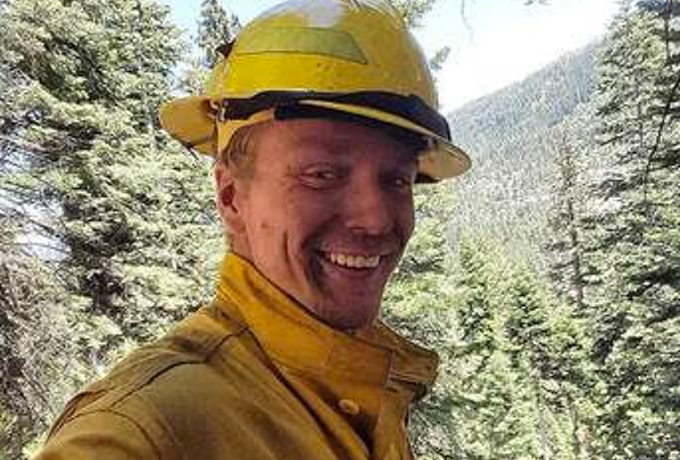
Michael Hallenbeck

Michael Hallenbeck

The procession will start at the Y in South Lake Tahoe at approximately 10am and proceed westbound on Highway 50 up Echo Summit through Sierra-at-Tahoe  to Placerville, ending at approximately 2pm.

The public is invited to show support along the procession route, in particular at the Cordon of Honor at the intersection of highways 50 and 89 in Meyers. In the Cordon of Honor, people line both sides of the roadway as a show of respect as the procession passes. The procession will pass under American flags suspended from two ladder trucks.

California Highway Patrol advises motorists to be prepared for slow-moving traffic and brief delays along the route.

Private memorial services are planned for Aug. 15. The Hallenbeck family has set up a fund to receive donations on their son’s behalf for funeral services as well as to make contributions to organizations that have helped Michael (Bi Polar Insights, Green Valley Church, and Wildland Fire Fighters Foundation). Donations may be made in care of Hallenbeck – Mikey-Hallenbeck Memorial Fund Account No. 2099471902 by either going into a Wells Fargo Bank branch or mailing it to:  Wells Fargo Bank, Attn:  R. Bechtel, 1512 Eureka Road, Suite 300, Roseville, CA  95661

South Lake Tahoe along with other agencies in the basin have lowered their flags to half staff to honor Hallenbeck. Flags will remain at half staff until the services.

Sierra-at-Tahoe will be the site of a candlelight vigil for Hallenbeck tonight at 7.

Hallenbeck is survived by his parents, Toni and Kirby Hallenbeck, and sister Jessica Hallenbeck.


20-cent pieces and secrets of the Carson City mint

By Guy Clifton, Reno Gazette-Journal

Coins and Carson City go together like cold milk and chocolate chip cookies.

“Coin collectors place a very special spot in their hearts for Carson City,” said John Frost of Worcester, Mass., director of education of the Liberty Seated Collectors Club. “It’s just a legendary mint and so much history is there.”

The Carson City Mint is now the Nevada State Museum and it’s the location of the annual Carson City Mint Coin Show and Fair on Aug. 21-22. The fair includes activities for children, prize drawings, lectures, coin sales and free appraisals with admission.

Read the whole story


Schools partly at fault for teens’ lack of sleep

By Rebecca Klein, Huffington Post

Most kids are severely sleep deprived, and early school starting times aren’t helping.

Across the country, only 17.7 percent of middle and high schools start classes after 8:30am, contrary to 2014 recommendations from the American Academy of Pediatrics. Instead, the average school start time for middle and high schools around the country is 8:03am, according to a new analysis from the Centers for Disease Control and Prevention.

The AAP recommends that schools start after 8:30 to help teens get 8.5 to 9.5 hours of sleep a night — the amount the AAP says is ideal. Currently, less than a third of high school students sleep eight hours a night, says the CDC analysis.

The analysis uses 2011-2012 information from the Department of Education to glean the start times of about 39,700 schools. Alaska has the latest average school start time at 8:33am, while Louisiana has the earliest at 7:40am.

Read the whole story