Chris and Tom Celio of Meyers talk about how they use pack animals today in the Tahoe basin. Photos/Kathryn Reed
By Kathryn Reed
CAMP RICHARDSON – Small hands are sifting through the sand, dirt and top soil; others are getting a lesson in how pack animals are still used in the basin; another group is getting educated about fire.
These were just a few of the 29 presentations that nearly 700 third- and fourth-graders were visiting at Camp Richardson on Sept. 22 as part of Ag in the Classroom day. Each group was able to go to six of the stations throughout the day.
Ryder Preston is pouring a container of water into grass that looks like it is growing out of a gutter that has been cut in half. It’s taking a while for the water to reach the bucket at the other end. This is proving how grass absorbs a ton of water. And at the end the water is yellowish. It started out pristine. Nutrients in the fertilizer help cause the discoloration.
Students get to feel soil as Brian Hirdman teaches them about what materials are good for growing plants.
Aaron Hussmann with the League to Save Lake Tahoe is demonstrating what a winter storm does when it hits different things on the ground – dirt, grass, wood chips with plants, and then what the water looks like that comes out at the other end.
This is the third year Tahoe students have been able to participate in the hands-on lessons, whereas it has been going on in Placerville for 14 years.
Avis Jolly, who runs the program, said this age group is targeted because they are able to grasp the various lessons that are being taught and it introduces them to things they may not have been aware of. Teachers are given curriculum they may use before and/or after the field trip to continue on with science and other lessons.
Aaron Hussmann with the League to Save Lake Tahoe has third-grader Ryder Preston demonstrate how long it takes water to pass through sod.
One of those things is how important agriculture is to El Dorado County’s economy. Apples are the No. 1 commodity, with grapes and timber near the top.
Chris and Tom Celio are on the far side of the grounds with their horse Dusty. He is used for packing and riding. Celio horses have been working in the basin since the 1800s when they used to bring milk from Meyers to Camp Richardson. Today, they carry tools, water and gravel for crews who are doing trail work for the Tahoe Rim Trail Association and U.S. Forest Service.
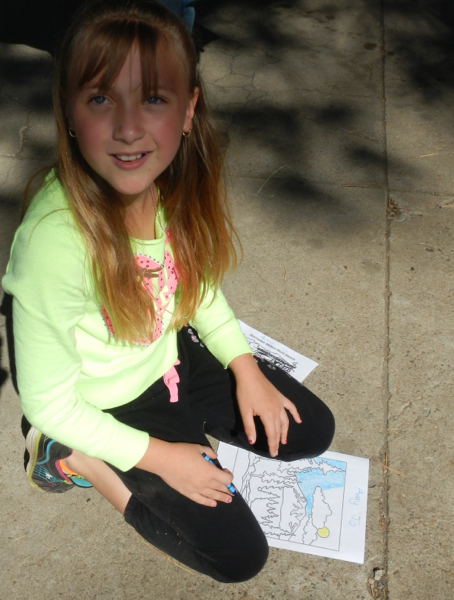
Amy Jo Storlie colors a watershed.
For Amy Jo Storlie, she liked the nutrition station where she learned she should probably be eating more protein, vegetables and fruits. At the watershed area she and her Sierra House Elementary third-grade classmates were coloring a photo to demonstrate what a watershed is.
“It’s important for kids to learn the lifecycle of food,” Adam Jones, Lake Tahoe Unified School District board member, told Lake Tahoe News as he toured the various stations. “This helps connect students to the land.”
When Americans understood weather was connected to larger forces
By Sean Munger
Two hundred years ago this week, the Great September Gale struck New England. The “gale” swamped the coastlines of five states with storm surges up to 15 feet. It reduced dozens of ships in Boston, Providence, and other harbors to matchsticks, and destroyed houses, churches, and barns from Long Island to New Hampshire. Forests were leveled, with trees torn up at the roots. High winds hurled broken glass, bricks, and slate roof tiles through the streets of urban areas. The storm bent the steeple of Old South Church in Boston. Most modern sources record the death toll at 38, but it could have been considerably higher.
Though people didn’t use the word “hurricane” much back then, it assuredly was one, most likely a Category 4. The Great September Gale was the second major hurricane to strike New England since the coming of white settlers, and since that time, only the famous “Long Island Express” hurricane of 1938 is believed to have been more destructive.
I came upon the Great September Gale while I was researching Americans’ perceptions of climate during the 1810s. This decade is particularly interesting because the climate all
around the world temporarily cooled for about a decade. And at the same time, many social
institutions, including science, were in significant transition. The September Gale is one of numerous weather and climate events that people remembered and recorded, especially in their diaries. Some peoples’ descriptions of the 1815 gale took me back to a tornado I experienced as a teenager in Nebraska in 1988. After that storm, the streets of Omaha filled with branches and bricks, much like Boston’s after the gale. When I read a newspaper account, the centuries just telescoped into a common moment in time.
Hurricanes have loomed large in our consciousness lately. Last month, the nation observed the 10th anniversary of Hurricane Katrina, an event whose meaning and legacy we are still quite painfully trying to evaluate. Unlike Katrina, the New England hurricane of September 1815 did not cause significant demographic shifts or provoke hard questions about our responsibilities to care for each other in disaster situations, but it does provide an opportunity to consider Americans’ attitudes toward storms—and our climate—then and now.
In 1815, most New Englanders called events of this size and intensity a “gale” or “tempest.” In an era before detailed weather forecasting became widespread, people tended to view extreme weather events as simply a natural feature of the places where they lived. Their understanding of weather and scientific phenomena came from the kind of earthy knowledge, colored by folklore and astrology, found in popular farmers’ almanacs. For example, the Boston-published Physician’s Almanac for June 1817 is a dizzying jumble of planetary and zodiac symbols and precise notations of tides and solar positions. Simple advice such as, “Good weather for vegetation, if not too cold,” and “Look for much rain,” is interspersed with platitudes and sayings such as, “Weakness is the only incorrigible fault men have.”
Americans’ views about weather and climate in the 1810s were more holistic than ours today. Gales and tempests were related, many people thought, to phenomena like lightning, volcanism, and earthquakes. The 1815 storm occurred only a few years after the powerful New Madrid earthquakes in Missouri commanded public attention, and less than a year before the bizarre climate anomalies of the “Year Without Summer” (1816)—which involved snowstorms in June and killing frosts in the dog days of August. In the 1810s, the idea of an “electric fluid” surrounding and suffusing the world—disturbances in which manifested themselves as earthquakes, waterspouts, hurricanes, and thunderstorms—was quite mainstream. “[A]ll observation convinces us,” wrote one author in an 1812 article in the Port-Folio, referring to this electric fluid, “that these phenomena are marked by its presence and arise from its agency.” For most people the Earth, the oceans, atmosphere and the heavens above it were all interconnected systems like those of a human body.
We ask very different kinds of questions today about the weather–and they mostly concern the future. Is that tropical depression going to become a hurricane? How strong is it going to be? Where will it come ashore? Many of the factors that made Katrina such a painful experience involved this future dimension, centering upon questions about what authorities should have known or done in advance of the storm’s landfall. It’s right that we ask these questions; the people of Boston and Providence could not prepare for the 1815 gale in advance. When they talked about weather, their preoccupations centered mostly on agricultural concerns: when to plant your winter wheat and when frosts could be expected that might damage your corn. Their conception of future weather was vague and mostly cyclical, tethered very tightly to natural rhythms observed in previous seasons. For them, the most important weather was that of the past.
Our current emphasis on weather in the future tense—and our reliance upon minutely specialized fields of expertise to explain scientific questions—has made it harder for us to appreciate specific weather events as part of a global ecosystem. Hurricanes are not a singular phenomenon. They are powered by warm sea surface temperatures and set in motion by wind patterns. The scientific consensus is that industries and other human activity are affecting these processes, driving up sea surface temperatures, increasing the intensity of hurricanes. Yet the connection between climate change and hurricanes is somewhat murky in public consciousness because it’s impossible to prove that this individual hurricane or that one was “caused” by global warming. The compartmentalization and specialization of modern scientific disciplines has greatly increased our overall scientific understanding, but sometimes it makes it harder for us to see the forest for the trees.
For many New Englanders in 1815, it was intuitively obvious that everything in the sky, and most everything on the ground, was connected somehow to everything else. It would have come as no surprise to vintners in 1815 New England that wine grapes harvested in the aftermath of the Great September Gale tasted like salt. Some took the interconnectedness a step further, seeing in it a higher meaning. Shortly after the gale, a deeply religious young woman wrote in her diary, “[W]ho can tell what providence has designed by this judgment? We cannot think ’tis sent for nothing.”
In 2015, we obviously know much more about hurricanes than we did 200 years ago, but looking back closely and carefully can be useful, too. History is more than a laundry list of problems or mistakes that we keep solely so we can avoid repeating them. Sometimes it’s a reminder that the view from the present can be more narrow and restrictive than the view from the past.
Sean Munger is a doctoral candidate at the University of Oregon in environmental history. He is studying environmental history during the “Cold Decade,” a period of temporary climate change between 1810 and 1820.
Vail employees spend day volunteering around Tahoe
On Sept. 19, more than 400 employees from Heavenly Mountain Resort, Northstar and Kirkwood Mountain Resort gathered to breathe new life into the North and South Lake Tahoe Boys & Girls Club locations, as well as help with various trail maintenance projects on Sawtooth Trail and throughout the Martis Valley in partnership with the Truckee Trails Foundation.
These volunteers represent a portion of the 2,000 Vail Resorts employees who gave back to their communities as part of Vail Resorts’ annual EpicPromise Day.
Established in 2010, EpicPromise Day brings together employees, their friends and families, to support a local community need. Since its founding, the annual EpicPromise Day has allowed more than 6,700 volunteers to give nearly 26,000 hours of time to local projects.
Volunteers updated classrooms and buildings at the Boys & Girls Clubs of North and South Lake Tahoe by deep cleaning, applying 29 gallons of fresh paint to the locations, installing and refurbishing cubbies, disposing 8 tons of debris, crafting a sandbox and assisting in landscaping that created a beautiful memorial garden where students can read and study outdoors.
Volunteers also were able to trim overgrowth and remove debris and loose rocks from the Sawtooth Trail and repair a boardwalk running through Martis Valley, aiding in trail maintenance as well as erosion and water quality efforts.
Flu vaccine expected to be better this year
By Victoria Colliver, San Francisco Chronicle
Federal health officials are urging Americans to start getting their influenza shots and emphasized that, unlike last year, this year’s vaccine appears to be a good match with the strains of flu they expect to hit the U.S.
More than 170 million doses of the vaccine are being produced, 40 million of which have already been distributed to doctors’ offices and pharmacies. No shortages are predicted.
Global and national health experts hope to avoid a repeat of last year’s debacle when the predominant strain of flu — a variation of Type A, subtype H3N2 — had mutated from what scientists initially thought it would be. By that time, it was too late to create a new vaccine, which takes about six months to develop. By the time a new vaccine would have been created and distributed, the flu season, which generally runs from December through early spring, would have already begun.
Event to provide food for kids in South Lake Tahoe
Bread and Broth 4 Kids will be having the inaugural Cram-A-Cruiser event on Sept. 26 at the Grocery Outlet located at 2358 Lake Tahoe Blvd., South Lake Tahoe.
A South Lake Tahoe police cruiser will be parked in front of the store from 9am-1pm and will be stuffed full of food that will be used to feed food insecure children in the community. People are encouraged to bring donations that are single serving size and can be easily prepared by children such as macaroni and cheese, Cup-of-Noodles, tuna, soups, canned vegetables, fruit cups, granola bars, fruit snacks, canned ravioli and spaghetti, juice boxes and any other single serving foods appropriate for kids in grades K-8.
Bread and Broth 4 Kids starts the school year off with supporting 100 local food-insecure school children with a backpack full of food every Friday. With so many children receiving free or reduced cost breakfasts and lunches in South Lake Tahoe schools, Bread and Broth 4 Kids has stepped in the help them with food over the weekend when the school lunch programs cannot help.
Page and Sage served 67 students a week over the last 3.5 years. Started by Paula Peterson with the assistance of Tahoe Douglas Rotary Club in 2012, Page and Sage grew as far as they could without being a nonprofit and with a limited number of volunteers. They also grew out of their generously donated storage and packing space at Temple Bat Yam.
Bread and Broth, a charitable, nonprofit organization whose mission is to feed those less fortunate in South Lake Tahoe with more 100 volunteers, contacted Page and Sage to see how they could assist the program.
Bread and Broth 4 Kids is the result of the collaboration and is poised to grow and help more kids in need in the South Lake Tahoe community.
Tahoe Tails — Adoptable Pets in South Lake Tahoe
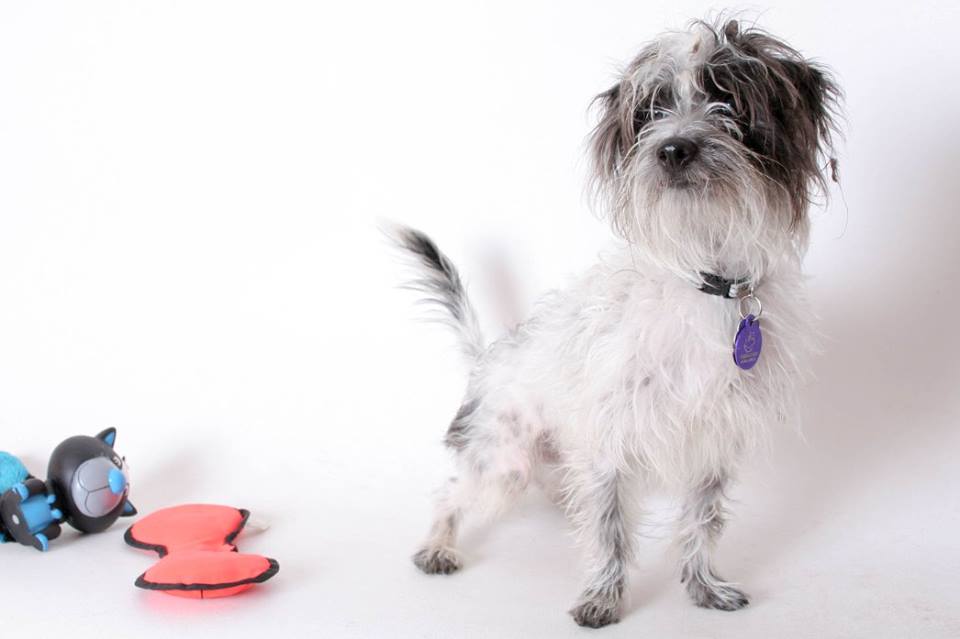
Austin
Austin is an active happy dog who is great with kids. He’s 2 years old, only 10 pounds, Heinz 57 mix with nice coarse fur. He’s playful and fun and loves other dogs.
The county has reduced some adoption fees until Sept. 30 due to large numbers of dogs and cats in the shelter:
Adult cat adoption fee is now $20. Normal adoption fee $80; Kkitten adoption fee 2 for 1 or $80 for a pair; all bully breed dogs are $60, normal adoption fee $120. The Tahoe shelter currently has threepit bull mixes.
Austin is neutered, microchipped, heart worm negative, and vaccinated. He is at the El Dorado County Animal Services shelter in Meyers, along with many other dogs and cats who are waiting for their new homes. Go to the Tahoe animal shelter’s Facebook page to see photos and descriptions of all pets at the shelter.
Call 530.573.7925 for directions, hours, and other information on adopting a pet.
For spay-neuter assistance for South Tahoe residents, go online.
— Karen Kuentz
EDC to offer series of caregiving classes
El Dorado County is putting on five weeks of aging and caregiving classes.
They are designed to provide instruction and support for caregivers who are or are planning to care for a family member or friend age 60 or older.
Classes include:
Oct. 12: Mealtime Matters: The Importance of Nutrition in the Elderly;
Oct. 19: Understanding the Stages of Alzheimer’s Disease;
Oct. 26: Compassion Fatigue: Caring for the Caregiver;
Nov. 2: Music and Memory: Awaken the Minds of Dementia;
Nov. 9: Legal Rights/Responsibilities of Caregiving: How to Stay Out of Trouble.
The classes are at Lake Tahoe Resort Hotel in South Lake Tahoe from 1-3pm.
All classes and materials are free, though donations are accepted.
For more information or to register, email tammy.bragg@edcgov.us.
Marlowe — Longtime South Shore doc retiring
By Angela Moniot
Longtime physician Paul Marlowe this month will say farewell to his patients and the urgent care practice where he has provided care for 32 years as he embarks on an adventure with his. wife Lorraine.
The uniquely quirky and endearing Marlowe is known throughout the community for providing exceptional care since 1983.
Growing up in Oakland, Marlowe spent the winters visiting Lake Tahoe and remembers skiing at Squaw Valley during its second season of operation. Skiing has always been a longtime passion of Marlowe’s. He was the team captain for his college ski team at UC Berkeley. While attending Cal, Marlowe fell in love with photography and recalls taking photos of campus protests against the Vietnam War.
“I was busy dodging tear gas and taking photographs of history in the making. I would be on the riot side avoiding rocks and tear gas taking pictures with Kodachrome 64,” he said.
Paul Marlowe skiing at Kirkwood. Photo/ Steve Brooks
After receiving his undergraduate degree from UC Berkeley, Marlowe moved to Tahoe to coach skiing at Ski Incline (now Diamond Peak) and save money for medical school. While working at Ski Incline, he also met his wife-to-be, Lorraine, who he adoringly calls his “dolly and the love of my life.”
Marlowe went on to attended medical school at the University Autonoma de Guadalajara, Mexico.
“Lorraine and I headed to Mexico in our Mercury Montego station wagon filled with books and toys. We would spend our free time collecting butterflies and roasting coffee. It was such a blast,” he said.
The couple returned to the United States and married in Incline Village and celebrated their honeymoon during a 45-mile backpacking trip near Kirkwood. Following his medical residency in Kentucky, Marlowe returned to Lake Tahoe to begin practicing medicine.
“Being a doc is totally cool. I get to wear a rubber tie [as he pulls on his stethoscope], kill bugs – the bacterial type – and make people happy,” Marlowe says. “It has been a great adventure and I have had the pleasure of working with the most remarkable team. Our office is what text books should be written about. I will miss our wonderful staff and patients.”
Longtime medical partner and family practice physician, Steven Brooks remembers the first time he spoke with Marlowe about starting an urgent care clinic at Tahoe together.
“I was in Chicago in a hospital looking at films with the radiologist and I took the call from Paul regarding the job opportunity at Stateline Medical Center, which is now Barton Urgent Care, in LakeTahoe. We had a nice chat regarding the setup of the facility and then he told me, ‘If you decide to move here be sure to bring your snorkel because there is so much powder you’ll need it!’ That statement closed the deal for me and we have been practicing together for over 30 years.”
Brooks continues to say that he could not have asked for a better partner, colleague or friend.
“Paul is the kindest most caring person I’ve ever known, in addition to being an outstanding physician. His diagnostic skills are amazing and he takes the time with each patient to know exactly what is going on with them. I know I’ll probably never meet anyone like him again, he is irreplaceable. He has clearly earned his retirement but I will miss seeing his smiling face in our clinic. It’s going to be sad but knowing that he and Lorraine will be enjoying their retirement together full time makes me happy,” Brooks said.
When Marlowe isn’t treating patients, he enjoys mountain biking, skiing, canoeing, photography and traveling. While you can spot him skiing the trees out at Kirkwood, he often spends winter days in the backcountry skiing favorites like Mt. Tallac and Elephants Back.
The Marlowes’ next adventure will take them to their favorite places.
“We are going to hitch up our trailer and drive around America to see the big furries in the Tetons, hear the elk bugle during rut, and see Nebraska’s Sandhill Cranes migration. Nature is so much fun,” he said.
Hundreds gather to celebrate South Lake Tahoe
South Lake Tahoe celebrates its 50 years with a parade on Sept. 19. Photo/Kathryn Reed
By Susan Wood
Tears of joy and sentiment. Cheers of happiness and celebration.
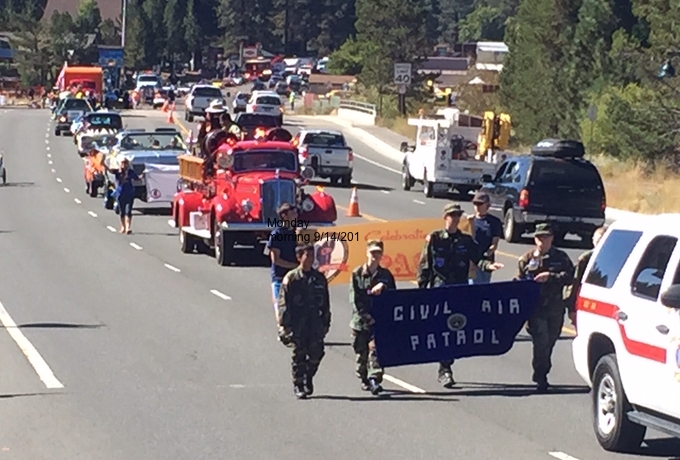
In a burst of community pride, hundreds of people gathered Saturday on Highway 50 and Al Tahoe Boulevard leading into Bijou Community Park to mark a picture-perfect day for a parade and party to honor South Lake Tahoe’s 50th anniversary.
For most longtime residents and even some newbies, it was one of the city’s finest hours, or two, to witness 67 parade entries of floats, walkers, classic cars, fire trucks and appropriately a snowplow make its way through town that morning. Although the official 50th birthday falls in November, the city and its citizenry took full advantage of clear blue skies and warm temperatures to honor the past, present and future of this resilient mountain town nestled in the Sierra Nevada Mountain Range.
South Lake Tahoe is celebrating the past and future. Photo/Kathryn Reed
“I’ve waited 26 years for this. What a good day to celebrate and see a little bit of history. Look there’s Old Smokey, putting out our fires,” said Kimberly Jamison, who runs the Mailbag at Highway 50 and Tahoe Keys Boulevard.
Jamison has lived on the South Shore for a quarter century and believes the most memorable times are the ones in which the residents celebrate what they share – community spirit.
She was joined on the corner in front of the shopping center where her business is located by a brand-new resident. The group enjoyed the old cars honoring the classes as far back as 1965, the city’s inaugural year.
Mayor Hal Cole spoke of how the city is on a path to making positive improvements. Photo/Kathryn Reed
“We’ve moved a lot, and we’ve never moved anywhere where it’s been so welcoming,” said Jessica Branson. She brought her three children Jonah, 10, Trevor, 7, and Nolan, 6, to the parade route to witness the spectacle. “We love it here.”
Up the highway, Kevin and Sheri Livingston came from Gardnerville and staged themselves near Al Tahoe Boulevard to cheer on their son Daniel. The 14-year-old boy marched in the Civil Air Patrol, a task his parents said he had looked forward to for quite a while.
“He wanted to be involved in a community project,” his father said.
Children who were spectators seemed just as engaged during the parade.
In a demonstration of community pride among three generations, grandma Sandy Jones joined her daughter Samantha Jones with her daughter Kiki, 6 – who attends Sierra House Elementary School, to watch the city throw its street party.
Sandy has lived with her daughter here for 30 years and wasn’t going to miss it. The two huddled together, identifying participants as they went by. One of them yelled happy birthday to Samantha.
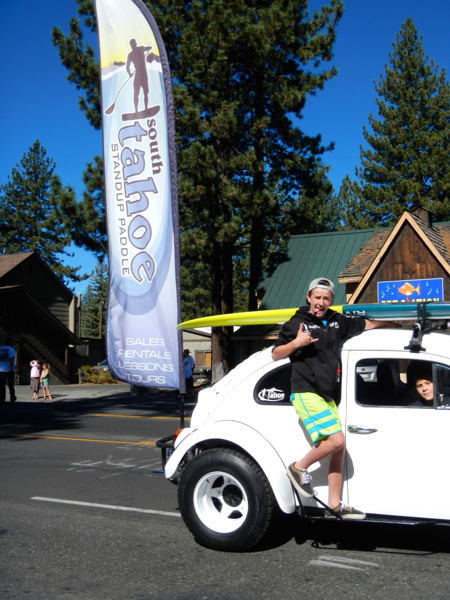
Mark Allen with Tahoe SUP. Photo/Kathryn Reed
Dance instructor Marcia Sarosik knows so many people, she fell behind her float and group who shimmied to “Dancing in the Streets.” She ran down the street with a mock Olympic torch. Sarosik ran a leg of it in 2002 when the torch graced the town on its way to Salt Lake City.
The elder Jones reflected back on the past, recalling small, homespun parades in the late 1980s at Tahoe Valley. The youngest said she liked the present day, filled with ribbons and balloons. Kiki waited patiently for her cousin Emerson Hawkins, 9, to walk with the Lake Tahoe Vikings Pop Warner contingent.
The camaraderie in the community was unmatched.
“I like that everybody comes together here. We’ve gone through a lot in South Lake Tahoe,” said Julie Incopero, a resident of 40 years who sat in a beach chair with her sheltie dog, Buddy. Incopero listed the Angora Fire of 2007 that ripped through 254 homes and the abduction of Jaycee Lee Dugard as a child as examples of a community in catharsis. She also mentioned appreciating how the community supported her when her daughter McKenzie got a blood cancer and needed help.
Some things you don’t forget.
Apparently, members of the community didn’t fail to forget how cycling guru Tom Wendell worked tirelessly to make the community more bike friendly.
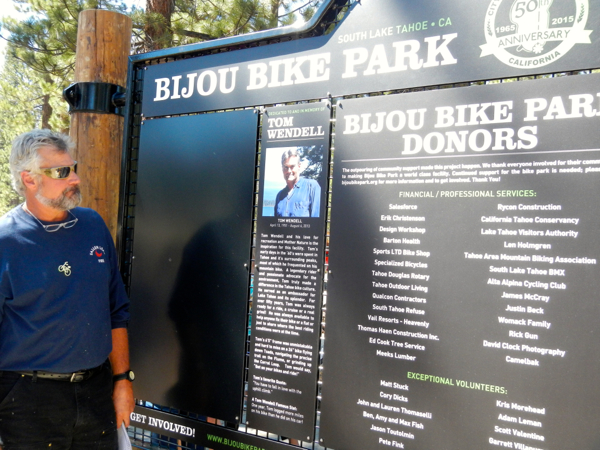
As the parade resulting from the hard work of former Councilwoman Brooke Laine emptied out into the city’s Bijou Community Park, dignitaries and bike advocates took the opportunity to dedicate its new bike park to a man who was undaunted in his pursuit to pass on the two-wheeling legacy – Tom Wendell.
Ted Wendell brought many people to tears with his tribute to his brother, Tom, for whom the Bijou Bike Park was dedicated. Photo/Kathryn Reed
Wendell died a few years ago, but now his legacy lives on in the center of town in the shadow of the pine trees he rode through along with other destinations and journeys that exemplified his coveted life in South Lake Tahoe.
“Welcome to our new bike park,” City Manager Nancy Kerry said to hundreds of people gathered for the formal unveiling. The park represents a maze of gnarly jumps, banks and turns that mark a turning point in public-private partnerships for the city embracing its recreation-oriented heritage and future.
“This is the most significant recreation opportunity we’ve had in years,” Mayor Hal Cole told the attentive crowd of several hundred people. “This city is on a mission to make this town first class in recreation.”
Cole labeled the park a “perfect place to put his name” when speaking of Wendell.
The mayor was followed by the ever-so humble Assistant Public Works Director Jim Marino, who couldn’t seem to accept his award and instead dedicated his honorary plaque to his fellow city employees. He waxed poetic in speaking of the park, calling it a venue of “flow” that represents the “flow in life.”
Apparently, there’s no stopping the city now.
The park was billed as a training place for athletes as well as an ideal hangout for youngsters wanting to master the art of two-wheeling like life-long BMX advocate and city Recreation Coordinator Lauren Thomaselli, who also received an award, and city Parks and Recreation Commissioner Peter Fink, who pedals the talk of cycling. (He and his wife, Karen, did an 8,000-mile cross-country trip years ago.)
The parade was the length of four football fields. Photo/Susan Wood
“This is what a citizenship can do,” Pete Fink said, while looking out at the park.
Councilman Tom Davis, who has spent several years serving the city, called the project “your government at its finest.”
To those close to the subject, the bike park was long in coming – a project that prompted many to want to pick up and shovel to see it happen instead of sitting as a ream of paper on a shelf.
And no one knows that better than Ben Fish, who is president of both the Tahoe Area Mountain Biking Association and Bijou Bike Park Association. Fish held up a rough sketch he drew in 2011 to show what can happen when you take an idea and hand it over to a visionary like Kerry, an open-minded city council and building types like Marino. He received more than a plaque and bike socks for his efforts. His wife, Amy, wheeled out a new bike on behalf of TAMBA. She was in tears when she honored his dedication with the gift.
Just as attendees were on the edge of heart-tugging sentiment, Wendell’s brother, Ted, took the microphone and reduced many to tears in discussing his brother Tom’s tenacious efforts to “do the right thing” by his community and support all things and venues that were bike friendly. Wendell, who Cole describes as “a gentle giant,” showed up at countless meetings with a smile and charm.
“He never wavered from his convictions, whether they were popular or not,” Wendell said of his brother, Tom. “He was always trying to make things for the better.”
The brother listed things that Tom did to exemplify passion and pursuit of outdoor recreation – including his Zen-like time on his mono ski, surfing longboard and his bicycle billed as his most treasured possession.
“He was always in the present. He had that gift, and he shared it with everyone,” Wendell said.
Brutally heart-warming, Wendell said he’ll remember Tom’s favorite lines: “C’mon, the best part is the uphill,” “What ropes? Sorry sir,” and “That looks pretty safe, doesn’t it?”
Tom Wendell had an adventurous spirit that didn’t go unnoticed. And now it’s being passed on.
Ted Wendell told the crowd he came down to the bike park and ran into a young rider who called the course “so totally sic,” meaning awesome.
It was as though Tom was there between the trees as the city of South Lake Tahoe moves into another half century, cultivating recreation advocates of a new generation to take part.
Ted Wendell reminded everyone, “Tom would say: ‘Be the change you want to see.’”
Truckee collecting unused prescription drugs
On Sept. 26 from 9am-1pm the Truckee Police Department and Tahoe Truckee Future Without Drug Dependence will give the public an opportunity to prevent pill abuse and theft by ridding their homes of potentially dangerous expired, unused, and unwanted prescription drugs.
Bring medications for disposal to the Gateway Shopping Center parking lot in front of Safeway at 11290 Donner Pass Road. Remove pills from containers. Sharps and aerosols are not accepted.
This event is for residents only; no businesses or DEA registrants.
In the previous nine National Take-Back events from 2010-14, approximately 277,595 pounds or 138 tons of unused medication was collected from Northern California and Central Valley residents. Nationwide, 2,411 tons of drugs were collected.
“Medicines that languish in home cabinets are highly susceptible to misuse and abuse. Rates of prescription drug abuse in the U.S. are alarmingly high, as are the number of accidental poisonings and overdoses due to these drugs,” Truckee police said in a statement. “Studies show that a majority of abused prescription drugs are obtained from family and friends, including from the home medicine cabinet. In addition, Americans are now advised that their usual methods for disposing of unused medicines — flushing them down the toilet or throwing them in the trash—both pose potential safety and health hazards.”