Men’s version of almost everything is cheaper

By Danielle Paquette, Washington Post

Radio Flyer sells a red scooter for boys and a pink scooter for girls. Both feature plastic handlebars, three wheels and a foot brake. Both weigh about five pounds.

The only significant difference is the price, a new report reveals. Target listed one for $24.99 and the other for $49.99.

The scooters’ price gap isn’t an anomaly. The New York City Department of Consumer Affairs compared nearly 800 products with female and male versions — meaning they were practically identical except for the gender-specific packaging — and uncovered a persistent surcharge for one of the sexes. Controlling for quality, items marketed to girls and women cost an average 7 percent more than similar products aimed at boys and men.

When asked about the price differences of other gendered toys — like the Raskullz shark helmet ($14.99) and the Raskullz unicorn helmet ($27.99) or the Playmobil pirate ship ($24.99) and the Playmobil fairy queen ship ($37.99) — the representative pointed to a company statement, declining to elaborate: “Our competitive shop process ensures that we are competitively priced in local markets. A difference in price can be related to production costs or other factors.”

Read the whole story


Nev. distillery, winery now a national historic place

By Mike Higdon, Reno Gazette-Journal

The Douglass-Frey Ranch, home of Churchill Vineyards and Frey Ranch Estate Distillery in Fallon, was added to the National Register of Historic Places last month. The National Register is the nation’s official list of properties worthy of preservation.

The Douglass Mansion, the centerpiece of the ranch, was designed by Nevada-architect Frederick DeLongchamps. DeLongchamps is also well-known for designing Reno’s original Main U.S. Post Office, now a retail center, and Second Judicial District Court house in downtown Reno. DeLongchamps designed more than 40 other buildings in the region, most of which are listed in the National Historic Register of Places.

DeLongchamps designed the mansion in the Prairie style, a style of architecture popularized in the American Midwest in the early 1900s by Frank Lloyd Wright. Prairie-style homes are extremely rare in Nevada, according to the historic register, and the Douglass Mansion stands as the only known project of that style completed by DeLongchamps.

Read the whole story


Vonn talks about her need for speed

By Brigid Mander, Wall Street Journal

When she hits the slopes, Olympic gold-medalistLindsey Vonn will be predictably focused on one thing: winning. For this habitué of terrifying downhill inclines (and red carpets), that’s merely maintaining the status quo. Vonn, 31, is the most decorated female ski racer in history, with two Olympic medals, 67 World Cup wins, 19 World Cup season championship titles and five World Championship medals.

Her wholesome Minnesota demeanor and disarming smile belie her ruthlessly competitive side—a combination that has consistently fascinated the public. Vonn has been featured in publications ranging from Sports Illustrated and ESPN to Vogue and Elle.

At 5-foot-10 and 160 pounds, she has a physique that’s sparked debate in the media about what it means to be healthy and strong—not simply skinny—something she’ll explore further in her forthcoming book, “Strong Is the New Beautiful,” to be released next year. According to Vonn, it will be a guide to staying healthy and feeling beautiful, with wisdom on nutrition and working out that she’s gleaned over the years.

Although Vonn maintains that her days primarily consist, rather mundanely, of eating, sleeping, training and skiing, she’s found time to oversee her recently launched Lindsey Vonn Foundation, a nonprofit that helps girls empower themselves and begin to realize their dreams, whether in sports or other arenas.

Read the whole story


Hotel reservations becoming more complicated

By Amy Zepkin, New York Times

The deal on the website of Hilton Hotels & Resorts seemed like a good one to Jeffrey Buszkiewicz: A 72-hour online sale after Thanksgiving showed a $129 room at a Hilton Garden Inn in Manhattan for Christmas night. Two subsequent nights cost more.

But there was a hitch. After he talked about it with his wife and was ready to book, the rate had increased by $40 a night when he logged on again the next day.

“I assumed if the sale was on for 72 hours, the rate would be good for 72 hours,” said Mr. Buszkiewicz, fiscal officer for the Indiana University School of Education.

Making hotel reservations used to be straightforward. Guests booked a room and could generally cancel without penalty until the day of arrival.

Now, as hotel chains consolidate, last-minute booking apps proliferate, and short-term rental sites like Airbnb and HomeAway grow, experts say the reservations landscape is undergoing an upheaval with new and higher fees and new restrictions on reservations that are driving new sources of revenue.

Read the whole story


Talks to highlight dangers of radon

The University of Nevada Cooperative Extension’s radon education program is offering educational presentations at various locations across the state during January in recognition of it being National Radon Action Month.

Free test kits will also be available at the presentations.

Radon is a naturally occurring, radioactive gas that is colorless, odorless and tasteless. It comes from the ground and can accumulate in homes, raising the risk of lung cancer. The U.S. Environmental Protection Agency estimates 21,000 Americans die each year from radon-caused lung cancer, killing more people than secondhand smoke, drunken driving, falls in the home, drowning or house fires.

In Nevada, one in four homes tested show radon concentrations at or above the EPA action level. According to experts, living in a home with radon concentrations at the action level poses as much risk of developing lung cancer as smoking about half a pack of cigarettes a day.

Scheduled presentations are:

  • Jan. 9 – North Valleys Library, 1075 N. Hills Blvd. No. 340, Reno, at 11am
  • Jan. 12 – Sierra View Library, 4001 S. Virginia St., Reno, at 4pm
  • Jan. 13 – South Valleys Library, 15650A Wedge Parkway, Reno, at 6pm
  • Jan. 20 – Northwest Reno Library, 2325 Robb Drive, Reno, at 5:30pm
  • Jan. 25 – Carson City Senior Center, 901 Beverly Drive, Carson City, at 6pm
  • Jan. 26 – Tahoe Regional Planning Agency, 128 Market St., Stateline, at 6pm
  • Jan. 27 – CVIC Hall, 1604 Esmeralda Ave., Minden, at 6pm
  • Jan. 28 – Incline Village GID Public Works, 1220 Sweetwater Road, Incline Village, at 6pm.


SnowGlobe VIP tent a questionable experience

Not everyone believes the  VIP area at SnowGlobe is worth the extra money. Photo Copyright 2015 Carolyn E. Wright

Not everyone believes the VIP area at SnowGlobe is worth the extra money. Photo Copyright 2015 Carolyn E. Wright

By Kathryn Reed

It doesn’t pay to be a VIP at SnowGlobe. At least that was the opinion of some who were asked about their experience.

A three-day general admission pass with shuttle costs $249. Three-day VIP was $449, which also included transportation. Both sold out. Promoters of the three-day music festival in South Lake Tahoe that ends tonight wouldn’t provide the number of tickets sold.

Most people are too busy enjoying the music to worry about the VIP area. Photo Copyright 2015 Carolyn E. Wright

Most people are too busy enjoying the music to worry about the VIP area. Photo Copyright 2015 Carolyn E. Wright

VIP tickets also come with an express line for entrance into the festival, an exclusive lounge, premium view of the main stage, viewing platforms, access to experiential art installations, daily tastings from on-site food vendors, and the opportunity for artist meet and greets, according to the website.

Several people in the VIP area on Dec. 30 told Lake Tahoe News they didn’t believe they were getting their money’s worth and said what was promised was not delivered.

Julia Scheibe, left, doesn't like the changes to this year's VIP perks. Photo Copyright 2015 Carolyn E. Wright

Julia Scheibe, left, doesn’t like the changes to this year’s VIP perks. Photo Copyright 2015 Carolyn E. Wright

“Last year it was double the size, there was better lighting, it was elevated, you could look around. There was a bigger patio,” Julia Scheibe of San Francisco told Lake Tahoe News. “I’m sitting here wondering what I paid for.”

The seat is one thing she paid for. The free warming tents don’t have seating, nor do the two concert tents.

The VIP area is also less crowded. This in turn meant the line at the bar was shorter.

Nick Arbelaez and Stephanie Shamo believe the VIP tent is a quiet spot from the masses. Photo Copyright 2015 Carolyn E. Wright

Nick Arbelaez and Stephanie Shamo enjoy the less crowded spot. Photo Copyright 2015 Carolyn E. Wright

For Nick Arbelaez and Stephanie Shamo of South Lake Tahoe they liked the privacy of the tent – being away from the drugs, fights and crowds, as they put it.

Getting out of the below freezing temperatures (it’s supposed be a low of 8 degrees tonight) was attractive to Ethan Polte and Brittany Fletcher of South Lake Tahoe. The couple had not planned to attend SnowGlobe, but Polte received the two VIP passes as a tip while waiting tables at the Driftwood Café.

Rob Garza keeps his fans warm by creating danceable music. Photo Copyright 2015 Carolyn E. Wright

Rob Garza keeps his fans warm by creating danceable music. Photo Copyright 2015 Carolyn E. Wright

But this isn’t the only venue to get warm. The Igloo Tent in particular with its low ceiling and dancing festivalgoers made it toasty inside. Wall-to-wall people in the two warming tents also provided natural heat beyond the limited heat that was blown in.

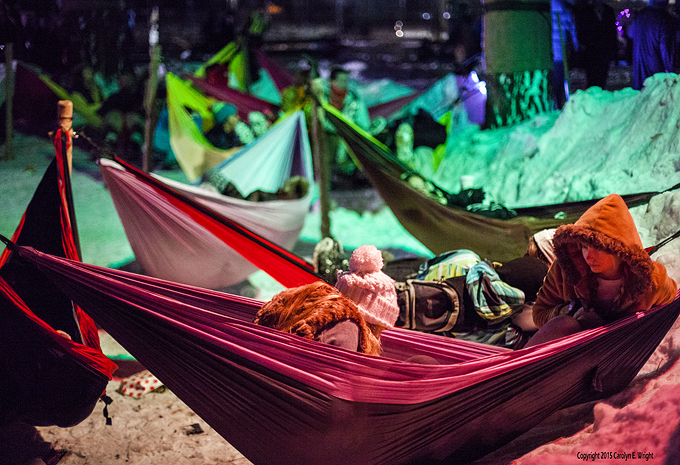
Those braving the elements found warmth huddling together in a grove of hammocks. Nearby was a fire art installation that cast off warmth.

Khloe Layo has a front row seat from the VIP tent to the main stage. Photo Copyright 2015 Carolyn E. Wright

Khloe Layo has an unobstructed view from the VIP tent to the main stage. Photo Copyright 2015 Carolyn E. Wright

This was Khloe Layo’s first experience at SnowGlobe and in a VIP area at any concert. Sitting at one of the three windows she had a direct view to the main stage. It was hard to tell who was on stage, though the music can be heard without any problem. There are no monitors or screens, however, to see what is going on at any of the three stages.

Layo said the best part was having bathrooms out back and not having to wait. What frustrated her was at the entrance she and the other VIP’ers were supposed to have their own line to speed up the process. Instead they were with the throngs of concertgoers.

Cozy hammocks are one way to beat the chill. Photo Copyright 2015 Carolyn E. Wright

Cozy hammocks are one way to beat the chill. Photo Copyright 2015 Carolyn E. Wright

One couple from the Bay Area thought they’d be paying extra to have bathrooms beyond regular port-a-potties. Wrong. What they got was a corral of these bathrooms that were not shared with the masses, which meant no lines. They also couldn’t believe how slick the ground was. It wasn’t just the snow. The entranceway and the path to the bathrooms each have a slab of what appears to be metal flooring that is painted. It’s hard to have stable footing on it in wet conditions.

Food was also an expectation of some. Two empty silver serving dishes were next to the bar. When a worker was asked if any food had been served the response at 6:50pm was, “Not yet today.” The event started at 2:30pm.

The VIP area was moved this year to be almost directly behind the main stage. Last year it was on the far side of the field and at a right angle to the stage. There was also a large elevated outdoor area in 2014. This year the crowd penned in at the VIP area was at the same level as the throng of general admission ticket holders.

SnowGlobe officials did not answer Lake Tahoe News’ questions about the VIP area.


Alcohol may cause long-term memory issues

By Melinda Beck, Wall Street Journal

Here’s a sobering thought for the holidays: Chronic heavy drinking can cause insidious damage to the brain, even in people who never seem intoxicated or obviously addicted.

Experts say alcohol-related brain damage is underdiagnosed and often confused with Alzheimer’s disease, other forms of dementia or just getting older.

Now, brain imaging is revealing how long-term alcohol abuse can change the structure of the brain, shrinking gray-matter cells in areas that govern learning, memory, decision-making and social behavior, as well as damaging white-matter fibers that connect one part of the brain with others.

Long-term alcohol abuse also changes how the brain regulates emotion and anxiety and disrupts sleep systems, creating wide-ranging effects on the body. Increasingly, clinicians are diagnosing “alcohol-induced neurocognitive disorder” and “alcohol-related dementia.”

Read the whole story


Mobile apps to elevate people’s moods

By Jeanne Nelson

Mobile applications are one of the newest methods available to help elevate your mood. If you have a smart phone or tablet, mobile applications are convenient, entertaining, and inspiring. They don’t take a lot of time and are often free of charge.

Here are some of my favorite apps that provide mood-lifting tips and entertainment. All are free to download and available on multiple phone platforms, unless otherwise noted.

Happify.  I am hooked on this app. The phone application touts “Happiness. It’s Winnable.” Happify is a sophisticated, research-based app that assesses your state of mental health and then exercises your brain as a muscle to overcome negative thoughts. The app focuses on positivity with the idea that happiness is a skill you can control and a habit you can develop. The app is free and premium features are available for an additional fee. If you don’t have a smart phone, you can also go to my.happify.com.

TZ Mood Tracker. This highly rated app monitors your emotional experience over time. Users rate themselves on six different scales: anxiety, stress, depression, brain injury, post-traumatic stress, and general well-being. Custom scales can also be added. The data gathered can uncover patterns in behavior, and provide helpful information for your health care provider. This app is only available on iOS devices (iPhones and iPads).

Breathe2Relax. Download this app and have an on-the-go tool to cope with stressful situations. Breathe2Relax offers guided breathing exercises to help manage stress, anger, anxiety, and difficult moods.

GoLantern: Lantern matches users with a one-on-one coach for expert advice. It takes a self-improvement approach to mental health combined with cognitive behavioral therapy. Lantern is primarily web-based and has a subscription fee, but also has a free, supplemental app for iOS devices.

PTSD Coach. Developed by US Department of Veteran Affairs, the PTSD Coach helps military personnel and civilians learn about and manage symptoms of PTSD (post-traumatic stress disorder­).

Optimism. Optimism and FindingOptimism.com offer a family of applications that focus on self-tracking as a tool for coping with depression, bipolar, anxiety and PTSD.

MoodRhythm.com. The hype is building for this app designed to help individuals with bipolar disorder listen to their daily rhythms and maintain balanced, healthy lives. The app actively and passively tracks daily rhythms for the user and provides valuable information back to the primary care provider. This application is currently being tested by Dr. Ellen Frank’s research team at the University of Pittsburgh and has not been released.

More apps are available or coming down the pipeline.  Search online for “top mobile apps for mental health” for additional results. Psyberguide.org is a helpful website that rates the effectiveness of apps for mental health by condition and treatment method.

Mobile apps are just one useful tool in our mental health toolkit. This technology can help improve mental health and can complement other treatments, but is not meant to replace a mental health professional or traditional treatment methods.

Jeanne Nelson is an instructor and liaison for the South Lake Tahoe Chapter of NAMI (National Alliance for Mental Illness). For more information about a workshop or support group, contact Nelson at 650.740.5776 or f2fnami@gmail.com.


Doctors starting to care about nutrition

By Christina Farr, NPR

Is your doctor your go-to for nutrition advice? Neither is mine. And why would I expect that?

Fewer than a quarter of doctors say they’ve had sufficient training to provide nutritional advice to their patients, according to recent polls. We all know about the Hippocratic oath, but there’s that other thing Hippocrates said: “Let food be thy medicine.”

For the American medical profession to live up to that, there’d have to be more thanone doctor in the country widely known for prescribing broccoli. Most medical schools aren’t particularly dedicated to teaching their students about food.

That’s beginning to change, though, as schools like Tulane University School of Medicine in New Orleans start thinking differently.

Read the whole story


‘It’s amazing what Calstar pilots, personnel do’

South Shore woman credits air ambulance with saving her life


By Laura Kaufman

Living in Christmas Valley, Billie Jo and Paul McAfee are used to a fairly self-sufficient life. The valley is 1,000 feet down, tucked into the mountains along Highway 89 on the South Shore. Paul McAfee, a former Marine and a heavy equipment mechanic for the city of South Lake Tahoe, is also a HAM radio operator. Billie Jo McAfee, a retired California Tahoe Conservancy secretary, says, “Due to the isolated area, we have been Calstar members for years.”

Billie Jo McAfee, 68, recalls the challenges when winter pass closures cut off the valley from surrounding communities. But a different, unusual emergency arose for her last winter—a fast-moving, mysterious flu-like illness—that put their Calstar membership into action.

“We are prepared for many things, but we were not prepared for this. It was so insidious, the way it snuck up on me. I realized that it was getting worse very quickly,” she says.
Billie Jo McAfee

Billie Jo McAfee

On Feb. 1, McAfee developed an unusual cough. Then, she started vomiting. Drinking lots of fluids, she suspected she had the flu, but wasn’t sure. Three days later, she met her husband at the door as he returned from work. “I think I’m in trouble,” she said. They went directly to the ER at Barton Memorial Hospital. On the way, she passed out in the car.

“When we got there, they asked me to spell my name, and I couldn’t,” she said. That is all she remembers.

McAfee was already in critical condition. Calstar was called to transfer her quickly to Renown Regional Medical Center in Reno. She vaguely remembers thinking that the helicopter looked like a tiny mosquito, and she didn’t think she would fit inside. But during the flight she recalls feeling comfortable and warm.

“I remember the scene in little funny flash clips,” she says. “I remember a soothing voice saying ‘in two minutes we will land, and here’s what will happen’.”

Flight nurse Mark Haase was on the transport that evening. He recalls Billie Jo’s situation as complex, compounded by multiple factors, including electrolyte imbalances and fever.

“She was gravely ill with overt cardiac complications that warranted rapid air ambulance,” he says. “I recall her demeanor to be rather brave and calm in light of the seriousness.”

On arrival, McAfee vaguely remembers having a port installed in her neck, being prepared for surgery, and then bright lights overhead. She was in the ICU for two days. She kept waking up to discover doctors all around her, but was not able to answer their questions. Her husband was always there. McAfee was put into quarantine, and on the fifth day, her doctor told her what had happened: severe sepsis.

“I had to look it up, as I had never heard of it. I was shocked to discover that this was one of the things people died from in World War I, when they had wounds and no antibiotics. It’s a bacterial infection, and it can get into your bloodstream and take over, wrecking your organs and your brain. I read that people often die within about four days,” she said.

According to the Sepsis Alliance, sepsis is the body’s toxic response to infection. The organization says, “every hour that sepsis is not treated increases the risk of death.”

“I truly believe that I would not be alive if not for the helicopter transport. At the time, I had no idea how sick I was. Sepsis gets to a point where you can’t reverse it, and time is of the essence,” McAfee says. “An ambulance would have taken an hour and a half, but Calstar got me there in about 20 minutes.”

In McAfee’s case, the source of the sepsis was a mystery. To her surprise, much later it was discovered to be caused by a seriously diseased gallbladder. Tests of that organ had originally come back normal—its condition possibly masked by all the medications and antibiotics she was on. However, as she continued healing, she was still aware that something was not quite right.
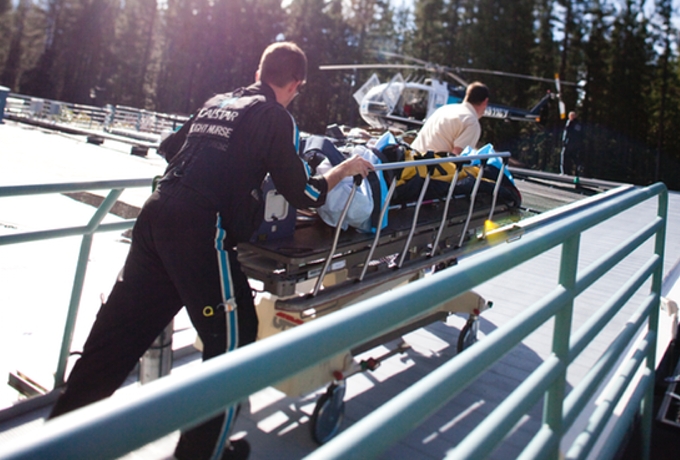
Billie Jo McAfee credits Calstar with saving her life. Photo/Provided

Billie Jo McAfee credits Calstar with saving her life. Photo/Provided

Recovery and recharging

After about two months, McAfee felt good enough to go for coffee or shopping with friends, but found she would have to spend the next two days in bed. “I’d tell myself, this is a reminder that you were very sick – and need to take things slow.”

Something still wasn’t allowing her to fully bounce back. After she underwent a highly specialized scan, it was indeed found that her gallbladder was in bad shape. When she had it removed, months later, McAfee recovered right away.

Recently, she stopped by the Calstar station at the South Lake Tahoe airport to say hello and to thank the staff for her nick-of-time transport last February.

“It’s amazing what Calstar pilots and personnel can do. In winter here, we have bad accidents or mishaps in the Kirkwood area, and they are crackerjack at getting in and helping people in need. I’ve told everyone in the valley that it’s a no-brainer: join as a member,” McAfee says.

“I just want to extend my thanks to Calstar. If they hadn’t gotten me to the trauma center in such an expeditious manner, I probably wouldn’t be here to deliver the message,” she adds.

Back in Christmas Valley, the McAfees are again readying for the winter. This time, they are looking forward to a happy, healthy, and much less eventful New Year.

Laura Kaufman works for Calstar.

—–

Notes:

·      Calstar memberships may be purchased online.