Road beat: Lancer slays the competition
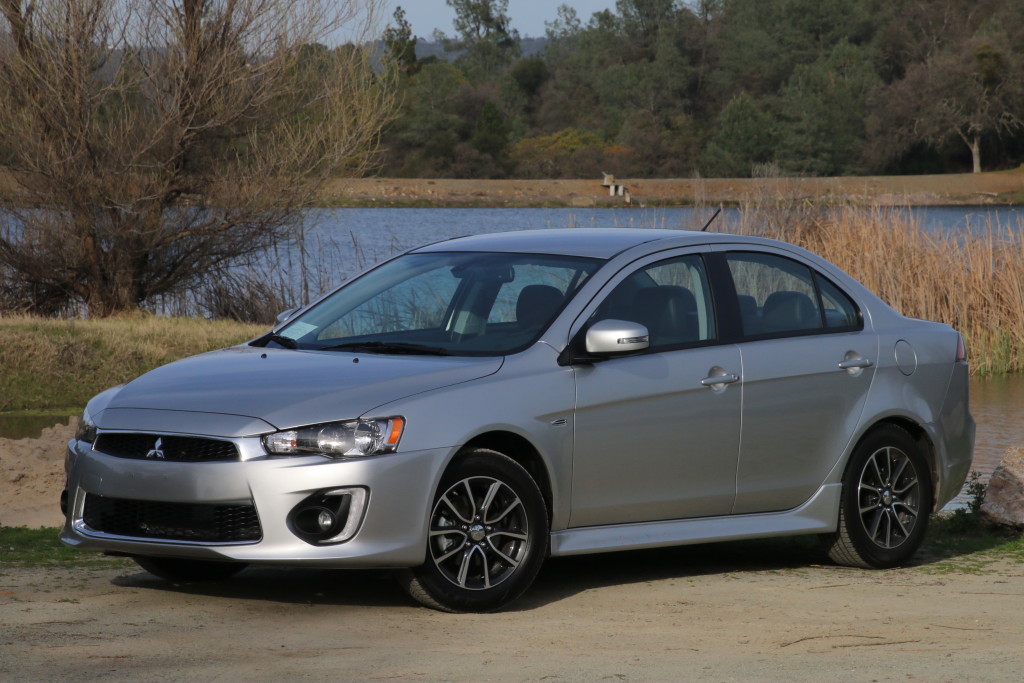
Mitsubishi is turing out quality vehicles. Photos/Larry Weitzman

Mitsubishi is turing out quality vehicles. Photos/Larry Weitzman

By Larry Weitzman

If you haven’t noticed, Mitsubishi is growing with total 2015 sales at about 100,000 vehicles, a sales growth of more than 22 percent, making it one of the fastest growing car companies in the United States. And 2016 is on a pace to exceed those record numbers. And they are making money.

Worldwide, Mitsubishi is huge. And the new Lancer is part of the reason. Dollar for dollar it is hard to get more car for the money.

After spending a week with the Lancer it’s a wonder why Mitsubishi sales aren’t growing faster. The 2016 Lancer’s shape has been in production for several years, and it is still quite the looker with its Concept-X shark nose, but it is slightly softened in its new form. It is still an aggressive, stylish design that still looks great. Its dimensions are pure compact, 104-inch wheelbase, 182-inches long, 69-inches wide and 58-inches high. Track is wide at 60 inches.
Specifications Price $21,995 plus $810 for the boat ride from Japan Engine  2.4L DOHC, 16 valve inline four cylinder 168 hp @ 6,000 rpm  167 ft.-lbs. of torque @ 4,100 rpm Transmission CVT  Configuration Transverse mounted front engine/AWD Dimensions Wheelbase 103.7 inches Length 180 inches Width 69.4 inches Height 58.7 inches Track (f/r) 60.2/60.2 inches Ground clearance 5.8 inches Weight 3,142 pounds Weight distribution (f/r) 59/41percent Fuel tank 14.5 gallons Trunk capacity 12.3 cubic feet Wheels 16X7 inch alloys Tires 205/60X16 all season Steering lock to lock 3.16 turns Turning circle 32.8 feet Performance 0-60 mph 7.39 seconds 50-70 mph 4.59 seconds 50-70 mph uphill 7.77 seconds Top Speed Don’t even consider finding out unless on a race track Fuel economy EPA rated at 23/31/26 mpg city/highway combined. Expect 33-34 mpg on the highway at legal speeds and about 28 mpg overall.

Specifications
Price $21,995 plus $810 for the boat ride from Japan
Engine
2.4L DOHC, 16 valve inline four cylinder 168 hp @ 6,000 rpm
167 ft.-lbs. of torque @ 4,100 rpm
Transmission
CVT
Configuration
Transverse mounted front engine/AWD
Dimensions
Wheelbase 103.7 inches
Length 180 inches
Width 69.4 inches
Height 58.7 inches
Track (f/r) 60.2/60.2 inches
Ground clearance 5.8 inches
Weight 3,142 pounds
Weight distribution (f/r) 59/41percent
Fuel tank 14.5 gallons
Trunk capacity 12.3 cubic feet
Wheels 16X7 inch alloys
Tires 205/60X16 all season
Steering lock to lock 3.16 turns
Turning circle 32.8 feet
Performance
0-60 mph 7.39 seconds
50-70 mph 4.59 seconds
50-70 mph uphill 7.77 seconds
Top Speed Don’t even consider finding out unless on a race track
Fuel economy EPA rated at 23/31/26 mpg city/highway combined. Expect 33-34 mpg on the highway at legal speeds and about 28 mpg overall.

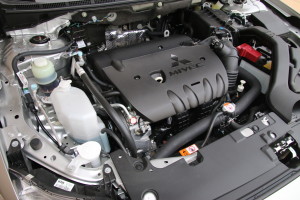
Under the hood is the Global Alliance engine jointly developed by Chrysler, Hyundai and Mitsubishi of 2.4L, four cylinders in line, DOHC and 16 valves with electronic variability. It develops 168 hp at 6,000 rpm and a strong 167 pounds of twist at 4,100 rpm. It is a bit of a torque monster. Now here is where it gets good by offering something only found in one other compact made by Subaru. Mitsu employs a CVT tranny that drives not only the front wheels, but with a switch can drive all four wheels either on demand or all four locked up. In this model its standard equipment. How terrific is that?

And it works great. During a little excursion into 6 inches of snow, absolutely no problems, real surefootedness. It’s also nice in heavy rain. Handling is also enhanced with its advanced fully independent suspension, something not found in most compact sedans. Steering is a hydraulic rack and pinion, albeit a bit slow, but feel is good. It’s also shod with 205/60 series rubber, nothing special there, but the 16 inch alloys are great looking. With stab bars at both ends, handling is quite sporty with limited roll, great steering feel and decent turn-in. Turning circle is a tight 33 feet. Lancer AWC (All Wheel Control) is one of the better handling compacts. It prefers aggressive driving; so will the driver appreciate the extra fun built into the Lancer.

Performance is also near the top of the compact class sprinting to 60 mph 7.39 seconds. Ditto for 50-70 mph passing runs. On level ground it takes 4.59 seconds and up a six percent grade will extend that time to 7.77 seconds, clearly all times at least a second quicker than your average compact. Since peak torque arrives at a low 4,100 rpm, midrange response is outstanding for a compact. There is something here that isn’t found in most other compacts, fun, performance and AWD. Remember that the Lancer is the basis for one of the great hyper-performance cars ever and well known for its rallying capability, the Mitsubishi (Lancer) Evolution, a turbocharged AWD monster with 300 plus hp.

If you are looking for maximum fuel economy look elsewhere, perhaps the base Mitsu Lancer 2.0L which still packs a 148 hp punch should deliver about 4 mpg more than this more performance oriented AWD sport model for a lot less money. My tester delivered 28 mpg overall and 33 mpg at 70 mph on the highway. In a round trip from Rescue to Pollock Pines it averaged 28.6 mpg. EPA rates this Lancer at 23/31/26 mpg city/highway/combined. Fuel capacity is 14.5 gallons.

Of course braking is all wheel discs and their performance is excellent in arresting forward progress stopping the Mitsu in a near benchmark 41-42 feet. The pedal is firm and strong. Of course there are a plethora of airbags and electronic interventions such as ABS, VSC, TC along with a whole alphabet soup of electronic safety devices. That kind of high tech electronic intervention is now on every new car, even back up cameras.

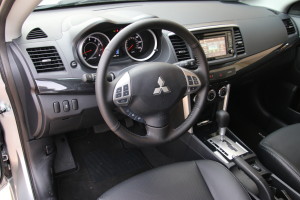
Inside this Mitsu is a leather interior, seats, steering wheel, shift knob and more. It has some luxury touches making it a notch above your average compact and it’s all standard. There is nothing extra to purchase with the SEL. Even the door paneling and dash are soft touch. Seats are comfortable and rear seating is good for two six footers. Instrumentation is also complete with a large standard tach and speedo in dual cowl binnacle which is becoming a bit dated. The trip computer is complete as well. This is a quality car.
Performance in snow is not a problem.

Performance in snow is not a problem.

Spinning at 2,400 rpm at 70 mph gives the Mitsu a relaxed feel on the highway and road noise seems to be a bit subdued for a compact.

So here’s the deal, this very well equipped, AWD, top of the line Mitsu Lancer stickers for just $21,995, plus $810 for the boat from Kurashiki, Japan. It needs nothing. Even the embroidered carpeted floors mats are standard. This is about the most car you can get for the money in a compact. And it is All Wheel Drive. It is a real value. Perhaps that’s the reason for Mitsubishi’s sales growth, making it one of the fastest growing auto companies in the business. People are finding out that nothing sells like real value. What’s even better is you can buy a Mitsubishi Lancer ES AWC for about $20 large. Don’t forget that all Mitsubishi’s come with a standard 5 year/60K mile bumper to bumper warranty plus a 10 year/100K mile powertrain warranty.

Larry Weitzman has been into cars since he was 5 years old. At 8 he could recite from memory the hp of every car made in the U.S. He has put in thousands of laps on racetracks all over the Western United States. 



How immigrants are changing U.S. ski towns

By David Page, Powder

Wednesday is ski day at Mammoth Elementary School. Which, for parents of kids in the program, means an added level of complexity on Wednesday mornings. Not only do the kids have to be in the car by 7:35am, with lunches, homework, combed hair, brushed teeth, and snow boots on the correct feet, but they also have to have their skis, boots, poles, goggles, helmets, gloves, long underwear, jacket, ski pass, sunscreen, snacks, bib, etc. One missing item could mean a kid gets stuck in the lodge all afternoon with a teacher. Or that a parent has to cut out early from work to go pick the child up.


On one such morning last winter, just as the first bell rang, Oscar Ayala (not his real name), dropped his kids at the school. In the near distance, above the paint-speckled ladder on the roof of his third-hand Isuzu Rodeo, Mammoth Mountain Ski Area stood against a blue California sky. They had their heads down, steeled for what lay ahead: four long hours of school—for “dual-immersion” kids like Oscar’s (and mine), education comes half in Spanish and half in English—followed by a short bus ride to the mountain and an afternoon on the slopes. Alison was in second grade; her brother, Oscar Jr., in fifth. Oscar Jr. was born in the U.S.; his sister in Mexico. He has a U.S. passport; she doesn’t. Neither was particularly excited about skiing, at least not early on a Wednesday morning heading into school.

Oscar is one of a growing number of immigrants finding a home in a ski town. He made his way north from Sinaloa, Mexico, in 2001. He had a degree in industrial engineering and went to Tijuana to try to get a job. Angela, his fiancée, had gone to Mammoth, invited by distant cousins on her mother’s side who needed help taking care of their kids while they worked. On the phone, she described to Oscar a place that sounded like paradise: jobs, clean mountain air, trees, a decent school, friendly neighbors, and a general lack of kidnapping, extortion, drug cartels, murder, bad water, extreme poverty, and mean-spirited immigration authorities. There weren’t any jobs in Tijuana—in industrial engineering or anything else. So Mammoth became the dream.

His Mammoth Mountain name tag bore the same name as his fake Social Security card and green card (neither his own name nor the one I’ve given him), for which he paid $150. The money withheld on his paycheck for Social Security, unemployment insurance, workman’s comp, and Medicaid would never be seen again. Not that he was complaining; that’s just how it was. “We have zero permission to stay here,” he says. “We’re the same as those who cross through the desert. The laws are starting to change, but we’re still here with the fear that at any moment for any reason they can send us back.”

Read the whole story


ZCES students show off their talents

It Takes Talent, now in its fifth year, proved there is quite a bit of talent at  Zephyr Cove Elementary School.

Volunteers Duane Nieman and Sunny Patel (Exhale Lounge) used professional lighting and sound to make the performers look like they were on a real stage. Students in every grade level participated.

Each year a student is chosen to emcee the event. Mia Roper helped the show run smoothly.

Judges Stella Roper, Ed Johns and Steele Wetterer said it was a tight contest. In the end, the prizes went to Lola Remmel (third), Ella Moretti and Emmy Brooks (second) and first prize went to Avi Rippet and Lilly Dingman.


Soroptimist grants enrich South Shore


Recipients of Soroptimist International Tahoe Sierra's 2016 community grants. Photo/LTN

Recipients of Soroptimist International Tahoe Sierra’s 2016 community grants. Photo/LTN

Students sleeping in cars, kids in need of a winter coat, food for the weekend. Those are some of the basic needs that aren’t being met on the South Shore. The extras, like being able to take a dance or tennis lesson, to have performing arts in their school – those are also hard to come by.

These needs and wants will be better met thanks to Soroptimist International Tahoe Sierra. Today the service club handed out $13,000 to 22 recipients.

At the March 24 breakfast meeting representatives from each entity talked about how they are going to spend the grant. They are:

·      Bijou Community School – Books to promote literacy.

·      El Dorado County Habitat for Humanity-A Brush with Kindness – Paint, tools and supplies.

·      Firefly Yoga – Provide yoga for those who have sustained a traumatic event.

·      Juvenile Services Council – To continue drumbeat program.

·      Kiwanis Coats for Kids – More than 600 coats were bought this winter for youth.

·      Lake Tahoe Shining Stars – Dance scholarships.

·      Lake Tahoe Unified School District-Homeless Advocacy – Bus passes for homeless to get to appointments.

·      South Lake Tahoe Cancer League – Financial grants to those with cancer.

·      South Lake Tahoe Family Resource Center – Community garden at Bijou.

·      South Lake Tahoe Humane Society – Books for My Reading Buddy program.

·      South Tahoe High Booster Club – Money to help stock room with food and clothing for teens in need.

·      STHS Avid Junior Class – Money to send kids on college scouting trip.

·      Tahoe Arts Project – Bringing performing arts to the schools.

·      Tahoe Coalition for the Homeless – Money for shower vouchers at South Lake Tahoe Recreation Center.

·      Tahoe Magic – Money for Tahoe Smiles, which provides dental care to youth.

·      Tahoe Turning Point – Gym passes at Kahle Community Center and buying sports equipment.

·      Tahoe Valley Elementary School – Equipment for performing arts programs; and separate grant for reading materials; and a grant to take kids to Sutter Fort.

·      Zephyr Cove Tennis Club Foundation – Scholarships for junior tennis program, expansion of program and to purchase equipment for kids to use.

The money for the grants comes from SITS’ annual Elegant Evening fundraiser. This year’s event is April 23 at Harrah’s Lake Tahoe.

— Lake Tahoe News staff report


Teens become educators about perils of smoking

Incline High School students on Thursday will become teachers.

Teens Against Tobacco Use is a program that allows students ages 14-17 to mentor younger students about the dangers of smoking.

IHS leadership students have been working with Lisa Sheretz of the American Heart Association to expand smoke free environments where people work, learn, live and play in Incline Village.

The teens will work with 200 Incline Elementary School fifth-graders on March 24.

Research indicates that peer pressure and initial experimentation with tobacco starts as early as the age of 10 years of age.


Spring planted bulbs extend growing season

Calla lilies, like Night Cap with its black flowers and the white blooms of Crystal Clear, are spring planted bulbs that thrive in full sun or part shade and can be cut to create an elegant display indoors. Photo/Longfield Gardens

Calla lilies, like Night Cap with its black flowers and the white blooms of Crystal Clear, are spring planted bulbs that thrive in full sun or part shade and can be cut to create an elegant display indoors. Photo/Longfield Gardens

By Melinda Myers

Keeping your garden looking its best throughout the growing season and into fall is possible with the help of low maintenance spring planted bulbs. Plant them in spring among other annuals or perennials and watch as these bulbs brighten the garden, adding new life to your late season gardens.

Whether your gardens and containers are in full sun or shade you’ll enjoy the attractive foliage and pop of color that dahlias, cannas, calla lilies, caladiums and elephant ears will add to the landscape.

These easy care plants reward you with loads of beauty. Just plant, water and enjoy. Quality online retailers offer the greatest variety of color, shapes and sizes as well as planting and care instructions.

Grow dahlias in sunny areas with at least six hours of sunlight for the best floral display. Simply plant the tuberous roots 4- to 6-inches deep with the stem facing up after the danger of frost has passed.

Use dahlias in a cutting garden or as an attractive screen along fences and property lines.  Use the shorter more compact border dahlias, like Gallery Pablo in containers on your patio, balcony or deck where you and the hummingbirds will enjoy their blooms.

Wait until the danger of frost has passed to plant cannas in a full sun to partially shaded locations. Plant the canna rhizomes horizontally 2- to 3-inches deep with the growing point facing up. Take advantage of their bold foliage and use cannas as a backdrop in the flower border or screen in the landscape. Use as a vertical accent in a large container or select dwarf varieties for smaller pots.

Calla lilies are another spring planted bulb that thrives in full sun or part shade. The speckled foliage adds color to the garden all season long. Include these 1- to 2- feet-tall plants in the front or middle of the flower garden or as a vertical accent or filler in a pot. And don’t forget to cut a few flowers to enjoy indoors. The black flowers of Night Cap teamed with the white blooms of Crystal Clear create an elegant display.

Like the other bulbs, wait for the danger of frost to pass before planting them outdoors. Plant the knobby rhizomes two to four inches deep with the growing point facing up.

Add some color and plenty of wow factor to shaded areas with the foliage of caladiums and elephant ears.  These tropical beauties thrive when soil and air temperatures are warm. Wait for the danger of frost to pass and the soil to warm, 65 to 70 degrees, before planting them in the garden.

Use caladiums to brighten containers, dress up window boxes or edge a shady pathway. The colorful leaves stand out amongst the greens of shade gardens. Team variegated varieties with complimentary colored begonias, coleus or impatiens.

Include elephant ears in the garden or containers. Their large heart shaped leaves give a tropical feel to the patio, deck or pool area.  Consider planting one, two or more to create an impressive welcome for guests or a bold statement in the landscape. They pair nicely with caladiums, coleus and other shade loving plants.

Make this the best season yet with the help of spring flowering bulbs. You’ll enjoy the variety and late season color these easy care plants provide.

Melinda Myers has more than 30 years of gardening experience and has written more than 20 gardening books, including “Small Space Gardening”. 


Actors sought for LTCC’s rendition of ‘Cabaret’

Lake Tahoe Community College is having auditions for the Tony Award-winning musical “Cabaret” on April 4 at 7pm in the Duke Theatre.

Community members and student actors, singers, and dancers of various ages and types are welcome to audition. Actors are required to sing pieces from the show.

This multiple Tony-winning musical is a classic of musical theater and has been revived on Broadway numerous times. The setting is 1930, and Cliff Bradshaw, an American writer, visits Berlin to search for “something to write about.” After meeting a few people and securing an apartment, he visits the seedy Kit Kat Klub, where the emcee, performer Sally Bowles, and a raucous ensemble takes the stage nightly to tantalize the crowd and encourage them to leave their troubles outside. As life in pre-WWII Germany grows more uncertain, will the decadent allure of Berlin nightlife be enough to get them through their dangerous times? This legendary musical contains some of the most memorable songs in musical theatre history, including: “Cabaret,” “Wilkommen,” “The Money Song,” and “Maybe This Time.”

Rehearsals are Monday through Thursday evenings beginning April 6. Performances are June 10-19.

For more information, call 530.541.4660, ext. 240.


Incarcerated youth use drumming as therapy

Drumming has been a regular sound coming from inside the Juvenile Treatment Center in South Lake Tahoe.

Five youth have been participating in the eight-week Challenge Program that culminated recently with a performance before family and elected officials.

Using the traditional African Djembe drum as the vehicle for communication, the program combined the therapeutic potential of musical expression with a range of social learning outcomes including emotional control, improved relationships, and increased self-esteem.

Liz Broscoe, a local professional musician, is a certified facilitator of the program, and has been using the program, combined with other outcome-based techniques, to help at-risk youth. Not only did Broscoe guide the youth through drumming rhythms to build community and support within the group, the youth were also given assignments to reflect on the role they play in their own destiny.

The Drumbeat Program was made available from grant funding to the Juvenile Service Council from the American Century Championship and El Dorado Community Foundation/South Lake Tahoe Fund.


2 acts added to Harveys Concert Series

Two concerts have been added to the lineup at Harveys Outdoor Concert Series — Tim McGraw and Widespread Panic.

McGraw has played the Stateline venue multiple times; most recently in 2013. He will be in town July 23 at 7:30pm. Tickets range from $89.50 to $179.50.

Widespread Panic will take the stage July 6 at 7:30pm. Tickets are $49.50.


Hotel transformed from old Tahoe into new

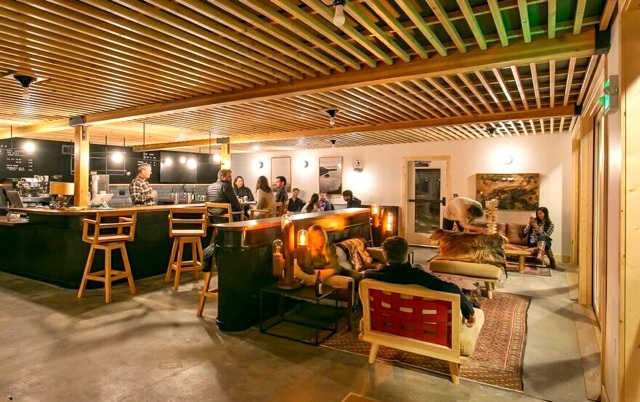
The lobby is also known as the living room. Photo/Matt Bolt

The lobby is also known as the living room. Photo/Matt Bolt

By Kathryn Reed

Modern and minimalist intersect with high quality and relaxed at one of South Lake Tahoe’s newest motels.

The Green Lantern is now the Coachman Hotel.

Justin Watzka has taken what was a rundown hotel in the Stateline area that looked like it hadn’t been renovated since it opened in the 1960s and has turned it into a three-star hotel that is already attracting guests even though construction is not done.

Last weekend 15 rooms were rented. The grand opening is slated for June. To date 30 of the 42 rooms have been renovated. There are 15 layouts. Depending on the time of year, rooms are likely to run between $125 and $220 a night.

In the 1980s the Green Lantern and Royal Coachman became one hotel. Watzka in naming his venture kept some of that history. While the property has driveways on Pine Boulevard and Manzanita Avenue, Pine is the main entrance.

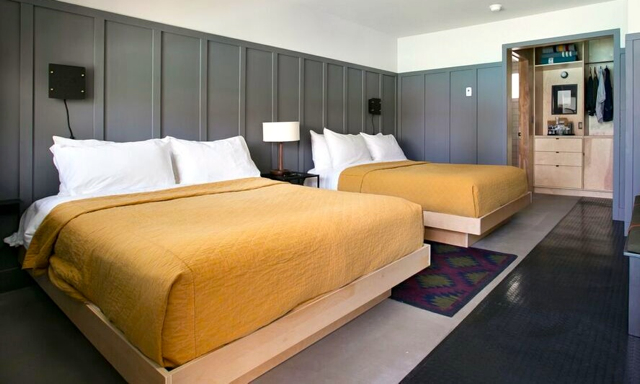
Rooms are the Coachman  Hotel come with king or queen beds. Photo/Matt Bol

Rooms at the Coachman Hotel come with king or queen beds. Photo/Matt Bolt

Watzka bought the 1.1 acres last April for $1.3 million. Since that time he infused “multiple millions” of dollars to transform the property.

“I want to do more projects in the future, so this has to last,” Watzka told Lake Tahoe News while on a tour of the site. He’s here for the long haul, not to just sell the hotel once it’s truly launched.

His background is in the lodging industry, having worked for Marriott Vacation Club for a number of years. He recently earned his MBA. In August, he moved to South Lake Tahoe full time.

Watzka has relied on his dad, Peter, for some expertise. The elder Watzka has spent his entire career in the hospitality business. Brother Garrett, who owns Duvin Design clothing company, has been tasked with creating apparel for the hotel to sell to guests.

The guest experience is what Watzka is focused on. He believes 20- to 50-year-olds from the Bay Area and Sacramento will be his market. It will be people who like to play outdoors. Heavenly Mountain Resort and Lakeside Beach are within walking distance. So are the Stateline casinos.

The lobby, which also is a bit like a living room where guests can relax in a variety of seating areas while enjoying a coffee, beer or wine, is where a garage used to be. Baristas use Stumptown coffee from Portland. Beers go for $5 – with Great Basin, Sierra Nevada, Kona and Stella available. The wines have not been selected yet, but Watzka wants them to come from innovative, young vintners.

Instead of a separate check-in area, it is combined with where people can purchase those hot and cold drinks.

The alder counter has been stained to look like it is walnut. Wood is a common theme throughout the property.

Adjacent to the lobby-living room is the breakfast area. A continental breakfast, including a waffle station, is complimentary.

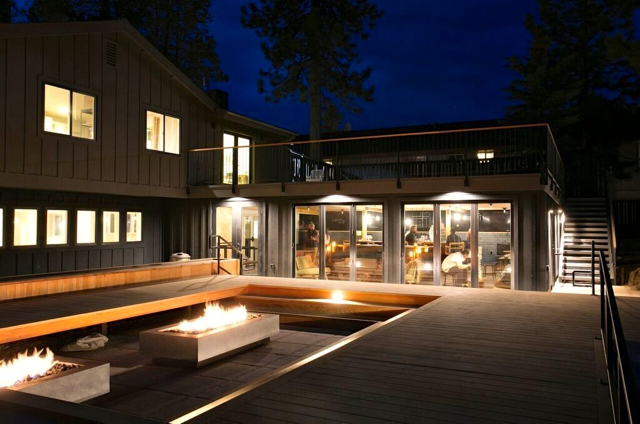
Outside the shared space is a tiered seating area with large gas fire pits. On top of the lobby-living room is a roof deck that in nicer weather will have seating. The original pool will be overhauled and ready for summer. A new hot tub is already operational.

Concrete floors are throughout the property – even in the rooms. A rubber flooring is on top of this in the rooms, which is ideal for when people haul in their ski gear or sand from the beach.

Instead of closets, a bar is in the vanity area of the bathroom where clothes could be hung. There’s also a rack for skis that could double to hang wet jackets or swim suits.

The old hotel lobby, which had a manager’s unit behind it, is now a spacious three-bedroom family unit that can sleep 11.

The fire pits are just outside the "living room" at the Coachman. Photo/Matt Bolt

The fire pits are just outside the “living room” at the Coachman. Photo/Matt Bolt

Sierra Sustainable Builders is the general contractor. Workers essentially took the innards down to the studs. New electrical is throughout, with plenty of outlets for people’s gadgets.

The bathrooms are small, but the showers are decent size. They are about the length of a bathtub – and there are no tubs. Shampoo, soap and conditioner are in bulk dispensers, which Watzka said allows for a higher quality product – Malin+Goetz – to be used.

A touch not often found even at high-end hotels is heated toilet seats.

That is all part of Watzka’s desires to not be ordinary, have little upgrades and still be affordable.

The rooms, some as small as 200-square-feet, are functional and cozy. Beds are either queens or kings. Apple TVs are in each room – another one of those upgrades Watzka wants to be known for.

“The guests’ comfort is No. 1,” Watzka said.