Straw bale gardening ideal when soil is tough
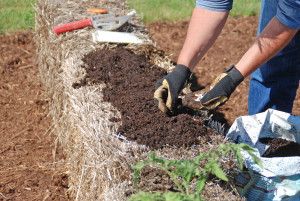
Create a planting bed for seeds by covering the straw bale with a one- to two-inch layer of planting mix. Photo/Melinda Myers, LLC

Create a planting bed for seeds by covering the straw bale with a 1- to 2-inch layer of planting mix. Photo/Melinda Myers LLC

By Melinda Myers

Add productive garden space and raise your planting bed with straw bale gardening. This technique allows gardeners to create raised bed gardens on a patio, lawn or any area with poor compacted soil. Straw bale gardening has been around for centuries, but thanks to Joel Karsten’s book “Straw Bale Gardens” it has gained new popularity.

All that is needed are a few straw bales, fertilizer, a bit of compost and time to condition, plant and water the garden.

Be sure to purchase straw bales made from alfalfa, wheat, oats, rye or other cereal grain that have less weed seeds than hay. Start a few weeks before the designated planting date.

Place the bales in their permanent location with the cut sides up and twine parallel to the ground. Once you start the condition process, the bales will be very heavy and hard to move. When the bales are in place you are ready to start the conditioning process. This is done to start the inside of the straw bales composting, so they’ll support plant growth.

On day one, spread fertilizer over the top of the bale.  Use a ½ cup of a complete garden fertilizer or 3 cups of an organic fertilizer. Then completely moisten the bale. The organic fertilizers feed the microorganisms that help decompose the straw into a nutrient rich planting medium.

Thoroughly soak the bale everyday. On days three and five you will add more fertilizer at the same rate used on day one.

Days seven through nine use half the rate used on day one. This would be one-quarter cup of a complete garden fertilizer or 1½ cups of an organic fertilizer. Thoroughly water the bale each time.

On day 10 you will add one cup of 10-10-10 or 3 cups of an organic fertilizer rich in phosphorous and potassium. This completes the conditioning process.

Bales treated with a complete fertilizer should be ready to plant. You may need to wait a few more days when using an organic fertilizer.  The inside of the bale should be the temperature of warm bath water or cooler for planting. If it is hotter than this, wait for the bale to cool a bit before you plant.

Use a trowel to pry open a hole in the bale. Place the plant in the hole and cover the roots with potting mix or compost.

Create a planting bed for seeds by covering the bale with a 1- to 2-inch thick layer of planting mix. Follow the planting directions on the back of the seed packet.

Regular watering is critical for success with this method. Soaker hoses or drip irrigation make this an easier task. You can also use gallon milk jugs with holes in the bottom or inverted 2-liter soda bottles placed near the base of each plant to provide water where it is needed.

Give your straw bale garden a nutrient boost about once a month or as needed throughout the growing season.

Follow these steps and you’ll be well on your way to growing a productive straw bale garden to enjoy throughout the season.

Gardening expert Melinda Myers has more than 30 years of horticulture experience and has written more than 20 gardening books, including Small Space Gardening and the Midwest Gardener’s Handbook. She hosts The Great Courses “How to Grow Anything: Food Gardening For Everyone” DVD set and the nationally syndicated Melinda’s Garden Moment TV  and radio segments. Myers is a columnist and contributing editor for Birds & Blooms magazine and spokesperson for Milorganite. 


Artist creates snow drawings in the Sierra

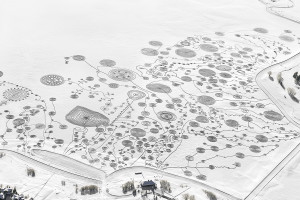
Creating art on snow can be a fleeting endeavor. Photo/Sonja Hinrichsen

Creating art on snow can be a fleeting endeavor. Photo/Sonja Hinrichsen

By Lori Halloran, KQED-TV

For the past seven years Sonja Hinrichsen has made snow drawings all over the world. Over time she’s come to terms with the completely unpredictable nature of her work.

Though she spends months planning her projects, she can never be sure if the weather will cooperate, until the appointed day arrived. If there’s no snow, there’s no canvas. If the snow is falling, she has to wait out the storm.

Even when conditions are perfect and her creation is complete, it’s a race against time to photograph the work before the next snowfall covers it up or it simply melts away.

Read the whole story


New SLT art gallery owner to give talk

Tahoe Art League’s next meeting will feature a young artist from the Los Angeles area who now runs the Genius Fine Art Gallery in South Lake Tahoe.

Scott Forrest’s abstract paintings are featured in this gallery along with the work of Rashad Hopkins, Salvadore Dali, Pablo Picasso, Joan Miro, and Marc Chagall.

The April 13 talk is free. The meeting, with refreshments starts at 6pm, with the presentation at 7pm at the South Lake Tahoe Senior Center, 3050 Lake Tahoe Blvd.


Book review: Learning to see with latest ‘Laws Guide’

By Kim Wyatt

Laws_Guide_cover

“The Laws Guide to Nature Drawing and Journaling”

By John Muir Laws

Heyday Books, 312 pages, $35

One-line review: An excellent art instruction book that could also improve one’s life.

Many of us in the Sierra are familiar with the illustrations of John Muir Laws, the naturalist, educator and artist behind the “The Laws Field Guide to the Sierra Nevada.” In his latest book, “The Laws Guide to Nature Drawing and Journaling,” just out from Heyday Books, rather than simply teach technique, Laws shows us how to see.

For anyone who has ever looked at an illustrated Laws Guide and thought, I wish I could do that, Laws gives you the tools and the inspiration. “The Laws Guide to Nature Drawing and Journaling,” is essentially a master class in capturing the Sierra Nevada in pencil, pen and ink, gouache, watercolor, and more. Although the book is ostensibly a guide to drawing, we learn how to deepen our observational skills, the practice (and benefits) of intentional curiosity, and the value of cultivating creativity—all of which expand our understanding of the natural world and our place in it.

The book is broken into useful sections: How to think about what we are seeing, how to capture it in a journal, what to keep in our journaling kit and how to draw our favorite subjects: animals, wildflowers, trees, and landscapes. At 312 pages, it’s not the kind of book you’ll carry in your backpack, but it is good for car camping, road trips and as an indispensable home reference. (You can always photocopy pages and stick them in your journaling kit.)

Hundreds of colorful illustrations with step-by-step instructions make this book a keeper. From beetles to bears, it’s all here. On a recent trip, I took the book and learned a few things new to me: When drawing waterfalls, you draw the rocks around the waterfall, not the water. Conifer branches reach out like a hand near the bottom of the tree—how had I not noticed this before? Now, when I’m in my backyard, I not only greet the lizard, but also note its proportions and where the light falls, which deepens our relationship. The habit of careful attention Laws encourages heightens our appreciation of the environment, which will make us better stewards.

“The Laws Guide to Nature Drawing and Journaling,” would be a great graduation gift for a budding artist or naturalist. Those new to drawing and journaling will find it an amazing resource, while veteran creators will appreciate the depth and specificity of Laws’ tips and hacks. All, however, will find inspiration—this book will elevate the wonder that lies in us all, and give us a new way to look at our beloved Sierra.

“The Laws Guide to Nature Drawing and Journaling” also has a great companion website, with a blog featuring video tutorials, and instructor guides. You may find it here.

Kim Wyatt is the owner of the independent press Bona Fide Books in Meyers.


Deaf cook lets food speak for him

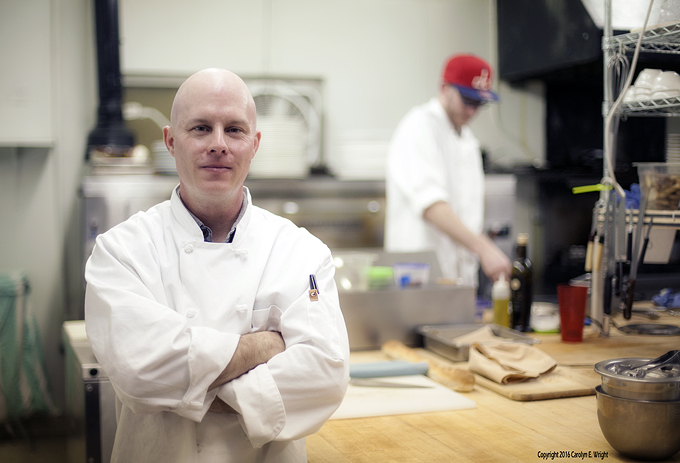
Charlie Somers doesn't let his disability of being deaf slow him down in the kitchen. Photo Copyright 2016 Carolyn E. Wright

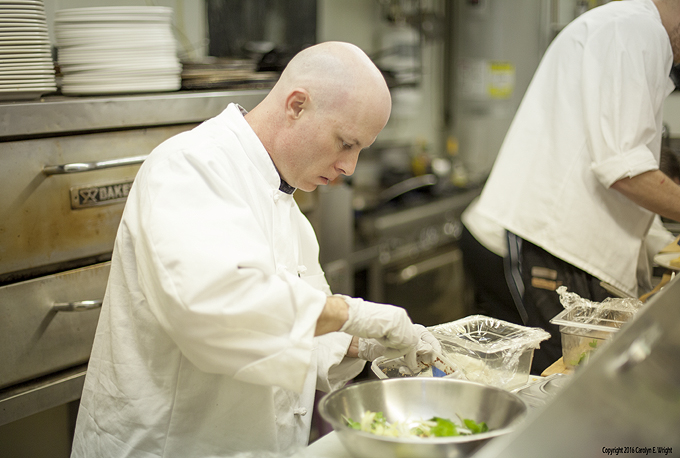
Charlie Somers enjoys learning the inner workings of a professional kitchen. Photo Copyright 2016 Carolyn E. Wright

By Kathryn Reed

STATELINE – Only one ingredient is missing from the kitchen at Mirabelle – the chatter among the staff.

Well, there’s chatter, it’s just not audible.

With the hiring of Charlie Somers, owner-chef Kenn Druley has had to rethink how he communicates with staff. Somers is deaf. Druley isn’t proficient in sign language, nor is anyone else who works at the Stateline restaurant.

It can be a challenge at times because the work of a chef involves having one’s head down nearly all the time cutting, chopping and stirring. It can be fast moving as well.

“It’s kind of like with any new language or any new guy in the kitchen, there are always things to adjust to. It’s just a different way to communicate,” Druley told Lake Tahoe News. “I see it as more of a positive challenge for the kitchen; for myself and Charlie as well. It’s a verbal occupation and you are constantly working with your hands and talking. So when Charlie needs some instruction or directions I have to stop and put things down.”

Photo Copyright 2016 Carolyn E. Wright

Charlie Somers doesn’t let his disability of being deaf slow him down in the kitchen. Photo Copyright 2016 Carolyn E. Wright

Despite what could be perceived as a language barrier, Somers, through interpreter Karla Johnston, told Lake Tahoe News that the “joking, teasing and camaraderie” are the best parts of the job.

Right behind that is learning to cook French cuisine – not something he does at home. Burgers and fries are his specialty when not at work.

He said there are few chefs in the United States who are deaf. The challenges, he assumes, would be the same whether it’s a small kitchen like Mirabelle or a larger one.

Mozzeria, a pizza place in San Francisco, is one place Somers believes would be interesting to work because it is owned and operated by deaf people.

Somers is cognizant that his disability can be more of a challenge to others than it is to him.

“I’m used to working with it, others aren’t,” he said. “I adapt pretty well.”

Everyone at Mirabelle has learned a little sign language.

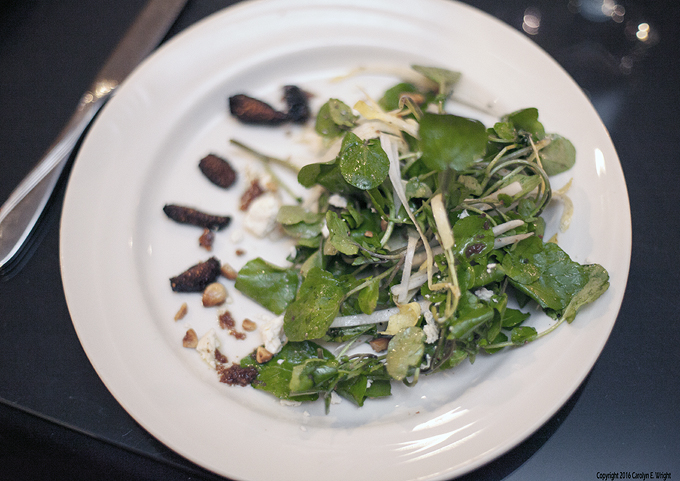
Salads are one of Charlie Somers' responsibilities. Charlie Somers doesn't let his disability of being deaf slow him down in the kitchen. Photo Copyright 2016 Carolyn E. Wright

Salads are one of Charlie Somers’ responsibilities. Photo Copyright 2016 Carolyn E. Wright

“He has to learn to work within this environment and how to teach other people how to work with him. It’s not a one-way street at all. It is a two-way street. Teaching is going on both ways all the time, every day,” Druley said.

Somers took a break from whipping the chocolate mousse into the perfect consistency to chat about how at age 43 he got into this profession. He credits his three children.

About five years ago they were all watching the movie “Ratatouille” and from there Somers got the idea that working as a chef would be interesting and rewarding. He was fairly proficient at barbecuing, but the intricacies of the kitchen – especially a commercial one – were foreign to him. That led him to Lake Tahoe Community College.

Somers now has a certificate in culinary arts. Last fall he answered an ad from Druley on Craigslist that led to him to Mirabelle. He started just before Thanksgiving.

“The ad didn’t say anything about hiring deaf guys only. It said it was open to anyone with a passion for cooking who wants to learn, would be here every day and had a great attitude. Charlie showed up and fit the bill. He was exactly what I was looking for,” Druley said.

Normally Somers works four days a week. A regular shift includes preparing the salads, then dessert, onion tart, bacon, chopping onions, doing dishes, taking out the trash and helping Druley and the line cook with whatever they need.

For Somers, the onion tart is one of his favorite items on the menu. He describes it as being like a French pizza. For now, it’s all about following the chef’s recipes and becoming proficient in various techniques.

Prior to putting on a chef’s jacket, Somers had been working in data entry before going to LTCC. His time in a kitchen had been at Bread & Broth and Little Philly Cheesesteak.

As for his future, he’s not sure. Owning a restaurant seems daunting to him. For now, though, he’s perfectly content to learn all that Druley has to teach.

Druley gives Somers high praise for how far he has come in these four months.

“He is anticipating what the line needs during service. He is learning how to be a good cook, what good cooks do and how they work,” Druley said.


Firefighters Ball to raise money for community

The 54th annual Firefighters Ball at MontBleu Resort is April 8.

A common misconception is that the firefighter’s ball is just for Lake Valley firefighters. It is not. This fundraising event is open to everyone 21 years of age or older.

Vokab Kompany is the band. There will be dancing, a photo booth, and giveaways.

Proceeds from the ball will help fund community programs such as the South Tahoe Middle School Drug Store Project, South Tahoe High School’s Every 15 Minutes Program, elementary school fire safety with the Life and Safety Trailer, and Fire Fest. The Lake Valley Volunteer Firefighter’s Association also awards a local high school graduate with a scholarship to the Lake Tahoe Basin Fire Academy run through the Lake Tahoe Community College. Additionally donations are made to the Pacific Fire Fighter’s Burn Institute, South Tahoe High School Sober Grad Night, Soroptimist International of Tahoe Sierra and more.

Money also goes toward providing community CPR and public awareness programs in fire safety, defensible space, and emergency medical services.

Discounted tickets are available online at or at Lake Valley Fire Station 7. Firefighters receive free admission with department ID. Two for one entrée specials will also be offered at the following restaurants: Echo at Lake Tahoe Resort Hotel, Scusa, Nepheles and Teps Villa Roma. Also, use group code “LVFD79” for $79 Suite Rates at Lake Tahoe Resort Hotel the night of the ball.


Talk to highlight planting for bees, butterflies

UC Davis Tahoe Environmental Research Center will host Ellen Zagory, director of public horticulture for the UC Davis Arboretum and Public Garden, on April 7.

She will talk about how to support the local ecosystem and insect pollinators like native bees and butterflies. Gardens must attract crucial pollinators and conserve water in order to thrive.

Registration for this event is required. The program will begin at 6pm, with refreshments and no-host bar from 5:30-6pm at 291 Country Club Drive in Incline Village.

Seating is open at 5:30pm to guests who have pre-registered, open seating starts at 5:50pm. Cost is $5.


Many benefits to pollinator gardens

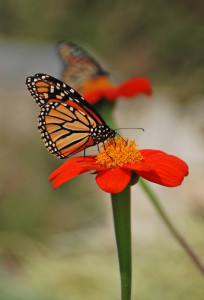
A monarch butterfly on a tithonia blossom. Photo/Melinda Myers LLC

A monarch butterfly on a tithonia blossom. Photo/Melinda Myers LLC

By Melinda Myers

Whether planting a garden, enjoying the beauty of your landscape or sitting down to a delicious meal, you have bees, butterflies and other pollinators to thank. These essential members of our ecosystem are responsible for much of the food and beauty we enjoy each day.

Unfortunately pesticides and habitat loss are threatening their existence.  There is something you can do to help.  Turn your garden, backyard or balcony into a pollinator’s habitat.

Plant a variety of flowering plants that provide nectar and pollen throughout the season. Planting masses of natives, herbs and other pollinator favorites like sedum, zinnias, alyssum, cosmos, and columbine will attract these beauties to your landscape. Include a variety of day and night blooming flowers in a variety of colors and shapes to support the widest range of pollinators. But don’t let a lack of space dissuade you; even a window box of flowers can help.

Keep your plants healthy and blooming with proper care. Match the plants to the growing conditions, provide needed water and fertilize with an organic nitrogen fertilizer when needed. You’ll promote slow steady plant growth that is less susceptible to drought and pests. Plus the slow release low nitrogen won’t interfere with flowering which is essential to the health and well being of our pollinators.

Supplement pollinators’ diets with a bit of rotten fruit. And be sure to provide trees, shrubs, parsley, dill and other plants that caterpillars, grubs and the immature stage of other pollinators prefer to feed upon. Put away the pesticides and tolerate a few holes in the leaves of their favorite plants.  With a diversity of plants you can easily overlook the temporary leaf damage. Plus, this is a small price to pay for all the benefits they bring to the garden.

Provide pollinators with shelter from predators and the weather.  Include a variety of trees, shrubs and perennials. Leave patches of open soil for ground nesting bees and some leaf litter to shelter some butterflies, bumblebees and other pollinating insects. Supplement natural shelter with commercial or homemade nesting boxes. You’ll find do-it-yourself plans on the internet from various educational sources.

Puddles, fountains, birdbaths and even a damp sponge can provide needed water. Include water features with sloping sides or add a few stones to create easier access. Or sink a shallow container of sand in the ground. Keep it damp and add a pinch of sea salt for the butterflies and bees.

Maximize your efforts by teaming up with your neighbors. Together you can create a larger more diverse habitat that provides pollinators with the resources they need to thrive.

Your efforts will be rewarded with greater harvests, beautiful flowers and colorful birds and butterflies visiting your garden.

Gardening expert, TV/radio host, author and columnist Melinda Myers has more than 30 years of horticulture experience and has written more than 20 gardening books.


Tahoe Tails — Adoptable Pets in South Lake Tahoe

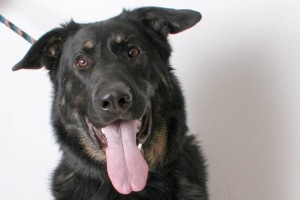
Bear

Bear

Bear is a German shepherd-Alaskan Malamute mix who is about2 years old. He is a very nice big boy who loves to play with toys.

Bear is neutered, microchipped, tested for heart worm, and vaccinated. He is at the El Dorado County Animal Services shelter in Meyers, along with many other dogs and cats who are waiting for their new homes. Go to the Tahoe animal shelter’s Facebook page to see photos and descriptions of all pets at the shelter.

Call 530,573.7925 for directions, hours, and other information on adopting a pet.

For spay-neuter assistance for South Tahoe residents, go online.

— Karen Kuentz


Gambling rats help reveal science of risk

By Pam Belluck, New York Times

When people make risky decisions, like doubling down in blackjack or investing in volatile stocks, what happens in the brain?

Scientists have long tried to understand what makes some people risk-averse and others risk-taking. Answers could have implications for how to treat, curb or prevent destructively risky behavior, like pathological gambling or drug addiction.

Now, a study by Karl Deisseroth, a prominent Stanford neuroscientist and psychiatrist, and his colleagues gives some clues. The study, published Wednesday in the journal Nature, reports that a specific type of neuron or nerve cell, in a certain brain region helps galvanize whether or not a risky choice is made.

Read the whole story