Books Americans want out of public libraries

By Niraj Chokshi, Washington Post

Explicit sexuality, offensive language, homosexuality, a religious viewpoint: Those are a few of the common objections to the 10 most-challenged books of 2015, according to the American Library Association’s latest “State of America’s Libraries” report.

The list, published this week, includes some well-known titles — the Holy Bible ranked sixth — along with some lesser-known ones.

Some deal with discovering sexuality; “Fifty Shades of Grey” ranked second.

Read the whole story


Groups offer free digitization of old Tahoe photos

Photographer H.T. Cowling on a pier at Tahoe. Photo/NLTHS

Photographer H.T. Cowling on a pier at Tahoe. Photo/NLTHS

The North Lake Tahoe Historical Society and UNR’s Photography Program are offering digitization services of historic visual materials related to the North Lake Tahoe community.

Digitization sessions will be open for drop-ins at any time June 26 between 10am and 4pm at the Gatekeepers Museum in Tahoe City.

Presentations will be given by historian Carol Jensen (2-3pm), photographer Peter Goin (11:15am-12:15pm), and photograph archivists Kimberly Roberts (3:15-4pm) and Katrina Windon (1-1:30pm). There will be docent-guided tours of the Gatekeepers Museum at 12:15pm and 1:30pm. All of this is free.

This one-day event offers a chance for community members and visitors to bring in historic visual materials documenting the region and have those materials digitized according to professional archival standards. In return, participants will have the option to donate a digital copy of these materials for inclusion in the NLTHS’s database, providing public access to anyone interested in researching North Lake Tahoe’s cultural history.

The goals of this event are: To increase community awareness of the wealth of cultural heritage in the region and how they can use these resources in their own lives and research; to acquire new materials to fill in gaps in the existing cultural record; and to provide community members with the knowledge and tools they need to become custodians of their own family history materials.

For more information and a detailed schedule of events, go online.


Noah Arzio — 1992-2016

Noah Arzio

Noah Arzio

Noah Arzio of South Lake Tahoe died April 15, 2016, after a brief illness. He was 23.

He was born on Oct. 8, 1992.

Noah was his happiest with his South Lake Tahoe audiences, whether it was Tiny Tim in “Scrooge”, Miss Marcia’s dance recitals, Mrs. Robinson’s Spring String Fling or just hanging out with friends.

He is survived by his parents Paula and Bobby; brothers Jesse, Eric and Matthew; and many aunts, uncles and cousins.

A memorial Mass will be celebrated at Saint Theresa Catholic Church (1041 Lyons Ave., South Lake Tahoe) on April 20 at 10am.

In lieu of flowers, donations in Noah’s name may be made to NAMI East Bay, 980 Stannage Ave., Albany, CA 94706.


Study: Changing prejudices is possible

By David Perlman, San Francisco Chronicle

Two young political scientists at UC Berkeley and at Stanford who exposed a major research fraud less than a year ago are now reporting the results of their own work on countering prejudice, and are being hailed for it by a leading expert in their field.

The scientists said they have found that the attitudes of voters who strongly disdain transgender people and opposed laws protecting them can be rapidly changed by brief conversations with volunteers, regardless of whether those volunteers are transgender.

The change in prejudice can be long-lasting, too, and persists for at least three months, the two investigators found.

Read the whole story


Road beat: Mazda CX-3 a worthy crossover

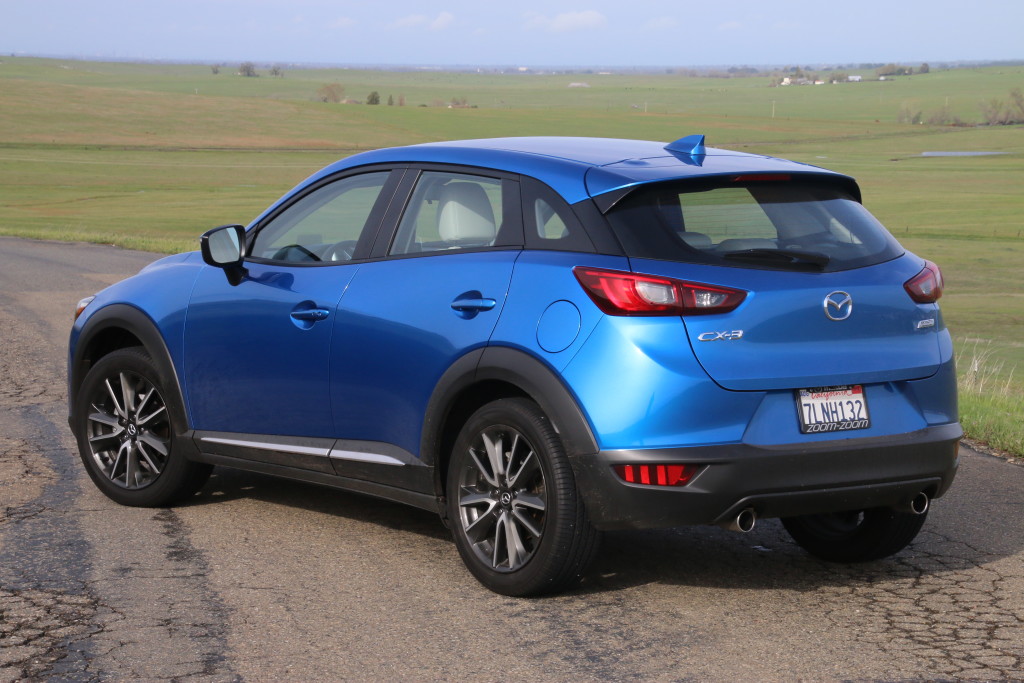
The Mazda CX-3 handles well making a name for itself. Photos/Larry Weitzman

The Mazda CX-3 handles well making a name for itself. Photos/Larry Weitzman

By Larry Weitzman

Introduced about nine months ago, the new Mazda CX-3 is already proving itself as a best in class vehicle. Other than carrying a baby grand piano or an eight-man football team, this new Mazda demonstrates this unique company’s purpose of building vehicles that outperform the competition in so many areas.

Starting with its KODO themed aggressive design (Mazda says “Soul of Motion”) which starts with a simple, but sophisticated open cross-member grille that might look good on a 1960s Ferrari, to its edgy, curvaceous lines which flow rearward, this Mazda (as with their entire line) speaks of forward movement almost like great airplane designs like the North American P-51 Mustang; when they look that good, they fly that good.

Specifications Pricing $19,960 to about $29,500 Engine  2.0L DOHC 16 valve direct injection inline four 146 hp @ 6,000 rpm            146 lb.-ft. of torque @ 2,800 rpm Transmission Six-speed torque converter automatic Configuration Transverse front engine//FWD/AWD Dimensions Wheelbase 101.2 inches Length 168.3 inches Width 69.6 inches Height 60.9 inches Track (f/r) 60.0/59.9 inches Ground Clearance 6.22 inches Curb weight (FWD/AWD) 2,809/2,952 pounds Turning circle (curb to curb)34.8 feet Fuel Tank capacity (FWD/AWD) 12.7/11.9 gallons Cargo volume (second row down/up) 44.5/12.4 cubic feet Wheels (std/opt) 16X6 inch steel/16X6.5-inch alloy opt/18X7 inch alloy opt Tires (std/opt) 216/60X16/215/50X18 Performance 0-60 mph 7.89 seconds 50-70 mph 4.45 seconds 50-70 uphill 6.86 seconds Top speed (according to Mazda) 119 mph Fuel economy EPA rated 29/35/31 mpg city/highway/combined. Expect 30.9 mpg in rural /suburban driving and 35 mpg at 70 mph on a level highway.

Specifications
Pricing
$19,960 to about $29,500
Engine
2.0L DOHC 16 valve direct injection inline four 146 hp @ 6,000 rpm
146 lb.-ft. of torque @ 2,800 rpm
Transmission
Six-speed torque converter automatic
Configuration
Transverse front engine//FWD/AWD
Dimensions
Wheelbase 101.2 inches
Length 168.3 inches
Width 69.6 inches
Height 60.9 inches
Track (f/r) 60.0/59.9 inches
Ground Clearance 6.22 inches
Curb weight (FWD/AWD) 2,809/2,952 pounds
Turning circle (curb to curb)34.8 feet
Fuel Tank capacity (FWD/AWD) 12.7/11.9 gallons
Cargo volume (second row down/up) 44.5/12.4 cubic feet
Wheels (std/opt) 16X6 inch steel/16X6.5-inch alloy opt/18X7 inch alloy opt
Tires (std/opt) 216/60X16/215/50X18
Performance
0-60 mph 7.89 seconds
50-70 mph 4.45 seconds
50-70 uphill 6.86 seconds
Top speed (according to Mazda) 119 mph
Fuel economy EPA rated 29/35/31 mpg city/highway/combined. Expect 30.9 mpg in rural /suburban driving and 35 mpg at 70 mph on a level highway.

As a crossover SUV, the CX-3 is small with a length of 168 inches (about a foot shorter than your average compact). It is wide, however, at 70 inches and stands 61-inches tall, not exactly a giant. Wheelbase is a long 101 inches, which can be seen in the very short rear overhang. As a benefit of that width is a wide track of 60 inches.

Power comes from inline transverse mounted DOHC, 16 valve, Skyactiv four-cylinder engine that pumps out 146 hp engine at 6,000 rpm plus 146 pounds of twist at an extremely low 2,800 rpm. Skyactiv is an important part of this remarkable engine’s equation as it adds direct injection plus the ability to Atkinson cycle which makes the engine more efficient, just wait until you see the real fuel economy numbers. The tranny is a six speed lockup torque converter automatic. Very quick shifting, it was sometimes reluctant to shift to a higher gear. While it has a sport mode, even when switched off it sometimes stayed in the lower gears too long. This might have been due to a memory function of modern trannies where they remember the driving habits of the hot-rodder before me.

Performance numbers reflect how remarkable this engine it. The CX-3 pops off 0-60 mph in 7.89 seconds. But the CX-3 really shows off its big mid-range torque in its 50-70 mph passing times of 4.45 seconds on a level highway and just 6.86 seconds blasting up a 6 percent grade. But adding to the CX-3 performance characteristics is its remarkable responsiveness. The throttle is linear, but get halfway into the go pedal and it feels like it has 246 horses working for you. Also while this was a front wheel drive CX-3, torque steer is almost non-existent. Performance is also helped by the light 2.809 pounds of curb weight. Being skinny also helps fuel economy and ride and handling.

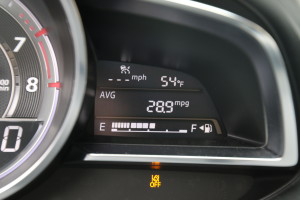
Sipping gas is another attribute of the CX-3. In about 300 miles of driving with less than 15 percent on the highway and including my performance testing, this CX-3 averaged 30.9 mpg and on the highway with the engine spinning 2,400 rpm, it returned an average of 35 mpg. I’ll bet with the addition of a seventh gear that number would go up by three mpg. The CX-3 is the most economical SUV ever tested by the Road Beat, quite remarkable considering its relatively excellent performance. One small item is the smallish fuel tank of 12.7 gallons. AWD will cost you about one mpg overall. The EPA says it should return 29/35/31 mpg city/highway/combined.

But it’s not just straight line performance, it’s also about when the road bends. In this category the CX-3 really can strut. Suspension is fairly standard with MacPherson struts up front and a semi-independent torsion beam in the rear. Its wide track improves stability and its gorgeous 18 x 7 inch alloys are shod with 215/50 series rubber. And those numbers don’t disappoint when changing directions, like it’s a larger Miata. The electric power steering has great feedback and feel and assures confidence when dancing through a good set of twisties. Body roll is almost flat. With respect to this SUV, the operative letter is the S. It is a delight to drive. When it comes to looks, performance, handling and fuel economy not only is this CX-3 at the top of its class, so is the Mazda3, Mazda6, Mazda MX-5 and the CX-5 all ratings just bestowed as well by the New York Daily Auto News. No one has tested the new CX-9, but you can bet scribes have high hopes for this new mid-size SUV with three rows of seats.

Comfort is part of the package.

Comfort is part of the package.

Ride quality is a bit firm, not harsh mind you, but firm. On smoother roads you will love the way it handles bumps and undulations, but sharper imperfections will be noticed. On the positive side large undulations don’t upset the handling as there is no float in the ride. In fact, Mazda CX-3 handles those kind of road imperfections better than SUVs with a softer ride. Road noise is about average for this class and wind noise is quite subdued making the CX-3 a good road car. With AWD (a $1,250 option) it would be a great all weather vehicle that could do well in the light bush.

Safety is second to none with an alphabet soup of electronic technology. Brakes are four wheel discs and in the AWD package the fronts discs grow by over half an inch for improved power. It stops in wet conditions in 46 feet from 40 mph under perfect control. You could feel all the systems working to make the stop in only about 6 feet longer if the surface was dry. Good stuff.

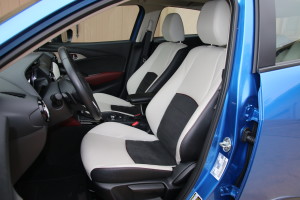
Not only are Mazda designers doing world class exteriors, but their interiors also deserve that nomenclature. Seats are superb in style and comfort, especially when done in black and parchment with a bit of red trim pieces which are done in a leather and a faux suede material. Instrumentation consists a central large tach with a digital speedo in its southeast quadrant and also on its heads-up display. Other info including the trip computer are done digitally left and right of the tach. Good stuff. But it’s the audio/nav system that is a distraction as it is still difficult to master and operate. I know Mazdas are about driving, which they definitely are.

Cargo capacity with the rear seats folded is about 45 cubic feet. With them up it shrinks to about 12 cubic feet. Not exactly your average moving van, but it’s a good way from blowing your budget when going to Home Depot.

Pricing starts at just below $20 large for a FWD Sport CX-3. However, my fully loaded Grand Touring FWD is $24,990, plus $880 for the boat ride from Hiroshima, Japan. AWD will add $1,250 and the option GT package is $1,920 which is appropriate for the inattentive driver with its smart braking, radar cruise, lane departure, auto high beams and a couple of other items, your choice. My tester which had all these options plus Mazda mobile start stickered at $28,340. Mazda makes driving fun as long as you don’t have to change the radio station.

Larry Weitzman has been into cars since he was 5 years old. At 8 he could recite from memory the hp of every car made in the U.S. He has put in thousands of laps on racetracks all over the Western United States.


Tahoe Tails — Adoptable Pets in South Lake Tahoe

Chunky Monkey

Chunky Monkey

Chunky Monkey is not one of your typical high-energy pit bulls. The best word to describe him is mellow.

He is very calm in the shelter, doesn’t bark, but wags his tail wildly any time someone comes to his kennel. He takes treats as gently as any dog can, and walks nicely on the leash. He is about 6 years old, weighs about 50 pounds, and is short and stocky (but not overweight). And look at those ears!

Chunky Monkey is neutered, microchipped, tested for heart worm, and vaccinated. He is at the El Dorado County Animal Services shelter in Meyers, along with many other dogs and cats who are waiting for their new homes. Go to the Tahoe animal shelter’s Facebook page to see photos and descriptions of all pets at the shelter.

Call 530.573.7925 for directions, hours, and other information on adopting a pet. For spay-neuter assistance for South Tahoe residents, go online.

— Karen Kuentz


A case for winter tires

By Bryan Rogala, Outside

Tires have a huge impact on car performance and safety, but most of us rarely give them any thought—until they quit working. That’s what happened in November when our headquarters in Santa Fe, New Mexico, got hit with the first major El Niño storm of the season. On the storm’s biggest day, most of the office drove up a local hill and proceeded to get stuck in the more than two feet of snow that had fallen overnight.

I had to abandon my Subaru Forester, with its regular all-season tires, in a snowbank and hop into a friend’s Toyota. After skinning up the resort and skiing all-time powder, that same friend gave me a ride back down, where we dug out my car, which I then white-knuckled back to town.

I resolved never to drive a snowy road without the proper treads again.

Read the whole story


Film highlights draw to the backcountry

Sammy Carlson’s two-year endeavor, “The Sammy C Project”, will have its Tahoe premiere screening at Sierra Nevada College on April 20.

In 2014, after winning five X Games medals, Carlson abruptly stepped away from competition and dropped out of Olympic contention even as slopestyle skiing was about to make its Winter Olympic debut. Instead, he decided to pursue a new path that would push him and the sport of skiing to new places at all costs.

Carlson’s newfound focus landed in the backcountry, where his drive and creativity could max out far beyond the limits of preset slopestyle courses.

The event is free and open to the public, with a $5 donation encouraged to support SNC’s Freeride Club.

Doors open at 7pm, with the film at 7:30pm in TCES 139/141.


What happens when books go to war

By Molly Guptill Manning

In January 1942, thousands of New Yorkers gathered on the steps of the legendary New York Public Library at 5th Avenue and 42nd Street wearing their Sunday best and warmest coats.  When standing room became scarce, crowds formed across the street. Nearly everyone had at least one book in hand. These were not overdue, nor did they need to be returned to the library; instead they were “Victory Books,” bound for soldiers overseas.

It may be difficult to appreciate the significance of a book drive held nearly 75 years ago. But this was no ordinary campaign. At the time, books—vehicles for new ideas—were being banned and burned in Europe by the German army. As the Nazis swept through Europe—occupying Poland, France, Czechoslovakia, Austria, Norway, Belgium, the Netherlands, and Denmark—restrictions were placed on the authors and titles that could be read in these conquered territories; books by American, British, and Jewish authors were outlawed. The most severe penalty for being caught with such contraband was death. This threatened punishment produced Germany’s desired effect: Strict compliance with the book bans was the norm.

With this threat across the Atlantic, Americans felt an urgent need to preserve books and all they symbolized. To spread this message, Hollywood celebrities, popular musicians, politicians, and military officials visited the New York Public Library in January 1942 to give speeches and performances that were broadcast nationwide over the radio. Katharine Hepburn, Chico Marx, Benny Goodman, Mayor Fiorello LaGuardia, Wendell Willkie, and Danny Kaye were among the famous who visited the library. They stressed that the best defense against Germany’s war on books was to do the opposite: read and spread information. And so books became a sort of weapon in the war—fighting ignorance, censorship, and boredom.

The Victory Book Campaigns of 1942 and 1943 enlisted ordinary Americans and their favorite books. Librarians across the United States scattered giant bins in stores, movie theaters, train stations, schools, and other public spaces to collect “Victory Books” for those serving in the Army and Navy. In 1942, 10 million books were collected by the Victory Book Campaign, making it the largest book drive in the world. Another 8 million books were collected the following year.

Most of the donations were hardcover books, a reflection of the American book industry at the time. The majority of American publishers refused to enter the paperback trade, fearful that 25- cent softcovers would ruin the handsome profit margins they earned from hardcover sales. The donated hardcovers were fine for stationary Army camps in the United States and aboard Naval ships, where soldiers did not need to carry all of their belongings on long marches or into battle.  When Americans shipped out to North Africa in 1942, they brought Victory Books to pass the long weeks spent sailing to their destination. Lacking any other entertainment, most tucked books into their packs and carried them into the invasion and beyond. But long marches with aching backs and blistered feet caused many to whittle down the possessions they carried; heavy hardcovers were reluctantly tossed.

American publishers heard of the insatiable demand for books overseas and the plight of the ill-suited hardcovers. They banded together to create books specially designed for American sailors and troops. Scrapping the hardcover, using lightweight paper akin to newsprint, reducing page margins, eliminating blank pages, and shrinking the size of books to as small as 3½  by 5½  inches, publishers created volumes sized to fit the pockets of uniforms. These miniature paperbacks were called “Armed Services Editions,” and were sold to the military at cost; they were distributed free of charge to Americans serving overseas. Westerns, sports stories, histories, bestsellers, fiction, nonfiction, short stories, books of humor, and poetry—the range of subjects ran the gamut. Soldiers devoured them. Creased covers, loose pages, taped bindings, and dog-eared pages were evidence of their popularity. No matter how worn, the books were passed from one GI to the next. According to one soldier, “To heave one in the garbage is tantamount to striking your grandmother.”

Homesick and lonesome soldiers found solace in books. Surprisingly, Betty Smith’s “A Tree Grows in Brooklyn” was the most popular of them all, despite being a coming-of-age tale from the perspective of Francie Nolan, a young girl. Troops related to Francie’s difficult upbringing, her discovery of comfort and escape in books, and her resolve to beat the odds and achieve her dream of going to college. Smith received over 10,000 letters of gratitude from Americans in uniform. In one letter, a marine described watching his friend’s final moments of life and said a part of him died with his friend. However, two years later, Smith’s book transformed him and his heart “turned over and became alive again.” Another man wrote Smith that her book inspired him during difficult battles, and that he and his wife vowed to name their first-born daughter “Betty Smith,” to honor the author who helped him survive war.

Other books were appreciated for their ability to amuse. Leo Rosten, author of “The Education of Hyman Kaplan”, received a letter of praise from a unit stationed in the Persian Gulf, whose only other entertainment was “a ping-pong set—with one paddle only.” Rosten’s humorous tales became the hottest commodity on the post; the men assembled each night by campfire and “roared” with laughter as they read one Kaplan story per day—it was their “ration on pleasure.”

Publishers received letters suggesting future titles to be printed. One man explained that the books that were in the highest demand had “at least an essence of—to put it bluntly—sex and a lot of it.” He asked for “Forever Amber, Strange Fruit”, and Tiffany Thayer’s “The Three Musketeers”, as they were all endowed with that quality. One man wrote: “For days, I’ve been hunting through our service club, bothering the Red Cross, scanning our library shelves and hunting unrelentlessly through the barracks—for what????” He desperately wanted a copy of H. Allen Smith’s “Low Man on a Totem Pole”, a popular book of humor. Another soldier summed up the success of the publishers’ Armed Services Editions: “You have no idea how many hours of pleasure your books give to us.”

The German army, by V-E Day, had burned an estimated 100 million books and destroyed hundreds of libraries, institutes, and rare book collections across Europe. By contrast, American librarians and publishers distributed over 140 million Victory Books and Armed Services Editions to those serving in the U.S. Army and Navy. These books made a lasting impact on the Americans who read them. Thanks to the Armed Services Editions, 12 million veterans returned home with an insatiable appetite for paperbacks. Demand was so high that publishers could not ignore this new market. A scant 200,000 paperbacks were printed in the United States in 1939; a staggering 95 million paperbacks were printed in 1947. Publishers realized they could earn a profit off paperbacks after all. In doing so, they printed books that attracted a larger audience of book readers than expensive hardcovers could.

Besides revolutionizing the book industry, the provision of books to those in the armed forces also changed attitudes toward higher education. Before the war, most Americans did not dream of going to college; expensive tuition made it a financial impossibility. However, the passage of the GI Bill, which promised a free education on the government’s dime, coupled with a newfound interest in books and learning led many veterans to consider returning to school. After all, they had proven to themselves that they enjoyed the scholarly activity of reading even under the stresses of war. Over 2 million Americans pursued an education under the GI Bill.

The next time you see a tattered paperback, think of the millions of Americans in uniform who cherished them while at war. These Americans not only fought and won a military victory against the Axis powers; the reading habit they gained led to the democratization of higher education and access to books at home.

Molly Guptill Manning is author of the New York Times best seller “When Books Went to War: The Stories that Helped Us Win World War II”. With a master’s degree in American History from the University at Albany and a law degree from the Cardozo School of Law, she is currently a staff attorney at the U.S. Court of Appeals for the Second Circuit.



Author, former cop to talk human trafficking

John Vanek, a retired lieutenant from the San Jose Police Human Trafficking Task Force, will discuss his book “The Essential Abolitionist: What You Need to Know about Human Trafficking & Modern Slavery” on April 26.

He will address the most commonly asked questions and topics surrounding human trafficking and the challenges involved in fighting this crime and assisting its victims. In addition, he will examine the myths and misconceptions related to modern slavery.

This event sponsored by the South Lake Tahoe Friends of the Library starts at 6pm.

Vanek’s book will be available for purchase. South Lake Tahoe Library is at 1000 Rufus Allen Blvd.