Road beat: Tucson Sport, new best in class?
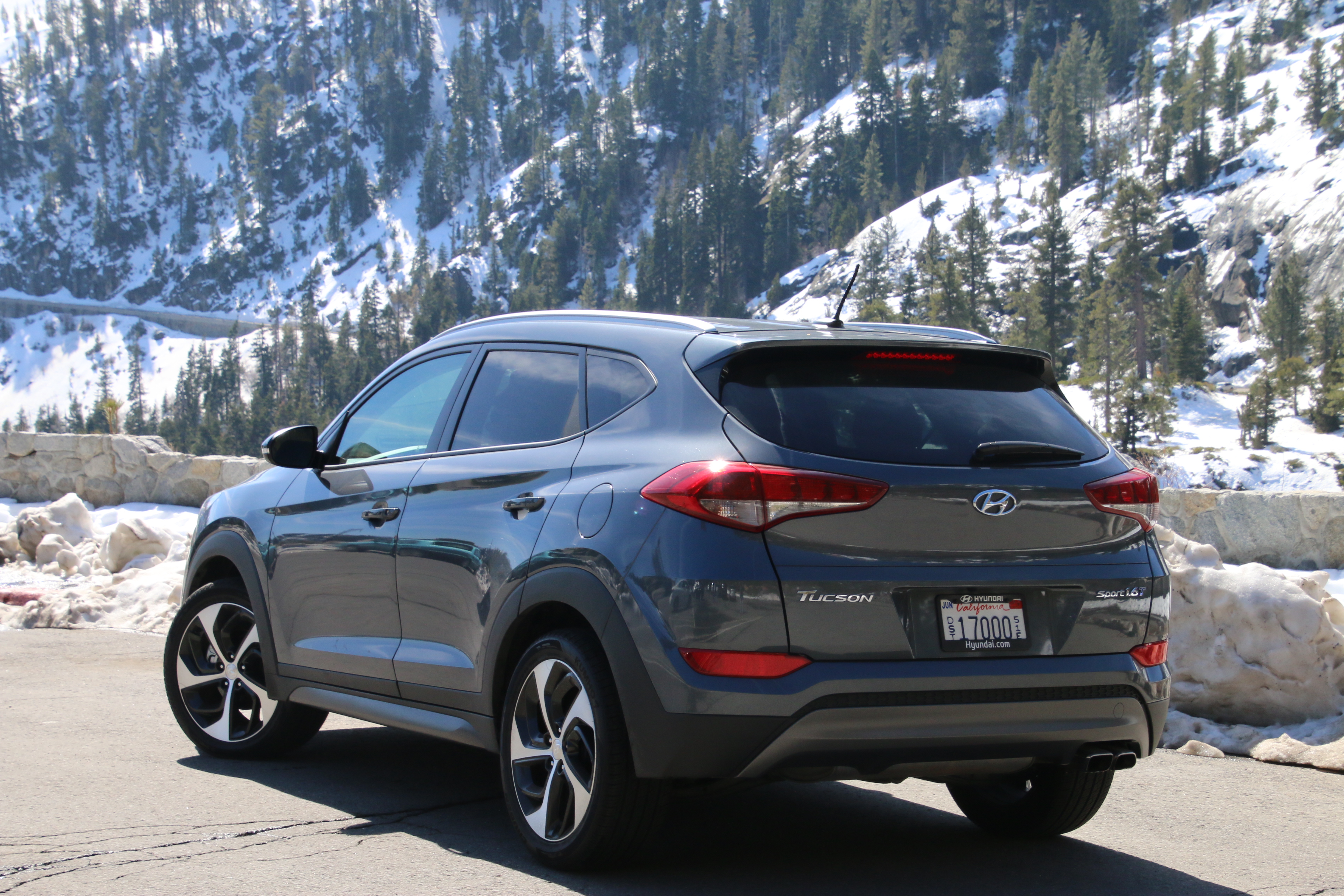
 

Hyundai is giving Mazda competition with its Tucson. Photos/Larry Weitzman

Hyundai is giving Mazda competition with its Tucson. Photos/Larry Weitzman

By Larry Weitzman

Hyundai is on a roll, now making not just good cars, but world-class vehicles that can achieve best in class status as this new Tucson Sport demonstrates in the compact SUV class.
IMG_0334

Specifications Price $27,170 Engine Turbo-direct injected DOHC, 16 valve, 1.6L inline four 175 hp @ 5,500 rpm 195 lb-ft of torque @ 1,500-4,500 rpm Transmission Seven Speed Dual Clutch automated manual Configuration Transverse front engine/FWD/AWD Dimensions Wheelbase 105.1 inches Length 176.2 inches Width 72.8 inches Height 64.8 inches Track (f/r) 63.3/63.8 inches Ground clearance 6.4 inches Fuel capacity 16.4 gallons Weight 3,369-3,580 Steering lock to lock 2.71 turns Turning circle 34.9 feet Wheels 19X7.5 inch alloys Tires 245/45X19 Cargo capacity (rear seats/up/down) 31.0/61.9 cubic feet Tow capacity 1,500 pounds (with trailer brakes) Co-efficient of drag 0.33 Performance 0-60 mph 6.97 seconds 50-70 mph 3.84 seconds 50-70 uphill 5.43 seconds Top speed Plenty fast (well into triple digits) Fuel economy EPA rated 25/30/27 mpg city/highway/combined. Expect 29 mpg in rural country, suburban driving. 34-35 mpg on the highway at legal speeds.

Stealing a bit of styling from its bigger brother, the Santa Fe, the new Tucson has a sleeker shape with edgy, defined character lines, a swept back window line, what’s becoming a Hyundai characteristic, an aggressive snout grille which makes a powerful statement and creates an excellent brand identity. If you study the grille’s design, you can see how other parts of the front end are tied in like the headlights, the lower fog and parking lights all working together to create a complex focal point that says muscle and athleticism. Tucson has a slick co-efficient of drag of a low 0.33.

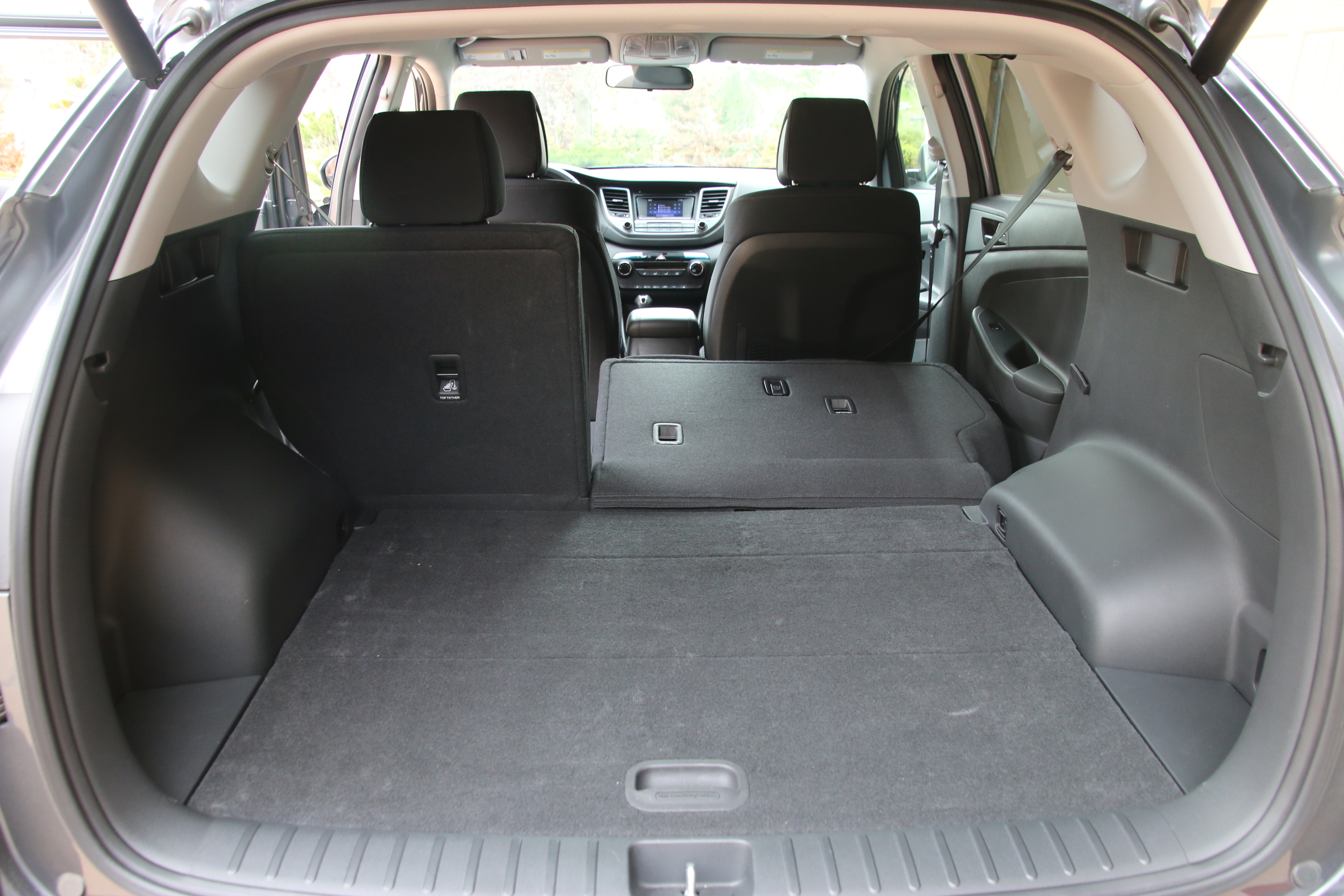
Being a compact SUV, the Tucson is only 176-inches long. But it is wide at 73 inches, which allows for a super wide track of 63.5 inches. That will pay dividends later. Height is deceiving at 65 inches, it looks lower. Ground clearance is good at 6.4 inches. Inside, Tucson is voluminous relative to its diminutive exterior, having a total volume of 133 cubic feet (large cars need to have 120 cubes in the cabin and trunk to meet that EPA class) and 62 cubic feet of cargo capacity with the second row 60/40 split seating folded flat. Upright, the cargo area still holds over 30 cubes.

What motivates the Tucson is a big part of the reason why Tucson is such a tremendous vehicle. It is powered by a diminutive 1.6L DOHC, 16 valve turbo inline four, first used in the Sonata Eco, but as in the Sonata Eco, don’t get the idea it is a performance slouch. As in the Sonata, this engine is a runner and a quick one at that. With a 175 ponies at a low 5,500 rpm and 195 pounds of twist between 1,500 to 4,500 rpm plus its super trick seven speed dual clutch automatic, the Tucson can scoot from Tucson to Phoenix in a nano second.

How quick you ask? How about 0-60 mph in 6.97 seconds. Want more? Passing performance is stellar with a 50-70 mph simulated pass stopping the Chrondek in 3.84 seconds. Up a steep grade it only slows the Tucson a second and a half to 5.43 seconds. That’s a heady bunch of steam from just a 175 hp and a curb weight of 3,500 pounds. But there is a reason for that flat torque curve and the efficient tranny. As you figured by now, this Tucson feels more like 225 hp with an incredibly responsive mid-range. What’s wrong, then? There is a bit of turbo lag, but once on the boost (which takes a couple of tenths) you start thinking about interstellar transportation. It rocks.

Now for the best news, fuel economy. You would think with that high of a performing SUV you would need to buy stock in an oil company. Not quite. EPA rates the Tucson at 25/30/27 mpg city/highway/combined, but during my testing the overall mpg was 29 mpg and at 70 mph on a level highway it returned 35 mpg. In a 175-mile roundtrip run from Placerville to South Lake Tahoe, the Tucson averaged 35.4 mpg. Interestingly, the Tucson Eco with identical specs to the Sport except for tires is EPA rated 1-3 mpg more than the Sport, so maybe it is in the EPA testing procedures as their mileage should be almost the same. My test proves that point. This is an absolutely “no-guilt” SUV that runs like a gazelle and eats like a cat.
The vehicle handles well in a variety of conditions.

The vehicle handles well in a variety of conditions.

As a handler, you never expect much from an SUV. Mazda with its CX-5 showed it could be done and while I can’t tell you which is the better handler unless driven back to back on a track, this new Tucson feels like it would give the CX-5 a serious run for the money. It is that good, maybe even better.  Suspension is state of the art all wheel independent, MacPherson struts up front and a dual control trailing link are in the rear with Sachs dampers in all four corners. Even the bushings have been optimized. Drive Mode allows the driver to select and control some of the dynamics, like steering, tranny and throttle mapping. Steering is very quick at 2.71 turns lock to lock. Then there are the wheels and tires, standard 19X7.5 in alloys shod with serious 245/45X19 rubber. While I have seen better looking wheels, this entire package goes around corners like water in a hose, flat with excellent feedback.

But while the Tucson shows it can dance with the best, maybe better, its ride is superb. You can barely hear the engine on the outside of the Tucson, on the inside the engine at idle is inaudible. You can actually feel the quiet, the sublime, controlled smoothness with not an ounce of float. It’s firm but anything but harsh. Tucson is one of the best riding SUVs considering its handling quality. The engine spins 2,200 at 70 mph and is silent as in wind and road noise.

Brakes are four wheel discs (front ventilated) with all the acronyms and arrested forward progress from 40 mph in 43 feet with a firm, linear pedal. Tucson also has all the electronic wizardry and airbags you would expect to find in any other automakers product. Headlights are excellent in depth and breath. Also standard on this Sport model are a color backup camera, blind spot detection and lane change assist.

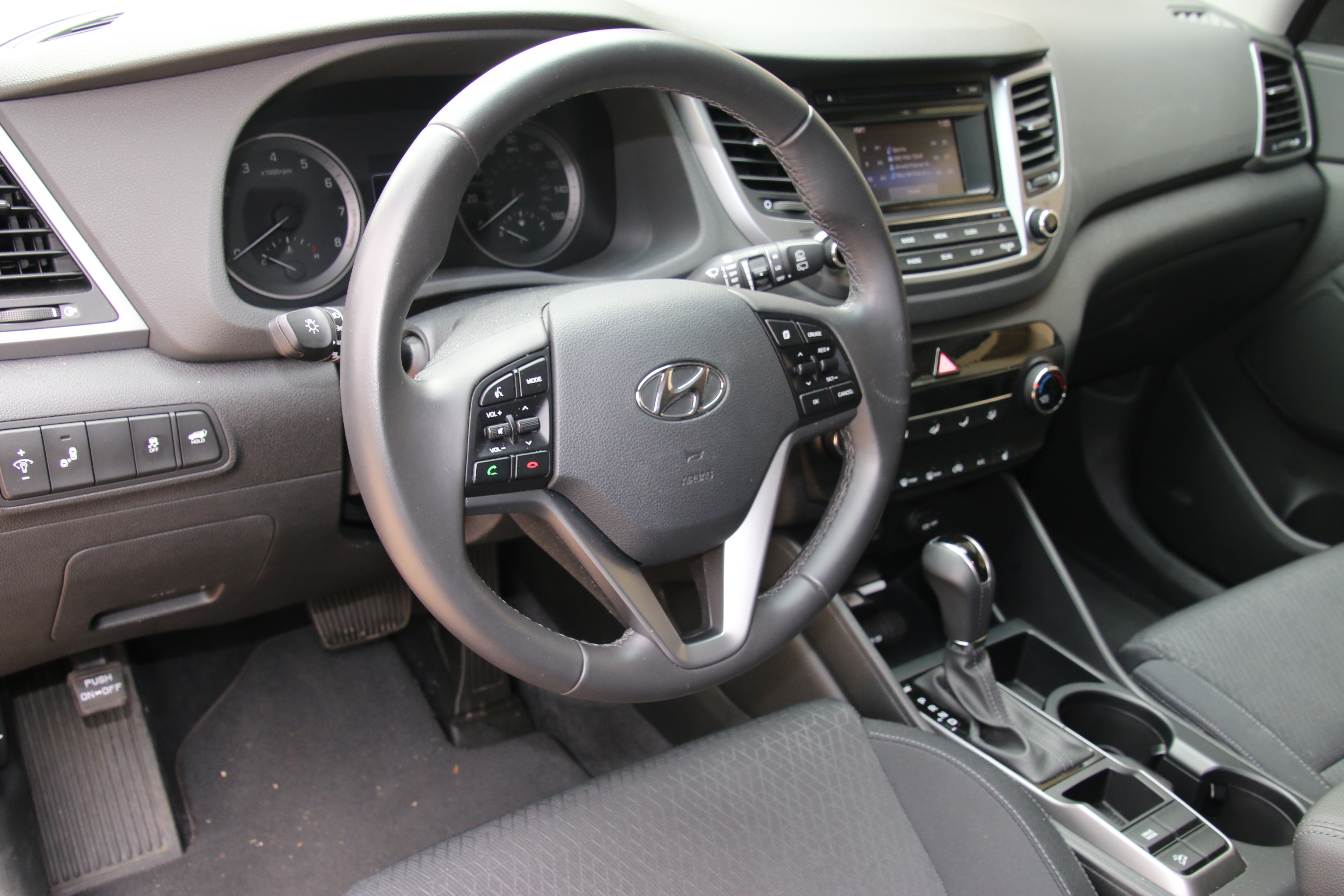
Inside is a well done interior in comfort and design. Seats are done in a subtle dark cloth that will undoubtedly look as good on the first day and the day 100,000 rolls past on the odometer. Even better is how they coddle your back side beautifully. Soft touch material is in most places and the whole package has a luxurious feel without being obvious. The instrument binnacle contains a large speedo and tach flanking an information center which is easy to use as is every device in the Tucson, including the media center and HVAC system in the center stack. Well done Tucson. While the interior is stylish, it is practical and easy to use. Rear seating is roomy for three.

Pricing is shocking, but in a reverse way. My loaded tester, a Tucson Sport, stickered for $26,150. The only add-ons were optional carpeted floor mats, $125, and the mandatory boat ride from Ulsan, Korea, of $895. Everything else was standard, heated power mirrors, pushbutton start, power remote lift gate and even the illuminated exterior door handles. AWD will add $1,400. Even though it has a center color center screen, a GPS is an option. There is no question that the Tucson has everything, including a 10-year/100,000 mile warranty, but a high price. The Tucson is one of the best deals on the market, even if you are looking for a sedan. It’s that good.

Larry Weitzman has been into cars since he was 5 years old. At 8 he could recite from memory the hp of every car made in the U.S. He has put in thousands of laps on racetracks all over the Western United States.


Kings Beach celebrates 10 years of beach music

This year commemorates the 10th annual Music on the Beach concert series at Kings Beach State Recreation Area.

To celebrate, NTBA is planning 10 concerts on Fridays starting June 17 and ending Sept. 2. There will not be concerts on July 1 and Aug. 12.

The free concerts feature a variety of music genres from 6-8:30pm.

2016 Music on the Beach lineup:
June 17 – The Blues Monsters
June 24 – The Wrinkle
July 8 – Coburn Station
July 15 – Sneaky Creatures
July 22 – Abalone Grey
July 29 – Buddy Emmers Blues Band
Aug. 5 – Paul David and the Drivers
Aug. 19 – Miss Lonely Hearts
Aug. 26 – Forget the Roses
Sept. 2 – Achilles Wheel.


Tahoe Tails — Adoptable Pets in South Lake Tahoe

Walter

Walter

Walter is a 7-month-old with lots of energy who walks nicely on the leash and is house trained.

Some might say he’s a pointer mix, others might point to his similarities with the Vizsla. In any case, he is a nice boy who would fit into just about any home. He is a little shy to start with, but warms up fast if you have a cookie.

Walter is neutered, microchipped, tested for heart worm, and vaccinated. He is at the El Dorado County Animal Services shelter in Meyers, along with many other dogs and cats who are waiting for their new homes. Go to the Tahoe animal shelter’s Facebook page to see photos and descriptions of all pets at the shelter.

Call 530.573.7925 for directions, hours, and other information on adopting a pet.

For spay-neuter assistance for South Tahoe residents, go online.

— Karen Kuentz


Why a historic highway that united California’s two halves may never reopen to cars

By Charles Fleming, Los Angeles Times

Harrison Scott discovered the Ridge Route in 1955. Then 18, he was out freewheeling in a brand new Ford he’d bought with a loan from his parents.

The sinuous route, an engineering marvel that tamed the San Gabriel Mountains through the highway corridor that is now known as the Grapevine, was already a relic.

Opened in 1915, and credited by historians with uniting the economies of Northern and Southern California, the notoriously slow and dangerous roadway had been superseded in 1933 by Highway 99, itself to be replaced in 1970 by Interstate 5.

Scott liked the abandoned motorway, but did not return to the route until exploring it again in 1991, this time on a road trip with his son. Spurred by the boy’s interest, and retired from a long career with Pacific Telephone, Scott became an amateur historian and began collecting photos and stories of the highway.

He learned it had once been dotted with gas stations, diners, nightclubs and hotels that hosted gangsters and Hollywood stars. Clark Gable, Jean Harlow and Bugsy Siegel visited places such as Kelly’s Halfway Inn — set dead center in the 12-hour automobile journey between Bakersfield and Los Angeles — and Sandberg’s Summit Hotel, which had a sign by the front door that said, “No Dogs or Truck Drivers Allowed.”

Read the whole story


Spiritual talk, music at Unity at the Lake

Anton Mizerak and Laura Berryhill will be offering a talk with integrated music titled Music and Mythology: Stories of Transformation at Unity at the Lake on May 15.

Mizerak and Berryhill live in Mount Shasta. Since 2010 they have toured extensively as a duo, performing at more than 450 venues throughout the West.

The 10am talk will be followed at 11:45am with transformational healing music, Celtic song, and chants from around the world.

Unity at the Lake is located at 1195 Rufus Allen Blvd., South Lake Tahoe.

Donations will be accepted.


The science of making friends

By Elizabeth Bernstein, Wall Street Journal

I’ve been going on a series of dates lately.

I exchanged numbers with the person sitting next to me at a Cabernet tasting at my favorite wine bar and went for a coffee with a neighbor I met walking my dog. I reached out to people from my past I haven’t seen in years, to see if they’re newly available.

I’m trying to make new friends.

A body of research shows that people with solid friendships live healthier, longer lives. Friendship decreases blood pressure and stress, reduces the risk of depression and increases longevity, in large part because someone is watching out for us.

Starting in early adulthood, our number of friends starts to decrease steadily. Changes in friendships typically happen around life transitions: graduation, parenthood, job switches, divorce or death of a spouse. One study, published in 2015 in Evolutionary Behavioral Sciences, looked at 540 men and women and showed we lose an average of two friends when we gain a romantic partner.

Read the whole story


Study: Food allergy costs more for poor kids

By Deborah Netburn, Los Angeles Times

What is the financial toll of having a kid with a food allergy? The answer may depend on how much money you have.

A study published last month in Pediatrics found that food-allergic children from households that earn less than $50,000 a year incur 2.5 times the cost of emergency room visits and hospital stays compared with their peers from families that are in a higher-income bracket.

At the same time, families that make more than $100,000 a year report spending more of their own money on visits to allergy specialists for their kids, as well as medicines paid for out of pocket, compared with families from lower-income groups.

Read the whole story


Howard Bittner — 1950-2016


Howard Bittner

Howard Bittner

Longtime South Lake Tahoe chiropractor Howard Bittner died April 17, 2016. He was 66.

Mr. Bittner had been struggling with Pemphigus Vulgaris, an autoimmune disease, for the last 18 months.

Howard Henry Bittner was born March 7, 1950, in Akron, Ohio. He spent his childhood in Arizona and California. He attended Santa Barbara Community College before enlisting in the Navy. Mr. Bittner graduated cum laude from Palmer College of Chiropractic in Iowa in 1980.

A resident of South Lake Tahoe for 33 years, he was passionate about his career. He was known for his compassion and generosity to the patients he served.

After he retired, Mr. Bittner focused on residential property remodeling, landscaping and gardening. He had moved from Tahoe, first to Yerington and then to Wellington.

He had been an active member of the Tahoe-Douglas and Yerington rotary clubs, as well as the Kiwanis Sunrisers.

Mr. Bittner enjoyed fishing, boating, motorcycle riding, biking, bowling, skiing and snowmobiling.

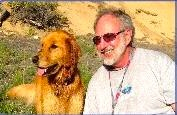
He is survived by his wife Mary; daughter Elizabeth of Reno; mother Ester, brother Tim (Leslie), and sister Priscilla, all of Pismo Beach; several nieces; and his devoted golden retriever and healing companion, Rosie.

There will be a memorial service May 28 at 10am at St. Theresa Catholic Church, 1041 Lyons Ave., South Lake Tahoe, with a reception to follow

In lieu of flowers, donation may be made to one of the rotary clubs.


Succession plans topic of workshop

The Business Case for Succession Planning and Talent Development is the subject of a workshop on May 11 from 8:30-11am at Truckee Tahoe Airport Community Room, 10356 Truckee Airport Road in Truckee.

Leaving talent and leadership development to chance and hoping that qualified successors can be found inside or outside the organization on short notice is short term thinking at best, according to business leaders.

This interactive workshop will help people to immediately kick-start bench strength

and succession planning efforts by providing tools to formally identify successors including a succession planning audit, statement of purpose example, individual development plan template, team talent review tool and leadership competency model.

Workshop speaker Laura Moriarty, president of Tahoe Training Partners, is a nationally known speaker and the architect of innovative learning environments at high profile organizations.

The workshop is put in partnership with the North Lake Tahoe and Truckee Donner Chambers of Commerce and Sierra Human Resources Association.

Register online by May 10. The cost is $59 for SHRA/SHRM members, $69 for chamber members, and $79 for non-members.


LTCC to showcase student art

Lake Tahoe Community College’s annual Student Art Exhibition opening reception is May 22 from 2-5pm in the Commons.

An awards ceremony honoring the winners starts at 3:30pm.

There will be approximately 400 works of student art on display, ranging from digital art to printmaking and sculpture. All of the artwork displayed represents student production over the past year. Much of the work reflects the Art Department’s curriculum, but also includes work created independently by LTCC students.

The work submitted for this exhibition will be juried for special honors in 17 categories. Selecting this year’s special honors will be guest juror Ahren Hertel.