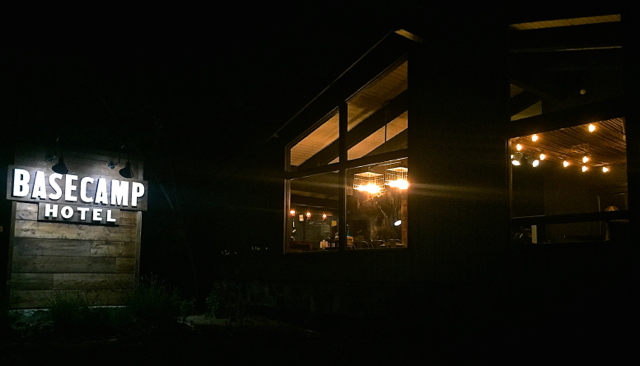
Basecamp TC blends indoors and outdoors

Basecamp has hotels in Tahoe City, South Lake Tahoe and Boulder. Photo/Kathryn Reed

Basecamp has hotels in Tahoe City, South Lake Tahoe and Boulder. Photo/Kathryn Reed

By Kathryn Reed

TAHOE CITY – Rooms are simple, efficient, clean and have what you need. It’s a bit minimalist without lacking anything.

Refreshing, unique beers are on tap – perfect after a day exploring Lake Tahoe. Sit inside on a couch or at one of the outside areas, even by a fire pit.

Basecamp Tahoe City, which opened in May, is attracting visitors from near and far and of all ages. It’s quieter and smaller than its sister hotel in South Lake Tahoe.

Basecamp Hotel Tahoe City is comfortable without frills. Photo/Kathryn Reed

Basecamp Hotel Tahoe City is comfortable without frills. Photo/Kathryn Reed

It’s hard to recognize this was once the Aviva Inn. The 24 rooms have been gutted – as well as the lobby and shared spaces. There are five room types, with a couple at the far end having limited views of Lake Tahoe. Rooms range from a spacious king to queen bunk to “great indoors family room”. The latter has a king bed, tent, faux fire pit and stars on the ceiling.

To call the whole hotel glamping with real walls would be selling it short. It feels a bit like camping mostly because of the décor. In the room is a mini Playmate cooler that the front desk will fill with ice. A larger metal cooler acts as a table between two directors chairs that give it a definite campy feel. A lantern on the desk adds to the motif. Other light fixtures are modern and a bit industrial.

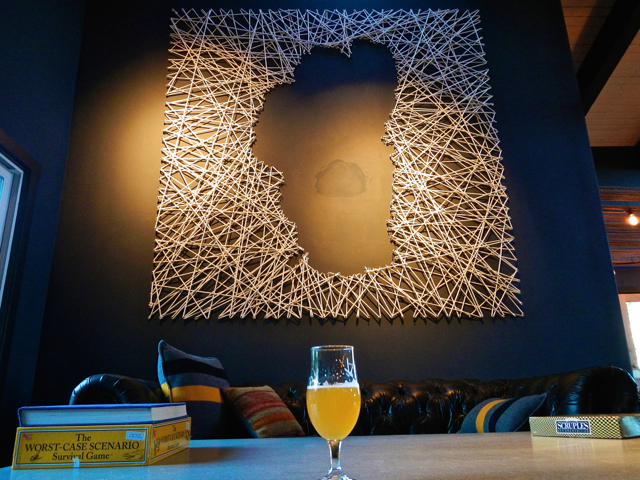
It was nice not to have the standard photos of Tahoe in the room. The wall hanging above the bed had key attractions pointed with an outline of the lake in the center. Where Sand Harbor is it says “swim suits galore”, between here and Truckee says “people floating down the river w/beer”, while on the West Shore it says “fancy pants boats”.

The communal space is ideal for relaxing and having beer or wine they have available for purchase. Photo/Kathryn Reed

The communal space is ideal for relaxing and having a glass of beer or wine that the hotel sells. Photo/Kathryn Reed

There is a television and indoor plumbing – oh, and a ceiling fan, air conditioning and heat – so, it really is far from camping.

The open closet area has ample room for skis and boots.

The bathroom is small, but the point of being here isn’t about spending hours getting pretty. It’s about getting out of the room and playing.

General Manager Robbie Kalinowski was great about suggesting places to go for a dog walk – ones right from the hotel as well as a short drive. Another worker suggested part of the Tahoe Rim Trail in the morning. Hmmm, sleep in or hike? (The super comfy bed won.)

Kalinowski came around the corner to show me a few places on his laptop. I opted for TC Cross Country because I had never been there in any season. He emailed a link to it, which I then texted to myself. Technology is wonderful even for the outdoors.

Plenty of hiking and biking options at Tahoe XC when there isn't snow on the ground. Photo/Kathryn Reed

Plenty of hiking and biking options at Tahoe XC when there isn’t snow on the ground. Photo/Kathryn Reed

It was the perfect recommendation for AJ and me. Mostly it was mountain bikers who shared the trails with us. Signage is good for the most part, though we managed to zig when we should have zagged, which had us come out into a neighborhood. Obviously we figured out how to find the Jeep.

A nice feature for those with dogs were the multiple areas to take her out to do her business.

For people not wanting to spend all their time inside the hotel room, there are places to get away and still be on the property. The Sun Room is at the back of the property. It’s a quiet place to relax. Just outside of there are Adirondack chairs around a fire pit.

There’s another communal outdoor area off the lobby area. And the lobby is much more than that. It’s like a shared family room with big screen televisions and board games.

Basecamp Hotel has several areas to relax beyond one's room. Photo/Kathryn Reed

Basecamp Hotel has several areas to relax beyond one’s room. Photo/Kathryn Reed

Even though Basecamp is on the far east side of Tahoe City, it is still walking distance to so many things – like downtown (dining, shopping) and the lake (ample water sports).

The hotel’s recommendation to eat at Blue Agave was perfect. The food and service were wonderful. AJ would have been welcome outside, but I left her behind, opting to sit at the bar where a band was playing.

Breakfast is included in a night’s stay, consisting mostly of waffles, fruit and beverages. This is served in the lobby-main communal area.

While the old hotel had a swimming pool, Basecamp owners opted to conserve water. In its place will be a hot tub that should be open this winter.


Sue Bartholomew — 1939-2016

Sue Bartholomew

Sue Bartholomew

Sue Bartholomew died Aug. 15, 2016, traveling home from a weekend reunion with her college roommates. She was 76.

Sue was born on Sept. 10, 1939, in Santa Monica. She grew up in Bellflower and then went on to Whittier College. She graduated in 1961.

There she met her seven roommates who remain some of her closest friends to this day. After graduation Sue moved to the Bay Area to begin her teaching career in Hayward.

In 1964 Sue moved to South Lake Tahoe to begin her career at South Tahoe High School where she taught home economics. In 1966 she married Dave Bartholomew, another South Tahoe High School teacher. They went on to have two children; Sue became a stay-at-home mom in 1971.

In 1983 Sue returned to full-time teaching when she joined the staff at South Tahoe Middle School. She taught there until her retirement from the district in 2003.

In 1988 Sue began working at Edgewood Tahoe during the summers.

After her retirement Sue moved to Arizona for the winters to be closer to her three grandsons. She was a daily presence in their lives and was always up for whatever they had in store. Sue loved to travel with her family and many close friends, and work in her garden. Grandma Sue was always planning the family’s next great adventure and took pride in showing her grandsons new and exciting places around the country.

Even though Sue lived in Arizona, she always called Tahoe home and cherished the wonderful friends she had here.

Sue leaves behind her son, Chris Bartholomew; daughter and son-in-law Carey and Tim Dahlstrom; and grandsons Nathan, Austin and Justin.

There will be a memorial service on Sept. 24 at 1pm at 3560 Ralph Drive, South Lake Tahoe.


Tahoe Tails — Adoptable Pets in South Lake Tahoe

Scooby

Scooby

Scooby is a huge Great Dane mix who is just a year old and very willing to please. He is house trained and has good manners, and walks nicely on the leash.

He was found tied up and abandoned and is a little shy of new people and things, but he is very affectionate once he knows you.

Scooby is neutered, microchipped, tested for heart worm, and vaccinated. He is at the El Dorado County Animal Services shelter in Meyers, along with many other dogs and cats who are waiting for their new homes. Go to the Tahoe animal shelter’s Facebook page to see photos and descriptions of all pets at the shelter.

Call 530.573.7925 for directions, hours, and other information on adopting a pet.

For spay-neuter assistance for South Tahoe residents, go online.

— Karen Kuentz


Author to talk, put on workshop at SNC

Sierra Nevada College’s Tahoe’s Writers in the Woods program starts with Luis Alberto Urrea on Sept. 9.

The series brings well known poets and writers from all over the country to the Incline Village campus for intimate readings and workshops, where audience members can meet and exchange ideas with the guest writers.

Urrea is the acclaimed author of 13 books across multiple genres. His newest novel, “Into the Beautiful North”, is the SNC 2016 Common Read selection and has been acquired by the TNT network for a television series.

The free talk will be at 7pm in TCES 139/141.

He will put on a workshop Sept. 10 from 10am-noon. To register, go online.


From Rio: Pampering in between volunteering

Louise Feller of Stateline spends off time seeing Rio. Photos/Provided

Louise Feller of Stateline spends off time seeing Rio. Photos/Provided

Being a volunteer at the Olympics is a balance between working, and seeing the sights and experiencing new things.

Louise Feller of Stateline is at her sixth Olympics.

An Olympic contingency from Egypt.

An Olympic contingency from Egypt.

Here are some of her thoughts:

“Well, today you will see some pictures of my area that I’m volunteering in.

“The practice area after one wins a medal the are so happy when they return from the arena.

“Before I went to volunteer I had time to walk on the beach, which was wonderful they were having a farmers market. They are so organized by placing vegetables in bins. They even set up little restaurants with tables and chairs. A really cool experience.

Lots of fresh produce at the farmers market.

Lots of fresh produce at the farmers market.

“I got a pedicure because my feet were killing from all the walking and stairs. Quite interesting. They use no water, just a plastic bag that has lotion to soften the feet. The rest was pretty much the same. The whole thing cost $18. I spoke to a women who said they get a manicure every week and pedicure every other week. She was a lawyer and going to NYC next week to shop for her baby because it’s too expensive in Rio.”

— Lake Tahoe News staff report


Michael Franti keeps crowd on its toes

Michael Franti thrives on interacting with his devoted fans. Photo/Kathryn Reed

Michael Franti thrives on interacting with his devoted fans. Photo/Kathryn Reed

By Susan Wood

STATELINE – Seeing Michael Franti perform is a workout for the body and the brain.

The singer-musician, who can cross genres as wide-ranging as reggae and soul to rap and alternative, provided a personable, press-the-flesh concert for hundreds at MontBleu’s showroom Aug. 19.

What the crowd received was a feast for the senses – hearing, sight and touch.

Franti with his five-piece band is known for getting up close and personal with his fans – especially through his signature messages of social consciousness.

This show was no different in delivering his messages of hope – all at the same time keeping the crowd on its feet, swaying, jumping and dancing for a few hours. A few people held up neon signs of “love” on cardboard.

His latest hit “Good to Be Alive Today,” which he performed, tells the story of an ideal world without violence, strife and racism. It went viral on social media before its formal release.

“Some people trying to get high. Some people losing their minds. Some people trying to get by. And when you look in my eyes, you see the sign of the times. We are looking for the same things. What if this song was No. 1? Would it mean that love had won? Would it mean that the world was saved, and no guns were drawn today?” – “Good to Be Alive Today”.

As he played a collection of songs for his Soul Rocker tour, Franti weaved his way through the audience on several occasions. Many reached out to touch him like he was a social justice prophet.

“It’s good to have him in the world,” John Eby of Nevada City said, summing up his love of the spiritual artist. He was surrounded by dancing women on the second level.

Michael Franti captivates an appreciative audience at MontBleu. Photo/Kathryn Reed

Michael Franti captivates an appreciative audience at MontBleu. Photo/Kathryn Reed

About a third of the time, Franti set up a mini stage near the back and brought several people on stage to dance and sing with him. In front, the guitarist even brought up his son, Cappy, to join the band and often turned the lights up to show off the audience.

“Hello, Tahoe. Anybody get any lake time, any beach time today?” he bellowed.

Franti, who was adopted by a Finnish-American couple, often engaged his fans with banter, chatting up his life and background. He was born in Oakland, grew up in Davis and lives in San Francisco – of which he invited all the fans to join him there.

The no-holds-barred show kept moving, albeit a bit repetitive at times, with Franti favorites such as his well-known opening number – “Hey, hey, hey,” off the “Sound of Sunshine” album, a tune he also performed along with his last song – the cult favorite “Say Hey.” (Franti even produced a San Francisco Giants version in 2010.)

Off his latest album, he graced the stage and beyond with “We Are Earthlings” and “My Favorite Wine is Tequila.” To that, many raised their glasses. He tipped his hat to musicians we’ve recently lost such as David Bowie, Glenn Frey and Prince – to which he launched a tribute performing “Purple Rain.”

Much of Franti’s music serves to overcome obstacles with positive reinforcements such as his tunes — “I Got Love For You,” which he performed along with the long version of “I’m Alive.” The latter had the crowd bouncing as if at the gym during aerobics.

He even got the audience square dancing with “Life is Better With You” — the culmination of a story in which he had to dance in front of the class in grade school and later redeemed himself in a bar later in life.

Franti began his music career in 1986 as part of the industrial punk band The Beatnigs. Eight years later, he formed his mainstay band “Spearhead.”

Alternative artist, Zella Day, in her rough Alanis Morissette style, opened for Franti.


From Rio: Time off from volunteering

Seats at the Rio Games are not comfortable. Photos/Louise Feller

Seats at the Rio Games are not comfortable. Photos/Louise Feller

Volunteering at the Olympics comes with being able to enjoy some of the surroundings and seeing the competition.

Louise Feller of Stateline, who was featured this month on Lake Tahoe News before heading to Rio, is reporting back on her experiences.

Food options are the same at most venues.

Food options are the same at most venues.

From Feller:

“Had a day off before I started volunteering in Taekwondo venue. Beach volleyball was very exciting since both Brazil’s women and men were in the semifinals. The stadium was electric to say the least.

“The seats in all stadiums are uncomfortable and plastic with short backs.

“The pictures on the beach are interesting. The umbrellas are full of bathing suits, so if you forget one, you can buy there.

Swim suits are sold on the beaches in Brazil

Swim suits are sold on the beaches in Brazil.

“You see signs for the special entrance; it’s for seniors and families with little children. What a nice idea. We should think about making seniors special.

“As far as food, just look at the menu. It’s the same in every stadium and no place to sit.

“Off to volunteer. My schedule is 3-10p. I have a driver pick me up one block from the stadium which as safe as you can get in Rio.”

— Lake Tahoe News staff report


Mentally ill suspects test law enforcement

Publisher’s note: This is one of several stories about mental health issues in the Lake Tahoe Basin that will be running through October. The other stories may be accessed from the Home page under Special Projects, then click on Mental Health.

By Susan Wood

El Dorado County Superior Court Judge Suzanne Kingsbury has learned personally there is no magic pill in terms of eliminating mental illness on our streets and in the judicial system.

Even with her steely resolve, calming demeanor and steady hand on the gavel that delivers justice in South Lake Tahoe, Kingsbury – who serves behind the bench of Behavioral Court among other disciplines — couldn’t save her sister from a debilitating struggle with bipolar disorder.

Mental-ILLNESS-LOGOShe knew the fatal result of her sister’s well being when she got a call from the coroner in Sacramento a few years ago.

“It was heartbreaking,” Kingsbury told Lake Tahoe News.

Like many, Kingsbury has seen her fair share of people “out there screaming and yelling and pushing shopping carts” barely able to hold onto some semblance of reality.

That’s just how cunning mental illness is. Throw in alcohol and drug addiction, and the problem grows like it’s on steroids.

“Often there are substance abuse issues. That’s when it becomes difficult because you need these people to detox to get to the root of the problem,” the longtime judge explained.

Medication can only go so far. With bipolar disorder, aka manic depression, the pharmaceuticals have side effects that prompt many afflicted to want to avoid them. The period of elevated mood counters the down times enough that some people suffering from it don’t want to end the up feelings.

“They hate the lows and love the highs,” Kingsbury said.

In the 1980s, the bulk of psychiatric hospitals in California closed, leaving the mentally ill to fend for themselves on the streets. When they’re brought in, often from an episode with police, they can get an assessment and substance abuse help if necessary.

Transitional housing, including the few units available in South Lake Tahoe, provides for stability in the community for those just seeking another chance at life.

“Without the housing, a lot of folks will do OK for a while then things will go south,” Kingsbury said.

Jail is not the housing answer

“Do you know what the largest psychiatric hospital is?” El Dorado County Undersheriff Randy
randy peshon

El Dorado County Undersheriff Randy Peshon recognizes the difficulties his deputies have with suspects who have mental health issues. Photo/Provided

Peshon asked rhetorically, answering: “State prison.”

“There is no easy answer. Part of the problems we face is the money we have for mental health is in a silo – some people might not fit the criteria,” said Peshon, who worked in the county jail in South Lake Tahoe for years. He now works in Placerville as second in command.

Peshon has viewed the double-edged sword of the mounting issue. Medical privacy laws have become stricter, while the stigma attached to mental illness has increased. The burden lies heavily on law enforcement trying to quell or at least reduce the perplexing problem.

“If law enforcement is aware somebody is suffering from mental illness, we have officers who are trained in crisis intervention,” Peshon said. “A lot of these situations are brought on because these people go off their meds.”

From the county jail and mental health to the state court system and local beats of police and sheriff’s departments, government continues to wrestle with the crisis.

In many cases, some refuse help. In others, the help fails to go far enough. Some are unaware of the assistance available – and sometimes, the system works for those who work it.

The highs and lows of fighting the good fight are as dramatic as the ups and downs of those struggling with mental illness.

Statewide, there are 112,300 people in California prisons, the Public Policy Institute reported. Last year 83,280 people were in county jails. Estimates are that 15 percent of those incarcerated are mentally ill.

In the entire state, California hospitals have about 7,500 beds, the Los Angeles Times reported in a recent study. The vast majority of these beds – 92 percent – is filled by patients from the criminal justice system and is no longer available for those in need of civil commitment. Only 600 beds are available for those just checking in, to say for example, to help themselves.

In other words, someone suffering from mental illness is apt to fall into law enforcement’s lap to gain safe harbor.

Officers want more tools

The lack of safe places to go represents a tough quandary for police officers who see the most unpredictable members of society who may either hurt themselves, loved ones or even those who may be passing by.

About a decade ago, a man who appeared to have a psychotic break stood in the middle of the street between the Taqueria and the former Tahoe Daily Tribune building and threatened to shoot himself in the head. At times, he laid down as if surrendering but kept a gun in his hand. Bystanders gathered around, exacerbating a pressing issue for police.

South Lake Tahoe SWAT Police Officer Brandon Auxier remembers the episode and points to it as just the tip of the iceberg in what police see almost daily.

“It’s a constant problem. We pick them up then sometimes Barton does not have any beds, and they’ve had to travel hundreds of miles,” Auxier said, adding he’s noticed more calls lately resulting in “5150s.” This term of condition relates to five-point restraints on the person who is suffering a mental breakdown.

“In the last couple of years, we’ve seen an increase,” the officer told Lake Tahoe News.

Many of those afflicted with mental illness are homeless. And with the popularity of the new winter warming center in the city, one can see there is a demand for a safe place for these people.

Auxier, a 13-year officer, has seen several repeat calls for those who are endangering themselves or others and create a scene. He’s part of a crisis intervention team, which prompts welfare checks on those who go through the county Mental Health program. Once a case is developed, restrictions abound on what caseworkers can do or say because of confidentiality issues.

Balancing the law of the land

And there lies a dilemma for law enforcement.

South Lake Tahoe Police Chief Brian Uhler would like to see more allowable communication between mental health caseworkers and police given the tenuous situations officers and the public are placed in when the call comes in.

Brian Uhler“When we know the situation, we can have empathy and some patience.”                  — South Lake Tahoe Police Chief Brian Uhler


“It’s a huge issue. The expectation is for us to manage or know a mental health breakdown. When we know the situation, we can have empathy and some patience. The issue is we face laws that prevent health care professionals from even talking to us,” Uhler said. “I’ve learned that even if we had the psychiatrist involved, we could not even confirm if this person is a patient. So we’re stuck out there with no help from the mental health community even if they want to help. It takes a change in state law.”

Law enforcement has a balancing act dealing with these calls.

Officers need to turn on a dime in terms of showing control and strength, while gently switching to empathy and heightening their listening skills.

When they pick these people up, some cases end well over time between bringing in the courts, transitional housing, medications, caring loved ones and police welfare checks.

But others break the hearts of officers – especially after they get to know the people behind the case numbers.

El Dorado County sheriff’s Sgt. Michael Yarbrough empathizes with Chief Uhler on wanting to gather as much information as possible on someone struggling with mental illness creating a threat in public.

He’s seen his fair share of crises as Officer of the Year honored by the National Alliance of Mental Illness.

Like Auxier, the county sheriff’s department recognizes Yarbrough as spearheading the county sheriff’s response through the CIT program. After all, he had three years on the police force on the rough streets of Stockton before landing in South Lake Tahoe in 1997.

Yarbrough said it’s tricky dealing with the mentally ill. Officers need to maintain that sense of control but show it in a kinder, gentler way. Communication – verbal and non-verbal as in body language — is key.

“It’s a different way of controlling, but you’re still in charge,” he said.

With “off-the-wall” individual behavior, Yarbrough has been trained and is experienced to see the body language and hear the responses of the subject of the call to be able to tell whether someone is undergoing a mental breakdown.

There’s such a new perspective in law enforcement to deal with these calls.

“It’s social services driven now,” Yarbrough said, comparing the situations to the old ways of handling a call where officers would just pick up the parties and throw them in jail to simply get them off the streets.

“Sometimes it would take six hospital visits before (the subjects) get it or for their families to get it,” he said.

El Dorado County sheriff’s Sgt. Michael Yarbrough is a leader in his agency when it comes to handling mental health issues. Photo/Susan Wood

El Dorado County sheriff’s Sgt. Michael Yarbrough is a leader in his agency when it comes to handling mental health issues. Photo/Susan Wood

Now officers are known to approach an individual with care, passing out pamphlets mentioning resources. Yarbrough reached in his desk drawer and quickly got out a county mental health brochure labeled “Guidelines for calling 911” in the event of a mental health emergency. Within the pamphlet, there’s even a script a family member may use to call in a mental health crisis at home. Also included is a list of critical phone numbers of resources.

The sergeant understands the call often doesn’t end with one response.

If he doesn’t have the answer, a member of a multi-disciplinary team that serves as a local think tank in dealing with mental health cases may have it. The think tank involves law enforcement, county jail, Mental Health Department and Barton Memorial Hospital.

The need is overwhelming. In three years, Yarbrough has seen 1,500 reports go through the system.

“It took some time to get (the caseload) managed,” he said.

He analyzed the cases to determine who would be best served by regular visits among his officer force. The dozen deputies who may go out on the welfare checks count medications, sit down with the subject for some positive reinforcement and talk to family members to get a sense of how the person is doing. They also keep an eye on whether clandestine substances appear.

“I’d say about 70-80 percent involve drugs and alcohol,” he said.

Yarbrough has become so keenly aware of the human condition he’s become an expert in the topic. He’s been invited to speak about the programs at a mental health conference in September in Sacramento.

“I can’t give enough credit to the whole collaboration. (The sheriff’s department) wouldn’t be able to do this on our own,” he said.

Beyond the agency resources, Yarbrough relies heavily on caring, knowledgeable family members.

Mental illness is a tricky condition to deal with because it comes with a stigma and emotions attached. Sometimes family members are reluctant to say something or intervene because they’re afraid of offending the loved one.

California AB1424, signed into law in 2015, requires any person who is authorized to have a person taken into custody for involuntary treatment consider available relevant information about the historical nature of the person’s mental disorder.

Upon the CIT visits, waivers are signed enabling family members to make critical decisions on the subject’s behalf. There’s a long questionnaire asking for information detailing the loved one’s historical condition, with a list of phone numbers to contact in the event of a crisis.

Yarbrough sees the slow-moving legislative changes as long in coming and necessary to a person’s well being because there is no easy fix.

“Why do we think the brain is the only thing completely immune to illness?” the sergeant asked. “That’s the hardest thing for people to understand.”

Help for those who help

The need to assist the mentally ill on the streets prompted retired San Rafael police Officer Joel Fay to make a business out of training officers to handle their calls.

The Marin County town has a plaguing homeless population with many classified as mentally ill.

“I thought: ‘Where do these people go?’” he said.

He found a way to balance being a police officer and psychologist.

“I knew that police needed to change the way we respond to calls,” he said. “For me, it was kind of like a mission in life.”

He moved into the field of psychology before fully retiring from the force five years ago. He contracts with counties to bring his specific expertise to their law enforcement units.

El Dorado County, which included Yarbrough, is among the jurisdictions that hired Fay’s business to assist them.

Fay trains the officers to look for signs of psychotic behavior such as the subjects reacting to other stimuli.  There are clues of what to look for – whether they “see” the officer, can they feel the officer’s presence and do they comply with requests. If they can’t meet any of the criteria, there are other forces at work in the subject’s brain.

“At that time, the officer knows to slow it down and make them come around to their way of thinking,” he said.

There are also telltale signs of depression the psychologist trains officers to look for.

“There are things to say to work with these people. I tell (the officers) that it’s important for you to stay calm,” he said. “I tell them to pretend like it’s someone you know.”

Fay admits it takes a while for law enforcement to change their frame of mind on dealing with these types of scenarios.

“The goal of the training is to show how to use less force and for officers and the citizens to get hurt less,” he said.

Granted, the approach sounds simple and inroads are being made to treat the mentally ill differently. However, there are still cracks in the overall system.

Fay was empathetic to Uhler’s complaints about not having enough information to keep all involved safe from harm. He echoed the chief’s sentiment about the need to change the laws.

“There are so many road blocks. One problem is the law requires a person to be in imminent danger to get some help,” Fay told Lake Tahoe News. “It’s very frustrating because frequently we’re not allowed to collaborate.”

Mental health on the case

Sabrina Owen, the manager of the county’s mental health programs, sympathized with law enforcement wanting more information readily available on mental health cases. However, she reminded that privacy laws override the need to find an easier way to deal with public displays from those afflicted with a mental illness.

“It’s nice that family members can always call. We can take phone calls all day long and take information, but we can’t acknowledge a case or give it out unless a patient signs a consent form,” she said.

Nonetheless, the programs set into place seem to be working if one looks at the numbers.

Despite what law enforcement projects, mental health evaluations between jurisdictions in the city and county have trended downward in the last few years.

The sheriff’s department in South Lake Tahoe reported 543 cases assigned to subjects for 2014; 501 in 2015; and halfway through 2016 lists 187.

South Lake Tahoe 5150 evaluations number 404 in 2014; 381 the following year; and to date this year show 160.

Owen attributes the drop in statistics to the combined efforts of the CIT consortium and other similar programs.

The mental health professional views the well-being checks as a tried and true way of keeping a careful eye on people who face the very large swings in life’s ups and downs.

Owen strongly supports the idea of intensive case management. This means tracking the subject’s medication, meeting with the person and urging family and group therapy.

“And in respect to law enforcement as first responders, (the mentally ill) would just like to know someone cares,” she said.



STHS grad training to be Navy pilot

South Tahoe High School graduate Kyle Hauss is in the process of becoming a naval pilot.

Ensign Kyle Hauss is a student pilot with the Rangers Training Squadron (VT-28) based in Corpus Christi, Texas.

Kyle Hauss

Kyle Hauss

“Being a pilot is something that is like nothing else,” the 2007 grad said in a statement. “I enjoy being able to experience things that most others don’t get to and it is a thrill like no other, it is somewhat addictive.”

The T-6B Texan is a training aircraft that is powered by a 1,100 shaft horsepower, free-turbine, turboprop single-engine, four-bladed propeller, with a cruising speed of 310 mph.

Students must complete four phases of flight training in order to graduate, including aviation pre-flight indoctrination, primary flight training and advanced flight training. After successfully completing the rigorous program, naval aviators earn their wings of gold.

After graduation, pilots continue their training to learn how to fly a specific aircraft, such as the Navy’s F/A-18 Hornet strike fighter jet, the P-8 Poseidon maritime patrol aircraft or the SH-60 Seahawk helicopter. They are later assigned to a ship or land-based squadron.


Squaw’s McKinney set the pace for U.S. skiers

By Sam Taggart, Powder

In the 1980s, Tamara McKinney skied fast down icy race courses across the globe, setting records and accumulating podium appearances in every event possible on the international circuit. She was the first American woman to win the overall World Cup title, and many of her records held strong until Lindsey Vonn began racing years later.

Today, McKinney channels her competitive and friendly spirit selling luxury real estate in her adopted hometown, Squaw Valley. McKinney, the youngest of eight siblings, was born in Lexington, Ky., but moved west when she was just a toddler, and spent most of childhood at her family’s home near Lake Tahoe. McKinney’s parents were steeplechase jockeys who balanced a long-distance marriage. At one point, her father, Rigan, was the fastest jockey in the country, and a handful of her siblings also held positions on the U.S. Ski Team—including her brother, speed skier Steve McKinney—so, it’s clear, racing is in her blood.

Powder sat down with McKinney to find out which lessons she learned as a ski racer still resonate, the importance of giving back to younger generations, and why “you’re never too cool to be nice.”

Read the whole story