Aging and caregiver classes in South Tahoe

The El Dorado County Health and Human Services Agency, Family Caregiver Support Program is offering a free Aging & Caregiver education series in South Lake Tahoe.

The series will be on Oct. 10, 17, 24, 31, and Nov. 7 and 14 from 1-3pm at Lake Tahoe Resort Hotel.

The educational series will provide instruction and support for people who care for or plan to care for an aging family member or friend.

Series topics will include:

  • Oct. 10 – Know the 10 Warning Signs: Early Detection Matters: This training will address the 10 signs of Alzheimer’s disease. Participants will learn what is involved in getting a diagnosis, risks associated with Alzheimer’s and the benefits of early detection.
  • Oct. 17 – Aging and Depression: How to Recognize Symptoms/Access Treatment: This topic will cover prevalence, signs and symptoms, risk and protective factors, effective therapies, crisis intervention and support for caregivers.
  • Oct. 24 – A Journey in Long Term Planning for Long Term: A frank discussion about the likelihood of needing long term care, documents to have in place and how to prepare them, and options that may be available to pay for long term care.
  • Oct. 31 – What is Palliative Care? This discussion will help participants understand the difference between hospice vs. palliative care, including who qualifies and services received under this valuable program.
  • Nov. 7 – Medication Safety: This informative talk will address safety issues regarding prescriptions, questions to ask your pharmacist and proper storage and disposal.
  • Nov. 14 – Becoming Dementia-Aware: This session will help caregivers and loved ones better understand the topic of dementia.

The educational series will be presented by local experts in their respected fields. Participates may attend one or all of the classes. The classes are free of charge; donations are accepted. Light refreshments will be served. The series is offered as an educational opportunity only; no solicitation of services will be presented.

Advanced registration is requested, but not required for the series. Call 530.621.6151 to register or for questions.


Vogelgesang: Fiscally responsible approach

Publisher’s note: Lake Tahoe News asked candidates for South Lake Tahoe City Council, Lake Tahoe Community College, Lake Tahoe Unified School District, Douglas County School District, South Tahoe Public Utility District and Lake Valley Fire Protection District a series of questions. We are running the responses in the order received. All profiles may be found under the Special Projects listing and then the 2106 November Candidate Profiles category.
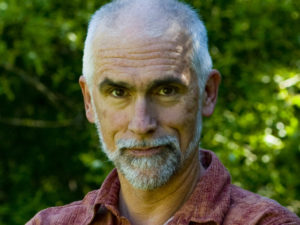
Randy Vogelgesang is running for one of two open seats on the South Tahoe Public Utility District board.

Randy Vogelgesang is running for one of two open seats on the South Tahoe Public Utility District board.

Name: Randy Vogelgesang

Age: 59

Job/profession: Civil/structural engineer

What boards, commissions, or other experience, including volunteering, do you have?: City of South Lake Tahoe Building Board of Appeals, member Tahoe Engineers Architects and Surveyors, member South Lake Tahoe Rotary, president

Why are you seeking re-election to the South Tahoe PUD board?: To continue building upon my goals and accomplishments of my first term, which I outline below.

Why should voters vote for you over another candidate?: Because of my knowledge, experience and fiscally responsible approach to the challenges the district faces.

What distinct experience or competency makes you uniquely qualified to lead effectively as an elected official?: The experience I have gained making common sense engineering decisions in my business has helped greatly when making decisions for the South Tahoe PUD. I try to always use my knowledge of the district and its workings to make decisions in the best interest of the ratepayers. As president of the board for the past two years, I have made it a point to work with all the board members and to treat them with respect.

Public agencies have been under scrutiny the last few years for lack of transparency and accountability. What will you do to ensure both?: This has been an important issue for me and I have made it a priority to get as much information as possible about the district out to the public. I have long believed that better decisions are made when the public is informed. During my first term the district hosted numerous public workshops focusing on the budget, priorities and long term planning. In addition I have encouraged (along with the board) Richard Solbrig, general manager, to be very active with public outreach on radio, TV and to numerous service organizations. The district’s website (www.stpud.us) has recently been upgraded for easier use and greater access to information. At my recommendation, the district started archiving audio files of all of our meetings, which can be heard on the website. In the near future video files will be available on the website.

What stands out for you in the current budget that you support and that you would change?: The district’s property tax revenue is still below the level of 2010. The challenge is to offset that revenue loss by increasing efficiency and seeking other sources of revenue such as grant money. It should be noted that the district has cut operations and maintenance spending by 20 percent since 2008-09.

Do you support current legislation for $15 minimum wage? Please explain: No comment

Do you support Proposition 55? Please explain: No comment

Describe three attributes for a successful board: Communication, respect, cooperation.

What are your thoughts about public employee defined benefits?: I would prefer a defined contribution over a defined benefit plan as a way to control costs.

Please explain your position on contracting out work normally done by staff: I like to have work done in-house as much as possible but sometimes it is more economical to outsource due to expertise or staff work load.

What is your 10-year vision for STPUD?: I would like to continue with steady needed improvements to the infrastructure to keep the quality of our service high, while being mindful of the cost to the ratepayers.

What as an elected official are the three things you are most proud of during your tenure?: Revising the rate structure (consumption vs. fixed costs) to more accurately reflect actual costs, reducing capacity charge fees, increasing transparency, water line upgrades and adding hydrants for fire protection.

Which votes would you change and why?: I am comfortable with the decisions I have made as a board member.

Being on a board means working as a team. How will you work with the other board members for the greater good of the community?: I touched on this above, but let me add that during my first term this board has worked well together, without acrimony, despite differences in opinion.

What should be the three main priorities for the board?: Striking a balance between infrastructure spending and rates. Salary negotiations. Public outreach.

How do you balance the economic situation of the community with the infrastructure needs of the district?: This is the most important question that I deal with on a daily basis. Too much spending on needed infrastructure burdens the ratepayer, but not enough could end up in costing more money in the long run. As a member of the finance committee I spend quite a bit of time working on both the annual budget and the 10-year plan. The way I try to achieve the balance between rates and spending is gathering as much information as I can to make the best decision I can.

STPUD is often criticized for having some of the highest paid public employees on the South Shore. Any comment?: Salary negotiations are one of the most important jobs that the board has. During these negotiations I have always fought for what is best for the ratepayers and will continue to do so.

When it comes to permits for construction, the district has high fees. Do you believe they are fair? Why or why not?: During my first term the board not only stopped large planned connection fee increases, they were lowered. It is my belief that these fees are still too high. I would rather make it easier for us to have more customers using our services than discouraging connections.

Tell us something about yourself that people may not know: My wife Cathy and I have lived in South Lake Tahoe for more than 30 years and raised two kids, Laura and Scott, who are now adults.


The long, steady decline of literary reading

By Christopher Ingraham, Washington Post

The percentage of American adults who read literature — any novels, short stories, poetry or plays — fell to at least a three-decade low last year, according to a new report from the National Endowment for the Arts.

In 2015, 43 percent of adults read at least one work of literature in the previous year. That’s the lowest percentage in any year since NEA surveys began tracking reading and arts participation in 1982, when the literature reading rate was 57 percent.

The NEA’s numbers, released last month, are meant to capture reading for pleasure. They explicitly exclude required readings for work or school. The survey also makes no differentiation between physical books and works read on e-readers, in an attempt to capture the broadest possible range of leisure reading.

Read the whole story


Road Beat: An improved Toyota Tacoma

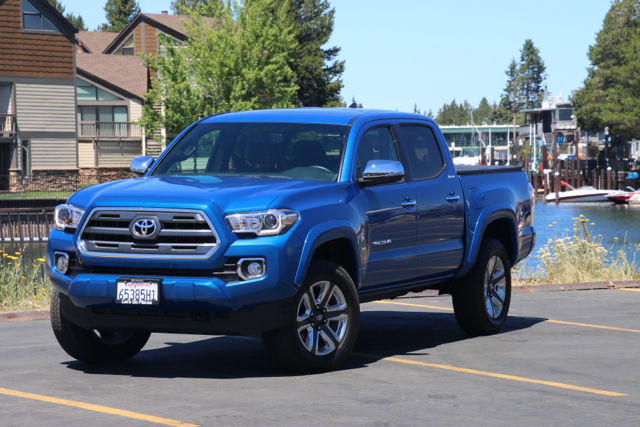
The Toyota Tacoma is designed for pavement and dirt trails. Photos/Larry Weitzman

The Toyota Tacoma is designed for pavement and dirt trails. Photos/Larry Weitzman

By Larry Weitzman

Tacoma makes the point that smaller engines don’t necessarily make the case for better fuel economy. With the new Tacoma there are two engine choices, a 2.7L DOHC, 16-valve inline four cylinder and a 3.5L DOHC, 24 valve V-6 with direct injection and a high 11.8:1 compression ratio.

The 2.7L cranks out 159 hp at a low 5,200 rpm and 180 pounds of twist at 3,800 rpm. However, the V-6 (about 750 more ccs) produces 278 hp at 6,000 rpm and 265 pounds of twist at 4,600 rpm, over 100 more hp an 85 more pounds of torque. It basically the same 3.5L V-6 found in so many Toyota and Lexus models.

So you would expect the 2.7L truck to achieve better fuel economy. In this case the EPA fuel economy numbers are virtually identical. In a 4X2, the V-6 actually gets better fuel economy with 19/24/21 city/highway/combined versus the four cylinders 19/23/21 mpg. For the 4X4 models, the V-6 returns 18/23/20 mpg, the four returned 19/22/20 mpg, effectively the same. Those numbers are for the six speed automatic tranny versions. The manual tranny actually hurts fuel economy for both engines by as much as one mpg.

Specifications  Price $27,105 to about $40,000 Engine  3.5L DOHC, 24 valve directed and port injected V-6 278 hip @ 6,000 rpm; 265 lb.-ft. of torque @ 4,600 rpm Transmission Five speed manual Six speed Manual Six speed torque converter automatic Configuration Longitudinal front engine/ rear wheel drive/four-wheel drive Dimensions Wheelbase 127.4 inches Length 212.3 inches Width 74.4 inches Height 70.6 inches Ground clearance 9.4 inches Fuel capacity 21.1 gallons Track (f/r) 63.0/63.2 inches Weight 4,480 pounds GVWR 5,600 pounds Tow Capacity 6,400 pounds (properly equipped) Steering lock to lock 3.64 turns Turning circle44.1 feet Co-efficient of drag 0.386 Performance  0-60 mph 7.48 seconds 50-70 mph 3.97 seconds 50-70 mph uphill 5.85 seconds Top speed Triple digits Fuel economy EPA rated 18/23/20 mpg city/highway/combined.  Expect 19-20 mpg in rural driving. 24-25 mpg on the highway at legal speeds.

Specifications
Price $27,105 to about $40,000
Engine
3.5L DOHC, 24 valve directed and port injected V-6 278 hip @ 6,000 rpm; 265 lb.-ft. of torque @ 4,600 rpm
Transmission
Five speed manual
Six speed Manual
Six speed torque converter automatic
Configuration
Longitudinal front engine/ rear wheel drive/four-wheel drive
Dimensions
Wheelbase 127.4 inches
Length 212.3 inches
Width 74.4 inches
Height 70.6 inches
Ground clearance 9.4 inches
Fuel capacity 21.1 gallons
Track (f/r) 63.0/63.2 inches
Weight 4,480 pounds
GVWR 5,600 pounds
Tow Capacity 6,400 pounds (properly equipped)
Steering lock to lock 3.64 turns
Turning circle44.1 feet
Co-efficient of drag 0.386
Performance
0-60 mph 7.48 seconds
50-70 mph 3.97 seconds
50-70 mph uphill 5.85 seconds
Top speed Triple digits
Fuel economy EPA rated 18/23/20 mpg city/highway/combined. Expect 19-20 mpg in rural driving. 24-25 mpg on the highway at legal speeds.

What I saying here is buying the four cylinder is false economy. Pay the premium (which runs from $1,500 to about $2,500 depending on the model) for the V-6, you will thank me later, especially for the added performance gain.

While the body is new, the chassis remains pretty much the same with a wheelbase of 128 inches a track of 63 inches, front and rear, a width of 74.6 inches and a 9.4-inch ground clearance. But the new, rugged body has grown with four more inches in length (212 inches long which is a foot longer than your full size SUV or minivan), a one-inch deeper cargo bed and it stands an inch taller at 71 inches. It looks big and you have to look twice to make sure it is not a full size truck. When you park the Tacoma in your garage, you will appreciate its actual slightly smaller size and at the same time realize it is not a full size truck.

Its new looks also come with a slightly lower co-efficient of drag at .0386, down from 0.394.

Perhaps the biggest change is the new, to the Tacoma, 3.5L V-6 down from a 4.0L V-6. Half a liter less displacement, and about 20 percent more hp and no loss in torque even with the smaller displacement. But it certainly does help fuel economy. And this is even with more curb weight of about 400 pounds. Zero to 60 mph lasted 7.45 seconds, identical to my test six years ago which used the 4.0L V-6 and was 400 pounds lighter. However, the new engine in passing performance is quicker with 50-70 mph taking 3.97 seconds and the same run up a six percent grade extended that time to 5.85 seconds. The six speed auto cog swapper was smooth and enhances performance, although it does hunt for gears a fair amount keeping the engine in the power band.

That same tranny also improves fuel economy. You have the EPA numbers above, but in real life the new Tacoma does a little better with an overall mpg of about 19-20 mpg mostly on rural, hilly byways at 55-60 mph with almost no highway driving. On the highway the Tacoma average about 25 mpg at a steady 70 mph in a two way run. On a round trip to South Lake Tahoe from Placerville the average was 20.8 mpg. My prior 4.0L truck averaged 16-17 mpg and 20 on the highway. Fuel tank is large at 21 gallons. But here’s the rub, full size V-8 trucks almost or do get the same fuel economy numbers as the Tacoma.

Part of the reason for the Tacoma’s new found fuel economy is its new taller gearing which causes some of that tranny hunting. But at 70 mph instead of spinning 2,450 rpm, it now spins at 1,850 rpm which is a huge factor in its fuel economy increase as well as the new, more efficient 3.5L V-6.

Handling is quite good, although with 3.64 turns lock to lock in the steering it takes some winding. Suspension is fairly standard full-sized truck, with double wishbones up front and a live axle in the rear with leaf springs and staggered shocks. On smoother roads the live axle doesn’t step out as a result of bumps and the Toyota tracks where you point it with little body roll. Big 265/60 series tires and great looking 18 inch alloys are fitted to this a sporty truck which already boasts a wide 63-inch track. On center steering is excellent. It’s not a sports car, it’s sporty truck. One item with respect to the steering wheel while tilt and telescoping, it is a bit too horizontal. The lower part of the wheel is much closer to the driver than the upper part. I noticed that in the new Prius too. Most trucks have the wheel on the same plane and is set 90 degrees to the steering column. The Tacoma wheel is set maybe at 75 degrees. Just a note.

Ride quality is like a pickup. It is extremely smooth on a smooth highway or road, but on more challenging pavement it is a bit jiggly. Not harsh, but somewhat unsettled. Being a 4X4, this Toyota is designed for real off road and has suspenders designed for that. Overall you get used to the jiggles which turn into giggles when off-road. But when on the interstate or Highway 50 even going into the mountains, the ride is smooth. Wind and road noise are well subdued as are the big tires quiet.

While the brakes feel strong and that this Toyota with the tow package is designed to tow up to 6,400 pounds, its brakes a rather small. Ten and three-quarters inch ventilated discs in front, and 10 inch drums in the rear. Compact cars have bigger brakes. Maybe that is a misprint in the factory specs but on the plus side, the system feels strong although I did no towing. Without the tow package the tow limit is 3,500 pounds, but in either case I would want trailer brakes. For the $650 tow pack, you don’t get bigger brakes, but a hitch, oil and fluid coolers for the engine and tranny, pin connector and trailer sway control. Of course all the basic safety acronyms are there, ABS, ESC, TC and more plus eight airbags. My Limited model also got rear sonar, backup camera, Blind spot monitor and rear cross traffic alert.

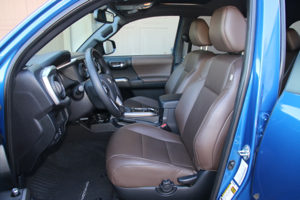
Toyota has done a number on the interior with seats swathed in gorgeous leather, more like the kind you would find on a saddle or in a tach room, soft and thick. No power seat option is offered something Toyota should think about as there is no manual seat height adjustment. But they are big and comfortable. The IP while done in quality materials, there is not much in soft touch. Instrumentation is complete with a big speedo and tach separated by a trip computer. The center stack and controls are stylish and easy to use. Nav was standard. Pricing for this maxed out fully loaded 4X4, V-6 Limited is $37,820 plus $650 for the hard, three piece tonneau cover and $650 for the tow package. In all models power windows and mirrors are standard, even cruise is standard on all but the base model. The total with the $900 for the boat from Japan is $40,020. The 4×4 option adds about $2,000. With the deeper the Tacoma has more versatility and utility than ever before.

Larry Weitzman has been into cars since he was 5 years old. At 8 he could recite from memory the hp of every car made in the U.S. He has put in thousands of laps on racetracks all over the Western United States.


Sherman William McKissock — 1922-2016

Sherman William McKissock

Sherman William McKissock

Former South Shore resident Sherman William McKissock died Aug. 29, 2016. He was 94.

Sherman was born Jan. 27, 1922, in Richmond, Ky., to Coy and Eleanor Wilcox Agee.

In his early years Sherman was raised by his grandparents in Fort Smith, Ark., and St. Louis. His mother took over his care at the age of 12 in Alameda. He was adopted by his stepfather and began his life as Sherman (Sherm) McKissock.

Sherman met his future wife, Dorothy,  in grammar school when she was 9 and he was 12. The were married for 72 years. Dorothy’s brother, Earl Peck, was Sherm’s best friend. Sherm thought of Dorothy as a pest until she turned 15. After their first date, Dorothy told her brother that Sherm “was it” and the rest is history. They became engaged and married in Baltimore during World War II in 1943.

They had six children: Lynda McDowell, Gordon McKissock (deceased), Marge Glaser, Jeanette Grubbs, Marianne Johnston and William McKissock; along with their 16 grandchildren, 19 great-grandchildren and one great-great-grandchild.

After high school Sherm went to work at a bank. He eventually became a vice president of Wells Fargo Bank.

When World War II broke out Sherm wanted to be a pilot. After taking an eye exam he found out he was color blind. The Merchant Marines accepted him. He went to the U.S. Merchant Marine Academy, Kings Point, N.Y., in the engineer program. He eventually received his 2nd engineers license. His home port was Naples, Italy. When in Okinawa his ship was targeted by kamikazes and he was one of the lucky ones to make it home. Sherm was very patriotic and had such a love for country.

In 1945 Sherm and Dorothy along with Dorothy’s brother, Earl, bought some property on Sierra Boulevard in South Lake Tahoe. The three had some cottages built and rented them out in the summer.

After the war Sherm returned to banking in the Bay Area. In 1963 the family moved from Alameda to South Lake Tahoe for him to open the first Wells Fargo bank. He was the bank manager.

He was very active in the community and was part of a task force committee to look at the pros and cons of South Tahoe becoming a city. He was active in the South Tahoe Rotary Club and the chamber of commerce, having served as president in both organizations. He sketched the first logo for the chamber which was used for many years. Sherm served on the Citizens Committee Research for the future Lake Tahoe Community College. In March 2015, Sherm received an honorary lifetime membership with the Lake Tahoe South Shore Chamber of Commerce.

Sherm was an elder in the Lake Tahoe Community Presbyterian Church and the church treasurer for many years. He was a director of the Barton Hospital board and volunteered at the hospital to stay current on the goings on at the hospital. He and Dorothy volunteered to serve at Bread & Broth for many years. Sherm loved to play golf and bridge.

In 1968 Wells Fargo asked Sherm to move to San Fernando Valley to open new branches in the area. To get his wife to leave her beloved Lake Tahoe, Sherm promised a swimming pool, but soon found heavy equipment was unable to get to the back of the new home. He took matters in his own hands and began to dig, one shovel full at a time, a pool for the family. This project took one full year (after work and weekends). He continued his community service by serving as president of the Van Nuys Chamber of Commerce in 1968 and president of the Woodland Hills Chamber of Commerce in 1971. He served as treasurer in the Woodland Hills Rotary Club and treasurer for the San Fernando Valley Industrial Association.

After retiring from Wells Fargo, Sherm returned to South Lake Tahoe in 1978 and became the manager of the South Lake Tahoe Chamber of Commerce. Eventually he was encouraged to re-enter the banking business, this time in Stateline as vice president and manager with First Interstate Bank, which eventually became Wells Fargo Bank.

After nearly 44 years in the banking business Sherman retired. While living in Stateline, Sherm became involved in politics and eventually became chairman of the Douglas County Republican Central Committee.

He was appointed to the Douglas County Board of Equalization.

Sherm and Dorothy moved from Stateline to Escondido, California in 2004 into Champagne Village at the Lawrence Welk Resort to live closer to three of their children.

In 2014, the couple moved again, this time to Minden, to be closer to their family and beloved Lake Tahoe. Sherm enjoyed the friendliness of the people of the Carson Valley and he and Dorothy became members of the Carson Valley United Methodist church.

Sherm is survived by his wife Dorothy; brothers Jim McKissock (Kathy) of El Cerrito, Harold Agee (Nel) of Richmond, Ky., and Marvin Agee of Richmond, Ky.; sister Helen Agee Hacker of Richmond, Ky; children Lynda McDowell (Robert) of Gardnerville, Marge Glaser (Steve) of Gardnerville, Jeanette Grubbs (John) of Bend, Ore., Marianne Johnston (Stan) of Escondido, and William McKissock of Round Hill;  grandchildren Kevin Kjer (Kristy) of Stateline, Kirsten Kjer Jobb of Brentwood, Karyn Kjer Clay (John) of Waimea, Hawaii, Robert McKissock of Desert Hot Springs, Ian McKissock of South Lake Tahoe, Joline McKissock Welch (Josh) of South Lake Tahoe, Jamie McKissock Spears (Ramen) of Valley Springs, Sean Glaser (Marissa) of Escondido, Alyson Glaser Ritz of Las Vegas, Heather Grubbs Smith (Robert) of Bend, Ore., Tiffany Grubbs Hernandez (Chris) of Bend, Ore., Justin Johnston (Jennifer) of Oceanside, Kylene McKissock of Truckee, Jared McKissock of Petaluma; 19 great-grandchildren; one great-great-grandchild.

Sherm was predeceased by his parents, Coy Agee and Eleanor Agee McKissock, stepfather Charles (Mac) McKissock, son Gordon McKissock and granddaughter Christy Glaser.

There will be a celebration of life on Sept. 18 from 11am-3pm at the home of daughter Marge and son-in-law Steve Glaser. RSVP to Lynda McDowell — 775.392.1234.


Tahoe Tails — Adoptable Pets in South Lake Tahoe

Delano

Delano

Delano is a wild and crazy 1-year-old, 8-pound white and apricot Poodle and Terrier mix.

He can jump really high, likes to be underfoot and needs a lot of exercise. He seems to be crate trained, if not housebroken. He loves other dogs and is fine with kids (but will jump on them and is a bit mouthy). He wants to play with cats like they are dogs, so he is not a good fit for sensitive cats, but would be fine with those who will correct him.

Delano was brought to us with several other dogs from a shelter near Bakersfield by Umbrella of Hope, a wonderful rescue group that has brought us many dogs and cats from overcrowded shelters throughout California.

Delano is neutered, microchipped, tested for heart worm, and vaccinated. He is at the El Dorado County Animal Services shelter in Meyers, along with many other dogs and cats who are waiting for their new homes. Go to the Tahoe animal shelter’s Facebook page to see photos and descriptions of all pets at the shelter.

Call 530.573.7925 for directions, hours, and other information on adopting a pet. For spay-neuter assistance for South Tahoe residents, go online.

— Karen Kuentz


Hamilton: Background, experience with LTCC

Publisher’s note: Lake Tahoe News asked candidates for South Lake Tahoe City Council, Lake Tahoe Community College, Lake Tahoe Unified School District, Douglas County School District, South Tahoe Public Utility District and Lake Valley Fire Protection District a series of questions. We are running the responses in the order received. All profiles may be found under the Special Projects listing and then the 2106 November Candidate Profiles category.

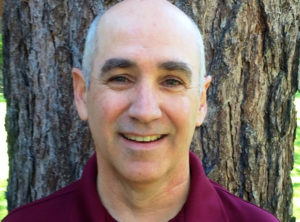
Dave Hamilton  is one of two candidates for the Area 4 seat for Lake Tahoe Community College.

Dave Hamilton is one of two candidates for the Area 4 seat for Lake Tahoe Community College.

Name: David Hamilton

Age: 60 (as of October)

Job/profession: Retired college educator

What boards, commissions, or other experience, including volunteering, do you have?: Local organizations: Currently part of core group forming the Tahoe Arts Alliance; president, Tahoe Tallac Association board of directors; 2007 board member from 2004-2014; member Pathway 2007 Forum (TRPA and LTBMU plan updates) representing non-motorized recreation in the Lake Tahoe Basin: 2005-2008;m ember of Public Lands Working group for Placed Based Planning Workshops, 2007; member board of directors Tahoe Rim Trail Association 2000-2003; member of initial planning committee for Van Sickle Park: 2000; president Tahoe Area Mountain Bike Association 1998-2005; member board of directors, Tahoe Arts Project 1990-92; president, board of directors South Lake Tahoe Theatre Company, 1990-1994

Regional/statewide organizations: member board of directors California Educational Theatre Association, 1993-1999, 2004, 2006-08 representing higher education; president board of directors Northern California Educational Theatre Association, 1993-1995, vice president 1990-1993

Why are you running for the college board?: My first connection with LTCC was taking classes back in 1976. I was first employed by the college in 1977 and I first taught at the college in 1984 then hired as a full time instructor in 1989 working until 2008. I consider Lake Tahoe Community College my college and I have been involved with much of its history. I helped write the original mission statement, participated in many annual planning sessions and three accreditations. Not only is LTCC a vital fixture, but also a large part of our community’s future. As a member of the board of trustees I want to continue serving the college in its important role for our students and community.

Why should voters vote for you over another candidate?: First, I have extensive background and experience with the college. As a faculty member over the years I connected with all types of students, getting to know them and understanding their academic needs. I was very involved with innovation in teaching and learning. In academic service I served as president of both the Academic Senate and the Faculty Association. I worked closely with the business office in the design and construction of the theatre as well as its yearly budget. I also served as a part time administrator gaining experience in administrative operations. I have worked as an administrator outside the district at other colleges, gaining insight to other ways of being successful within the California Community College system. But that experience is only one piece of why I would deserve the vote. South Lake Tahoe is my home town. I first moved to South Lake Tahoe in 1968. I graduated from STHS and have had about 38 full time years here. In that time I have been involved in many community projects and organizations. I have extensive experience in working as a member of a board of directors and feel I am innovative, collaborative and inclusive in that work.

What distinct experience or competency makes you uniquely qualified to lead effectively as an elected official?: Though I have all this experience with the college, it really just amounts to having knowledge and doesn’t by itself make me an effective board member. I think what makes me uniquely qualified is that I have spent a large part of my career working collaboratively with groups of people to achieve a goal. Whether it is directing a play, which involves bringing a new group of people together to build a production, negotiating a union contract, working within the boards of various nonprofits or being a member of the Pathway 2007 Forum which updated the TRPA Regional Plan. I believe I have an ability to help synthesize ideas and discussion into agreement and forward movement. I enjoy group synergy and work hard to establish positive working relationships with individuals and the community.

Public agencies have been under scrutiny the last few years for lack of transparency and accountability. What will you do to ensure both?: I believe the college already does a good job making sure the community is aware of what is going on. Accreditation requires the college to be accountable for how it operates. Though accreditation is only every six years, it ensures the college has processes and policies that ensure it is staying on track. As a public agency under the Brown Act the public has access to all board meetings as well as documents such as the budget, policies and procedures, etc. The college has been good about providing easy access to those documents. As a trustee I would want to make sure the Board communicates with both the public and staff in an open and timely manner. Processes for communication need to be clear and effective. Any decision made should have background and justification available.

What stands out for you in the current budget that you support and that you would change?: The budget process with the college involves many layers. It would be difficult to pick out a specific that is, or isn’t, valid without understanding all the background and discussion. That being said, in a general sense and based on the past few years of data, I support the current budget being based on zero growth. The F2F FTE (number of general students) is still dropping and though it has been filled in in other categories it is a good idea to not over-project. The college has traditionally been fiscally conservative in budget projections and I think that is wise in the current climate. I also support the level of reserves and the additional funds for STRS/PERS reserve. In the change area, one of the things that stands out for me, though it is not in the current budget, is why the college is spending money from Measure F on the bleachers and scoreboard in the gym. To my knowledge they are not currently used much and we do not have any competitive sports that need them. Again, I wasn’t in on the discussion, but that doesn’t seem like a priority.

Do you support current legislation for $15 minimum wage? Please explain: Yes I support it. I think the improvement in living standards would outweigh the effect on employment and increases in consumer costs. In Tahoe it will be felt strongly because we have a lot of small businesses that are barely making it now and they will take the brunt of the change. But at the same time, students coming to LTCC from out of town need to be able to make a living wage while going to school, no matter what job they find.

Do you support Proposition 55? Please explain: Even though Proposition 30 was a temporary tax, I feel that we have been able to absorb it without undue stress to our higher income earners. In addition, Prop. 55 does not extend the one-quarter cent sales tax. The money helps in areas that always need help, schools and health care. Though the state is recovering from the recession, I think it will be beneficial to extend this formula.

Describe three attributes for a successful board: Collaborative, innovative and responsive. They should be collaborative in making decisions using their collective knowledge in a synergy to make good decisions. They should be innovative in thinking as the college must grow and change with the ever changing environment of higher education. They should be open to new ideas brought forth as well being able to think outside the box. And they must be responsive to the public and staff of the college with open communication and dialogue as well as timely responses to issues and concerns.

What are your thoughts about public employee defined benefits?: Defined benefits have a long and involved history. The college deals with PERS and STRS. Unlike many other government entities, LTCC has not negotiated substantial benefits for retirees beyond the state level benefits. Both retirement systems are significantly out of balance in terms of unfunded liabilities. The process to make both systems fully funded has begun to take more money from both members and employers. LTCC, anticipating these continued increases is placing money into reserves to cover increasing costs. So the question is, is it worth it for the state to continue these systems as they are? Defined benefits have basically disappeared in the general workforce. Many people see them as a taxpayer gift to public employees. This is reinforced by sensationalized examples of the highest end of retirees, the people who make six figures in retirement. But the reality is that the average retiree makes significantly less and a large portion of their retirement is money they have contributed out of their salary. I think overall they are working to get the systems sustainable. As the economy improves and the market goes up, so too will the amount each retirement system has. For the college it is still a way to attract people to jobs. As the LTCC board we only have the ability to augment the retirement systems. And that is the place where we would need to be very careful in how much money that would be in the long term.

Please explain your position on contracting out work normally done by staff: In general contracting out work should only happen for a three main reasons. Either it is temporary work that staff does not have the expertise to accomplish, it is work that would overload staff beyond their ability to complete and/or an outside contractor will save a significant amount of money. Your question indicates work “normally done by staff”, which would seem to indicate contracting out different services to a private contractor. It depends on the nature of what the situation is. If it is a long term situation then the benefits must be examined. An example would be janitorial work. It is often less expensive to hire a service to clean rooms, restrooms etc. than to hire full time janitors. But you have less control and flexibility with a service so you must balance the results with the costs. If there are substantial savings, that money could be put to better use, though on some level, you get what you pay for. An outside contractor does not necessarily have your best interests at heart, as their primary interest will be financial. I think the key is consistent monitoring of outside contracts to make sure you are achieving your goals with them.

What is your 10-year vision for LTCC?: It will be very interesting to see where the California Community Colleges are in 10 years. I believe the system is currently undergoing fundamental changes to its mission and what we see 10 years from now may look very different from what we see today. I would like to see LTCC continue to build a reputation as a destination college beyond the beauty of being in Tahoe. Part of this will be the introduction of new, unique programs such as the current fire science or wilderness programs that provide students training, certificates and/or degrees that will draw students from outside the area. The college will not be able to rely purely on transfer programs. If new programs can build the student population then that will help the college keep the breadth of programs it has now and will make it financially sustainable with faculty and staff making equitable wages. I would also vision greater partnerships with universities and participation in offering Bachelor degrees. The potential for student housing is still a reality. If it is financially sustainable that could also provide a resource to attract and retain students.

What one vote in the last four years that the current board made do you disagree with and why?: Again, without having been in on the planning and discussions I wouldn’t want to second guess decisions made by the board. It is also easy to see the results of a decision in hindsight and thus disagree with it. But I am of the belief that once a decision is reached, whether you vote to agree or disagree, you live with that decision and move on.

How many meetings have you attended this year for the board you are running for?: Over this year, none. I recently finished a one-year assignment as dean business, design and workforce at Cañada College in the Bay Area and was only home on weekends. Prior to that I have been to an occasional board meeting, though when I was Senate President I was at many. The agendas and minutes are posted, so it not difficult to keep up on discussion and decisions.

What do you know about the strategic plan, finances, debt, goals of college?: I have been catching up on the current state of the college. I have read the current plans and budget. Having been connected with the college I have a context for the content of the goals and strategic plan and understand how the college is moving forward.

Being on a board means working as a team. How will you work with the sitting members for the greater good of the community?: As I had stated above, I work well in collaborative decision-making. I already know the members of the current board and have worked with a couple members in different settings. As a new board member I would take the time to strengthen relationships with the rest of the Board and not simply come in with thoughts about what I think should happen. The reason we are all elected is to represent the community and provide a collective voice to help direct the college.

What should be the three main priorities for the board?: 1. Help the college achieve its mission 2. Maintain the fiscal health of the college 3. Represent the public interest.

What have you done to make yourself ready to be a board member?: I suppose one way I have made myself ready to be an LTCC board member by being involved with the college and the community over the last 45 years. More specifically, I am now current on college policies and procedures as well the recent budget and issues the college has faced.

What is your opinion about career and technical education at the high school level?: CTE is a vital component of our education system. Along with providing a general education, our education system gets students ready for careers they will pursue in life. Many careers in today’s world require training but not necessarily in a traditional academic environment. And many of these career paths can begin in high school. By providing hands on career training opportunities (CTE) in high school we can shorten the time needed for students to transition from high school into successful careers. And CTE is no longer seen as simply traditional blue collar jobs or an end in itself. CTE now represents pathways with multiple entry and exit points and also represents high paying careers. An example would be the tech industry. In high school students could get hands on experience in coding and/or graphic design which might transition them to a program at a community college where they could achieve a certificate or degree that would place them into a high demand area where they could earn a significant salary. At some point they might take that work experience and re-enter a training program to further their skills for a next level job or change careers entirely. The work they did in high school would fast track them at the next level, having them career ready with less time and cost. The state is currently providing funding for these pathways through the CTE Transitions program, which connects CTE high school students with degree and certificate pathways in a community college.

What will you look for in a new college president?: If I am elected to the board, the new college president will have been selected and will be starting the same time I do. I have faith that the current board will have made the best choice based on the profile given in the search announcement. As the new superintendent/president begins I would look for the building of a solid relationship with the board, the college and the community. We are a small community and the more engaged and active the president can be with both the college community as well as our greater community, the better.

Tell us something about yourself that people may not know: Two things: First, I once performed with the San Francisco Symphony at Davies Hall and I don’t play an instrument. They did a performance of “The Flood” by Stravinsky which had spoken parts, of which I got to do one. Second, I know Nancy Dalton who is also running. I think she is also well qualified and an excellent person and community member. It will be a win for the college either way.

As a former instructor at LTCC, how can the public believe you will represent everyone and not just staff?: I understand what it means to be a trustee. As a trustee I do not represent the staff at all. I represent the public interest and my job is to work with the entire board to help the college fulfill its mission and to make sure the use of taxpayer money is responsible. The only thing I represent as an individual board member are the people in Area 4. Even when I was an instructor at the college I understood the importance of every element of the college to make everything function well. I had no illusions that my needs were more vital than any others.

Weather apps are not all created equal

By Graham Averill, Outside

Search “weather” in the App Store and you’ll be bombarded with an endless scroll of options—from radar imagery good enough for meteorologists to an app that shows you a different picture of a kitten every time you check the weather. Seriously. Weather kittens.

But if you’re using your smartphone to plan an adventure, or even just figuring out when you should walk the dog, you’re going to need more than just cute kittens.

We spent a month testing dozens of weather apps on the iPhone in a variety of scenarios. I used them to plan hikes and bike rides in the mountains and surf sessions on the coast in an attempt to separate the good from the bad.

Read the whole story


Flu shots to be available in S. Lake Tahoe

The El Dorado County Health and Human Services Agency, Public Health Nursing will be conducting flu vaccination clinics from Sept. 28 through mid-November for $10 per vaccine. No one will be denied service due to inability to pay.

It is recommended people 6 months and older get the shot.

Cash or checks are accepted. Parents should bring their child’s immunization records.

Dates:

  • Sept. 28, Oct. 12 and Oct. 26 from to 10:30am-12:30pm at the Senior Center, 3050 Lake Tahoe Blvd., South Lake Tahoe.
  • Oct. 5 and Oct. 19 from 3-6pm at Bijou Community School, 3501 Spruce Ave., teachers’ lounge, South Lake Tahoe.
  • Nov. 4 from 3-6pm at Lake Tahoe Airport, 1901 Airport Road, South Lake Tahoe.


Lilburn “Jonesy” Jones — 1925-2016

Jonesy Jones

Jonesy Jones

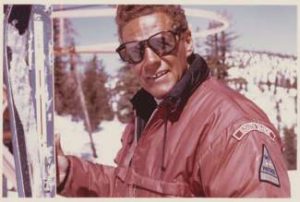
Lilburn “Jonesy” Jones died Sept. 4, 2016. He was 91.

He was in Newburyport, Mass., on March 27, 1925, to G. Howard Murley and Louise May Jones.

Jonesy was an honored member of the Tenth Mountain Division who served in Italy during World War II. As a sergeant, he was proud to have brought all his men home safely.

Taking advantage of the GI Bill, he headed west, first graduating from Lassen Junior College, then Chico State, where he met and married Donna Marie Elliott.

With skiing in his blood, he relocated to the mountains, working in various aspects of the ski business, including ski instructor, ski patrol, and finally mountain manager at Heavenly Valley Ski Resort. He worked to open the first ski lift at Mt. Shasta, served as ski patrol leader at Squaw Valley, and helped create the first 10-year master plan at Heavenly Valley with the assistance of Robert Shedd. He also wrote the master plan for Kirkwood Ski Area and was instrumental in establishing Silver Basin Ski Area, now known as Iron Mountain.

An avid skier and mountain man, he liked nothing better than to be out in nature, sniffing the breezes, and watching wildlife.

Jonesy is survived by his wife of 62 years, Donna, daughters Louisa and Carroll-Sue, and grandsons Marcale and Brandon.

Honoring Jonesy’s wishes there are no services scheduled for this time. Donations may be made in his name to Lake Tahoe Wildlife Care.