Unlikely basketball star recalls her glory days

By Linda Fine Conaboy

Maybe some of you know South Lake Tahoe resident Maureen Stuhlman who is employed as the city’s vacation home investigator. Maybe not.

Perhaps a few readers know about Immaculata University in Malvern, Pa., just outside of Philly.

There is even a chance that some have seen the movie “The Mighty Mac,” released in 2011.

Stuhlman is the linchpin holding this unlikely triumvirate together.

As it turns out, both Stuhlman and Immaculata have stories to tell. Stuhlman’s, starting in the early 1970s when Immaculata was not more than 60-years-old, and she, a mere fun-loving lass in her teens living in Havertown, Pa., taking advantage of a special pre-college scholarship program offered by nearby Immaculata, a private Roman Catholic university founded in 1920 by the Sisters of the Immaculate Heart of Mary as an all-girls school. (In 2005 it became co-educational.)

The athletic teams at Immaculata University are known as the Mighty Macs.

When Stuhlman and her friends entered the college as freshmen, on a lark, they decided to join the basketball team. As she told Lake Tahoe News, it looked like a fun thing to do, although their knowledge of the game was limited. “Anyone who wanted to play just showed up,” she said. “And it was a pleasant way to spend an afternoon.”
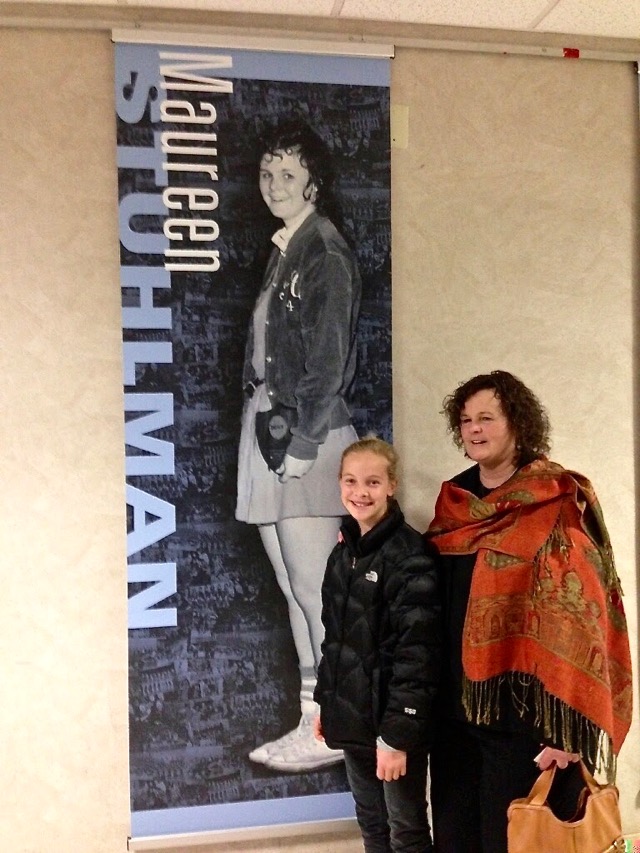
Maureen Stuhlman has passed the basketball bug onto her niece. Photo/Provided

Maureen Stuhlman has passed the basketball bug onto her niece. Photo/Provided

Nevertheless, lark or not, lack of skill on the part of her team didn’t deter Cathy Rush, the new girls’ basketball coach. She had a job to do. She was hired in the late 1960s at a salary of $450 a month with the mandate to mold a basketball team … and while she was at it, to build a gym since the old fieldhouse had burned down.

Stuhlman mused that in the early 1970s there were no sports scholarships for girls and there most definitely was no Title IX protection for women in sports. Title IX requires that all college students receive the same opportunity to play college sports under any education program or activity receiving federal financial assistance.

This was soon to become a significant factor to the fledgling team, who unbelievably began to win games. Not only did they win games, they also won tournaments, only to discover they would have to raise their own funds to attend the tournaments that were the spoils of their winning streak.

Stuhlman, who played forward, said her parents were troopers, ferrying she and as many teammates as they could fit into to the family station wagon to the games.

 “We didn’t know there were such things as tournaments. To us, basketball was totally a social thing,” Stuhlman said.

But win tournaments they did; these Mighty Macs, garbed in their wool tunics draped over the pleated skirts that served as their uniforms. These same Mighty Macs soon found themselves going door-to-door or accosting their friends and loved ones in an attempt to sell toothbrushes to fund their airfare to get to the national tournament at the University of Illinois in Normal.

“We did happen to win all of our games in one season,” she said. “We went to the regionals where they brought out their second string and we trounced them. When we returned to the regionals, they played their first string, and they trounced us.”

Feeling dejected by their defeat, upon their return to school the girls prepared to beat a hasty and silent retreat to their rooms. But their classmates as well as their teachers had other ideas. “The entire school gathered in the rotunda to greet us—we were all in tears.”

Although they came in second, they were invited to play in the National Championships. Surprisingly, they hammered the team that had just slaughtered them, although, according to Stuhlman, only one of the team members was a naturally good athlete.

screen-shot-2017-01-04-at-1-52-30-pmThe flight to Illinois was probably the first flight that many of the girls had taken. “It was such a lark for us. We had two hotel rooms, four to a room. We played four games in three days,” she said.

Stuhlman recalls the wins as much more than just wins. “We grew a lot and we learned we could do what we set our minds to do. We had confidence in each other; it was a team effort. At the time, it was new for women to train; [basketball] was considered a pastime. But these were formative years, they taught us what it meant to be a part of a team—we had formative experiences that still serve me today.”

As Stuhlman reminisced about the Mighty Macs, she recounted the achievements of her team: Of the starting five players, one, Theresa Shank Grentz, went on to become the first women’s basketball coach at Rutgers as well as a coach for the women’s Olympic basketball team.

Cathy Rush, the Macs coach from 1972 to 1977, led the school to three consecutive  AIAW national titles from 1972-74 and was inducted into the Basketball Hall of Fame in 2008. She had also been inducted to the Women’s Basketball Hall of Fame in 2000 and the Philadelphia Sports Hall of Fame in 2005.

Another Maureen (there were three on the team), coached women’s basketball at Pennsylvania State University and was an Olympic coach. Her married name is Rene Courtland; she is now retired.

“And then our entire team was inducted into the Basketball Hall of Fame in 2014—this was such an honor,” Stuhlman said. At the ceremony, Stuhlman recalled, the team had the opportunity to rub elbows with the likes of basketball greats Larry Johnson and Meadowlark Lemon.

To their amazement, 40 years later, “The Mighty Macs”, a movie about the season leading to the winning of the first women’s national basketball championship in 1972, was released. And just to prove that camaraderie is not fleeting, the entire team attended the movie’s premier en masse, which was at the Kimmel Center in Philadelphia.

According to the movie trailer, the film is about Cathy Rush, a woman ahead of her time who takes a job as the coach of the women’s basketball team at Immaculata College, as it was known in the 1970s. She and her team face huge challenges competing against perennial powerhouses—and the rest, as we know is history.

“The general theme of the movie is true,” Stuhlman said. “The coach who was married to an NBA referee, that was Cathy. But a lot of the details didn’t really happen.”

She laughed, describing a good bit of the movie as artistic license. But to those of us who were not part of the Mighty Macs, the movie does not seem to be merely artistic license. It’s the tale of a cohesive team of females, led by a tough but respectful coach, who were united to strive for a single goal—winning, while maintaining their youthful eagerness and their sense of loyalty to each other.

Now, Maureen Stuhlman is a happy resident of South Lake Tahoe, where she moved several years ago after visiting a friend and falling love with the place. Prior to her Tahoe gig, she lived in Venice Beach for 30 years working in the travel business. She said she also for a time worked in Dubai.

Not surprisingly, her niece is now a basketball player in Philadelphia. Stuhlman says although she’s not in the shape she was in her playing days, she loves snowshoeing out the back door of her Lake Tahoe home.


Radon to be subject of presentation in Stateline

Tahoe Regional Planning Agency is hosting a radon educational event on Jan. 23 at 6pm at its Stateline office.

Free test kits will be available for Nevada residents at the presentation. Test kits can also be purchased at low-cost for out-of-state residents.

For those who cannot attend a presentation, free radon test kits are also available at Cooperative
Extension offices and partner offices statewide through Feb. 28.

January is National Radon Action Month.

Radon is a naturally occurring, radioactive gas that is colorless, odorless and tasteless. It comes from the
ground and can accumulate in homes, raising the risk of lung cancer. The U.S. Environmental Protection
Agency  estimates 21,000 Americans die each year from radon-caused lung cancer, killing more
people than secondhand smoke, drunk driving, falls in the home, drowning or house fires.

In Nevada, one in four homes tested show radon concentrations at or above the EPA action level. In
Stateline, the potential is higher, as 70 percent of the homes tested had an elevated radon level.

According to experts, living in a home with radon concentrations at the action level poses as much risk of
developing lung cancer as smoking about half a pack of cigarettes a day.


Friends are the antidote to loneliness for seniors

By Paula Span, New York Times

The circle shrinks. As the years pass, older people attend too many funerals. Friendships that sustained them for decades lapse when companions and confidants retire or move away or grow ill.

These days Sylvia Frank, who moved into an independent living residence in Lower Manhattan in 2014, can email or call one longtime friend in Florida. Another, in Queens, is slipping into dementia and will most likely exclaim, “I haven’t spoken to you in months!” when, in fact, they talked the day before.

But even at advanced ages, new relationships take root. Frank’s son kept telling her that a colleague’s cousin, Judy Sanderoff, was about to move into the same facility. They sought each other out.

Now, Frank, 91, and Sanderoff, 96, eat breakfast together almost daily; they have dinner, à deux or with other friends, many evenings. Sanderoff spent Thanksgiving with Frank’s family in Brooklyn.

Read the whole story


Author to give talk, host workshop at SNC

Author Shaun Griffin will give a free talk Feb. 3 as part of the Writers in the Wood Series at Sierra Nevada College in Incline Village.

A long-time resident of Virginia City, he has taught poetry workshops in the Northern Nevada Correctional Center and is co-founder of the Community Chest, a nonprofit agency serving children and families in Northwestern Nevada.

Griffin wrote “Anthem for a Burnished Land,” “This is What the Desert Surrenders and Bathing in the River of Ashes,” and was editor of “From Sorrow’s Well,” a volume on the poet Hayden Carruth, among other works. 

The 7-9pm talk is free. Griffin will be putting on a workshop Feb. 4. To sign up, go online.


‘July & Winter’ simplifies gardening in Tahoe

By Kathryn Reed

Stop making excuses for not growing produce in Lake Tahoe. There is finally a book that seems to answer every question imaginable.

“July & Winter: Growing Food in the Sierra” is Gary Romano’s tell-all book about gardening at higher elevations. The book came out last year; published by Meyers-based Bona Fide Books.

JulyWinterGarden_CVR_FNow is the time to start reading this book if you intend to be digging in the soil later this year. For one, it’s not a quick read because it is really a reference book. It’s nothing like Romano’s book “Why I Farm” that came out in 2013.  That was more of a memoir. “July & Winter” is a how-to book.

It’s not just for those in Tahoe, though. The wealth of information is pertinent to anyone living at higher elevation – this includes the foothills.

“In any attempt to farm or garden in the Sierra, the consideration of extending your season is a must. Because of our short season, from 30 to 80 days at elevations above 4,000 feet, trying to grow any crops other than cool-season crops from June through September is difficult without some kind of season extension structure such as cold frames, hoop houses, or green houses,” Romano writes.

While Romano is a farmer, he is speaking to the masses in this latest book. It’s for the average person who wants to grow their own produce. Romano doesn’t glamorize the process. In fact, in some ways I felt exhausted at times reading the book. He made me realize why my feeble attempts at growing vegetables at 6,200 feet have not been all that successful. At the same time he has taught me how to change the outcome.

So many pages are dog-eared and passages underlined. I don’t usually like to deface a book, but at the same time I think reference books should be written in. One day my own notes about how things worked will fill the margins.

To me, this is one of those books that is better in print than electronic form because you might want it in the backyard as you construct the hoop house, or in the garage as you assemble parts. An index makes it easy to tap into a specific topic.

Romano doesn’t hold back in his opinion about how to do things and what to use (never use Round Up), but he is also humble as he shares what has gone wrong for him.

It’s not just what to plant and how to do it. Topics include dealing with wildlife, fruit trees, soil, water management and more.

—–

Notes:

·      “July & Winter” is available online for $19.95. 


Bill Mosher — 1953-2017

Bill Mosher

Bill Mosher

Bill Mosher, a descendent of several prominent South Lake Tahoe pioneer families, has died. He was 64.

William Merwin Mosher IV passed away Jan. 6, 2017, after a lifelong battle with rheumatoid arthritis.

He was born Jan. 2, 1953 in Sacramento to Melba and William G. Mosher Sr.

Mr. Mosher was a fourth generation cattleman in South Lake Tahoe and Sloughhouse. He ran cattle from the Barton Ranch to their summer range on family property in South Lake Tahoe.

He was owner/operator of the WM Cattle Co. With his easy going personality he had the same cattle crew for many years.

While serving as president of the Amador El Dorado Sacramento County Cattlemen’s Association he organized the Cattlemen’s Jackpot Show, which he continued for more than 30 years.

He also served on the Sloughhouse RCD Board and the last several years as chairman. He hosted many events including the Sheriff’s Ride and Elk Grove’s Project Ride at the Barton Ranch. He spent many years helping with Elk Grove’s Western Festival Days.

Mr. Mosher was a 45-year member of Elk Grove Parlor No. 41 Native Sons of the Golden West.

He had a love for agriculture, was an avid reader and loved his family. During his childhood Mr. Mosher went on many trips and visited many countries with his grandparents.

Mr. Mosher was a graduate of Elk Grove High School and Cal Poly, San Luis Obispo.

He was preceded in death by father William G. Mosher Sr., grandparents Lester and Fay Ledbetter, grandparents William and Rosalyn Mosher, great-aunt Alva Barton, uncle William Ledbetter and aunt Madelyn Valensin.

He is survived by wife Kay of 39 years; daughter Melanie Mosher Baiz (Sean) and grandchildren Madelyn and William; his mother Melba Mosher; sisters Faye Krull (Robert) and Ouida Garms (Herb); and many nieces, nephews and cousins.

A funeral Mass will be said at St. Vincent de Paul, 14673 Cantova Way, Rancho Murieta on Jan. 14 at 10am.

Donations may be made to Project Ride, 8840 Southside Ave., Elk Grove, CA 95624.


6 workshops for El Dorado County caregivers

El Dorado County Health and Human Services Agency is putting on a six-week program for caregivers.

The series topics include:

Feb. 24 – Taking Care of You
March 3 – Identifying and Reducing Personal Stress
March 10 – Communicating Feelings, Needs, and Concerns
March 17 – Communicating in Challenging Situations
March 24 – Learning From Our Emotions
March 31 – Mastering Caregiving Decisions

The program will be from 2-3:30pm at the El Dorado Hills Senior Center, 900 Lassen Lane.

The trainings in the educational series will provide caregivers of older adults with tools and strategies to assist them in handling the unique challenges they face.

Class size is limited and registration is required — 530.621.6192. The training series is offered at no cost; donations are accepted.


How Hollywood changed the slot machine paradigm

By Dan Michalski, Vegas Inc.

Gov. Brian Sandoval was chairman of the Nevada Gaming Commission in January 2000 when the panel enacted a ban on slot machines with cartoon themes deemed appealing to minors.

Controversy over a slot machine built on the TV-MA-rated cartoon “South Park” had sparked then-presidential contender Sen. John McCain, R-Ariz., to call on the Federal Trade Commission to investigate whether casino marketing practices were picking up where cigarette mascot Joe Camel left off, luring minors into a potentially addictive abyss.

Sandoval and the Nevada Gaming Commission jumped into action to preempt federal activity and reaffirm that Nevada knew best how to regulate the gaming industry, even as casinos proliferated nationwide.

Read the whole story


Learn about Tahoe Natural Year

Throughout the calendar year Earth’s orbit and tilt causes shifting weather patterns, movements and migrations of animals, emergence and disappearance of various plants and wildlife, and a host of other natural history phenomena.

Learn about a wide variety of these natural history topics, track the ebb and flow of the Sierra’s seasons, and catch a sneak peek at some of the wildlife to watch for in the coming year at the Tahoe Natural Year: A Journey through the Seasons talk at Sierra Nevada College on Jan. 19.

Tahoe Institute for Natural Science is sponsoring the 2017 Tahoe Nature Chase, a yearlong scavenger hunt that encourages participants to learn more about Tahoe’s environment by providing new nature observation challenges each month.

Registration is required. The program will begin at 6pm, with refreshments and no-host bar from 5:30-6pm on the campus of Sierra Nevada College.

A $5 suggested donation will be collected at the door.


Calif. trees subject of poster, video contests

To help educate Californians on the value trees provide to building successful, healthy cities and neighborhoods, CalFire and California ReLeaf are sponsoring a poster contest for students in grades 3-5.

Rules and details are online. 

In addition, the two groups are having a video contest for students in grades 6-8. Those rules are also online.

For each contest, students are asked to create original artwork or video based on the theme “Trees Are Superheroes!”

Submissions are due Feb. 14. Winners will be featured at the State Fair in the summer.