10 locals to compete in Tahoe dance contest

Rehearsals for the 5th annual Dancing with the Tahoe Stars started this week.

The event is March 4 at 6:30pm at MontBleu.

Similar to the popular TV show, rookies will learn a choreographed dance routine complete with costumes. They will be paired with real dancers.

Local contestants and their partners are:

·      Betsy Belotti and Rainer Herm

·      Marimille Dacia and Gerzon Chaves

·      Alison Ganong and Bob Truesdale

·      Brooke Hernandez and Alex Kaskie

·      Cindy Martinez and Rex Kline

·      Jeff Cowen and Rhonda Keen

·      John Freidrich and Jodi Patton

·      Matt Levitt and Robyn Lindner

·      Chuck Malone and Angela Smith

·      Austin Sass and Catherine Arens.

Judges will be Marcia Sarosik, Don Bosson and Paul Middlebrook. The audience will have the opportunity to vote by text for their favorite couple. The people’s choice award is a separate prize based on the couple that raises the most money for Tahoe Arts Project by collecting donations. Online voting for People’s Choice can be done anytime through TAP’s website.

Tickets range from $10 to $50 and will go on sale Feb. 4. 


Third Eye Blind to play outdoors at Tahoe

The first show of the 2017 Harveys Summer Outdoor Concert Series has been announced.

Third Eye Blind will take to the stage on July 16 at 7:30pm. This coincides with the final day of the annual celebrity golf tournament.

Tickets go on sale next month.

The last time the band was in Lake Tahoe was in 2015 at MontBleu.

— Lake Tahoe News staff report


Professor to give lecture on political divide

Political Polarization and Policymaking after the 2016 Election will be the subject of a Feb. 2 talk at Sierra Nevada College in Incline Village.

Just how divided are we? And what are the nature of those divides? Political science research indicates that a diverse set of conflicts-differences in issue attitudes, policy priorities, race and ethnicity, core values and beliefs, and culture/lifestyle-continue to overlap on one another. This has produced polarized voting patterns, partisan behaviors, and increasing distrust and dislike of those in rival ideological and
partisan camps.

Christopher Hare, UC Davis political science professor, will review those findings and discuss the implications for policymaking in the 115th Congress.

The program will begin at 6pm, with refreshments and no-host bar from 5:30-6pm at 291 Country Club Drive in Incline Village.

Seating is open at 5:30pm to guests who have preregistered, open seating starts at 5:50pm. A $5 suggested donation will be collected at the door.


More Americans retiring outside U.S.

By Maria Zamudio, AP

Newly widowed, Kay McCowen quit her job, sold her house, applied for Social Security and retired to Mexico. It was a move she and her husband, Mel, had discussed before he passed away in 2012.

“I wanted to find a place where I could afford to live off my Social Security,” she said. “The weather here is so perfect, and it’s a beautiful place.”

She is among a growing number of Americans who are retiring outside the United States. The number grew 17 percent between 2010 and 2015 and is expected to increase over the next 10 years as more baby boomers retire.

Just under 400,000 American retirees are now living abroad, according to the Social Security Administration. The countries they have chosen most often: Canada, Japan, Mexico, Germany and the United Kingdom.

Retirees most often cite the cost of living as the reason for moving elsewhere said Olivia S. Mitchell, director of the Pension Research Council at the University of Pennsylvania’s Wharton School.

“I think that many people retire when they are in good health and they are interested in stretching their dollars and seeing the world,” Mitchell said.

McCowen’s rent in Ajijic, a community outside Guadalajara near Mexico’s Lake Chapala, is half of what she was paying in Texas. And since the weather is moderate, utility bills are inexpensive.

In some countries, Mitchell said, retirees also may find it less expensive to hire someone to do their laundry, clean, cook and even provide long-term care than in the United States.

McCowen has a community of other American retirees nearby and has adjusted well.

But for others there are hurdles to overcome to adjust to life in a different country.

Viviana Rojas, an associate professor at the University of Texas at San Antonio, says the biggest obstacle is not speaking the language or knowing the culture.

“Many of the people we interviewed said they spoke Spanish, but they actually spoke very little Spanish,” said Rojas, who is writing a book about retirees in Mexico. “They didn’t have the capacity of speaking enough Spanish to meet their basic needs like going to the doctor or to the store.”

Access to health care also can be a challenge. While retirees still can receive Social Security benefits, Medicare is not available to those living abroad, Mitchell said.

Joseph Roginski, 71, says that while the cost of living is higher in Japan, access to health care is not. “Things are very expensive here. It is impossible to live off Social Security alone,” said Roginski, who was stationed in Japan in 1968. “But health insurance is a major factor in staying here.” 

The former military language and intelligence specialist said he pays $350 annually to be part of Japan’s national health insurance. His policy covers 70 percent of his costs. The rest is covered by a secondary insurance program for retired military personnel.

Japan experienced biggest growth, 42 percent, of American retirees than any other country between 2010 and 2014, according to data from the Social Security Administration. The large U.S. military presence in the country may be a factor.

There are more than 50,000 U.S. military servicemen and -women stationed in Japan. The presence is so large that in the island of Okinawa, the U.S. military occupies about 19 percent of the area, according to Ellis S. Krauss, professor emeritus of Japanese politics and policy-making at the University of California, San Diego.

Roginski, who volunteers for the Misawa Air Base Retiree Activities Office, said he helps connect more than 450 retirees and their families living in Northern Japan with resources. He said he would never move back to the United States.

“We have a real strong sense of security here,” he said. “I can leave my door unlocked and no one will take anything. When I go to another country I feel nervous, but when I come back I feel like I’m home.”

Mexico has become home for retired firefighter, Dan Williams, 72, and his wife, Donna, 68. The couple has been living near the same retirement community in Lake Chapala for 14 years.

“The climate and the medical services are very good,” Williams said.

Williams teaches painting to adults and children and puts together a monthly magazine for the local American Legion. He is also a member of the Lake Chapala Society, which offers daily activities for American retirees.

It was those same services that attracted McCowen to the region.

“Before moving, I found out how many widowed and divorced women lived here,” she said. “There is comfort in numbers.”

She says she loves being in a lively community.

“I see older people walking year round. I see them all over the place even in their wheelchairs. If they were in the U.S., they would probably be in a nursing home,” she said. “I don’t think I could move back.”

California Legislature fellowships available

Applications for the 2017-18 California Senate Fellows Program and Assembly Fellowship Program are available.

The programs provide college graduates an opportunity to become full-time Senate or Assembly staff members at the State Capitol for 11 months beginning in the fall.

Fellows are assigned to the personal or committee staff of a senator or assembly member, and also participate in academic seminars with legislators, senior staff, journalists, lobbyists and state government officials. The fellowship programs are administered by the Center for California Studies at CSU Sacramento in partnership with the state Senate and  Assembly. 

Fellows are paid a monthly stipend, plus health, vision and dental benefits. They enroll as graduate students at Sacramento State and receive graduate units. The enrollment fees are paid by the programs.

Anyone who will be at least 20 years of age and a graduate of a four-year college or university by the beginning of the program may apply. Individuals with advanced degrees and those in mid-career are also encouraged to apply. Detailed information about the fellowships and applications are online.

The application deadline is Feb, 13.


Road Beat: Mazda CX-9, full-size luxury CUV

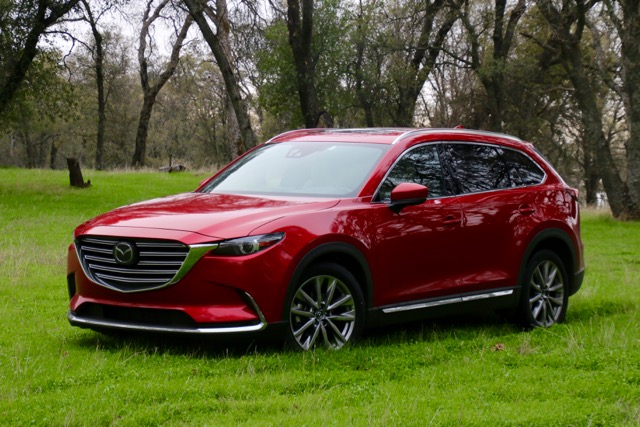
The Mazda CX-9 is everything you expect in a Mazda and then some. Photos/Larry Weitman

The Mazda CX-9 is everything you expect in a Mazda and then some. Photos/Larry Weitman

By Larry Weitzman

For 2016, Mazda reintroduced a new CX-9 crossover utility vehicle, a brand-new vehicle, although it uses the nomenclature from the prior CX-9 which was a superb CUV in its own right. Mazda’s new tag line “driving matters,” is an obvious part of the CX-9’s DNA as it is a pleasure to drive while being at the same time engaging to drive.

Mazda’s Kodo design philosophy is apparent in the CX-9 in perhaps its most elegant form. Staring with its themed, aggressive front end, the lines flow in a fluid manner in perfect proportion only to disappear into its curvaceous body. There are four lines in the design, a hood line that flows into the A-pillar, another secondary hood/shoulder line that disappears into the body in the rear door and a third rear shoulder line starting in the formation of the taillight that also turns fluidic in the rear door and a subtle fourth line that starts in the rear D-pillar that also disappears in the upper window line. Clever stuff. Adding to its beauty are the perfect proportions of the body. In relation to other current Mazda designs, the hood is carried a bit higher, being less snout like.

CX-9 is a full size CUV with a length of 199 inches on a wheelbase of 115 inches. Its broad, strong shoulders of almost 78 inches offset its tall, 68 inches of height.                   

Under the exquisite hood is a blown version of Mazda’s 2.5L, DOHC, 16 valve, Skyactiv (direct injected) inline four-cylinder engine Instead of 185 hp the relatively low boost turbo charger adds 65 hp bringing the total output to a max of 250 hp at a super low 5,000 rpm and a stump pulling 310 pounds of twist (that’s the torque made by some 5.0L V-8s) arriving at just 2,000 rpm (on premium fuel) meaning this powerplant is cranking out a whopping 120 hp when peak torque arrives making this an extremely responsive engine that doesn’t require it to wind out before it starts making lots of thrust. It is so strong that you forget it’s a turbo with that characteristic turbo lag. Not here. Compression ratio is a very high 10.5:1.

Specifications Price $31,520 to about $45,000 for the Signature model Engine 2.5L turbocharged DOHC, 16 valve direct injected inline four 250 hp @ 5,000 rpm 310 lb.-ft. of torque @ 2,000 rpm Redline 6,300 rpm Transmission Six-speed torque converter automatic Configuration Transverse mounted front engine/FWD/AWD Dimensions Wheelbase 115.3 inches Length 199.4 inches Width 77.5 inches Height 67.6 inches Track (f/r) 65.3/65.2 inches Ground clearance 8.8 inches Weight (FWD/AWD) 4,054/4,307 pounds GVWR (FWD/AWD) 5,661/5,816 pounds Tow capacity 3,500 pounds Steering lock to lock 3.1 turns Turning circle 38.4 feet Fuel capacity 19.5 gallons Wheels 20X8.5 inches Tires 255/50X20 Co-efficient of drag 0.35 Performance 0-60 mph 6.54 seconds 50-70 mph 3.58 seconds 50-70 uphill (6-7%) 5.00 seconds Top Speed Does anyone really care? Fuel economy EPA rated (FWD//AWD) 22/28/25//21/27/23 mpg city/highway/combined. Expect 23 mpg in rural country and suburban driving and 28-29 mpg on a level highway at legal speeds.

Specifications
Price $31,520 to about $45,000 for the Signature model
Engine
2.5L turbocharged DOHC, 16 valve direct injected inline four 250 hp @ 5,000 rpm
310 lb.-ft. of torque @ 2,000 rpm
Redline 6,300 rpm
Transmission
Six-speed torque converter automatic
Configuration
Transverse mounted front engine/FWD/AWD
Dimensions
Wheelbase 115.3 inches
Length 199.4 inches
Width 77.5 inches
Height 67.6 inches
Track (f/r) 65.3/65.2 inches
Ground clearance 8.8 inches
Weight (FWD/AWD) 4,054/4,307 pounds
GVWR (FWD/AWD) 5,661/5,816 pounds
Tow capacity 3,500 pounds
Steering lock to lock 3.1 turns
Turning circle 38.4 feet
Fuel capacity 19.5 gallons
Wheels 20X8.5 inches
Tires 255/50X20
Co-efficient of drag 0.35
Performance
0-60 mph 6.54 seconds
50-70 mph 3.58 seconds
50-70 uphill (6-7%) 5.00 seconds
Top Speed Does anyone really care?
Fuel economy EPA rated (FWD//AWD) 22/28/25//21/27/23 mpg city/highway/combined. Expect 23 mpg in rural country and suburban driving and 28-29 mpg on a level highway at legal speeds.

One interesting note that if you choose to use regular fuel, the engine hp rating goes down to 227 hp at the same rpm probably due to the engine’s computer retarding the spark to prevent pre-ignition. I didn’t test the vehicle with regular gas, but I doubt the following performance numbers would be effected by much or that the overall feel of the vehicle would change or even be noticeable.

Speaking of performance, this 4,054-pound vehicle gets it done quickly. Zero to 60 mph occurs in 6.54 seconds, making it the quickest Mazda except for the MX-5 Miata and understanding that all Mazdas are pretty quick cars. There is no such thing as a lethargic Mazda. Passing times also reflect the CX-9’s outstanding performance with a 50-70 mph passing simulation of just 3.58 seconds and the same run up a 6-7 percent grade lasts just 5 seconds. This is a honkin’ on CUV with immediate and a linear throttle response that without the traction control and in spite of the big meats, can light’em up easily at lower speeds. What’s nice about a turbo charged engine and living in the foothills and Sierras, there is no performance loss as you climb in altitude. At 7,382-foot Echo Summit, the CX-9 is still making its max rated hp of 250 hp where a normally aspirated engine of the same sea-level power rating would be down to about 195 hp because of less oxygen and induction pressure.

Mazda also holds the title as the auto industry’s highest   average EPA CAFÉ (Corporate Average Fuel Economy) numbers for all their models, but the CX-9 has to bring up the rear as it’s rated by the EAP at 22/28/25 mpg city/highway/combined. My testing revealed almost identical numbers with a two-way highway run at 70 mph returning 28.5 mpg. A round trip to South Lake Tahoe from Placerville averaged 24.6 mpg and overall in country rural two-lane road driving showed 23.5 mpg. While not the greatest numbers on their face, when compared to other full size SUV/CUVs, the CX-9 looks darn good.

Now to a Mazda forte, handling. As with all Mazdas, handling matters and the CX-9 certainly is not only an easy handler, but an adept one as well. It has all the creds, sophisticated four well independent suspension, coils in all the corners, stab bars at both ends, a wide 65-inch track and reasonably quick steering at 3.1 turns lock to lock. Also, adding to the CX-9 cornering power are massive 255/50 series rubber mounted on 20X8.5-inch great looking alloy wheels. Needless to say, turn in is crisp and its attitude is flat when pushing hard in the twisties. It simply goes where you point it without feeling like a cumbersome, head tossing, big top-heavy SUV, but more like a sporting sedan. Making 2 tons change direction with aplomb is no easy feat, but Mazda has found a way.

Ride quality is excellent. One passenger immediately remarked about its quiet and wonderful ride quality. It has the ability to absorb road imperfections with its very supple suspension and absolutely no harshness. While the engine spins a relatively low 2,200 rpm at 70 mph, it extremely quiet with no wind or road noise.    

Four-wheel disc brakes (front ventilated) are over a foot in diameter and have all the safety acronyms making for powerful controlled stops and Smart City Braking which includes a large flashing red “brake” sign in the heads-up display. Standard in this Grand Touring unit are lane keep assist, blind spot monitoring, roll stability control, adaptive headlights which turn night into day and so much more. Safety has certainly not taken a backseat with Mazda.

Inside is another area where Mazda is an industry leader with soft, leather sublime (full power) front chairs, second row seating with huge legroom and a third-row fold down system for two. Actually, the second-row folds flat as well. Most all of the interior surfacing is quality soft touch.

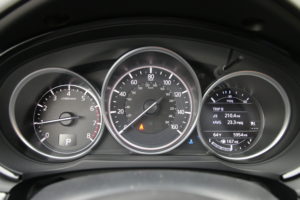
Instrumentation is all business with a three-hole dash containing tach and speedo left and center with the right dial containing the trip computer, with a secondary instant read out with a needle pointer instead of a graph which also depicts the average fuel economy with a blue indicator besides a digital average readout in the multipage trip computer. Nice.

If there is a negative, it is the center stack with the large screen stuck on top of the dash and its mouse like sound system/Nav controller. Mazda is such a great company making some of the best cars in the world all holding top of class positions, yet their radio systems need work. Maybe you get used to them after a while, but I have seen better. On the other hand, HVAC controls are easy to use.

In another surprise, the CX-9 is well priced with this top of the line Grand Touring model in FWD stickering for a very reasonable $40.170 plus $900 for the boat from Hiroshima, Japan. The only option was the (glow in the dark) Soul Red paint ($300) bringing the bottom line to $41,370. Personally, I like just about any color that is shiny. A base model CX-9 with the turbo engine and six speed auto cog swapper starts at just $31,520.  All wheel drive will add $1,800 to the price and will add about 250 pounds and cost you an mpg according to the EPA.

Larry Weitzman has been into cars since he was 5 years old. At 8 he could recite from memory the hp of every car made in the U.S. He has put in thousands of laps on racetracks all over the Western United States.


LVFPD chief restores traditions to department

By Kathryn Reed

Tradition is in large part what the fire service was built upon. It is those rituals that help bind the men and women who put the uniform on each day.

Lake Valley Fire Protection District, though, has been lacking those ceremonial rites. That’s all about to change.

Tim Alameda, who became chief last year, immediately knew he wanted to create an honor guard and reward his staff with commendations. These are some of the traditions he is introducing to the department even though they are the norm so many other places.

“This will probably be one of the most important things I will do in my career here,” Alameda said of creating the honor guard. “It’s a beautiful, gorgeous tradition. I’m just tickled to think I could bring that home.”

It is considered an honor to be chosen to be in this guard. The U.S., California and Lake Valley Fire flags are part of the ensemble. Another person gives the orders. They present the colors at official events, including funerals.

This summer the crew will be sent to a special training in Carson City to learn what to do in a full honor guard ceremony, which will include a mock funeral.

Another job of the honor guard is to make sure everyone’s uniform is correct.

The chief didn’t have his full dress uniform yet when it was time to attend Zach McAllister’s services at Sierra-at-Tahoe last month. He was going to wear a white shirt and tie. Honor guard members wouldn’t let him leave the station until they pieced together the uniform.

“They insisted their fire chief be in the right uniform to pay tribute to this young man,” Alameda told Lake Tahoe News.

The other team Alameda has assembled is the commendation group.

“What that means is if someone does something out of the ordinary, really special, then any firefighter in the organization can nominate them for a commendation,” Alameda explained.

The chief, though, is not involved in who gets what. That is entirely up to the select group, which is made up various ranks within the department as well as a board member.

The first award ceremony will be in the first quarter of this year. Mostly it will be from events in 2016, though it’s possible if something significant happened in 2015 that it may be included.

Most of the awards are a ribbon that then goes on the individual’s dress uniform.

The awards include:

Valor – This is going beyond the call of duty; where the risk is beyond the normal scope of the person’s job. “We don’t just hand that out,” Alameda said.

Lifesaver medal – Where someone’s life was saved because the employee either did something dangerous, technical or extraordinary. This goes beyond the routine lifesaving firefighters/paramedics do every day. “It’s when you get the patient to the hospital and the doctor says if you didn’t do what you did, the patient would have died.”

Merit – This can be awarded to employees and the public. It is the highest level award a civilian can receive. It’s about hard work. It can be hard to get the pin. Sometimes a letter of recognition is given instead of the ribbon.

Fire chiefs commendation – A plaque is given to the individual by the chief officers for doing something special, something that changed the dynamics of a situation.

Field save – This deals with CPR specifically. “You get the person to the hospital and that person then walks out of the hospital,” Alameda said.

Campaign ribbon – This is for significant events like last fall’s Emerald Fire. The first responders will receive a green and white ribbon to wear. This summer for the 10-year anniversary of the Angora Fire the department will be awarding ribbons for that fire to those who were involved in the initial attack.

“These rich traditions are so important,” Alameda said.


Hal Cole Sr. — 1922-2017

Hal Cole Sr.

Hal Cole Sr.

Even though Hal Cole Sr. brought in the New Year dancing with family and friends, he died of a short illness two weeks later. He was 94.

Harold Cole Sr. died Jan. 14, 2017, in Reno.

Mr. Cole was born in St. Louis, Mo., on July 24, 1922.

He overcame a rough start in life to become decorated for his service in the Navy during World War II and then ran his own electronics firm.

Mr. Cole was orphaned at age 5 when his mother died. He was shuffled between orphanages and an aunt.

He enlisted in the Navy at 17, where he served aboard the USS Nashville in the Pacific during World War II. He was a radioman, which was where he learned the trade that would shape his future. He was in the Battle of Guadalcanal, escorted Jimmy Doolittle in his raid on Japan, was with Gen. Douglas MacArthur for his return to the Philippines in 1944, and was hit by a kamikaze in December of that year that killed 133 of his fellow sailors. He received two battle stars.

Mr. Cole also played drums in a band aboard the Nashville. Between battles they would perform aboard various ships in the Pacific. He continued playing the drums throughout his life, favoring Dixieland and jazz music.

Mr. Cole’s love of music ultimately resulted in meeting his future wife. Carmen Rushing was playing the piano at a USO. They were married in Reno in 1948.

With their two sons, the family of four enjoyed many jam sessions at home.

After his stint in the Navy, Mr. Cole attended UC Berkeley, graduating in 1954.

Many summers were spent in Sciots Camp just west of Strawberry Lodge at the cabin Mr. Cole’s father-in-law had built in the early 1920s. Trips to Tahoe for groceries and beachcombing instilled a desire to relocate there. 

During the 1950s Mr. Cole worked for Shell Development as an electronics technician in the research department. It was there he used his skills and knowledge of radios, which later expanded into television. On one trip to Lake Tahoe he found a TV shop on Ski Run Boulevard for sale. It included the rock house at the corner of Aspen Boulevard, a building next door, a television shop with all the inventory, a Volvo station wagon and a malamute husky. All for $38,000. 

With the help of an aunt, Mr. Cole mustered up enough money for the down payment and opened up Cole Electronics in 1960. He operated the business through 1972. He then bought and operated Alpine Security, a local burglar alarm company, until he retired in 1998. 

While living in South Lake Tahoe, Mr. Cole was an active member of the Senior Center. He even served as president.

He was the drummer in the local Dixieland band The Tahoe Toads, which would often perform at the Senior Center.

Mr. Cole was the ski reporter for the Tahoe Daily Tribune. He also had a weekly column for much of the early 1960s.

He would transport the local high school ski racers to many events.

He also was an avid photographer and had his own darkroom.

After his wife died in 2000, Mr. Cole met Ruth Eachus at the Senior Center. She became his partner and loving companion. They lived in Reno until his death.  

He was preceded in death by his wife, Carmen Cole, and daughter Rhonda Cole.

Mr. Cole is survived by sons Hal Cole Jr. and Robert Cole, both of South Lake Tahoe; grandchildren Clayton Cole, Casey Cole, Melody Cole and Robert A. Cole; and companion Ruth Eachus.

The family will get together at an undetermined date to celebrate his life.


Details of Maloff center at Barton subject of talk

Chris Proctor of Barton Health on Jan. 25 will talk about how the Robert Maloff Center of Excellence is changing the face of healthcare locally by moving from a reactive healthcare model based on treating illness/injury, to a proactive model using prevention and education.

The Robert Maloff Center of Excellence will house orthopedics, rehabilitation, sports performance and wellness programs designed to address all stages in the care continuum, enhancing health and wellness within our community.

It is expected to open in the fall.

The free talk starts at 6pm in the board room at Lake Tahoe Community College.


Tahoe Tails — Adoptable Pets in South Lake Tahoe

Conrado

Conrado

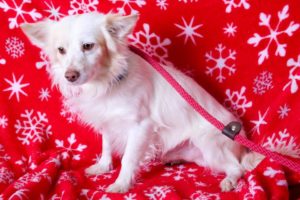
Conrado is a cute 5-year-old Pomeranian mixed with Chihuahua or maybe Papillon — who knows! He was brought to Tahoe by a rescue group along with several other nice dogs to find their forever homes.

Conrado is sweet and gentle, loves to wag his tail, and likes other dogs. He has beautiful long white and tan hair, and has a great personality.

Conrado is neutered, microchipped, tested for heartworm, and vaccinated. He is at the El Dorado County Animal Services shelter in Meyers, along with many other dogs and cats who are waiting for their new homes. Go to the Tahoe animal shelter’s Facebook page to see photos and descriptions of all pets at the shelter.

Call 530.573.7925 for directions, hours, and other information on adopting a pet.

For spay-neuter assistance for South Tahoe residents, go online.

— Karen Kuentz