Tahoe Tails — Adoptable Pets in South Lake Tahoe

Marshall is a 6 year old Chihuahua mix who is very friendly and wags his tail constantly. He is house trained and likes other dogs. Marshall is very smart. Even though he’s a little guy, he can climb fences so he must be kept on a leash while outside.

Marshall is neutered, microchipped, tested for heart worm, and vaccinated. He is at the El Dorado County Animal Services shelter in Meyers, along with many other dogs and cats who are waiting for their new homes. Go to the Tahoe animal shelter’s Facebook page to see photos and descriptions of all pets at the shelter.

Call 530.573.7925 for directions, hours, and other information on adopting a pet.

For spay-neuter assistance for South Tahoe residents, go online.

— Karen Kuentz


Librarians take up arms against fake news

By Jerry Large, Seattle Times

Janelle Hagen is a school librarian whose job goes far beyond checking out books. She and many other librarians are equipping students to fight through lies, distortion and trickery to find their way to truth.

Helping students become smarter evaluators of the information that floods into their lives has become increasingly necessary in an era in which fake news is a constant.

Two University of Washington professors recently announced a new class that will focus on the ways data are misused to mislead the public. Younger students may need guidance even more.

Besides running the library, Hagen said, she teaches a class called “digital life.” She meets with fifth-graders twice a week and with eighth-graders once a week. The classes are a mix of technology and information-literacy skills, but since the presidential election, she’s increased the focus on the latter.

Read the whole story


Road Beat: Improved design on Sportage

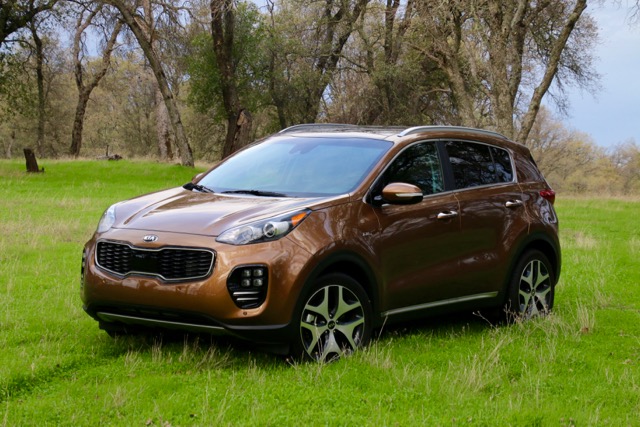
The latest Kia Sportage has substantive improvements. Photos/Larry Weitzman

By Larry Weitzman

Kia Sportage was launched in the United States in about 1994, a year after Kia arrived in the United States with the Sephia. Now in in its fourth generation, which came out about a year ago, the Sportage has grown by an inch and a half in wheelbase and length over generation three. While the new design, again by Kia President Peter Schreyer, it has a strikingly similar design with most changes in detailing. But the profile and window line are similar.

However, Schreyer’s design improvements make a big difference. It has lost some of its bulk, especially in the front end. The new Kia signature grille is smoother and more refined. It has been given a set of menacing four block driving lights a la the K900, Kia’s super luxury car. New taillights give the new Sportage a cohesive, slick modern look. Everything ties together beautifully. I am not a fan of the truncated window line and its “Hofmeister kink” terminating the rear window line. It gives the Sportage a bit of a stubby ending. Wilhelm Hofmeister was the legendary BMW designer who first used the “reverse” window line design in the 1961 BMW 1500.

Now with a length of just 176.4 inches on a wheelbase of 105 inches, Sportage offers an unusually large cabin because of its wide 73 beam. And no, this is no boat, unless you are thinking small deep “V” off shore racer, like a Reggie Fountain or Formula. It stands a reasonable 65 inches tall. Total interior volume is pushing 130 cubic feet and there is a solid m60 cubes behind the front chairs and half again as much behind the second row. This “small” CUV can definitely hail the mail in more wats than one.

Under the bonnet is one of two engines, the ubiquitous 2.4L DOHC, 16 valve inline wazoo four found in so many Kias and Hyundais today as well as some other manufacturers as this engine was designed by a consortium and it has been refined over the years to be a world class, direct injected engine which in the Sportage cranks out 181 hp at 6,000 rpm and 175 pounds of twist at 4,000 rpm. But forget about that engine and focus on the rocket motor, or should I say a square 2.0L DOHC 16 valve turbo blown inline four that pits out a conservative 240 hp at 6,000 rpm and 260 pound of twist between 1,450 to 3,500 rpm. That is a serious torque curve which translates into massive down low power.

Specifications
Price $34,895
Engine Turbo-direct injected DOHC, 16 valve, 2.0L inline four 240 hp @ 6,000 rpm
260 lb-ft of torque @ 1,450-3,500 rpm
Transmission
Six-speed torque converter automatic with lock-up
Configuration
Transverse front engine/FWD/AWD
Dimensions
Wheelbase 105.1 inches
Length 176.4 inches
Width 73.0 inches
Height 64.8 inches
Track (f/r) 63.3/63.8 inches
Ground clearance 6.4 inches
Fuel capacity 16.4 gallons
Weight 3,765-3,997
Steering lock to lock 2.71 turns
Turning circle 34.9 feet
Wheels 19X7.5 inch alloys
Tires 245/45X19
Cargo capacity (rear seats/up/down) 30.7/60.1 cubic feet
Tow capacity 2,000 pounds (with trailer brakes)
Co-efficient of drag 0.33
Performance
0-60 mph 6.73 seconds
50-70 mph 3.53 seconds
50-70 uphill 5.15 seconds
Top speed Plenty fast (well into triple digits)
Fuel economy EPA rated 20/23/21 mpg city/highway/combined. Expect 24-25 mpg in rural country, suburban driving. 29s mpg on the highway at legal speeds.

How serious? How about 0-60 mph in a very quick 6.73 seconds or a level 50-70 mph pass in 3.53 seconds and going up a steep (6-7 percent) grade only slows that time 1.6 seconds or 5.15 seconds for the run. Not only does this Sportage fly, but throttle response is almost too strong as when it comes on boost it creates some significant “G” forces. Sportage rocks, especially considering is almost 4,000 pounds at the curb. Tow capacity is limited to 2,000 pounds meaning perhaps a small bass or aluminum boat with as much as a 100 hp outboard or a couple of jet skis.

Power is sent to all four wheels via a six-speed auto torque converter tranny and a single speed transfer case. Very smooth and there is little if any gear hunting. In fact, in Eco mode shifting becomes aggressive meaning even with throttle pressure in sixth gear at speeds below 40 mph, the tranny will not downshift. That improves fuel economy.

EPA rates the Sportage Turbo at a not so good 20/23/21 mpg city/highway/combined. But as with most Kia Hyundai products, those numbers are extremely conservative. At 70 mph in cruise control on a level highway during a two-way run the Sportage averaged 29.5 mpg and on a round trip run from Placerville to Carson City the Sportage averaged 28 mpg. Overall it returned about 24-25 mpg, far better than the dismal mileage projected by the EPA. With this power train in a Santa Fe Sport returned even a couple of mpg better, so the numbers I am reporting should be accurate.

Sportage has all the credentials of a sweet handling CUV. Significant suspension and steering improvements have been made. The structure is safer, stiffer and stronger. Steering is a quick electric power rack at 2.7 turns lock to lock, turning circle is under 35 feet, track is almost 64 inches, it has 19X7.5 inch alloys shod with lower profile, wide 245/45 series rubber and all four wheels are independently sprung on a state of the art system. The results are a quick and crisp turn in with only mild understeer, a flat attitude and excellent cornering power. In other words, the Sportage flat out handles like a sporting sedan. In traffic, handling couldn’t be easier, but while I found the steering perfectly weighted some might find it just slightly heavy.

Ride quality is quiet. This powertrain is perhaps the least intrusive of all four bangers. It rides beautifully when the going gets tough, with sublime compliance and well-tuned shocks. On smooth roads, because of the quiet, it seems extra smooth. NVH has become a term of the past. The engine spins about 2,150-2,200 rpm at 70 which may be the reason the Santa Fe Sport returns slightly better fuel economy as it is geared to spin 2,000 rpm at 70 mph. But if minimum overall length is important then go with the Sportage as it is inches shorter without sacrificing width.

Brakes are over a foot in diameter and are very strong with all the acronyms. It has a forward collision warning system and advanced emergency braking. Headlights are terrific and you gotta’ love those parking/driving lights. Although high beam automatic dimming has been around for about 60 years (I remember Cadillacs from the 1950s have a spacey looking device on the left side of the upper dash that was an auto dimmer), but the one on the Kia is better than a human it works so well. Also, loved the adaptive front lighting (developed by Tucker in 1947) that bends the light in the direct of your turn (Kia calls it Dynamic Bending Light). Of course, standard are blind spot detection, lane change assist, lane departure warning, and rear cross traffic alert. Safety definitely does not take a back seat here.

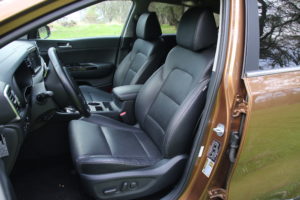
When you open the door, it is amazing just how luxurious the new Sportage is. High quality, soft touch materials are everywhere and the seats in my top of the line tester are well designed in soft leather. A great place to spend several hours. About the only negative is that the head restraints at their lowest position intrudes into the area where my upper back resides. You might have to adjust them up by about an inch. Rear seating is spacious for three and the rear cargo area is huge for a vehicle this size.

Instrumentation is complete (speedo, tach flanking the trip/info computer) in a well-designed IP. The center stack (radio/HVAC) is complete and easy and intuitive to use, no problems there. 

Finally, what is it going to cost you? My loaded tester had a Monroney of $34,000, which is refreshing not to see something like $33,999. (It’s called a Monroney in honor of Oklahoma Sen. Mike Monroney who introduced the window sticker legislation back in about 1957. The FAA headquarters is also named after him.) The boat from South Korea is $895 bringing the total to $34,895. This vehicle had no options or add-ons. Everything but the kitchen sink and hot and cold running water is standard, including the famous 10 year/100,000-mile powertrain warranty. Even the entire vehicle is warranted for five years/60,000 miles. Nothing like standard piece of mind as well.

Larry Weitzman has been into cars since he was 5 years old. At 8 he could recite from memory the hp of every car made in the U.S. He has put in thousands of laps on racetracks all over the Western United States.


Valhalla putting on spring play

Valhalla is teaming up with the Lake Tahoe Golf Course for the spring production of “Women in Jeopardy.”

It is billed as a hilarious adult comedy written by Wendy MacLeod and directed by David Hamilton.

Divorcees Mary and Jo are suspicious of their friend Liz’s new dentist boyfriend. He’s not just weird; he may be a serial killer. His hygienist just disappeared. Attempting to get to the bottom of the mystery, imaginations run wild as the women try to discover the truth and save their friend.

Performances are March 24, 25, 30, 31 and April 1 at the golf course in Meyers. Tickets go on sale Feb. 15.


Backcountry film festival in Tahoe City

The Alpenglow Mountain Festival, a nine-day celebration of human-powered mountain sports, continues its three-part film offering on Feb. 21 with the ever-popular Winter Wildlands Alliance Backcountry Film Festival.

The event will take place at Granlibakken Resort in Tahoe City at 7pm. All ticket proceeds will be donated toTahoe Cross Country Ski Education Association Association’s Winter Discovery Center.

The festival provides a fresh line-up of cutting-edge films.

This year’s program includes:

·       Reflections

·       Lifecycle of a Powderwhore

·       AK Girls Way

·       SnowSchool

·       There on the Periphery

·       An Education

·       Season on the Brink

·       Pace

·       The Lost Sierra

·       China: A Skier’s Journy

·       Snow Artist.

Doors open 6pm and the festival of films begin at 7pm. Admission is $10 in advance online or $12 that night.


‘Carry On’ — a story of friendship, hardship

By Kathryn Reed

High school is hard enough for the average teen. Throw in poverty, neglect and physical disabilities and the outcome is likely to be less than positive.

Ultimately that wasn’t the case for two boys living and going to school in inner Cleveland. If it weren’t for Lisa Fenn, a producer for ESPN, Leroy and Dartanyon’s lives would likely have been remarkably different, and not in a good way.

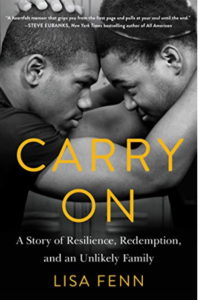
“Carry On” is Fenn’s memoir of the time she spent with these two boys who eventually came to be like family.

It’s one of those feel good and gritty books all wrapped in one. At times I wanted to shake each boy to knock some sense into them. Fenn wanted to, too. She learned that their upbringing didn’t prepare them for things she took for granted. And while she didn’t come from money, her background was white, middle class – a far cry from what these boys knew.

I also wanted to shake Fenn. She broke a cardinal rule of being a journalist. You don’t become the story. She got too involved, crossed the line too many times. In the book she admits it. Eventually she moved on from ESPN.

Beyond life’s struggles, what binds Dartanyon and Leroy is wrestling and the fact each has a disability. One is blind, the other has no legs. Their friendship helps the other to succeed.

While there are a lot of books in this genre – athlete with a disadvantaged background succeeds – this has a twist with the role of Fenn. It proves how one person can make a such a dramatic difference in a person’s (this case people’s) life.

My book club read this for January. We all liked it more than we didn’t, and would definitely recommend it more for the story than the writing.

HarperCollins published “Carry On” in 2016.


NYT editor talks about importance of real news

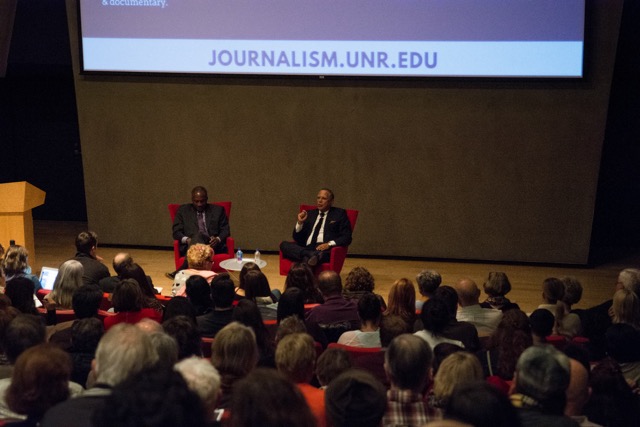
New York Times Executive Editor Dean Baque and Caesar Andrews with UNR’s journalism department on Feb. 8 in Reno. Photo/David Calvert

By Linda Fine Conaboy

RENO – To some, the latest chapters in U.S. political history read like a catchy novel; to others, current changes are merely pulp fiction.

These are attention-grabbing times no matter how one views the unfolding daily drama floating over the political landscape.

In a conversation on Feb. 8 sponsored by the University of Nevada Don Reynolds School of Journalism at UNR and later that evening at the Nevada Museum of Art, New York Times executive editor, Dean Baquet (pronounced like valet), the current and the first black editor of the New York Times and previously, the Los Angeles Times, discussed the need to keep his paper nimble, open-minded and forward thinking.

His UNR audience consisted mainly of students, who were all exceedingly interested in the election of the new U.S. president and who peppered Baquet with hard-hitting questions about current issues such as fake news, accountability, integrity and presidential tweets.

Regarding his integrity as executive editor of a major newspaper, Baquet said he always tries to make sure associates don’t know where he stands on issues. “It drives some people crazy. Almost all of my friends are journalists, and I don’t know their political views either. I at least vote, but some other editors don’t,” he said, explaining their need for total transparency.

He said he avoids relationships with public officials and he didn’t meet President Barack Obama until near the end of his presidency.

He cautioned that in the newspaper business it’s imperative to hold people accountable, but to also remain objective. “Don’t take for granted what politicians say, be skeptical.”

He said President Trump has told many falsehoods, the first coming to his mind is the Obama birther issue. “It’s an effective cover to say things that are blatantly false.”

Baquet added that the new president’s tweets are particularly revealing. “He is the president of the United States. When he tweets, it’s an unfiltered view of the most powerful person in the U.S. It’s the closest view inside the mind of the president that we’ll ever get.”

Warming to his subject, he declared, “We must cover Trump. The things he does have huge consequences; what he does affects the lives of hundreds of thousands of people. Trump eats away at the trust in the media.”

Fake news is really nothing new, Baquet said, declaring there has always been fake news and pointing to the blatant and salacious headlines the National Enquirer spouts regularly as a case in point. However, he said, some fake news is designed to lessen the trust the public has in journalism.

“Journalism is not flawless, but what the First Amendment is meant to protect is under attack,” Baquet said. “Now though, fake news is on steroids. It’s insidious and puts more pressure on us to be honest and honorable.”

Facebook and other sites, he said, need to work harder to police it.

Because the fake news issue is on the minds of many, Baquet said his reporters are becoming exceedingly motivated.

“There’s an extraordinary clarity about what needs to be done. I remind [reporters] what our jobs are and the fact that we’re the opposition party necessitates that we ask hard questions. It’s not the job of journalism to be liked,” Baquet said.

He added that when people call the NY Times on a mistake, he and his staff will always own up to those mistakes and attempt to make them right.

Unfortunately, according to Baquet, all media now is in financial turmoil, but the NY Times less than others. “Now, more than half of our revenue comes not from advertising, but from our readers, and readers make measurable demands.”

Baquet said after the presidential election, he received many angry emails blaming the Times because Trump won the election. However, shortly thereafter, his emails took a positive turn resulting in a sizable and unexpected increase in circulation.

“There used to be a powerful world of great newspapers. But now the whole system has broken down,” he said. Nevertheless, according to Baquet, liberal media elitism is curable starting with getting out into the world and listening to people’s views.

“Objectivity is real and it is important. People have a right to unbiased news,” Baquet said.

He said his outlook on journalism has changed over the years.

“I am very confident about the future of journalism. There’s been a tremendous increase in readership. I’m probably more a believer in asking hard questions of powerful people now,” Baquet said. “We’re in for years of rapid change, but there have been periods like this before. We need to train journalists as much as possible. Journalism schools have a larger role than they have ever had and now it’s important to cross-train them.”

He explained that to his way of thinking future journalists must be comfortable not only in the world of words, but also be within the realm of the visual aspects of journalism.

What makes a good reporter? A good reporter listens, is open minded, is a voracious reader, especially of good novels, and is open to learning new ways to tell a story. “Everything in journalism has happened before, except now, we know more about it and we know it instantly.”

As he prepared to wind down his conversation, Baquet returned to the newly elected president.

“The myth of the uneducated person who voted for Trump is just that—a myth. He won the Republican vote; he won the vote of those who make a lot of money; he won votes from people who think the system is screwed up,” Baquet said. “A Trump voter is probably more sophisticated than we think. The political elite don’t understand the upheaval, but Trump seized on it. There are people who voted for Trump who also voted for Obama.

“It is my job to understand all sides of the story and to do this every day. I feel like I’m in a novel; you get a glimpse of the world you’re never going to get anywhere else.”

Jack Johnson, Rebelution coming to Tahoe

Two shows have been added to the Harveys Outdoor Concert Series — Jack Johnson and Rebelution.

For the first time since 2014, Johnson is hitting the road. He will be in Tahoe on July 28. Tickets go on sale Feb. 17.

Fans who purchase a ticket will receive a download of Johnson’s new song, “Fragments,” which is also available for purchase or streaming on all music services on Feb. 17. The new material accompanies the film “The Smog Of The Sea,” a documentary that provides a new perspective on the once pristine oceans of the world, while making an artful call to action for rethinking single-use plastic. 

On the 2017 tour, additional greening actions include sourcing sustainable biodiesel for tour vehicles, producing up-cycled and eco-friendly merchandise, and expanding waste reduction, composting and recycling. The tour will also source local, organic food as part of a “farm to stage” program, offer bike valets and alternative transportation incentives, as well as offset all remaining CO2 emissions.

Tickets to the Stateline show are $70 plus fees.

Rebelution, a California Reggae band, will be in town June 30. Tickets for this general admission show are all $37.50, plus fees. Tickets go on sale Feb. 16


5 years cancer-free without Big Pharma

By Kathryn Reed

Five years is a milestone most cancer patients celebrate. It doesn’t mean the disease won’t come back, but it is a positive indicator.

Chemo, radiation, surgery or some combination is usually the medical cure. Not so for Steve Kubby. He attributes reaching the five-year mark to cannabis cryogenic extract.

This month the 70-year-old South Lake Tahoe resident celebrates being cancer free for five years.

At 21 he was first diagnosed with cancer. At 28 he was told he had terminal malignant pheochromocytoma. According to the Mayo Clinic, pheochromocytoma  “is a rare, usually noncancerous tumor that develops in cells in the center of an adrenal gland.”

The rare disease is often fatal. He was give six months to two years to live, and told to get his affairs in order.

Steve Kubby and Nobia Monsaurt with the marijuana plants they use for medicine. Photo/Lisa Gresham-Gordon

“I went to the Mayo Clinic. They threw everything they had at it. Nothing worked,” Kubby told Lake Tahoe News. He defied doctors’ predictions, but the cancer was always there.

It was five years ago that he started using the cannabinoid.

Raphael Mechoulam, who discovered tetrahydrocannabinol is the most active ingredient in cannabis, had figured out cannabinoids are lost whenever cannabis is dried. That is what led Kubby to the cryogenic or freezing process. Kubby developed the process by using a plant from South America he had been breeding.

It’s non-psycho active, which means using it won’t make the person high. Kubby ingests the medicine, as opposed to smoking it.

“It can trigger adult stem cells. No one is using this method that we know of,” Nobia Monsaurt said. Monsausrt is an integral part of Kubby’s continued research into medical marijuana. They plan to be married this April.

They have a research team helping them refine the product, which one day the couple would like to bring to market.

Kubby had gone off the drug for a while, believing he was cured of cancer and not in need of it anymore.

In April 2016, he suffered a minor stroke. Kubby returned to using his special medicinal marijuana formula. He said it alleviated the lingering stroke issues, brought down his blood pressure and even decreased his prostate numbers.

The plan going forward — stay on the medicine indefinitely and continue to study the benefits with the hope one day the strain is available commercially.


2 dates for ‘Vagina Monologues’ in South Tahoe

The “Vagina Monologues” returns to South Lake Tahoe for the 15th anniversary on Feb. 24 and Feb. 25 at 8pm.

The award-winning play is based on V-Day founder/playwright Eve Ensler’s interviews with more than 200 women. V-Day is a global activist movement to end violence against women and girls, by raising funds and awareness. Productions like this and other V-Day benefit events organized by volunteer activists take place around the world, educating millions of people about the reality of violence against women and girls.

The cast is made up of community members, students, mothers, daughters, sisters, new-to-the-stage and seasoned performers. 

Proceeds will benefit Partners Against the Trafficking of Humans, Tahoe Youth & Family Services, and Live Violence Free.

Go online for tickets.