Tahoe Tails — Adoptable Pets in South Lake Tahoe

Marley

Marley is a pretty 7-year-old tortoiseshell cat who has been at the shelter since December. We are concerned that she is being overlooked because she needs a home without other pets or children. But hopefully that special person who wants just one kitty will consider Marley and come meet her.

Marley is spayed, microchipped, tested for FIV, and vaccinated. She is at the El Dorado County Animal Services shelter in Meyers, along with many other dogs and cats who are waiting for their new homes.

Go to the Tahoe animal shelter’s Facebook page to see photos and descriptions of all pets at the shelter.

Call 530.573.7925 for directions, hours, and other information on adopting a pet.

For spay-neuter assistance for South Tahoe residents, go online.

— Karen Kuentz


NDOT’s 100-year evolution connects the state

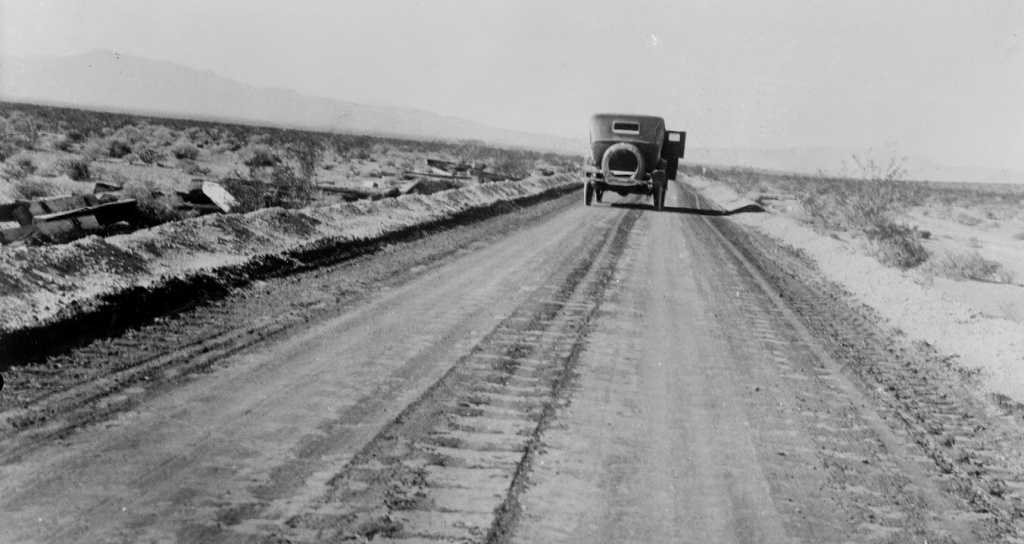
A completed sand and oil surface except for the final dragging, circa 1919. Photo/NDOT

By Susan Wood

The Nevada Department of Transportation turned 100 last month, and amid challenges and opportunities construction engineer Steve Lani has spent about a quarter of that time paving the way for a more improved Silver State.

It’s not a bad day’s work for a 47-year-old civil engineer who essentially matured with the agency while relishing the responsibility of building things. Lani jokes he still plays with Legos, a building-block toy set carried over from his childhood.

“I don’t think I necessarily thought of myself ending up with NDOT, but once I landed here, there was no question I belonged here,” Lani told Lake Tahoe News.
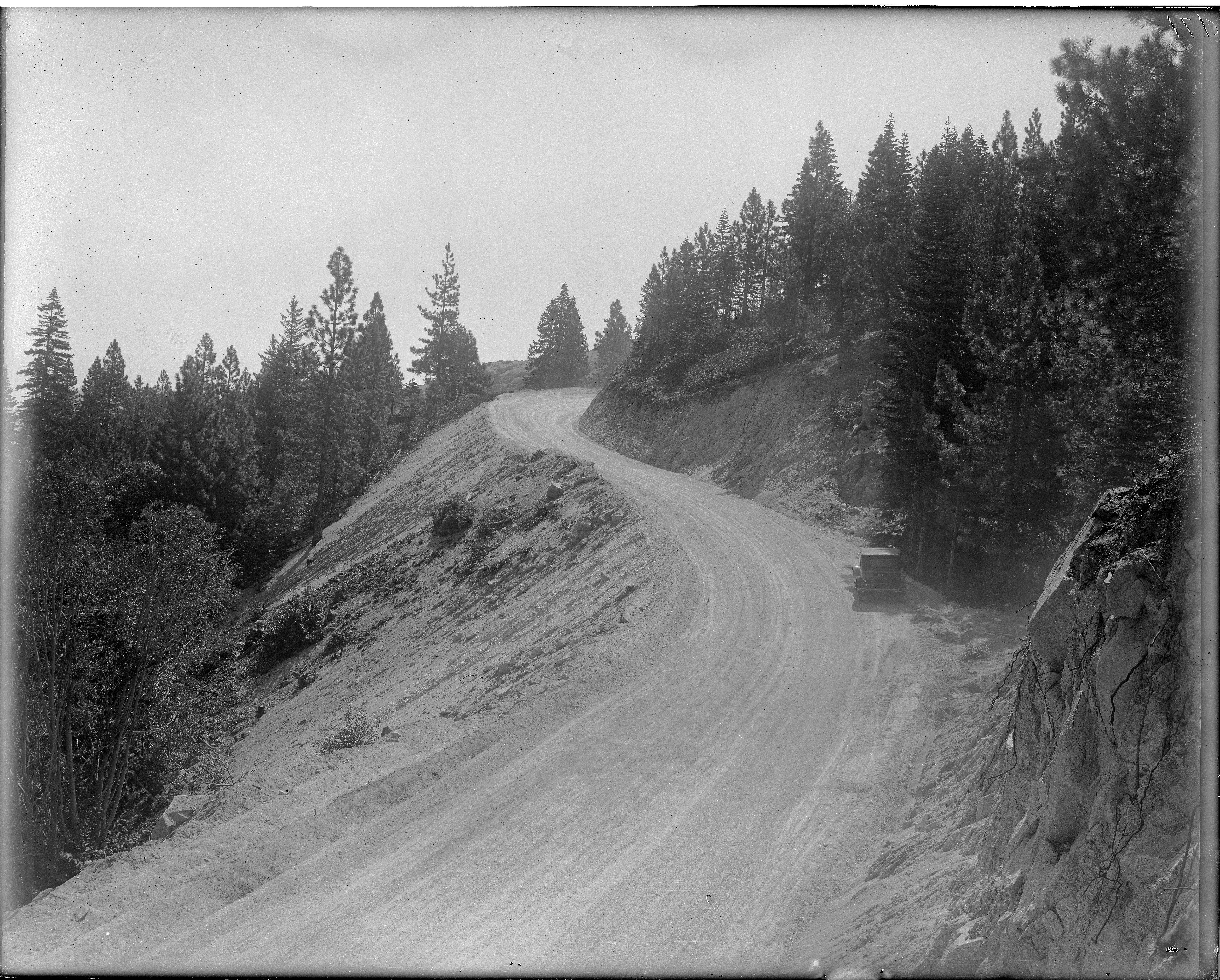
Paving trails through the mountains took special engineering, circa 1920. Photo/NDOT

The builder who since 1998 has been in the construction division is a quasi-chip off the old block. His father was a maintenance highway supervisor for 30 years in Austin where Lani grew up. He moved to Carson City in 1994.

His most memorable moment on the job revolved around his discovery that the concrete structure making the Highway 50 interchange at Tahoe Country Club Drive on the Spooner climb just “didn’t fit” halfway into the job. The crew had to conduct a logistical, mathematical scramble to adjust the dimensions and work backward. If this sounds easy, it’s not. A state highway department must always meet design criteria.

How has the world of transportation changed in an expansive state known as much for its “don’t-fence-me-in” attitude where horses roam as modernized infrastructure improvements?

“When we started we were known as the highway department. Now we’re multi-modal, evolving to being a full-blown transportation department,” Lani said. This means caring as much for water quality, storm water and bike paths as overlaying or snowplowing a highway.
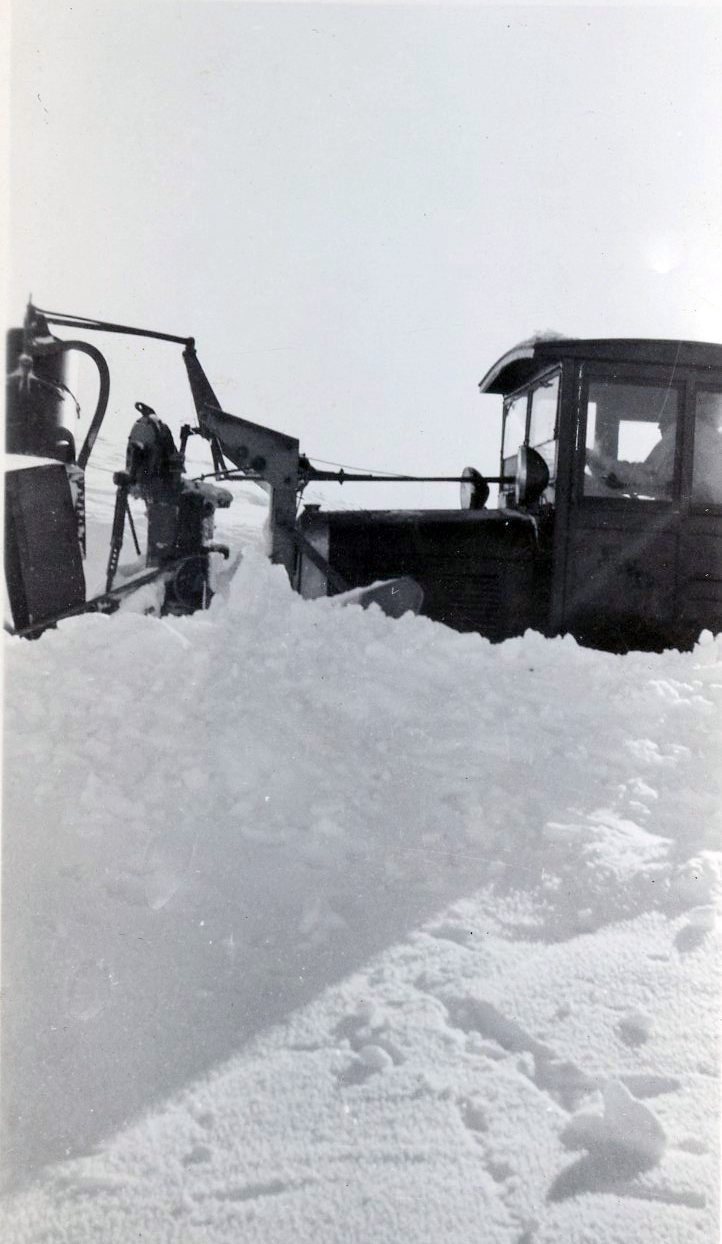
Early snow plow equipment. Photo/NDOT

Evolution of the department

One of Lani’s personal favorites is putting up horse crossing signs so motorists know to be aware of four-legged pedestrians.

He also shared a fondness for the aesthetic improvements that enhance the grey, black and brown world the department is exposed to every day. Even concrete comes in varying colors now – which Lani calls “eye candy.” 

Another aspect to the department that has evolved involves the critical need to have partnerships.

“We’ve made it a point to juggle the public and TRPA,” he said of the Tahoe Regional Planning Agency, Lake Tahoe’s bi-state regulatory organization that dictates most of what happens in the basin.

“Lake Tahoe is kind of unique with all the stakeholders, and we’re proud of these relationships,” he said. 

For example, it is no longer considered the norm for NDOT to tear up the road or put in an improvement without considering what other agencies and government agencies and even businesses and event planners might have to say about the matter.

Case in point, NDOT makes an effort to not conduct work on the roads during the heavily populated week in which the American Century Championship golf tourney occurs since it’s an already busy summer month for Tahoe.
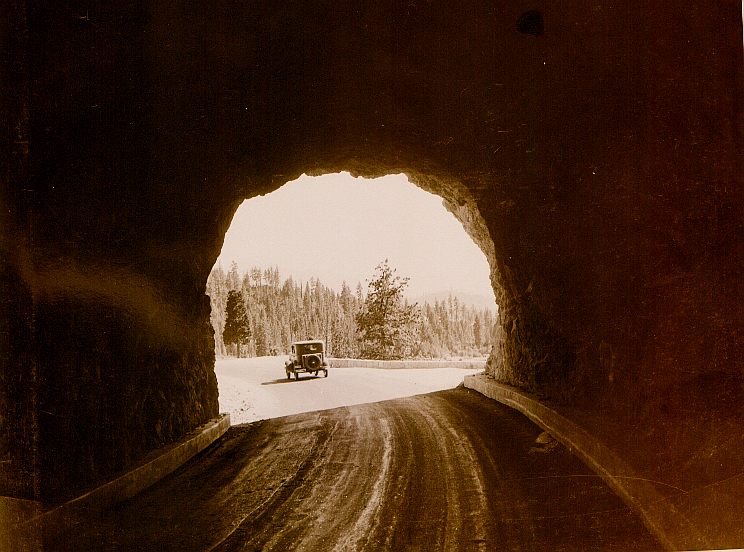
Cave Rock tunnel, circa 1930s. Photo/NDOT

Working as a team

Through the years, Lani has noticed the public being more receptive to times when the agency is forced to close the road or level restrictions on travel.

 “You can never make everybody happy,” the engineer said. “But we’re doing more public outreach.”

It’s as though people just want to know ahead of time what to expect. They also realize there’s a tradeoff in having their state look better and run better.

And when the department’s employees are on – they’re on. Take this winter. Many endured inconveniences – including staffers.

Even as adrenaline junkies, Lani pointed out how a hopping snowplowing crew wondered: “Do we ever get a break?”

NDOT counted 18 emergency projects it put into place over this unprecedented, drought-breaking winter.

“With all that Mother Nature has to dish out, our guys do an amazing job,” Lani said. At last count, the department numbered 1,788 employees divided between administration, pre-construction, construction and maintenance. The latter represented the majority of staff.
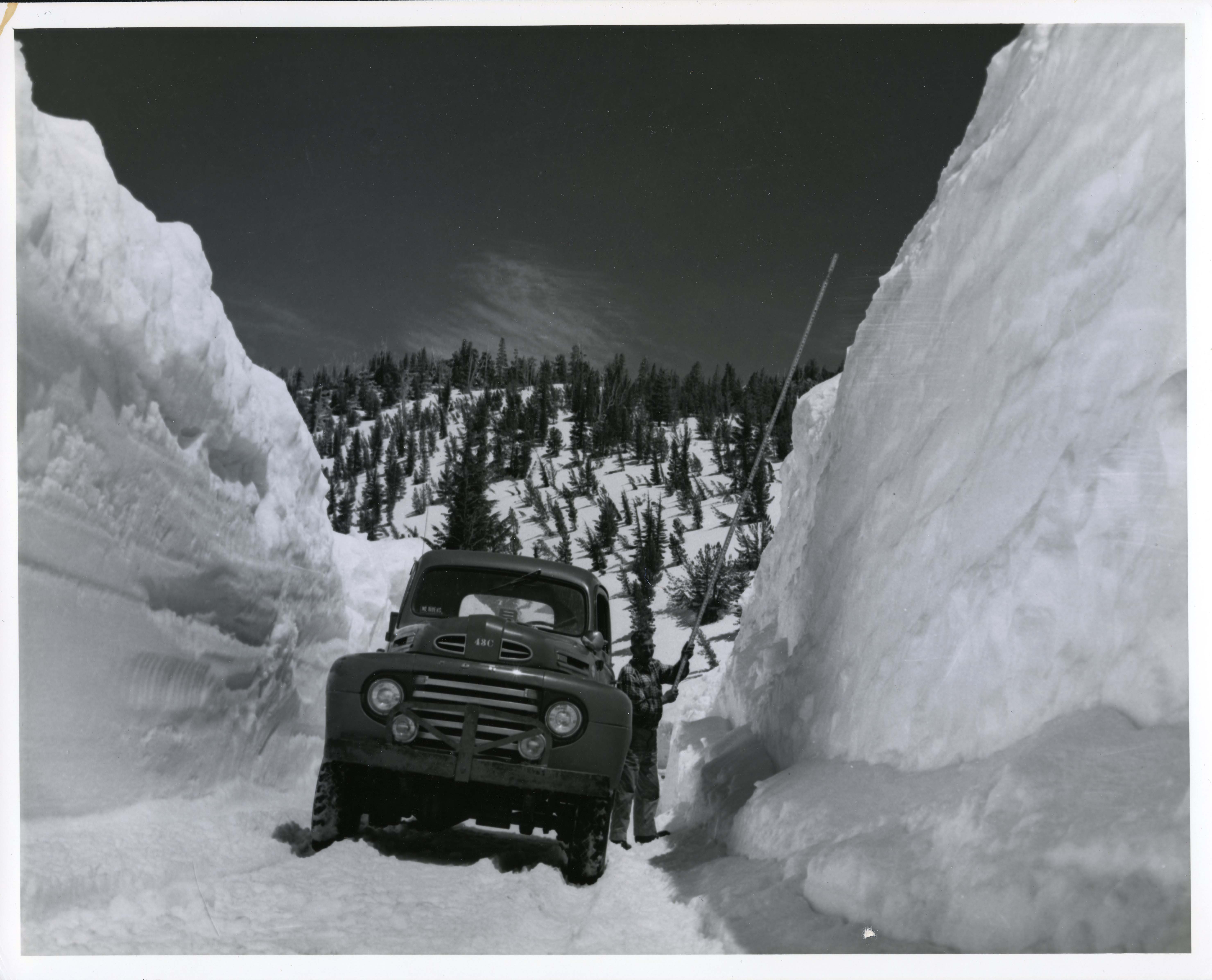
NDOT employee measuring the snow, circa 1940s. Photo/NDOT

And such being the nature of construction, everything costs more than expected, requiring in some cases for allocations divvying up over time.

Revenue is largely generated through fuel tax, while construction spending at NDOT exceeds about $800 million. The widening alone of Highway 50 east between Dayton and Stagecoach needed a cool $22 million.

“It used to be a two-lane road,” he said. That’s progress for you.

Lanes are always on the wish list of motorists, and NDOT knows it.

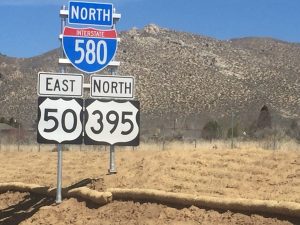
That’s why Carson City travelers are eagerly anticipating the completion of the project Lani is proudest of – the Carson City I-580 bypass. But don’t call it a bypass in front of Lani. He wants the businesses along Highway 395 in town to know the state supports commerce in town.

Nonetheless, the connection linking the Spooner grade to the freeway at Fairview Drive will reduce a lot of time for motorists traveling from the lake to Reno.
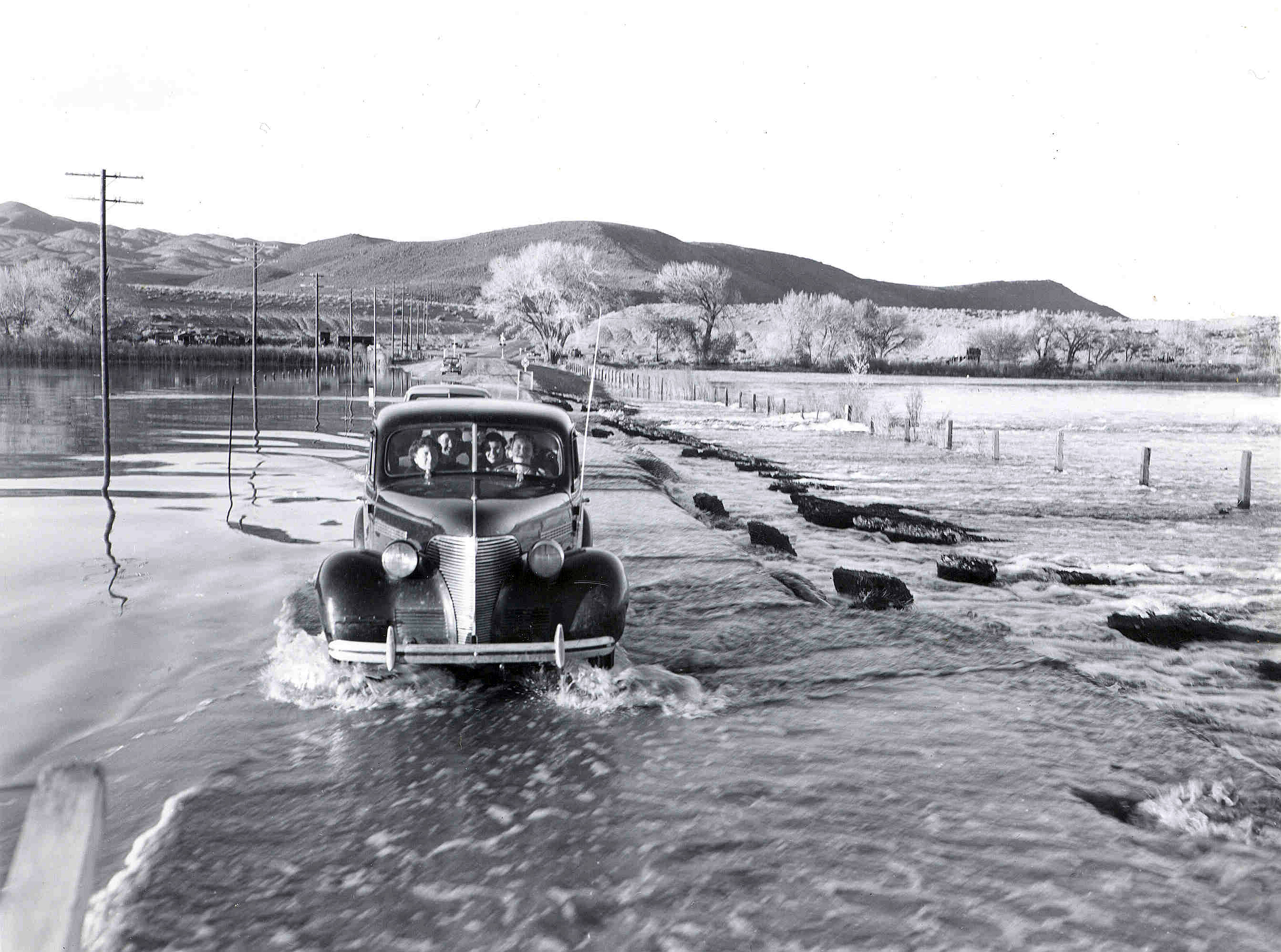
The flood of 1950 in Reno. Photo/NDOT

The project is due for completion in six months – not a minute too soon for Lani. He toured the site about a week ago to check on the progress. One layer of asphalt has been laid in most places. Iron accents ranging from covered wagons to a fish run were placed on bridges marking the crossings of Koontz, Snyder, Clearview and Fairview drives. Artist designs blanket concrete barriers. Detention ponds were dug out.

“I can remember when we dug these bridges out,” Lani said in a trip down memory lane.  

“I’m pleased to see it. Unfortunately, it took a while to get here,” he said. The project underwent at least seven contracts to accommodate the funding stream.

Lani and public information officer Meg Ragonese expressed awe over the progress at the 2-mile-long jobsite – occasionally pointing out the window and jumping from the truck to get up close and personal with heavy equipment. And for Lani, the tour represented a nostalgic trip.

He recalled another memorable moment occurring on this very jobsite. Work crews witnessed a hang glider landing on the site with no incident.

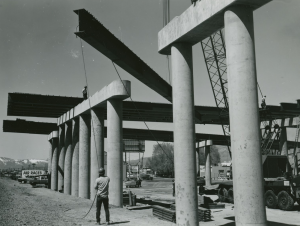
Building Interstate 80 near Reno in May 1972. Photo/NDOT

Changing times

You may even see boulders the size of trucks plunge onto the road. Such is the case east of Cave Rock on Highway 50 next to Lake Tahoe, which endured a winter for the ages this year.

“We’re always aware of rock fall hazards. We’re working our way around the basin,” Lani said. Crews have come to know the slope just west of Spooner Summit, among other frustrating sites.

What’s the biggest upcoming challenge?

 “Given the age of our infrastructure, it’s being able to take the revenue we’ve got and keep the system in place that we have,” he said.

What’s the future of the state transportation department?

Like many aspects of professional and personal life – in a word, technology.

Gone are the days of the pencil and gridded notepad. And even the substances used on the ground require technology to result in a perfect blend of materials to make the ideal, durable overlay.

“Old-timers would probably argue that the old asphalt is better, but we’ve adapted,” Lani said. What was once a simple sand, rock, water mix has transformed into a “chemical soup.”
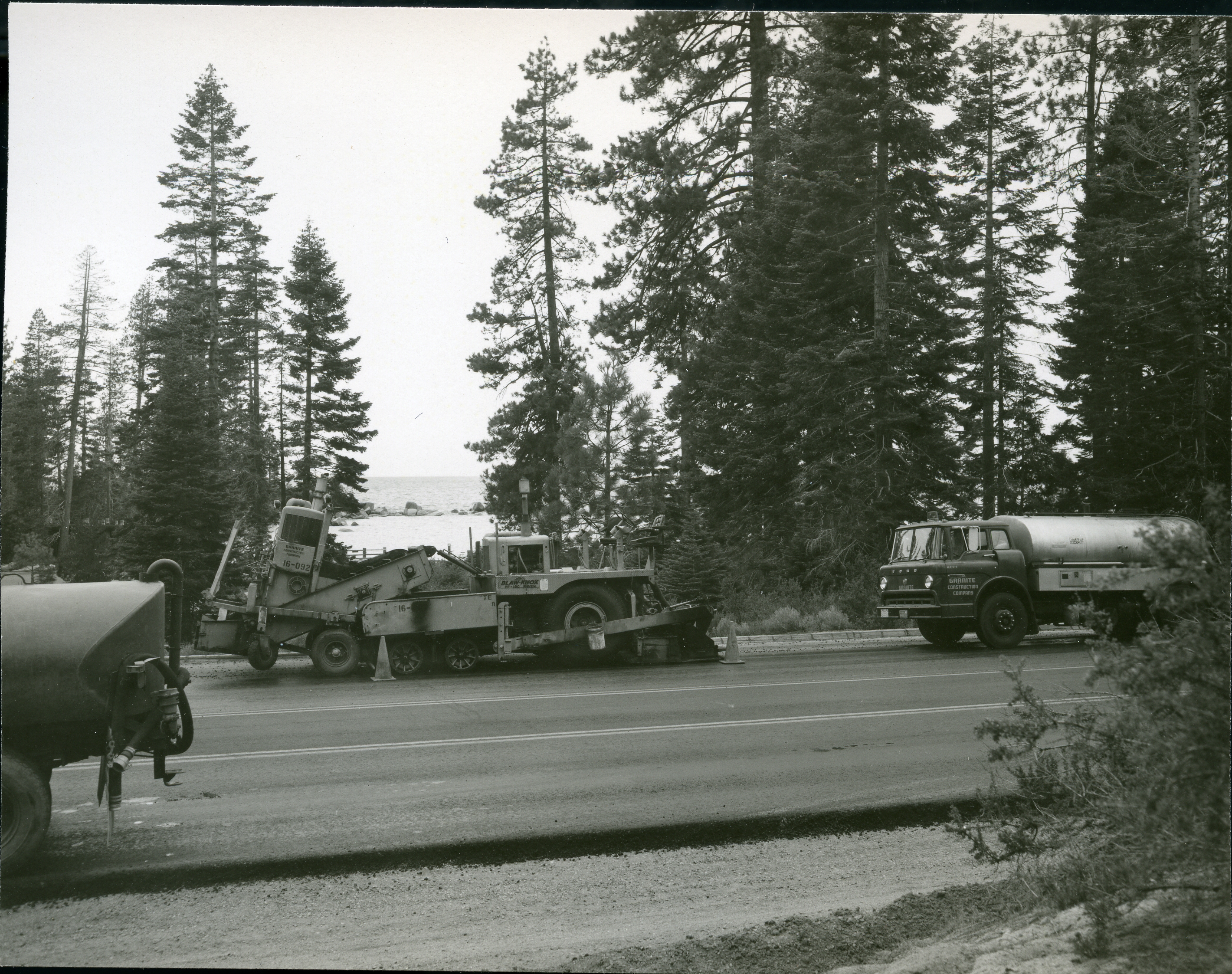
Paving of Highway 28 in August 1985. Photo/NDOT

In the construction office, doing away with manual practices has cut the manpower in half, thus allowing crews to work on other things.  

“Our long-term objective is to be paperless and stay ahead of the power curve,” Lani said.

Of course, to know where you’re going is to embrace where you’ve been.

Pride rises to all levels

“As governor of the great state of Nevada, I am proud to congratulate the Department of Transportation on its 100th anniversary. Since its inception, NDOT has provided invaluable service to our citizens and visitors – maintaining more than 5,400 miles of highway and more than 1,000 bridges, providing rides in hour rural areas and supporting regional aviation and railroad services all across the Silver State,” Gov. Brian Sandoval told Lake Tahoe News.

The governor tipped his hat to NDOT staffers’ commitment to making travel in Nevada safe. 

Sandoval also took note of the agency’s many historic transportation projects, singling out the section of Interstate 80 at Lovelock as contributing to a highway that eliminated “the last traffic signal on Interstate 80 coast to coast.”

To commemorate its century-old anniversary, NDOT is posting historical photos on its website and social media along with an invitation for residents to share their transportation memories.

“We’ve been helping keep Nevada safe and connected for 100 years,” NDOT communications director Sean Sever said. “Nevada has a rich transportation history, from the dirt paths of a century ago to today’s interstates carrying as many as 300,000 vehicles every day.”

A timeline of major milestones will also be on display to reflect on a highways department formed on March 23, 1917. The nostalgic project comes a few years after the state itself experienced a 150-year birthday.

Interstate 580 in Carson City will be open later in 2017. Photo Copyright 2017 Carolyn E. Wright

——

An overview of NDOT history:

  • The Nevada Department of Highways was formed on March 23, 1917, with a mission to surface what were often rutted dirt paths first forged by pioneers. Highway construction of the time was an arduous undertaking through Nevada’s desert expanses, with teams of horses grading the roads.
  • In January 1919, the department’s first construction project built a trestle bridge over the Humboldt River in Pershing County at a cost of $10,953. In the same year, a $72,000 project kicked off to build a concrete roadway from Reno to almost six miles south.
  • Photo/Susan Wood

    In the mid-1920s, the state’s 45 mph speed limit was removed and replaced with a guideline to limit speeds to that of “sane and safe driving.”

  • In 1923, another vital source of transportation funding was forged as the state gasoline tax came into being as an important resource for developing the state’s transportation system.
  • In 1929, the last Nevada link of Highway 91 near Apex was oiled, providing a smooth highway from California across Nevada between the California and Arizona state borders. In later years, it would pave the way for Nevada’s busiest interstate, I-15, which now travels alongside the iconic Las Vegas Strip.
  • Photo/Susan Wood

    In 1931, a 124-foot-long tunnel was blasted through Lake Tahoe’s Cave Rock to create a roadway, bypassing a previously harrowing drive alongside the lakeside rock face.

  • A traffic safety program was launched in 1936. Within two short years, the department’s driving safety literature and programs became so popular that 12 safety committees were formed across the state to spread the word.
  • As World War II erupted, many highway employees left to fight the war. The department’s 1940-42 Biennial Report was dedicated “to those very fine young men who have left the department to go into the service of our country, and with the sincere hope that they will all return to resume their duties with the department as soon as the world is safe for decent-living people.”
  • Photo/NDOT

    In 1956, President Dwight Eisenhower signed the Federal Highway Act to build 41,000 miles of interstate highway across the nation. Nevada then had a pivotal role in completion of the interstate system when a new section of interstate in Lovelock was completed, eliminating the last traffic signal on Interstate 80 between the Pacific and Atlantic coasts.

  • While there had been no speed limit for decades, a speed limit law established lower speed zones on certain sections of highways in 1955.
  • In the 1960s, a hard hat and safety vest program was implemented; requiring NDOT employees to wear safety vests while working on the roadway.
  • Photo/NDOT

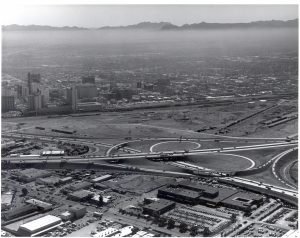
    The original Las Vegas Spaghetti Bowl was completed in 1968. The interchange connected Interstate 15 to the new, crosstown Las Vegas Expressway.

  • On Sept. 25, 1975, the I-80 Carlin Tunnels west of Elko were opened to traffic. The tunnels provide smoother, safer interstate travel by bypassing a sharply curvy stretch of Highway 40 alongside the Humboldt River.
  • As the 1970s ended, the Department of Highways changed its name to the Nevada Department of Transportation, seeking balanced transportation policy and planning and incorporating state social, environmental and economic goals.
  • In 1985, NDOT led the transportation industry by installing a Road Weather Information System along Mt. Rose Highway south of Reno. System sensors transmit road condition information and temperatures, allowing NDOT to better control when, where and how much sand and salt is used on winter roads.
  • Photo/Susan Wood

    Highway 50 was officially named the Loneliest Road in America by Life magazine in 1986.

  • In the 1990s, NDOT embarked on a list of “super highway” construction plans totaling $1.5 billion in response to a statewide population explosion. The super highway strategy included widening Interstate 15 between Las Vegas and the California state line, widening Highway 95 in the northwest Las Vegas Valley, extending Interstate 580 between Reno and Carson City, improving Highway 93 through Boulder City and starting construction on the Las Vegas Beltway.
  • In 1991, the Nevada Legislature established a bicycle and pedestrian planning position within NDOT responsible for integrating the needs of bicyclists into NDOT road projects and programs.
  • In January 1997, downtown Reno/Sparks streets flooded and bridges across the Truckee River were closed as water surged across roadways. Westbound lanes of Interstate 80 near the Helms Pit in Sparks crumbled. Large rocks and 125,000 cubic yards of material were dumped into the south end of the pit and the roadway was stabilized in six days.
  • In 1998, the department implemented the Freeway Service Patrol, a fleet of vans that cruise the freeways to help keep traffic safely flowing.
  • Photo/NDOT

    A makeover of the Interstate 515 and 215 Beltway interchange, known as the Henderson Spaghetti Bowl, broke ground in September 2003.

  • The first segment of the Carson City Freeway, consisting of a 3.5-mile-long freeway from Highway 50 to Highway 395 north of Carson City, was completed in 2006.
  • The department began using technology to better manage congestion by building the Freeway and Arterial System of Transportation in 2005. The $15 million complex in southwest Clark County was launched to manage and monitor traffic in the state’s three largest cities – Las Vegas, Henderson and North Las Vegas – through 600 cameras and a network of pavement, Bluetooth and microwave sensors.
  • Statewide traffic fatalities reached an all-time high in 2006 with more than 430 lives lost on Nevada roads. Collaboratively with traffic and safety stakeholders across the state, the department launched the Strategic Highway Safety Plan in 2006. To this day, the plan identifies targeted strategies to save lives on Nevada roads through its Zero Fatalities program.
  • Photo/Susan Wood

    The Hoover Dam bypass bridge opened on Oct. 19, 2010. The four-lane bridge, soaring nearly 90 stories above the Colorado River, eliminated the narrow switchbacks and low travel speeds that had long plagued Highway 93 crossing the dam.

  • In 2012, an 8.5-mile extension of Interstate 580 between Reno and Carson City was constructed including a 1,722-foot-long, 295-foot-tall cathedral-arch bridge traversing Galena Creek.
  • In 2015, NDOT broke ground on the first phase of the long-awaited Interstate 11 in Boulder City. Interstate 11 will improve motorist safety and convenience while reducing travel time by 30 minutes with a direct link bypassing Boulder City. The project marks the first new infrastructure to the Interstate Highway System since it was deemed complete in 1992. Construction is scheduled for completion in late 2017.
  • In 2016, the state embarked upon an even bigger undertaking with “Project Neon” – the largest and most expensive public works project ever undertaken during Nevada’s 152-year history. The nearly $1 billion project will widen 3.7 miles of Interstate 15 between Sahara Avenue and the Spaghetti Bowl interchange in downtown Las Vegas.
  • Today, the department builds, maintains and operates 13,000-plus lane miles of state thoroughfares — roads that have been ranked among the nation’s smoothest. More than 1.5 million bus rides are provided every year on federal transit money NDOT administers to rural Nevada transit providers. Meanwhile, by rail and air, NDOT supports regional and rural aviation and railroad services to safely heighten Nevada’s transportation and tourist options.

Source: NDOT



Road Beat: 2017 Acura MDX, another spectacular product

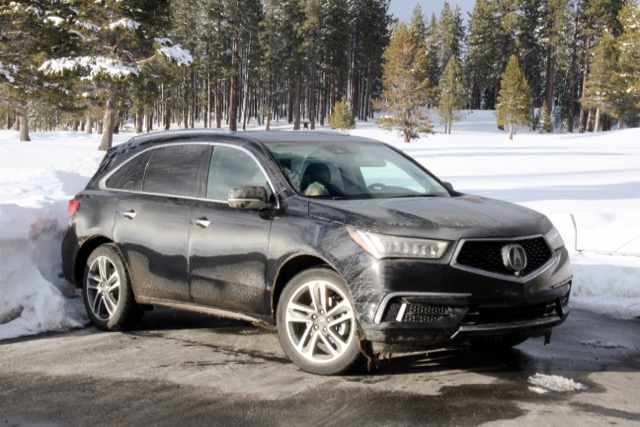
The Acura MDX handles extremely well in snow and ice. Photos/Larry Weitzman

By Larry Weitzman

Honda and its luxury brand Acura are on a roll. My last three Honda/Acura Road Beats have all reported great new products out of the company that started with Soichiro Honda and his marvelous 50 cc Honda Cub that is still in production nearly 60 years after its introduction. With production exceeding 87 million units, it’s making the little Honda, by far, the most produced motor vehicle in history. That’s some ongoing heritage.          

MDX introduced the third generation in 2014, with each successive generation growing by a couple of inches in length and wheelbase, with this third iteration now firmly into a large midsize with a 111-inch wheelbase and a length of 196 inches. Width is a trimer 77 inches (where most large SUVs are 79-80 inches). A benefit of its width is a super wide track of 66-inches front and rear.

Acura has done a rhinoplasty to the MDX nose and in its face lift for 2017 removed the “eagle beak” grille replaced by a mesh insert in its five-sided signature theme. The result is a cleaner appearance. When combined with the new window line and shape it gives the MDX a handsome shape. Maybe my only gripe is the oversized front emblem. It’s big.

Specifications
Price S44,050 (MDX FWD) to $58,500 plus $975 for the boat
Engine
3.5L SOHC, 24 valve, direct injected V-6 290 hp@ 6,200 rpm
267 lb.-ft. of torque @ 4,700 rpm
Transmission
Nine-Speed torque converter automatic
Configuration
Transverse mounted front engine/FWD/AWD
Dimensions
Wheelbase 111.0 inches
Length 196.2 inches
Width 77.2 inches
Height 67.4 inches
Ground clearance 7.3 inches
Track 66.3 inches
Weight 4,257 pounds
Weight Distribution (f/r) 57/43 percent
Fuel capacity 19.5 gallons
Passenger volume 132.7 cubic feet
Cargo volume behind third row seat 15.0 cubic feet
Wheels 20X8 inch alloys
Tires 245/50X20
Turning circle 38.7 feet
Performance
0-60 mph 5.65 seconds
50-70 mph 2.87 seconds
50-70 mph uphill (6-7 percent) 4.11 seconds
Top Speed Probably way too fast for me.
Fuel economy EPA rated at 19/26/22 mpg city/highway/combined. Expect 22-23 mpg in rural country, suburban driving. 26-27 mpg on the highway at legal speeds.

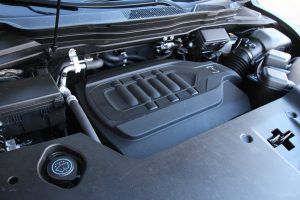
In the engine bay is a revised 3.5L SOHC, 24 valve direct injected engine with all the wazoo bells and whistles, including multi-cylinder displacement and a drive by wire throttle system. Trick stuff that leads to prodigious power of 290 hp at 6,200 rpm and 267 pounds of twist at 4,700 rpm which means the MDX is pumping out about 240 hp at just 4,700 rpm. That’s responsive mid-range power. Acura has added some more gears to its slick cog swapper, now totaling nine.

Performance is world class with this MDX 4,257 pound AWD knocking off 0-60 mph in a very zippy 5.65 seconds. MDX backs up that world class average with a 50-70 mph simulated passing run on a level highway of just 2.87 seconds coupled with the same passing run up a steep grade of just 4.11 seconds. This MDX can fly. Throttle response is perfect and linear with a telepathic gearbox almost reading your mind as to gear selection. Beautiful.

Now here is where it gets amazing. EPA rates the MDX at 19/26/22 mpg city/highway/combined with respect to fuel economy. MDX picks up an mpg in the city and combined cycle with the Advance Package’s auto stop feature which shuts off the engine while sitting at a signal. It was unobtrusive as I seem to always forget to turn it off anyway. It always defaults to auto-stop every time you start the engine.  When switched off by a button on the console, a yellow light in the gauge binnacle lets you know auto-stop is disabled. EPA numbers were fairly close to my test numbers. Overall the MDX did average 22-23 mpg in a mix of rural and suburban driving with almost no time spent cruising the Interstate. In two runs to Carson City and back from Placerville, the MDX averaged 26.6 mpg in both runs, with about half of the run driving aggressively. On the highway at 70 mph in a two-way run, the MDX also averaged 26.6 mpg. With its 19.5-gallon fuel tank that equates to a good 500 miles nonstop. Most human “tanks” won’t hold out.

We are only warming up here as there is a lot more to talk about. First is the ride and drive quality. MDX is deafeningly quiet as is the smooth demeanor of its ride quality. With the nine-speed tranny and tall gear ratios, the inaudible engine spins just 1,700 rpm at 70 mph. The body and structure is built like a tank, tight and strong. MDX is a unibody crossover and has state of the art suspension of MacPherson struts up front and a multilink system in the rear with big stab bars at both ends. Its integrated Dynamic System of comfort, normal and sport will slightly change the character of its ride and handling qualities, but sport is my preferred mode, while the ride is taut, it is still supple.

Sport mode also lends itself to extra sharp handling, but rest assured, handling is pretty sharp in comfort as well. Remember that wide track mentioned before? When you couple that with 20 x 8 inch alloys and super wide 245/50 series high performance all-season rubber, you get a capital S of the SUV that this MDX is. Grip is strong and steering is quick, estimated to be under three turns lock to lock and with the wide series 50 rubber turn in is very crisp and accuracy is true.

Plenty of room to haul people, toys and cargo.

One of my drives up Highway 50 was on a snowy day with snow and ice on the road. The MDX handled it perfectly with positive control and added confidence in the systems. It was truly amazing how well the Acura handled under these difficult conditions at speed. Lesser cars simply faded away. Turning circle is a decent 38.7 feet. Weight distribution is also reasonably balanced at 57/43 percent, excellent for a chassis that was initially an FWD system with a transverse front mounted engine.

Safety is of course second to none with every safety acronym on board, especially with the Advance Package — including a heads-up braking warning. Lane departure warning, lane keep assist, road departure mitigation, adaptive cruise and more are all standard. MDX’s strong huge disc brakes are over a foot in diameter with all the braking acronyms. MDX also has a full surround camera system giving the driver a 360-degree top view of its surroundings. Even in tight parking situations you should never put a scratch on its beautiful finish. Acura’s beautiful headlights are excellent.

Now to another bright spot for the MDX, its comfortable and beautiful interior done in soft perforated leather with umpteen way power adjustable seats with memory. Nice. The IP gauge binnacle has the customary large tach and speedo separated by the trip computer-information center. That’s all good. The center stack has two big info screens stacked on one another and that makes for complications as they are controlled by a kind of vertically operated center knob or mouser. There is a learning curve to successfully operate the system. It’s not a touch screen, but it is still hard. Sometimes (most of the time) buttons and knobs are better and easier to use while being less distracting.

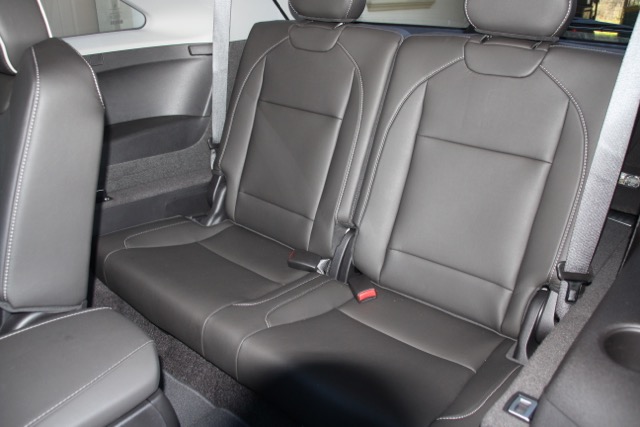
Second row seating is comfortable and copious, and while it looks less than inviting, the fold-down rear seats are good for two, even adults as long as they are not NFL linemen. Passenger volume is huge at 133 cubes and it will please the Home Depot/Lowe’s lover. I easily carried a bunch of 8 foot 2 x 4s and 1 x 6s one with one second row seat remaining up right with plenty of room to spare. It can swallow a load.

Pricing for this MDX SH-AWD (SH for super handling which it does) starts at $46,050. For the sake of brevity, SH is a sophisticated torque vectoring system proprietary to Acura that was first developed about a dozen years ago. With the Advance Package, which has features that most buyers will want, (my tester had the Advance Package), it is $56,500. The base SH-AWD MDX is well equipped, leather, etc. Perhaps the Technology version at $50,460 will work for most buyers. Study the brochure as like the center stack, there is a lot to learn. Destination, i.e., the boat (luxury suite) from Japan is additional $975. Acura MDX with the face lift (I’m being a bit superficial here) is a new favorite of mine.

Larry Weitzman has been into cars since he was 5 years old. At 8 he could recite from memory the hp of every car made in the U.S. He has put in thousands of laps on racetracks all over the Western United States.


Tickets available for summer classical music fest

The sixth season of nationally celebrated classical music festival, Classical Tahoe, will be July 28 through Aug. 12.

The festival brings together nationally and internationally recognized musicians for three weeks of concert performances in Incline Village. Under the direction of Joel Revzen, the 10-concert series supports Tahoe’s cultural growth, while bringing together an assembly of musicians from the Metropolitan Opera Orchestra, San Francisco Symphony, Seattle Symphony, Los Angeles Philharmonic and other orchestras throughout the world.

Guest soloists are traveling to Lake Tahoe from all over the globe: Cuban pianist Aldo López-Gavilán ignites Gershwin’s “Rhapsody in Blue,” Israeli violinist Itamar Zorman performs Jonathan Leshnoff’s “Violin Concerto,” and four award-winning soloists from the San Francisco Opera’s prestigious Adler Fellowship Program bring to life scenes from Mozart/Da Ponte operas.

Concerts begin at 7pm at the Festival Pavilion at Sierra Nevada College in Incline Village. Ticket prices are $25, $50, $75 and $100. Chamber music concerts are $30. Season subscriptions available. Student tickets are offered at a 50 percent discount off regular ticket pricing.

For tickets and more information, go online.


Tahoe’s past droughts subject of talk

John Kleppe, UNR professor emeritus, will be on the South Shore on April 25 to discuss Ancient Mega Droughts in the Lake Tahoe Basin and Beyond.

Kleppe fished Fallen Leaf Lake for 15 years before discovering it contained a preserved medieval forest in its depths. Intrigued by his fishing hooks getting caught on a mysterious underwater object, Kleppe sent down a diver. Kleppe discovered a 200-year-old medieval tree, still standing upright at over 100 feet tall, rooted on the bottom of the lake. Using carbon dating he determined it had drowned in 1215AD. He has since found more than 100 more trees.

Attendees will be taught about Fallen Leaf Lake’s role as an important microcosm of Lake Tahoe and how it is a “real world” working model that can be effectively used to develop concepts, methods, instrumentation, monitoring approaches, and complex models essential to the understanding and solving of problems throughout the Lake Tahoe Basin.

The talk is free for Lake Tahoe Historical Society members, $3 for nonmembers. It will be at 7pm at the Camp Richardson Lodge.


Collection of tennis essays bring life to the sport

By Kathryn Reed

What would David Foster Wallace have to say about the state of tennis today? What nuances would he bring to life? How would he dissect icons Roger Federer and Rafa Nadal, who are still the pillars of men’s tennis, who just last weekend battled it out in the final at the Miami Open?

We’ll never know. Wallace took his own life in 2008 at the age of 46.

I just finished reading Wallace’s “On Tennis: Five Essays” (2014 Hatchett Book Group). You don’t have to be a tennis player to appreciate these five works.

Wallace’s writing is delightfully descriptive, bringing the reader into the sport and beyond in ways that reading the sports pages seldom is able to do. He is a bit wonky, as well as insightful. His words are playful and purposeful.

Having played junior tennis at a fairly high level, Wallace isn’t some interloper. He understands the mental and physical fortitude needed to play this sport. And, yet, he is humbled as well as he let’s loose in “Federer Both Flesh and Not.”

It’s that love of the game that allows him to create stories almost out of nothing and turn them into masterfully written works of art.

In “How Tracy Austin Broke My Heart” he delves into how our sports heroes are mortal and how that can be a disappointing revelation.

These essays could all stand on their own – and have been previously published. Together, though, they are an in depth walk through the world of tennis.

Anyone who likes tennis will devour these essays. Anyone who likes sport will relate on some level. Anyone who appreciates fantastic writing will undoubtedly enjoy this collection.


Allergy season could be a doozy in Tahoe

Each year pollen collects everywhere in Tahoe, including on the lake. Photo/LTN file

By Kathryn Reed

It’s coming, and may arrive with a vengeance. We’re talking about allergy season.

“The wet weather will bring a lot more vigorous plant growth, which means more pollen and more allergies,” Ronald Roth, otolaryngologist at Barton Ear, Nose & Throat, told Lake Tahoe News. 

The one good thing about all the snow is that it could delay the onset of allergies. And if it snows early in the fall, it could be a really short season.

As soon as the snow melts those in the Tahoe-Truckee areas can expect allergies to kick in. They already are in lower locales like Carson City, Reno and the foothills. While those places have some similar triggers that are found in the basin, they also have olive trees, eucalyptus, and grasses.

“A general rule of thumb for the start of allergy season is when it stops snowing in May or June or when flowers start to bloom. I like to say when you start to see your lawn, allergy season is starting to ramp up,” Roth said.

What strikes first, according to Roth, are allergens that come from “dust on the roads and other areas drying out. After that, in maybe June or July, pine pollen, sage, and other plants will strike.”

Allergy Facts
• There is no cure for allergies. You can manage allergies with prevention and treatment.
• Researchers think nasal allergies affect about 50 million people in the United States.
• Allergies affect as many as 30 percent of adults and 40 percent of children.
• Allergic disease, including asthma, is the fifth leading chronic disease in the U.S. in people of all ages. It is the third most common chronic disease in children under 18.
• In 2012, 11.1 million people were diagnosed with allergic rhinitis.
• In 2010, Americans with nasal swelling spent about $17.5 billion on health costs. They have also lost more than 6 million work and school days, and made 16 million visits to their doctor.
• Many people with allergies often have more than one type of allergy. The most common indoor/outdoor allergy triggers are: tree, grass and weed pollen, mold spores, dust mites, cockroaches, and cat, dog and rodent dander.
Source: Asthma and Allergy Foundation of America

It’s not that the allergens will change because of the snow that fell this winter, it’s that it makes for a more intense experience for those who suffer because there is likely to be more of everything that blooms.

The Asthma and Allergy Foundation of America says, “An allergy is when your immune system reacts to a foreign substance, called an allergen. It could be something you eat, inhale into your lungs, inject into your body or touch. This reaction could cause coughing, sneezing, itchy eyes, a runny nose and a scratchy throat. In severe cases, it can cause rashes, hives, low blood pressure, breathing trouble, asthma attacks and even death.”

Roth has a few tips for trying to prevent allergies:

·       Use a hepa filter in the house.

·       Wash hair at night after a day of exposure to pollen in the air.

·       Replace the air filter of a heating and air system.

·       For spring cleaning, wear a dust mask.

·       Wearing a dust mask outside can help as well, though it may not be practical.

Roth recommends starting with over-the-counter remedies such as Zyrtec (cetirizine) and Claritin (lortadine), while Nasacort (triamcinolone) and flonaze (fluticasone) are nasal sprays. These come in children and adult dosages.

When those don’t work, it’s like time to see an allergist or an ear, nose, and throat doc.


Hotels latest frontier for voice-command technologies

By Hui-Yong Yu and Spencer Soper, Bloomberg
 
Amazon.com Inc.’s battle with Apple Inc. over digital assistants is moving to a new venue: hotel rooms, where Alexa and Siri are both vying to be the voice-controlled platform of choice for travelers.

Marriott International Inc., the world’s biggest lodging company, is testing devices from the two tech giants at its Aloft hotel in Boston’s Seaport district to determine which is best to let guests turn on lights, close drapes, control room temperature and change television channels via voice command. In December, Wynn Resorts Ltd. became the first hotel company to install Alexa-powered Echo devices, starting with suites at its flagship Wynn Las Vegas property.

Technology companies are using hotel rooms as showrooms for new services and devices that can also control so-called smart homes.

Read the whole story


2 nights of ‘Carmina Burana’ in Incline Village

Sierra Nevada College’s choir will perform “Carmina Burana” on April 6 and April 8, at 7 both nights, at St. Patrick’s Episcopal Church in Incline Village.

“Carmina Burana” is based on 254 poems from 11th-13th century Europe that were discovered in 1803 in a Benedictine Monastery in Bavaria. “O Fortuna” from “Carmina” is featured in many movies, including “Lord of the Rings,” “Excalibur” and “The Hunt for Red October.” It is the most played classical music of the past 75 years.

Donna Axton, SNC’s music program director, will be the conductor. Soloists include Brad Perry, Marty Gollery, Heather Shook, Elizabeth Rutherford, Miho Ogawa and Karen Colbert. The choir will be accompanied by an eight-piece orchestra, and the North Tahoe Children’s Choir will perform.

Tickets are available at The Potlatch, Handmade at the Lake and the SNC bookstore in Incline, and at The Store in Tahoe City. Tickets are $15 in advance, $20 at the door, and free those 12 and younger. For more information, call 775.881.7586.


‘People of the Passion’ at St. Theresa Church

To celebrate the season of Lent and Easter in a unique way, St. Theresa’s Catholic Church is presenting a production of the play “People of the Passion,” written by Mary Betten and directed by Susan Boulanger.

The free performance will be on April 14 at 6pm in the church, 1041 Lyons Ave., South Lake Tahoe.

“People of the Passion” presents the stories of a variety of gospel characters who witnessed or participated in the crucifixion of Jesus, and were forever changed by that experience. Through their personal stories the audience becomes witnesses to the Passion of Jesus in a personal way.

The St. Theresa’s Children’s Choir, under the direction of Maureen Leonard, will be performing musical interludes.

Members of the cast include Ryan Adams, Frank Dixon, Tessa Dixon, Maddy Evans, Sharon Kerrigan, Thomas Lopez, Alia Enriquez, Joanie San Agustin, and Elliott Smart.

For information, call 530.544.3533.