How California’s housing crisis happened

By Angela Hart, Sacramento Bee

California’s high housing costs are driving poor and middle income people out of their housing like never before. While some are fleeing coastal areas for cheaper living inland, others are leaving the state altogether.

Homelessness is on the rise. California is home to 12 percent of the U.S. population, but 22 percent of its homeless people. Cities that have seen dramatic rent increases, such as San Francisco and Los Angeles, attribute their spikes in homelessness directly to a state housing shortage that has led to an unprecedented affordability crisis.

Housing experts trace the problem back to the 1970s. Backlash began to arise – in coastal communities, in particular – from neighbors who opposed new housing in their neighborhoods.

Read the whole story


Climate change, forest fires focus of Tahoe summit

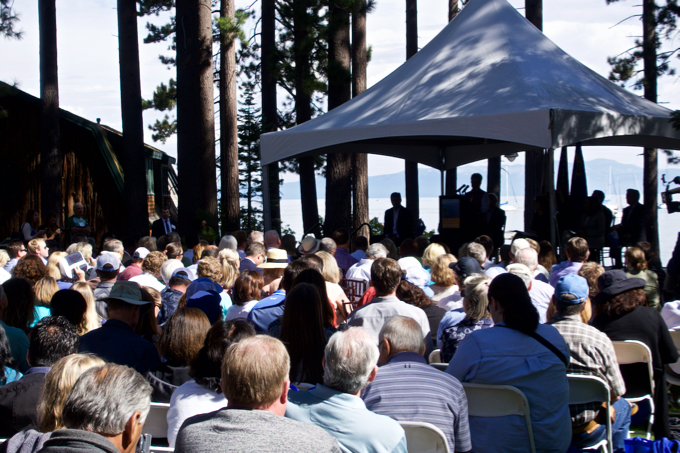
TRPA chief Joanne Marchetta talks to about 300 people about the challenges and successes of protecting Lake Tahoe’s environment on Aug. 22 at the annual summit. Photo/Kathryn Reed

By Kathryn Reed

CAMP RICHARDSON – On the same day when climate change and what that means for potential wildland fires dominated the conversation, the reality of the threat came to fruition hours later as firefighters fought multiple blazes from lightning strikes.

Speaker after speaker on Tuesday dwelled on the health of local forests and that more needs to be done to quash the threat of fire. Then that afternoon between 1:51pm and 6:41pm the Sierra Front Interagency Dispatch Center recorded 12 wildland fires caused by lightning.

Yes, lightning happens in this region in the summer. But there is no arguing the climate is changing. Scientists have the data to back it up.

Joanne Marchetta, executive director of the Tahoe Regional Planning Agency, pointed out how the warming air and water temperatures are impacting the ecosystem in the basin, that drought takes a toll. Climate change is not unique to Tahoe, it’s a global crisis, she said.

Aug. 22 marked the annual Lake Tahoe Environmental Summit. With Lake Tahoe’s pristine waters as the backdrop at Valhalla, it was hard not to want to buy into what the lawmakers had to sell. The message – the fight to protect the basin on land and water is a struggle, but one that is worth the effort.

California Sens. Dianne Feinstein and Kamala Harris are committed to protecting Lake Tahoe. Photo/Kathryn Reed

Partially it was a new slate of characters on the podium with the retirements of Sens. Harry Reid and Barbara Boxer. Taking their place were Sens. Catherine Cortez Maesto, D-Nev., and Kamala Harris, D-Calif. Sen. Dianne Feinstein, D-Calif., hosted the event which is now in its 21st year. Joining them were Nevada Republican Gov. Brian Sandoval, Rep. Tom McClintock, R-Calif., Sen. Dean Heller, R-Nev., and Rep. John Garamendi, D-Calif. Bruce Babbitt, secretary of the Interior under President Bill Clinton and the former governor of Arizona, gave the keynote address.

Heller pointed out that at the start of the day more than 1 million acres had already burned in Nevada this year. That number increased in the 24 hours since he spoke because most of those lightning strikes were in his state.

He is an advocate for more funding for Alert Tahoe, which puts cameras in locations to detect wildfires.

“I won’t be satisfied until there is a camera covering every inch of this (basin),” Heller said.

Cortez Maesto said, “We need to appreciate climate change and why fires are happening. The threat is only increasing, especially under this administration.”

Harris said it’s important to realize that it’s not a choice to help the environment or help the economy; that decisions can be made to enhance both. She also promised to be at all future summits, something her predecessor did not believe was important.

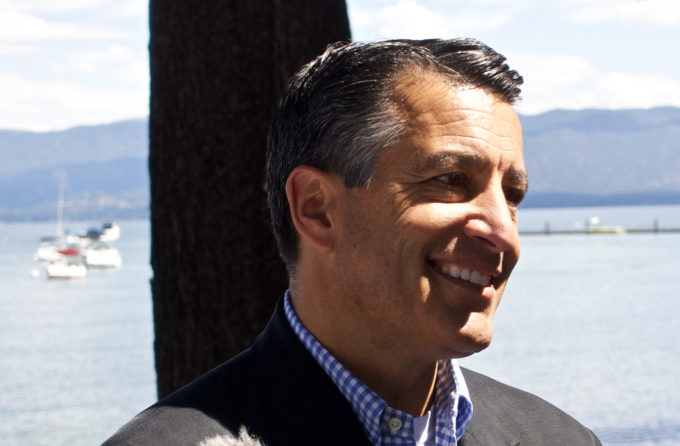
Gov. Brian Sandoval said Lake Tahoe is his favorite place. Photo/Kathryn Reed

Lake Tahoe has long had bipartisan congressional support from both states. They all have stories about what the area means to them on a personal level. This makes the basin special, showing that cooperation can work.

Another component of Tahoe being able to infuse $2 billion into environmental projects since the first Lake Tahoe Restoration Act was approved in 2000 is that local government and private individuals/companies have also stepped up to do their part. (The act was reauthorized last year, but the $415 million over seven years has not been appropriated.)

Babbitt said this is what makes Tahoe unique, that much of what has taken place to improve lake clarity and forest health has been at the ground level and not dictated from those in Washington, Sacramento or Carson City.

While McClintock is not a believer is human-caused climate change, citing how the climate has been changing since the last ice age, he is a huge proponent for being able to make the forest healthier faster.

“The management tools are now in place and we need to use them with the urgency that our forest systems demand and hope that it is not too late,” McClintock said.

On summit day it was announced the Tahoe-Central Sierra Initiative was created as yet another layer to protect Lake Tahoe and the central Sierra from impacts from large, damaging wildfires and unprecedented tree die-off.

Members are Sierra Nevada Conservancy, California Tahoe Conservancy, U.S. Forest Service, Nature Conservancy, National Forest Foundation, University of California, Natural Reserve System-Sagehen Creek Field Station, and California Forestry Association.

The number of dead trees in the Lake Tahoe Basin has more than doubled from 35,000 to 72,000 in the last year.

CalFire has pledged $5 million to the Sierra Nevada Conservancy to implement high-priority forest health projects within the TCSI area.

The other financial commitment at the event was the Environmental Protection Agency disclosing it was giving $197,250 to the Tahoe Regional Planning Agency to assess and restore wetlands in the Lake Tahoe Basin.


In solar scuffle, big utilities meet their match

By Elizabeth Shogren, High Country News

Near the end of 2005, Louise Helton had one of those life-changing moments that usually only happen in Hollywood movies. Friends had invited her to join Nevada movers and shakers in an ostentatiously decorated Las Vegas casino ballroom to hear former President Bill Clinton speak. He challenged the audience to diversify the state’s economy, and to do so in a very specific way. Adopting a Southern drawl, Helton recalls the words that inspired her: “And he said, ‘If I were y’all, y’all would be the Saudi Arabia of solar.’”

Clinton’s pitch made sense to the 51-year-old Helton. With its abundant sunshine, Nevada was well positioned to become a clean energy leader. Besides, the state lacks its own coal or natural gas reserves, so it has to import those conventional fuels, thus benefiting other states’ economies instead of its own. “There is no better or cheaper resource than the sun that is shining down on the sunniest place in the West,” Helton says.

Clinton’s words percolated away inside Helton for a few years. Then, in 2008, she took the leap. Using savings from the two decades she spent working with at-risk kids, she opened her own company, 1 Sun Solar Electric. She kept costs down by melding it with her life partner’s successful tile and stone company, and in 2009, they started attaching solar panels to roofs in Las Vegas. Her timing was unfortunate; the recession hit Las Vegas especially hard and the impacts lingered, but Helton was able to keep her small crew working and her business in the black. By the time Nevada’s economy bounced back in 2014, the cost of solar panels had plummeted. Helton’s company was ready to ride the wave. “We were making a very good living and supporting a crew of folks who were able to support their families,” she recalls.

Read the whole story


Squaw’s parent company buys Deer Valley

By Jason Blevins, Denver Post

A looming season-pass showdown among Colorado’s ski-industry heavyweights moved closer to reality Monday as the new Aspen Skiing-KSL Capital Partners venture bought Utah’s posh Deer Valley resort.

The purchase adds a key Utah destination to the partnership’s growing portfolio that already included resorts in Colorado, California and elsewhere, and makes a direct challenge to Vail Resorts, the world’s largest resort operator.

The newly formed — and yet unnamed — Denver-based partnership already ranks as North America’s second-largest player in the ski resort world after its formation in April. With the Deer Valley deal, it picked off one of the highest-end ski areas in the world, which sits adjacent to Vail’s sprawling Park City resort complex.

Read the whole story


Boarded up Meyers gas station on track to reopen

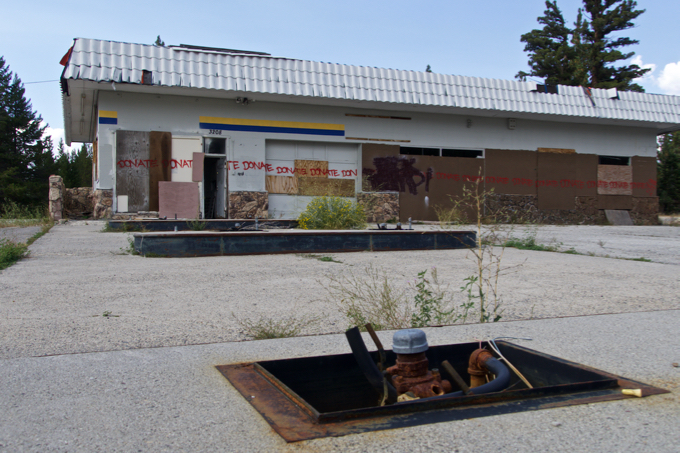
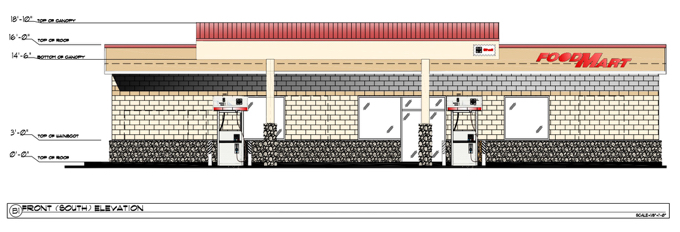
A Shell station is slated to open in Meyers at this site. Photo/Kathryn Reed

By Kathryn Reed

The dilapidated, graffiti-ridden, eye-sore of what once was a gas station in Meyers could be history this time next year.

The building isn’t going anywhere – but it will undergo a major remodel. The former use is staying the same; only instead of a Beacon gas station it will be a Shell. The owners are the same ones who have let the site sit in disrepair for years.

It’s not a done deal, but all of this has been in the works for a while.

County staff has been working with the applicant since last fall. Sutton and Associates out of Sacramento is representing the owners, Meyers Holding Co. based in Concord. Azad Amiri is the face of Meyers Holding Co.

The state in 2005 sued Amiri and Sarbjit Singh Kang, who own several gas stations, for allegedly mishandling underground storage tanks.

Regarding the Meyers location, the state Water Board spent $1.1 million to clean up the site.  

“We worked with the attorney general to request reimbursement and we received a fraction of that amount back. The state is no longer pursuing reimbursement of funds,” Lauri Kemper with the Lahontan Water Quality Control Board told Lake Tahoe News.

The old tanks are still in the ground and will have to be unearthed prior to the station reopening. The new ones will be installed closer to the fueling islands for better delivery access.

“Because we have to remove the tanks we cannot break ground this year. It will be next spring,” Steve Sutton with Sutton and Associates told Lake Tahoe News. “It won’t take long to get it done. Everything is pretty much preordered at this time, but we want issuance for the use permit, so it will be sometime next year, midsummer when we’ll be open for sales of fuel.”

A visual of what the gas station is projected to look like. Rendering/Sutton and Associates

To open, the county must issue a special use permit, which is something the Planning Commission would vote on. Their decision can be appealed to the Board of Supervisors.

“I think the best thing we can do is get the community involved. They should be writing, they should be participating,” Supervisor Sue Novasel told Lake Tahoe News. “The Planning Commission has allowed and not allowed things that the community has needed and wanted. The community may feel like it has its hands tied, they don’t. They need to voice their opinion one way or not.”

Because the county has never approved the Meyers Area Plan, this application comes under the outdated community plan. However, both planning documents would allow for a gas station at this location (3208 Highway 50) and both would require a special use permit.

Meyers has had three gas stations in the past; and the Shell station would make it so this enclave at the base of Echo Summit has three again.

Several residents who worked on the new area plan had hoped the location would be something more than a gas station and mini mart; something outdoorsy, and certainly a conduit to the trails in the area.

Free market, zoning and private property rights, though, are factors here.

(Novasel said the area plan’s environmental documents should be released this fall.)

The county on Aug. 16 sent a letter to area agencies and government bodies notifying them about the gas station application. Comments and concerns are due at the end of the month. The county’s technical advisory committee is then set to meet Sept. 18 “to take one or more of the following actions; 1) make an environmental determination, 2) determine final project conditions and/or, 3) confirm the public hearing date.” That meeting is not open to the public.

In an email county planning chief Roger Trout sent to Novasel and CAO Don Ashton, he said it will be three to six months before the Planning Commission takes up the special use permit.

The email further said, “Often the public will be interested in the early steps of processing this special use permit, but it is a little early in the process for public comment. However, we would welcome members of the public informing planning of their interest in the project. They should contact the staff planner, ask questions, and ask to be added to the mailing list for the future public hearing.”

The plan is to remodel the 1,900-square-foot building, have eight pumps on two islands, add interior bathrooms, a new sign, new asphalt, and removal of the old diesel pump in the back.

“It won’t look like the same building when we are done with it,” Sutton said.


Calif. Legislature grapples with affordable housing

By Angela Hart, Sacramento Bee

Democratic state lawmakers aiming to ease California’s housing shortage say they are focused on three bills they estimate would generate $20 billion for affordable housing development over the next five years and lead to 70,000 new low-income apartments.

They acknowledge it won’t be enough to solve the state’s unprecedented housing problems. But Assembly Speaker Anthony Rendon calls the package he and other lawmakers are working on “an important first step.” The Legislature begins the final month of the 2017 session today with housing atop its agenda.

“We know we’re not going to address it entirely this year,” Rendon said in an interview. “Doing streamlining and getting some funding for affordable housing would be a tremendous victory … our efforts are going to carry into the future regardless.”

Read the whole story


Eclipse diffuses sun’s light, drops temp in Tahoe

The eclipse on the sidewalk at Cave Rock as seen through a tree. Photo Copyright 2017 Carolyn E. Wright

By Kathryn Reed

While the sky didn’t go dark in Lake Tahoe during the eclipse Monday, the light was muted and the temperature definitely dropped.

“The main thing out here is everyone noticed the temperature dropped,” Bob Nielsen of South Lake Tahoe said while at Cove East.

According to the National Weather Service in Reno, the temperature in South Lake Tahoe dropped 4 degrees when the moon passed in front of the sun on the morning of Aug. 21.

Jessica Randall of South Lake watches the eclipse Aug. 21. Photo/Kathryn Reed

In South Lake Tahoe, the eclipse started at 9:04am, with the peak (84 percent) at 10:19am, and it was over by 11:42am.

Arless Lopez-Taylor, 7, liked watching it through his glasses, seeing how the shape of the sun kept changing. He is a bit of an astronomy nut, even likes to read astronomy news.

He was sitting on a log at Cove East, with Lake Tahoe behind him as he looked east with his dad, Nick Taylor, beside him.

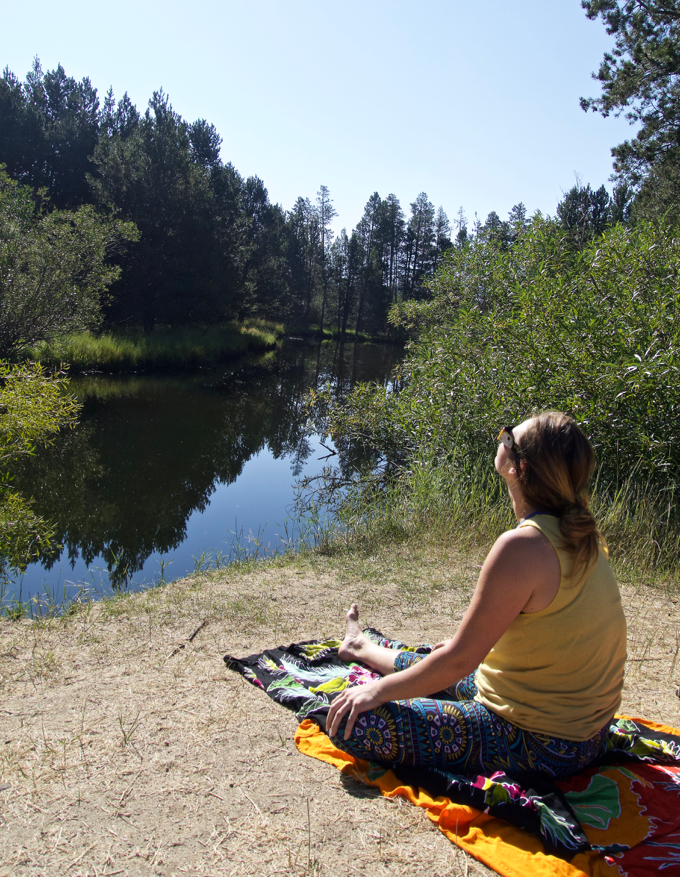
Jessica Randall of South Lake Tahoe had her spot along the Upper Truckee River staked out just off Venice Drive. Being in her late 20s she knows it could be a few decades before another eclipse is so prominent where she lives. She’ll have stories about this one to tell when the next one comes along.

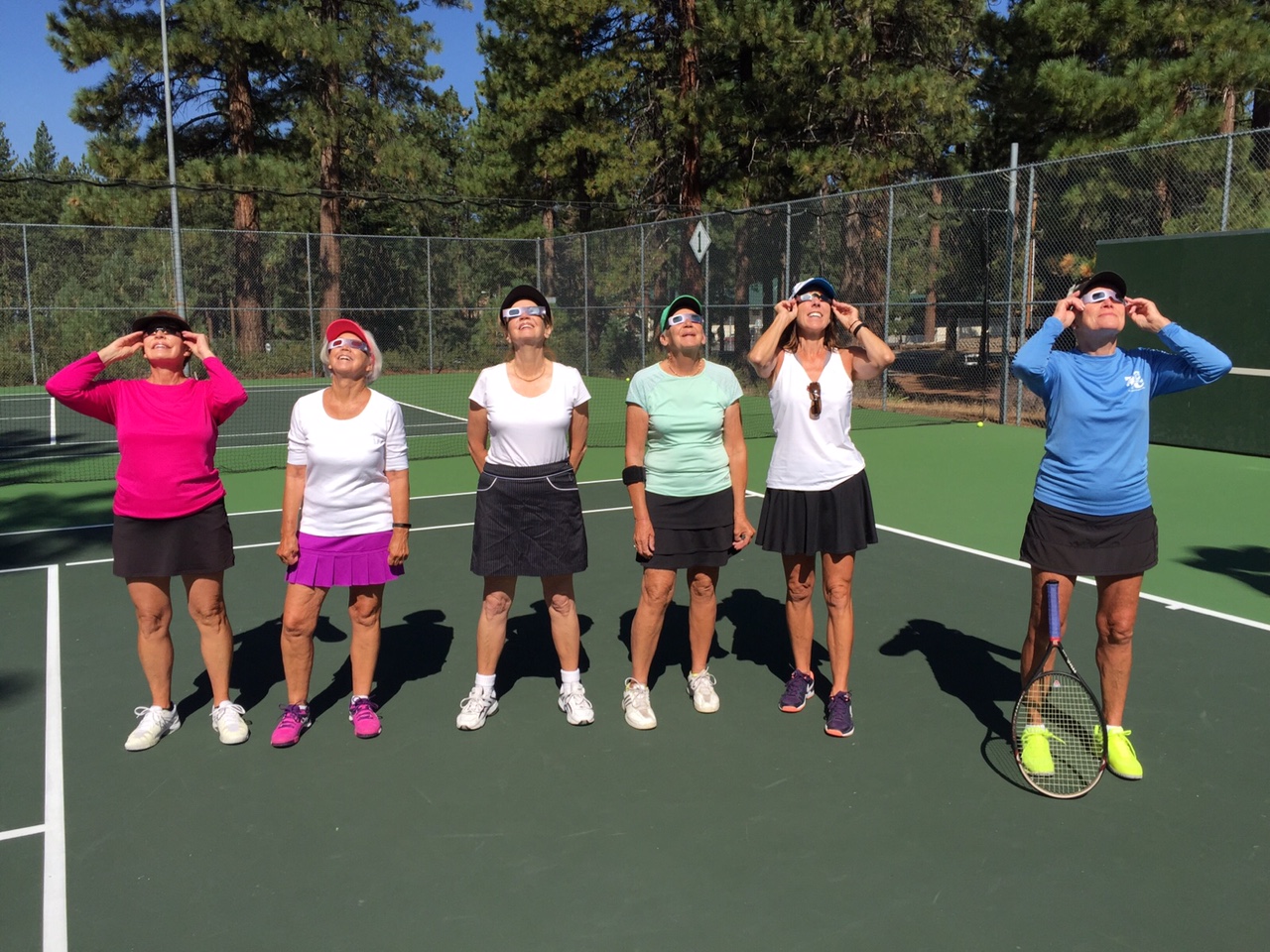
Players at Zephyr Cove Tennis Club call a timeout to watch the eclipse. Photo/Dave Nostrant

It’s not that solar eclipses are rare. At least two occur each year. It’s just that most occur where people can’t see them – like over some body of water.

This one, though, had a large swath of the United States in its path – from the Northwest to South Carolina, and an arc in between, able to experience the total eclipse. The total eclipse only encompassed an area 70 miles wide.

Even though the sun’s diameter is 400 times larger than the moon’s, the sun is 400 times farther from Earth than the moon. This is why the two orbs look the same size, and the eclipse is possible.

For Darla Sadler of Bend, Ore., it was her dad who got her to travel to Prairie City, Ore., for today’s event. It was Jim Sadler of Concord who said the partial eclipse in the Bay Area wasn’t enough, nor was the 99 percent in Bend. He wanted the full deal. This bucket list item was “spectacular” for him.

“I didn’t really know what to expect, but it was so worth seeing. If there is another in my lifetime, I will definitely go see it,” Darla Sadler told Lake Tahoe News.

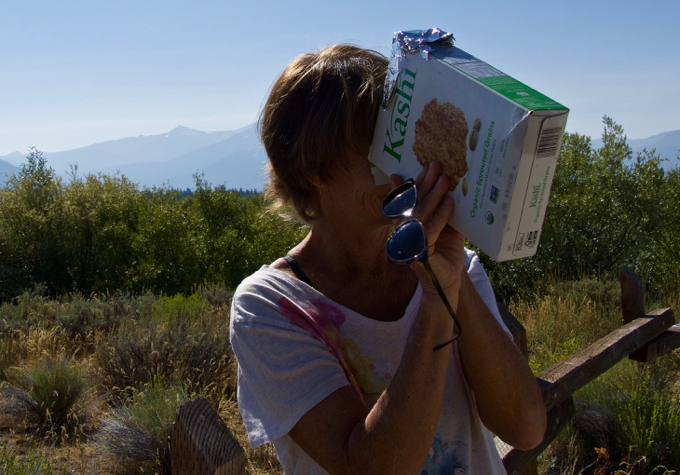
Cynthia Gorney uses a homemade device to view the eclipse. Photo/Kathryn Reed

Many who were out at Cove East didn’t have the special viewing glasses. It was a bit amazing when offered to look through a pair many said no thanks. Once convinced, the facial expressions and words of wonder were evidence they were seeing something special.

For Cynthia Gorney and Bill Sokol of Oakland they hurriedly put together a cereal box viewing contraption this morning. With foil attracting the sun and a hole in the box it was possible to see the eclipse reflected at the bottom of the box.

“I felt compelled to see the eclipse. And it’s the last day of our vacation. It’s a giant solar celebration of the wonderful three weeks we’ve had in Tahoe,” Gorney told Lake Tahoe News.

South Lake Tahoe Police Chief Brian Uhler had one of the more unusual vantage points for the event. He was flying in his plane at 14,000 feet in Central Oregon near Mount Jefferson.

“I wasn’t expecting it to be like it was. As soon as the direct light from the sun was covered by the moon it instantly illuminated this bluish-white coronal light you usually don’t see,” Uhler told Lake Tahoe News. He was flying his plane with his brother, Mark, as the passenger.

Uhler flew into Bend this morning, had breakfast and then went up to see the eclipse. He’s already back in Tahoe working.


All income levels impacted by Tahoe housing crunch; moving a little east often the answer

Publisher’s note: This is one in a series of stories about affordable housing in the Lake Tahoe-Truckee region. All articles may be accessed via the home page under Special Projects, 2017 Affordable Housing.

By Susan Wood

There’s something extraordinary going on in the Lake Tahoe housing market when “The Guy from Tahoe” isn’t.

Curtis Fong, who long has had a connection with Tahoe (hence the name), moved to Gardnerville 30 years ago – marking a trend that hasn’t slowed down. In the last few decades, he’s had company. Some former Tahoe residents have moved as far away as Dayton to make the dollar go further, among other reasons.

“Bottom line, it was a better value,” Fong said of his family’s move to the Ranchos. The popular Carson Valley neighborhood was also a better place to raise children, he added.

“And when I look back 30 years ago in the days of ‘Deep Snow,’ there were drugs all over town, and most kids were latchkey kids,” Fong said of the 1989 undercover law enforcement operation that resulted in the arrest and conviction of then South Lake Tahoe Mayor Terry Trupp.

In 1987, the average price for a home in Tahoe was about $140,000. At the time, a three-bedroom on one-third of an acre in Carson Valley was $75,000. Thirteen years ago, the appraised value was $200,000 for that same property. And through the last decade, the median for a comparable property in Lake Tahoe has still dwarfed the price in comparison to its high desert neighbor. The median in South Lake Tahoe runs $404,200. In Gardnerville, it’s $330,700 at $213 per square foot, while the Ranchos is a little higher at $233.

Granted, moving outside of a tourism hotbed, especially ski towns, is not a new phenomenon to the housing market. In Mammoth, workers live in Bishop. Vail employees commute in from the far reaches of Eagle County.

Fong, who is better known as an activity-based tourism guru and icon, believes he made the right choice for financial and quality of life reasons to “go off the hill,” as it’s called.

He empathizes with those seeking a home to buy at the lake or even to rent, with the latter climbing in price but falling in inventory.

“I feel for those people out there looking for a place to live,” he said.

Where does he see the trend of Tahoe going culturally?

“It’s interesting with the millennials. I kind of see a shift to young professionals moving in, but I guess time will tell,” Fong said of the age group 18-36.

His kids, Matthew and Erin, are now in their 30s as well, and he still spends a lot of work and play time in Tahoe. He even owns office space at the lake.
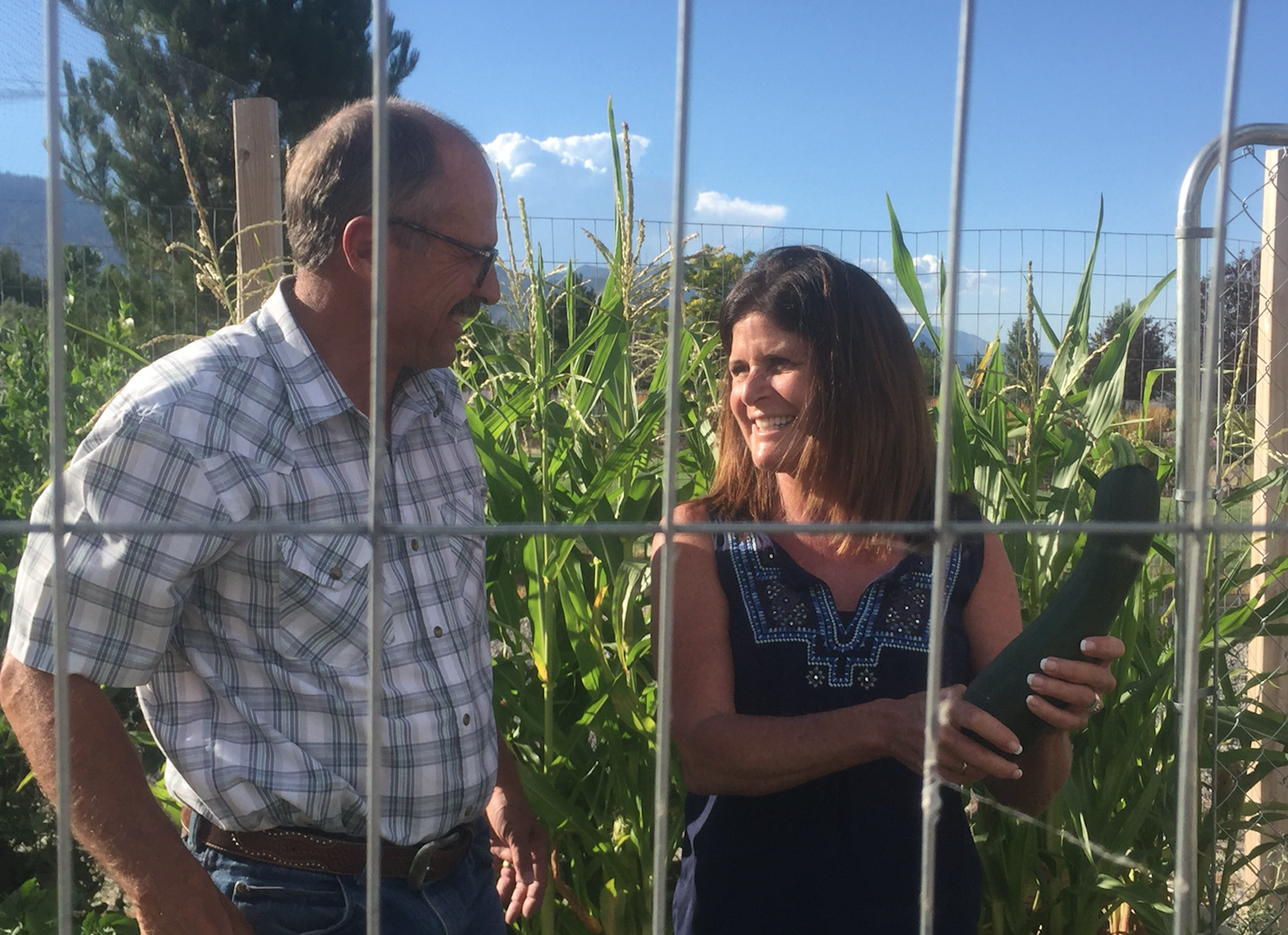
Living in the Carson Valley allows Bob and Tita Anderson to enjoy things they couldn’t at the lake — like having a prolific garden. Photo/Susan Wood

In good company

Fong is not alone in keeping limited ties with Lake Tahoe while living east of it. Some made the exodus decades ago like Fong. Others just ventured down recently. Either way, it’s a continuing trend that is worth noting.

South Lake Tahoe accountant Weldon Wulstein moved to Carson Valley four years ago. He lived in Tahoe Paradise neighboring Meyers five years ago, but the family needed space and the right zoning. His daughter was into horses.

They moved onto Foothill Road south of Genoa where Wulstein said the family likes “the quiet nature” of the community.

“It’s only 15 to 20 minutes away (from the Tahoe region), but it’s a completely different world,” he said. “And prices are rising down here too, but not as fast as the lake.

“It’s interesting to straddle two communities. You can’t be as spontaneous,” he said.

He also thought about moving his South Lake Tahoe offices to the Carson Valley, but decided against the idea.

“It’s too late to start over,” he told Lake Tahoe News.

Wulstein runs into people he knows from Tahoe in stores in Carson Valley.

“I think more and more people are moving here because of the affordability factor,” he said.

Just down the road from Wulstein are Bob and Tita Anderson, a couple who moved to the Carson Valley with similar circumstances after being at the lake 36 years.

The Andersons, who also have horses, sought a place three years ago that was ideal for their retirement – one that provided good bang for the buck while, like Wulstein, they kept their company operating in South Lake Tahoe. One difference from Wulstein – the Andersons added a satellite office in Gardnerville to run two sites. The financial endeavor tripled their business market.

Through the years, the Andersons have felt the pain from their employees seeking housing in Tahoe, with rentals averaging between $1,500 to $1,600 a month in some locales.

“The biggest factor is the inventory is so low,” he said, echoing what’s become a well-known trend in a region thought of as “poverty with a view.” There’s a price to have a piece of paradise.

“Quite simply, Tahoe is a great place for young people to have fun. We don’t need as much excitement,” Bob Anderson told Lake Tahoe News.

Nonetheless, the couple has no regrets about their life path but emphasize how paradise has taken on a different meaning.

For one thing, they get to look straight up the Sierra at the snow when it dumps at Lake Tahoe. Their lower elevation allows them to tend to a prolific garden full of beets, zucchini, lettuce, squash and other lush produce. Their horses have plenty of room out the gorgeous back yard to roam when they’re not seeking cookies by the fence. They’ve quasi adopted stray ducks that follow Bob Anderson around and stroll up to the relaxing deck that resembles a sanctuary. And the chickens are tame, happy and productive with eggs.

In other words, their home could be the setting of a tourism commercial for the good life in the West.

“We loved our years we lived up there, but we haven’t heard of too many people going back,” he said.

Rich Heffelfinger is able to provide more for his boys by living in Dayton. Photo/Susan Wood

Seeing the movement every day

Even the Sierra Nevada region’s real estate agents have experienced the migration – some personally and professionally.

A 37-year real estate agent, Jim Valentine of Re/Max came from the lake but now lives and works in the Carson Valley.

He’s seen the exodus up close and personal.

“A lot of people started coming down. The migration started in the ’80s. When things were getting pricey, the Gardnerville Ranchos were built,” Valentine said.

At first, it seemed the middle class wanted simple affordability, but then things changed in recent years.

“What we’re seeing now coming off the hill is more high-end people,” Valentine said. These residents are seeking a certain lifestyle, space and quiet time like the Wulsteins and Andersons. And like Fong, Valentine cites parents looking for a place for their children to thrive.

“People are looking to escape California,” he said.

And even though the topsy-turvy real estate market took a dive in 2009 to coincide with the recession, the rebound has allowed many homeowners to get the equity back in their properties.

“It was a bucket of tears at that time,” Valentine said of the industry. “But now we’re seeing levels we saw in 2003 and 2004, with the economy getting stronger.”

Valentine expects to see a huge growth spurt with major, innovative corporations such as Tesla and Apple moving into Northern Nevada.

“Talk about a tremendous amount of employees coming here in the next few years,” he said. The influx will drive the commercial market along with it, he anticipates.

“We’ll have more people with more demand for more things,” Valentine told Lake Tahoe News.

That same drive for affordable housing in the last 30 years will drive companies to supplement the need of an expanding workforce.

Take Rich Heffelfinger. The longtime Harrah’s Lake Tahoe concierge manager describes his life at the lake like the toast of the town.

He now works in a hardware store in Dayton where he lives with his family with different priorities. Now it’s all about spending quality time with his children and watching the sunset in the high desert.

Still, he reflects on those 11 years in Tahoe with fondness as a more charged, glamorous environment of perks and recognition. However, it was a tough road from professional success to personal success for the man who started his hospitality career as the “Voice of the M.S. Dixie” at age 18.

“I thought Tahoe was my home. I moved to Tahoe (in 1996) with the intention of setting up roots. I grew up in the Washington (D.C.) suburbs, so I know about setting up roots,” he said. “I found it quite unaffordable to live here (in Tahoe).”

Being in his 20s early on, buying a home wasn’t on his radar in 1997. He rented a cabin for $400 a month.

“I wish I would have been in the mindset, but I didn’t feel like it at that stage in my life,” Heffelfinger told Lake Tahoe News. Then, there’s the perplexing challenge of getting the capital together.

More than four years ago, Heffelfinger rented a duplex for $1,800 a month in the meadow behind Lakeside Casino. His mother-in-law lived downstairs.

He wanted more for his money, so he moved from Tahoe to the Carson Valley on a lease option, but that deal fell through.

“I didn’t mind the commute (to Harrah’s), and I was trying to follow a budget,” he said.

A year ago, he ended up in Dayton with his three boys and two dogs. It backs up to open space in Storey County where the wild horses often make appearances outside their $1,000 a month rental house.

In the meantime, Carson Valley rentals have gone up alongside Lake Tahoe’s. He was looking at rentals for $1,800 a month before deciding to migrate farther east.

It’s definitely a different lifestyle.

“I’ve learned the simple things – to appreciate nature, solitude and good friends,” he said.

The commute to Harrah’s was unfeasible from Dayton. He ended up getting laid off within the last year anyway. He took the downtime as a way of spending quality time with his boys.

“If there was a winter to be laid off, it was this last one,” Heffelfinger said. Staying put proved safer than struggling with an hour and a half commute under normal weather conditions.

“I’m learning to like Dayton, and we’re learning to live with less,” he said. The family eats in most of the time as a healthier and less expensive alternative to flitting around restaurants most nights in Tahoe.

The 38-year-old man is saving to buy a home and is “grateful for what we have,” he said of his change of heart.

“In Tahoe, it was tough trying to keep up with the Joneses. I felt like I had to be ‘on’ in tourism concierge. I love living the simpler life,” he said.
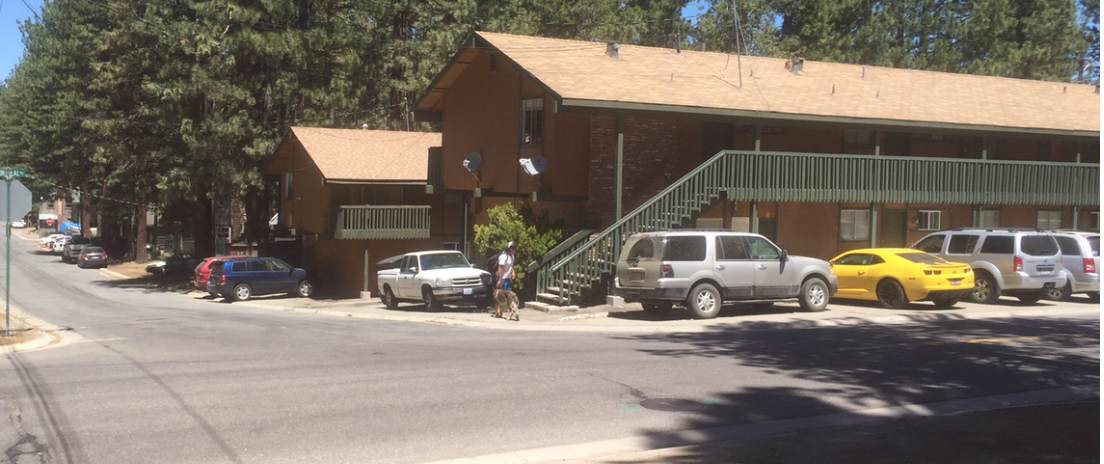
The apartment complex Randy Valiente lives in would be demolished if the loop road goes through. Photo/Susan Wood

Life loops around

Randy Valiente could be facing a similar life choice if the loop road project comes to fruition like the Tahoe Transportation District plans.

The project, which is undergoing an environmental review, calls for Highway 50 to be diverted through the Stateline area from Pioneer Trail around the 7-Eleven convenience store, connect with Montreal Road in front of the Van Sickle Bi-state Park and hook up with Lake Parkway as it weaves back to its main channel on the east side of MontBleu.

The controversial proposal is intended to make the casino corridor into a pedestrian hub. But there’s more to it than that.

Part of the deal calls for a denser replacement of units to make up for the modest, to-be-demolished checkerboard houses, cabins and apartments now located on those “shortcut” streets such as Moss, Fern, Chonokis and Primrose avenues. In an ambitious government maneuver, a land swap is required to move the highway to become city property. The California Department of Transportation would take over the new highway and put greenbelts alongside it.

Valiente’s apartment at 3734 Primrose is right in the path – within a block east of Moss Avenue, straight up from the 7-Eleven.

The food and beverage worker now walks to his job at Harrah’s and wonders what will happen if the project goes through in the coming years.

The Stateline renter shared that he had no knowledge of the project since the landlord has not discussed the subject with him.

He is open to suggestions in moving from his two-bedroom apartment he rents for $850 a month.

“For us, if they give us a place to stay, then fine. That’s a problem living around Tahoe. It’s quite hard,” he told Lake Tahoe News, while sitting outside his place.

Motorists whizzed by on this popular shortcut used to circumvent traffic backups on Highway 50 in the casino corridor.

That’s precisely what Tahoe Transportation District Director Carl Hasty expects to hear and wants to answer.

“Housing is important. That’s how I look at it. It doesn’t solve all our housing issues, but it takes care of much of it,” Hasty told Lake Tahoe News during a stroll through the affected area. “This is a way of getting density housing in.”

The plan is for 76 residential units to be built, with “no net loss” of housing. Still, displacement is a hard sell anytime residents are relocated in the name of what proponents call progress. And with Hasty’s long planning tenure in Tahoe including as a high-ranking authority at the Tahoe Regional Planning Agency, he may know better than anyone.

A relocation assistance analysis study was conducted in respect to the loop road.

“Acquisition and relocation are the most expensive part of the process,” he said.  Fair market value will be the order of the day.

But of course it comes with the territory as South Lake Tahoe knows. Redevelopment in Stateline was never easy but turned out to be a financial boon in tax dollars if one forgives a few hiccups along the way associated with albatross amenities such as the parking garage at Heavenly Village.

But what’s the alternative to moving ahead?

“There are multiple reasons (for) and benefits to this. If there’s no project, it’s a lost opportunity,” Hasty told Lake Tahoe News. “It would accelerate the city’s local area plan objective.”

The city has special districts at Ski Run Boulevard, the Y referred to as Tahoe Valley, and Harrison Avenue.

On one recent summer morning, Hasty paused a long time at the corner of Moss and Pioneer to imagine the prospects of what could be developed at an open lot there.

“The question becomes what happens here. This is the gateway. There are endless creative opportunities,” he said, while pondering the future. “It’s time to build for the next 75 years.”

Eclipses create science and so can you

By Seth Borenstein, AP

The sun is about to spill some of its secrets, maybe even reveal a few hidden truths of the cosmos. And you can get in on the act next week if you are in the right place for the best solar eclipse in the U.S. in nearly a century.

Astronomers are going full blast to pry even more science from the mysterious ball of gas that’s vital to Earth. They’ll look from the ground, using telescopes, cameras, binoculars and whatever else works. They’ll look from the International Space Station and a fleet of 11 satellites in space. And in between, they’ll fly three planes and launch more than 70 high-altitude balloons.

But it’s not just the professionals or students. NASA has a list of various experiments everyday people can do.

Read the whole story


Covered California is 1st in U.S. to promise insurers help

By Catherine Ho, San Francisco Chronicle

Covered California, the health insurance exchange created under the Affordable Care Act, will take the unprecedented step of offering insurance companies financial incentives, and guardrails, to encourage them to continue selling health plans through its program.

The agency’s board on Thursday approved a proposal to allow insurers to raise premiums more than normal between 2019 and 2021 if they lose more money than expected in 2018 due to federal policy changes, such as a lack of federal enforcement of the health law’s individual mandate. This will allow insurers, in future years, to recoup losses they may see in 2018.

The move by Covered California is an aggressive tactic that has not been attempted by other states, said health policy experts. It signals that state officials are willing to take bold steps to ensure the exchange remains viable.

Read the whole story