2045 eclipse should be big for Nev. tourism

By Richard N. Velotta, Las Vegas Review-Journal

To the parents and grandparents who took the time to share the science of last week’s Great American Eclipse to children and grandchildren, I salute you.

You might have planted a seed of curiosity that one day might play an important role in our tourism economy.

The youngsters of today will be in their 30s and 40s in 2045, the year Great American Eclipse III darkens the skies over Northern Nevada in what could be one of the greatest tourism events in our state’s history.

Read the whole story


Sierra hiker tells harrowing lightning tale

By Olga R. Rodriguez and Jonathan J. Cooper, AP

There was no rain, no rumbling, no sign of danger before the blinding flash and deafening bang of a lightning bolt threw Mathias Steinhuber to the ground, tore off his clothes and burned a gaping hole in his shoe.

The 31-year-old Austrian teacher, an avid hiker, had just reached the 9,000-foot summit of a Sierra mountain range ahead of his companions when he raised his arms for a picture and was struck in the back of the head. The electricity shot through his body and exited through his foot, and he was too stunned to know what had happened.

“It was like in a dream,” Steinhuber told the Associated Press Thursday. “I woke up. I had blood everywhere. My clothes were ripped apart. At some distance I heard my girlfriend scream my name. My first conclusion was that I probably fell down the mountain.”

Read the whole story


EDC grappling with CalPERS, worker obligations

By Kathryn Reed

The financial situation in El Dorado County continues to deteriorate.

The obligation to retirees via CalPERS keeps growing and contract negotiations with employees could be going better.

The county’s unfunded obligation to the California Public Employees Retirement System is more than $346 million. This is $64 million more than when the last actuarial report was done.

“Further, CalPERS has informed the county that seven years from now the required annual payments to CalPERS will be $22 million per year higher than they are now. Balancing the county’s budget and providing critical public safety and road maintenance services will become much tougher in the future because of our unfunded obligation to CalPERS,” Auditor-Controller Joe Harn told Lake Tahoe News.  

If the county were to withdraw from CalPERS, it would cost more than $1 billion to do so.

The county is not alone in its debt to the retirement agency. The problem is there is no plan to deal with it. It’s like the county’s leaders – elected and otherwise – are wishing the problem would go away.

Carla Hass, spokeswoman for the county, merely said staff is concerned and looking at options. The only option she pointed to is if there is any extra money at the end of the fiscal year, it will go to offset PERS increases.

Supervisor Shiva Frentzen, who is chair of the board, did not respond to Lake Tahoe News’ questions.

Harn this week sent the entire board a letter outlining the gravity of the situation, as he has done year-in-and-year-out. But the actions by the powers that be make it appear his words are falling on deaf ears.

“The county needs more tools and options that are not currently available to reduce these unaffordable and insurmountable unfunded obligations,” Harn said. “The Board of Supervisors should seek the assistance of California State Association of Counties, CalPERS and our representatives in the Legislature so that changes in state law and CalPERS policies will provide better options to enable us to reduce these unaffordable obligations. What we can do locally now is work to set aside significantly more funds in our reserves to help cover these costs in the future.”   

For some reason, when CalPERS told member agencies in 1999 that it was overfunded, everyone believed this to be true. Now, though, when CalPERS is issuing forecasts for further indebtedness for the next five years, many of these same agencies are not taking the threat seriously.

In 1999, in order to pay back public employee unions for massive campaign contributions then-Gov. Gray Davis and a super majority of the Legislature passed Senate Bill 400. This allowed the state, counties, cities and special districts in California to offer employees drastically enhanced retirement benefits retroactively.  

“CalPERS gave the county ridiculously low cost estimates in 1999. CalPERS projected that the retroactive application of dramatically enhanced retirement benefits would not increase the cost to the county for the next 11 years,” Harn said.

That projection could not have been further from reality.

El Dorado County supervisors ignored warnings from Harn at that time and instead offered employees dramatically enhanced retirement benefits on a retroactive basis.

The county has continued to add fuel to this financial catastrophe by giving exorbitant raises. It wasn’t that long ago employees received 15 percent raises. This in turn increases the county’s PERS obligation.

The county and Local 1 are in negotiations now. The union represents more than 900 employees.

“The county did a class and comp study last year that they want to base their proposals on, but they feel it will take them another year to 18 months to be ready. We want to negotiate a contract now, so it’s more of a process issue then an amount issue,” union rep Jere Copeland told Lake Tahoe News. “The only real issue is wages. Any decisions on job actions would be made after we declare impasse.”

The union is tired of waiting for the county to talk numbers. While a strike would be a ways off, impasse could be reached this fall.

The  county spokeswoman had this to say: “The negotiations are not public and are addressed in closed session with the Board of Supervisors. We continue to meet with Local No. 1 representatives in good faith and work toward an agreement that is satisfactory to both parties.”


Nevada earns D on health-care report card

By Paul Harasim, Las Vegas Review-Journal

A nonprofit created by heavy hitters from Nevada’s business and medical communities gave the state a D grade on its first report card on the state’s health-care system.

The report card was released Wednesday by the Nevada Medical Center, or NMC, and is intended to focus attention on improving access to quality health care in the state.

Larry Matheis, the NMC’s CEO, said the report card will help state leaders focus on the gaps that must be filled to improve Nevada’s medical standing. Currently, he said, the state’s medical system “resembles a series of isolated communities … due to the lack of collaboration among medical professionals and the dearth of thought given to enhancing our community’s reputation.”

Read the whole story


Weed could cut into liquor sales across Nevada

By Chris Kudialis, Las Vegas Sun

In three of the first four states to start legal recreational pot sales, an increasing number of consumers are choosing bud over Budweiser.

That conclusion comes from a study by New York-based investment and research firm Cowen and Co. In Colorado, Oregon and Washington, domestic beer sales for Budweiser, Coors and Miller were down 4.4 percent from January 2015 to the end of 2016, while purchases of craft beer fell 2.4 percent. No data was available for Alaska.

How the beginning of recreational marijuana sales in Nevada affects local alcohol sales remains to be seen, as the program began just eight weeks ago.

Read the whole story


WHS football team calling South Tahoe home

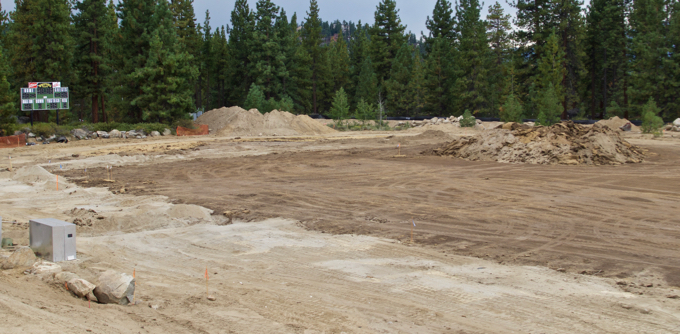
Whittell’s field is not suitable for any sports this fall. Photo/Kathryn Reed

By Kathryn Reed

Before Whittell High School’s football plays its first game tonight it has already scored in the arena of community cooperation, as has Lake Tahoe Unified School District.

They are showing what it truly means to blur the state line.

Construction equipment is occupying Whittell’s gridiron as it undergoes a major transformation. It’s all dirt, a complete work zone. This means no games there this season.

“I thought about our families who would be attending games. I know it’s easier to be here at the lake than to go down off the mountain,” Principal Crespin Esquivel told Lake Tahoe News.

That’s how LTUSD got involved.

South Tahoe Middle School is going to be Whittell’s home field for this season. Games will be Sept. 8, Sept. 29, Oct. 13, Oct. 26 at 7pm. The Warriors are expected to have a good team this year. Last season they finished 9-2 and made it to the playoffs.

“We got contacted last spring to see what we could figure out and it ended up to be pretty easy. It was an amicable resolution on both sides,” Pat Harnett, STHS athletic director, told Lake Tahoe News. “They wanted to be at a consistent site. That’s why they are at the middle school. The high school site was not always available.

“There is no facility use fee. We are taking care of our neighbors.”

WHS will pay for any LTUSD personnel involved with the game.

The Warriors are able to practice at home. Photo/LTN

If a facility in LTUSD could not have been found, the Warriors would likely have ended up at Douglas High. And while that would have kept them in their same school district, going across town is more like playing at home.

The team is still able to practice at home. That upper field has grass.

What will be different at STMS is that it is artificial turf. The other thing is that the field is wider and will have to be altered. WHS plays eight-man football instead of 11. Tape has been ordered to stripe lines for their games that will be put down and taken up each night.

The goal is for the field in Zephyr Cove to be finished for the start of next season.

WHS soccer games will be played at Zephyr Cove Park this year. The track team has never had home meets.

A donation of $3 million from the Lisa and Robert Maloff Endowment Fund is paying for the football field to be completely renovated as well as the track.

“The drainage was a huge problem. It always looked like a moat out there,” Esquivel said.

Improving the water flow is a big part of the new infrastructure. While the original plan was to put in artificial turf, now sod is going to be laid. An all-weather track is coming, visitor seating and concession stand as well.


Toxic algae bloom in Tahoe Keys lagoons

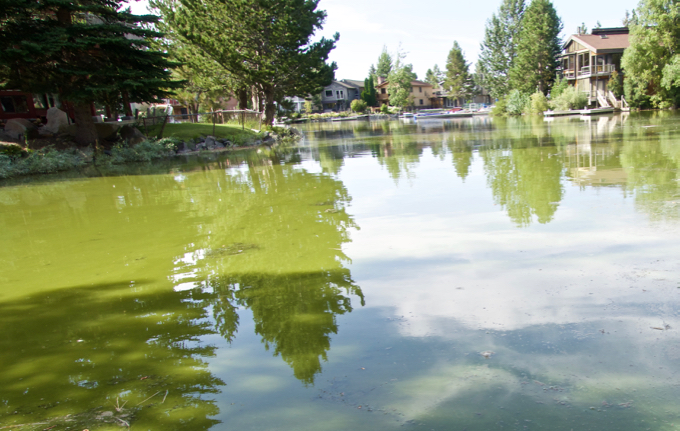
Canals in the Tahoe Keys are plagued by blue-green algae. Photo/Kathryn Reed

By Kathryn Reed

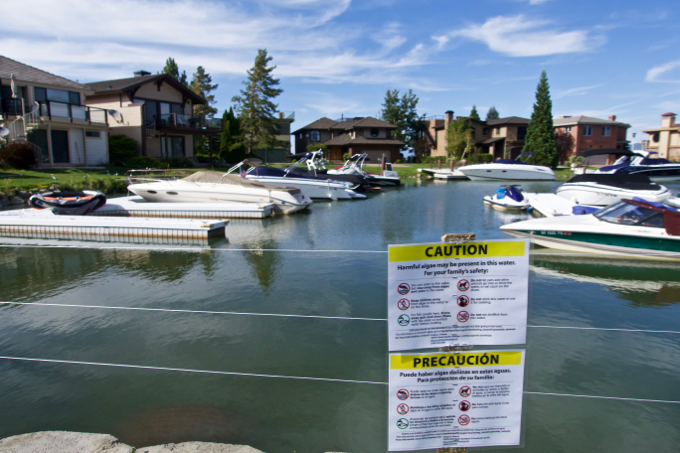
A toxic algae bloom is covering a large swath of the Tahoe Keys, prompting a warning to people to be wary of the water.

Officials with the Tahoe Keys have known about the blue-green algae since Aug. 11. Warnings, though, did not start until Aug. 23.

For such a big problem, the caution signs are very tiny.

“It’s in different locations in the west lagoons,” Kirk Wooldridge, general manager for the Tahoe Keys Property Management Association, told Lake Tahoe News. “It’s in various degrees in different areas. It depends on sunlight, current and depth.”

Some warning signs are in Spanish, but most are just in English. Photo/Kathryn Reed

On Wednesday the Lahontan Regional Water Quality Control Board encouraged signs be posted alerting people to the danger. Driving by it is near impossible to see them, but out with a dog is a different story.

“The level tested at Tahoe Keys did not show a high danger level. It was at the much lower caution level,” Doug Smith with Lahontan told Lake Tahoe News.

There are three levels of danger for cyanobacteria, which is better known as blue-green algae. The toxicity in the canals of this South Lake Tahoe neighborhood are at the lowest level.

Still, the “caution warning” includes: humans and dogs should not come in contact with the algae or scum on the shoreline, neither people nor pets should drink the water, fish caught in the area should be cleaned with tap/bottle water before cooking, no shellfish should be eaten from these waters, and the water should not be used for cooking.

More dangerous toxic levels can cause eye irritation, skin rashes, mouth ulcers, vomiting, diarrhea, and flu-like symptoms. Two dogs in Napa County died this summer after drinking water from a pond with the algae.

“Blue-green algae naturally occur everywhere in the environment. We don’t know the exact reason why certain areas have blooms,” Smith said.

Outbreaks have been occurring throughout California this year.

Contact with the water of a large swath of the Tahoe Keys lagoons could be dangerous because of the algae bloom. Photo/Kathryn Reed

Why it goes away also isn’t known.

The plan is to continue field tests. If those have indicators that the level of toxicity is rising, it will be sent to the lab for definitive proof.

This is not something the Tahoe Regional Planning Agency or El Dorado County Environmental Health regulate.

“TRPA is aware of this concerning development and working closely with the Lahontan Water Board, who has jurisdiction on this matter, to monitor the situation and make sure that appropriate steps are taken to protect public health, safety, and the environment,” Tom Lotshaw with TRPA told Lake Tahoe News.

Copper sulfate is a proven herbicide that kills the algae. Applications have worked in other jurisdictions under Lahontan’s oversight. An emergency provision in Lahontan’s Lake Tahoe Basin Plan would allow the use, but the danger level would have to increase substantially for that option to be on the table.

It is not known if the algae can be spread by watercraft, but boat travel has not been halted. It could be that if it were to get into Lake Tahoe, it would die because of the colder water temperature.

The Keys put up a boom on a canal linking the regular homeowners with the Lighthouse Shores gated community. According to Wooldridge, it didn’t do any good. The algae went under the boom.

He did not know how deep the muck goes.

The waterway at Venice and Alpine drives looks like a holding pond for a toxic chemical plant with the eerie green color and swirls along the shore.


Stand of Tahoe City trees focus of debate

Christy Hill’s cottonwood trees from the lake. Photo/Brent Thrams

By Melissa Siig, Moonshine Ink

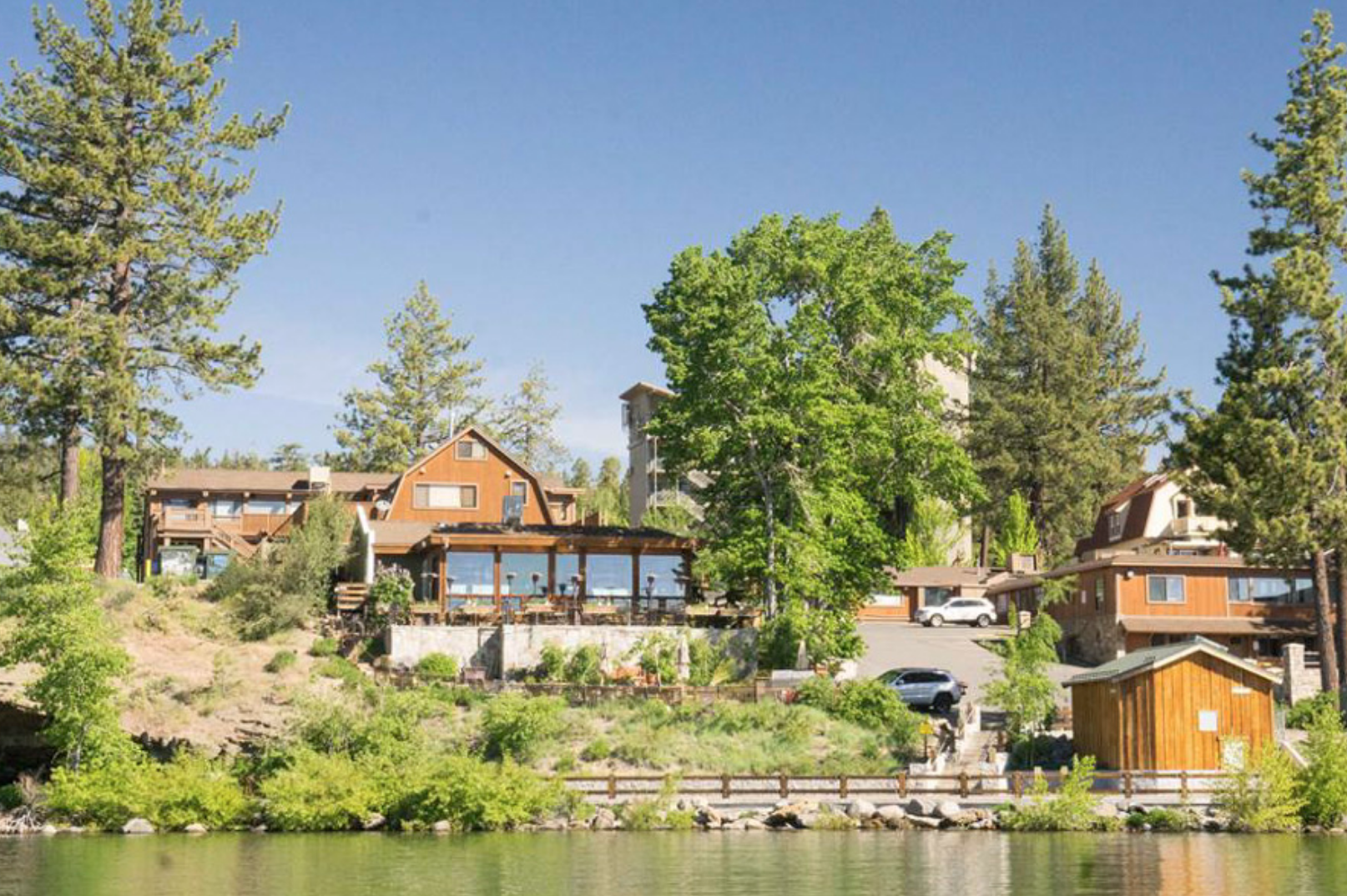
At 5:45 one morning in early June, Tahoe Vista resident Brent Thrams parked his truck in front of the grove of cottonwood trees near the entrance to Christy Hill restaurant in Tahoe City. Thrams, who was accompanied by two others, was not there to watch the sun rise over Lake Tahoe or take an early morning jog on the bike path. He was there to protest.

A few minutes later, when an Arbor Care crew showed up to cut the dozen 50-foot cottonwood trees down, Thrams refused to move his truck.

“My intention is to not have you cut these trees down today,” he told the Arbor Care foreman. “I’m not moving.”

Arbor Care eventually left, leaving the cottonwood trees standing … for now.

Read the whole story


Tree mortality in Tahoe a growing concern

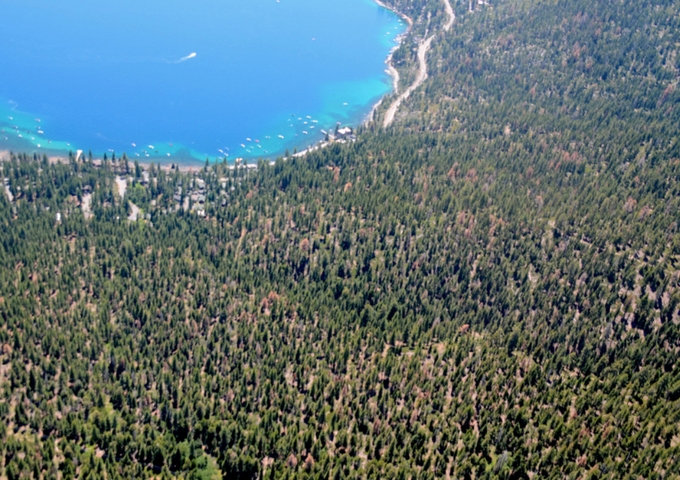
The orange reflects dead trees in Tahoe in July 2016. Photo/USFS

By Kathryn Reed

STATELINE — It was a lively conversation about a deadly situation at Wednesday’s Tahoe Region Planning Agency Governing Board meeting.

Trees took up the morning session; specifically dead trees and what is being done about them.

One good winter didn’t cure what ails Lake Tahoe’s forests – or those throughout the Sierra. Part of the problem is drought, part is beetle infestation – though, those are linked.

The board on Aug. 23 was given an update about the strategic initiative to create a healthy forest in the basin. The board members also approved a permit for Caltrans to thin hundreds of trees along California’s highways in the area.

While there is still more green than orange in the forest here, especially compared to the southern and central Sierra, the number of dead trees is increasing. According to statistics provided by Kevin Conway of CalFire this is the tree mortality rate in the Lake Tahoe Basin:

·      2012 –1,025

·      2013 – 905

·      2014 – 5,989

·      2015 – 34,947

·      2016 – 126,479.

Statewide more than 100 million dead trees have been identified.

Conway’s report said, “We have never seen an event which will so profoundly impact the forest of California and its associated resources including water, wildlife, fire regimes, public safety, forest products, recreation, and their associated economics.”

For Calfire, the major issue is the dying trees are fuel for a wildland fire.

Mike Vollmer, TRPA environmental improvement program manager, said the sugar pines have been “extremely stressed by drought.” Drought leads trees to be more susceptible to being ravaged by insects like the pine engraver, fir engraver, satin moth, and mountain pine beetle. All but the moth is native to the area.

The moth is most prolific in the Marlette Lake area right now. The hope is nature – aka winter – will kill them off and pesticides would not be needed.

Austin Sass, who represents South Lake Tahoe on the Governing Board, questioned why no money is being allocated to help local residents and businesses to remove dead trees when the fire community admits its priority is public safety. There was no answer from the firefighters in the room.

Caltrans, though, is coming to the aid of some private entities with their plan to remove trees along nearly 68 miles of highway on the California side of the basin. This includes highways 50, 89, 28 and 267.

If a dead or hazardous tree along a state highway poses a public threat and is on private property, Caltrans will remove it for free assuming the property owner grants permission. If the person says no and the tree falls onto state property, they are liable for any damages as well as the removal. (Caltrans has the right of way 100 feet in both directions from the center line.)

The TRPA on Wednesday approved the permit to fell 875 hazardous trees that are more than 14 inches in diameter that the state agency has identified. The completely dead trees don’t require a permit, nor do ones less than 14 inches in diameter.

“All trees within this area that are dead, dying, diseased and/or hazardous and can hit the road if they fail are being marked for removal,” the report says.

Any tree more than 30 inches in diameter that is identified for removal must also have a second OK by TRPA’s forester.

The staff report says, “… due to the current dynamic nature of tree mortality in the Tahoe basin, the exact number of dying trees requiring a TRPA permit can only be known for a short period of time as dying trees become dead trees and new trees are identified as dying. For this reason, the Governing Board is being asked to permit a process and methodology for identifying hazard trees for this project rather than a specific number of trees.”

Luther Pass will be the first area where Caltrans will work.

One of the costly and time consuming aspects of dealing with these drought-beetle ridden trees is that they are scattered about, as opposed to being in a grove.

Larry Sevinson, Placer County’s rep on the board, asked what will be done with all the wood. There is no definitive answer. That is the conundrum with removing them. Much of it is not salvageable for the lumber industry, as LTN reported in May.

“This issue is now being talked about everywhere. It’s a major issue of what to do with the wood when it’s removed,” TRPA Executive Director Joanne Marchetta said. She mentioned how at this week’s environmental summit Sen. Dianne Feinstein, D-Calif., expressed support for Republican Rep. Tom McClintock’s idea to lift the export ban for wood products going to China. This could open up a huge market.

Genetic screening to speed up search for resilient pines in Tahoe

By Carolyn Wilke, Sacramento Bee

A recent report by UC Davis gave a grim assessment on the health of forests around Lake Tahoe.

The threats facing them include white pine blister rust, an invasive fungus, and bark beetles, an insect that attacks trees. And both of these were exacerbated by the recent drought. From 2015 to 2016, tree mortality more than doubled, from 35,000 to 72,000.

Blister rust has hit sugar pine trees hard. They’re the largest species of pine, with enormous pine cones, and they grow at low elevations.

Read the whole story