Toxic algae continues to cover Keys canals

By Kathryn Reed

Tests on the water of the Tahoe Keys canals continue to show blue-green algae, also known as cyanobacteria.

The toxic algae have been in the lagoons of this South Lake Tahoe neighborhood since at least Aug. 11.

“Based on the levels being detected in last week’s samples, coupled with the site-indicators present (floating scum, blue-green color), we recommended that TKPOA continue to post caution advisories and advise pet owners to be especially careful if their dog might play in the affected water. Unlike a human, a dog can be exposed to the toxin by drinking the water, eating a glob of algae that might contain the toxins, and further by grooming their coats when they get out of the water with saturated fur,” Mary Fiore-Wagner, senior environmental scientist with Lahontan Regional Water Quality Control Board, told Lake Tahoe News.

She sent an email to veterinarians about the low levels of cyanotoxins – Anatoxin–A and microcystin that were found in water samples last week and the potential harm to dogs. Detailed information was sent to the doctors so they would be aware of symptoms.

Tahoe Keys Property Owners Association took additional water samples on Aug. 28. The results are not in yet.

The blooms are improving in some locations, but have developed in others. Cyanobacteria blooms can look like slicks of opaque, bright green paint, or “pea soup,” but closer inspection often reveals the grainy, sawdust-like appearance of individual colonies, according to the state Water Board.

“Next week we are coordinating with TKPOA to initiate a larger sampling effort throughout the Tahoe Keys waterways. EPA-Region 9 will be supporting the effort by funding analysis of one of the toxins being detected (microcystins). Analysis will be through the EPA-9 laboratory. Additionally, several field duplicates samples — samples collected at the same time, from the same location — will be collected and run at a commercial laboratory paid for by TKPOA and the EPA-Region 9 laboratory for analysis of Anatoxin-A,” Fiore-Wagner said.

The state Department of Water Resources on Friday sent out information about the various algal blooms in California what with Labor Day weekend being big for boating and swimming.

The Keys has not limited boating activity in the contaminated canals, but human contact with those waters is not advised.

Toxic blue-green algae exposure can cause eye irritation, allergic skin rash, mouth ulcers, vomiting, diarrhea, and cold- and flu-like symptoms.

The state said, “Bloom conditions can change rapidly, and wind and waves may move or concentrate the bloom into different regions of the lakes. Algal blooms can appear as blue-green, white or brown foam, scum, or mats that can float on the water’s surface and accumulate along shorelines and boat ramp areas.”

Here are the statewide guidelines regarding waters with blue-green algae:

·         Take care that pets and livestock do not drink the water, swim through algae, scums, or mats or lick their fur after going in the water. Rinse pets in clean water to remove algae from fur.

·         Avoid wading, swimming, and jet or water skiing in water containing algae blooms, scums, or mats.

·         Do not drink, cook, or wash dishes with untreated surface water from these areas under any circumstances; common water purification techniques such as camping filters, tablets, and boiling do not remove toxins.

·         People should not eat mussels or other bivalves collected from affected waters. Limit or avoid eating fish taken from these waters; if fish are consumed, remove the guts and liver, and rinse fillets in clean drinking water.

·         Get medical treatment immediately if you think you, your pet or livestock have been poisoned by blue-green algae toxins. Be sure to alert the medical professional to the possible contact with blue-green algae.



SLT revamping upper management compensation

By Kathryn Reed

While the 2017-18 budget is on Tuesday’s South Lake Tahoe council docket, an item tucked on the consent agenda may be the bigger news. Employees not represented by a union are voluntarily rejiggering how they get paid in an effort to save the city money and provide themselves with a cushion if CalPERS implodes.

City Manager Nancy Kerry earlier this summer was the first city employee to go down this road.

At the Sept. 5 meeting if the electeds OK the plan, the compensation changes will affect all unrepresented employees, which includes the fire chief, police chief, director of development services, finance director, public works director, airport manager, human resources manager, deputy city attorney, deputy director of development services, communications manager, unrepresented/non-management administrative employees in the city manager’s office, and any other unrepresented employees who may be added.

(The city manager and city attorney have separate contracts, and negotiate terms directly with the council members. With Tom Watson leaving at the end of the month, it is unknown how the future city attorney’s compensation package will be structured.)

The changes for the rest of the unrepresented employees would be effective Oct. 1 and go through the end of 2018.

Kerry in her report to the council wrote, “To be clear, CalPERS plans to extract approximately 25 percent of the city’s revenues within the next five years, which will severely hamper the city’s ability to meet current expenses as well as any new expenses.”

The city is forecasting a negative cash flow by 2020 in large part because CalPERS obligations are forecasted to double in the next five years.

The California Public Employees Retirement System tells member agencies how much each must pay to cover current and projected retirees. These people get a promised amount of cash which actually on average goes up 2 percent a year. The money comes from taxpayers. It is an obligation members must pay and one they cannot negotiate. It would take an act of the Legislature to change this.

Unfunded CalPERS liabilities are growing for most organizations. Today the city’s liability is $50 million, and is expected to grow to $60 million in a few years.

Kerry in the report went on to say, “Many CalPERS retirees have the incorrect belief that their pensions are ‘paid for,’ and thus are not at risk.”

South Lake Tahoe officials are trying to get rank and file employees as well as retirees to realize the gravy train might derail.

That is why at least the non-union employees of South Lake Tahoe are hedging their bets by restructuring their compensation plan. All employees could, but it would take the will of the union to do something that in many ways is radically different.

The purpose of the changes is to stem the city’s pension obligation, while at the same time providing workers with more control over their future retirement dollars and being able to give them raises. If CalPERS were to go bankrupt or cut payments, they would still have the cash in the 401(a) or 457 accounts.

The police and fire chiefs have agreed to reduce their pensionable salaries to $140,000 a year, the maximum recognized under the 2013 California Public Employees’ Pension Reform Act. The remainder ($29,291) will go into an employer funded retirement account that would be similar to a private sector 401(k).

Employees other than the chiefs, city manager and city attorney will have money put into a non-pensionable retirement account.

Raises they all will receive would be one-time payments that go into the new retirement funds.

In essence their base pay has been frozen and the raise automatically goes into a retirement account instead of being disposable income.

Kerry summarized the changes by saying, “The proposed compensation plan for unrepresented employees utilizes a defined contribution approach and considers the city’s current available financial resources while simultaneously not obligating the city to long-term financial obligations.”

A benefit change is this group will now have paid time off instead of separate vacation and sick pay.


Sandoval joins group proposing Obamacare alternative

By Julie Carr Smyth and James Anderson, AP

Nevada’s Brian Sandoval is part of a bipartisan group of governors urging Congress to retain the federal health care law’s individual mandate while seeking to stabilize individual insurance markets as legislators continue work on a long-term replacement law.

The recommendation spearheaded by Ohio Gov. John Kasich, a Republican, and Colorado Gov. John Hickenlooper, a Democrat, is part of a compromise plan that’s designed to be palatable to both parties. It was endorsed by eight governors who shared their plan in a letter to congressional leaders Thursday.

“Since the beginning of the recent healthcare debate I have said that I will fight for the Nevadans who now have access to healthcare as a result of the Medicaid expansion and Silver State Health Insurance Exchange,” Sandoval said in a statement to the Las Vegas Review-Journal. “I have also stated that I will fight against any plan that places an increased financial burden on Nevada. Holding states harmless should be a priority as Congress continues to debate federal healthcare policies.”

Read the whole story


Ski resorts worry feds may cut visa workers program

By Hugo Martin, Los Angeles Times
 
The Trump administration is considering overhauling a program that allows foreign college students to work temporarily in the United States, sparking panic among operators of ski resorts and concessions at state and national parks who rely heavily on such seasonal help.

In a conference call Wednesday, ski resort operators and other tourism industry officials urged representatives of Trump’s domestic policy staff to keep intact the so-called J-1 visa program.

Tourism executives who participated in the call said Trump officials were polite and inquisitive, but did not indicate how they planned to change the program, if at all.

Read the whole story


Radio trouble keeps Calstar from flying in Tahoe

Airbus is working to solve the radio problem with Calstar in Tahoe. Photo Copyright 2017 Carolyn E. Wright

By Kathryn Reed

Calstar’s helicopter at Lake Tahoe Airport has been grounded for more than two weeks and there is no date on the horizon when it will be flying again.

“We are unable to efficiently and effectively communicate in that region because of the radios. We won’t fly without good communications,” Anna Blair, vice president of business strategy for Calstar, told Lake Tahoe News. “It is very specific to the radio frequency that is utilized in your community.”

No other base is affected by this radio issue.

Air Medical Group, which is now the parent company of Calstar, has 240 air ambulance in 32 states. Calstar has bases in Auburn, Ukiah, Gilroy, Concord, Salinas and Santa Maria. It has been in South Lake Tahoe since October 2001.

Since the merger last year Calstar now uses an Airbus H135/P3. Airbus is working on a solution to the radio problem.

“They are literally working every single day until we are back in service. Typically, they are a very responsive vendor,” Blair said.

It was not an immediate issue, but something that developed over time.

In the interim Care Flight has been picking up the slack. It operates out of the Truckee and Minden airports and is based in Reno.

“It’s not uncommon to rely on each other for service when things are busy. We haven’t experienced anything where we’ve left the region uncovered,” J.W. Hodge, COO for Care Flight, told Lake Tahoe News.

His people and Calstar are in regular communication. Care Flight has not needed to adjust its staffing or move resources to accommodate the increase in calls with Calstar’s absence.

The air ambulances cover for each other during routine maintenance of the aircraft and when one is on a call. So in many ways this is no different for the crews.

Plus, the number of calls tends to decrease when school is back in session and even more so after Labor Day weekend.

Not being able to fly hasn’t meant the local Calstar employees are out out of work.

“For the staff, there is still a lot of items to do – training, collateral duties. We do have other Calstar bases and they do move around,” Blair said.

For South Lake Tahoe Fire Department, Calstar’s situation has not caused any problems to date.

“Generally we give the helicopter a heads up before we think we need them. When we’ve needed the helicopter the other company has been here,” Fire Chief Jeff Meston told Lake Tahoe News.

One thing to note is that when Calstar was bought last year the reciprocal membership agreement with Care Flight went away. This means it’s a good idea to have both memberships because one never knows which helicopter will arrive on scene. The membership is like an additional insurance policy.


$4B water, parks bond may be before Calif. voters

By Angela Hart, Sacramento Bee

As torrential rains and dangerous flood waters pummel large swaths of Texas and parts of Louisiana, California lawmakers are eying legislation to prevent similar damage from from the state’s own disasters.

Senate Bill 5 from state Senate President Pro Tem Kevin de León would ask voters this upcoming June to approve a $4 billion bond to fund water, flood and parks projects across California.

To make it to the governor’s desk, it would need to clear the Assembly, where another water and open space bond from from Assemblyman Eduardo Garcia, D-Coachella, is under debate.

Read the whole story


Dems, enviro groups ready for battle over monuments

By Gary Martin, Las Vegas Review-Journal
 
WASHINGTON — Democrats are charging the Trump administration of using a politically driven process to undermine protections to public lands as environmental groups gird for a legal battle to stop the shrinking of national monuments under review — including two in Nevada.

Gold Butte National Monument and Basin and Range National Monument were on a list of 22 national monuments designated by presidents since Jan. 1, 1996, that President Trump directed by Interior Secretary Ryan Zinke to review.

Trump ordered the review to determine whether designations under the 1906 Antiquities Act should be rescinded or scaled back.

Read the whole story


No easy answers to Tahoe’s homeless issue

Cheyanne Lane with Tahoe Youth & Family Services talks about homelessness on Aug. 30. Photo/LTN

By Kathryn Reed

No one ever said they wanted to grow up to be a homeless person. And, yet, today a growing number of people are finding themselves without a traditional roof over their heads.

Twenty-six percent of the people who stayed in South Lake Tahoe’s warm room last winter were employed. Eighty-seven percent of the warm room users were locals. There are 25 million housing units in California to accommodate 40 million people. Every 5 percent increase in rent in Los Angeles equates to another 2,000 homeless people. Eighty-five percent of the homeless in the United States are not the street people the public sees. In El Dorado County, on average, $35,000 a year is spent on each homeless person when it comes to law enforcement, hospitalization and social services. California has about 25 percent of the country’s homeless population.

These were just some of the statistics presented Aug. 30 by six panelists talking about the growing homeless problem here and elsewhere. The 90-minute presentation at Tahoe Beach Retreat in South Lake Tahoe was hosted by Tahoe Regional Young Professionals.

Speakers were: Marissa Muscat, a physician with Barton Health who runs the local warm room; Cheyanne Lane with Tahoe Youth & Family Services; South Lake Tahoe police Lt. Dave Stevenson; rabbi Evon Yakar; Benjamin Henwood, a licensed clinical social worker who is a faculty member at USC; and Daniel Del Monte, El Dorado County deputy director of Community Services.

“Homeless at its core is a housing issue,” Del Monte said.

In other words, there isn’t enough housing for everyone.

Del Monte said that for every 100 people California has added to its population in the last 40 years, there have been 32 housing units built.

Affordable housing is one thing, lack of housing is another. The Lake Tahoe Basin is contending with both.

Mental health issues and addiction are not uncommon in the homeless world. But in many ways those are the more visible and certainly stereotypical members of this group.

One of the nearly 50 people in attendance asked whether the warm room, which opened in 2015, is bringing these people to Tahoe. The overwhelming answer was no.

As Henwood put it, “People don’t identify as homeless and then look for the best place to be homeless.”

Most people want to stay in the town they know.

Lane would like the South Shore to have a permanent shelter, but doesn’t foresee people moving her to live in it.

Historically, the powers that be would try to get a homeless person off drugs and treated for whatever health issues they had. Housing came next. Henwood said the conventional approach is to secure housing for a person and then address the issues that led them to become homeless.

That approach, though, requires a vacancy sign somewhere, and those are hard to come by here and throughout much of California as well as Northern Nevada.

Knowing why they became homeless could provide the answers to help keep them from returning to that state.

None of the six had definitive solutions for the homeless problem. Muscat would like local regulations changed so it would be easier to build housing. Henwood said if the money saved from the mortgage write off on taxes were transferred to homeless causes, this would be a good redistribution of wealth.

Continuing to talk about homelessness, recognizing that people are on the brink of becoming homeless, erasing the stigma associated with it and working as a community were some of the baby steps suggested in order to move forward.


Lake Valley captain falls from moving vehicle

By Kathryn Reed

A Lake Valley fire captain is lucky to be alive after falling out of a moving truck going at least 25 mph.

The firefighter was released from the hospital Aug. 30, but it is not known when he will be back to work.

The incident happened Aug. 27 on Highway 50 in the Camp Sacramento area. The captain had to be airlifted from the accident site.

“They went to a vehicle accident and were on their way back. They were going about 25 to 30 mph around a sweeping turn. The door flew open and out he went,” Fire Chief Tim Alameda told Lake Tahoe News.

An internal investigation is going on with the help of CalFire. The state is also involved.

“CalOSHA has been notified of this incident and is currently investigating. This is all the information available at this time,” Jeanne-Mairie Duval with CalOSHA told Lake Tahoe News.

The state agency has six months to issue any citations. Until findings are made the case is confidential.

The captain, whose name has not been released, was a passenger in the fire engine. It is the law that everyone in a fire vehicle must be wearing a seat belt. Clearly, this was not the case on Sunday. It is a serious violation not to do so. What kind of discipline the captain might face will be determined after the investigation is finished.

It is normal for buzzers to go off when the belt is not on, just like in a passenger vehicle. It is not known if those were tampered with or if the other two people in the fire truck knew the seat belt was not being worn.

Lake Valley is governed by a board of directors. Those elected officials were not formally made aware of this incident.


Peak of political incorrectness in Alpine County?

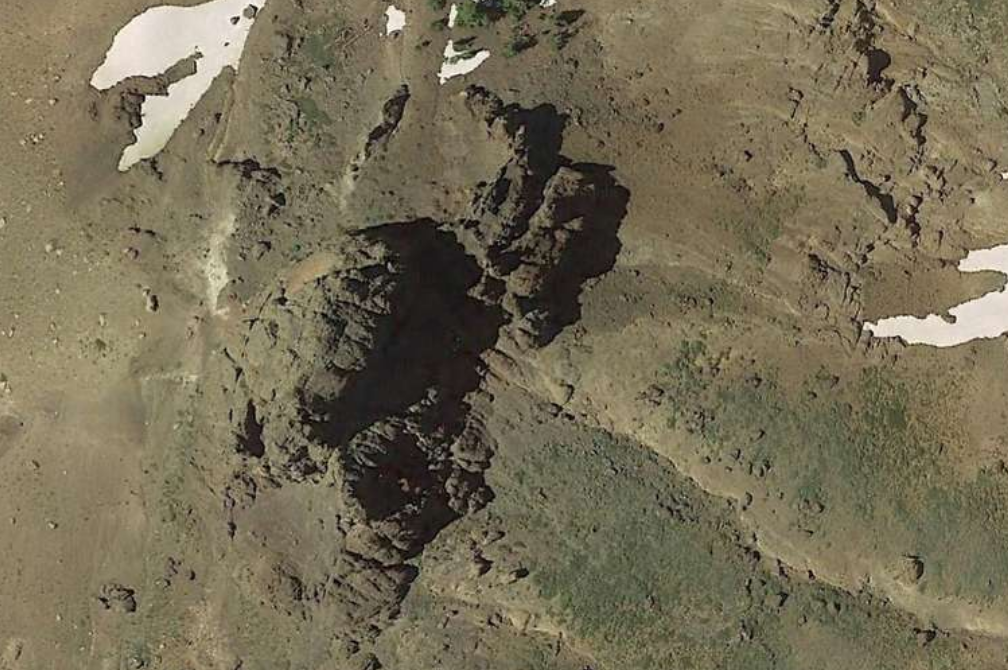
A Google Earth satellite image of Jeff Davis Peak in Alpine County.

By Mike Moffitt, San Francisco Chronicle

Jefferson Davis never set foot in California or Nevada, but two peaks — one in each state — bear the name of the president of the Confederacy.

One, the third-highest mountain in Nevada at 12,771 feet high, towers over Great Basin National Park. The other, 444 miles to the west, is a little known and rarely climbed volcanic plug near Lake Tahoe in Alpine County.

The latter’s rugged, near-vertical slopes seem out of place with the surrounding terrain. They look like they belong in Arizona’s Monument Valley.

Read the whole story