S. Lake Tahoe on cusp of limiting vacation rentals

By Kathryn Reed

Owning and operating a vacation rental in South Lake Tahoe is likely to become more restrictive.

The City Council on Tuesday spent nearly six hours listening to the ideas staff and the subcommittee of councilmembers Austin Sass and Wendy David came up with, and then heard 35 people give their input. (Several people had to leave and never got a chance to talk.)

What the council didn’t identify was what problems exist that necessitate any changes to the current ordinance.

A cap on the number of vacation rentals and the density of those types homes in neighborhoods are the two big unresolved issues.

Sass is of the thinking everyone believes there is a saturation point for VHRS. But that is factually inaccurate. Plenty of people in the room believed free market should dictate the number.

Even among the council there was not consensus on a cap.

Comments on Sept. 5 spanned the spectrum from wanting a ban on the rentals to having an unlimited supply.

Most believe enforcement needs to be a bigger part of the picture. That has been an ongoing theme as these meetings. Noise, trash and parking remain the top three complaints.

The police department has the responsibility to make sure the laws are enforced. Community service officers are hired to do this. A second person is coming on board soon, which means there will be coverage seven days a week.

Councilwoman Brooke Laine believes enforcement is lacking – saying one CSO working four days a week is not robust enforcement.

Sass doesn’t believe there will ever be enough enforcement to satisfy people.

An increase in permit fees for owners was supposed to pay for added enforcement. The city admits it has had a hard time finding people to fill that position, so the added enforcement has not been consistent. This means it is not known if adequate enforcement would resolve real or perceived problems.

From mid-December through mid-March, High Security Patrol workers were hired in a pilot program to work 10-hour overnight shifts. They did not interact directly with people at the VHR, but instead reported back to the community service officer who made the face-to-face contact. The $30,800 for the 90-day contract came from the Undesignated Vacation Home Rental Fund.

As of Tuesday’s meeting, there were 1,350 active vacation home rental permits, with 92 pending. This represents about 18 percent of the housing stock in the city limits. Including the tourist core, there are about 1,800 VHR permits.

While the city contends the number of VHR permits is going up, based on stats provided by staff in July 2015 there were 1,600 permits before the changes took effect that year and were closer to 2,000 after the new rules.

In 2015, it was stated that vacation rentals are a $20 million business in town. Changing the rules could reduce that figure. As one person said, a cap would be a “community killer.” Secondary businesses like cleaning, hot tub service and landscaping are part of the VHR economy.

For the city, transient occupancy tax is its main revenue source, equating to millions of dollar a year.

The council has been tweaking the ordinance nearly every year since it was first adopted in January 2003.

While no action was taken Sept. 5, direction was given to staff to come back with a revised ordinance that would include:

·      Mandatory bear boxes for VHRs.

·      Allowing homeowners associations in the Tahoe Keys and Tahoe Tyrol to enact their own rules.

·      Increasing fines.

·      Eliminating warnings.

·      Counting children as occupants.

·      Limiting hot tub use from 7am-10pm.

·      Occupancy totals being two per bedroom. Occupancy is any time of day – not just those sleeping there.

·      Eliminating zoning hearings.

The tourist core area would not be affected by any changes in the next iteration of the ordinance.

Many of those commenting spoke about the potential of new VHRs not being allowed within 250 feet of an existing one. (This was a subcommittee recommendation.) With many neighborhoods having 50- to 60-foot frontages, that would mean about every fifth house could be used as a VHR. The city, though, could not provide a figure for how many VHRs would then be allowed.

Laine did math at the meeting and came up with a total of 250 VHRs would be allowed if the 250-foot rule were enacted.

Staff said they’d come back in October to show how many VHRs would be allowed based on different density scenarios.

Existing VHRs would be grandfathered in. However, industry representatives said about 15 percent of VHRs turn over each year. Their fear is ultimately there would be a dramatic decrease in the number of VHRs because the homeowner could not meet the 250-foot criteria.

Jerry Goodman, who has been a longtime opponent of VHRS because of the problems in his neighborhood, said he would consider getting a permit to stop others from being able to get one.

The subcommittee thought going forward 1,100 square foot homes or smaller should not be allowed to be a VHR. The thinking is this could help free up housing stock for permanent residents.

Councilman Jason Collin said it’s important to separate the VHR issue from housing for full-time residents. He mentioned how he recently rented a small place and knows people coming to Tahoe might want a similar abode. Plus, he believes those owners should be able to make money.

Councilwoman Brooke Laine seconded those thoughts. She said it’s better to incentivize what the council wants, not set up obstacles to what they don’t want.

David supports 1,100 square foot and smaller houses being taken out of the VHR pool because she believes locals would be able to live there.

Ultimately, the 1,100 square foot threshold was eliminated.

(Councilman Tom Davis had recused himself from the entire discussion because of his ties to Tahoe Keys Resort Association.)

The subcommittee had wanted owners to be subjected to the same rules as renters, which would include noise and occupancy. That rule would mean owners could essentially not have parties because they would be over the occupancy threshold. That idea got dropped.

It was also agreed to back off on the idea of having an owner or their rep have to meet with the renters in person.

The council is slated to revisit the vacation home rental ordinance at the first meeting in October.

At the end of the meeting the council asked staff to bring back an agenda item to discuss possibly limiting the size of house on lots to thwart McMansions that tend to be built primarily as a vacation rental.




Catastrophic storms, once rare, are almost routine

By Amina Khan, Los Angeles Times
 
While climate change did not cause Hurricane Harvey, it could explain the intensity of this tropical cyclone as well as other catastrophic storms that have hit the United States in recent years, experts say.

Harvey is the latest in little over a decade of “500-year” and “100-year” floods that once were considered rare. The storm, a Category 4 hurricane when it initially made landfall last week, has dumped trillions of gallons of water onto southeastern Texas, submerged houses and freeways, driven Houston-area residents from their homes and resulted in more than 20 deaths.

Climate change won’t mean more storms overall — but it probably will mean that that biggest storms become even bigger, scientists say.

Read the whole story


Tahoe Paradise Park reinventing itself

Michael Moughler looks on as his mother and sister kayak around Lake Baron. Photo/Jessie Marchesseau

By Jessie Marchesseau

MEYERS – On a recent Friday afternoon, Michael Moughler lounged on the shore near Lake Baron while his mother and sister paddled their kayaks in the quiet, mirror-smooth water. This is a pretty average day at Tahoe Paradise Park, and that’s part of the reason Michael loves it so much.

He comes here at least three times per week, sometimes more. He walks his dog on the trails, kayaks and swims in Lake Baron and rides his bike around the 56-acre park. He taught his mother, Jan Moughler, how to kayak on this very lake where she is now, in turn, teaching Michael’s sister.

The park is mostly used by locals, and most days it’s pretty quiet. Jan Moughler pointed out that you can still come down here and be able to get a picnic table pretty much anytime, but she also enjoys the events in the park like the concerts, car shows and dog-friendly fundraisers.

Tahoe Paradise Resort Improvement District has been implementing quite a few changes in recent years, including hosting such events. Though they weren’t able to pull together many events this summer, the board of directors has still been busy working on projects.

As for visible changes at the park, the new sign should go in at the entrance this month, the recently restored flower garden is just starting to bloom, and if you take the time to throw in a line, you might pull out one of the freshly stocked trout.

Moughler said he has noticed the trails looking cleaner than in past years and is a big fan of the board’s decision to start allowing dogs in the park a few years ago.

“I just hope that everyone respects it as much as I do,” he said of walking his dog in the park.

The newly resurfaced pickleball courts at Tahoe Paradise Park. Photo/Jessie Marchesseau

Another recent, though less visible change, is the transition from a resort improvement district to a parks and recreation district. Though this change should not have much, if any, effect on the day-to-day operations of the park, it will allow them to take advantage of more recent laws and regulations. The paperwork is still in the pipeline, but the switch is expected to be final in January.

The board is also gearing up for a fall project which includes replacing the deck, adding ADA compliant paths to the building, beach and deck, as well as rehabilitating the sandy beach area in front of the clubhouse. At the Aug. 31 meeting, board members discussed procuring bids in the coming weeks with the intention of completing the project before winter so it will be ready for spring weddings.

Last year, the TPRID board decided to raise the fees for weddings, almost doubling the price, to an amount they deemed to be more in line with the rates of other local wedding venues. Victor Babbitt, chairman of the board, explained that part of the reason behind the price increase was an effort to make the park and its clubhouse more about the community and less about weddings.

Babbitt said he envisions things like community events, boat rentals and kids programs taking place in and around the clubhouse. If it is rented out for a wedding every weekend, it makes that virtually impossible. It also makes maintenance difficult as it can’t be done during weddings and events. However, they still need the revenue from weddings, so having fewer weddings at a higher price has worked out so far.

Another source of income this summer has been fees for using the newly resurfaced tennis and pickleball courts. One of the existing courts was resurfaced as a tennis court again, and one was turned into four pickleball courts. A $3 per day fee was implemented for use of the courts which visitors put into a box designated for payments. It’s strictly on the honor system, and there are enough honest people using the courts that it has brought in more than $1,300 this summer.

The third court still sits in disrepair with its future up in the air. It could become any number of things: a sand volleyball court, basketball court, bocce ball court, tennis court and raised community garden are just some of the ideas being considered.

Moughler, though not much for organized sports, told Lake Tahoe News he thought people would probably like the see the volleyball court put in.

Another potential source of revenue could be created by allowing a Verizon cell tower to be erected on park property. Verizon would pay a monthly rental fee for the tower. While still in the early stages of discussion, if approved, construction of the tower could start as early as next summer. 

Other recent changes include renting out the onsite house which used to be part of the compensation package for the park caretaker. The tenants have been in for nearly a year now. They pay a reasonable rent and perform only minor duties like opening and closing the gates and ensuring everyone is out by closing time.

Tahoe Paradise Park currently has three employees: two maintenance workers and one event coordinator. The board is looking at expanding the staff next spring to also include a part-time park aide, a student intern and possibly a live-in park host similar to a campground host. The host would be able to park a live-in trailer or RV in a designated spot in the park in exchange for helping visitors and performing light park maintenance duties.

The board still has numerous additional master plan items in the works, the largest of which is the installation of bathrooms. With a price tag in the hundreds of thousands, the board is still searching for grants or donations to help fund it. Other projects such as benches around the lake, restoring the large picnic area, installing a gazebo, rehabilitating the basketball and baseball areas, staining the clubhouse siding, creating a walkway through the marsh at the south end of the lake and repairing the parking lot are still on the list. Board members hope they will come to fruition in the no-to-too-far future through a combination of donations, volunteer hours, grants and park funds.

But with all these “improvements” on the horizon, Moughler said he likes the park just the way it is: “I love it here. It’s my little paradise.”


A candid discussion with Nevada’s governor

By Steve Sebelius, Nevada Public Radio

Gov. Brian Sandoval is a fan of history. And why not? He’s made a fair bit of it himself.

He was Nevada’s first Hispanic statewide elected official when he won the race for attorney general in 2002. He was the first Hispanic governor when he was elected in 2010. And he was the first person in state history to defeat an incumbent of his own party in a primary when he ousted then-Gov. Jim Gibbons.

He was also the first Republican governor to decide — after the U.S. Supreme Court upheld the constitutionality of the Affordable Care Act — to expand Medicaid in Nevada and establish a state-based health insurance exchange. His support of the program was a factor as national Republicans debated an ultimately unsuccessful effort to dismantle it. And he was the governor who oversaw the implementation of the first tax on business revenue in state history in the unlikely crucible of a Republican-dominated state Legislature in 2015.

Read the whole story


Wildfire outlook: Nev. risk high through Sept.

By Benjamin Spillman, Reno Gazette-Journal

The western wildland fire season is reaching its peak and will head into decline by the end of the month, except in western Nevada around Reno and Carson City.

That’s according to the National Significant Wildland Fire Potential Outlook issued Friday by the National Interagency Fire Center.

The seasonal outlook forecasts the nation’s fire risk by region.

“Fire season will peak by mid-September as the fuels remain much drier than average and as existing precipitation trends continue,” the overall forecast stated. “By mid-September decreasing solar radiation received and longer nights will allow for fuel moistures to begin recovering.”

Read the whole story


Opinion: Embracing change on Labor Day

By Kathryn Reed

It was in 1894 that Congress passed legislation making the first Monday of September a holiday in honor of those who labor.

More than 120 years later the labor force is dramatically different, and yet not so much. There are still carpenters, teachers, nurses and many other professions from the 19th century.

But who could have envisioned the shared economy we have today that is upending the norms of long-held traditions? Visionaries. That’s who.

Innovation and progress are the American way. People are always looking for new ways to provide an old product. We are looking for new products to improve upon what we have. And then there is the creation of entirely new commodities and services.

The world today is moving fast. It’s easy to fall behind. Technology is a blessing and a bane.

I look at when I was in college. I had an electric typewriter. There were students who couldn’t type who paid me to type their papers. Today, every elementary school student can type because they are using computers in the classroom. I think about the discs I had for old computers. Now I’m on the couch typing this on a laptop; my work is automatically saved in the cloud.

(This device also serves as my Kindle, stereo and primary communication tool to the world.)

As a kid I looked forward to watching certain TV shows on set nights. “The Wonderful World of Disney” was on Sundays, and was family time. Is there even that sense of anticipation anymore? It was a big deal when I got my first VHR player. Then a DVD player. Now I don’t own either. I stream and watch shows at all hours of the day and night, nothing to record. Binge watching – gotta love it.

It’s easy to take these advances in technology for granted. It’s easy to ignore that these “improvements” displaced some workers. Jobs were eliminated. It was more than downsizing; it was that the actual job no longer existed. It’s happened in my own profession. While I don’t remember lead type, I do remember newspapers being pasted up. I even remember paper.

Nothing stays the same. That can be sad. We all have a sense of nostalgia for the good ole days – whenever those were for each of us.

I hear a lot of grumbling about the shared economy from those who are content with the status quo. Change is hard. It’s especially difficult when you’ve built a successful business – the model has worked for years – and suddenly you feel blindsided. It’s not an enviable position to be in.

But change isn’t new.

Successful businesses provide the consumer with what they want. Steve Jobs, the late Apple Computer co-founder, told Business Week, “A lot of times, people don’t know what they want until you show it to them.”

Who knew people wanted lime colored bikes to ride in South Lake Tahoe? Apparently the owners of LimeBike. Much to the consternation of some folks this concept of renting a bike for a few minutes and dropping it off pretty much anywhere is too much for them. It’s upending their business model.

Ah, those words – change, adaptability, innovation, progress. It’s hard when it’s forced upon you. It’s hard when you are the follower and not the leader. It’s hard when all you want to do is keep things just as they are and the world around you won’t let that happen.

The founders of Airbnb didn’t really create something new; they put a modern twist on a short-term boarding house. The lodging industry is adapting.

Ride sharing companies have turned the taxi industry upside down.

Food trucks and delivery services are changing what it means to eat out.

Massage therapists travel to people’s houses; not everyone needs a spa.

Businesses don’t need their own four walls, but instead are content to share space with others – even on an hourly basis.

The news comes to an inbox and not the front porch.

Change. It happens in every business. Sometimes if feels like it comes at a glacial pace, sometimes at the speed of light.

Fighting it is rarely successful. It’s the consumer, really, who will dictate what succeeds.

Hopefully, it’s a labor of love that keeps you punching that proverbial time clock. Just don’t get too complacent, change is coming – it always does.

Kathryn Reed is publisher of Lake Tahoe News.


To Tahoe Eric Church is Mr. ‘Understood’

Eric Church delivers high-energy country to fans on Sept. 2 at Harveys. Photo/Kathryn Reed

By Susan Wood

STATELINE — It was like a revival the minute southern country artist Eric Church hit the stage for the faithful who showed up and stood up in great numbers Saturday night for the last artist at the outdoor summer concert at Harveys this year.

Church, a singer and guitarist who represents a cross between southern rock and outlaw country, played the entertainer to the cowboy-hat-clad crowd. Many fans were enthralled, mouthing the words to most of the songs they all recognize from his high-energy, seven-piece band. 

Among the fans were Amanda Horsman and Byron August, the latter who came in a Led Zeppelin shirt. They came up from the Sacramento area for the concert, which started later than usual by a half hour.

“We’ve seen a lot of people, but he really cares about his fans,” August said. He explained that he heard Church bought a record press so he could deliver the music to his fans before it was released to radio stations.

Church does nothing to shy away from the unconventional. His latest album released two years ago, “Mr. Misunderstood,” arrived in the mailboxes of his church choir members.

August understands that purist dedication to country music. He owns a record player.

Mitzi Olsen of Gardnerville, who danced most of the evening, also noted that she admires Church because he is “super country.”

“So many people play country songs. I feel like he’s still just country. He’s stayed true to his roots,” she said. Olsen first heard Church while she was vacationing in Utah and has remained loyal to the North Carolina artist who played Jimmy Buffet cover songs with a band while in high school.

He’s come a long way since then.

With his signature aviator glasses that protect his contact lenses from the heat of the lights, Church, 40, burst on the scene about a decade ago. He styled an image from his blue-collar demeanor and no-surrender type of passion that proves nothing comes easy – even to nice guys.

His southern outlaw country rock genre ran the gamut at the concert. The outlaw appeal of an award-winning artist with five albums under his belt came out with 2009’s “Smoke a Little Smoke,” written with his known cannabis advocacy in mind; and his No. 1 single from 2012, “Drink in My Hand” – which joins the mega hit “Springsteen” on his widely popular 2011 album “Chief.” “Cold One” from the 2014 “Outsiders” album also got the crowd jumping, yelling and raising their drinks.

“Doing OK?” he asked, holding up his own beverage. The crowd roared.

With a few fist pumps and lunges to the edge of the stage, Church often smiled and looked tickled by how engaged his audience was.

Fans show their love for Eric Church. Photo/Kathryn Reed

During “These Boots” from his 2006 “Sinners Like Me” album, some in the crowd threw their cowboy boots up on the stage. Church implied they’ve “saved his ass” a few times, even while holding up a red kiddie boot that appears too young to worry about such things.

Beyond the raucous image, Church demonstrated how quickly he can rotate from hard-driving electric guitar to acoustic with sentimental tunes that touch at heart strings.

His huge hit “Give Me Back My Hometown” shows his appreciation of his geographic roots complete with a “Pizza Hut,” and the crowd reciprocated. As many do, the first-timer to the area also mentioned how lucky Tahoe residents have it with the region’s stunning beauty.

And with love you baby “Like a Wrecking Ball,” he gave the audience a glimpse of what it’s like to come home from his on-the-road excursions. 

A few women even made a banner to acknowledge their fan club-like appreciation of reckless love by recklessly trying to gain access to the stage. Security stopped them temporarily, but Church ended up signing the banner later in the show.

More of the sentimental that had the crowd swooning and swaying, Church launched into his new smash hit “Record Year” – with the crowd immediately recognizing it. At first, the song from “Mr. Misunderstood” is just that. But it’s really about how he dealt with the loss of a love.

At times, the country artist marveled by his fans’ enthusiasm.

“You know, I’ve played this song countless times, but I’m not sure if anything is better than this right here,” he said, stopping to admire the crowd. He stood there with two American flags handed to him, draped around his neck as he played his mega hit “Springsteen” about a love affair. 

Upon ripping into “Holdin’ My Own,” Church touched his heart to say goodbye on his last song running long past 10pm. But he returned for an encore of “Like Jesus Does” – an acoustic number about lasting love.

“This is the greatest thing music does. It freezes this moment in time. We haven’t played for a while, so this moment is frozen for me. The way you stepped in to sing. I want to say you’re the greatest,” he told the crowd with a bow.

Church plays again Sunday evening to wrap up the Harveys Outdoor Summer Concert Series.


Why housing costs are so high in Calif.

By Ben Christopher and Matt Levin, CalMatters

Half the state’s households struggle to afford the roof over their heads. 

Homeownership—once a staple of the California dream—is at its lowest rate since World War II. Nearly 70 percent of poor Californians see the majority of their paychecks go immediately to escalating rents.

State lawmakers are debating a long-delayed housing package.

Just how hard is it to buy a home in California? Hard. Really hard. Both compared to how hard it is in other states, and how hard it was for previous generations of Californians to buy homes.

Read the whole story


American pika disappears from large area of Sierra

By Tim Stephens, UC Santa Cruz

The American pika, a small mammal adapted to high altitudes and cold temperatures, has died out from a 64-square-mile span of habitat in California’s northern Sierra Nevada mountains, and the cause appears to be climate change, according to a study published Aug. 30 in PLOS One.

Researchers surveyed pika habitat throughout the North Lake Tahoe area and found that pikas had disappeared from an area that stretches from near Tahoe City to Truckee, more than 10 miles away, and includes Mount Pluto. This local extinction is the largest area of pika extinction yet reported for the modern era.

“The loss of pikas from this large area of otherwise suitable habitat echoes prehistoric range collapses that happened when temperatures increased after the last ice age,” said lead author Joseph Stewart, a doctoral candidate at UC Santa Cruz. “This time, however, we’re seeing the effects of climate change unfold on a scale of decades as opposed to millennia.”

Read the whole story


Tahoe’s summer heat ties at fourth hottest

By Susan Wood

It’s been hot this summer at Lake Tahoe – to the tune of fourth in ranking since records were taken 123 years ago at an average of 62.1 degrees. It ties with 1981’s figure. Keep in mind, this is the average from day to night.

The record was set in 1988 at 62.4 degrees – the same year in which Tahoe experienced its hottest day on record at 99 degrees on July 22, the National Weather Service reported this week.  The “summer” officially ends its quarter on Aug. 31 for the federal agency.

As a comparison, this summer’s hottest day occurred on June 19 at 90 degrees – at a time when some people were still skiing.

And so it goes with our topsy-turvy climate.

Even though this year missed the record by 0.3 degrees, the significant aspect of the data shows that four of the five record years have fallen in the last five years. Case in point, 2014 was second in line for the record at 62.3 degrees; with 2015 close behind at 62.2 and 2013 at 61.8 degrees.

This year goes down as having continuously hot days. And if you remember especially in July, the variance wasn’t as great from day to night as it traditionally is in Lake Tahoe’s surrounding air. Hence, we were near a record average for the 24-hour days.

Reno hit a record of 108 degrees this July – a month that will go down as the 10th hottest in the United States. The contiguous U.S. averaged 75.7 degrees in July. That’s 2.1 degrees above average. Even the northernmost state, Alaska, experienced a hot July with 56.2 degrees. That’s 3.5 degrees above the long-term average.

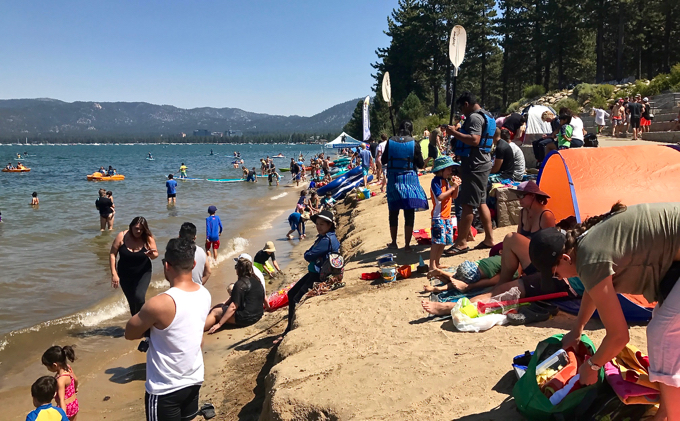
Lakeview Commons in South Lake Tahoe is a popular spot to beat the heat. Photo/Kathryn Reed

Is this the new normal?

“What contributed to our hot summer is the month of July. And (in Lake Tahoe), there were more days in which we were warm,” Evan LaGuardia, meteorologist with the National Weather Service meteorologist in Reno, told Lake Tahoe News.

Even the water temperature in the lake shows an abnormal result. The lake temperature within 2 meters down is fluctuating between 69 and 70 degrees. Albeit the water temp being normal for the summer, it shouldn’t necessarily be true this summer given the aftermath from our uncharacteristically dramatic snowfall from last winter.

“With a 69- to 70-degree average, it’s significant this summer because of the water that’s been added from the snowmelt, (which should be taken into account,)” LaGuardia said. In other words, the water temperature should be colder with the high lake level.

Another factor in warm surface water temperature: “There hasn’t been the storms to churn up the water making it cold,” the meteorologist added. Storms mix up the surface with the deep water of Tahoe through upwelling.

“It has been warm. Who knows what the future holds,” LaGuardia said.

To that, Western Regional Climate Center climatologist Dan McEvoy provided a glimpse.

“There’s definitely a climate change signal pretty much all around the region with our warm days,” McEvoy told Lake Tahoe News.

We’ve been seeing this every year. We can’t put our finger on any one thing, but we should see warmer temperatures, in general, as we’ve seen in the last few decades,” he said.

What does this mean?

“What we’re going to see doesn’t contribute to drought, but it intensifies the impact of those droughts,” he said, listing the wildfire danger and bark beetle infestation.

McEvoy pointed out that most of the 10 coolest summers of the last 100 years have occurred in the first half of the 1900s. Records show the last cool summer occurred in 2011 at an average of 58.3 degrees – the coolest in the last decade. The coolest average summer in the years of record keeping was in 1980 at 54.5 degrees.

So the decade of big hair showed big temp swings in summer as having the coolest and hottest for our region.

“The last summer when the temperature in Reno was below the 20th century average was in 1999,” said Jake Crouch of the National Oceanic and Atmospheric Administration. “While the upward trend is likely to continue, indicating that warm summers will occur more often than not, we can still experience cool summers in an overall warming world.”

Still, it’s hard to ignore that warm is the new normal, all data and climate stakeholders say.

For example, the 20th century’s average summer temperature for Reno was 71.2 degrees, while this one has already dwarfed it at 74.2 degrees. And, there are 83 years left to sizzle.

With that, utility companies are keeping an eye out and doing their record keeping.

Energy use represents a mixed bag for South Lake Tahoe. Liberty Utilities shows no spike in California electricity this summer compared to previous ones, with kilowatt hours holding steady this last July at 47.66 million. The highest in the last five years came in at 49.05 million in 2013, company spokeswoman Kathy Carter dictated.

And water use is usually higher in the summer, according to the South Tahoe Public Utility District, for obvious reasons.

And these numbers could fall for not-so-obvious reasons, with STPUD in the process of installing more than 1,000 meters this summer. The effort encourages water conservation.

“July is always the month of peak production, followed closely by August,” STPUD spokeswoman Shelly Thomsen said for now. “The district’s water production doubles to triples in summer months, mainly due to landscape irrigation.”

However, many homeowners have elected to forego grass in their Tahoe yards – with hundreds waiting to be called up for the turf buy-back program. So conservation efforts should continue to keep in line with increasingly hot summers.

This trend may represent good news for businesses such as Nixon’s. The local HVAC company has experienced a doubling of calls this summer inquiring about air conditioning during our heat waves in contrast to previous years.

“Before, people here would pass on AC. Now it seems we’re putting in AC units in every Tom, Dick and Harry unit. Lots of Bay Area people who are buying and have the means to put them in are opting to have them,” said Wendy Pierson, who works for Nixon’s.