Meyers Area Plan on track for winter adoption

By Kathryn Reed

After two years of silence, El Dorado County has released the final draft of the Meyers Area Plan. This is the fourth version.

It was almost like all sides needed a cooling off period.

Years of raucous meetings did more to divide than to unite the community.

What most could agree on was the mission statement that was developed: “Meyers is an ideally situated, spacious, historic, and walkable mountain community that values sustainability, health, wellbeing and the natural environment. Uniquely concentrated with year-round outdoor sport and recreational opportunities, the Meyers mountain culture is the hallmark of our thriving local-based economy boasting a diverse commercial and retail environment, welcoming visitors and providing residents with an extraordinary place to live, work and play.”

The area plan was created with the goal of embracing that sentiment, while at the same time adhering to a lot of government regulations.

The public has a month to comment on the notice of intent to adopt a mitigated negative declaration of environmental impact. There is one public hearing on the notice. However, the area plan itself will have five public hearings – two via El Dorado County and three for the Tahoe Regional Planning Agency. Feb. 22 is the tentative date for the TRPA Governing Board to vote on the plan.

This area plan builds on the 1993 community plan. That plan, while it was supposed to be updated every five years, never was.

“I thought the Meyers Community Plan was well thought out and I think the area plan is, too,” Supervisor Sue Novasel told Lake Tahoe News. “It will be interesting when we go through public comment to see if people have concerns with it.”

Novasel will not be able to vote on the plan because of having property in the area.

“At a glance, it looks like the proposed land use and zoning does not match what the majority of the community input asked for during previous iterations,” Jennifer Quashnick, a Meyers resident who has been vocal throughout the process, told Lake Tahoe News.

Brendan Ferry with the county said the substantive changes since the public last viewed the area plan have more to do with TRPA passing its transit plan, as well as changes to state and federal law.

The 42-foot maximum height for new construction was retained from previous versions. TRPA would have allowed 65 feet.

“We changed the sign standards extensively,” Ferry told Lake Tahoe News. “There will be a more uniform setback to make the corridor more visually appealing.”

In the new plan 348 acres are considered conservation land, while 137 acres are designated recreation. Historic trees remain protected.

Condensing the plan to three distinct regions would allow for a hotel to be built; which was not possible under the community plan. Density regulations would limit it to 30 units per acre.

TRPA rules, the right-of-way from Caltrans and the limited size and number of parcels in Meyers might never make that type of business a reality, though.

The extensive right-of-way that Caltrans has remains. Rejiggering that debacle would come outside the scope of the area plan.

Even without the area plan being a done deal, the county is going forward to make the roads in Meyers better. On the Sept. 12 Board of Supervisors agenda is an agreement with Caltrans for “a multimodal complete streets strategy.” A roundabout at highways 50 and 89 is in the works.

—–

Notes:

·      Comments are due Oct. 6. Send them to: El Dorado County, 924 B Emerald Bay Road, South Lake Tahoe, CA 96150 Attn: Brendan Ferry.

·      The public hearing on the notice will be Sept. 27 before the Tahoe Regional Planning Agency’s Regional Plan Implementation Committee. The meeting will be at the North Tahoe Event Center in Kings Beach.

·      The document is available online.


West had snowy winter, so why the fiery summer?

By Dan Elliott, AP

Acrid yellow smoke clogs the skies of major Western U.S. cities, a human-caused fire in the Columbia River Gorge rains ash on Portland, Oregon, and a century-old backcountry chalet burns to the ground in Montana’s Glacier National Park.

Wildfires are chewing across dried-out Western forests and grassland, putting 2017 on track to be among the worst fire seasons in a decade.

A snowy winter across much of the West raised hopes that 2017 wouldn’t be a dried-out, fire-prone year, but a hot, dry summer spoiled that.

Read the whole story


Real estate investors not living where they buy

By Michelle Robertson, San Francisco Chronicle
 
At 24 years old, Ben Hunter is a homeowner, but a sizable portion of his paycheck goes to rent for a room in an 11-person house in San Francisco. That’s because the home he owns is located about 3,000 miles east, in Atlantic City, N.J.

About 35 percent of homes in the county of San Francisco are occupied by their owners, according to census data, compared to 54 percent nationally.

Brooke Hernandez, a Realtor in Lake Tahoe and former president of the South Tahoe Association of Realtors, says about 75 percent of her clientele lives in the Bay Area. She says she’s recently worked with 10 buyers with permanent residences in the Bay Area who can’t afford to purchase homes there.

“It makes sense to me,” she said. “There’s value in investing in real estate, even when you can’t afford what’s in your neighborhood.”

Read the whole story


National tennis tourney coming to Zephyr Cove

By Kathryn Reed

Zephyr Cove Tennis Club will be hosting its first national tournament next week – the USTA National Husband Wife Hard Court Championships.

Each year there are four main husband-wife events played on a different surface: hardcourt, grass, clay and indoors. And like the pros, if a couple were to win them all, it would be a grand slam.

It’s open to any level, though most have a 5.0 or 5.5 rating. The actual categories are combined ages of 100, 120 and 140. More than 50 people have signed up for the Sept. 11-17 tournament. They are coming from as far away as Massachusetts and Florida.

Sheryl and Hersh Herschman, who live part time at the lake and part time in the Palm Springs area, are running the tournament. They are founders of the annual Tahoe Tennis Classic that is played at ZCTC, which is now run by the nonprofit that operates those six courts. For the last three years the Herschmans have run the national father-daughter and mother-son tournaments at Springs Country Club in Rancho Mirage.

“I love Lake Tahoe and wanted to bring these people up here,” Sheryl Herschman told Lake Tahoe News.

These tournaments don’t change locations every year, so in many ways this is quite a coup for the Herschmans as well as Zephyr Cove Tennis Club and all of Lake Tahoe.

If all goes well, the Herschmans hope the husband-wife tourney is a regular fall event on the South Shore.

“USTA national tournaments are the only ones that the USTA awards the gold ball to the champions, silver ball to finalists and bronze ball to the third place winners. Being the recipient of any of these balls is considered a very impressive accomplishment,” Herschman said.

The U.S. Tennis Association is all about getting more people onto the court. Specialized tournaments like this is one way to do it.

It’s a lengthy process to apply to be tournament director, secure the location and do everything that is involved with such an event. The Herschmans started the procedure more than a year ago.

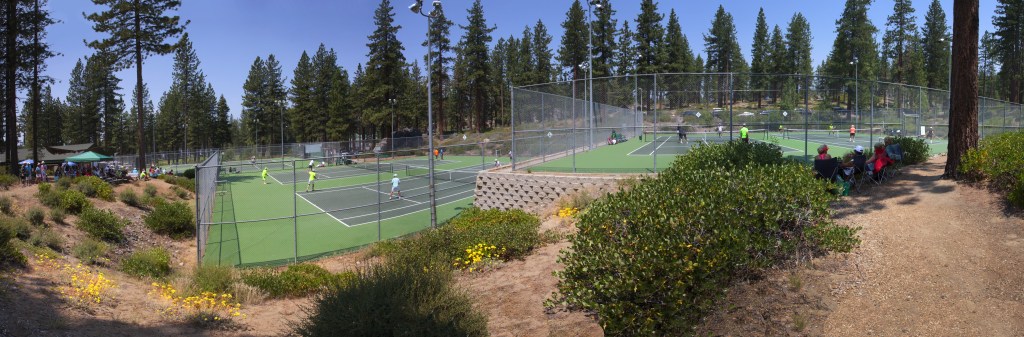
The USTA National Husband Wife Hard Court Championships will be at Zephyr Cove Tennis Club Sept. 11-17. Photo Copyright 2017 Carolyn E. Wright

“Why choose Lake Tahoe? No. 1 it’s the facility, and No. 2, how do you beat Lake Tahoe?” Steve Leube, executive director of USTA Northern California, told Lake Tahoe News. “It’s about playing the sport of tennis and the atmosphere and what the area offers outside of tennis. There is a lot to do outside of tennis.”

That is what Herschman used to sell the area as well – the whole outdoor lifestyle, and indoor, too, if people are into gambling.

For the club, it means a little more exposure beyond the local members and couple hundred people who play in the July tournament.

“Zephyr Cove is a special tennis venue, being nestled in the forest with peeks of the lake. Our tennis community welcomes all levels of play, making it feel like a family. That’s why having one of the USTA’s family events here is so special,” Carolyn Wright, Zephyr Cove Tennis Club Foundation president, told Lake Tahoe News. 

Three local couples are playing in the tournament: Holly and Ross Rittiman of Zephyr Cove, Louise and Philip Proffer of Glenbrook, and Susan Losoncy-Ruch and Lee Ruch of Carson City.

“We want to take advantage of this opportunity to play in a national tournament and to see how we do with this higher level of competition,” Holly Rittiman told Lake Tahoe News. “Tennis is such a great sport for the whole family and I can’t tell you just how much I love playing with my husband and children. I know that many spouses have problems on the court together … what can I say, Ross is very tolerant and forgiving.”

Actual play starts Sept. 12. There is no charge to watch the various matches. Food will be available as well as merchandise.


Billions of dead trees force fire crews to shift tactics

By Associated Press

Vast stands of dead timber in the Western U.S. have forced firefighters to shift tactics, trying to stay out of the shadow of lifeless, unstable trees that could come crashing down with deadly force.

About 6.3 billion dead trees are still standing in 11 Western states, up from 5.8 billion five years ago, according to U.S. Forest Service statistics compiled for the Associated Press.

Since 2010, a massive infestation of beetles has been the leading cause of tree mortality in the West and now accounts for about 20 percent of the standing dead trees, the Forest Service says. The rest were killed by drought, disease, fire or other causes.

Read the whole story


Scientists: ‘Fingerprints of climate change’

By Dale Kasler and Ryan Sabalow

Wildfires from the Oregon border to Los Angeles. Temperatures hitting 100 degrees in San Francisco, and higher in Sacramento, capping off the hottest summer in California history.

Not to mention two of the most ferocious hurricanes ever recorded.

It has to be climate change, right?

The answer is a little more complicated than you might think.

Read the whole story


Transit agency working on short-term upgrades

By Kathryn Reed

Those who run the South Shore bus system and those who use it know it’s a bumpy ride, at least figuratively.

No longer using the never understood BlueGo name, the Tahoe Transportation District is just calling the system by the government body’s name. New buses have the TTD logo and color scheme. (Money isn’t being spent to repaint the old buses.) Signs at the stops have a bus symbol for the first time. No longer do people have to guess what a BlueGo is.

Three additional hybrid buses will be operational later this month; two electric buses are coming in 2018.

Even though the system appears to be managed more professionally, operationally it is still far from ideal. Frequency – or lack of – is a constant complaint. Routes are another contentious topic.

TTD is addressing some of those concerns in the short range transit plan, the first such document it has created for the South Shore bus line. This bus service also stretches into Carson City because of funding from Nevada; it’s a way to help commuters.

The document will be the subject of a discussion at the Sept. 8 TTD board of directors meeting. The five main objectives in it are: safety, workforce development, fleet expansion and replacement, facility capacity and modernization, and future service expansion. Many of these are interrelated, though not necessarily in an obvious way.

Tahoe Transportation District is working on little things — like logical signage. Photo/LTN

The district hosted a public meeting last week, which was not well attended, that was intended to provide information about the plan. The document outlines goals for the next five years.

Funding is the main constraint when it comes to expanding routes and service. Expanding to Meyers and creating a hub at Lake Tahoe Community College are the first likely expansions. Seasonal routes are being worked on to get riders from the casino area to Emerald Bay.

“Without funding to support it, it does the community no good,” Tara Frank with TTD told Lake Tahoe News of why changes will not be immediate. The same goes for increasing frequency to every 15 or 30 minutes. Those ideas are not currently sustainable.

The district has a number of funding sources, from the federal and two state governments, to grants and private contributions. Vail Resorts is a significant contributor, but no longer do the casinos contribute a dime.

Safety will always be at the top of the list as a priority – for workers and riders. Complaints were received last winter that buses weren’t rolling on time. Nothing was. They don’t have magic powers to get through unplowed streets and can only move with the flow of traffic.

Workforce development really means the district is having staffing issues. It’s not alone. TART, the North Shore bus line, had to eliminate some of its winter routes because of a driver shortage.

“We have overtime because we can’t find drivers,” Frank said. “It’s compounded because they can’t find housing. It’s hard to provide service with a thin crew.”

This, then, becomes a safety issue as well.

As the fleet expands – a necessity if routes are added and times shortened – a larger yard will be needed to accommodate the buses. The property leased in South Lake Tahoe is at capacity. The goal would be to build headquarters someplace else, then potentially have workforce housing at the garage.

No land has been identified to service the district’s needs. Officials had looked at the old Kingsbury Middle School site, but safety at the intersection at Highway 50 was a main reason that idea got nixed.

Money for such an endeavor is also elusive.

—–

Notes:

·      The TTD board meeting is Sept. 8, 9:30am at the North Tahoe Event Center in Kings Beach.

·      The draft plan is available online.

·      The last day to comment is Sept. 9.


Travel industry a potent job creator in U.S.

By Tanya Mohn, Forbes

High-tech, health and engineering are among the fields people typically think about when it comes to robust workforce opportunities, but travel is one of the most potent job creators of any American industry. In this country, workers who began their careers in travel and tourism achieved higher peak salary than most other industries.

Those are the results of a new study that analyzed data from the U.S. Bureau of Labor Statistics to highlight the significant economic power of the travel industry in America, the quality of the industry’s jobs, and the large number that are created by small businesses.

“Travel: America’s Unsung Hero of Job Creation” was released by the U.S. Travel Association, a trade group, to correspond with the Labor Day holiday, a peak travel period, to underscore how travel fuels economic recovery, creates promising career paths and spurs small business growth.

Read the whole story


‘Free college’ is a new rallying cry in California

By Alexei Koseff, Sacramento Bee

When State University of New York and City University of New York students return to campus this fall, tens of thousands of low-income undergraduates will pay no tuition under a new scholarship program.

Rhode Island will also begin to cover tuition for nearly all recent high school graduates entering the state’s community college.

And San Francisco will, for the first time, waive enrollment fees at City College of San Francisco for any resident.

Read the whole story


Opinion: LTCC denounces DACA decision

By Jeff DeFranco

Lake Tahoe Community College joins the California Community Colleges Chancellor’s Office and Chancellor Eloy Ortiz Oakley in denouncing the White House’s action on Tuesday to end the Deferred Action for Childhood Arrivals (DACA) program.

Jeff DeFranco

The program protects 800,000 immigrant youth who were brought to the United States by their parents from deportation, and gives them the freedom to work, learn, and live their lives. These young people attend high schools and colleges, hold jobs, and in some cases serve in the United States Armed Forces. This is the only country, and sometimes the only language and culture, many of them know.

On Tuesday, Oakley described ending DACA as a “senseless decision that goes against American ideals and basic human decency. In California, we don’t put dreams – or Dreamers – on hold.”

Lake Tahoe Community College remains committed to serving all students, regardless of their backgrounds or immigration status. We are committed to providing them with a safe learning environment. And, we will continue to protect the private information that all of our students provide in the college application and registration process.

I have met many of our DACA students, and I know they are contributing members of our college and our community. I want our DACA students to know that we stand with them and remain fully committed to helping them achieve their educational goals.

The decision to “unwind” DACA does not impact LTCC students’ ability to attend college, qualify for an exemption from non-resident tuition fees under AB540, or to apply for financial aid under the provisions of the California Dream Act. These are state programs that are entirely separate and distinct from DACA and the federal enforcement of immigration laws.

Current DACA students should know that the action taken by the White House does not mean that the DACA program has been terminated. Instead, a six-month window was created by the Trump administration for Congress to put the program into legislation. For now, current DACA students should know that:

  • Anyone with a current DACA status can continue to enjoy the benefits of the program, including deferred action and work authorization.
  • The Department of Homeland Security (DHS) does not intend to terminate an individual’s DACA status prior to its stated expiration date.
  • An individual whose DACA status is set to expire between now and March 5, 2018, may still apply for a renewal of their DACA status. However, the application for renewal must be accepted by Oct. 5, 2017.

This information comes from a DHS memorandum released on Sept. 5. A link to the entire memorandum is here.

For more information about the California Dream Act and Tuesday’s DACA announcement, please go online.

Jeff DeFranco is president of Lake Tahoe Community College.