West Slope courthouse clears litigation hurdle

By Joann Eisenbrandt

The legal roadblock that has prevented construction of a new courthouse facility in Placerville has just been removed. More than two years after the Placerville Historic Preservation League first challenged the environmental document approving the courthouse, the First Appellate Court of Appeal in San Francisco denied the appeal.

Currently, the county’s Superior Court services on the West Slope are divided among the historic 1912 courthouse on Main Street in Placerville, Building C in the County Government Center on Fair Lane, and a small court facility in Cameron Park. The new courthouse would consolidate court services in an 88,000-square-foot facility on Forni Road off Highway 50 just west of Placerville and adjacent to the county jail.

A decadeslong process

El Dorado County has been considering constructing a new courthouse adjacent to the jail since the jail was built in 1988. It prepared its own environmental document on such a project in 2000. The courts were under the jurisdiction of the counties until 2002, when the state of California took them over under the oversight of the Judicial Council. The land on which the new courthouse would be built will eventually be given by the county to the state.

The process has been a contentious one. The Judicial Council certified its environmental impact report (EIR) for the Placerville courthouse in June 2015. Some have alleged that favoritism, back-door dealings, and a flawed site selection process led to the choice of a site beneficial to special political interests. Concerns were also raised about the impacts on downtown Placerville if the Main Street courthouse and the economic benefit it brings were to be removed.

The courthouse, Kirk Smith of the Placerville Historic Preservation League contends, is essential to the economic health of the downtown business area. Its removal would lead to “absolutely horrendous blight to Placerville’s Main Street, all but turning this historic community into a ghost town.”

Jurors, other court visitors and courthouse staff would no longer contribute to the downtown economy. Court-related county agencies and private legal firms would move to the new courthouse site. Smith proposed leaving some court services at the existing Main Street courthouse and adding an annex.

Opponents of the Placerville Courthouse project lost their appeal. Photo/LTN

The legal battle

In July 2015, Smith’s group filed a lawsuit in San Francisco Superior Court against the Judicial Council’s EIR. El Dorado County and the Board of Supervisors were real parties in interest and respondents in the case as was former state Sen. John Briggs. Briggs swapped 5.2 landlocked acres he owned adjacent to the proposed courthouse site for land the county owned. This was done, the county said, to allow for the best facility site design. Briggs received $10,000 for two yearlong option agreements with the county. The transfer of land has already taken place.

The preservation league contended the Judicial Council failed to adequately consider the “urban decay” the removal of the Main Street courthouse would create. Projects by public agencies must comply with the rules of CEQA, the California Environmental Quality Act. It requires them to identify any substantial environmental effects of proposed projects and outline mitigation measures that would reduce such impacts to less than significant. In July 2016, the court denied the league’s writ.

The league appealed this decision to the First Appellate District Court of Appeal in San Francisco. On Sept. 15, the appellate court agreed with the earlier trial court decision that the Judicial Council’s EIR was not defective and should be upheld. The decision said, “The trial court rejected the argument (of the Placerville Historic Preservation League) and denied the petition in a thorough and well-reasoned written decision that hardly needs elaboration. The decision of the trial court is affirmed.”

Money talks

El Dorado County Chief Administrative Officer Don Ashton told Lake Tahoe News, “The county is very pleased with the appellate court’s decision. It allows the county to move forward with this essential project.”

But this does not mean that construction of the new Placerville Courthouse project will be starting anytime soon.

With the legal obstacles removed, it now becomes an issue of money. In 2008, Senate Bill 1407 authorized up to $5 billion to renovate existing substandard courthouses and build new ones. The Judicial Council reviewed and prioritized the state’s court facilities and created an “Immediate and Critical Need” list of court facilities they termed “the worst of the worst.” El Dorado County’s courts are on that list with funding first approved in 2009.

A critical needs account was created to pay for the projects. Over the intervening years, state budget problems caused money to be withdrawn by the state from the courthouse construction fund and diverted to other uses. This caused some court projects to be scrapped and others like the Placerville project to be delayed. The Judicial Council plans to ask the state to return the money borrowed in the past, but this will take time. In August 2016, the Judicial Council accepted the recommendation of their Court Facilities Advisory Committee to allow courthouse projects like the one in Placerville, which is still in the “site acquisition” phase, to complete the phase they are in, but then be put indefinitely on hold, awaiting an influx of funding.

The Judicial Council website says the projected completion date for the Placerville Courthouse is spring 2022.

Don Mooney, attorney for the Placerville Historic Preservation League told Lake Tahoe News, “We are disappointed in the court’s decision and continue to believe that the project will result in significant impacts to the downtown area.”

What the court said

In its decision, the First Appellate Court of Appeal noted that the Judicial Council’s EIR did address “the possible economic impact of moving judicial activities from the downtown courthouse, it concluded the impact was not likely to be severe enough to cause urban decay.”

CEQA does not usually require agencies to address economic and social impacts of their proposed projects, except when these changes will cause a serious physical change in the environment. It describes “urban decay” as “… physical deterioration of properties or structures that is so prevalent, substantial, and lasting a significant period of time that it impairs the proper utilization of the properties and structures, and the health, safety, and welfare of the surrounding community.” Smith believes this is what will happen. The Judicial Council does not.

The court agreed with the Judicial Council. “Substantial evidence supports the Judicial Council’s conclusion that the type of physical deterioration embodied in the term ‘urban decay’ is not a reasonably foreseeable consequence of withdrawing judicial functions from the Main Street Courthouse and relocating them to a new building outside the downtown district.”

Repurposing the Main Street courthouse

The court concluded that repurposing the building will mitigate economic impacts. Its decision pointed to the creation of a Blue Ribbon Committee to study potential re-uses. The Blue Ribbon Committee was formed in 2015 and consists of members from the city, county and Placerville business owners.

The Judicial Council agreed to provide funding for a consultant to facilitate the committee’s meetings and help identify workable new uses for the courthouse. Although a consultant firm was selected in 2015, the Judicial Council has not finalized their contract due to the current freeze on the courthouse project. The Blue Ribbon Committee has only met sporadically. A survey was created asking residents to prioritize new uses for the Main Street courthouse, with a meeting in April 2017 to go over the results.

Smith told Lake Tahoe News, “The Blue Ribbon Committee was created as a ploy to support the baseless argument that serious efforts were made to mitigate blight. The committee held off meeting until before the case was argued before the trial court, stopped meeting not long after that, resumed as needed when the case was before the appellate court and then they stopped meeting after that. That’s irresponsible.”

According to Smith, “The stakes are too high to give up.” The league will be considering all its options, including appealing the appellate court’s decision.




How Trump will affect Nevada midterm election

By Las Vegas Sun

When will they stop running and start governing? It’s a question voters increasingly have been asking themselves for at least four decades.

Democratic pollster Patrick Caddell first described the phenomenon in 1976, and it was explored more thoroughly by journalist Sidney Blumenthal in a 1980 book, “The Permanent Campaign.” Those who have been elected immediately govern with an eye toward re-election and those who were vanquished look for a way back as soon as the votes are counted.

What had been a latent instinct for politicians developed in the cable news era and accelerated in the internet age with shorter news cycles to be “won.” The same day he was sworn in as the 45th president, Donald Trump filed with the Federal Election Commission to become a candidate for re-election in 2020.

So, no, it’s not too soon to consider how the 2018 midterm elections will unfold. With the balance of the U.S. Senate in part dependent on the Nevada race and a wide-open race for governor, here are key questions about the 2018 elections.

Read the whole story


Tahoe CEQA lawsuits: Public good or private gain?

By Melissa Siig, Moonshine Ink

When Kila Properties purchased the dilapidated Henrikson building in 2013, the majority of Tahoe City residents and businesses breathed a sigh of relief. The run-down Henrikson building, built in the late 1950s (much of it without permits), today is only partially occupied and serves as an eyesore at a key location — the west gateway to Tahoe City.

Kila Properties’ plan to demolish the crumbling building and replace it with the 118-room Tahoe City Lodge, complete with a restaurant, rooftop pool, and bar, met with widespread community support. At the end of 2016, as part of the Tahoe Basin Area Plan, it was unanimously approved by the Placer County Board of Supervisors and the Tahoe Regional Planning Agency, and even received the hard-to-come-by endorsement of the League to Save Lake Tahoe. Demolition was set to occur this spring.

And then it all came to a grinding halt.

In January, the Davis-based California Clean Energy Committee (CCEC) filed a lawsuit to stop the implementation of Placer County’s Tahoe Basin Area Plan, claiming that the environmental analysis of traffic impacts under the California Environmental Quality Act (CEQA) was inadequate. The lawsuit named the Tahoe City Lodge as a party of interest.

Read the whole story


Winter still wreaking havoc on Tahoe power grid

By Kathryn Reed

Power outages are normal, but this hasn’t been a normal summer.

Liberty Utilities is still dealing with the aftermath of last year’s winter. Relying on NV Energy is also impacting customers.

Liberty provides electric service to the California side of the Lake Tahoe Basin, as well as to Truckee, Alpine County and other regional locations. Liberty has been doing so since 2011 when its parent company bought NV’s California territory.

Normally the top four reasons for outages are:

·      Car vs. pole accidents

·      Weather, such as snow, wind, lightning, or trees falling on wires

·      Critters (like squirrels) getting into equipment

·      Equipment failure.

This summer has been different.

“Unfortunately, we’re still feeling the impact of the extreme weather experienced this last winter which really stressed the infrastructure (poles, wires, transformers, etc.) with snow loads and lots and lots of water in equipment (such as underground vaults) that had never been exposed to that much water/snow before,” Travis Johnson, Liberty’s vice president of electric operations, told Lake Tahoe News. “Many of these weak points aren’t readily visible, so the crews can’t proactively go out and fix; they have to wait until a circuit goes out and then track the problem down.”

Liberty is also at the mercy of NV Energy. When something goes wrong across the state line, it can have a ripple effect. An example of this was on Aug. 28 when NV Energy’s Round Hill substation had a fire and cut the power to customers in Nevada and California. The substation is still out of service.

“Liberty has picked up additional load to help them continue to serve their customers until this substation can be repaired. Picking up this load causes greater circuit exposure to the elements because the lines are switched in a way that makes them longer – for example there is more opportunity to have a lightning strike or car v. pole –  and being in fire mode means we have to send someone out to patrol the line before we can restore service,” Johnson said. “The same is true for NV Energy customers—carrying additional, temporary load for Liberty results in greater exposure for their customers.”

Johnson pointed out that while the companies are separate in so many ways, they are relying on a lot of the same old equipment. They have interties to send electricity between service areas. That’s why outages can affect both states at the same time.

Much like the agreements between the local water districts where they can help the other if need be, Liberty and NV have a similar mutual aid agreement.

Outages are usually short-lived. When it’s not fire season the lines automatically recharge. It’s still fire season, so when the energy stops flowing on a line crews have to go find it. It isn’t like there is some circuit board in some office pointing to where the problem is, or that a flick of switch can solve it. It takes manpower out in the field to resolve the problem.


Nev. developing global renown for drone research

By Mick Akers, Las Vegas Sun

After the Federal Aviation Administration designated Nevada one of six unmanned aircraft (UAS) research sites in 2013, the state has been capitalizing on the rare opportunity and cultivating an international reputation in the drone industry.

“The (designation) … provides a superhighway to jobs and businesses to develop,” said Chris Walach, director of the Nevada Institute of Autonomous Systems, speaking at the Nevada Economic Development Conference on Wednesday. “The question is what can we do together as a state to develop that superhighway?”

Nevada has been on the forefront on various drone breakthroughs.

Read the whole story


Decline in inmates hampers fire fight

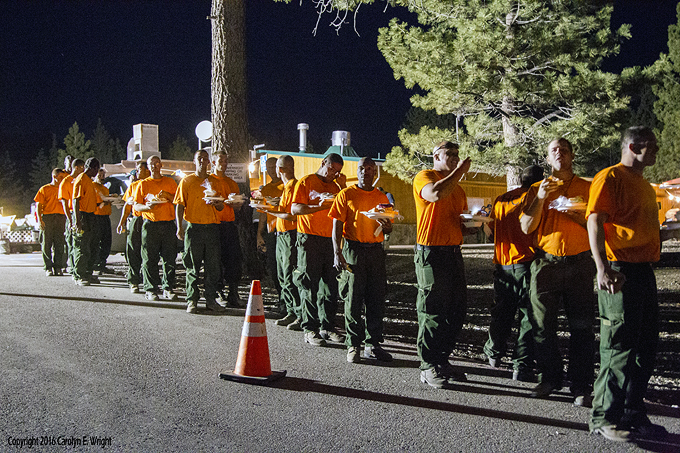
Inmates were used on the Washington Fire near Markleeville in 2015. Photo/Carolyn E. Wright/Copyright 2017

By Lizzie Johnson, San Francisco Chronicle

Thomas Rohl adjusted the 30-pound pack strapped to his back and hopped into a nearby fire rig. He was in a remote part of Solano County, on his way to help put out a grass fire smoldering a few miles to the west.

It’s backbreaking, dangerous work. But it beats prison.

Rohl and minimum-security inmates like him are a firefighting force the state counts on every year when the hills dry up and the weather gets hot. But there’s a problem: Thanks to changes that have redirected many low-risk offenders who used to crowd the state’s lockups, California is heading into the height of this year’s fire season with a reduced number of what one official called “the Marines” of wildfire fighters.

Read the whole story


Foodies sample their way through Sierra edibles

Patrick Harrity with Cold Water Brewery preps his dessert plate at Sample the Sierra. Photo/Kathryn Reed

By Kathryn Reed

Beer with bread pudding. Chickpeas as a main ingredient in the entrée round of the chefs’ challenge. Wine that wouldn’t stop flowing.

This and a whole lot more is what Sample the Sierra is all about.

The eighth annual food pairing was a celebration of local restaurants, regional foods and adult libations, interspersed with artisans. Bijou Community Park in South Lake Tahoe was full of people enjoying themselves Sept. 16 – what with the event selling out.

This culinary extravaganza showcases food grown in the region, local chefs cooking with it and El Dorado County adult beverage makers.

“It’s like Costco, but better. There is no pressure to buy,” said Danielle Cvitanich of South Lake Tahoe. “It’s great. We get to try all of these local vendors.”

This was the first year she and her husband, Joel, have been to Sample the Sierra.

They were partial to MoonHouse BrewHouse’s Cuban with its lemon-limey flavors that was paired with a rum sampler.

West Shore Cafe in Homewood on Sept. 16 was serving house made herb crisp crackers topped with roasted eggplant and garlic puree that was provided by Mountain Bounty Produce. Photo/Kathryn Reed

Kari Koutnik of Christmas Valley was also a first-timer to Saturday’s event. She loves to cook and eat good food.

“This is a friendly event that isn’t intimidating,” she said.

Some of the lines at first seemed intimidating, but they moved fairly fast.

Most vendors had an ample serving of food and alcohol.

The Brewery at Tahoe created a watermelon, strawberry arugula salad with ingredients from Mama Earth Farms & Perez Farms that was worth visiting more than once. The Paramount Porter from Stateline Brewery was a fabulous pairing.

Chef Anthony Schiavone’s vegetarian rice concoction was being talked about by many patrons.

In the middle of the event was the annual chef’s showdown. This year it was structured like the Food Network’s “Chopped” show where chefs have to use a mystery box of food to come up with an appetizer, entrée and dessert in a certain amount of time, and with one chef being eliminated after each course.

Sample the Sierra is Lake Tahoe South Shore Chamber of Commerce’s annual event showcasing local chefs, regional food and area libation creators. Photo/Kathryn Reed

Starting the competition were Stephen Gill of Cherry Bomb Catering, Kristina Forsberg with Hard Rock Lake Tahoe, Anthony Schiavone of Bespoke Private Chef Services, and Patrick Harrity with Cold Water Brewery.

They were judged on cooking, plating and creativity. They had 30 minutes to create each dish.

In the appetizer round they had to use quail, pop rocks, cashews and sun dried tomatoes. It was Schiavone who was sent home first.

They had a pantry of sorts – though not to the extent of the TV show – to work with. Items ranged from butter to cilantro to corn to eggs to rice vinegar.

The entrée had to consist of pork chops, chickpeas, yellow curry and major grey chutney.

“The chutney is the hardest. I don’t know what to do with it,” Gill told Lake Tahoe News.

For Harrity, he was most worried about the chickpeas. He didn’t let that bother him too much, and instead wowed the judges with his smoked pork.

Forsberg wasn’t fazed at all by the ingredients in round two.

“I think they are all really good together. It makes sense,” she told Lake Tahoe News. “When I saw the box, I knew what I was going to do.”

It paid off. It was down to Forsberg and Harrity in the final dessert round.

They had to create something out of mascarpone, English peas, almonds and white chocolate.

Debbie Brown, who owns Cold Water Brewery, was a nervous wreck. After all, a chef of hers had won the competition twice before. Harrity, who has been with the South Lake Tahoe establishment since January, was being put to the test. He was also performing in front of family members.

The pressure, while intense, didn’t rattle him. His fritter over white chocolate and cranberry mascarpone with a sweet pea caramel put him over the top.

Asked by LTN if he would be making this at the restaurant anytime soon, he resoundingly said, “Absolutely not.”

A capacity crowd meanders through Bijou Community Park at Sample the Sierra on Sept. 16. Photo/Kathryn Reed

The dessert round was the hardest for Harrity; saying the peas challenged him the most.

While Brown was a vision of nervousness as time went on, she is a staunch proponent of the competition, and said so long before the final decision was made. She encourages all restaurants to participate, saying it helps chefs grow and builds camaraderie among the staff.

For Harrity it meant practicing ahead of time – working on technique, memorizing what to do with ingredients. Ultimately, though, it was his creativity and ingenuity that paid off — peas et al.


USFS fire hoses in California get a second life

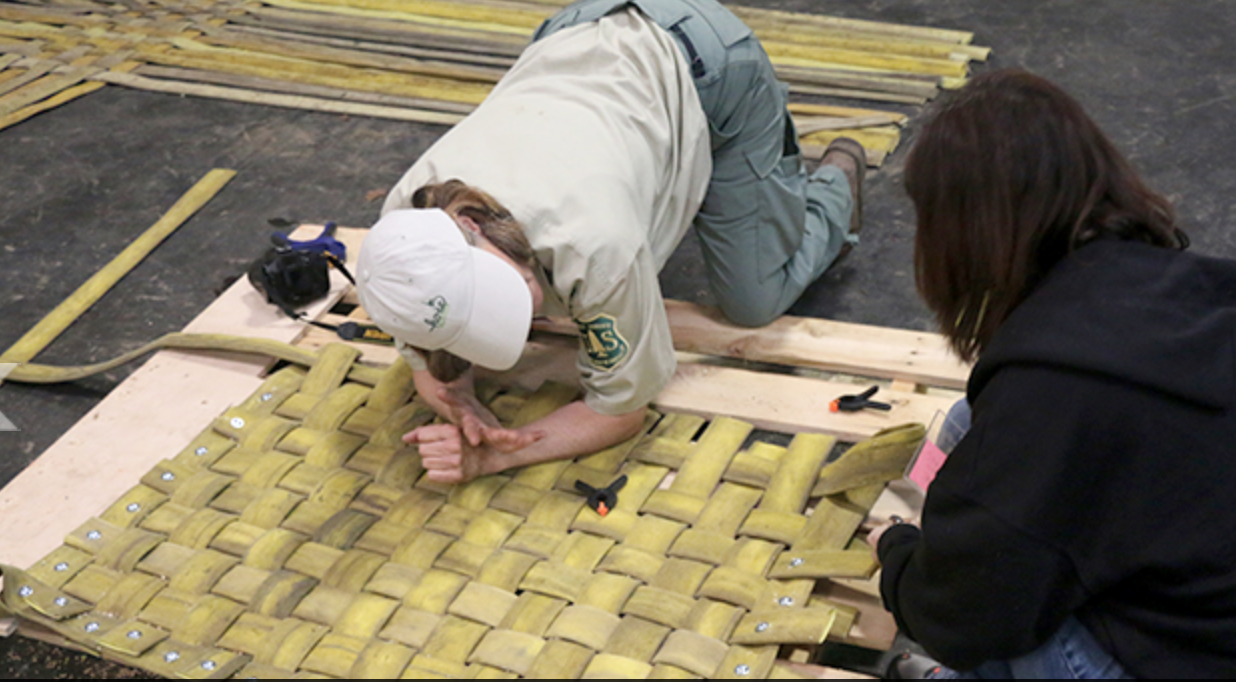
Lisa Ussery, left, with the USFS, assists Sharon Clay, animal keeper for the Turtle Bay Exploration Park in Redding, with a platform bed made using repurposed U.S. Forest Service fire hose. Photo Kerry Greene/USFS

By Kerry Greene

On average an estimated 15 tons of waste is generated annually by fire suppression efforts in the northern zone of the U.S. Forest Service’s Pacific Southwest Region, which covers as far south as Sacramento to the border with Oregon.

As of 2015 over 13 tons (or 87 percent) of that waste was disposed into landfills each year. In an effort to become a net zero waste facility, per a Forest Service initiative, the North Zone Fire Cache (NZFC), located in Redding conducted a waste audit to find out what kinds of materials were going into the trash.

Audit findings inspired one worker to look for a second life for fire hoses and other materials. Now as part of NZFCs recycling effort, scrap fire hoses are collected by the nonprofit group Hose2Habitat, based out of Maryland. Hose2Habitat connects zoos and animal sanctuaries with donations of materials that can be diverted from landfills and safely used for animal enrichment.

The mission of the U.S. Forest Service is to sustain the health, diversity, and productivity of the nation’s forests and grasslands for present and future generations. While the numbers are still being tracked and reported, so far in 2017 the NZFC has diverted a little over 10 tons of material from entering landfills. Almost 9,000 pounds, or 40 percent, of that material was fire hoses.

Hose2Habitat is an American Association of Zoo Keepers conservation partner and, according to its website, the only organization in the world whose mission is to improve the physical and psychological well-being of captive wild animals by providing and enhancing habitat enrichment through the donation of recycled and other materials, free workshops, programs and services. Hose2Habitat, who has been around since 2014, is a 100 percent volunteer-run organization. It serves zoos, sanctuaries research and conservation projects.

The NZFC is one of 14 National Support Caches located throughout the United States with a combined inventory valued at over $170 million. The role of the Fire Cache is to provide logistical support to all requesting state and federal agencies. Support is primarily directed toward wildland fire suppression activities. Local and interagency efforts are also supported in cases of natural disasters and large projects such as prescribed burning.

In March the Forest Service hosted a Hose2Habitat animal enrichment workshop at the Forest Service’s Northern Operations Service Center in Redding. Animal caretakers came from far and wide to learn from Hose2Habitat volunteers the techniques for creating enrichment items, such as crafting hammocks, cubes, feeders and climbing ladders out of fire hoses. This was the first ever West Coast workshop of this kind.

“The fire hose is just one piece of the puzzle,” said Lisa Ussery, materials handler with NZFC, who has been working hard to find ways to divert materials from the landfill. “The overall vision is to find ways to repurpose or recycle all the materials we have here, once they’ve reached the end of their useful life.”

North Zone employees are currently networking with other fire caches and partners to divert scrap Nomex, plastics, tents, sleeping bags, cargo nets and other materials from the landfill.

Kerry Greene works for the USFS Pacific Southwest Region.


Red Hawk Casino wins appeal in $30M judgment

By Dale Kasler, Sacramento Bee

Red Hawk Casino hit a jackpot of its own Friday, fending off a $30 million court judgment that once threatened its existence.

Nearly six years after a jury said Red Hawk’s tribal owners owed millions to its former business partner, a state appeals court wiped the verdict off the books.

The 3rd District Court of Appeal ruled that the ex-partner’s claims weren’t valid because his contract with the tribe was never approved by the federal agency that oversees Indian casinos.

Read the whole story


Concussion not something to take for granted

Helmets can help, but they are no guarantee a skier won’t sustain a concussion. Photo Copyright 2017 Carolyn E. Wright

By Kathryn Reed

While football players are getting a ton of ink when it comes to concussions, these head injuries aren’t limited to those on the gridiron.

Skiers and snowboarders – and not just the professionals – are susceptible to concussions. It could be the result of catching an edge and taking a hard fall, or a trick gone wrong in the terrain park.

Car accidents, falling on ice or any surface, or getting hit in the head – they all can result in a concussion.

The good news is doctors are more aware of the symptoms and are taking the issue more seriously than they used to. The bad news is there is no definitive test to determine if someone has a concussion.

A panel of medical experts from Barton Health on Sept. 13 spoke before a group of nearly 80 people at Lake Tahoe Community College about how dangerous a concussion is, the symptoms and what can be done to recover fully from one.

Terry Orr, an orthopedic surgeon with Barton who has worked with the U.S. ski and snowboard teams, rattled off several statistics:

·      Two-thirds of those with a concussion don’t think it’s a serious condition

·      41 percent don’t want to be taken out of play

·      36 percent don’t think they had a concussion.

He said this is why it’s necessary for coaches and parents to know the signs and symptoms of concussions.

Neck pain, double vision, severe headaches, weakness or tingling in arms and legs, seizures and being unconscious are some of the symptoms. A person might stagger after the impact, have a blank look or stare, be disoriented or confused.

Depression, seizures and cognitive impairment can be long-term complications.

Players in the National Football League have proven why concussions need to be taken seriously. The Journal of the American Medical Association this summer revealed that of the 111 brains of deceased players it examined 110 had the degenerative brain disease CTE or chronic traumatic encephalopathy.

Those involved need to understand that a concussion without proper care can lead to long-term brain damage. That’s why that college scholarship or championship needs to become secondary to the player’s health. A concussed player should never be allowed to return to the field, and instead should be seen by a medical professional.

“We want people to recover,” Jeremy Vandehurst with Barton Health said. “Return to play should be gradual.”

Barton has protocols in place to determine when a player can participate in her sport again. It could take a week, could take longer. It’s up to the individual’s progress.

Primary care doctors are often the ones who first see the concussed patients. There is a list of 22 symptoms they look for. What the initial exam reveals will determine the course of treatment.