Security, political anxiety part of ’18 Winter Games

By Susan Wood

PARK CITY, Utah – Despite a war of words between the United States and North Korea, U.S. Olympic officials and winter athletes all but shrugged off the danger of a nuclear threat affecting the Games in South Korea in February.

Team USA and representatives from the PyeongChang Games on Sept. 25 discussed the current matter among other issues during the media summit at Park City.

After all, the Olympics is an event born as a symbol of unity and goodness in humankind.

Missile- and Twitter-launching threats between President Donald Trump and North Korea leader Kim Jong-un, with its southern neighbors caught in between, have led to questions about whether the Games would be safe.

This is not the first time the Olympic Games have felt the effects of international relations gone awry.

In 1972, the Summer Olympics in Munich experienced a massacre when 11 Israeli Olympic team members were taken hostage and eventually killed at the hands of a Palestinian terrorist group called Black September.

On the domestic front, the Games in Atlanta in 1996 were marked by an explosion of a bomb in Centennial Park, killing two and injuring more than 100 others.

USOC Chairman Larry Probst and USOC CEO Scott Blackmun talk about security for the 2018 Winter Games on Sept. 25. Photo/Kathryn Reed

A strong resolve and heavy hand in security are expected to protect the upcoming Games. Still, a sports minister in France has a large enough concern to question whether the nation would pull out, the Los Angeles Times reported days ago.

To that, U.S. Olympic Committee Chief Executive Officer Scott Blackmun told Lake Tahoe News at a filled press conference “the statement was taken out of context.” He pledged diligence from Olympic officials to lock down the Games to danger with a constant reliability on law enforcement and wisdom of the International Olympic Committee.

“Should the unthinkable happen, it’s the issue of the IOC,” he said.

USOC Chairman Larry Probst countered the qualified suggestion of danger a quasi whim from the French official. He declared it would be “highly unlikely (France) would pull out.”

When asked whether athletes approached the USOC about the matter, officials quickly responded with “not one.”

U.S. halfpipe snowboarder Kelly Clark, a veteran of four Olympics, seemed undeterred by the perceived threat. She remembered competing in her first Olympic Games in Salt Lake City five months after 9/11.

“Based on my experience, the United States makes the right decisions to make the athletes safe,” she told Lake Tahoe News. “I saw the power of sport and what it can do – especially the Olympics. It brings the world together. People put their differences aside and celebrate sport.”

South Korea would be her fifth Olympics. She has experienced a variety of security protocols but “has always felt safe.”

PyeonChang Olympic spokeswoman Nancy Park and POCOG Executive Vice President Jaeyoul Kim are confident athletes, spectators and others will be safe during the Games. Photo/Kathryn Reed

U.S. bobsled competitor Aja Evans also shared her faith in officials to keep her protected.

She was joined by Olympian Mikaela Shiffrin who insisted she plans to concentrate on her sport.

“Right now it doesn’t look like the political tensions are going to have an effect on the Olympics. I’m thankful because I want to compete on that stage,” Shiffrin said.

But U.S. biathlete Susan Dunklee appeared more skeptical of international relations running smoothly.

“I think we’re not able to see the whole situation, and it could change at any time,” Dunklee told LTN. She added the spectrum of possibilities could even accelerate to the point the United States “may not even go.”

Alpine skier Julia Mancuso, an Olympic veteran who hails from the slopes of Squaw Valley, provided the perspective that every Olympics has the potential of some kind of threat. In visiting South Korea for a test run on the courses with the other athletes, Mancuso compared the Asian nation to Russia.

“I felt really safe at South Korea,” she mentioned, further commending organizers for essentially seeming prepared. The Games in Sochi had a less secure feel that she had to overcome.

This could be music to the ears of PyeongChang 2018 Games officials.

“We appreciate the confidence the USOC has in us delivering a great Games,” POCOG Executive Vice President Jaeyoul Kim said. He pledged to LTN during the summit that South Korea has “taken all the necessary precautions to deliver a safe and secure Games.”

Raising the bar, Kim went on to insist POCOG and IOC officials are working diligently with military police and international security teams to avert any disaster. And they’re all about sharing information – the power of knowing. He noticed the potential of enhanced “intel sharing” at the Rio Summer Games in 2016.

In these circumstances, a beefed up evacuation plan would be in order. Kim said his government has complied.

POCOG spokeswoman Nancy Park noted “everybody has the same concerns.”

Park clarified security has always been important.

“It’s just that it’s never been out in the forefront (until now),” she said.

Nonetheless, this tension at some level must have escalated to at least a heightened awareness. The name of the location has been altered for the Olympics. Local leaders were apparently afraid international visitors would confuse Pyeonchang, a county in eastern South Korea, with Pyongyang, the capital of North Korea, NBC reported. That’s why the spelling has been changed to PyeonChang.

Apparently, the Unforgotten War isn’t all forgotten. In 1953, the Korean War ended with not a peace treaty but a truce – a temporary pause in fighting. Back then, North Korea invaded South Korea with the blessing of the Soviet Union and China. The United States served to support the south.

Trouble on the home front

Adding to the tension of present-day politics at home, Trump has fueled the fire of civil discourse with provocative tweets to North Korea.  

Policies out of the White House have prompted far-reaching peaceful protests – in particular among national athletes. From the NBA champions Golden State Warriors declining a traditional visit to the latest surge in National Football League players taking a knee as a gesture of disapproval, U.S. protests became a topic at the media summit.

Kelly Clark of Mammoth trusts officials to provide the requisite security for athletes. Photo/Kathryn Reed

“One of the proudest parts of being an American is freedom of speech. I’m proud of athletes who stand up for what they believe in,” Mancuso said.  

She further clarified though it may be more appropriate for athletes who compete every week such as the NFL players to carry on such a gesture rather than Olympic athletes who may take a stand only to wait four years to continue to take another.

And as icons of their country, athletes may see these issues as multi-dimensional in which aspects of solidarity can be agreed upon.

Alpine skier Laurenne Ross demonstrated the complexity of the issue when asked if she would visit the White House, an invite her fellow athlete Clark would certainly accept again.

“I would go. It doesn’t mean I love what is going on there,” Ross said.

She believes people have the right to freedom of expression, and that’s one of the great things about the country she’s representing.

But the Olympics has a code of conduct. Rule 50 of the Olympic Charter states: “No kind of demonstration or political, religious or racial propaganda is permitted in any Olympic sites, venues or other areas.”


Study: Wildfires increase sediment in watersheds

By Alastair Bland, Water Deeply

Around California, the country and the world, reservoirs are silently filling with sediment, and only a few people are thinking about it. Among them is Tim Randle, a civil engineer with the United States Bureau of Reclamation’s Sedimentation and River Hydraulics Group.

“We used to be gaining water storage capacity with dam building,” said Randle, who is based in Denver. “Now, around the world, the pace is slowing down as sediment builds up. This is true in the U.S., too.”

According to new research from the U.S. Geological Survey, in many regions erosion rates are now accelerating thanks to wildfires and climate change. The Western U.S., which relies on reservoirs for vital water storage and flood control, will be particularly impacted.

Joel Sankey, a coauthor of the study and a USGS research geologist, says portions of the Cascade Range in Washington, Oregon and California, as well as parts of the Sierra Nevada, are likely to experience particularly dramatic increases in fire damage and subsequent erosion.

Read the whole story


Stinging reality about yellowjackets

By Linda Fine Conaboy

INCLINE VILLAGE – Who knew yellow jackets could be so fascinating? But spending time with Lynn Kimsey one blustery evening last week at Sierra Nevada College and listening as she revealed some of the secrets of these pesky critters was almost as entertaining as sitting around a campfire swapping stories.

At best, Kimsey knows her bugs and doesn’t hesitate to share her scientist’s look into the mysterious world of yellow jacket wasps, commonly referred to by some as the scourge of the Sierra.

Lynn Kimsey

Although they can be easily angered and have the potential to inflict painful stings if their nests are threatened, they also help to keep other insect populations in control, as well as serving as a food source for area bears.

There are about 10 species of yellow jacket, but only two are considered pests—the Western Yellow Jacket being one; the Bald-faced Hornet the other. Their ravenous appetites lead them to collect everything they can find including human food, garbage and road kill, along with myriad insects that keep the colony well fed.

“These two pest species are doing very well,” Kimsey said, “because we humans ‘feed the beast’ so to speak by providing lots of avenues and places to find food.”

Although there are thousands of wasps, the yellow jackets are social wasps, like bees, but unlike bees, they do not pollinate. “They collect nectar for their own needs. The nectar can be considered their jet fuel; it allows them to fly.”

Unlike the Bald-faced Hornet that make aerial nests and are not particularly aggressive, the Western Yellow Jacket can be nasty and choose to construct their homes in cavities, such as hollow trees or rodent burrows.

“Yellow jackets sting for two reasons—defense and killing. Their venom is a cocktail of chemicals and they will sting as long as they’ve got venom left—they are good for up to three stings.”

Stings cause pain, irritation or swelling and can be dangerous if allergic, which can lead to organ failure. “If you get stung and your throat becomes scratchy or swollen or if you have trouble breathing, call 911 at once,” she said. “At the very least you need an Epipen and Benadryl.”

Normally, a sting can be soothed by applying ice and an antihistamine, with pain lasting a few days depending on pre-exposure. “My advice is don’t put your hands and feet anywhere you can’t see into.”

The summer of 2017 saw a decrease in the number of yellow jackets in the Sierra, although Kimsey said she had her first invasion at her home in Davis this summer.

“My understanding is that the numbers are down in the Sierra, but in the Sacramento Valley they’re up. The populations depend on the weather in the previous months.”

She said colonies last about nine months, but the health of the colony depends on the queen surviving the winter alone after mating. She remains fairly dormant during the cold months, finally reviving herself in the spring. Instinctively, she knows it’s her responsibility to find a suitable place to establish a new colony where she is responsible for the initial population of the new group. After this initial flurry of birth, the workers take over. One queen can produce up to 5,000 wasps.

Historically, wasps live a cyclical life; however, a constantly warming climate seems to be causing some colonies to become perennial, resulting in huge numbers of inhabitants within a nest—up to three million workers. Hawaii, with its moderate year-round climate has perennial wasp colonies, a phenomenon that seems to be filtering now to the Mainland and other places.

Kimsey treats the subject of bugs humorously, delivering her vast knowledge in easy-to-understand terms. Her expertise has led her to a professorship at UC Davis in the Department of Entomology and Nematology, where she also serves as director of the Bohart Museum of Entomology located on the UC Davis campus.


Truckee woman send bikes to hurricane victims

Meg Kiihne loads abandoned bikes into a U-haul on the Playa. Photo/Provided

By Ally Gravina, Moonshine Ink

Every year, thousands of bikes are left scattered throughout the post-Burning Man Playa. This year, however, the number of abandoned bikes was more than double the usual numbers, with an estimated 4,000 left behind. Typically, the process of distributing these bikes to various nonprofit organizations is streamlined and organized. However, with the massive amount of bikes left on the Playa this year, event organizers entered crisis mode and photos of piles of abandoned bikes ended up on social media.

Truckee resident Meg Kiihne saw the viral photos of an event that has “leave no trace” as one of its 10 principals. Thanks to a unique set of skills and an established community of friends in the Turks and Caicos, she knew that she could leverage her talents and the surpluses of abandoned bikes in Black Rock City for disaster rebuilding efforts on the small British territory. The Turks and Caicos were hit by Hurricane Irma, a Category 5, on Sept. 7 with gusts up to 150 miles per hour. Hurricane Maria then hit.

Read the whole story


Ski industry lobbying for more immigration

By Megan Michelson, Powder
 
Urh Vodopivec is a 24-year-old ski instructor and student from Slovenia. He’s been traveling to Tahoe the last two summers to work seasonal jobs at restaurants. He’s one of about 300,000 people, many of whom are college students, visiting the U.S. each year on J-1 visas, which are designed as cultural exchange work permits for short-term foreign visitors.

“I would love to come back in the winter to teach skiing,” says Vodopivec. “But right now, it’s too hard to get a visa.”

Ski towns rely heavily on these visas to fill seasonal jobs—an estimated 7,000 to 8,000 J-1 workers are employed at ski resorts nationwide each winter, according to the National Ski Areas Associations. Yet tightening governmental restrictions on foreign visas may make it harder for ski resorts and other ski town employers to continue hiring these short-term international employees.

Read the whole story


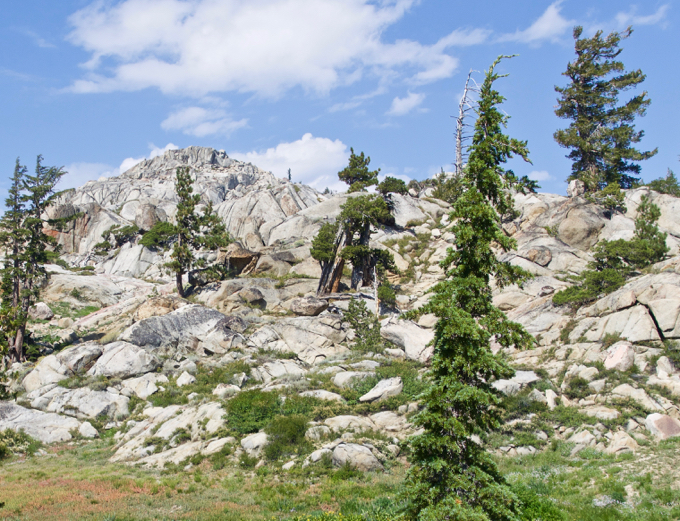
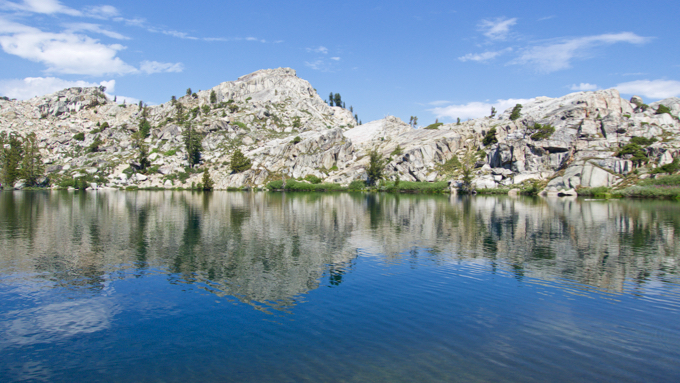
Granite Lake trail worth the initial drive

Granite Lake lives up to its name. Photo/Kathryn Reed

By Kathryn Reed

HOPE VALLEY – Hiking is supposed to be about getting away from the masses and being immersed in nature. That’s why the chaos of Blue Lakes Campground was a bit of a turnoff and caused us to wonder why we were there on Labor Day weekend.

Fortunately, the campers seemed to think the campground and immediate lakes provided enough entertainment.

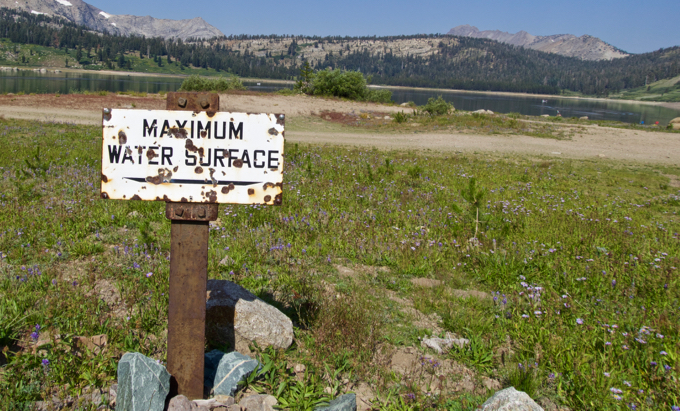
Upper Blue Lake is being drawn down and Middle Creek Campground is closed to reduce the risk of flooding if an earthquake were to occur. Seismic analysis of Upper Blue Lake Dam has necessitated these actions by PG&E, which has the rights to this body of water.

As soon as we got onto the trail near upper Blue Lake it was like we were in a different world. Civilization, so to speak, was completely behind us.

Upper Blue Lake is not full because of seismic concerns regarding the dam. Photo/Kathryn Reed

We took the advice of backpackers to walk across the earthen dam, then go down a little hill to hook up with the trail. This meant not having to cross the creek.

The superlatives ran off our tongues. None of us had been there before. There being the trail to Granite Lake. This is the Granite Lake in the Mokelumne Wilderness, not the one in Desolation Wilderness.

A pleasant surprise was the dazzling display of wildflowers not far from Granite Lake. I can only imagine what they might have looked like a couple weeks earlier.

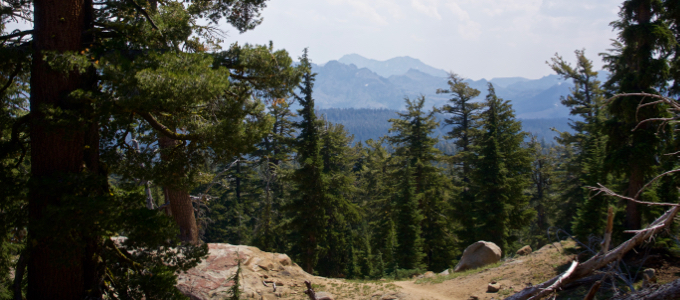
From the trail we could see the backside of Round Top. It’s the highest peak in this wilderness area at 10,382 feet.

The trail is a gradual climb – about 700 feet total elevation gain. It meanders by a lake without a name, before taking a short, steeper climb toward our final destination. A couple splotches of snow remain to the side.

Looking toward the mountains near Ebbetts Pass. Photo/Kathryn Reed

In some places the trees are dense, other locations the foliage is lush from the ample flow of water, while other areas have rock outcroppings.

The lake is aptly named because it is essentially in a bowl surrounded by granite, though it’s not as rugged as some areas in the Sierra.

Several people were there, many with fishing poles. They were hoping to catch golden or Lahontan cutthroat trout.

While Granite Lake is hardly a secret, it was a special little gem that until then the three of us knew nothing about.

Rosemary and I have a history of extending hikes or experiencing weird mishaps. This particular Sunday was no different. A vehicle appeared to block the road just past Lower Blue Lake so we parked there. Plus, the road appeared to get a little sketchy. (Walking on it proved it was fine, and passenger vehicles had made it to the upper campground.) So, this mileage added to what we were planning on.

In total, we walked eight miles. The actual trail, according to my mileage tracker was 5 miles round trip. The sign says it’s 2 miles to Granite Lake.

Granite is one of the dominate features in this area of the Mokelumne Wilderness. Photo/Kathryn Reed

—–

Getting there:

From South Lake Tahoe, take Highway 50 west. In Meyers, go left onto Highway 89. At Picketts Junction, go right onto Highway 88. Blue Lakes Road will be on the left; and not too far. Follow the road – it’s long – and park near the Grouse Lake trailhead. There is a trailhead sign.


Tahoe’s level could change quickly this fall

By Paul Nelson, KTVN-TV

Last winter brought a record amount of precipitation to the Sierra, filling Lake Tahoe almost to the brim. Several feet of water were also released from the Tahoe City Dam to make room for the snow melt. 

The lake is still in good shape. Tahoe’s level is still more than 5 feet above its natural rim and less than a foot from its legal limit.

The lake’s level has only been this high 12 other times. If the Sierra has a repeat of last winter, Chad Blanchard, federal water master, said it would be a welcome sight as long as it comes in the form of snow.

Read the whole story


More talk than action on Tahoe workforce housing

Publisher’s note: This is one in a series of stories about affordable housing in the Lake Tahoe-Truckee region. All articles may be accessed via the home page under Special Projects, 2017 Affordable Housing.

By Kathryn Reed

Nearly two years after Vail Resorts announced it would spend $30 million on workforce housing, the financial commitment is beginning to pay off in Colorado, though not so much in Tahoe.

The ski resort behemoth has been doing more at its Colorado properties than in California. Keystone is getting a $6 million workforce housing project, while 23 acres near East Vail have been identified for housing. It is spending $440,000 to convert a commercial building it owns in Silverthorne (Summit County, Colo.) into housing.

Vail Resorts says it owns or leases approximately 3,000 beds in Eagle and Summit counties, which is where its Vail, Beaver Creek, Keystone, and Breckenridge resorts are located.
“Employee housing is a priority for us at both Heavenly and Kirkwood mountain resorts, and we continuously work with our community partners and stakeholders to provide housing options and opportunities for our resorts’ teams. For instance, we have employee housing at both of our mountains; and recently, we added an additional 32 beds to our housing at Kirkwood,” Kevin Cooper, spokesman for the resorts, told Lake Tahoe News.

However, what he wouldn’t say is how many employees can be housed at the company-owned facilities, what the amenities are (laundry? food provided?), if they are more like apartments or dorms, if they are seasonal or year-round, and the cost to workers.

At the Sept. 21 California Tahoe Conservancy meeting, staff noted they are in talks with Vail Resorts – the Colorado-based parent company of Heavenly and Kirkwood – about developing workforce housing on a parcel the state owns near the Crossings at the Y in South Lake Tahoe. CTC is doing the prep work to get that land ready to be sold, with the desire for it to be used for worker housing.

It’s estimated 40 residential units could go there.

CTC staff said Vail is interested in year-round housing for employees as it expands its summer attractions.

The board will see this parcel and idea on the agenda when the environmental documents are completed and more details are solidified. Staff had no time line for when that might be.

Northstar, the Vail Resorts property in Truckee, is part of the Truckee North Tahoe Regional Housing Council, and has pledged $30,000 to the Housing Solutions Fund.


No immediate solution to toxic plume in SLT

By Susan Wood

Water agencies are pressing forward on a proposed work plan designed to outline how to eliminate the contaminant PCE from groundwater near the Y in South Lake Tahoe.

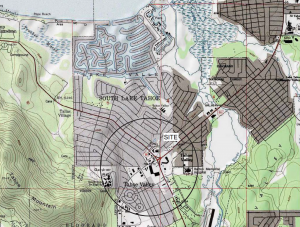
Richard Solbrig, South Tahoe Public Utility District general manager, gave his board an update Sept. 21 on treatment of a toxic plume known for decades to leach into the groundwater in the highly industrial area at the Y. Officials have narrowed at least one scope of the plume to property owners and operators of the Lake Tahoe Laundry Works, which once existed at the shopping center anchored by Raley’s. But the extent of the plume may not end there, and the plume could be co-mingled with others.

The circle represents the known area of the PCE plume in South Lake Tahoe. Image/LRWQCB

Delineating that represents part of what the work plan is intended to do.

The Lahontan Regional Water Quality Control Board has put into place a conditional work plan to further investigate the magnitude of the situation in order to define where and when to fix the problem, and who’s responsible. Responsible parties known so far, who were sent a letter by the regional water agency on Sept. 15, would be tagged to hire contractors to conduct the cleanup. First, water agencies need to figure out where the plume begins and ends.

“The plume is quite extensive,” Solbrig told his board. “We may have more contamination. We have a lot at stake.”

With at least a handful of wells known to have been contaminated in the Tahoe Keys and Lukins Brothers water districts that were shut down and capped off, STPUD has provided water from its system. However, the hope is STPUD’s backup supply won’t be too taxed.

All eyes from three water purveyors and the state are on those area wells – which all meet in one highly used zone drawing from the same aquifer.

The drought prompted California to regulate groundwater, ordering water jurisdictions to develop management plans. STPUD has taken the lead on the mandate and about a month ago, counted more than 600 private wells within its boundaries.

Contamination remains the biggest threat to the water supply.

An initial study was approved to investigate this latest PCE contamination. Monitoring the wells represents Job 1 while Lahontan’s proposed work plan is out for public comment.

Winter’s impact will have no bearing on changing the work plan – but within reason, Lahontan Executive Officer Patty Kouyoumdjian said a day after snow ushered out summer in South Lake Tahoe.

“If it snows 6 inches, at least it would be harder to drill,” she said.

 But Lahontan needs a clear view of what is going on.

“This work plan will yield a lot of information,” she added.

Much is at stake for the water agency and the affected water districts. They’re asking for more money from the state water board.

Tetrachloroethylene, or PCE, is a manmade chemical largely used commercially as an industrial degreaser or spot remover. When improperly disposed of, the chlorinated solvent seeps into groundwater supplies.

In worst case scenarios, chronic exposure can cause damage to the liver, kidneys and central nervous system. It may also increase the risk of cancer.

Kouyoumdjian commended STPUD for stepping in to provide clean drinking water.

“It’s unfortunate for these water districts. They didn’t cause this, and in the meantime, they’re concerned about getting clean water to their clientele,” she told Lake Tahoe News.

Lahontan plans to host community meetings on the subject.

This isn’t the first time STPUD has been forced to deal with a contaminant issue. In 1997, the gas additive MTBE — methyl tertiary butyl ether – was found in a dozen wells. The wells, among gas stations were consequently shut down. The district sued big oil in 2001 and won a $69 million lawsuit from 33 oil companies.

Like MTBE, the latest toxin – PCE – is a water solvent that represents a challenge corralling. It can move fast and wide.

The Y in particular is characterized as a commercial zone with the types of businesses deemed with disposing of chemical waste.

“There are lots of industrial businesses in that area,” said Jennifer Lukins, who runs the Lukins water district.

The profile of the area makes it susceptible to this type of groundwater contamination.


Seat belts save lives — even firefighters’

By Kathryn Reed

Maybe if seat belts had been mandatory in the 1960s a 29-year-old Lake Valley firefighter would not have died.

The July 9, 1964, Tahoe Daily Tribune had a story about Larry Stewart who was a passenger in a pumper tanker driven by James Stephens. They were on their way to a fire at Camp Richardson. The engine went around a corner, the driver tried to avoid a car pulled off to the side, the ladders on the side of the engine were snagged on trees, and Stephens lost control. The fire truck ran into a tree.

The story says, “California Highway Patrolmen reaching the scene found Stewart pinned in the wreckage and Stephens standing nearby trying to give help.”

Stewart died and was buried at Happy Homestead Cemetery. Stephens survived with minor injuries.

When asked about the incident, current Lake Valley spokeswoman Kileigh Labrado said only one person was in the fire engine. Asked what the findings from the investigation were – she didn’t respond. Asked if there were seat belts in the engines then – more avoidance.

Ask any first responder and they’ll tell you seat belts save lives. It’s cops, firefighters, and paramedics who see the carnage when the safety devices aren’t worn.

In California, the law has been on the books since 1986. A couple of states enacted seat belt laws in 1985, with the last holdout being Maine in 1995. While that is when the law took effect, vehicles had seat belts long before then.

Besides being a state law, a seat belt is a required piece of equipment in the fire industry just like a helmet.

In Burton Clark’s book “I Can’t Save You, But I’ll Die Trying: The American Fire Culture” he has an entire chapter about seat belts.

Lake Valley is keeping pretty mum about the incident in August when a captain fell out of a moving fire engine after taking his seat belt off. The agency said it happened when he was taking his jacket off and it got hung up on the door lever.

The captain is out on medical leave. The extent of his injuries has not been released, nor is it known if he intends to return to work.

The agency also isn’t revealing if any of the three on board will be or have been disciplined. In the fire industry it is the driver’s responsibility to ensure everyone has a seat belt on.

As for the California Highway Patrol, they are not assessing blame to the driver.

“This collision was found to be ‘other than driver’ simply because the driver of the fire truck did not have anything to do with his passenger falling from the truck.  The passenger was removing his jacket when part of his uniform caught the handle, opening the door and allowing the passenger to fall out,” Officer Ruth Loehr told Lake Tahoe News. “No citations were issued. We do not normally write citations from collisions.”

The state Occupational Safety and Health Administration is still investigating. A fine is the likely outcome.

Lake Valley is governed by a board of directors, but it is not kept in the loop on things like this.

“To my knowledge there are ‘no protocols’ for when the board is notified of incidents,” board Chairman Bob Bettencourt told Lake Tahoe News. “If there is a significant sensitive event or incident, it is brought to the board in a closed session which unfortunately cannot be disseminated outside the closed session.”