SLT to chip away at affordable housing quagmire

Publisher’s note: This is one in a series of stories about affordable housing in the Lake Tahoe-Truckee region. All articles may be accessed via the home page under Special Projects, 2017 Affordable Housing.

By Kathryn Reed

South Lake Tahoe intends to acquire three vacant parcels on Riverside Avenue with the intent to turn them into housing.

The city’s Successor Agency owns them. This came about when the state dissolved redevelopment agencies. Per the state, the agency must get rid of what it owns.

The parcels have been on the market at different times in the last few years. Part of the difficulty in selling them is that there are no development rights associated with the lots. One escrow fell through and other offers have not been accepted.

The City Council last month gave direction to staff to come up with a contract to make the deal work between the city and Successor Agency. (The council acts as the directors for the Successor Agency.) The deal is expected to be consummated in October. The city will have to pay fair market value. Collectively, the parcels were appraised at $250,000.

The city could use one-time funds, possibly from excess reserves, for this purchase knowing that it will likely recover those dollars when it sells the property to a developer.

The council at its February strategic planning session talked about how businesses in the area would like the land to be converted into a parking lot. However, current zoning would not allow that use. The plan area statement would have to be amended for parking to come to fruition.

Affordable housing is an allowable use.

Kevin Fabino, who heads the city’s planning department, in August told the council it would be reasonable to merge the three parcels into one to allow for more density. Five or six units might be able to be built on that site.

While it was acknowledged this was not going to make a huge dent in the ongoing affordable housing issue plaguing the area, it would do more for the community than parking.

Councilmember Brooke Laine threw out the possibility of using some of the sewer unit allocations from the former Knights Inn motel for Riverside Avenue. Right now South Tahoe Public Utility District doesn’t allow the transfer of sewer allocations, but that board could change that rule if it so desired.

One thing the council will have to define is affordable housing. To the lay person it is often interchanged with work force or even fair market housing. However, legally, affordable housing has specific requirements based on income and can come with deed restrictions.

The exact type of housing will be decided at future council meetings.

The city has some commodities it could tie to the parcels as well to entice developers. Or it could leave it up to the next buyer to secure those rights.

Report: Nev. a dangerous place for women

By Sarah Litz, Reno Gazette-Journal

Nevada was ranked as the state with the second-highest rate of women murdered by men, a report from the Violence Policy Center said. 

Alaska was ranked the highest. Other states in the top 10 include Louisiana, Tennessee, South Carolina, Arkansas, Kansas, Kentucky, Texas, New Mexico and Missouri.

The annual report, “When Men Murder Women,” is a state-by-state analysis of homicides involving one female murder victim and one male offender. The latest report looks at the most recent data set from 2015.

Read the whole story


Disappearing Sierra meadows bad news for water

By Matt Weiser, Water Deeply
 
Mountain meadows are starting to get some respect. For over a century, meadows were the first alpine environments targeted for development, grazing and farming, because they tend to be flat and packed with rich soil and nutritious plants. But we’re starting to understand that meadows have a much more important role to play for society at large.

Meadows, it turns out, are water banks. As winter snows melt, the runoff flows into meadows, where deep organic soil holds the moisture like a sponge and then releases it slowly. This helps minimize downstream flooding during spring. Meadows release that runoff over a longer period, helping stretch valuable water supplies through the long, dry summer months.

Efforts are underway to restore meadows, which have lost some of their water-holding ability as they’ve been compacted and eroded by grazing, logging and other activity. Unfortunately, a new threat has emerged: climate change.

Read the whole story


Athleticism not only component to being Olympian

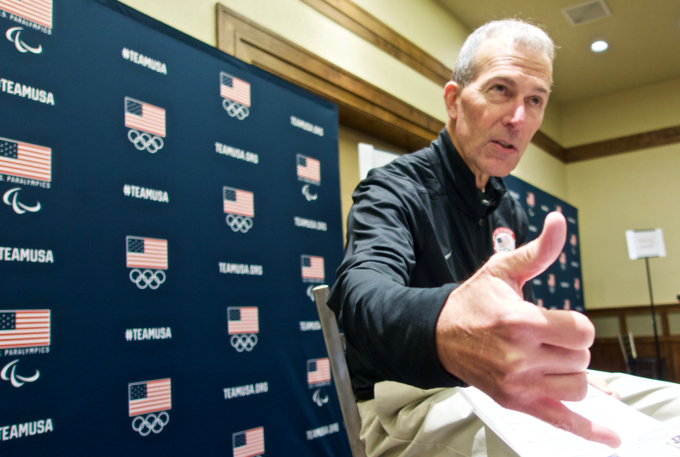
Randy Wilber with Team USA explains how to get Olympians to sleep as they travel around the world. Photo/Kathryn Reed

By Kathryn Reed

PARK CITY, Utah – Sleep and nutrition – they can’t be overlooked when it comes to athletics. And when the competitor is on the U.S. Olympic team, the importance is ratcheted to a level a weekend warrior might not be able to fully comprehend.

These elite athletes have access to sports psychologists, the latest technology, in addition to strength and conditioning experts. Some have their own entourage, some rely on the national experts, others use a combo.

Olympic officials have taken sports and made it a science.

The U.S. team mines data, analyzing an athlete’s performance against others. When a tenth of a second can make the difference between being on a podium or going home without hardware, every second on the snow or ice can make a difference.

Information is also used in hopes of preventing injury.

Travis Ganong, who lives in Tahoe City and calls Squaw Valley his home resort, is quick to admit that the mental aspect of the sport is what separates this level of athlete from others. While the downhiller doesn’t tap into the team’s psychologist, he knows to work on the mind game himself.

He takes a step back when needed, and says he internally processes what is going on without an external facilitator.

Still, his handlers also know when to manage him, so to speak. In January, at a men’s downhill race in Germany, Ganong was to race right after fellow American Steve Nyman. Nyman crashed, had to be airlifted out and sustained a season-ending injury. Ganong’s people told him Nyman was fine and was able to ski down after the fall.

Ganong admitted on Sept. 27 at the Team USA media summit in Park City that the false information helped him to focus. He went on to win that event.

For Randy Wilber, his expertise is in sports physiology.

“The No. 1 thing we’ve learned in the last five years is a lot about the biology and physiology of sleep – about the quality of sleep,” Wilber said.

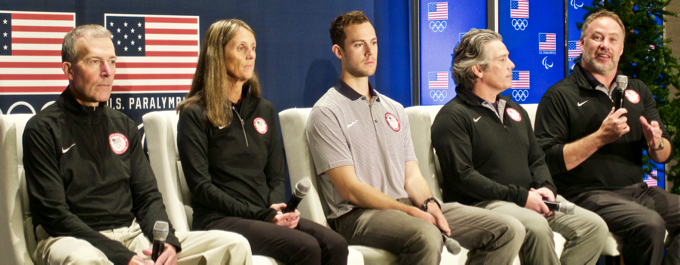
U.S. Olympic athletes have a variety of resources at their disposal. From left, Randy Wilber, sports physiology; Susie Parker-Simmons, nutrition; Brandon Sjakel, strength and conditioning; Alex Cohen, psychology; and Scott Riewald, sports technology. Photo/Kathryn Reed

Experts are using it to monitor training and recovery. Coaches-trainers can access the devices to know if the athlete had a good night’s sleep. Based on the data, the workout might be changed.

When traveling, athletes are given detailed info about when to sleep, when to get exposure to light, when to eat, when to exercise – all with the intent to get onto the new time zone as fast as possible. As little jetlag as possible is the goal.

These are disciplined individuals so being put on a regimen works – even for sleep.

“A couple challenges this year is that athletes will be competing late at night for TV. They aren’t used to that,” Wilber said of events scheduled at the 2018 Games in South Korea.

For Susie Parker-Simmons, she is tasked with making sure the athletes have enough nutrients to perform at their peak. The dietician took 10 years to develop a hot recovery drink. It’s not something that is available to the masses.

“Recovery foods have a specialized composition,” Parker-Simmons said. “Part of my job is to design foods that are not on the market.”

In PyeongChang, South Korea, she will have two venues set up just for the U.S. team competitors. She wants them in a food bubble, eating things they are used to.

She tries to get the athletes into the kitchen at the U.S. training center so they will develop healthy lifelong habits and be able to feed themselves, and make healthy decisions when she isn’t around.

An Olympian needs on average 30 percent more nutrients than the everyday athlete. Being in a cold venue requires an intake of 18 percent more calories than warm weather sports.

Cross country skiers are the hardest for Parker-Simmons to keep fueled because they need an extra 1,000 calories beyond the normal 3,000. This is because they are working their arms and legs for a sustained period of time. She said it’s that last 1,000 calories that can be difficult because people feel full. That’s why new foods need to be developed.

Parker-Simmons also has to battle the athletes being inundated by social media about the latest diet craze. Two years ago it was gluten free, today it is vegan or plant based diets.

Getting the correct allocation of nutrients is her concern and responsibility. This doesn’t usually jive with what the masses are doing.

Then there are the athletes like snowboarder Jamie Anderson of Meyers who do what they want, which isn’t always conventional at least by Western standards. She is more into holistic remedies and natural foods. She has what she calls a “green drink” with lots of nutrients.


Nevada OKs ban on reptile collection

By Ben Botkin, Las Vegas Review-Journal
 
CARSON CITY — The Nevada Board of Wildlife Commissioners has permanently banned the commercial collection of reptiles in the Silver State.

The state commission’s 6-1 decision, made during its Saturday meeting, effectively ends Nevada’s policy of allowing unlimited commercial reptile collecting. The decadeslong policy set the state apart from its neighbors in the West, alarming conservationists and state wildlife officials who are concerned about the effect on reptile populations.

The Center for Biological Diversity pushed for a complete ban, sending state wildlife officials a letter signed by four dozen scientists.

Read the whole story


Calif. housing legislation won’t soon bring down costs

By Angela Hart, Sacramento Bee

California lawmakers this year took historic action to address what one housing economist says is the state’s most serious problem: unaffordability.

“Over the past 30 years, we’ve made it very difficult to build new housing and wages have not kept pace with the rising cost of house prices or rents, to the point it has grown into a crisis. It’s the single biggest problem California faces,” said Ken Rosen, a professor at UC Berkeley’s Haas School of Business and chair of the Fisher Center for Real Estate and Urban Economics. “If we don’t solve this problem, the economic impacts over the next five to 10 years will be devastating.

“Companies will move out. Young people won’t be able to afford to stay here. As people retire, they’ll move, and California will no longer be the Golden State,” Rosen said.

Democrats in the Legislature – and one Republican – have advanced to Gov. Jerry Brown a package of housing bills that seek to stem the bleeding. Through a spokesperson, Brown said he supports each of the 15 bills, which provide new funding for low-income housing development, seek to lower the cost of construction, fast-track building and restrict the ability of cities and counties to block new development.

Read the whole story


Elite athletes bond as they rise above everyone else

By Kathryn Reed

PARK CITY, Utah – It’s more than training, dedication, drive, determination, athleticism and skill. It’s about believing you are better than everyone else. That is what often sets a gold medal Olympian apart from others.

It’s not that these select athletes don’t have their doubts – even on game day – but it’s the persistent confidence in themselves that keeps them going.

Mikaela Shiffrin admitted this week she gets nervous before most races. Her mom is a calming influence.

In nearly the same breath, though, she wasn’t about to back down from her earlier claim that she could compete in five disciplines in the 2018 PyeongChang Games – and medal in them. The World Cup season that starts next month will help determine what events she will compete in in February.

She earned a gold in slalom at Sochi, Russia, in 2014; the youngest athlete in history (age 18) to do so. On the World Cup circuit last season, including at Squaw Valley, she was dominating the slalom and giant slalom courses.

Shiffrin along with more than 100 athletes are in Park City this week as part of the annual Team USA media summit. 

Multiple generations — in athletic terms — make up the U.S. ski and snowboard team. From left are, Squaw Valley’s Julia Mancuso, Laurenne Ross, Jackie Wiles, Chloe Kim of Mammoth Mountain, Mikaela Shiffrin, and Kelly Clark of Mammoth. Photo/Kathryn Reed

Another common thread is they are having fun. Yes, being a professional athlete (the Olympics are long past being about amateurs) is a job, but, it’s so much more. For the most part these men and women started out in their sports like anyone else. It might have been something mom and dad introduced them to, or friends were doing and they wanted to join.

Sometimes it was natural ability that pushed them along, or sibling rivalry, or wanting to keep up with or be better than a friend.

Joss Christensen and McRae Williams grew up together in Park City. Both hope to be on the freeskiing team that goes to South Korea in a few months. On Sept. 26, though, it was obvious their friendship and the camaraderie they have with other guys is what helps keep them motivated. It’s not often teammates can talk about how the other’s mom drove them places in middle school.

Believing in each other is another motivating factor. If they aren’t No. 1, they want their teammate and friends to be.

Maddie Bowman of Meyers, along with Maggie Voisin and Devin Logan all compete in the same event – halfpipe skiing. Bowman brought the gold back to Tahoe in 2014; in particular to Sierra-at-Tahoe, her home resort.

The three sat next to each other Tuesday. It was obvious theirs is a genuine friendship. They admitted to being exuberant when the others are in the pipe – they want to share in each other’s successes. It some ways it’s like being a team in an individual sport.

As with many sports, there comes a point when an idol becomes a colleague. Chloe Kim remembers when she was about 8 and for the first time saw Kelly Clark at Mammoth – where they both snowboard. Kim was giddy, Clark was encouraging. Today they are teammates. Kim couldn’t compete in Sochi because of age restrictions. South Korea would be Clark’s fifth Olympics.

“Hopefully, my ceiling becomes her floor,” Clark said of Kim and their respective achievements and places in history.


Heavenly cements Hollay’s legacy at resort

Martin Hollay has been an icon at Heavenly for decades. Photo/Terra Breeden

By Terra Breeden

There are a lot of South Lake Tahoe residents who ski, ride or work at Heavenly Mountain Resort, but few have had an impact on the mountain like Martin Hollay. The 96-year-old skier embodies the spirit of Lake Tahoe.

On Sept. 25, Heavenly honored Hollay with a hiking trail named after him in his honor of his lifetime of dedicated work and joyous skiing at the resort.

“He’s a legend in everyone’s mind but his own,” Stan Moore, friend of Hollay and longtime Tahoe resident said.

Hollay is a Hungarian native who has lived in South Lake Tahoe for well more than six decades. His passion for skiing brought him to Tahoe in the late 1950s. He began working at Heavenly in the 1960s.

At Heavenly, Hollay was the head of ski patrol in the winter, and he planned and carved out runs in the summer, cutting trees and pruning branches to open up areas to tree skiing. Hollay also had a hand in building Heavenly’s first snowmaking machine, and a dam and reservoir to conserve water runoff. Through his work, Hollay has helped transform Heavenly from a small-time ski resort to the sprawling world-class resort that people enjoy today.

“He created all of the runs on the Nevada side of Heavenly, laying them out and felling the trees,” Tom McGowan said. “He’s done so much for this mountain and today is all about him, as it should be.”

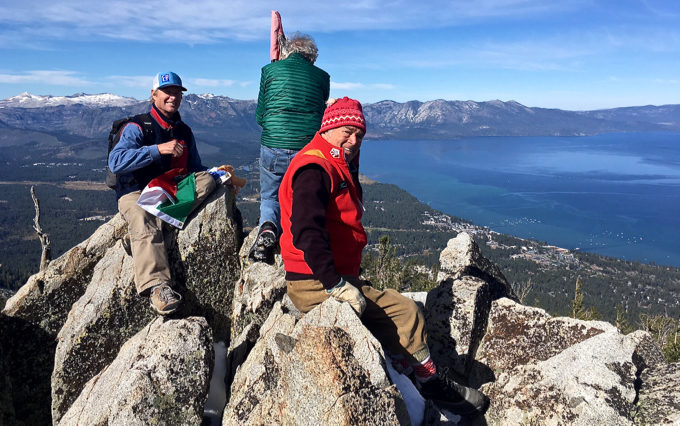
Martin Hollay on Sept. 25 at Heavenly is honored with a trail and grove of trees named after him. Photo/Terra Breeden

Hollay not only cut down trees at Heavenly, he also planted them. The man has a soft spot for nature. He hated seeing the mountain barren of trees after clearing a run, so over the years, Hollay planted saplings around the resort. Today, if you ski down Maggie’s run, many of the towering trees you’ll see on either side were planted by Hollay decades ago.

An avid skier, Hollay spent every day of the winter at Heavenly until he retired from ski patrol when he was 70. At 96 years old, Hollay still skis more than 100 days a year. It’s a personal goal of his. Last winter, when Heavenly closed for the season, Hollay had only gotten 96 days of skiing under his belt, so he drove to Mammoth and skied four more days there, just to make sure he achieved his goal.

“I admire Martin Hollay because as long as he’s doing it, I know we all can do it,” South Lake Tahoe Mayor Austin Sass said.

A crowd of about 60 people gathered at the base of the Heavenly gondola on Monday morning. The day was crisp and clear and South Lake Tahoe residents were bundled in gloves and beanies as they exchanged greetings and hugs. When Hollay arrived, he was immediately surrounded by friends and together, the crowd took the gondola to the mid-station.

On the Observation Deck, Hollay was honored for a lifetime of achievement at Heavenly resort with a trail named in his honor: Martin’s Trail. The quarter of a mile-long trail winds from the Observation Deck through the trees to Martin’s Peak.

“His life is a life well-lived and that’s an understatement,” Mike Goar, Heavenly COO said. “We want to thank him for creating this place: a world-class ski resort.”

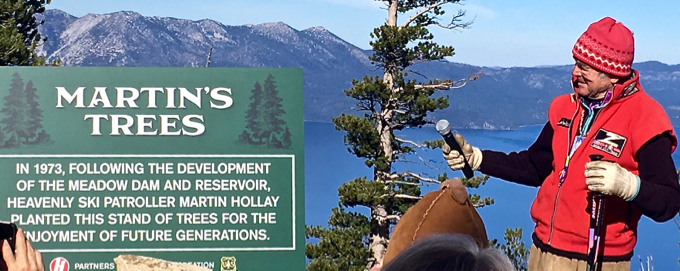
During the event, the grove of trees planted by Hollay all those years ago was given the name “Martin’s Trees” and a sign emblazoned with the story was unveiled to resounding applause from the crowd.

Hollay stood at the podium afterward with tears in his eyes.

“When the dam was finished, I looked around and saw that all the trees had been cut down,” he said. “I had to get the trees back on the mountain. So in 1973, I planted the trees at Maggie’s Run.”

At the end of the event, the crowd hiked Martin’s Trail to Martin’s Peak, an outcropping of rocks overlooking the Lake.

Hollay led the way.

“Here we go,” he said. “I hope I make it.”

Everyone in the group laughed. It was clear that if anyone could make it to the top, it was Hollay.

When all of the hikers reached Martin’s Peak they noticed a scrappy bit of red fabric waving from the top. The tattered remains of a flag Hollay hung there decades ago. On Monday, a new flag was hung there in Hollay’s name. A brand new, red, white and green Hungarian flag.


Nev. posts poor eighth-grade math scores

By Meghin Delaney, Las Vegas Review-Journal
 
Nevada students are slowly making gains in math in elementary school, but by the time eighth grade rolls around that progress comes to a screeching halt.

At least that’s what the most recent testing data released by the state suggests. Only 18 percent of students reached the proficiency level on the eighth-grade math exam, compared with 29 percent for seventh-grade math students. That made eighth-grade math the scoring nadir on the Smarter Balanced test in Nevada among all grades.

Other states that use the test don’t show similar drop-offs for their eighth-grade students.

Read the whole story


AAA study reveals Americans love fall travel

By Donald Wood, Travel Pulse

A new study revealed that almost 30 percent of Americans plan to take a fall vacation this year.

According to AAA, 28 percent of United States citizens expect to make time to travel between Labor Day and Thanksgiving. Fewer crowds and children, more favorable weather and a better value are some of the reasons travelers prefer vacations in the fall.

For autumn travelers, a road trip in the family vehicle is the most common form of transportation, with 62 percent of survey respondents driving to their destinations.

Read the whole story