Cyclists commemorate historic 1917 Tahoe ride

Bikes and roads between Sacramento and Tahoe were much different 100 years ago. Courtesy of the Photo/Center for Sacramento History Eugene Hepting Collection

By Emily Zentner, Sacramento Bee

A group of Sacramento area bicyclists took off on a 150-mile ride on Oct. 20 to commemorate a similar record-breaking ride taken in 1917.

Jeff Barker, 49, of El Dorado Hills organized the Centennial Ride to honor the 100th anniversary of Eugene Hepting and Abbie Budd’s bicycle trip from Sacramento to South Lake Tahoe. The 1917 ride broke a long-standing record at the time for the fastest ride from Sacramento to Myers Station in South Lake Tahoe, according to newspaper clippings from the Center for Sacramento History.

“The whole idea was, let’s commemorate that ride,” Barker said. “Let’s see if we can put it together, because the bikes they rode in 1917 were pretty primitive compared to what we have now. The conditions weren’t all that good.”

Read the whole story


Beauty of fall lingering throughout Tahoe area

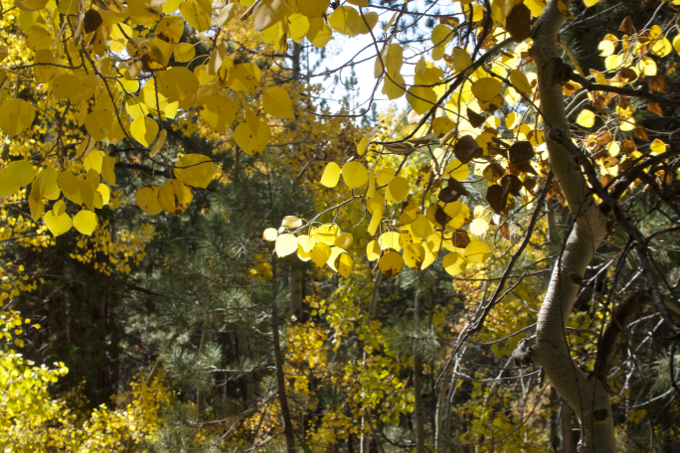
Aspen medallions dance in the breeze. Photo/Kathryn Reed

By Kathryn Reed

HOPE VALLEY – Vibrant. Dazzling. Stunning. The superlatives runneth over when it comes to describing the autumn colors throughout the Lake Tahoe Basin.

While the peak is over, Mother Nature isn’t quite done. There is still some beauty to captivate.

One of the benefits of such a moisture-heavy winter a year ago is the richness of this fall’s colors.

Last weekend driving into Hope Valley, going past Sorensen’s and hiking off Burnside Road it was a feast for the eyes. Bursts of orange and yellow were almost electrifying, especially as the branches seemed to want to scratch the cobalt blue sky.

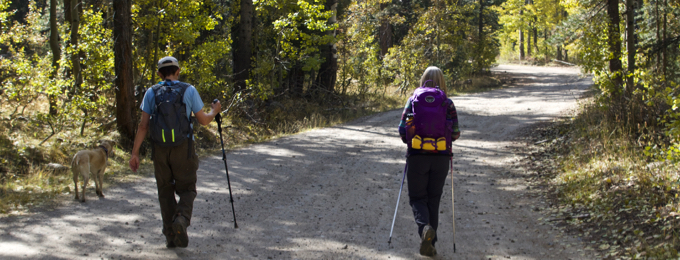
AJ, Rosemary and Carolyn along Burnside Road. Photo/Kathryn Reed

Burnside Road – that’s about all we had planned. We drove until Rosemary said she had enough. And from there we started exploring. We sauntered onto an offshoot from the main road that we thought looked pretty. It was, but the trail petered out.

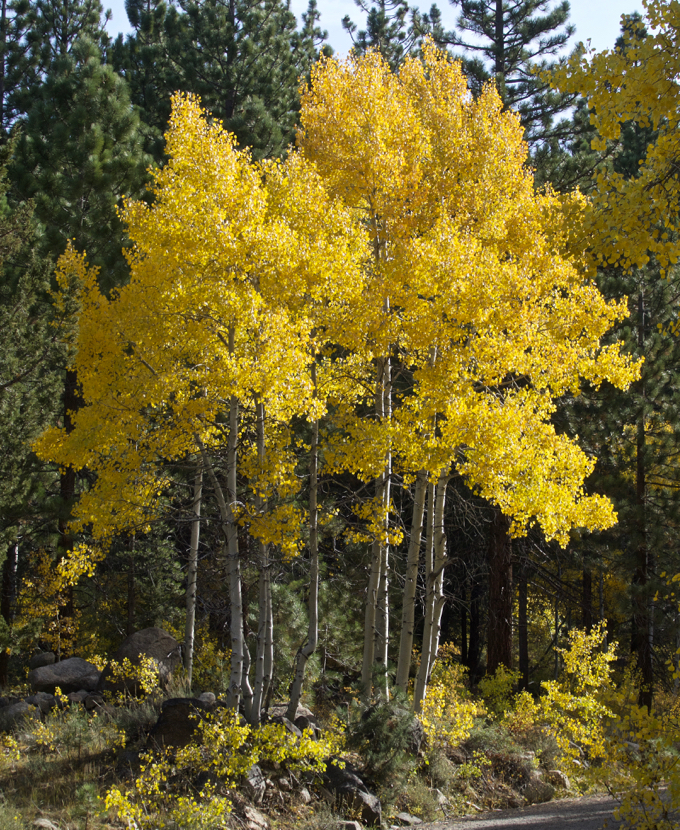
We continued on the main trail, which opened up onto some small, glorious groves of aspens. With how the sun was, it was even more magnificent on the trip back. The color was more majestic and worthy of stopping for photographs and to gawk at the splendor before us.

Aspens are super lush because of last winter’s moisture. Photo/Kathryn Reed

Going out we came across a sign that helped us decide if we were to keep wandering toward Burnside Lake or if a side route should be taken. Knowing we had no desire to put in the miles to get to the lake, we went onto Forest Service Road 31053 toward Pickett Peak (9,148 feet).

Good choice.

Red Lake Peak (10,063 feet) was the main mountain we saw on much of the trek. It still has a couple distinct splotches of snow left over from last winter.

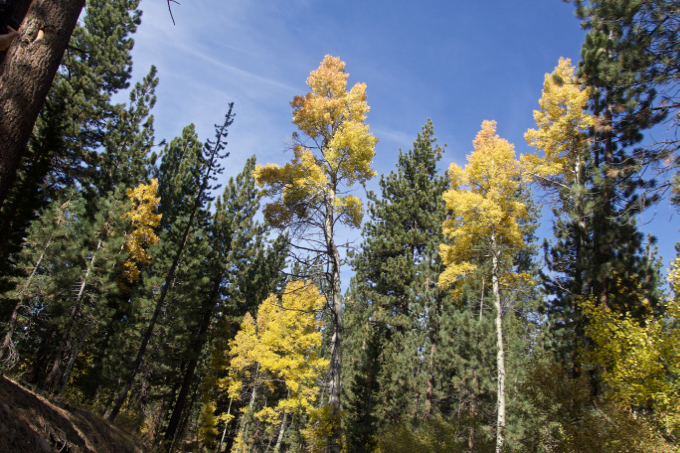
Aspens dance toward the sky. Photo/Kathryn Reed

At various points we could look out into Hope Valley, with the mountainside on the other side of Highway 88 looking like a painter’s palette.

We got to the top, which gave us a wonderful view of Pickett Peak. Climbing the peak will be saved for another day.

Vehicles of different types were able to make it up the road. While four-wheel drive was not necessary, a rugged type vehicle would be recommended. Mountain bikers and dirt bike riders were also out.

In all, we did about 6½ miles. It was a steady climb up, but not strenuous. Coming down Rosemary and Carolyn had an easier time navigating the loose dirt because they had poles.

Pickett Peak is the focal point during a stop for lunch. Photo/Kathryn Reed

—–

Getting there:

From South Lake Tahoe, take Highway 50 west. Turn left onto Highway 89 in Meyers. At the intersection with Highway 88, go straight. That is Burnside Road. Drive however far you want. Vehicle access is not allowed in the winter.


Blue-green algae in Keys disappearing

By Kathryn Reed

The cautionary signs that have dotted the canals in the Tahoe Keys are coming down.

“As expected with the seasonal change, the shorter days (less sunlight) and cooler temperatures have helped control the cyanobacteria levels,” Mary Fiore-Wagner with Lahontan Regional Water Quality Control Board told Lake Tahoe News.

The most recent water samples taken Oct. 16 show “non-detectable levels for Anatoxin-a (this is the toxin that domestic pets-dogs) may be especially sensitive too due to increased exposure), and low (below 0.8 ug/L) or non-detect levels for microcystins. Additionally, the TKPOA area is no longer supporting the summer recreationalists entering the Tahoe Keys waterways for both contact and non-contact water recreation, so exposure potential to any cyanotoxins is minimized.”

These numbers are below the mark that necessitate a public advisory.

The blue-green algae was first detected in August. Warning signs were placed throughout the South Lake Tahoe neighborhood. People had been advised not to touch the water, allow dogs to drink it, or to eat the fish from it.

Cyanobacteria blooms can look like slicks of opaque, bright green paint, or “pea soup,” but closer inspection often reveals the grainy, sawdust-like appearance of individual colonies, according to the state Water Board.

Scientists don’t definitively know why-how it is created or how it goes away.

“We did recommend that TKPOA continue routine visual monitoring and one more sampling run within a month’s time to confirm that cyanotoxins have maintained at non-detect and/or insignificant levels that no longer pose a potential risk to human or animal health,” Fiore-Wagner said.


Mass exodus of young people from rural areas

By Leah Todd, High Country News

Across the West, more young people are moving out of rural communities than in. In every decade since 1980, most rural counties in the 11 Western states lost twentysomethings, without an influx of other young adults to make up for the loss, according to an analysis of U.S. Census Bureau migration data by the Bozeman-based Headwaters Economics.

A few managed to attract young people with the lure of some nearby metro area like Albuquerque or Denver, or a roaring tourism industry like Jackson Hole, Wyo., but the undeniable trend has been a slow march to cities, where, especially in the West, jobs and people are increasingly concentrated.

In New Mexico, all but two rural counties have lost far more twentysomethings than they’ve gained since 1990.

Read the whole story


EDC ‘beeting’ a path to better roads

By Susan Wood

When it comes to clearing and cleaning up roads in El Dorado County, the lake’s new mantra could be “Keep Tahoe Red” in the winter and “Keep Tahoe ‘really’ Blue” in other seasons.

The county’s inventive punch behind road maintenance is twofold – a level of reasoning that could lead to keeping Tahoe in greenbacks.

The topic came up twice during the El Dorado County Board of Supervisors annual gathering in South Lake Tahoe on Oct. 17 — first at the county maintenance yard during an early morning tour and again later at the regular meeting in the city.

Come the (real) snowy season, county road crews plan to use an unconventional substance to de-ice and clear snow that requires less sand. Beet juice – that’s their solution.

During a snow conference in Iowa, the county learned about the vegetable-based liquid mix to blend with brine as an effective way to break down the cold enemy. In the long haul, it’s more cost-efficient.

And in the road construction season of summer, county storm water and planning gurus Russ Wigart and Brendan Ferry told the board they want to pave their way into lake clarity.

El Dorado County doesn’t want it’s old equipment to be detriment. Photo/Susan Wood

What might have been a no-go at Ferry’s regulatory employer decades ago may just be the county’s secret weapon in combating the lake’s loss in clarity and crumbling roads over the years.

The two environmental giants joined by Lahontan Water Quality Control’s Bob Larsen are making the hard case that fixing and keeping local streets up to par is an environmental argument because the debris from broken down roads more easily turns into sediment that seeps into the lake. And keep in mind, the sediment from asphalt is oil-based.

Beet juice is less corrosive and more environmentally friendly, county equipment superintendent Kent Taylor pointed out on the tour Tuesday. At the same time, beet juice maintains its integrity at minus 15 degrees Fahrenheit. Brine without it works at 15 degrees above. The “ice-biting” soupy beet mix can act like Teflon on a pan.

Alongside Taylor on the tour, county highway superintendent Matt Moody pointed to a big drum filled with beet juice. The county bought 1,000 gallons for $500 to try out the substance this year “and see how it works,” Moody said.

So, if you notice a reddish color in the snow, don’t call in a crime scene, the county warned.

As it is, a backbreaking winter like last year netted 100 calls a day into county road maintenance phone lines.

“We’re hoping not to have a winter like last year,” Moody said during the transportation yard tour.

The big picture in surviving the seasons means evaluating the roads, the budget, the material and the machines used to clear them of snow.

Keeping 11 aging graders (1982 to 2005) up to par can be a challenge for four mechanics. Each one costs at least $30,000 in upkeep. They cost about $400,000 new. That’s why El Dorado County is also examining whether leasing one from Washoe County for $5,000 from November to March is worthwhile.

“They’re in as good a shape as they can be,” Taylor said, when asked about the health of its own graders that the 14 drivers use to plow snow.

If only one could say the same thing for county roads.

Crews are teaming up with visionary planners like Ferry and Wigart to experiment with different methods of protecting county roads as well as the lake.

It’s a win-win type of thinking that could turn a synergistic corner on the relationship between the lake’s environment and economic value. Good roads equal a good image to the resident and the visitor. Endless, deep cracks on South Upper Truckee Road, huge pothole-infested streets in the Angora burn area and even the closing of Elks Club Drive for the winter because of a complete road breakdown could be a thing of the past.

And the county seems receptive to throwing its weight behind backing that goal.

County Chief Administrative Officer Don Ashton told Lake Tahoe News, after observing the Ferry-Wigart presentation, El Dorado’s $569 million budget allocates about $6.5 million to road maintenance. About half of that is discretionary emergency funding special to this year.

Wigart and Ferry are proposing a new funding mechanism be found, suggesting perhaps a user fee, gas tax and water quality grant project or combination thereof that is multi-pronged.

Big and bold in the presentation is a shocking declaration — “Maintaining pavement is a BMP.” The notion appears to run contrary to the Tahoe Regional Planning Agency’s aversion toward material that purports blanket coverage.

But this is a new day and age, requiring a new line of thinking. If anything, TRPA’s main mission is still lake clarity. The argument being made is keeping the county’s 220 miles of roads paved and fixed is good for lake clarity.

Lake Tahoe lost about one-third of its clarity between 1968 and 2000.

“Paving could be the largest BMP we have,” Wigart said. Best management practices are erosion control measures enforced lakewide.

In their board presentation, Wigart and Ferry listed culprits such as roadside soil accounting for 43 percent of the pollution source. A breakdown of particles from asphalt was also dominant at 31 percent. Abrasive sand was third at 16 percent. Heavy equipment also contributes to the rough surfaces. The study was completed during a period of low winter moisture.

“We destroy our roads in winter,” Wigart told the board, equating the breakdown of the road to a Jenga puzzle.

The presentation got the supervisors thinking.

“We need to capitalize on the car,” Supervisor John Hidahl said.

Most were in agreement that the funding source would need to be multi-dimensional, involving road condition and storm water drainage in order to receive more grant money.

“We’ve got to start with the basics. You can have the best roads in the world, but it won’t make a difference if they don’t drain,” Supervisor Brian Veerkamp said.

In other action, the board:

·      Unanimously approved the sheriff’s Office of Emergency Services recommendation that a local state of emergency continues in the county due to severe storms from last winter.

·      Considered in a 5-0 vote a $5,000 request from the Lake Tahoe Bicycle Coalition to support the Lake Tahoe Bikeways map and its overall efforts.

Nev. commits $1M to fight opioid epidemic

By Ben Botkin, Las Vegas Review-Journal

The state’s Interim Finance Committee on Oct. 19 approved more than $1 million in expenditures for a five-point opioid initiative to fight abuse of prescription painkillers in Nevada.

The initiative from Attorney General Adam Laxalt’s office was unanimously approved by the legislative panel. It includes money for everything from incinerators for disposing of drugs to education and treatment programs.

“On average, one Nevadan dies per day from drug overdose, and opioid-related overdoses have become the lead cause of death in America,” Laxalt said in a statement. He added that the initiative “creates an opportunity to face the epidemic that touches our families, friends and loved ones, and to promote prevention in Nevada.”

Read the whole story


Chancellor has high hopes for Nevada colleges

By Natalie Bruzda, Las Vegas Review-Journal

Thom Reilly believes there is no more time to waste.

The Nevada System of Higher Education chancellor has been on the job for only two months, but he has a bevy of goals ready for the state Board of Regents meetings this week.

“We need to build our budget. We need to get ready for the (2019) Legislature, and identifying what our focus should be is important,” Reilly said. “The time is now. We can’t wait much longer.”

Beginning Thursday, the board will convene for a two-day special meeting and workshop to discuss, among other issues, the five goals Reilly has identified, with improving access at the top of the list.

Read the whole story


Insured losses top $1 billion in NorCal fires

The exact cost of the October fires will take months to tally. Photo/CalFire

By Joseph Serna, Sonali Kohli and Makeda Easter, Los Angeles Times
 
Deadly wildfires in Northern California have caused over $1 billion in insured losses, according to California’s insurance commissioner.

Preliminary loss figures released Thursday by State Insurance Commissioner Dave Jones estimate total insured losses at $1.045 billion.

The insurers — eight of California’s largest — also found that there were 4,177 partial residential losses, 5,449 total residential losses, 601 commercial property losses, and over 3,000 auto losses.

Read the whole story


NOAA: La Niña an uncertain forecast for Tahoe

By Susan Wood

The National Oceanic and Atmospheric Administration on Thursday released the U.S. Winter Outlook, which calls for La Niña. For Lake Tahoe it’s a wild card with equal chances for above- and below-normal precipitation and temperatures.

The outlook encompasses December through February.

La Niña, a weather phenomenon originating off the western shores of South America, is more than halfway developed and could influence the West Coast in its predictable ways – if there is such a thing.

Typically, La Niña brings on a warmer and drier Southern California, while giving the northern end cooler temps and more precipitation. El Niño, which formed two years ago, results in the opposite. Lake Tahoe is on the cusp for both, which strengthen in varying degrees.

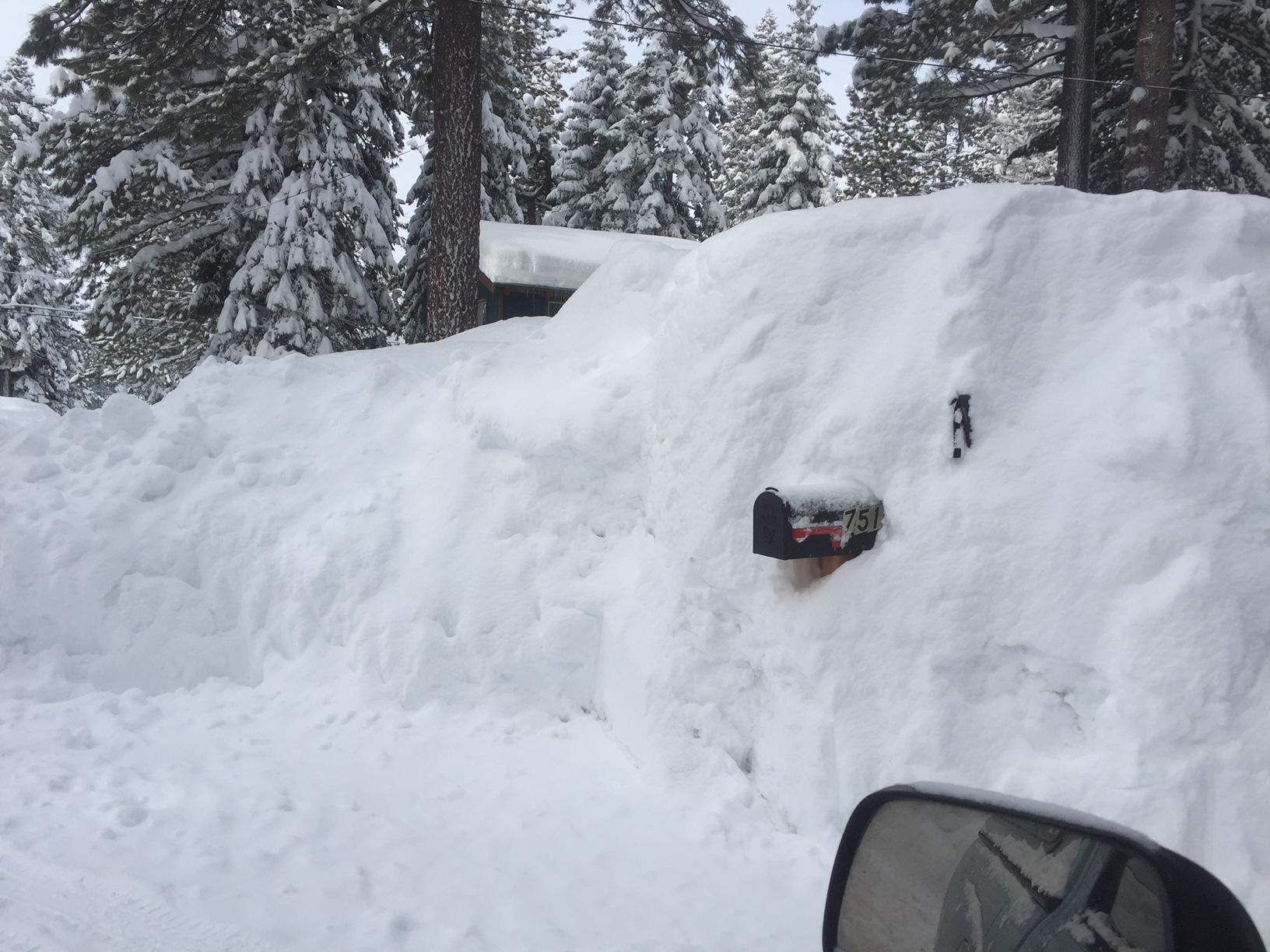
Buried mailboxes were the mild inconveniences of last winter. Photo/Susan Wood

“The reality is, the storm tracks don’t come out the same each time, and we don’t know in advance,” NOAA’s Climate Prediction Center Deputy Director Mike Halpert told Lake Tahoe News on a media conference call Oct. 19. “It’s a tricky one. I would plan for it all.”

Certainly, last winter’s deluge has shown a need for the Tahoe-Truckee-Reno area to be prepared.

Halpert said he doesn’t expect “such an extreme event, especially with La Niña (conditions)” because “that wouldn’t favor it.” But Northern California could see “any one of three outcomes” meaning above, below or equal chances.

NOAA will provide an update on Nov. 15.

The climatologist called last year “a rare event” that had “less than a 5 percent chance” of forming.

That rarity coming off four years of drought provided a huge crop of fuel for exploding wildfires this summer and fall that marked some of the hottest days recorded.

The winter of 2016-17 prompted many closures in government offices as well as private sector companies. Lakes formed in South Lake Tahoe where none had been seen before. Roads crumbled and shut down. Blizzards blinded commuters on the mountain passes. Sandbagging was all the rage. And while skiers rejoiced, commuters experienced nightmarish driving conditions.

“We were shaking our heads a little bit,” Halpert said in discussing the extremes.

Within its models, NOAA’s Climate Prediction Center studies factors that influence the precipitation and temperatures across the United States. But gusty winds that turn wildland fires into raging infernos and snowstorms into blizzards are “something to look at,” Halpert told LTN. NOAA is in the process of developing a “hazards product” that can more closely evaluate and account for risk of the

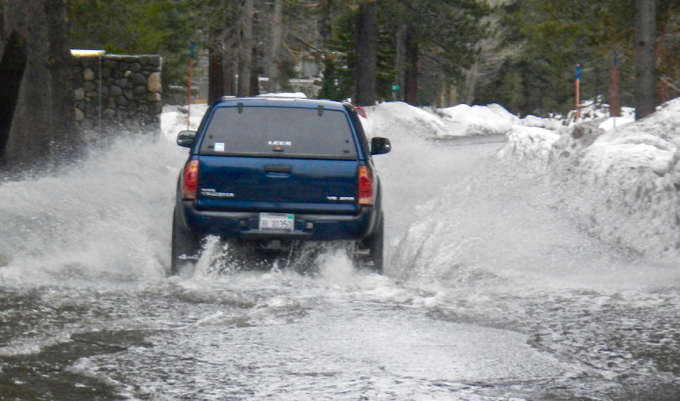
Flooding in the Tahoe Keys and state street areas of South Lake Tahoe was normal last winter. Photo/LTN file

nation’s communities.  

The “2018 Farmers Almanac” calls for “above normal snowfall” in the California mountains and characterized the zone where Lake Tahoe falls as “cold and wet.”

Last winter’s severe storms produced quite a quandary, as water managers celebrated an end of the long-term drought in California. But there is such a thing as too much, too fast.

Reno had its wettest water year on record. Tahoe’s seasonal snowfall last winter measured 248.5 inches between November to April, dwarfing the average of 184.9, according to the National Weather Service. And some ski resorts topped 400 inches. But that wasn’t the whole story. It was particularly wet.

“The difference is the precipitation. This was the biggest winter we’ve had since 2010-2011. Then we had the drought,” Weather Service meteorologist Scott McGuire said from his Reno office. “Atmospheric rivers” became a part of our vernacular.

From Reno to Carson City to Gardnerville to Lake Tahoe, much of that water flowed everywhere and flooded areas not accustomed to seeing water. In the North State, the Oroville Dam was breached.

And so begins our water season, according to the California Department of Water Resources. DWR ranks the 2017 water year as second only to 1983 as the state’s wettest. That was an El Niño year that flooded large swaths of Southern California and caused bluffs to collapse.

Last year, 52 counties declared states of emergency due to January’s sequence of storms. There are 58 counties in California.

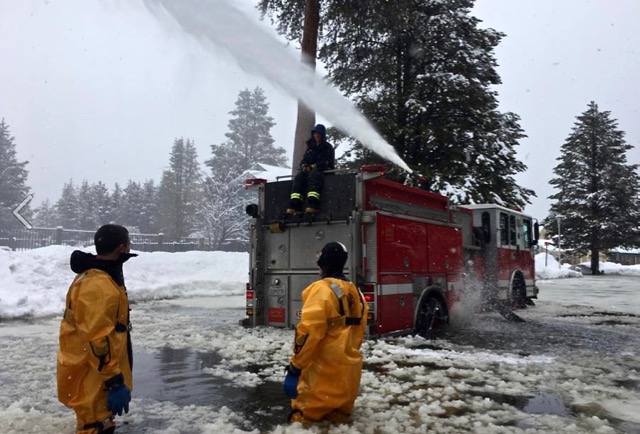
South Lake Tahoe fire crews in February get rid of ice and water on city streets. Photo/SLTFD

The phenomenal wet winter has resulted in residual effects. Mice have taken up residence in homes at abnormal rates because their ground holes were filled in.

The impact of last winter could linger into this year. Standing water dots the landscape of South Lake Tahoe.

Where does that water go? The thought of this may keep engineers and storm water gurus up at night.

“If we end up having an above average winter or even an average winter this year, it could be challenging,” South Lake Tahoe storm water program coordinator Jason Burke told Lake Tahoe News.

It’s a perfect storm of reasons.

The lake level is up, the groundwater is high and an already moist soil can’t absorb as much.

Crews are out now using the hydro vac truck to clean the pipes in anticipation. Like last winter, the city will avail sandbags at its yards and stations.

“People should be prepared for a hard winter,” Burke said.

In particular, Burke said homeowners in low-lying areas such as Tahoe Island, Tahoe Keys, Glenwood, Al Tahoe, the state streets, and Bijou Meadow should be on the lookout. The city just completed Phase 3 of its $3.4 million storm water project at Sierra Tract.

The problems lie in drainage systems, which have public works staffers hopping. The city was laid out with minimal thought to storm water placement and channeling. Now retrofitting that backward infrastructure is an expensive endeavor. For example, Sierra Tract’s entire project cost about $15 million just for that neighborhood.


SLT Chateau site to finally be filled in

By Kathryn Reed

While driving by on Highway 50 it’s hard to know the hole still exists, going down one of the side streets in the state line area reveals concrete and rebar are very much a part of the landscape.

The owners of this much maligned piece of real estate in South Lake Tahoe hope to start filling in the back portion next summer.

“It will be consistent with the prior approvals, with changes to where the convention center was to go,” Gary Midkiff with Midkiff and Associates told the City Council on Oct. 17. “We anticipate we will come to staff soon for design changes.”

The goal is for construction to start in 2018.

Long called the Chateau project, the more than 11-acre site was at one-time going to be the largest redevelopment project in the city’s history; a decade ago the price tag was more than $400 million.

Bankruptcy and the dissolution of the state’s redevelopment agency have the future less definitive now.

On Tuesday, though, the council approved the final subdivision map. According to the staff report, this affects the “14 original pre-redevelopment lots, portions of the abandoned pubic rights-of-way, and parcels located within the Chateau at the Village footprint.”

Midkiff said the owner is in preliminary discussions with city staff as to what the future holds. Lodging – 387 units – will still be a substantive component. Whether it’s full ownership, operated like a hotel, condos or something else remains to be seen.

Tahoe Chateau Land Holding LLC, a Chinese-American investment group, earlier this year bought the property from Tahoe Stateline Venture LLC, a subsidiary of Owens Realty Mortgage Inc., for $45.5 million.

A press release in May said, “The original convention center plan will be eliminated and replaced with smaller meeting rooms targeting incentive and group events.”

The goal is that the new development will complement the existing condos – called Zalanta – and retail that fronts the highway. Zalanta opened earlier this year. It is full ownership condos, with the assumption most will be put into a rental pool for tourists.

“As the property manager of Zalanta, Vail Resorts will operate a 24/7 front desk and ski valet for the property in addition to managing both the homeowners’ association and vacation rental program on behalf of owners,” Kevin Cooper with Heavenly Mountain Resort told Lake Tahoe News. “Vail Resorts is well-versed in property management and homeowners’ association operations in seasonal mountain resort destinations throughout Lake Tahoe at Heavenly, Northstar and Kirkwood as well as its resorts in Vail, Beaver Creek, Breckenridge and Keystone in Colorado and Park City in Utah.”

A second phase of Zalanta is in the works as well, which will be more lodging.

The entire site will include open spaces, being walkable, and more retail.