Voters say no to South Tahoe’s Measure C

By Kathryn Reed

While the majority of voters said yes to Measure C, that was not enough support for the South Lake Tahoe roads measure to pass.

The sales tax initiative required two-thirds of the voters to cast yes ballots.

With all the votes counted on Nov. 7, El Dorado County Elections Department is reporting the measure received 1,194 yes votes (54 percent) and 1,017 no votes (46 percent.)

The low voter turnout (22 percent) was expected with this being the only item on the ballot.

The ballot measure asked the residents of South Lake Tahoe to raise the sales tax from 7.75 percent to 8.25 percent. The $2.5 million that was projected to be raised annually could only have been spent on roads.

There are zero dollars for roads in the 2017-18 South Lake Tahoe budget. The City Council of late has funded roads at the mid-year budget review. However, not a single road was paved in 2000, 2002, 2004, 2005, 2011 and 2016.

With a projected deficit coming in the next few years based on revenues leveling out and expenses – retiree costs in particular – increasing, the mid-year cash infusion into roads is likely to go away.

The council will have the option to continue to not make roads a priority in the budget or cut something else to clear the way for pavement projects.

While the City Council on Tuesday appointed members to a roads authority management board, those people need to look for another way to be civically involved. They were to have had oversight of the projects.

Neither City Manager Nancy Kerry nor Mayor Austin Sass returned Lake Tahoe News’ calls, nor did Measure C opposition spokesman Bruce Grego.


SLT limits VHRs to 1,400 in residential areas

By Kathryn Reed

Fourteen hundred. That’s the maximum number of vacation home rentals South Lake Tahoe will allow.

After another meeting of the City Council on Nov. 7 where short-term rentals dominated the discussion, it’s possible the electeds might let the ink dry on the latest ordinance before revising it yet again. But no promises because already Councilman Jason Collin broached the idea of reducing that number even further. He even wants to revisit this whole topic every six months if not more often.

On a 3-1 vote Tuesday, the first reading of the newest ordinance passed. The second reading is slated for Nov. 21. Then the ordinance takes effect 30 days later. Until then the law of the land is the urgency ordinance approved last month, which called for an immediate moratorium on VHRs.

All of the changes only pertain to the non-tourist core area.

Councilman Tom Davis recused himself from the discussion because of his stake in Tahoe Keys Resort. Councilman Austin Sass voted against the ordinance, stating the only dissatisfaction being the 1,400 number. He preferred the limit be 1,200.

The latest numbers show there are 1,397 VHRs outside the tourist area.

Before that vote was taken Sass was able to bully his way into making sure no new permits are issued until the new ordinance takes effect. Before the council was an agenda item asking to allow the 93 permits that had been submitted to go through the approval process. At previous meetings that was the sentiment of the majority, but it was not written into the urgency ordinance. Tuesday’s measure was in essence a clarification of council’s wishes. It required a fourth-fifths vote, but with one councilmember unable to vote, it really had to be a unanimous decision. That didn’t happen. The motion failed on a 3-1 vote.

Sass said to allow the permitting process to proceed would be “hypocritical” when his goal was to reduce VHRs.

“We have changed the rules on them halfway through,” Councilwoman Brooke Laine said of the applicants. “It’s lights out. We didn’t intend that.”

Laine, Collin and Councilwoman Wendy David were adamant in not wanting to hurt the people who had been going through the process in good faith.

Between 15 and 20 VHR owners choose not to renew their permit each month, so about 200-250 go off the market each year. Of course new ones take their place.

And new ones will still be allowed – just not more than 1,400, and not until Jan. 21.

The current applicants will remain in the pool if they want to be; or they can ask to have the application pulled and be issued a refund. (It costs more than $500 for a VHR permit.) They will all have to abide by the ordinance that was approved Tuesday.

Some of the key rules in the ordinance include:

·      Mandatory bear box, with number of cans based on square footage.

·      Occupancy being two per bedroom, plus four.

·      No use of hot tub between 10pm and 8am.

·      No special treatment for applicants in escrow.

·      No zoning administration hearing.

·      No notification of neighbors of a new VHR in the area.

·      No warnings will be issued; only citations.

·      Three violations in 24 months and the permit is revoked.

·      Five community service officers will be hired. (One is employed now.)

·      Fines of $1,000 will be issued to renters and owners for each violation.

·      Owners will be subject to VHR rules.

·      Shared rentals are not part of the ordinance, meaning they don’t have to be permitted or pay transient occupancy tax. This topic will be discussed on its own at a future meeting.


U.S. climate report forecasts shrinking snowpacks

By Don Jenkins, Capital Press

Snowpacks in California, Oregon, Idaho and Washington are expected be much smaller by mid-century if greenhouse gas emissions continue to rise, according to federal projections released Friday.

The Fourth National Climate Assessment, completed once every four years, asserts that the mild winter of 2014-15 may have foreshadowed the future.

“As a harbinger, the unusually low Western U.S. snowpack of 2015 may become the norm,” according to the report.

Read the whole story


Olympic medal the 1 trophy Holland is missing

Publisher’s note: This is one of a series of stories about Lake Tahoe area athletes who hope to compete in the 2018 Olympics in South Korea. 

By Susan Wood

PARK CITY, Utah – With 16 medals under his belt, it’s difficult to imagine this self-assured family man who snowboards for a living insisting on needing to fill a void in his life.

But Nate Holland isn’t your ordinary athlete.

The Truckee snowboarder wants an Olympic medal – sooner than later. He will be 39 on Nov. 8. So, as he prepares to work toward the PyeongChang Games in South Korea in February, he’ll aim for the podium when he roars full-throttle down the snowboard cross track for the one thing that’s eluded him.

Truckee’s Nate Holland is eager to add Olympic medalist to his resume. Photo/Kathryn Reed

Even with eight X Games gold medals and three Winter Olympics appearances behind him, he came up empty-handed in 2006, 2010 and 2014. In Vancouver, he even came in fourth, with toes almost reaching the bronze podium. To this day, he laments about having control in the first three turns, then missing the notorious Turn 4.

This time, the steely look in his eyes matches his good health. And if a sense of humor contributed to the medal criteria, he’d win gold hands down.

He pokes fun at his youthful competitors’ ages, believing being the elder statesman is actually an advantage despite the sport attracting more and more young bucks.

When they’re staring at their Fitbits and describing their intakes and outtakes with energy concoctions that sound like something out of a sci-fi movie, he shrugs it off.

“I just have Advil, coffee, a hot tub and a good breakfast, man,” he quipped. Of course, a workout that inflicts some pain is incorporated in that routine. The fierce athlete knows he’s of a certain age to where he can’t “roll off the coach” and tax his body without solid conditioning.

But what his competitors may not know is the competition for Holland can be waged in a verbal exchange to psyche them out.

“One of my strengths is my mental warfare. They know that when I was competing, they were eating popsicles,” he joked during an Olympic media summit roundtable discussion earlier this fall. 

He gains insight from other older athletes.

“Look at Tom Brady, Aaron Rodgers,” he listed the New England Patriots and Green Bay Packers quarterbacks as examples.

The athlete who traded in a freestyle career for snowboard cross in 2006 is banking on his “closure” ability. This is huge based on the physics of his sport. A handful of snowboarders race alongside one another on a track with jumps and banks. Collisions and mishaps are frequent. And like a bike race, successful riders will draft on each other until they make their move like a slingshot around the competitors.

Besides the strategy, there’s the sheer thrill of it all.

“When you’re going 60-plus miles per hour, there’s nothing better than big air,” he said. It’s also a risky time to land wrong and blow half a year’s or half a lifetime’s training. 

But that’s Holland – all or nothing.

Nate Holland, center, is the senior snowboarder for the U.S., with Alex Deilbold, left, eight years younger and Ryan Stassel 15 years his junior. Photo/Kathryn Reed

This may be it for the longtime rider from Idaho, who grew up practicing then honing his craft on a small hill near Sandpoint with his buddies.

From there, Holland said their mothers got tired of “driving us around” and hired a ski coach “as a chaperone.” The rest is history.

He moved to Squaw Valley in 1999 to pursue his snowboarding career, and has called Truckee home ever since.

“I’m taking it one day at a time, one year at a time,” he said.

So far, he likes what he sees in his chances in South Korea. The track is big to his liking, as witnessed with his test run there last year with other Olympic athletes.  

“My biggest challenge is getting there and making the team,” he said. “Once I’m there, I know that track suits me.”

Plus, some could argue the adrenaline may build off the course as well.

Given the tensions with the United States between South and North Korea, he wonders whether the Games will be secure. During the test run, F16 military jets were “flying over every 15 minutes.” He made light of the spectacle then by telling his teammate: “Dude, I love you man – if it’s all over.”

These days, he questions whether his daughter should be there at the grand global event. His wife, Christen, insists their daughter see her dad compete.

“Then, I thought if we’re going down, we’re going down together,” he said. Holland was sarcastic, but honestly blunt.

He’s also sentimental when it comes to his family.

“Fatherhood is the coolest thing I’ve ever done,” he said of his 2-year-old daughter, Lux.

Still, despite the bout of parental responsibility, Holland has shown he knows how to have fun.

He not only looks forward to his time on the course. He is eager to immerse himself in the culture, informing Lake Tahoe News at a press conference that he plans to “brush up on a few more songs” for the local karaoke bar.

Holland thoroughly relishes his time with the South Korean people.

“There’s no other place like it. Every time I get on a (chair) lift, they give me a double hand wave and a big smile,” he told LTN.

Western guvs want federal help in invasive species fight

By Associated Press
 
Governors of 19 Western states are pressing the federal government to do more to prevent the spread of damage-causing invasive mussels from infected federally managed waterways.

The Western Governors’ Association last week sent a letter urging Interior Secretary Ryan Zinke to put in place by spring 2018 controls to prevent the spread of zebra and quagga mussels.

The governors are also asking that federal agencies conduct mandatory inspections and decontamination of boats leaving infected water bodies. The mussels can attach to boats and trailers and travel long distances, clogging water pipes, damaging boat motors and affecting other aquatic life.

Read the whole story


Rain, snow don’t mean an end to fire danger – yet

By Sam Stanton and Nashelly Chavez, Sacramento Bee

Rain and snowfall that swept over Northern California on Saturday morning hold the promise of relief from the deadly fire season that ravaged the state this year, but fire officials say it is far too early to believe the danger of more wildfires has passed.

“It just continues on,” CalFire spokesman Scott McLean said of the possibility of more fires in the coming months, despite the start of the fall rains. “Let’s see what the rains bring. Definitely, it will slow things down, but it will not stop.”

So far this year, CalFire says it has battled 6,405 blazes that consumed more than 556,090 acres, more than double the acreage that burned through the same time last year. Overall, 1.1 million acres – more than 1,718 square miles – burned between CalFire areas and U.S. Forest Service territory in the state. The carnage, as usual, was worst in October, when devastation hit Santa Rosa, Loma Rica and Redwood Valley and other communities and killed at least 43 people.

Read the whole story


Basinwide ski marketing group disbands

By Kathryn Reed

Ski Lake Tahoe has long been a behind the scenes group of Tahoe area resorts that collectively promoted their industry.

After 20 years the group has dissolved and will no longer be that one voice this winter or beyond.

“Ski Lake Tahoe certainly was a brand platform for the regional ski product, but the individual marketing efforts of the resorts may end up being equally powerful. In other words, whether we’re sending a single message ‘Ski Lake Tahoe,’ or several messages, we’re marketing the destination,” Carol Chaplin, executive director of Lake Tahoe Visitors Authority, told Lake Tahoe News.

It’s still possible resorts will partner, but the ownership landscape has changed since Ski Lake Tahoe first formed. At the time owners were all different for Sierra-at-Tahoe, Heavenly, Kirkwood, Northstar, Squaw Valley, Alpine Meadows and Mount Rose. In many ways this made for a more level playing field no matter the size of the resort.

Today, Heavenly-Northstar-Kirkwood have the same parent company, while Squaw-Alpine are united.

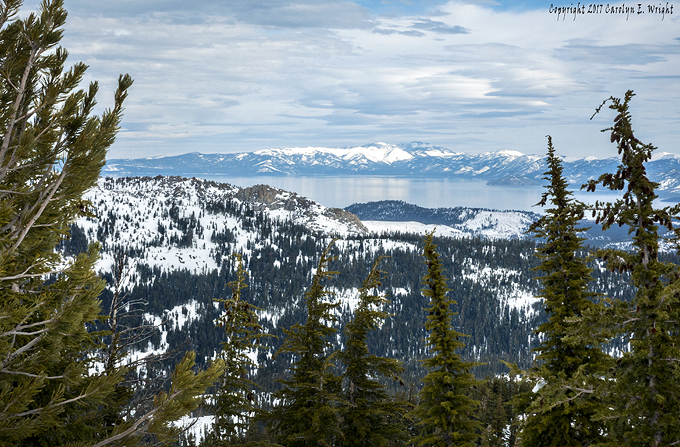
Sierra-at-Tahoe has new plans for attracting skiers this season. Photo Copyright 2017 Carolyn E. Wright

“Sierra-at-Tahoe originally joined to have one common voice amongst seven different major resorts around the lake. To promote the destination as a whole and educate people on all the amazing options when it came to winter recreation in Lake Tahoe,” Steve Hemphill with Sierra told Lake Tahoe News. “Fast forward to today, while there are still seven ‘separate’ resorts, we really only have four sitting at the table. With two of those, owning five out of the seven mountains.”

Sierra realized last spring it wanted out. The board agreed to disband in the summer. Letters were sent to destination marketing organizations and lodging partners.

In part it said, “As the competitive landscape continues to change, Ski Lake Tahoe resorts will refocus their efforts and resources. The resorts will continue to play an integral part in the Reno-Tahoe tourism industry and continue to promote the region and look forward to working with you in those efforts.”

Ski Lake Tahoe had offered an ultimate pass for the seven resorts. Those no longer exist.

“We continue to work closely and collaboratively with other partners including Visit California and (North Lake Tahoe Resort Association),” Liesl Hepburn with Squaw-Alpine told Lake Tahoe News.

Reps from Heavenly, Northstar, Kirkwood and Mt. Rose did not respond to an inquiry.

The resorts have long worked with the visitors bureau in its region. Other partnerships are part of the mix, too. Each benefits from the other’s marketing because so many tourists just think of skiing Lake Tahoe, without realizing the choices they have that even go beyond the seven resorts that were in this select group.

“I believe the resorts are still having conversations about where they still collaborate, so while the actual organization goes away, the shared goals don’t,” Chaplin said. “Finally, if we are to stay current with our customers/visitors, we constantly have to look at what’s the best and highest use of funds. It’s not a bad thing to look at different ways to market, particularly since technology causes us to do so frequently these days.”

Hemphill at Sierra echoed that sentiment.

“Each resort will continue to move forward with their individual campaigns and marketing efforts. Sierra and the other resorts remain committed to marketing the destination as a whole and will look for opportunities to collaborate when they’re presented,” Hemphill said.


5 Lakes Trail in Squaw-Alpine ski gondola battle zone

The gondola’s impacts to the adjacent wilderness area are being questioned. Photo/LTN file

By Tom Stienstra, San Francisco Chronicle

From a Sierra crag at north Tahoe, with one sweep of the eye you can look across towering peaks and down into a valley — and take in a landscape shaping up as the next big turf battleground in California.

On one side are the world-renowned Squaw Valley and Alpine Meadows ski areas and their lodging, restaurants and shops. On the other side is the Granite Chief Wilderness, which abuts land where a contested 13,000-foot gondola is proposed to rise up to the ridge and link the ski areas.

In the middle, the Five Lakes Trail rises through a section of Alpine Meadows, including one stretch in which hikers walk beneath a ski lift trolley line and base. The trail then tops the ridge at 7,400 feet, passes the wilderness boundary and feeds hikers to a mosaic of five lakes, small and jeweled. It is one of the best short hikes in the High Sierra. For extended trips, the trail then connects a few miles beyond to the Pacific Crest Trail.

Read the whole story


Study: Climate change sucks moisture from West

By Stuart Leavenworth, Sacramento Bee
 
The Trump administration released a sweeping report Friday that pegged man-made climate change to droughts and wildfires in California and the West, but for reasons one may not expect.

Scientists have uncovered little evidence that climate change is a driver of reduced rainfall and snowfall in the region, including during the drought of 2001-2015. But studies have found strong links that higher temperatures, caused by climate change, have reduced soil moisture in California and other states. That in turn has affected farm operations and dried out vegetation, creating fuel for wildfires.

“Much evidence is found for a human influence on surface soil moisture deficits due to increased evapotranspiration caused by higher temperatures,” said the congressionally mandated National Climate Assessment, an annual review of scientific literature on climate change affecting the United States.

Read the whole story


Wilderness waterfall worth the walk

Galena Creek falls in September. Photo/Kathryn Reed

By Kathryn Reed

INCLINE VILLAGE – Waterfall season is usually a late spring ritual. Not this year.

With the abundance of snowfall last winter in the Sierra, it meant water flowing long past when it normally would be a trickle.

Taking advantage of a Sierra Club hike, I ventured with a group to the Galena Creek waterfall in the Mount Rose Wilderness several weeks ago. What a treat. I didn’t even know this 60-foot high waterfall existed until then.

In mid-September it was more like summer hiking. With this weekend’s storm, it’s hard to know what the access will be like or if snowshoes would be the better choice of footwear.

Part of the hike is along the Tahoe Rim Trail. From here it’s also possible to get to the summit of Mt. Rose.

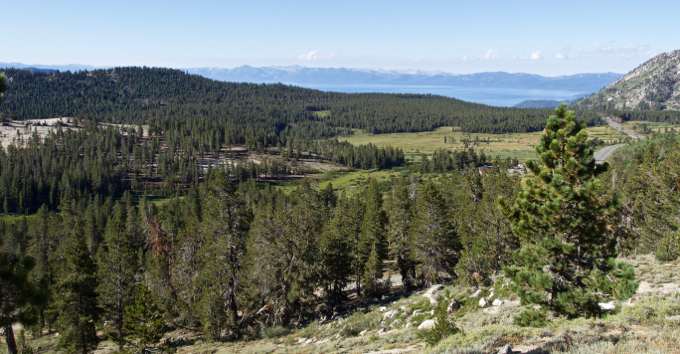
Lake Tahoe is visible near the start of the hike. Photo/Kathryn Reed

It didn’t take long for expansive views of Lake Tahoe to come into view, along with the meadow that spans both sides of the highway. Winding around, the south part of Reno then comes into view.

The guide points out Tamarack Lake to our right, which through the trees could easily be missed. Tamarack Peak (9,897 feet) is nearby, though Mt. Rose (10,776 feet) is the most dominate feature as it looms large for much of the walk.

It’s a single-track trail that at times is wide-open and other times is closed in by the forest.

While beauty is everywhere, the waterfall really is what makes this hike so outstanding. Looking at the rocks, it’s easy to imagine how thundering the water must have been in the summer. It makes me want to return next year, closer to peak flow.

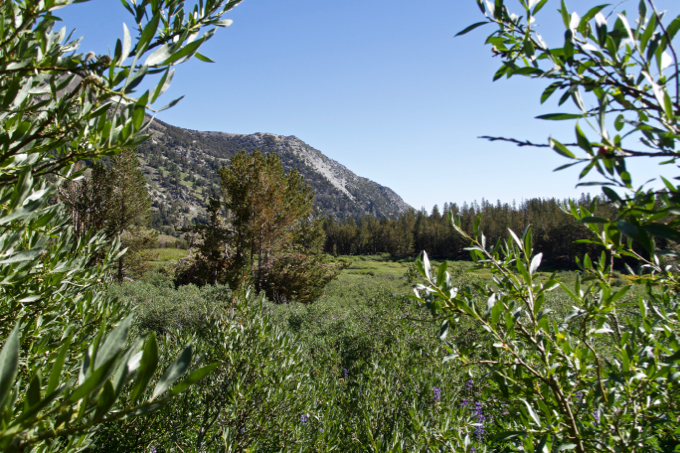
Looking in the other direction is a lush, verdant meadow fed by these waters.

To the waterfall it was 2.4 miles, a 557-foot elevation gain, and 328-foot elevation loss. Our guides took us a bit farther, through the meadow with its gentle creek and wildflowers still vibrant. This added about another mile to our trek.

It had been a while since I had hiked with a group of mostly strangers. On the one hand it’s nice to meet others and be led, on the other hand the pace is inevitably slower and dogs are less likely to be allowed off leash. Still, the Sierra Club is to be commended for offering these free hikes and allowing non-members like myself to participate. All that’s asked is a $1 donation that goes for the guides to get first aid training without out-of-pocket costs.

A lush meadow is fed by Galena Creek. Photo/Kathryn Reed

—–

Getting there:

From South Lake Tahoe, go east on Highway 50. Go left onto Highway 28 at the top of Spooner Summit. At the roundabout in Incline, go right onto the Mount Rose Highway. Park at the summit on the left. The trail starts to the left. The starting elevation is 8,911 feet – the highest year-round pass in the Sierra.