State forcing Kindertown to close
kinder

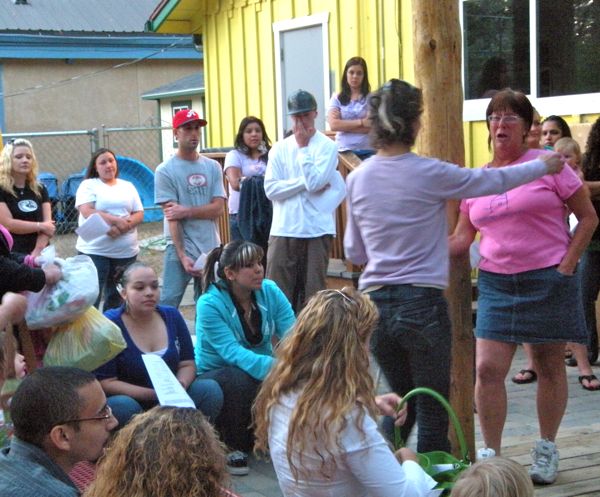
Maria Barrows-Crist, right, receives one of many hugs of support Wednesday night. Photo/Kathryn Reed

By Kathryn Reed

Tears were flowing and words of anger uttered as more than a 100 parents stood in the play yard at Kindertown on Wednesday night to hear owner-director Maria Barrows-Crist explain that the state plans to close the facility Oct. 15.

It means 130 children who attend the South Lake Tahoe day-care center will be displaced and the 20 employees will be without a job.

None of the parents at the 30-minute meeting said anything negative about the center. Most looked dumbstruck.

“I am sorry this slander has hit your employees too,” Ian Baker told Barrows-Crist afterward. “I think it’s all fabrication. I come here all the time and everyone is coherent.”

Baker was referencing the state’s charges that employees have been at work under the influence of drugs or alcohol.

Rebecca Westmore, administrative law judge, handed down her decision Aug. 17 in a 28-page document. However, it was just last week that Barrows-Crist found out her state license was going to be revoked. It came in the form of a condolence letter from Choices from Children about the impending closure.

The directive also says Barrows-Crist, who has run the 36-year-old facility since 1978, must not work with children for two years.

Two of the key witnesses for the state are former Kindertown employees who had been fired by Barrows-Crist.

Barrows-Crist’s attorney on Monday applied for a stay and reconsideration of the decision.

“The judge said I didn’t show remorse. Both of the girls who complained cried,” Barrows-Crist, 57, said of the May 14-15 and July 20 hearings in Sacramento.

Judge’s ruling

In Westmore’s decision she cites Kindertown giving a peanut product to a child who is allergic to substance. The judge ruled Barrows-Crist tried to “minimize the gravity of the situation.”

To the charge of removing a child without parental consent, Barrows-Crist said the child was taken to her daughter’s home — who at the time was an employee of Kindertown — because no one picked the child up, nor were they reachable and the center was closed. The judge said that showed poor judgment.

Accusations against Dee Dee Crist, the owner’s daughter, relate to her allegedly being under the influence of alcohol or other drugs while working. The judge ruled Crist should never be permitted to work with children again.

In an incident from 2003, the judge believed Diane Brown, a licensing program analyst, over Barrows-Crist when it came to whether a child was burned by hot soup.

“I find the testimony of LPA Whitmire to be credible. Respondent Barrows-Crist’s testimony was an obvious attempt to minimize the misconduct, and reflects a continued pattern of denial related to her management and operation of the Kindertown facilities,” Judge Westmore wrote.

Lake Tahoe News can only surmise the judge got the LPA’s name wrong. LPA Whitmire is referenced in other testimony, but not this particular item.

Part of Kindertown’s license revocation includes 2.5 pages about Miss Marcia, aka Marcia Sarosik, not being fingerprinted, but teaching a class at the preschool-day care-infant center.

The fence has been 3-feet high for 30 years. Suddenly, Barrows-Crist was reprimanded for it not being 4-feet high.

The judge’s decision goes on to say Barrows-Crist retaliated against former employees. The judge sided with the former employees.

Parents react

After Barrows-Crist read a one-page letter last night to parents, many of whom had little ones with them, one after another said they’d do everything they could to keep Kindertown open. Some talked of staging a protest march in the coming days.

“You can’t find anything like this in Tahoe,” Stephanie Yuzbick said as she held one of her two daughters who attend Kindertown. “I know what she has done for this community. This needs to stay open.”

One person shouted, “If we wanted to be somewhere else, we probably would be.”

Other parents worried it might mean needing one spouse to quit their job to be able to care for a toddler.

“I’ve noticed Ryan is ahead of kids who don’t come here,” John Cocores said of his son who is about to turn 3.

Tiffany Reid said her 2-year-old daughter is thriving at Kindertown, and that Barrows-Crist and the staff are incredible.

Laura Barber with the South Lake Tahoe Women’s Center said Barrows-Crist has always allowed their clients access to her facilities at a reduced rate.

Future for kids

If Kindertown is not able to stay open under Barrows-Crist’s leadership or possibly by an employee, it means losing the $386,000 the state Department of Education gives the center to pay for low-income families to have child care.

The El Dorado County Office of Education has said it will open a center at the old Al Tahoe Elementary School if Kindertown closes. It would be eligible to receive those state dollars.

More than 6,000 kids have attended Kindertown. The center cares for those ages 6 weeks to 10 years.



Ordinance for pot clubs extinguished

Ordinance for pot clubs goes up in smoke.

Ordinance for pot clubs goes up in smoke.

By Kathryn Reed

A meeting set for yesterday at 10am never occurred. Apparently South Lake Tahoe Police Chief Terry Daniels took it upon himself to schedule the meeting with the three pot dispensaries in town without the knowledge or consent of the City Council.

Daniels said the meeting was like any other when an ordinance or revision to one is being drafted – get the people who will be affected by the rules involved early on.

The problem is higher ups never gave him the direction to draft such legislation.

The police department has oversight over a few types of businesses in town. Massage is one of them. Every therapist working in the city must be fingerprinted and carry a SLTPD issued card. But no one has said medicinal marijuana should come under the department’s prevue.

Most occupations don’t have this added layer of oversight.

When City Manager Dave Jinkens was asked by LTN about the pot club meeting, he knew nothing of it. Jinkens and Finance Director Christine Vuletich were copied on the letter from Daniels to the pot clubs.

Jinkens had been out of town on city business when the letter was written.

“When the chief of police realized that no direction to proceed with an ordinance had been given by the City Council, he decided to cancel the meeting,” Jinkens said in an email to Lake Tahoe News after getting up-to-speed on the matter. “The decision not to move forward with the meeting and discussion is prudent and proper under these circumstances. No further action will be taken on this matter until specific direction to do so is given by the City Council and the matter is not on the calendar to be brought back.”

The meeting was canceled less than 24 hours before it was set to begin.

The council last took up the legal cannabis issue on July 7. No action was taken, though a slew of supporters of the medicinal pot clubs spoke that day.

Several issues remain unresolved because federal and state laws contradict each other regarding medicinal marijuana. The city has opted to not issue business licenses to the dispensaries in town. This means they are not paying their share of taxes.

“The federal and state governments need to get their act together to make our job easier on these sensitive matters at the local level,” Jinkens said.


Do It Center coming to South Tahoe

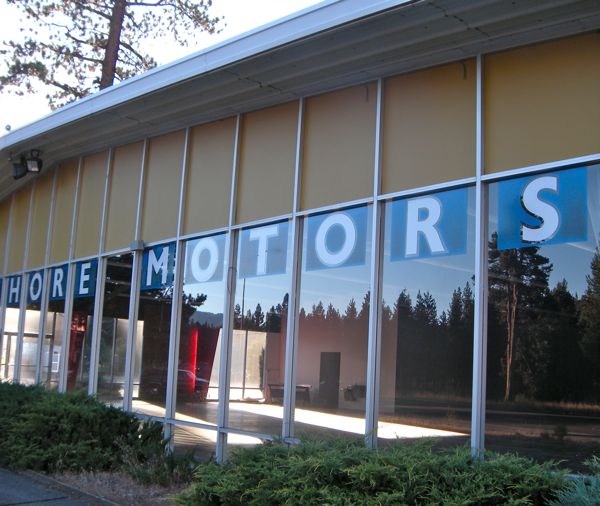
Do It Center will soon occupy the old South Shore Motors building in South Tahoe.

Do It Center will soon occupy the old South Shore Motors building in South Tahoe.

By Kathryn Reed

The Do It Center did it.

South Lake Tahoe officials issued the permit Monday for the old South Shore Motors building on Lake Tahoe Boulevard to become a general merchandise-nursery.

A special use permit is not required for this type of business.

In the permit it says, “A condition of approval is included that requires the DIY Center to maintain this variety of merchandise and not evolve over time in to a store that would be defined under a different use.”

Do It Center President Jess Ruf had wanted to be much more — just like his other locations scattered throughout California. Ruf was not available for comment Monday night.

Ruf signed a 10-year lease on the building in December.

Do It Center’s approval from the Planning Commission was appealed by Robert Cosmi, whose family has owned Scotty’s Hardware for 40 years. The council sided with Cosmi in June by denying the special use permit that was required if Ruf were to carry the more extensive inventory. Since that time Ruf and his backers have been working to reconfigure the business model to fit the 18,792-square-foot site.

What neighboring businesses are upset about is oversaturating the market with the same type of merchandise. Besides Scotty’s, Ace Hardware and Kmart’s home center are within walking distance. There are myriad other businesses on the South Shore that carry similar stock that Do It Center is likely to have on its shelves.

Cosmi on Monday night said he wasn’t surprised about the permit. Still, his intention is to file an appeal within the five-day window that he and anyone else has.

“What, they drop lumber and it becomes a totally different store?” Cosmi said. “Most of the gentleman’s suppliers are mine.”

Twenty-five to 30 percent of the store is expected to be devoted to nursery items and 10 to 15 percent will be seasonal items. The remaining categories include lighting-electrical, paint, hardware, plumbing, cleaning supplies, small appliances, storage-home decor, clothing, auto, pet, sundries, pool-spa supplies, and a display of large appliances that can be ordered.

Plans call for overhauling the outdated facade with a cleaner, more contemporary look. The parking lot will be reconfigured so traffic flow is better.

The permit says, “The applicant is proposing to remove existing windows and much of the glass on the front and sides of the building. The plan proposes to fill in the space for the windows and doors on the sides of the building with siding and CMU block wainscot to match the existing building.”

Cosmi said he plans to talk to Nel’s and Meeks today. He also plans to contact the National Hardware Association.


Put the fleece away — it could be a record breaking week

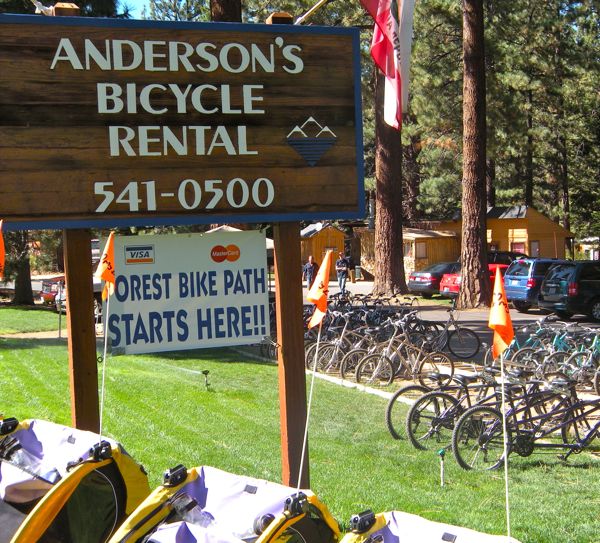
Anderson's Bicycles is all geared up for a warm fall.

Anderson's Bicycles is all geared up for a warm fall.

By Susan Wood

Don’t put away the shorts, swimsuits, garden tools, bikes or appetites for an Indian summer.

The mercury in South Lake Tahoe is expected to rise this week and may even meet or surpass the record high for Sept. 25 of 81 degrees, the National Weather Service in Reno reported Sunday.

It will definitely feel more like summer, even though the first day of fall  is Tuesday.

At the very least, Tahoe residents and visitors will see temperatures continuing to stay warmer than normal. Meteorologist Gina McGuire said the forecast for this week calls for highs 10 degrees above the normal 70-degree mark.

“We’ve been warm this month,” she said. “And we’ll probably tie the record this week.”

“Bring it on,” sums up the response from Doug Anderson, who owns Anderson Bicycle Rental on Highway 89. The South Lake Tahoe business has been around for 31 years, so it’s witnessed the ebb and flow of Mother Nature’s whims.

“I aim for Halloween weekend (to close), but in the last three years, I’ve been open until Thanksgiving,” he said, grinning. “I like this time of year. I hope we have an Indian summer.”

Even when the Central Valley and San Francisco Bay Area types board up their Tahoe cabins and second homes and head home, Anderson said he enjoys sitting in the warm fall sun waiting for customers.

The Bay Area may see inland temperatures hit the century mark this week, so those residents may not be through with cooling off in Tahoe yet.

Still, most people in Tahoe would be advised to bundle up at night as the regional highs will be offset by an extreme temperature differential by as much as 50 degrees on some days this week. Overnight lows are predicted to drop to the mid-30s at night.

The warm September coincides with the latest prediction from the “2010 Old Farmer’s Almanac”, which forecasts an Indian summer as late as early November for the Intermountain region, which includes the Central Sierra Nevada Mountain range. Tahoe, which sits on the triangular corner of this region with the Pacific Northwest and Northern California, may also see a winter characterized as mild and wet.

Extremes could be the name of the game this winter in Tahoe, according to the Almanac, which boasts an 80 percent accuracy rate. November’s unseasonable warm temperatures are predicted to give way to much shoveling in December and power outages in January. Look for an early February welcome mat to birds and an early thaw in March may launch spring and cut winter short, the publication claims.

Even the “Almanac” has something to say about climate-change debate.

“The prolonged low level of sunspot and space weather activity in the early stages of Solar Cycle 24 reinforces our belief that we are at the beginning of a period of significant change,” it reads under the General Weather Forecast and Report section. It explains the atmosphere’s gradual cooling could be offset by “warming caused by increased greenhouse gases.”

The “Almanac” agrees with other climate reports that the winter of 2009-10 will experience conditions of El Nino, a tropical weather phenomenon characterized by a warming of the Pacific Ocean off the coast of South America. However, a mild El Nino should be in store.

Skiers may rejoice at the prospect of the above normal snowfall prediction for the Intermountain region by the “Almanac”.

Susan Wood is a freelance writer based out of South Lake Tahoe. She may be reached at copysue1@yahoo.com


Budget, personnel issues dominate Happy Homestead Cemetery agenda

Linda Mendizabal, John McChesney, Del Laine

Linda Mendizabal, John McChesney, Del Laine

By Kathryn Reed

The Happy Homestead Cemetery board approved a budget last week without having final numbers tabulated. As of Saturday not all board members knew what the exact figures are for revenues and expenses for the fiscal year that starts Oct. 1.

The board agreed to slash the estimated interest to be accrued from $50,000 to $20,000. Then the three members (John McChesney, Del Laine and Linda Mendizabal) started cutting expenses.

The end result is a difference of about $7,000 that the board expects to put into reserves.

When board clerk and bookkeeper Coco Kelly left the Sept. 16 meeting to borrow a calculator she came back with a reserve of $90,000, but said the calculator was too small to get accurate numbers and that she did the calculations three times, with three different results.

The total budget for the South Lake Tahoe cemetery is close to a half million dollars.

Confusion reigned between the board members toward the end of meeting about how to pay Kelly for expenses she incurred while the county withheld payment for services rendered.

Kelly owns Substitute Personnel & Business Services and works at the discretion of the board to do clerk and bookkeeping duties. The job of clerk-bookkeeper has been in her family for about 30 years. Things started to get sticky in the last year when the county auditor-controller said Kelly could not work for the board while her husband, David, was a board member.

David Kelly chose to resign even though he had been on the board since 2003 without any alarms going off in Placerville.

Joe Harn, El Dorado County auditor, said in a letter dated Sept. 2 he was not going to pay a $2,411.50 bill submitted by Coco Kelly until county counsel reviewed it.

Cemetery legal counsel Dennis Crabb said after the meeting that Kelly has since withdrawn her request to be paid for the work. Still, he said she would be getting paid for the expenses incurred because she had to borrow money to keep her finances in order.

At last week’s meeting there were questions whether Kelly had been paid the $3,000 for expenses related to the matter. McChesney said he didn’t know how to get a check out of the endowment fund for this. Laine was adamant that Kelly gets reimbursed.

Because of a 3-0 vote by the board to combine what Kelly does with that of the cemetery’s receptionist, it is possible Kelly will be out of a job unless she wants to give up her business and become staff at the cemetery.

The board also agreed to expand to become a five-member board. That could be in place by the end of the year.

The Board of Supervisors, which oversees special districts like this, will make the ultimate decision at a public hearing. Appointments would be made that day after the hearing. So far John Poell has applied to be on the board. He was at last week’s meeting.


Both sides claim victory in shorezone ruling

By Kathryn Reed

A federal judge on Friday gave the Tahoe Regional Planning Agency what it wanted —  the ability to continue the permitting process for buoys and piers at Lake Tahoe, but not allowing construction to continue.

U.S. District Judge Lawrence Karlton listened to arguments Sept. 14 in Sacramento before making his ruling four days later.

Sierra Club and League to Save Lake Tahoe have sued the bi-state regulatory agency over its shorezone regulations. The number of new buoys and piers is a large part of the controversy.

Today there are about 800 piers and 4,000 buoys on Lake Tahoe. TRPA’s plan is to allow an additional 128 private piers and 1,822 buoys.

“Not one new buoy will be added to the lake until every buoy is permitted and the illegal ones are removed,” TRPA spokesman Dennis Oliver said late Friday night.

He further stated, “At the hearing we argued in favor of a partial injunction.”

The shorezone issue has been contentious for 22 years and even more so after the Governing Board of the TRPA adopted a shorezone plan in October 2008.

In the original complaint filed by the League and Sierra Club with Earth Justice attorneys representing the environmental groups, it says, “By enacting the Amendments, TRPA not only violated its duty to protect the Lake from environmental degradation but also its fundamental charter to restore and maintain the health and natural beauty of one of the deepest and clearest lakes in the world.”

According to Associated Press reports, the environmental groups are claiming victory after Friday’s ruling.

However, in court what Earth Justice wanted was a full injunction — something the judge said no to.

The entire matter should be resolved next year. The trial is scheduled to begin March 16.


State of roads dig deep hole in South Tahoe

Even though some roads in South Lake Tahoe got repaired this summer, most make for a bumpy ride. Photo/Kathryn Reed

Even though some roads in South Lake got repaired this summer, most make for a bumpy ride. Photo/Kathryn Reed

By Susan Wood

Forget that time heals all wounds. With respect to South Lake Tahoe roads, time is the enemy – one the City Council has grappled with for more than eight years.

While the debate over how to fund street repair continued in council chambers last month, the network of 130 miles of roads has disintegrated to a level where city engineers believe 65 percent of the streets will need to be reconstructed by 2024. City staff is basing its estimate on a pavement management study conducted by a consultant two years ago that painted anything but a rosy picture of the public works program.

By next year, almost 40 percent of the roads are projected to be rated in “poor” condition. Airport Road is one of those. Under an elaborate rating system, the consultant estimated the network would bump two-thirds of the roads in the “very poor” category in the next 14 years.

Less than a quarter of city streets are considered “fair,” “good” or “very good.”

Even though most city officials agree the streets need to be overlaid or patched, the amount of money earmarked for the program remains in jeopardy every year.

The $1 million allocated for street overlay in this budget year was slashed by more than half as a result of an unprecedented economic downturn. This wasn’t the only year the roads took a back seat in the budget. No budget was allocated in 2001, 2004 and 2005.

According to a staff report, the cost of asphalt has skyrocketed by 130 percent from $37 per ton to $85. Asphalt is oil-based, contingent on the volatile price of a barrel of oil in world markets.

City Engineer Jim Marino said staff is looking into using a new rubberized chip seal next year. The seal is a mix of oil and crushed rock. Crews would cover the surface twice with the hope ultraviolet exposure and snow removal equipment don’t break down the double layer.

“With limited funding, we should be focusing on keeping our good roads in good shape in order to extend lifespan,” Marino said.

Adding to the problem is Sacramento. The state temporarily crawled out of its budget quagmire to patch its funding holes. In doing so, it is still considering taking back California’s gas tax money of 18 cents a gallon local governments have come to rely on.

Public Works Director John Greenhut has called his task of developing a budget for his department “challenging.” The city’s fiscal year begins Oct. 1.

But the cry of being poor doesn’t sit well with locals. Motorists and residents like Evan Williams have complained to the city in recent years about the state of Venice Drive. The popular Tahoe Keys thoroughfare where Williams lives delivers a bone-jarring experience in a vehicle and bicycle trying to negotiate 3- to 5-inch-wide cracks that cover the Keys water lines.

“Every time any vehicle of weight goes by (over the cracks) the whole house shakes,” Williams said. “The city has some culpability of maintaining our roads.”

But Public Works contends simply patching these cracks won’t work because the original asphalt failed to bind adequately enough to handle the wide temperature variances this region experiences. To fix the expanding and contracting of cracks on Venice the city would need to go in and grind out the problem areas before filling in.

Mayor Jerry Birdwell has asked the Public Works department for a list of streets in need of repair. He wants to find one-time funds to fill the holes that pop up every year.

At an August council meeting, Councilman Bill Crawford suggested the city Budget and Finance Committee reduce the general fund reserve earmarked for emergencies be reduced from 25 percent to 15 to help “get serious about public works.”

Susan Wood is a freelance writer based out of South Lake Tahoe. She may be reached at copysue1@yahoo.com.


Man found floating in Lake Tahoe

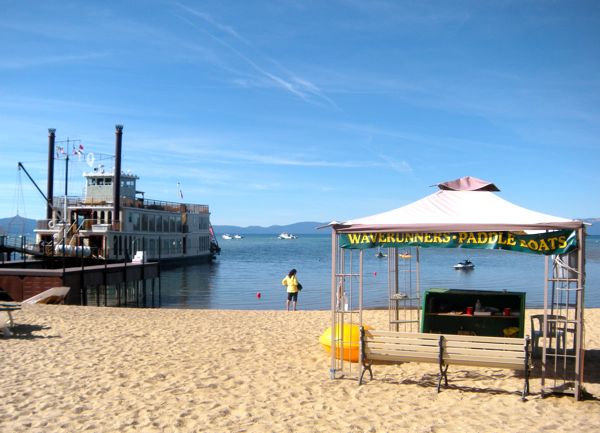
People returned to the water at Ski Run Marina late Wednesday afternoon after a body was found floating by the Tahoe Queen early in the morning. Photo/Kathryn Reed

People returned to the water at Ski Run Marina late Thursday afternoon after a body was found floating by the Tahoe Queen early in the morning. Photo/Kathryn Reed

By Kathryn Reed

A captain of a fishing boat found a man face down early this morning in the shallow water of Lake Tahoe near the Tahoe Queen paddle-wheeler.

The captain called his boss, John Shearer, owner of Tahoe Sportfishing, who then called the South Lake Tahoe Police Department about 7:15am.

“They were backing out and they saw the body,” Shearer said. “There was no movement. I have no idea who it is. Hopefully, we don’t know them.”

The local police as of 4:15pm had not identified the man they describe as being between 25 and 30 years old. Nor do they know where the man is from.

It is too early in the investigation to know if foul play was involved.

Ski Run Marina, where the body was found, is in the middle of South Lake Tahoe and is a bevy of activity most days. The marina was shut down until about 3pm. The Tahoe Queen had to cancel its 11am and 2:30pm cruises.

Chris Joyner of South Lake Tahoe had his wakeboarding plans changed. He arrived at the marina about 7:30am to find about nine police cars in the area, and the marina off-limits to watercraft.

He said the body was found near the Queen.

For the fishing boats, they had to dock at Timber Cove when they returned. Captains were retrieved via kayak and customers had to walk back along the beach.


LTUSD students post double-digit test score gains

LTUSD test scores are rolling forward.

LTUSD test scores are rolling forward.

By Kathryn Reed

Superlatives were rolling off educators’ tongues when the annual test scores were officially released Tuesday.

Lake Tahoe Unified School District surpassed everyone’s expectations as well as state and federal minimums.

If Tahoe Valley Elementary and South Tahoe Middle schools maintain this level of performance for one more year, they will no longer fall under “program improvement” status.

Of the district’s six schools, half met the state’s Academic Performance Index goal of a score of at least 800. Sierra House hit 799.

All of this testing is part of the federal No Child Left Behind. Instead of following the progress of a class of students, one third grade is compared to the next third grade – so improvements are not an apples to apples comparison.

However, the district has the capability to do that type of longitudinal analysis to know if a class or individual student is regressing, progressing or at a plateau.

Students in grades 2-11 take the language arts-math tests.

One thing Superintendent Jim Tarwater points to as being a plus is all-day kindergarten and preppie K.

“The second-graders were the first class with full-day kindergarten and they scored about 20 percent better than the other grades (without all day K),” Tarwater said.

Tarwater, who is in his fifth year at the helm of the academically challenged district, said it would take three years to see improvements once the district and most of the schools hit PI status. His prediction was spot-on.

Teaching, looking at how well a student learned the material, and then re-teaching made the difference, Tarwater said.

He said during the last year more intensive math instruction was part of the game plan. Using a pacing guide so the instruction was completed before the standardized tests were given also helped.

A component that is missing for many students because of all this testing is instruction beyond English, language arts and math.

Tarwater hopes if test scores keep going up, social sciences, arts, science and the other disciplines that make for a well-rounded student will be incorporated back into the curriculum.

He admits that without learning science or subjects at middle school – and many are not – that those students are at a disadvantage when they reach high school.

Because South Tahoe High School is now in year three of being PI, it’s possible a District Assistance Intervention Team will come in to assess what the school is doing. It could mean losing a bit of autonomy.

Tarwater believes the 20-point API gain when only five were required will show the powers that be that the school is on a corrective course.

All eyes are also on Washington because President Obama has said he wants to overhaul NCLB because the goals are unattainable and funding for mandated programs was never in place.

2009 API results:

Bijou went from 625 to 689, gain of 64, state had set a minimum gain of 9;

Magnet went from 881 to 919, gain of 38, no gain required;

Sierra House went from 768 to 799, gain of 31, state had set minimum gain of 5;

Tahoe Valley went from 743 to 820, gain of 77, state had set minimum gain of 5;

STMS went from 772 to 800, gain of 28, state had set minimum gain of 5;

STHS went from 730 to 750, gain of 20, state had set minimum gain of 5.

“I don’t think we’ll always make double digit gains like this, but we won’t ease up,” Tarwater said. “We will continue to increase, but probably not as dramatically as this.”


Council to undertake South Tahoe Y Community Plan

Blight and empty buildings are the foundation of declaring a large segment of South Lake Tahoe a redevelopment area.

Blight and empty buildings are the foundation of declaring a large segment of South Lake Tahoe a redevelopment area.

By Susan Wood

A bold plan to redevelop the better part of South Lake Tahoe will be before the City Council Tuesday. The ambitious plan could cost millions of dollars if the city has to acquire property and will require the cooperation of land and business owners — two things not everyone believes are achievable.

No longer just the Y, the proposal goes along Highway 50 to the Bijou area.

At the 9am meeting the council will vote on the draft redevelopment plan for the proposed South Tahoe redevelopment project known as Project 2.

Revitalization of the town’s west-end area was known as the Tahoe Valley Community Plan two years ago. Community plans are requirements by the Tahoe Regional Planning Agency, but what is before the council goes beyond anything the bi-state regulatory agency mandates.

Two years ago, through the efforts of a citizen’s group created by the city a plan was developed and abandoned.

It has become a launching pad for a redevelopment project area spanning a swath beyond the Lake Tahoe Airport along Highway 50, up 89 to West Way and continuing on 50 to Al Tahoe Boulevard. From there, it leapfrogs to Harrison Avenue down to Glenwood Way.

If the project goes forward, the formal public hearing will be next February.

Blight is the key word

There’s a history for the city — one wrought with controversy over $12 million spent on eminent domain, displaced businesses, its largest redevelopment project remaining a hole in the ground and some disgruntled citizens feeling the Y plan they spent two years on was ripped out of their hands.

The South Lake Tahoe Redevelopment Agency will review a 1-inch binder that essentially makes the case for redevelopment in an area so large it almost reaches the Ski Run-to-Stateline redevelopment zone.

In fall 2007, the city approved the revised survey area and contracted with Southern California consultant Fraser & Associates to reevaluate the level of blight in the area. The report concludes that 86 percent of the 2,681 parcels in the area are considered physically blighted.

More shocking, it continues to say, “The entire project area is affected by conditions of economic blight.” Photos dot the proposed plan, including the old Re/Max building near the Y labeled economically blighted just because it’s empty.

The report highlights crime in the proposed redevelopment zone, using pictures of graffiti to make the point. It adds the need for investment in the Y area because it accounts for a third of the retail sales in town. Also mentioned is a 33-acre individual plan called the Mikasa Gateway that encompasses 49,000 square feet of commercial space. The idea is to position the boarded-up, privately owned shopping center as a retail destination.

The Tahoe Valley plan of 2007 calls for mixed commercial use, public plazas and native landscaping. The same goes for this one.

With the city’s franchise agreement making the local government accountable, Lukins Brothers water customers have a right to an adequate system. This is why the city has included the water company in the latest redevelopment plan. The city has not found a way to rectify a huge problem that could have spelled disaster during the Angora Fire.

It will cost nearly $30 million to fix Lukins’ infrastructure, though the consultant had the outdated $18 million figure. The small water company services more than 40 percent of the proposed redevelopment area’s parcels.

Questions about businesses

Another section of the proposed plan highlights relocation assistance for businesses. The rules of participation declare the agency may buy land and improve the property “at fair market value from existing owners.” For months, the city has contended it would not use eminent domain on residential properties in respect to the Tahoe Valley plan, but how far the city will go to push for its agenda appears questionable.

City Councilman and Redevelopment Agency board member Bill Crawford, for years a critic of the government practice, insisted Sunday the city wouldn’t opt for eminent domain based on recent board actions prohibiting its use.

“The city can’t afford any more debt,” Crawford said. “And I don’t think the community would support it.”

He has concerns about what’s considered blight and references in the plan to tax increment, which is property tax aimed at servicing debt incurred through eminent domain. The city pays more than $7 million each year to service the debt from Heavenly Village.

“The problem with redevelopment in this town is that redevelopment on the public side has been a failure,” Crawford said. The latest example is the non-existent convention center.

It could be a bane and blessing to Pat Frega, who served as a city planning commissioner and a Tahoe Valley Community Plan committee member. Frega said that even after two years, a majority of the dozen citizens who served on the community group still feel the project “was hijacked” by a council subcommittee because “we were going on a different course than what they wanted.”

Councilmen Ted Long and Hal Cole served on the subcommittee. Long no longer serves. Phone calls to Cole were unreturned. He is the liaison to the Tahoe Valley Community Plan and the architect of the convention center contract that did not include a performance bond.

“We told them we didn’t want to see Stateline at the Y,” Frega said, adding he’s not happy with the magnitude of the project area.

Problems have arisen since then over the allowable height of buildings in the gateway district. At one point, the city was suggesting six-story structures, but that idea has since been cut in half.

“I understand how cities would use redevelopment as a tool to jump-start community plans, but shouldn’t our energy be focused on what we’ve already started,” he said, referring to the stalled convention center project near Stateline.

Susan Wood is a freelance writer based out of South Lake Tahoe. She may be reached at copysue1@yahoo.com.