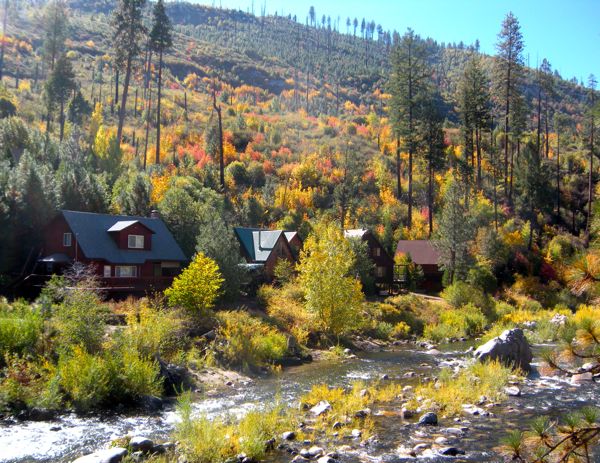
A river runs through the foliage

American River Canyon on Oct. 17, 2009. Photo/Kathryn Reed

American River Canyon on Oct. 17, 2009.    Photo/Kathryn Reed

New England might be home to the most famous swath of fall foliage in the United States, but it isn’t the only place to see nature’s palette.

The American River Canyon (Highway 50 between Echo Summit and Pollock Pines) is rich with color right now. Various shades of yellow — ranging from golden to pale are visible. The red spectrum goes from pink to fire engine red. Orange and green fill the gaps.

With the river at a rather subdued state, at times it appears perfectly still — offering reflections of the foliage. A few rapids exist, just a reminder of the velocity of this river in the spring and early summer when whitewater kayakers ply the waters.

ngg_shortcode_0_placeholder


Immersion in the SF arts scene

The Academy of Sciences roof. Photo/Kathryn Reed

The Academy of Sciences roof. Photo/Kathryn Reed

By Susan Wood

SAN FRANCISCO — Lake Tahoe could learn as much about tourism from San Francisco as the Western world could from the Egyptians about preserving ancient treasurers.

That’s what I surmised from a recent trip to San Francisco. So often it’s the arts that get me to The City.

Arts are precisely what The City’s tourism officials are banking on in these challenging economic times.

From the San Francisco Symphony to the de Young Museum’s 30-year return of King Tut to the one-year anniversary of the California Academy of Sciences to the annual Fat Tire Bike Festival, the storied city’s culture or counterculture as in the case of the latter, boasts the draw of a varied audience seeking a big bang-for-the-buck travel experience.

For tourism officials in The City by the Bay, there’s a reason they call the experience “only in San Francisco.”

“Events are the big attractions. This is so much a part of what San Francisco is,” said San Francisco Convention and Visitors Bureau spokeswoman Laurie Armstrong, who once lived and worked in South Lake Tahoe.

Sure, times have been tough — especially in terms of hotel occupancy, which stood at 84.2 percent in July compared to 88.8 percent a year ago at that time. Moreover, hotels’ average daily rate has plummeted from $252 to $188 to keep the visitors coming.

“Tourism overall has been a mixed bag in San Francisco,” Armstrong said.

Armstrong noted how visitors expect a certain, multi-faceted experience from San Francisco. For one thing, almost all events have green standards. Recycling is part of everything — including bins saying “landfill” so people get a clear idea of what is and isn’t reused. The third year of the Fat Tire Bike Festival in Golden Gate Park brought out a slew of recycling bins, while also touting the benefit of human power to save the planet.

Another example of event creativity, AT&T Park — home of the San Francisco Giants — has hosted a live telecast of the San Francisco Opera.

“It’s something to see the place full — 40,000 people looking at the (AT&T Park) jumbotron appreciating the opera,” Armstrong said.

San Francisco is so serious about the arts that the Convention and Visitors Bureau employs a director of arts and culture. Geraldine O’Brien said she’s noticed the arts remain strong in visitation in a troubling national economy. Like hotel bookings, these visitors tend to make reservations more at the last-minute. When a household budget remains in flux, it’s difficult to know whether the trip to the grocery store will cut out entertainment for the week.

O’Brien added how more than half of the city’s visitors come from outside the area. Many are seeking an experience one can’t get on Main Street USA.

“This summer museums have done remarkably well,” O’Brien said.

The Asian Museum has absorbed days of record-breaking visitors. The California Academy of Sciences’ unique experience has brought out 2.3 million people to take in its journey into the planet’s origin and sustainability along with an up-close-and-personal view of wildlife and its varied habitats.

Preserving ancient culture

The de Young Museum in Golden Gate Park has enjoyed a summer and fall filled with visitors day after day witnessing the unearthing and display of artifacts of Egypt’s boy-king pharaoh King Tutankhamun. It’s been 30 years since the ancient treasures have graced the museum, introducing the young and old to his mystery.

But unlike the display in the 1970s, the famous mask was not part of this tour.

At age 9 in 1332 B.C., King Tut took control of the valley of the Nile River, the longest in the world. He died 10 years later after inheriting a country in disarray. For a perspective of the Egyptians’ tenure, the ancient pyramids were already 1,000 years old.

The Egyptian culture used tombs as a mini universe for the deceased, prompting some visiting the museum to question whether British archaeologist Howard Carter should have taken the 16 deep steps to exhume the boy king’s 5,000 treasures from a remote tomb grave. But many museum visitors were in awe of the variety of artifacts, ranging from sharp daggers and a game board the boy played called “Senet” to a decorated chest and 150 pieces of jewelry.

“Everywhere was the glint of gold,” a display dictated the words from Carter.

Also on display within the exhibit is a collection of photographs from Harry Burton who followed Carter on the Tut expedition.

The King Tut exhibit is at the de Young through March 28. Tickets are available through Ticketmaster. Reservations are highly recommended.

Academy of Sciences

The California Academy of Sciences celebrated its first anniversary in Golden Gate Park Sept. 26-27 with a test in internal operations. A fire alarm sent scores of visitors out in the park plaza and staff on high alert. After distributing vouchers for Ben & Jerry’s ice cream for the inconvenience on an unseasonably hot day in The City, visitors didn’t miss a beat. They stuck around for more than 90 minutes in the heat before being able to return to the fun and air conditioning.

A live display put on by the Wild Cat Education and Conservation Fund of Sonoma County introduced many of the fascinated children and big kids to a sampling of the 22-acre center’s 20 species.

“Ooooh, ahhhh,” kept being repeated as host Barbara Dicely talked about how the rather small caracal African desert lynx can bring down a 100-pound antelope.

Much of the majestic new building’s displays focus on habitat, whether it’s the simulated rain forest, life outside the Milky Way or how climate change in the Sierra has a ripple effect through all of California.

One interactive display welcomes visitors to the carbon cafe to test how their lifestyle creates an emissions score.

To give back to the environment, attendees are urged to visit the 2.5-acre rooftop where a living roof is dotted with mini weather stations that contribute to the building’s ventilation system. The roof measures rainfall, solar radiation, wind direction and speed as well as temperature and humidity levels.

Academy of Sciences staffer Rene Blanco said her biggest challenge is avoiding the bees, which albeit good news for scientists, have found safe haven in the self-healing flowerbed of 40 species surrounding the nervous naturalist.

From the bees to the birds, the academy’s science and sustainability tent was also the setting for an up-close showing of a kestrel and great horned owl by bird handlers. The place became a children’s paradise with wildlife and interactive exercises in which they could grow their own plants.

Penguin feeding in the aquatic park of the African center captured more of the children’s attention (and those turning 44 that weekend) — their eyes bugging out at watching the tuxedo-clad birds swimming and waddling in their designated space.

Throughout the building, people of all ages were transfixed by the reality of the displays.

For a true escape, the academy just launched the “Journey to the Stars” show in the world’s largest digital planetarium. Warning: high-back chairs in the darkness may prompt a weary visitor to get a little too comfortable. But for those paying attention, Whoopi Goldberg narrates a remedial and easy-to-understand trip into space.

In the spring, the Academy will host an exhibit called Extreme Mammals highlighting various living and extinct species. For more on the attraction, visit www.caladademy.org. General admission is $25 and open 9:30am to 5pm Monday through Saturday and 11am to 5pm Sunday.

Timeless music

As a blues and jazz lover, the symphony isn’t the first genre that turns the dial of my musical tastes — and much of that preference or lack thereof, is generated from a limited exposure and education. However, I must admit the San Francisco Symphony can make the hair stand on end when the angelic sounds emit in perfect harmony in a building constructed for such delicate artistry.

The acoustics at Davies Symphony Hall made me wishing for such a venue in Tahoe. The three tiers above the graduated floor level provide a great seat to all.

Plus, the compositions of Prague native Gustav Mahler in the hands of any music director other than Michael Tilson Thomas may have been lost in translation. Even under pressure of show-taping cameras on rails passing before him and his 100-plus accomplished musicians, Tilson Thomas provided a narrated introduction into the life of Mahler for the novices in the crowd.

The journey took the attentive listening audience into a yearnful romance that turned bittersweet.

Tilson Thomas brought baritone Thomas Hampson on stage for the more sentimental pieces.

The violin strings played in such harmony it was hard to imagine this instrument is the one that can make an entire household cringe when someone is learning it.

All along, I found my body and spirit sway with the kind of beauty I have experienced with romantic scores from “Out of Africa” or “Somewhere in Time.”

Prices for the 8pm symphony range from $15 to $125.

Susan Wood is a freelance writer based out of South Lake Tahoe. She may be reached at copysue1@yahoo.com.

ngg_shortcode_1_placeholder


Dumpster diving

A South Lake Tahoe bear looks for dinner. Photo/Janice Eastburn

A South Lake Tahoe bear looks for dinner. Photo/Janice Eastburn

Bears in Lake Tahoe are common — after all, these black bears (though many are brown and cinnamon in color) were here long before the region was developed. The problem is with open dumpsters like these because then the bears get used to eating human food.

One bruin has been roaming around the Taylor Creek area in recent weeks. It’s easy pickings for the bruins right now as the kokanee salmon are spawning. This is behavior that is natural and normal.

These bears at Bijou Woods Apartments in South Lake Tahoe were photographed by Janice Eastburn on Oct. 15 about 4:45pm.

ngg_shortcode_2_placeholder


Kindertown’s doors open for now

kindertownBy Kathryn Reed

“I attended the hearing (Thursday) because I was there the day it opened and I wanted to be supportive of its continued existence,” Dave Kurtzman said.

He and a couple dozen parents filled the courtroom of El Dorado County Superior Court Judge Steven Bailey Thursday at 4pm, about two hours after the hearing was scheduled. After less than an hour of testimony from both sides, Kindertown owner Maria Barrows-Crist was granted a 20-day stay.

The decision brought a resounding round of applause — not something often heard in a courtroom.

It was a state of elation at Kindertown as the news spread and parents picked up their kids.

“We’re so happy,” Stephanie Yuzbick said as she loaded her 3-year-old and 18-month-old into the car. Yuzbick was at Thursday’s hearing, where tears of joy flowed.

The stay means Barrows-Crist’s attorney, who she had hired the day before, has until Nov. 4 to review all the documentation that led to the state Department of Social Services to want to close the 36-year-old day care-preschool.

It will also be his job to prove the state’s punishment was not in line with the charges. Those charges include drug use by Barrows-Crist’s daughter, who no longer works at the center; taking kids off the hill without permission during the 2007 Angora Fire; allowing a well-known dance studio owner to teach a class without being fingerprinted.

South Lake Tahoe City Attorney Patrick Enright wrote a letter on behalf of the City Council in support of keeping Kindertown open. Assemblyman Ted Gaines and state Sen. Dave Cox’s office have also been involved.

At the El Dorado County level, Barrows-Crist said Supervisor Norma Santiago never returned calls and that she spoke to her assistant once.

“As far as Norma returning calls, I talked to Maria on all calls she made; in great, great detail. Each time, Norma was in session and asked me to handle the calls,” Judi Harkins, Santiago’s assistant, wrote in an email. “I worked very hard behind the scenes to follow all leads to help Maria.”

Regardless, Barrows-Crist knew one thing she had to do was change legal counsel. Not believing the attorney she had was doing enough to keep the doors open, Barrows-Crist on Wednesday hired Mike McLaughlin with Feldman Shaw LLP in Zephyr Cove to represent her.

The state argued via telephone that keeping Kindertown open would hurt the community. McLaughlin argued that displacing families is more of a threat.

“She tried to make me look like the monster from hell,” Barrows-Crist said of the state’s attorney after the hearing was over.

The threat of closure already meant more than half of the 130 kids Kindertown cared for went elsewhere and half of the 20 employees had to be laid off.

“One thing that interested me is the representative of the state said parents seemed to have no problem placing their kids elsewhere as the state had not received any letters stating otherwise,” Kurtzman said. “I found this curious as the state person seemed to think parents just ‘park’ their kids while, in fact, parents make deliberate decisions regarding the education and care of their children and moving them can be difficult and sometimes traumatic. The state representative seemed somewhat insensitive to the desires and needs of the parents. The arguments seemed very clinical to me.”

Kurtzman credits his former wife, Judy, not himself, for starting Kindertown on July 1, 1973, with about 10 students. The Kurtzmans had moved to South Lake Tahoe seven months earlier; opening Aspen Realty the same year.

Barrows-Crist is the third owner of the center.

Kurtzman said, “(Kindertown) has become a Tahoe institution, with, per Crist, 6,000 past and present students.”

It’s well documented multiple generations have been cared for at Kindertown.


SLT city attorney requests public airing of grievance

Jacqueline Mittelstadt

Jacqueline Mittelstadt

By Kathryn Reed

Transparency within South Lake Tahoe’s city government is about as clear as mud, which is appropriate since plenty of it is being slung. But what it’s sticking to is even less clear.

On Oct. 20 the City Council is expected to decide Jacqueline Mittelstadt’s future as city attorney. Mittelstadt told Lake Tahoe News she is going to request the dismissal hearing be in open session.

Also that day, the council is scheduled to discuss in closed session City Manager Dave Jinkens’ actions related to personnel issues.

“I expect to be fired,” Mittelstadt said Wednesday. “The community is being short-changed and money is not being spent with transparency and openness. (The community) needs to know what’s going on. It’s a bigger issue than me.”

Mittelstadt and Patrick Enright started work June 1 as attorneys for the city. It was Councilman Bruce Grego who lobbied his colleagues to hire two instead one lawyer, as had always been the policy. This was so the city could reduce the number of outside attorneys it hires.

To curtail spending, council gave direction to the new attorneys to draft an ordinance what would prohibit the city manager from hiring outside counsel without authorization from the city attorneys or City Council.

The language and action got muddled when Mittelstadt missed a meeting during the summer, and Enright and Jinkens tweaked the language to make it weaker.

It had appeared the council unanimously supported keeping legal matters in the city’s legal department.

However, in a 180-degree twist, Grego got consensus from the council to have on next Tuesday’s agenda an item that would return the hiring of outside legal counsel to the city manager.

Grego was unavailable for comment Wednesday night.

Cost of doing business

Another initial directive from the council to Enright and Mittelstadt was to find out how much money was being spent on outside counsel.

Mayor Jerry Birdwell said before the attorneys came on board he repeatedly asked for those figures from Jinkens and Finance Director Christine Vuletich. He said he and Councilwoman Kathay Lovell asked for the numbers when they were acting as the hiring subcommittee. (Lovell was unavailable for comment Wednesday night.)

“We requested the amount we were spending on outside counsel,” Birdwell said. “We were given $196,000. That’s what was budgeted. I assumed that we were working within that budget. Little did I realize that was not so.”

Mittelstadt and Enright uncovered about $800,000 had been spent in a single year on outside counsel.

Birdwell said the money came out of undesignated reserves from various departments.

At one point this summer it looked like the council was going to make the finance director’s position be accountable to the elected officials, as is the case for the city attorneys and city manager.

Vuletich reports to Jinkens. She is the one who for the past two years has proposed a budget that says the hotel tax is going to increase. Projections were off by $1 million for 2008-09. (Despite the fiscal year beginning Oct. 1, the council still doesn’t have a budget for 2009-10.)

With more convoluted discussion by the electeds, Councilman Hal Cole decided to let his idea about the change fade away.

By keeping with the finance director being accountable only to the city manger, the city manager then has discretion to spread cash around and spend with little or no oversight.

Complaints roll in

As the expenditures on outside counsel were coming to light, Vuletich on Aug. 10 filed an Employer’s Resource Management Association complaint against Mittelstadt and Enright. Mittelstadt has never seen the complaint nor has it been resolved.

Mittelstadt’s attorney and the city’s outside counsel hired to handle her situation disagree whether the ERMA needs to be settled before the council votes next week to keep her on the city payroll.

At some point, Mittelstadt filed an ERMA complaint.

Why Enright is not fighting for his job like Mittelstadt, is part of the lack of transparency at the city.

“My reports resulted in retaliation against me,” Mittelstadt said. “I do believe wrongful conduct occurred (by others).”

But the fact is Mittelstadt and Enright worked side-by-side, with both their names on the reports.

One of those reports was uncovering a $69,000 bill approved by Jinkens for outside counsel. Any expenditure more than $30,000 was supposed to be brought to the council for its OK.

Asked if he thought someone might be getting a kickback from the contracts, Birdwell said, “I have no reason to believe that at all.”

Jinkens did not return a call to his home last night.

It would take outside legal counsel to do a forensic accounting of the city’s books, of employee bank accounts as well as councilmembers’ to determine if anything inappropriate, illegal or unethical has occurred.

On Aug. 14, Jinkens sent an email to all five councilmembers about the complaint Vuletich had filed.

On Aug. 17, Jinkens sent Mittelstadt an email with eight points outlining how he saw fit to resolve the employee complaints. All councilmembers have reportedly been given a copy of this letter.

Point No. 3 says, “Any matter or consideration to make the Finance Director an at-will employee reporting to the City Council will be stopped.”

Mittelstadt didn’t respond to the email. However, she met in private with Jinkens after the Sept. 1 council meeting. He printed a copy of the email for her and read it to her.

Mittelstadt said in discussing the points with Jinkens she was left to believe that if she didn’t push for Vuletich to be under the purview of the council, Jinkens would get Vuletich’s complaint against her dropped.

Mittelstadt said she wasn’t going to be part of unethical behavior.

Two days later Mittelstadt was told the majority of the council wanted her resignation and that she had until noon that Friday to make up her mind. She said no.

It was on a 3-2 vote in closed session Sept. 3 (a vote that has never been put into the public record). Grego, Lovell and Cole said start the termination process.

Cole’s voicemails were full and he did not answer the phone Wednesday night.

On Sept. 14, Crawford hand-delivered to Human Resources Director Janet Emmett a complaint against Jinkens. Crawford believes Jinkens violated the privacy of Vuletich, Mittelstadt and Enright when he sent the Aug. 14 email. Part of his complaint also includes the Aug. 17 email.

It’s in closed session Tuesday that this matter will be talked about.

The future

To add a layer of muck to the situation, the El Dorado County Grand Jury is looking into the whole South Lake Tahoe city attorney situation.

“Every reason I’ve heard for why they are getting rid of me is not true,” Mittelstadt said.

She wants the truth to be in the public domain — that’s why she wants an open hearing that will be televised and recorded for perpetuity.

If fired, she will be owed three months pay. She has been on paid administrative leave for six weeks at a cost of more than $10,000 a month to the city.

If she were to sue the city, the expense of hiring this attorney that all five councilmembers had originally highly touted, could skyrocket. It is not known how much the city has paid in legal fees to terminate Mittelstadt’s employment.

Mittelstadt realizes fighting is a delicate situation for her professionally. She could lose her license if the state rules she said more than she should have.

“But it’s important for the public to have the truth,” Mittelstadt said.


Storm wallops Sierra

Satellite image of Sierra storm.

Satellite image of Sierra storm.

By Kathryn Reed and Susan Wood

Pelting rain pummeled Lake Tahoe for more than 24 hours, making Tuesday one of the wettest days on record, which in turn is likely to make this a record month if storms keep rolling in.

National Weather Service officials were a bit harried all day and didn’t have previous water accumulations at hand, but said, “This is one of our better winter storms.” And winter is still more than two months away.

“It’s a very strong jet stream that sucked up moisture of remnants of a typhoon that created excellent ingredients to bring rainfall in a winter-like storm to California and Nevada,” explained Chris Jordan of the National Weather Service in Reno.

The storm that walloped all of California and much of Northern Nevada was being called one of the strongest October events in a half century. Some localities were reporting three times the amount of typical rainfall for this time of year.

Even though the wet stuff started coming down about midnight Tuesday in the greater Lake Tahoe area, the Weather Service said since 1pm about 1 inch was falling every three hours.

Jordan said more than 3 inches had fallen throughout the basin as of 10pm, with 3.8 inches recorded at the base of Alpine Meadows at 7pm.

“Usually we don’t see storms of this magnitude until November or December,” Jordan said. “This will be one of wettest days on record in October and probably one of top 10 wettest Octobers on record.”

Jim Cantore, one of the Weather Channel’s main meteorologists, made a rare appearance on the West Coast as he gave his report from Placerville.

Hazardous conditions

On the West Slope, the storm couldn’t keep former El Dorado County Office of Emergency Services Director Marty Hackett from being close to the action. His new job with the El Dorado County Ambulance Authority — which handles services for 10 fire districts — prompted him to respond to a tree hitting the authority’s office in Diamond Springs.

“All I know is we’ve been really, really busy,” Hackett said, answering his cell phone at 9:30pm. Accidents filled his call sheet. “Anytime you get the first winter storm, the roads are really slick.”

Gov. Arnold Schwarzenegger had state emergency crews on alert, especially in areas prone to landslides because of recent fire activity.

Early in the day South Lake Tahoe officials set up sandbag distributions at 1160 Rufus Allen Blvd. and near the intersection of David and Ruby lanes.

Oct. 15 is the deadline the Tahoe Regional Planning Agency has for moving dirt, but no one told Mother Nature.

A small landslide sent Douglas County crews scurrying on Highway 50 east of Spooner Summit about 6pm. Crews heaved debris off the road, sheriff’s Sgt. Anthony Field said.

It’s too early to know what the storm will do to construction sites. Steve Morales, facilities director for Lake Tahoe Unified School District, arrived at last night’s meeting soaked. He and the construction gurus were at South Tahoe High School ensuring everything was in place to keep the dirt in place.

The Angora Fire burn area of 2007 has held up for two winters without any earth movement, but this is the most significant storm to hit since that June inferno burned more than 3,000 acres on the outskirts of South Lake Tahoe.

Pine needles along highways and city-county streets were plugging drainage routes and sending water into the road. Standing water on roads made driving conditions a little squirrelly and hydroplaning common.

A tree that fell about 10pm onto Highway 50 one-quarter mile north of Cave Rock near Warrior Way sent one motorist to Barton Memorial Hospital with minor injuries and closed down the major artery between Carson City and South Lake Tahoe for a half hour, Tahoe Douglas Fire Battalion Chief Ben Sharit said.

Earlier in the evening the Douglas County School District board of education was meeting at the county library. The wind was not robust at 6pm.

Like Lake Valley Fire, the California Highway Patrol watch commander reported a relatively quiet day. But its counterpart in Nevada cited 14 accidents in the Reno area in the morning.

Power outages were reported in several parts of the Bay Area. Locally, reports of no electricity came from the Hopi Road area of Meyers. Sierra Pacific Power offices did not return calls.

Flickering lights were the norm Tuesday.

Snow on mountaintops

The Mount Rose Highway — which may see 2 feet of snow as morning dawns — saw its share of spinouts Tuesday, NHP Trooper Chuck Allen added.

Caltrans had chain controls in place on Highway 88 near Kirkwood Tuesday night. Be sure to check with Caltrans and NDOT (or click on their icons on the Home page of LTN) to be current with road conditions.

“Snowfall was limited to above 8,500 feet. What happened was a few inches of snow fell (Tuesday) morning as the storm came in,” Jordan said. “Then it was rain on snow. As the storm winds down and the cold comes in, the snow levels will be back down probably not much below 8,000 feet.”

Having an initial wet storm like this is just what ski resorts like for a base.

Kirkwood Mountain Resort was reporting 2-6 inches Tuesday night, while Mount Rose Ski Resort had 6-8 inches.

Although high wind activity produced up to 6-foot waves on the lake, the U.S. Coast Guard reported no activity.

A high wind warning has been issued until 8am for the entire Lake Tahoe area. Today will be breezy.

Temperatures are expected to be in the upper 60s by Friday, before cooling off to about 60 on Sunday when a cold front moves through.


South Tahoe may ban plastic bags

Canvas bags are growing in popularity.

Canvas-nylon bags are growing in popularity.

By Kathryn Reed

Paper or plastic? One day that question may not be allowed to be asked in South Lake Tahoe.

The city’s Sustainability Commission is developing a survey to send to business owners to find out how banning plastic bags in the city would impact them.

The board is leaning toward creating incentives for businesses to voluntarily stop using them instead of dictating policy. Incentives may include creating a consortium to buy more environmentally friendly bags for customers. To do so in bulk would cut the expense dramatically.

The commission intends to work with the Lake Tahoe South Shore Chamber of Commerce through its green team.

Jeff Tillman of South Tahoe Refuse is a non-voting member on the local commission. He said at this month’s meeting, “It’s going to be up to the consumer and what type of habits they want to have. It’s no different than the blue bags we have now (for recycling).”

The amount of petroleum used to create plastic bags is one of the major arguments for ridding the world of them. When they finally decompose after about 1,000 years, the bags leach contaminants into the soil.

Plastic bags that end up blowing along roadways and in the water pose a hazard to birds and marine life.

But they are cheap – about a penny to make. This compares to the nickel it costs to create a paper bag and the dime for compostable bags.

Many stores in Tahoe and elsewhere offer people the opportunity to buy canvas or nylon, reusable bags. South Tahoe with some partners developed such a bag that was a focal point of the 2008 annual Environmental Summit.

Simply switching to paper bags is not the best environmental decision because, according to the Environmental Protection Agency, creating paper compared to plastic bags causes 70 percent more air pollution and 50 times more water pollutants.

This is why reusable bags are all the rage.

Commissioners in November expect to approve the survey and have a plan for distributing it.


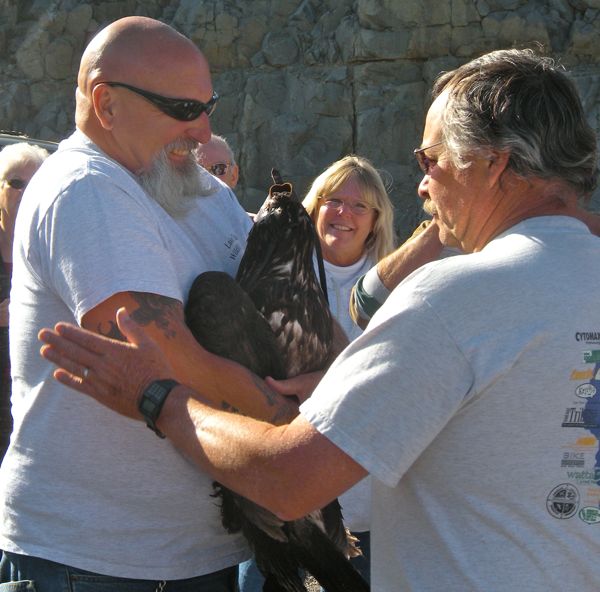
LTWC returns bald eagle to wild

A bald eagle is released Sunday near Carson Pass. Photo/   DanThriftPhotography.com

A bald eagle is released Sunday near Carson Pass. Photo/ DanThriftPhotography.com

By Kathryn Reed

HOPE VALLEY – Seconds after she flew from the arms of Wayne McKnight, the young bald eagle was tested when two other raptors raced toward her.

Holding her own, she dove, darted and averted harm. All three bald eagles landed in trees by Red Lake as a crowd of people above them on Highway 88 watched the spectacle.

“That’s a first,” said Tom Millham, who with his wife, Cheryl, runs Lake Tahoe Wildlife Care on the outskirts of South Lake Tahoe.

His guess is the other eagles may have been showing the rehabbed bird that this was their territory.

The female eagle was about 4 months old when she arrived at LTWC in the summer. It had fallen out of a nest near Lake Almanor. The nest was so high a tree trimmer could not reach it.

The eagle at 12 pounds is a little heavier than most 8 month olds would be – usually they are 8 to 10 pounds.

“She’ll fly and lose some of that baby fat,” Millham said.

Trout caught by Lake Tahoe fishermen is what was fed to the eagles, and remaining bear cubs and river otters.

For the last three weeks members of LTWC’s eagle team have been exercising the bird in preparation for Sunday’s release along the Carson Pass.

This location is used because no matter what direction they take off there is plenty of food – primarily fish. To the east are the Smith and Carson valleys, north is Tahoe, west is the San Joaquin Valley, and Bear Valley is to the south.

LTWC let another baldy go at this location in July. The third bald eagle it had been carrying for was put down because its wing didn’t heal and therefore the animal could not survive in the wild.

LT Wildlife Care is all about returning animals to the wild.

McKnight helped with the release of a golden eagle a few years ago, but this was his first experience helping with a bald eagle.

He and Millham entered the bird’s cage about 2:30pm. The magnificent animal with its massive wingspan landed on McKnight’s heavily gloved forearms. Her eyes and beak were covered for the ride up to her release point.

She is a talker – but a calm bird, according to her handlers.

“It’s respect for the bird that keeps me going,” McKnight said.

McKnight looked like a proud dad letting an offspring into the world.

“See how well she flew,” Millham said – another proud “father.”

Wayne McKnight takes the eagle from Lake Tahoe WIldlife Care. Photo/Kathryn Reed

Wayne McKnight takes the eagle from Lake Tahoe Wildlife Care.    Photo/Kathryn Reed

Wayne McKnight and Tom Millham prepare for the release. Photo/Kathryn Reed

Wayne McKnight and Tom Millham prepare for the release. Photo/Kathryn Reed


$1 million to be cut from state parks in Tahoe

Vikingsholm

Vikingsholm

By Kathryn Reed

Keeping California’s state parks open doesn’t mean they will be fully operational. The governor is still cutting $14.2 from the parks budget. It’s just that the decision how to do that is being made at the local level.

Pam Armas, superintendent of the Sierra District, expects to decide by November how to trim nearly $1 million, or 10 percent, from her budget. The Sierra District encompasses the entire Lake Tahoe Basin, goes down to Mono Lake and includes Bodie.

In addition to crunching the numbers, Armas must work with fewer people. Politicians in Sacramento axed the seasonal budget.

“I don’t have any money to hire park aides to clean the park bathrooms,” Armas said. “It’s a huge stress on the permanent staff. Typically it’s not their job.”

The stress will be even greater next year when employees prepare the seven state campgrounds in the basin to be ready for Memorial Day. Anyone who lives in snow country knows what spring is like for cleaning up a yard – multiply that by the acreage in a state park and the workload is pretty hefty.

Staff vacancies are not being filled. The Tahoe Basin usually has seven rangers – it’s down to five.

“It costs a lot to maintain parks. We provide recreation, we protect resources,” Armas said. “We don’t just provide camping. There is a lot that goes into protecting the land that we have. That is our mission and what we are mandated to do by law.”

Even though Lake Tahoe Golf Course in Meyers that is on Washoe State Park property is a huge money generator, the cash doesn’t stay in local coffers. What’s collected at state parks is put into one big pot and then doled out accordingly.

“I don’t make enough money through day-use fees, camping and concessionaires to fully fund my district. Very few do,” Armas said.

One idea to trim the Sierra budget is to not allow winter camping at Sugar Pine Point on the West Shore. Those wanting to set up a tent in the white stuff can go to Grover Hot Springs near Markleeville.

Other ideas being talked about to cut the $1 million are closing museums like Vikingsholm and Ehrman Mansion a couple days week, and curtailing camping operations.

“I’m still looking at numbers and doing a cost-benefit analysis,” Armas said.

She said the best thing is that even though a decision on what will be cut will be made in the next couple of weeks, she has several months to figure out how to implement the decisions because much of her district is closed during the winter.

“We will get through this. We are resilient,” Armas said of the budget fiasco.


Swine flu prevalent throughout LT Basin

maskBy Kathryn Reed

This week California and Nevada received their first shipments of the H1N1 (swine flu) vaccine.

This is a good thing because several cases have been reported throughout the Lake Tahoe Basin.

Twenty-four cases were confirmed on the South Shore in July, 11 in August and 29 in September.

El Dorado County has documented 52 swine flu cases, with one person on the West Slope dying from the illness.

Barton Community Hospital has treated two patients with swine flu since May. Hospitals test for H1N1, not doctors’ offices.

Throughout California as of this week 2,510 people were hospitalized because of swine flu and 181 people have died. U.S. figures are 16,174 in the hospital and 1,379 deaths.

Placer County officials are estimating 100,000 residents just in the North Shore county may become infected with the potentially deadly flu in the next year.

In a Field Poll survey released this week it showed 51 percent of Californians are worried about swine flu. The theory is with so many not concerned about it, the odds are they will not get the vaccine.

Most cases of H1N1 are not life threatening. Pregnant women, children younger 5 and adults older than 65 are most at-risk.

A notice at Lake Tahoe Community College tells people with flu symptoms to stay home.

Schools everywhere are warning parents to keep kids home if they are sick.

“We have been working with the El Dorado County Health Department and Lake Tahoe Unified School District and have placed an order to cover our usual vaccine population and the school district,” Barry Keil, director of pharmacy for Barton Health, said in a prepared statement. “We anticipate receiving enough Flumist for younger children and enough injections for older children and adults.”

Students in Douglas County School District are vaccinated through the Carson City Health Department.

“Our county will receive the vaccine in several shipments,” El Dorado county Health Officer Olivia Kasirye said in a press release. “For people who are anxious to get the vaccine, we ask that they be patient. We believe that eventually everyone who would like to get the vaccine will be able to receive it.”

Health officials everywhere say the same thing – people who develop flu symptoms such as fever with cough, sore throat, body aches, headache, fatigue, diarrhea or vomiting, should stay home from work, school and not visit any public places – even grocery stores. Remain home until the fever has been gone for at least 24 hours.

The Centers for Disease Control and Preventions says the ways to help prevent the spread of H1N1 include:

* Cover nose and mouth with a tissue when you cough or sneeze and then throw it away. If tissues aren’t available, cough into your elbow or sleeve (not your hand).

* Wash hands often with soap and water, especially after coughing or sneezing. Alcohol-based hand cleaners containing at least 60 percent alcohol are also effective.

* Avoid touching your eyes, nose and mouth to avoid spreading germs.

* Avoid close contact with people who are sick (hand holding, hugging, kissing).

* Avoid sharing items such as food, drinks, and lip gloss with others.

Ways to get more info about swine flu: www.bartonhealth.org/flu, www.flu.gov, www.edcgov.us/publichealth, http://www.placer.ca.gov/, www.cdph.ca.gov, and http://flu.nv.gov/.