Whittell was the Floyd Mayweather of yesteryear

By AutoWeek

George Whittell Jr. was the scion of an immense gilded age fortune, amassed by his grandfathers through banking, transportation, real estate and utility ownership in San Francisco, then consolidated by the marriage of his parents in 1879. He grew up in a mansion on Nob Hill, the toniest address in the city at the time. His father was a member of the most prestigious clubs and social circles. Whittell never sought to follow in his family’s ambitious, entrepreneurial footsteps, though. His goal was to live a sybaritic life, one founded on adventure, unconventionality and, most of all, speed.

“George Whittell liked all things fast,” says Brad Carter, operations director at Whittell’s Thunderbird Lodge, the private estate the playboy built on Lake Tahoe. “Cars, planes, boats and women.”

Whittell began his oppositional antics at quite an early age, running away with the Barnum & Bailey circus after high school rather than attending college, eloping with a chorus girl rather than marrying the society bride his parents had selected for him and buying himself a position in the Italian Army rather than waiting for the U.S. to join World War I.

Read the whole story


Honoring special group of South Tahoe veterans

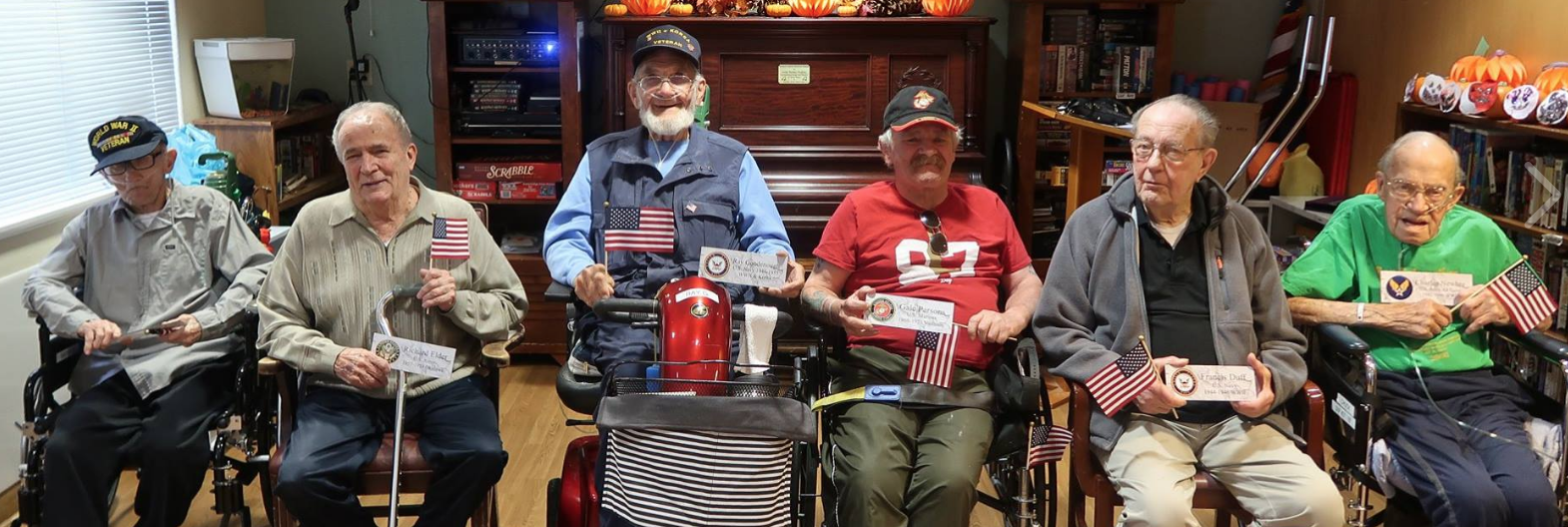
Veterans residing at Barton’s Skilled Nursing Facility, from left, Gaston Mariolle, Richard Elder, Ray Goodenough, Gale Parsons, Frank Duff and Chuck Newbre. Photo/Barton Health

By Kathryn Reed

“I think the military is one of the proudest things this nation has. It did more for me than I did for it.”

Those are the words of Ray Goodenough.

He is one of six veterans living at Barton’s Skilled Nursing Facility who was honored Nov. 10 – an early Veterans Day tribute. Also recognized were volunteer Jim Carpenter and hospital staff.

Being in the military is a life-changing experience for almost everyone who serves. It doesn’t matter if they did so voluntarily or were drafted.

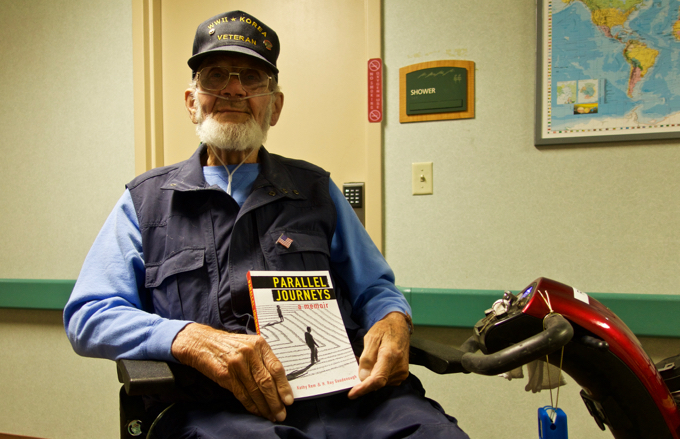
For the 88-year-old Goodenough, the Navy taught him discipline and how to be a man. At 14 he had run away from home in Lockport, N.Y. He lied about his age, trying to join the service. At 17 they let him in; this was after the bombs had been dropped on Japan.

World War II was a popular war for young men; where they saw a purpose and something worth fighting for, where the enemy was real and the cause understood. A sense of patriotism permeated the American culture in the 1940s.

Ray Goodenough wrote “Parallel Journeys” with his daughter, Kathy Rem. Photo/Kathryn Reed

Goodenough stayed nine years – until 1955 — which put him in the Korean War, too. He had plans to make a career of the military, but his wife at the time wanted a different life. Plus, they had two kids.

Mostly he worked on aircraft carriers where he had to manage the arresting gear to stop the planes as they landed. And while one time he got hit by a wire and flew 4 feet in the air, he was lucky not to be thrown overboard.

It was in 1972 that he moved to Tahoe. While he had met his second wife, Callie, just as he was leaving Orange County, it was two more years before they were married and they both called South Lake Tahoe home. Together they founded Sierra Council on Alcoholism, Tahoe Turning Point, and both worked for O.P.E.N. — Ordinary People meeting Extraordinary Needs. She died earlier this year.

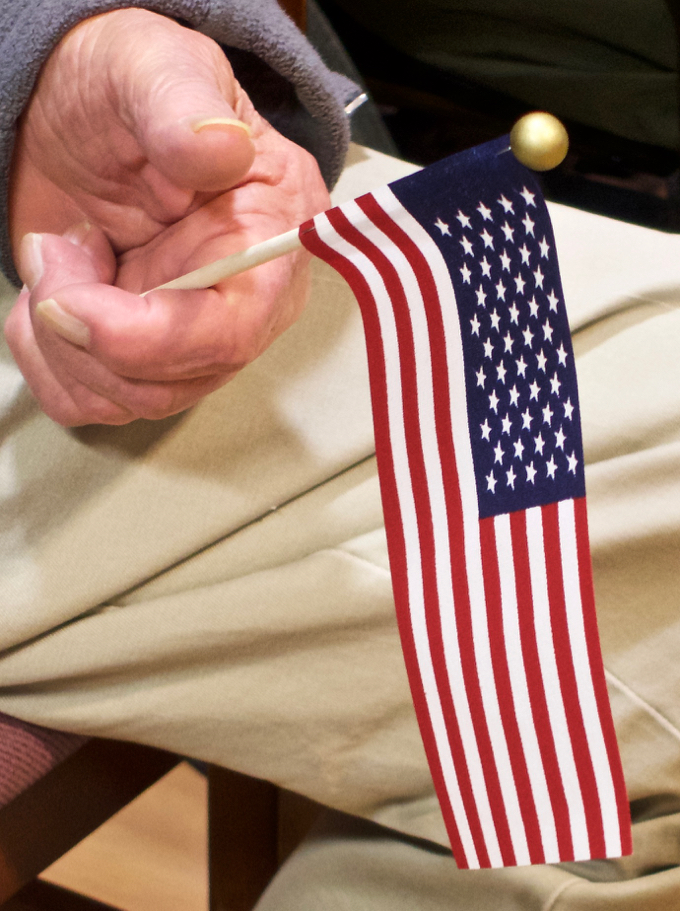
Nov. 11 is Veterans Day. Photo/LTN

Most of the residents at the SNF are WWII era vets – Gaston Mariolle was in the Navy from 1943-46, Chuck Newbre in the Army Air Corps from 1942-46 and Frank Duff in the Navy from 1944-46. Gale Parsons was in the Marines from 1968-71, and Richard Elder in the Army from 1957-59.

They each received a plaque noting their service that will be placed in their rooms.

For Jim Carpenter, it was having his mom sign for him at age 17 after high school to join the Air Force in 1962 that changed his life. He wasn’t a bad kid, but lacked direction. For the last eight years the veteran has been volunteering at the SNF.

In the military he was a crew chief – a jet mechanic – working on fighter planes. He served from 1962-66. Six months of that he was deployed, the rest of the time he was at Travis Air Force Base. He worked in the “alert barn” where with five-minutes notice he had to have the planes ready to be airborne.

In 1974 he moved to South Lake Tahoe with his wife and son. He worked in body shops; now he spends his summers detailing boats.

For Carpenter and Goodenough the military is still something they are proud of. Without hesitation they would recommend it for young men and women.

Like many who have served, talking about the experience takes some prodding, and even then the stories are limited. And that’s OK. They and those they served with know what they did. Theirs is a kinship that crosses military branches and generations.

Today, though, is when the rest of the country has the opportunity to acknowledge their service.


Film spotlights need to protect firefighters

Mary Beth Wusk, a deputy director at NASA Langley Research Center in Hampton, Va., is working with a team of NASA material experts to design a new emergency shelter for wildland firefighters. Photo/NASA

By Kurtis Alexander, San Francisco Chronicle
 
As Hollywood rolls out a blockbuster drama about the 19 firefighters killed after crawling inside their protective emergency shelters during a raging 2013 wildfire, the federal government is wrapping up a real-life bid to improve the nation’s standard-issue fire shelter — by going space-age.

Much of the redesign is being done by a group of NASA engineers, and their work couldn’t come at a more opportune time, with the deadly Wine Country fires just the latest in an escalating trend of wildland blazes tearing up the West.

The engineers were already busy building heat shields for space missions four years ago when they heard of the unprecedented deaths of Arizona’s Granite Mountain Hotshots, portrayed in the new film “Only the Brave.” The NASA engineers immediately decided to volunteer their expertise.

Read the whole story


Study: Weed can be worse for forests than logging

Tree leaves and needles are removed because they block sunlight needed for marijuana crops. Photo/USFS

By Kaleigh Rogers, Motherboard

From guzzling water to pesticide pollution, it’s been long established that growing weed—legally or not—isn’t great for the environment. But a recent study published in the journal “Frontiers in Ecology and the Environment” shows that, at least by some measures, it can be even worse for the environment than logging.

By comparing GIS data in Northern California from 2000 to 2013, researchers found that while logging has a greater impact overall, weed can be even more destructive on a per-unit-area basis. That’s because illegal cannabis grow ops are typically buried deep in the woods, are irregular in size and shape, and are scattered around randomly.

Compared to logging, which typically occurs in large, clear-cut swaths at the edge of the forest, this can have a serious impact on what should be the most protected part of the forest: its core.

Read the whole story


Ballot proposal would obliterate VHRs in SLT

By Kathryn Reed

From 1,400 vacation rentals to zero is what a group of South Lake Tahoe residents would like to see happen.

Dan Browne and Ken Weitzman are the two who have signed the paperwork to bring the initiative to the ballot in November 2018. Peggy Bourland, they both said, is the other key player behind the movement. (She chose not to speak to Lake Tahoe News.)

Browne and Weitzman say hundreds of residents have said they support the cause.

Weitzman told Lake Tahoe News the reason for the measure “is because the city has not done anything to alleviate the problems create by vacation rentals in neighborhood. There are so many people who are tormented weekend and week out.”

They say residences are being turned into hotels. Noise is a predominant issue. And no one at the city, they contend, is doing anything to curtail the problems. They are fed up, don’t believe the council is listening and want the people of South Lake Tahoe to take control.

Their proposal would take the 1,400 VHRS that are permitted outside the tourist core area and eliminate them all within a year of the initiative’s passage.

According to City Manager Nancy Kerry, “Many of those homes would likely be placed on the market to sell, which would flood the market immediately, reducing property values. As you know from the Great Recession, as home prices were rapidly falling, the problem was exacerbated as people flooded the real estate market by adding their home for sale to the mix. Consider that if even if just 10 to 20 percent of the 1,400 VHRs (140-280 homes) were added to the for-sale market overnight due to the ban, the competition for buyers would drive prices down, reducing property values, which in turn reduces income for homeowners and all the residual financial impacts. If the percentage of VHR owners who put their home on the market was more than 20 percent, the financial impacts to the real estate market would be significant.”

The Gondola Vista condo project near the state line could provide more vacation rentals in the tourist core. Photo/LTN

It’s a lengthy process to get the proposal on the ballot, and then people must vote for it. If approved, there is always the threat of a lawsuit to challenge its legitimacy. Plus, there is talk of a counter-measure that would further muddy the waters.

Proponents have 180 days from Nov. 8 to get signatures from 10 percent of the registered voters in the city based on the last General Election, so just more than 1,100 people. Those will then be verified by the county elections officials. Other paperwork is required as well.

“We are willing to roll the dice. If people in South Lake Tahoe want an unlimited number of vacation rentals, so be it,” Browne told Lake Tahoe News. “We tried to bring this to the attention of the City Council and work with them as much as we could and they gave us a deaf ear.”

Weitzman said, “We are willing to sit down and talk. The city has neglected us. We have to somehow make them understand us. I want to have a nice, congenial, pleasant town.”

While both say a compromise is possible, neither would say what it would take to get them to drop the ballot proposal.

Vacation home rentals in the city – and throughout the state and elsewhere – have become more contentious as residents grow frustrated with lack of enforcement and locals can’t find a place to live.

The city has had dozens of meetings, revised the ordinance multiple times since it was first approved in 2003, commissioned an economic study, formed a subcommittee of two councilmembers, and has met with various interested parties.

The ballot group wants the real estate community to come to the table and propose a number. It has yet to do so as a group.

The South Tahoe Association of Realtors provided the following statement to Lake Tahoe News, ““Representatives from the South Tahoe Association of Realtors met with members of the group pursuing a ballot measure to ban VHRs outside of the tourist core area, and sincerely engaged in dialogue in an effort to come to better understanding of issues and concerns about VHRs. Our intention is to work with all interested parties to find a mutually acceptable solution. Given the size of our diverse membership of 300-plus Realtors and 500-plus MLS participants, we need time to reach out to them before we can take a position. We do agree that robust enforcement is key to making any option work.”

Austin Sass, whose tenure as mayor will be over Dec. 12, has taken it upon himself to meet with various groups under the guise of representing the entire council. However, his colleagues gave him no direction to do so, nor did he have the power to make promises. He and Councilwoman Wendy David were the council’s VHR subcommittee, but she was not invited to all of the powwows.

The city is going forward with its business, including looking for a company to provide assistance with monitoring VHRs and providing enforcement help. Bids are being taken until Nov. 20, with the expectation the council will vote on a firm at its December meeting. At the Nov. 21 meeting the second reading of the latest VHR ordinance is expected to be voted on. This is what limits the number of VHRs to 1,400.

Regarding the ballot proposal, the city plans to analyze the financial impact.

“If it were to pass, as I wrote in the last staff report to council, something that drastic could very likely create a similar impact of a recession,” Kerry told Lake Tahoe News. “The loss of 1,400 vacation home rentals would result in a substantial loss in transient occupancy taxes for the city.”

The city receives approximately $2.8 million in TOT from VHRs – which is citywide. The ballot initiative would not affect the tourist core, which has a few hundred units.

Browne was asked if the economic impact weighed on his decision to go forward. It’s “not a concern,” he said.

Weitzman, though, disagrees with his compatriot. “Yes, that does concern me because I love this local town.” What he wants is for people in VHRs to use the empty hotel rooms so the economic impact is not as severe.

Here is the ballot title and summary as prepared by law by the city’s attorney.


Dispute disrupts deal to save hundreds of Nev. horses

By Benjamin Spillman, Reno Gazette-Journal
 
Nevada officials have terminated a privately-funded agreement that’s kept hundreds of free-range horses from western Nevada’s Virginia Range without resorting to slaughter.

The agreement provided a framework for state officials to work with a nonprofit to control the horse population through capture, adoption and birth control drugs.

Controlling the horse population is critical because overpopulation results in increased instances of horses on roads, in communities and in distress.

Read the whole story


Ostrich-like robot may be tool for SAR teams

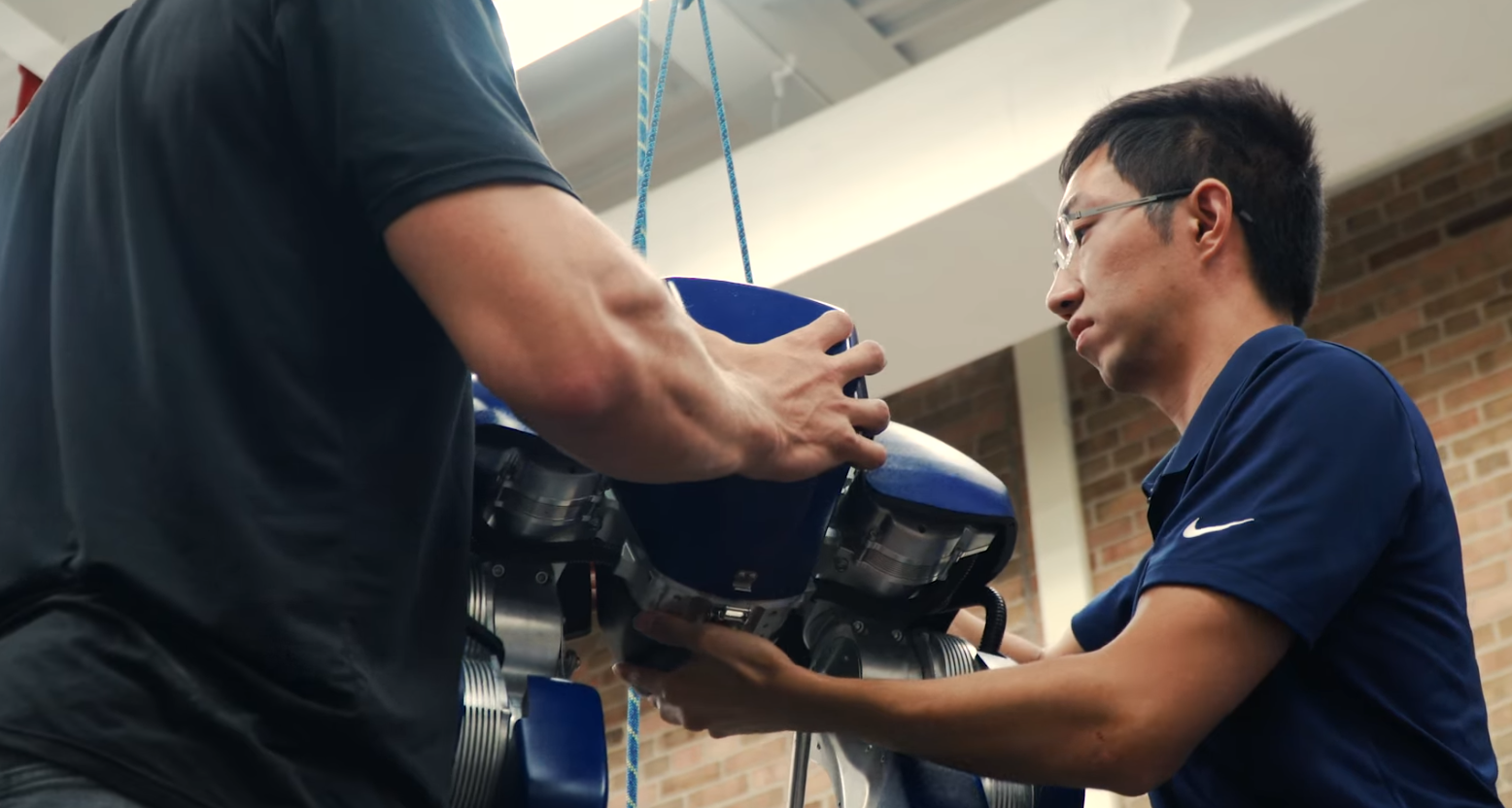
University of Michigan students assemble the robot. Photo/UofM

By Mike Householder, AP

ANN ARBOR, Mich. — A rare bird has landed at the University of Michigan: a two-legged robot named Cassie that researchers hope could be the forerunner of a machine that one day will aid search-and-rescue efforts.

Cassie — whose name is derived from the cassowary, a flightless bird similar to an ostrich — stands on legs with backward-facing knees. The biped that weighs about 66 pounds may not have feathers or a head, but she is attached to a short torso that holds motors, computers and batteries and is able to walk unassisted on rough and uneven terrain.

Cassie, which stands a bit over 3¼ feet at full leg extension, was built by Oregon’s Agility Robotics and purchased by Michigan researchers using grant money from the National Science Foundation and Toyota Research Institute. Although other institutions have acquired similar models, Michigan’s team is excited about using its version to put the school’s cutting-edge programming to the test, said Jessy Grizzle, director of Michigan Robotics.

Read the whole story


Info lacking on mountain snowpack, runoff

By Matt Weiser, Water Deeply

Most Americans may not realize it, but we really don’t know with a lot of accuracy how much snow there is sitting in the mountains during winter. We also don’t always have a precise picture of where the snow level is when a storm moves in, or how much will run off when the snow melts.

One reason for this is that, in most areas, the weather sensor network in the mountains simply isn’t very dense. Gauges that measure rain and snow are often placed for convenient access. The highest elevations and forested areas often have no sensors, leaving huge data gaps in many watersheds.

This creates a host of problems, from estimating flood risk accurately to figuring out how much water is available for summer farm irrigation.

Read the whole story


Jury awards ex-Barton CFO nearly $800,000

By Susan Wood

After hearing a high-level power struggle among Barton Health executives, an El Dorado County Superior Court jury on Wednesday awarded former Chief Financial Officer Steve Neff with almost $800,000.

Steve Neff

Neff’s lawsuit involved a violation of labor law, fraud and breach of contract.

The Nov. 8 judgment in favor of Neff includes $715,782.50 for “breach of the covenant of good faith, fair dealing and defamation” as well as $71,578.25 in punitive damages for defamation, Neff’s attorney Patricia Kramer said. Nothing further was provided from Kramer on the trial presided over by Judge Daniel Proud.

The civil case stemmed from disputes that occurred in contract negotiations and the seven months leading up to Neff’s termination in March 2015. The negotiations were between former Chief Executive Officer John Williams, then-Chief Medical Officer Clint Purvance — the current CEO. Neff was replacing the retiring Dick Derby, who returned to the job when Neff left.

The complaint filed a year ago this month laid out 11 counts ranging from negligent misrepresentation and breach of contract to unlawful harassment and defamation of character.

For the jury, there were 19 items they had to rule on. Of those, they determined three in Neff’s favor and 16 in Barton’s.

It’s unclear whether the South Lake Tahoe-based medical group will appeal as Barton attorney Tom Perry declined to speak to Lake Tahoe News.

“We are pleased the jury found in Barton’s favor on most disputed issues,” Barton spokeswoman Mindi Befu said in a statement. Barton added the penalty reflects the remainder of Neff’s three-year contract, and punitive damages amounting to 10 percent of the contract sum were inflicted “because some statements that were attributed to Barton were considered defamatory” to the jury.

“Although we are not in agreement with all of the jury’s findings, we respect their diligence and conscientious effort in dealing with the many complex issues in this difficult case,” the statement reads. “We are glad to move forward and continue focusing our attention on the health of our community.”  

Neff claimed that he came on board with the notion and alleged promises that his CFO job would eventually lead to him taking over for Williams, with Purvance agreeing to mentor him.

The complaint adds that Neff took the job with the understanding that Purvance as the CMO “had no desire to fill that position and that the CFO position Neff was being recruited for would be the perfect segue for Neff to become CEO of Barton.” It reads the CEO position paid about $600,000 a year base salary with potential bonuses that could result in another $300,000.

But that didn’t happen. Instead, it appeared Neff and Purvance – who allegedly was supposed to be grooming the plaintiff – were each vying for the top job.

The jury, though, did not find those claims in Neff’s favor.

Further, Neff listed a barrage of incidents in the complaint in which he was poorly treated and subjected to “frequent religious proselytizing in the workplace” with the “express purpose of receiving Christian indoctrination that conflicted with Neff’s own religious belief system.” He’s Jewish. 

This too was not found to be true, according to the jury.

Neff took issue with Barton’s discrepancies posed during the recruitment process and of questionable working conditions and operations at the hospital while he was there. At one point, Neff alleged Williams told him he was “the king” of Barton and that “he was unaccountable to Barton’s board of directors.”

The discrespanices in the recruitment process were not ruled in Neff’s favor.

The contract between the hospital and Neff was a point of contention on several occasions. His tenure appeared rocky throughout the seven-month stint right up to his termination, including a claim he was “humiliated in front of his colleagues” despite the hospital allegedly insisting they were firing him for “no cause.”

The medical executive primarily laments about uprooting his family and enduring financial losses when he in good faith left a 17-month partnership at Renaissance Healthcare Partners in Massachusetts to go to work at Barton on a base salary of $285,000.

In the last few years, Neff has been unable to secure any position as a CFO or CEO and believes he’s “lost approximately $548,420 in income.”

Neff has worked in health care for 32 years. He now operates a BrightStar Care home care franchise in Carson City.

Lake Tahoe News Publisher Kathryn Reed was a reluctant rebuttal witness for the prosecution. She was brought in to testify about the story she had written in 2015 after Neff was fired  and the story last June about the lawsuit. Much of the testimony centered on the use of the word “fired.”


Calif. dream is becoming a bit nightmarish

By Matt Levin, KQED

The California dream isn’t dead. It just upped and moved to South Dakota.

Less than half of people born in California in 1980 are making more money than their parents did as young adults. That’s the lowest percentage of children out-earning their parents that California has seen since at least 1940.

By contrast, 62 percent of people born in South Dakota in 1980 out-earn their parents. That’s the highest percentage for any state in the country.

Those figures come from a study by Stanford economist Raj Chetty and several prominent co-authors, whose widely publicized work on intergenerational income mobility—the likelihood children will fare better financially than their parents—has transformed what we know about the data behind the American dream.

Read the whole story