Looking into Trump’s impact on tourism in U.S.

By Bing Pan, The Conversation

Are fewer people visiting the U.S. now that Trump is president?

Some have blamed the Trump administration for a sharp downturn in international tourist arrivals in 2017, as measured last September. A more recent revision of the numbers suggests that might not be accurate.

So what’s driving the latest trends in U.S. tourism – and what does that mean for the nation’s image on the global stage?

I am a researcher who studies tourism. Many factors impact the volumes of travel between countries, including travelers’ income levels, exchange rates, diplomatic relations and hospitality infrastructure. Even the release of a movie can affect the volume of tourists.

Many elements played a part in the lackluster performance of the U.S. international tourism industry in the past two years. Ample evidence shows that the Trump administration contributed to this. It’s hard to quantify the exact amount, but it’s likely less significant than many people think.

Inbound tourism is flat

Inbound tourism is very important to the economy of the U.S., as it brings in international visitors and foreign currency. In 2016, visitors to the U.S. generated $245 billion in travel spending. That counted as one-third of U.S. service exports, making tourism number one among that category.

However, in 2016, the number of international tourists to the U.S. dropped by more than 2 percent, while international tourism spending remained almost flat. This is in sharp contrast to a 4 percent increase worldwide in international arrivals in 2016.

Data for 2017 are less clear. Numbers on the U.S. are still being revised by the National Travel and Tourism Office. The United Nations World Tourism Organization reported that international tourism arrivals worldwide in 2017 were up 7 percent. I believe the U.S. is unlikely to match this pace, even with revised numbers.

The causes of the flat performance deserve a little more in-depth investigation.

First, as a mature tourist destination, it’s very hard for the U.S. to generate 5 to 7 percent of increase annually. The U.S. is a long-haul destination for China, South Korea and Europe. In terms of tourism worldwide, residents from those areas generated the most growth last year. Those citizens are more likely to travel to nearby destinations.

Second, among all the factors affecting travel between nations, exchange rates might be the one of most important, since they determine visitors’ spending power. Canada is the largest inbound nation for the U.S. In 2016, 19.3 million Canadians visited – a quarter of total international visitors. The value of its currency has been dropping compared to U.S. dollars in recent years.

Trump administration’s impact

Has the new administration played a role in tourism numbers?

Strictly speaking, to investigate the effect of one factor on international arrivals, you would have to conduct a controlled experiment. For example, you could tell half of the world’s population, randomly, that Trump is our president and the other half it was Hillary Clinton, then measure the different amounts of visitors from those populations. Of course, that’s not possible.

However, many data points hint at the Trump administration’s impact on tourism. International visitation from certain countries is declining. There were already 3 percent fewer visitors from the Middle East to the U.S. in 2016.

What’s more, data on airline reservations tell a similar story. Olivier Jager, the CEO of ForwardKeys, a company that specializes in air reservation data, has been tracking changes since President Trump took office. In a March 2017 report, air bookings from seven Muslim countries in the Trump administration’s travel ban decreased 80 percent from last year.

An updated news release shows strong recovery in the Americas, but bookings from the long-haul market remain flat, lagging behind an uptick trend globally.

Finally, international sentiment toward new U.S. policy is now mostly negative. The Pew Research Center found the overall image of the U.S. suffered a sharp decline since Trump took office.

There’s also some anecdotal evidence. For example, in the responses to a Facebook post by The New York Times, many Europeans said they would avoid trips to the U.S. due to the Trump administration. Recently, one of our own colleagues, Mark Harvitz of the University of Waterloo, declined to travel to the U.S. to accept an award due to a self-imposed travel ban to the U.S.

However, there are exceptions: Chinese visitors are actually more likely to visit the U.S. under the Trump administration.

In conclusion, the Trump part of “Trump slump” might be true, but international tourism to the U.S. can hardly be described as a slump. It would be more accurate to say that the U.S. is lagging behind other nations. We cannot put all the blame on the Trump administration.

The U.S. has a strong reputation as an international destination, due to its wonderful naturally endowed resources and its cultural influence around the world. However, perhaps it’s time for the tourism industry to beef up its marketing muscle, in order to mitigate the negative political climate and to boost continuing growth.

Bing Pan is an associate professor of tourism management, Pennsylvania State University.



Calif. wants federal money for water projects

By Laura Tsutsui, Politico

California is one step closer to getting a cut of $2.5 billion over the next decade for its water needs now that the House has passed a bill aimed at funding water research and infrastructure projects.

The drought-stricken state has positioned itself as independent of the federal government — most notably, the Trump administration — on issues ranging from immigration to health care coverage. However, it still turns to federal lawmakers when it needs a financial boost for an issue as central to the state as water.

The Water Resources Development Act, which passed the House last week by a vote of 408-2, identified more than 40 projects nationwide to fund with federal cash. The Senate is expected to pass its own version this summer.

Read the whole story


Dramatic decline in Tahoe’s clarity — 9.5 feet

By Kathryn Reed

Despite $2 billion being spent on environmental improvement projects in the Lake Tahoe Basin over the course of more than a decade with the primary goal to improve the clarity of the lake, Mother Nature is foiling those plans.

UC Davis Tahoe Environmental Research Center on June 13 released the annual lake clarity report for 2017, which shows a decline of 9.5 feet to 59.7 feet from a year ago. The previous lowest level was 64.1 feet recorded in 1997.

Scientists are blaming the decline on the confluence of weather extremes – the drought and then the winter deluge.

“We are not shocked by it. I think everyone was expecting a low clarity year based on the drought conditions we had followed by what really is one of the wettest winters on record,” Tom Lotshaw, spokesman for the Tahoe Regional Planning Agency, told Lake Tahoe News.

Still, the trend of the last few years is declining clarity. It dropped 3.9 feet in 2016 and 4.8 feet in 2015. In other words, the clarity of Lake Tahoe has dropped more than 18 feet in three years.

“If you look at the bigger picture we know that these clarity numbers can vary wildly from season-to-season and year-to-year. That is why the total maximum daily load looks at five years. That five-year average even after this low year is still at 70 feet,” Lotshaw said. “The longer term declines we were seeing for 20 to 30 years has been stabilized.”

Clarity is measured by taking various readings with a Secchi disk, which looks like a white dinner plate. It is put over the side of a boat and with the naked eye someone looks to see how far down they can clearly see it.

Numbers are usually the worst in summer and then improve in the fall and into winter. In 2017 the fall readings continued to decline. Then the winter rains just flushed a tremendous amount of sediment into the lake. Usually runoff is not a concern until spring.

“This report serves as a stark reminder about the importance of conservation and restoration efforts. Without that progress, the lake would already have been lost. We must continue investing in those efforts if we’re going to save Lake Tahoe,” Sen. Dianne Feinstein, D-Calif., said in a statement.    

California Natural Resources Secretary John Laird and Nevada Director of Conservation and Natural Resources Bradley Cowell issued the following joint statement: “While annual clarity declines are not unusual, the record decline experienced last year warrants an in-depth review to further understand the causes and impacts, and to help ensure the 2017 decrease is an anomaly, and not a trend. After 20 years of significant investment to protect the clarity of Lake Tahoe, we take this development seriously. As the natural resources leads for our states, we are asking the science community to take a fresh look at factors affecting lake clarity and recommend actions to continue our success in protecting the ecological health of Lake Tahoe in a time of changing climate.”

While officials talk about climate change being a serious issue in the basin, no answers have been forthcoming. Weather extremes are predicted to become the norm, not be an anomaly. The lake is warming, which presents other issues. A warmer lake keeps the fine sediment particles closer to the surface which in turn diminishes clarity.

A bright spot though is that Geoff Schladlaw, director of TERC, said numbers collected so far in 2018 are encouraging, calling them “more in line with the long-term trend.”

UC Davis researchers are hoping an autonomous underwater vehicle and an underwater robotic glider that are new tools in its arsenal will help provide data that can provide answers and solutions to ongoing and growing concerns at Tahoe.

Even so, most of the money, time and scientific studies have been spent on worrying about lake clarity in the middle of Tahoe. Those who frequent the beaches worry more about the muck and the discoloration – it being more brown than clear – by the shore. But that’s a whole different issue called the near shore, which until the last handful of years wasn’t even on officials’ radar.


Rice, Engels win DC Commission primary

Voters on June 12 cast ballots at Kahle Community Center. Photo/LTN

Updated 11:05pm:

By Susan Wood

Douglas County Board of Commissioners will see two new faces come November for seats representing the lake and the valley.

Deputy constable and Round Hill General Improvement District board member Wesley Rice has 52.69 percent of the vote amounting to 4,420 ballots cast in Lake Tahoe’s District 4 seat to be vacated by Nancy McDermid. His opponent, Janet Murphy – an engineer-turned-government consultant, brought in 3,968 votes at 47.31 percent.   

“I’m very pleased. We fought a clean campaign. We were very respectful. I just came out and said why we were the best choice, and the people responded,” Rice told Lake Tahoe News. Screaming could be heard in the background of the phone call, as he attended an election party with his friends.

The Republican candidate will face undeclared Kristi Kandel, a real estate consultant, in November during the general election.

Rice plans to approach his race with Kandel with a continuation of his principles and much talk of the role of vacation home rentals at the lake. He believes they differ, something Rice would like to stabilize since the “pendulum has swung” from rare intervention to overbearing enforcement. He cited the $1,000 parking citation the city of South Lake Tahoe handed down.

The shocker for the June 12 primary was the race for the valley’s District 2 seat – with political newcomer John Engels beating incumbent Steven Thaler. Engels garnered 52.57 percent with 4,445 votes over Thaler’s 47.43 percent with 4,011 votes.

Engels will appear on the November general election ballot unopposed.

“It’s been a lot of work. One common denominator we’ve encountered throughout the campaign – all told me they wanted to maintain the rural character of our area,” Engels told LTN. “Look at what’s happened to the lake – all that congestion.”

Engels ran on shying away from the county’s seemingly pro-growth stance he said his opponent has supported.

The growth of Douglas County is matched by its political activism.

Despite having less population than neighboring Carson City, Douglas touts more active voters. Its 33,442 voters amount to about 4,000 more people practicing their civic duty. The capital city houses about 7,000 more people than Douglas.

Active voting is a relative term. Traditionally, the primaries don’t pull the kind of numbers that general elections do. But this year elections officials witnessed a spike in activity compared to most.

California’s primary staged a week ago pulled in at least a 40 percent turnout, with El Dorado County coming in at a strong 48.3 percent. Nevada’s last primary in 2016 brought out 34.5 percent registered voters. This year’s stands at 39.72 percent.

County Clerk Kathy Lewis, the registrar of voters, expected a greater return compared to two years ago. Nevada has accelerated the process with procedures and protocols to spur the voter turnout.

With early voting starting a few decades ago, Nevadans wanting to cast their ballot as soon as they get it may do so. This year brings the first primary in which seniors ages 65 and older as well as the disabled may elect to have a permanent absentee ballot, without the elections department needing to ask.  


Landslide for Coverley in DCSO sheriff race

Updated 11:12pm

By Kathryn Reed

Douglas County Sheriff Ron Pierini’s heir apparent, Dan Coverley, will be the next sheriff.

Coverley is a captain, having spent 21 of his 23 years in law enforcement with Douglas County Sheriff’s Office.

Dan Coverley

He pulled in 53.79 percent of the vote, with 6,954 votes. The next closest of the three other contenders was DCSO Capt. Joe Duffy with 3,173 votes, or 24.54 percent.

Coverley will not face a runoff in November. To be a clear winner he needed 50 percent of the vote plus one.

“It’s very humbling to think there are that many people and that much support. They put their faith in me so I will have to work to deliver my best,” Coverley told Lake Tahoe News on election night. “We will work closely with Sheriff Pierini to have a smooth transition.”

Early on Pierini endorsed Coverley, who has most recently been working at the Tahoe substation.

The vacancy comes about because Pierini is calling it quits. He has been sheriff since he was appointed to the position in 1997. In December he will wrap up his fifth four-year term.

Other challengers in the June 12 primary were David Brady with 15.25 percent, 1,971 votes; and Dean Paris with 6.42 percent, 830 votes.


Nev. to gain from nationwide legal sports betting

By Todd Prince, Las Vegas Review-Journal
 
Nationwide legal sports betting could generate a much larger handle and more local casino visitation than Nevada gaming insiders expect, a Wall Street analyst said.

His proof? A surge in local hockey bets.

The regular-season hockey handle jumped 40 percent from October to April to $271 million in Clark County — which includes the Strip, downtown and locals markets. It was up more than 30 percent in the locals market alone.

Read the whole story


Maloff Center not just about helping the injured

Rehabbing at the Maloff Center comes with stunning views. Photo/Kathryn Reed

By Kathryn Reed

People are hobbling on crutches, easing along with a walker and relying on a cane for stability. Clearly, this is a place for healing. But just steps from the entrance is what looks like a state-of-the-art-gym, not just the usual apparatuses in a rehabilitation center.

The dichotomy between patient and tools appears extreme, at least to the lay person.

To those who work here, it all seems very normal.

“Treating the entire patient and not just the injury or symptoms.”

The Robert Maloff Center in South Lake Tahoe is designed to revolutionize wellness on the South Shore. Photo/Kathryn Reed

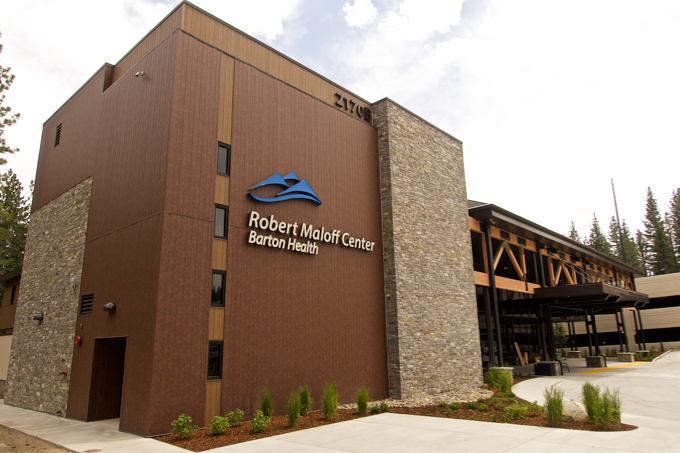
That is the overriding philosophy of the Barton Center for Orthopedics and Wellness that opened in May in the Robert Maloff Center. The complex is walking distance from Barton Memorial Hospital in South Lake Tahoe.

It’s been a gradual opening, with rehabilitation staff starting to work there last week, orthopedics and integrated medicine will move over next week, and the grand opening will be in July.

While words like “performance” and “excellence” were first associated with the facility when it was in its developmental phase, this led to some confusion as to whether this center was for elite athletes or everyone else. It’s both, with the “everyone else” being more of the emphasis because there are more of them. “Performance” and “excellence” are defined by the individual without comparison to others.

Chris Proctor is in charge of overseeing all things at the Maloff Center. Photo/Kathryn Reed

“It’s a community building at its heart. And it’s a wellness building at its heart,” Chris Proctor told Lake Tahoe News during a tour of the 26,000-square-foot, two-story building. He is the administrative director for the center. “It is available to anyone who is ready to commit to wellness. Wellness should be about how do we approach the whole body.”

Barton has long been a leader in orthopedic medicine, but more on the surgical and recovery side. What the Maloff Center does is allow professionals to work with anyone in what is more of a preventative manner so perhaps they are never in surgery. Every client will get a customized program. It goes beyond what a trainer at a gym would do because assessments involve looking at the whole person – their gait, how one arm might be stronger than another, a leg could be shorter. These and other factors play into how someone should workout/train/strengthen their bodies. Movement analysis is at the foundation of the assessment.

Nutrition is a component, as is stress management.

Performance and physical therapy are integrated.

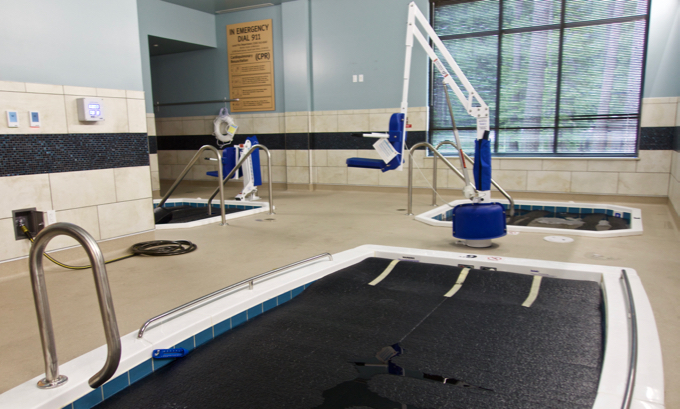
Water therapy is part of the protocols at the wellness center. Photo/Kathryn Reed

While plenty of people will be referred here from a doctor, others can benefit from the physical therapists’ knowledge.

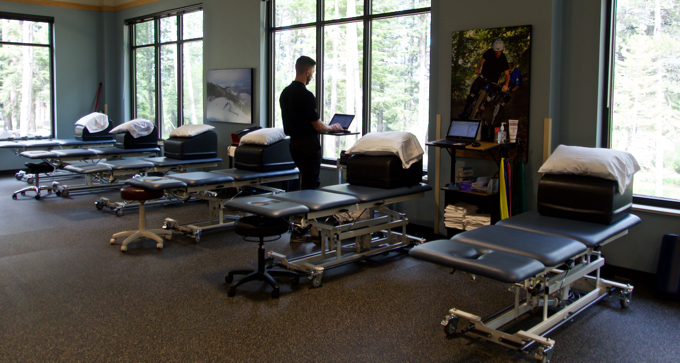
The backdrop for the six rehab tables are large windows that open to the forest, with the Upper Truckee River and Johnson Meadow just beyond the trees. It’s an incredibly serene setting that is therapeutic in itself.

People are getting treatments in this open setting – no individual, sterile rooms.

The expansive, openness is by design – to physically and emotionally integrate therapy and training.   

Athletic equipment is available to anyone who wants to workout. Photo/Kathryn Reed

The goal is not to compete with area gyms. In fact, Barton sees its services complementing what people do at their gym. For $29/month people can be on a performance plan after an initial assessment; this tells the person what they need to be doing and then a coach tracks the person. People outside of Tahoe could do this version.

An initial assessment costs $149, lasts up to 90 minutes and includes use of the center for one month.

Unlimited use of the facility costs $129 a month. This also allows individuals to pop over to the rehab side to work out a kink at no additional cost, and without a referral. Working with a coach is part of the fee, too.

There are also youth programs and community fit classes.

Also on the first floor is the wet room, which includes a series of three pools. One hot, one cold, one where people can swim or walk. The funding came from Paul Fry’s estate. Fry established Tahoe Fracture Clinic in 1964. The well-known physician died in 2015.

A $10 million donation from Lisa Maloff paid for about one-third of the expenses of the building, including parking garage. A plaque honoring her and husband Bob is in the reception area. She is expected to be at the grand opening next month to see what her money helped create. After all, she was at the groundbreaking.

The center is expected to employ between 25 and 30 people. This changes depending on which doctors are there. There will be six physical therapists and six fitness coaches. Health coach is a certified position.

Upstairs is where the 17 exam rooms are located. This is twice as big as any of the current clinics that Barton operates.

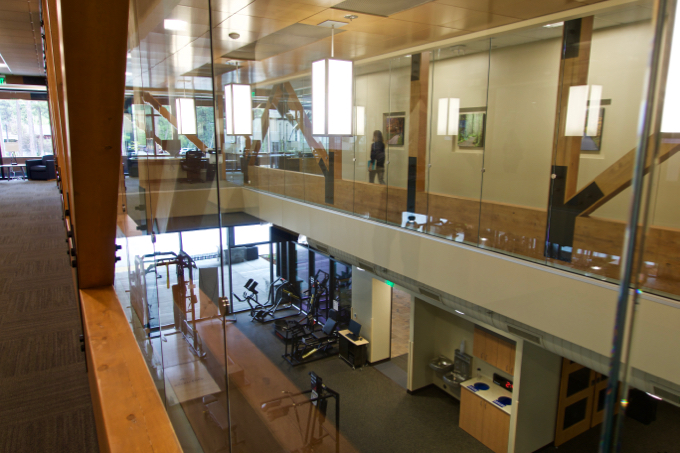
The Maloff Center has openness to it, with the second and first floors visible to one another. Photo/Kathryn Reed

The goal was to create four care stations so the medical team is closer to the rooms. This makes more efficient use of time for employees and should mean patients are getting treated faster.

Unusual in medical exam rooms is the carpet. As Proctor explained, this makes it quieter and warmer. The material can also be mopped to keep it sanitary.

A big change is that the monitor allows for X-rays to be seen in each room so the patient and doctor are not viewing it in the hall, as is the case now at the various clinics. The desks on which the keyboard sits swivels, so medical personnel do not have their backs to the patient. The screens may also be used as an educational tool.

Three of the rooms will be used for procedures, such as injections so the patient does not have to come back.

One side of the second floor is meeting space that can be sectioned off. This is where classes are taught. The dividers double as white boards. Each section has audio-visual capabilities.

In between the two areas is glass, with a view to the first level. All of this makes for an experience that is unlike most medical centers – it’s warm and welcoming. Even the brown/gold/blue color scheme is soft, which is noticeable when walking in off the street.

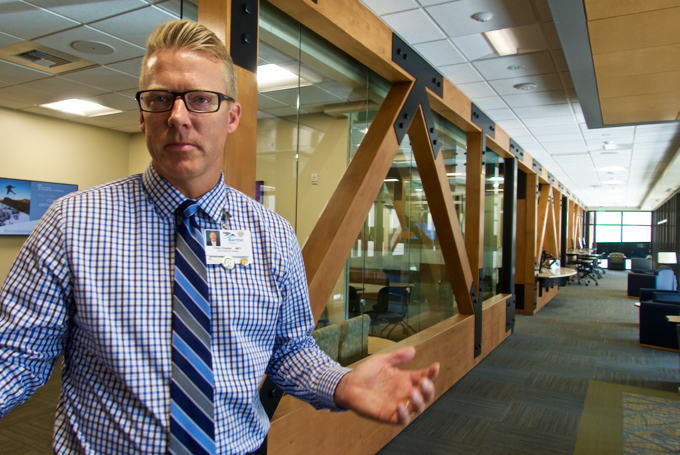
A long hallway with seating, computers and a view to Mount Tallac is for people to gather. The area is a work in progress, and purposefully designed that way. The hope is it will be more of a social area. In this space is the care coordinator hub, where employees will help clients dial in their needs. They are essentially medical concierges.

Barton is still assessing what it will do with its current offices. For certain the 1139 Third St. facility will be repurposed, possibly into a rural health clinic. A wound care clinic is another need. The rehab center in the hospital will remain, as this new one is meant to be focused on orthopedic needs.


California drinking water tax dies

By Dale Kasler and Adam Ashton, Sacramento Bee

A proposed tax on California’s drinking water, designed to clean up contaminated water for thousands of Californians, was abandoned by Gov. Jerry Brown and legislative leaders Friday as part of the compromise on the state budget.

Lawmakers and Brown’s office scrapped the “Safe and Affordable Drinking Water Act,” which would have taxed residents 95 cents a month to raise millions for cleaning toxic wells. Instead, legislative leaders agreed to spend $5 million from the general fund to deal with lead in drinking water at child care centers. They also plan to allocate $23.5 million from the general fund for “safe drinking water actions later in this legislative session,” according to a Legislative Budget Conference Committee report released Friday.

Read the whole story


Experts: N. Nev. may be hurt by lax pollution rules

By Benjamin Spillman, Reno Gazette-Journal

Republican President Trump’s efforts to loosen vehicle pollution standards at the federal level could mean less healthy air and more local regulations in Northern Nevada.

That’s according to air quality experts who say communities in Nevada and around the U.S. would face pressure to offset increased pollution from cars with regulations on other sources of pollution.

Additional pollution from tailpipes and other sources would also put people at greater risk of health problems associated with breathing polluted air.

Read the whole story


Equipment changing landscape of fire prevention


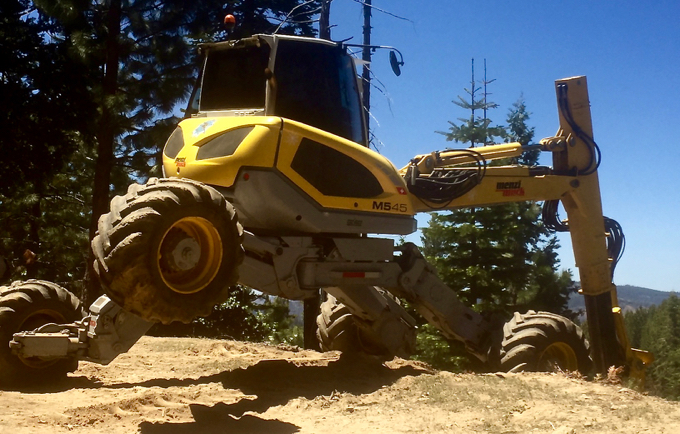
The Spider looks like a Transformer ready to tromp through the forest. Photo/Susan Wood

By Susan Wood

POLLOCK PINES – Relying heavily on prescribed burns as fuel reduction among forest officials may be steeped in tradition – but the practice isn’t enough to fight the types of raging infernos the West is seeing year after year.

Much of the challenge often lies in fire prevention over steep terrain requiring a cross between the old and the new. It takes oversized Tonka trucks and Transformer-type heavy equipment.

California is coming off a series of drought years, then one of the worst seasons ever for wildland blazes on the 25th anniversary of the Cleveland Fire. The mega blaze burned more than 24,000 acres in 30 hours, closed a 50-mile stretch of Highway 50, killed two people and injured 72. The hot fire that roared eight miles east of Pollock Pines along the Peavine Ridge north of Riverton at Ice House Road presents a painful reminder of what could be.  

Another more recent blaze nearby — the King Fire of 2014 — scorched more than 97,000 acres in El Dorado County and destroyed 80 structures. The fire’s cause was arson, but the damage is still visible from the highway and restoration is ongoing.

The terrain is thick, steep and unforgiving to get to off the roads.

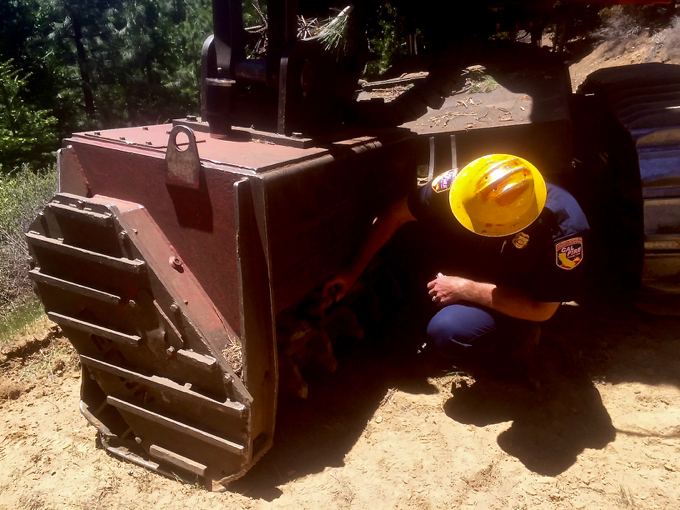
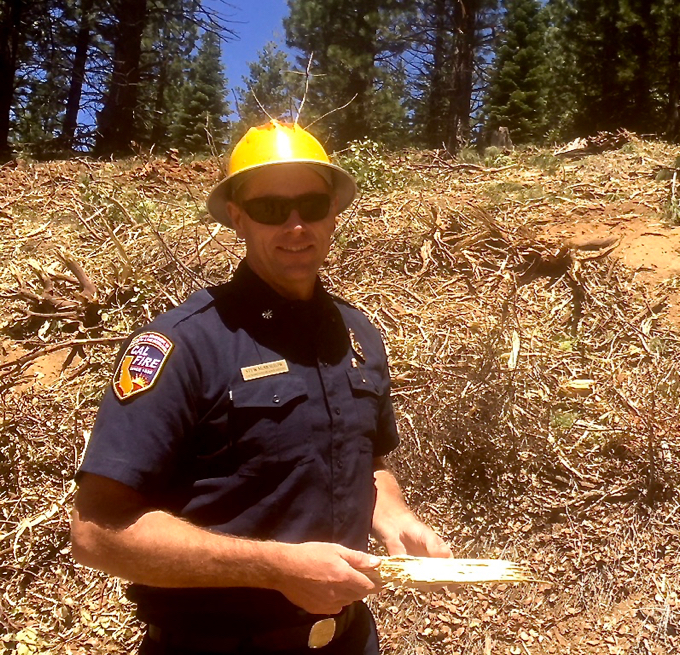
CalFire Deputy Chief Stewart McMorrow looks at the chewing teeth of the TimberPro attachment. Photo/Susan Wood

“We’ve spent $6 million to restore 11 Pines Road, and it’s still closed,” Eldorado National Forest Supervisor Laurence Crabtree told Lake Tahoe News preceding a tour last week from the Ice House Resort 10 miles up from Riverton.

The U.S. Forest Service spends over half its budget on fighting fires, knowing prevention is where the emphasis needs to be. 

Forest managers were joined to view the equipment and results up close by small groups of residents, Sierra Pacific Industries and CalFire officials, who declared a suspension to burning starting today in El Dorado, Amador and Alpine counties. Some see the declaration as the official start of fire season. Others would agree fire season has turned into a yearlong event.

Crabtree estimated at least 35 percent of the burn area with a mix of conifer trees such as fir, pine and cedar from the King Fire is steep, posing a hazard to property owners – especially as more build in the wildland interface. In the last five years, Forest Service officials have negotiated agreements with private property owners to establish firebreaks on their land.

Among them is Sierra Pacific Industries – which manages the resources on 1.8 million acres in California.

The excavation machine made by Pacific Tech handles the steep terrain of the Eldorado Forest. Photo/Susan Wood

“We need to manage fire; we don’t need it to manage us,” Sierra Pacific spokesman Mark Luster summarized about the tree-clearing demonstration. 

Take an overgrown forest with mass pockets of dead trees in timber-dry conditions, an excess of fuel following wet winters while throwing in windy conditions, and California is ripe for a no-win perfect storm of fire capable of producing the kind of huge complexes that ripped through the Wine Country last year.

Firefighters regionwide are quite aware of how vulnerable the rugged, woody Sierra Nevada Mountain Range is – especially in hard-to-get-to, steep terrain.

Fire science proves flames burn faster up steep slopes. Unfortunately, this terrain makes it difficult for firefighters to cover the ground necessary to build a perimeter to contain and control fires that hop from low-lying brush, to ladder fuels up to the crown.

That’s one reason managing the resources ahead of the worst time of year in fire season may seem like a never-ending task when other forces like drought and bark beetle stack on the obstacles.

Sometimes it’s just as hard to manage the people doing the work of clearing the debris. 

Contractor Jeff Holland quipped that his company of 30 machines and 25 people said his company has grown increasingly busy since 1983 since the forest has been “mismanaged.”

To that, Luster countered that the job is overwhelming anyway.

“If you look at how much acreage, there’s so much volume, it’s hard to keep up with the amount of volume,” he said.

CalFire Deputy Chief Steward McMorrow, who works out of Sacramento, agreed. 

“What we’re doing here is rearranging the fuels on the lower forest floor,” McMorrow said as he glanced over a cleared segment of acreage where the Timberpro harvester had gone through. He contends that environmentally chewing the trees and leveling the land also helps to stimulate the fungal process. 

The goal of the equipment demonstration: To witness how the latest and greatest in excavating, skidding, moving and mulching equipment can clear a fire prone region in steep terrain by digesting woody debris in ways unheard of decades ago. The key is in the equipment attachments assembled to address the job, the level of fineness and the terrain. 

Some of these heavy-equipment machines look like something out of an animated space film – such as one called the “spider.”  The walking excavator made by Menzi of Switzerland essentially crawls down the hills with the use of four independently-operated mega wheels, front stabilizers and a loader appendage that helps it crawl up and down a slope of at least 40 degrees with ease. The 30,000-pound machine looks like a living thing when it lays flat or arches its back.

“It can collapse down to 7-feet wide,” said equipment operator Eric Monson, whose Atascadero-based Stroles Tri Service company contracts with Sierra Pacific and the U.S. Forest Service to clear the thick forest in hard-to-treat fuel reduction regions.  

CalFire Deputy Chief Stewart McMorrow surveys the land cleared by a tree harvester. Photo/Susan Wood

Down the road, Brian Kile, the western regional manager of Fecon, explained how his agile track mulcher can handle steep slopes of 45 degrees. The finished byproduct looked like something homeowners might be happy with in their own back yard. The mulcher was put to the test during the West Yellowstone fires, serving as an emergency fire break.

“This thing can blow dirt and can (at times) put a low-ground fire out,” Kile said with pride.

Bruce Jackson, displaying ASV’s skid steers and track loaders, noted to the tour group how pleased he is with the performance of his equipment in the steep terrain of the Eldorado Forest.

 “You have to do something drastic to flip it,” he said.

Jackson also insisted the cooling system makes his machine superior in that it can work for prolonged periods without overheating.

All in all, the heavy equipment of today isn’t your grandfather’s and plays a more important role in human survival than dirt excavation.

This is a video the Sacramento Bee shared with LTN showing the equipment in action.