Farmers’ markets about to open in Lake Tahoe Basin

By Kathryn Reed

Farm fresh produce is headed to Lake Tahoe as the annual farmers’ market season begins.

Tahoe City gets things going May 27 at Commons Beach. The 8am-1pm market is every Thursday through September.

South Lake Tahoe’s market opens five days later – June 1 – in the parking lot of the American Legion on Highway 50. It, too, goes from 8am-1pm. The Tuesday event will run through Oct. 5.

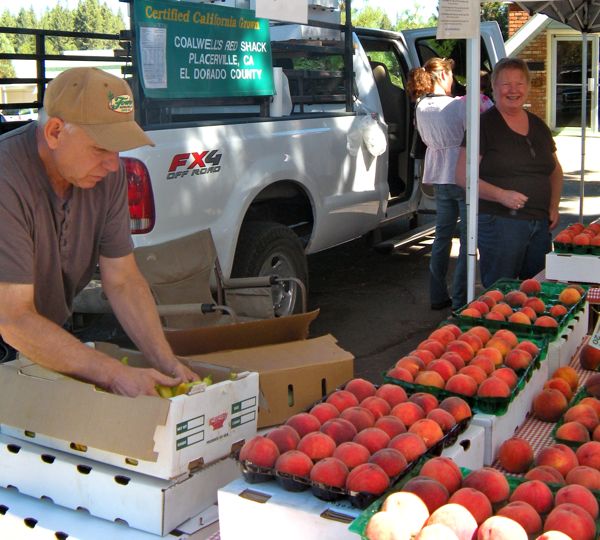
Jim and Lois Coalwell are ready for another season to begin June 1 in South Tahoe. Photo/Kathryn Reed

Jim and Lois Coalwell are ready for another season to begin June 1 in South Tahoe. Photo/Kathryn Reed

“It’s been cold down here so things are slow,” Jim Coalwell, who runs the South Lake Tahoe certified market, told Lake Tahoe News on Monday. He and his wife, Lois, run the Red Shack in Placerville. “We had a couple bouts of hail which probably did do damage.”

Coalwell has heard 30 percent of the cherry crop in El Dorado County has been damaged from the winter that won’t end. Some of the pears will have brown spots from the weather. They may not be pretty, but the flavor will be there, he said.

It is possible peach season will be delayed because the temperatures have been cool. Still, it’s peaches, cherries and greens that are expected to dominate the booths on opening day.

Vendors come from as far south as Fresno to sell their goods in Tahoe.

The South Tahoe market has room for 25 growers. However, several of them take two booth spaces.

“Because of the economy people are trying to get into farmers’ markets,” Coalwell said.

He has been fielding calls from all over the state from people wanting to get into the six markets the El Dorado County Certified Farmers Market Association puts on. The Placerville market opened May 15. New this year is one in Folsom.

Growers aren’t sure what to expect from the clientele in Tahoe. On the South Shore the numbers were down in 2009 compared to other years.

“It didn’t seem to have the enthusiasm it’s had. We had our regulars, but it didn’t have as much of a community event type feel,” Coalwell said of the market last year. “I think people were hurting.”

With the unemployment rate in the city nearing 18 percent, it’s likely people may not be shopping for fresh, farm grown produce like they have in the past. Plus, the population seems to keep dwindling.

Another 19 spaces in South Tahoe are for prepared food and other vendors. Bread, cheese, tamales, lavender, jams-jellies, salsa, fish, kettle corn, pottery, photography – all will be available.

Market organizers are going to help with the plastic bag conundrum. Coalwell has bags that say “please reuse” on them. A barrel will be at the market for people to recycle their bags.

The Foothills Farmers Market runs the Tahoe City market, as well as the one in Tahoe Donner on Tuesdays; and the Thursday markets in Truckee and Kings Beach.


Lake Tahoe Basin lags in returning Census forms

censusBy Kathryn Reed

Census workers will be out in force in Lake Tahoe this month because the number of people who returned forms by mail is lacking.

Throughout South Lake Tahoe 40 percent of the forms were returned. From Ski Run Boulevard to the state line that figure drops to 28 percent. That area of town has a number of Hispanic residents. People here illegally may be fearful of being turned in.

However, the U.S. Census Bureau keeps all information private, assuming any incriminating information is even obtained. In fact, Census workers can be fined $250,000 or jailed for five years if they share information with another government entity or the police.

The reason all towns want an accurate Census count is that money from the federal government for certain services is based on population. Political boundaries are also drawn based on the numbers that are gathered every 10 years. Money goes toward education, adult education, job training, and other programs.

For Californians, any federal assistance may be even more critical in the near term. Gov. Arnold Schwarzenegger on Friday called for closing the $20 billion deficit with cuts to most social service programs.

“Aside from possibly losing out on federal funding, California is also in danger of losing a congressional seat because of low Census participation. The speculation as of now is that the seat will likely come from Northern California. We are about to lose a voice to fight for our rights, which is completely unacceptable,” Patty Diazm from Services, Immigrants Rights and Education Network, said in a statement.

The Census Bureau stopped receiving mailed responses at the end of April. Households that did not return their forms can expect to receive a visit from an enumerator this month. An enumerator is a Census Bureau worker who goes door-to-door to help households fill out the forms.

The enumerators will have official U.S. Census Bureau badges and may contact the households of those who did not fill out their Census forms up to six times.

The final count for the mail back response rate is: 72 percent nationally, 71 percent in California and Nevada in 69 percent.

The five counties in the Lake Tahoe Basin came in at: El Dorado 64 percent, Douglas 72 percent, Carson City 79 percent; Washoe 74 percent; and Placer 70 percent.

Nevada County, which includes Truckee, had 67 percent participation. Alpine County had 22 percent.

For more information, click here.


Borges joins select club in state Wrestling Hall of Fame

By Kathryn Reed

Dave Borges says he never made it to the elite category in wrestling. That changed Saturday night when he received the Lifetime Service Award from the state Wrestling Hall of Fame.

“Dave is being recognized because of his long years of dedication and work and community service mindedness within the wrestling arena,” said John Taylor, who nominated Borges for the honor. “He has just given a lot of his time and efforts.”

Taylor also credits Borges for training referees in California and Nevada.

Dave Borges

Dave Borges

Borges was one of 11 people to receive the Lifetime Service Award at the May 15 dinner in Sacramento before hundreds of people. The actual hall of fame is in Clovis.

He is one of the younger inductees. He also got in on the first ballot.

For 43 of his 56 years Borges has either been a competitor or a coach. And most of that time on the mat has been in South Lake Tahoe.

“The thing that stands out for me is my teammates along the way. Even today, (Taylor) who nominated me, I wrestled in the early ’80s and we are still great friends,” Borges said.

He said there is a camaraderie that grows as wrestlers compete, along with respect and lifelong attachments.

Although Borges has fleeting thoughts of competing in the senior circuit, he admits the sport is now a hobby and not a vocation.

“I’ve had desires to compete in (senior nationals), but then I see who is on the list. They are tough,” Borges said. “I keep it in proper perspective.”

Some of the guys still competing have day jobs, like being a Marine, that are more conducive to competing regularly. Borges is a chiropractor by trade.

It was his older brothers who got him interested in wrestling when he was a seventh-grader at what was South Tahoe Intermediate School. They competed, so then he did. So did the youngest Borges brother.

It was at South Tahoe High School that he developed his skills that allowed him to compete at the university level. A hand injury prevented him from wrestling his fourth year at Pacific University in Oregon.

He calls himself an above average wrestler who could hold his own against the elite wrestlers back in the day.

As an amateur he wrestled in Japan and Korea.

“There’s no money in wrestling. There are no sponsorships,” Borges said. “A lot of top guys in mixed martial arts have a wrestling background.”

Now Borges’ emphasis is coaching kids, mostly ages 5-12.

“We have some tough wrestlers,” Borges said of the youths on the South Shore.

They have a tough coach – a hall of famer, now.


LTCC eliminating international program

ltccBy Kathryn Reed

All of the information about being an international student at Lake Tahoe Community College or studying abroad is still on the website, but the program no longer exists.

It will continue to be there, just changing a bit.

The college board of trustees this week eliminated the program as well as Jen Spina’s job. The department ceases to exist after June 30.

However, LTCC students can study abroad through other colleges and earn credits. Instructors can also teach via other institutions.

Spina, who was not at Tuesday’s meeting when decision was made, had given a presentation to the board earlier this year about her efforts to recruit international students. Although she went to where the would-be students are, they chose not to come to South Lake Tahoe.

Two students are signed up for fall quarter. Thirty are needed to make the program work.

The elimination of the program doesn’t mean people from other countries can’t come to LTCC. It means no one is promoting the college.

It wasn’t about Spina; it was about economics.

“Jen Spina has done a phenomenal job,” said Diane Rosner, dean of instruction.

“It’s a matter of priorities,” Rosner explained.

With the state not paying community colleges for all of their full time students, LTCC chose to cut a program that essentially drains other resources. The students who go on the trips are counted in the full-time equation.

Cutting the program means being able to serve more students on campus with more academic-oriented instruction.

And although the study abroad program has been poplar, like the trip to Chile this school year, it requires someone to oversee the program. With Spina’s job being axed, so too are those study opportunities.

“I look back and I’m proud of what we’ve done. It’s a sad time for me because I was one of the creators of the program,” Rosner said. “I think it will come back.”

The formal study abroad program started in 2001. Former Art Department Chairman David Foster had been taking students on international art related to art study programs before that.

If enough people sign up by the May 24 deadline, the Paris trip set for September will be honored. An ecological trip to Costa Rica in October is on the books, but Rosner said it looks likely it will be canceled.


Potential investor backs out of convention center project

By Kathryn Reed

The investor developer Randy Lane lined up to take over the stalled South Lake Tahoe convention center project backed out of the deal this week.

“The Investor is no longer pursuing an investment in the Debtor or otherwise pursuing a plan in the Case,” reads Michael Rosenfeld’s May 12 letter to the bankruptcy court in Sacramento.

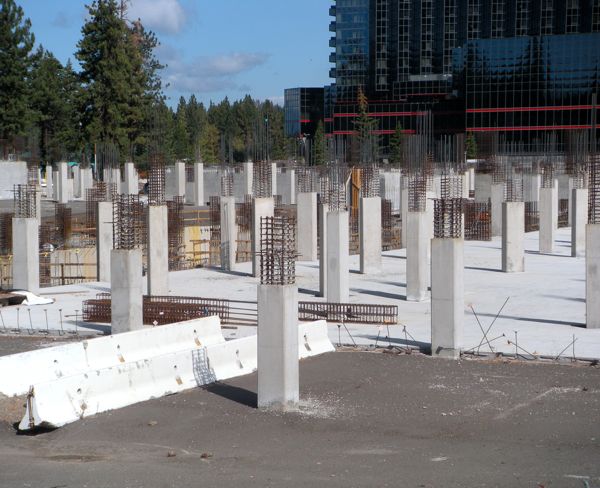
The would-be convention center took another his this week. Photo/Kathryn Reed

The would-be convention center took another hit this week. Photo/Kathryn Reed

That is the letter in its entirety.

Lane, the principle with Lake Tahoe Development Company, filed for bankruptcy last fall on the $400-plus million endeavor to create two high-end hotels, a convention center and retail space on the northeast corner of Highway 50 and Stateline Avenue.

He brought in Rosenfeld earlier this year to create a plan to resurrect that project that has not had a laborer on the 11-acre site in a couple years. Although some in the city saw Rosenfeld as a savior, others considered him nothing more than a salesman with glossy photos to show for his credentials.

Lane was not available for comment, nor was Mayor Kathay Lovell.

The court had given the Zephyr Cove developer exclusive rights to come up with a plan. The deadline was June 2. That exclusivity goes by the wayside with Rosenfeld’s withdrawal.

South Lake Tahoe City Attorney Patrick Enright said now any creditor may come up with a plan.

“(Rosenfeld) did submit a term sheet on May 1. It was an outline of what the deal would be without substance. It was a bullet point,” Enright said.

The city learned about Rosenfeld’s decision to end his involvement with The Chateau project at the close of business Wednesday. As of Thursday evening the city had not connected with Lane.

“I’m not sure if we were surprised. We knew it was a possibility,” Enright told Lake Tahoe News of Rosenfeld’s decision. “I want to talk to the creditors. I think they have been in contact with other people who may have an interest in the project or something similar.”

It’s possible the judge could say liquidate the property. The problem is rebar and concrete cover the 29 parcels. A final map was not filed with the city before permits were issued to allow construction to begin. This muddies the waters in being able to return property to the original owners. Plus, structures that were there have long been bulldozed.

The city is not one of the creditors. The money South Lake Tahoe has spent relates to consultants and planning costs. Until a little more than a year ago Lane picked up those costs. A dollar amount for what the city has spent on the convention center project could not be tracked down Thursday night.

South Lake Tahoe continues to receive its share of property tax on the land from El Dorado County because of the Teeter law even though Lane isn’t paying his tax bill. With the assessed value more than what it was before construction started, the city is making more on the property now in property taxes compared to when businesses were open near Stateline.


Forest Service creating blueprint for Tahoe’s future

By Kathryn Reed

Creating a working document with a bit of elasticity is the goal of the Lake Tahoe Basin Management Unit. With the current Forest Plan dating to 1988 and its roughly dozen amendments since then, the local Forest Service office is looking to create a new bible of sorts from which to seek guidance.

About 20 people gathered at the Forest Service office in South Lake Tahoe on Tuesday night for two hours to offer their feedback and input. The main topics were:

• Watershed and aquatic habitat;

• Forest health/terrestrial habitat;

• Recreation.

Forest Service personnel listen to the public May 11 in South Lake Tahoe. Photo/Kathryn Reed

Forest Service personnel listen to the public May 11 in South Lake. Photo/Kathryn Reed

Recreation is always a popular topic because so many people move to Tahoe to play in the 155,000 acres in the Lake Tahoe Basin that the Forest Service manages.

The irony is that as local tourism officials change their mantra from gaming to the outdoors, more stresses will be put on an already overused system. LTBMU is one of the heaviest used forests in the country on a per acre/per capita basis.

What more people will mean to an ecosystem that is already taxed and to an agency that is hard up for money to manage its resources remains to be seen.

Eli Llano, assistant forest supervisor, said the current plan is not entirely outdated and therefore his agency is not starting from scratch. He said that nationally all forests are looking at climate change, aquatic invasive species and incorporating new science into their respective plans. These concerns were not part of the 1988 plan.

The idea behind developing a flexible plan is that when changes need to occur it will be easier to do so instead of going through the formal, more cumbersome amendment process.

In the current plan the emphasis is on expanding recreation opportunities in the basin. The focus going forward is maintenance, especially with a $25 million backlog of projects needing to be done to keep the facilities functioning.

However, not all expansion ideas are off the table. Under consideration is allowing ski resorts to offer more to the public outside the traditional ski months.

The need for separation of user groups is high on the list of the public’s concerns. People want mountain bikers on trails not used by hikers. Moving snowmobilers someplace else is also a common refrain. Promoting the use of the water trail was also talked about.

Much of the plan is integrated and not isolated. For example, watershed and recreation are tied together when authorities look at removing recreation sites from stream environmental zones.

It’s issues like these the Forest Service will wrestle with as the Forest Plan is created.

As the people in attendance Tuesday broke into three groups, Forest Service personnel wrote down the public’s wish lists.

“Relocate trails from meadows” and “make sure recreation doesn’t interfere with biodiversity” and “increase the amount of fuel reduction” and “restore fire to the landscape for fuel reduction, vegetation conditions, ecological health” were some of the comments.

The LTBMU Forest Plan revision has been in the works for years. Initially an environmental impact statement was not going to be done. However, a court ruling in 2008 changed that course of action. The draft EIS is expected to be released this fall, with a 90-day comment period to follow.

The EIS will have the option of doing nothing, a preferred alternative and several other alternatives. The exact number of other alternatives to be studied has not been determined.

USFS officials anticipate another public hearing to air concerns during the comment period. Responses to comments will then be put together, with the final EIS released in summer 2011. People will have 45 days to appeal it. It will be up to the regional forester in Vallejo to sign off on the framework.

Another meeting on the plan will be tonight from 5-7 at the North Lake Tahoe Conference Center in Kings Beach.


Former LTCC counselor hired to be vice president

By Kathryn Reed

A familiar face has been hired to replace Susan Middleton, who after 24 years is retiring this summer as vice president of Academic Affairs and Student Services at Lake Tahoe Community College.

Tom Greene was once a counselor at the South Lake Tahoe two-year institution. He is currently associate vice president of Enrollment and Student Services at Sacramento City College.

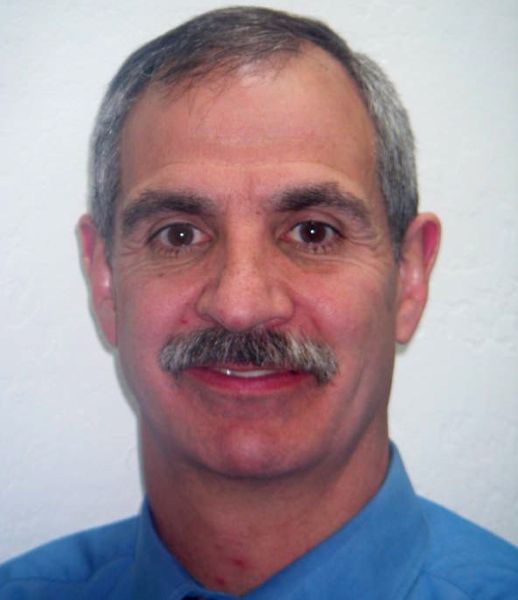
Tom Greene

Tom Greene

LTCC’s board, with Molly Blann absent, voted 4-0 Tuesday night to hire Greene. Ironically, Greene doesn’t know if he will be reporting to President Paul Killpatrick. Killpatrick was gone May 11 to interview for a job out of state. It was Middleton who sat in the president’s seat this particular night.

Greene did not attend the meeting.

Not only is Greene familiar with the campus, but also he is intimately knowledgeable about the faculty. He and English instructor Suzanne Roberts are engaged to be married this summer. An exact start date has not been set. He will be making more than $100,000.

Middleton will leave later in the summer, with the hopes of being able to train Greene before turning in her keys.

“The first thing I want to do is enjoy Tahoe,” Middleton said of her plans for retirement.

She started at LTCC as a counselor with the college when it was based out of a hotel on Highway 50. She was promoted to dean of Student Services. With Lori Gaskin leaving her post a year ago, the job of Student Services and Academic Affairs was blended into one position – the one Middleton has had this school year.

Moving to the campus off Al Tahoe Boulevard, watching it grow, seeing ideas become a reality like the Spanish Institute and the fire academy are the memories she will take with her.

It’s listening to students return to campus to praise their education at LTCC and talk about what they are doing now that Middleton will miss.

“I will miss the people without a doubt and the students,” Middleton said. “It will be hard to adjust to.”

Board members had praise for Middleton and her successor.

In closed session Tuesday the board deliberated over two finalists.

“He is a jewel,” board President Kerry David said of Greene after the meeting. “We are most fortunate to get him.”

Before Greene’s first stint at LTCC he was a TRIO counselor at Vermillion Community College in Ely, Minn. He left LTCC in 2003 to earn his doctorate from the University of Texas, Austin. He also has a master’s in education with an emphasis in counseling and a bachelor’s in finance.

He was the special assistant to the president at Valencia Community College in Orlando before taking the job in Sacramento. In Sacramento, he oversees a staff of more than 200 with an operational budget in excess of $10 million.

“The board and the committee believe he was the No. 1 candidate,” David said. Ten people were interviewed for the job.


Wet weather snarls roads, wilts plants — isn’t unusual

By Susan Wood and Kathryn Reed

Twenty-four hours after the Earth experienced its warmest day on record, Mother Nature cooked up a winter storm for the Sierra Nevada that showed the extremes climatologists and even the “Farmers Almanac” predicted last fall.

“We could have a very cool May. And if it stays this way, it will be the first one since 1998,” Kelly Redmond, chief climatologist with the Western Regional Climate Center, said Monday.

Although Redmond studies El Nino weather patterns like the moderate one the Pacific Coast experienced this winter, he said he doesn’t think the symptoms of the tropical weather phenomenon are still lingering.

Visibility was nil Monday heading into Tahoe on Highway 50. Photos/Kathryn Reed

Visibility was nil Monday heading into Tahoe on Highway 50. Photos/Kathryn Reed

“Most of those end in March,” Redmond said.

The region is experiencing a series of fluctuations in temperature and storm cycles. Early May’s normal freezing elevation of 10,800 feet is 800 feet lower than what is usual for Lake Tahoe. As oscillations go, April’s freezing level for Lake Tahoe was 1,000 feet lower in elevation than the normal 8,700 feet. The freezing level is determined by where rain turns to snow.

This pattern made snow more plentiful for a wider region of the Sierra Nevada and its foothills, Redmond reported.

“This is unusual. No question about it. But spring’s back and forth from hot to cold is more noticeable when you’re hoping for the opposite,” he said, referring to the summerlike days that have sprinkled the calendar.

On Monday, Reno’s high temperature was 34 degrees; Donner Summit’s 23 degrees; and Incline Village came in at 26 degrees.

Horrible road conditions

The nasty weather had law enforcement and tow truck drivers scurrying to keep up with the calls. Nearly 20 motorcyclists thought it a good idea to head west over Echo Summit only to get stuck on Highway 50 at Twin Bridges.

A motorcyclist on Highway 50 on May 10.

A motorcyclist in the snow on Highway 50 on May 10.

“It’s not too bright when you know what’s going on with the weather,” California Highway Patrol Officer Jeff Gartner said of the two-wheelers.

A pickup almost landed in the American River off of Highway 50. Another pickup farther east was pulling a sedan out of a snowbank on the north side of the two-lane road.

Highway patrol officials in California and Nevada said early Monday night no major accidents had occurred, just a lot of spinouts. They said people seem to have forgotten how to drive in the snow.

It was a whiteout on much of Highway 50 on Monday afternoon just outside of Placerville to Meyers.

South Lake Tahoe police officers were hopping as well with spinouts. A scare after school with three missing children ended happily when the Bijou Community School students were located after missing their bus.

Perennials will survive, annuals no

Even though storms like the one Monday that dumped about 4 inches of snow at lake level are not unusual, not all the plant life knows this. Daffodils and other bulbs are likely to spring back, though maybe not as straight as they were on Mother’s Day.

“Snow doesn’t hurt. It’s the cyclical temperatures (that are bad). The wind we had (Monday) morning, then the precipitation, that turns leaves black,” explained Ron Zehren of Zehren’s Landscape Nursery in South Lake Tahoe. “You can’t hurt a bulb. Perennials will take the cold.”

It’s annuals like marigolds, petunias and zinnias that shouldn’t be planted until after Memorial Day.

At Perennial Landscape & Nursery in Tahoe Vista they hold off on ordering the non-frost resistant plants because of storms like the one this week.

Rite-Aid had flowers for sale in its parking lot last week in South Tahoe. They probably didn’t make it sitting on the asphalt or if people planted them.

“It’s way too early for annuals. You can’t fool Mother Nature,” Zehren said.

Most nurseries in the basin tell customers not to plant until June – no matter if it seems like an early spring.

Zehren said the other thing people have to worry about is having plants acclimate to the area. They may be grown in the Central Valley, shipped to the Carson Valley and then put in the ground in Tahoe in a 24-hour period.

“The plant says ‘get me out of here’,” Zehren said of that scenario.

Climate change

Even though May snowstorms are not unusual in Tahoe, including last year, the Western United States has seen more cold spells in the last few years.

However, before labeling the planet’s spring weather as a symptom of the Ice Age, look at other areas of the world to get a grip of climate change in the form of warming. There’s a huge difference between global warming and localized weather.

A truck barely stops before hitting the American River.

A truck barely stops before hitting the American River.

“You can’t tell the climate by looking out the window. The whole planet doesn’t work altogether in one direction,” Redmond, the climatologist, said.

Redmond warned the planet is experiencing “more pluses than minuses” in terms of temperature.

“Although it’s been very cool in our neck of the woods, 2010 has turned out to be very warm in the first four months. This one has been the warmest in 30 years of our satellite records. It may turn out to be the warmest in the last 100 years,” he said.

The National Oceanic and Atmospheric Administration’s average of its collective temperature readings from around the world on May 9 was 20 degrees below zero. This sounds cold, but it is a few degrees warmer than average.

Scientists have long predicted weather extremes may become more frequent with climate change.

Redmond has seen it all firsthand this year. He was attending a conference in Miami in January when the Southeast had a deep freeze – and no heaters. Last week he was visiting Boston when highs hit the mid-80s.

The word from him – prepare for anything. In Tahoe that means keeping the shovel and rake next to one another.

Allergy season blowing into Tahoe with a vengeance

allergiesBy Kathryn Reed

Does that sniffling sound from friends, family members and co-workers seem louder, more constant and earlier than years past?

Allergy season is here – in the Lake Tahoe Basin, Carson Valley and seemingly everywhere else.

Physicians’ offices affiliated with Barton Health have seen a 27 percent rise in allergy shots for the first quarter of this year compared to 2009.

In the first quarter of 2009, 169 cases of allergic rhinitis were diagnosed compared to 200 cases in the first three months of 2010. This is a 30 percent increase.

Allergic rhinitis is an inflammation of the nasal passages, usually associated with watery nasal discharge and itching of the nose and eyes – in other words, the basic reaction to what you are allergic to.

Reports state 20 percent of the population has allergies. They are caused by an overreaction of the body’s immune system.

Veronica Scola, an allergy technician with Alpine Family Practice in South Lake Tahoe, said she started seeing people with seasonal allergy issues last month on the few warm days of April.

“I do think (allergies) are going to be much worse this year,” Scola said. “It’s a little bit worse than normal because of the weather patterns.”

She said the back and forth spring-winter-spring cycle makes pollen worse.

Flora contributing to the problem includes: pines, ash, birch, juniper, alfalfa, grasses, rabbit brush and sagebrush. Trees pollinate in early spring, grasses in summer and weeds in the fall. Allergy season in the basin is from the time the snow melts until it starts to fall again.

As soon as people start raking pine needles from their lawns it stirs up components they may be allergic to.

Michelle Feeney, a family nurse practitioner with Barton Family Medicine, recommends over the counter saline irrigation to her patients.

“You get pollen on your hands, your face, you breath it in,” Feeney said. “The more important thing is to stay indoors on windy days. Wear a mask if you are really susceptible to allergies.”

She said a lot of people forget eyes are affected by allergens and they often water, get itchy and turn red. Some people think they have pink eye, when what they have is allergies.

Scola is a not a big proponent of allergy medicines. She recommends people with persistent allergies to get tested and then possibly get weekly allergy shots.

For a regional pollen report, click here. The pollen hotline is (775) 359.5010, ext. 35.

For a pollen forecast by ZIP code, click here.


Trek to top of Mt. Tallac opens up another world

By Kathryn Reed

Something about Mount Tallac calls to people – more so in the summer than now.

Still covered in snow, the icon of the South Shore of Lake Tahoe that seems to be present no matter where one is, now requires an ice ax, crampons and an appreciation for Mother Nature if one is to trek to the top.

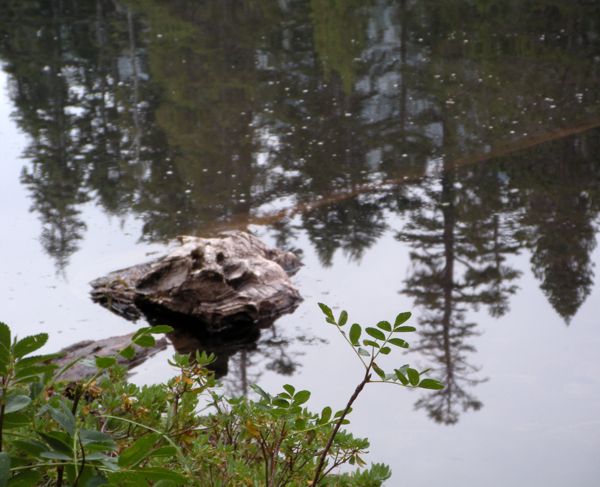
Floating Island Lake

Floating Island Lake

Soon, though, as the temperature begins to consistently rise, the snow will disappear – though not always completely. There have been years where splotches, sometimes even the cross, are evident until the snow begins to fly again.

Last August I made my second ascent of the 9,735-foot mountain. Though it’s not the highest in the basin, it is one of the most beautiful. It’s not even the most difficult to hike. (I don’t need to slog up Freel Peak again.)

Tallac, though, is worth the climb. And worth doing multiple times.

It is just one of the many peaks people bag each year in the 63,960 acres called Desolation Wilderness.

Unfortunately, on this particular Friday the basin is socked in with smoke from some now forgotten wildfire outside the area. Still, the trail is full of hikers destined for the rocky summit.

Access to the trailhead can be obtained from a few areas off Highway 89. This time Sue and I opted to go in from Cathedral Road.

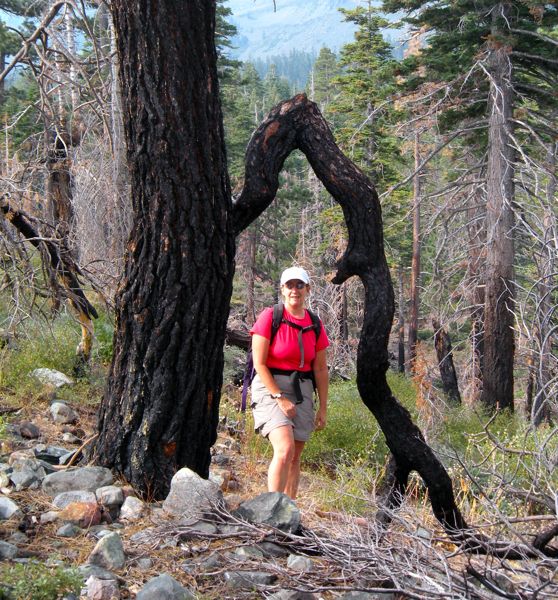
Sue Wood along the trail near Fallen Leaf Lake.

Sue Wood along the trail near Fallen Leaf Lake.

Not far in are some charred trees. They linger from a fire a few years ago (before the 2007 Angora Fire) that burned some of the area. The last time Sue was there she had a notebook in her hand and fire officials telling her she wasn’t supposed to be there. Then a bit of fire retardant drifted toward her – staining her clothes for posterity.

This day was about enjoying the hike, the scenery and being one with nature. But even on Friday the trail is well used. Several people have stopped to snack at Floating and Cathedral lakes. The stillness of the water transforms them into reflecting pools.

A group from the Student Conservation Association is working with the U.S. Forest Service – which maintains Desolation Wilderness – to make part of the trail a little less steep. The work was to be completed last October.

Even though the trail (5 miles one way) is full of people, it’s not anywhere as congested as Half Dome in Yosemite. On this Friday it was full of locals. Though a couple cousins from Maryland seemed to be sprinting up the mountain.

Unfortunately, people were able to get cell phone reception at the top. Somehow this seemed to negate the point – to get away from life below.

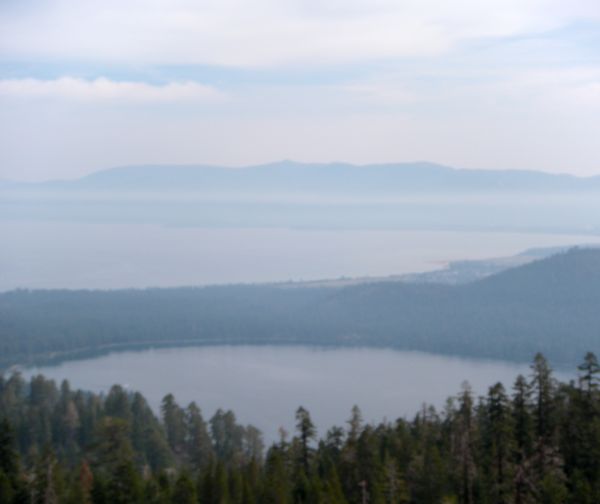
Fallen Leaf Lake and Lake Tahoe are covered by smoke in August 2009. Photos/Kathryn Reed

Fallen Leaf Lake and Lake Tahoe are covered by smoke in August 2009. Photos/Kathryn Reed

What little wind there was (usually the wind is significant at the top) just filled the senses with smoke instead of the usual clean mountain air.

Chipmunks scurry from one group of people to the next at the top in hopes of crumbs being left over.

Along the way birds chirp. Sage grouse hide in the brush, trying to avoid having their picture taken. We didn’t know what it was until we looked it up at home. We thought it was a prehistoric chicken.

Sage Grouse

Sage Grouse

Normally, the views of Lake Tahoe are breathtaking from the summit. Today the smoke obscures the azure water. Fallen Leaf is also buried in the haze.

I guess it just means I need to get my hiking legs in shape to make the trek this summer – under sunny, clear skies.