Lakefront luxury condos ready to be built in S. Tahoe

By Kathryn Reed

Five multi-million dollar condominiums will replace a rundown building that looks like a relic from an architectural era that would be best not repeated.

Tahoe Lakeview LLC had the final subdivision map and condominium plan approved by the South Lake Tahoe City Council last week. TRPA permits are already in hand.

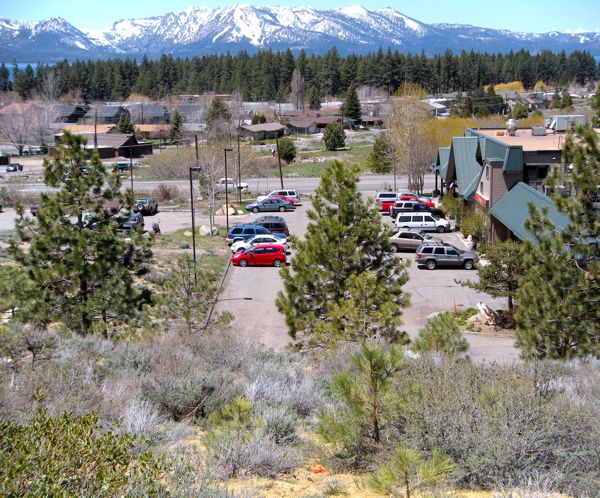
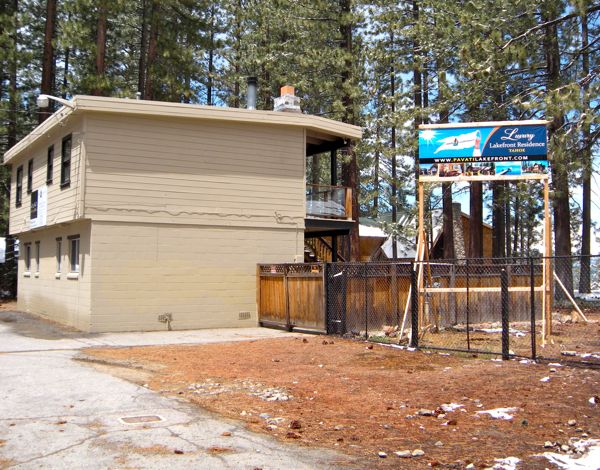
Five luxury condos are slated to occupy this site in South Lake Tahoe. Photo/Kathryn Reed

Five luxury condos are slated to occupy this site in South Tahoe. Photo/Kathryn Reed

Don Reid, who owns the property on Lakeview Avenue near El Dorado Beach, was in the audience May 18 in case the council had questions. With him was Gary Midkiff of Midkiff and Associates.

“I hope this summer,” Reid said of when construction will begin. “We still have some hurdles – political and financial.” Construction is expected to take 12 months.

None of the condos has been pre-sold. Reid expects them to range in price form $2 million to $2.5 million. He has bought a large billboard on Highway 50 in the American River canyon that travelers to South Tahoe pass.

The name of the project is Pavati Lakefront. Maybe sales would be going better if www.pavatilakefront.com actually went someplace.

The permitting process has been going for two years, according to Midkiff. One piece that isn’t complete is getting all the agencies to sign off on Reid being able to extend the pier and remove the boathouse.

Four buoys come with the site. Buoys and piers are a big deal at Lake Tahoe because a limited number are available. In essence, they are a commodity unto themselves.

Reid, who lives in Folsom, hired Midkiff because as a former Tahoe Regional Planning Agency employee, he is well versed in how the system works in the Lake Tahoe Basin. Reid has owned the parcel for three years.

Besides the city and TRPA, Midkiff said this project involves Lahontan Regional Water Control Board, California Fish & Game and California State Lands.

“It’s an opportunity to take a parcel that long ago had a house torn down that was not rebuilt and has a three-unit apartment, and hopefully start to improve that neighborhood,” Midkiff said.

The condos are expected to range in size from 1,800- to 2,500-square-feet. Each will have a custom floor plan. Rock and wood will be used extensively inside and out to fit in with the mountains more so than the structure that is there now.

“My dream is for it to be the nicest thing on the lake,” Reid said.

Each unit will have a 150-degree view of Lake Tahoe. The parcel sits right on the lake.


MV Transit set to put brakes on South Shore bus service

Publisher’s note: Updated May 28, 2010, at 11:55am.

By Kathryn Reed

MV Transit may walk away from its three-year contract to provide bus service to the South Shore of Lake Tahoe if something isn’t done about the more than $2 million it is owed.

The Fairfield-based company entered the contract Aug. 1, 2009. On May 25, the firm gave South Tahoe Area Transit Authority – the coalition it has the contract with – a 60-day termination notice.

Transit on the South Shore has hit a serious roadblock.

Transit on the South Shore has hit a serious roadblock.

The company also informed employees things might soon change. This must be done via the WARN Act. WARN kicks in when 50 or more jobs are eliminated or an entire plant is about to be shuttered. WARN mandates employees be given at least 60 days notice.

MV has 70 employees on the South Shore. Management is having one-on-one meetings with employees to let them know what is going on.

“We’ve never been current in our billing. It’s just gotten worse,” Thom McAleer, MV general manager, told Lake Tahoe News.

A payment plan was in place, but the deficit kept growing.

McAleer is hopeful things can be worked out so MV continues to operate BlueGo, the name of the local bus system.

“This is a fragile situation for MV. MV has never walked away from a contract. We don’t take it lightly,” McAleer said. “But at some point we need to protect ourselves. We need to have assurance that future billings will be current and there will be a solution to the outstanding billing and how they will pay the billing that is in arrears.”

Stacy Dingman, spokeswoman for the STATA board, said the notice to end the contract surprised her.

“Ideally, we will resolve our issues and it will be business as usual except it will be a different operation model that we can afford,” Dingman said. “If we can’t resolve our issues, STATA would operate (the system). Our intention is to flawlessly as possible continue the operation. We will have to make some service changes.”

When MV started it was contracted to provide 96,000 hours of service a year. That has been reduced to 67,000 hours. Whoever operates BlueGo, the Nifty 50 Trolley and the ski shuttles in the future will likely have even fewer hours.

This also means riders will have to adapt to another schedule change with fewer options. Dingman wants riders to have input into future changes.

The STATA board will meet Friday in closed session to discuss the MV situation. Its next regular meeting is June 4 at the Tahoe Regional Planning Agency office in Stateline.

MV first came on board as a temporary operator when ATM abruptly left a couple years ago. Then MV was awarded a long-term contract.

John Andoh was the transit administrator until earlier this year when he was let go by the STATA board. The evaluation committee recommended MV be hired.

Dingman said Andoh was approving expenditures the board knew nothing about. Andoh said that isn’t true, that he had been updating the board and had asked MV to defer payments based on a letter dated June 2009. STATA has no reserve fund. It was operating on a cash in, cash out basis.

Another money issue is all the costs associated with getting MV in place because of the disarray ATM left the transit garage in, the buses not all running and other unforeseen expenses.

When it comes to income, most of the grants are for buses, not operating costs. Ridership is down, so the fare box is far from full. The entities that make up STATA – South Lake Tahoe, El Dorado and Douglas counties, Heavenly Mountain Resort, the Stateline casinos and a few others – subsidize the transit operation.

The board approved a cost containment plan in the last year, but McAleer believes it did not go far enough. Nonetheless, he said MV wants to keep operating on the South Shore. The company just wants to be paid for the service it’s providing.

Dingman said under no circumstances is the public bus system going away. The need is there and for it to not exist would create more problems, she said.

“It’s not about tourism as much as it’s about residents and the people who are transit dependent,” Dingman said of why BlueGo will continue on.


South Shore water meter project off to rocky start

By Kathryn Reed

Surprises. There have been a lot of them as crews put in water meters on the California side of the South Shore.

One house had five lines to it. Pipes aren’t the size crews expected. Some lines are not straight. Others aren’t as deep as expected. Crews have dumped dirt on flowerbeds. Water hasn’t been turned back on. Debris has come out of indoor spigots.

Streets around South Tahoe are a mess as water meters are put in. Photos/Kathryn Reed

Streets around South Tahoe are a mess as water meters are put in. Photos/Kathryn Reed

It was such a cluster of chaos that construction teams in the Angora area were pulled from the job last week and sent to another location of El Dorado County. The North and South Upper Truckee areas are also slated for meters.

“We’re working with the contractor to find a solution,” Paul Sciuto, STPUD assistant general manager, said of the Angora situation. “There are a lot of unknowns.”

It was hoped 40 meters would be installed each day. Some days it has been 15 because of the problems.

GPS units are being used to record where lines are so records will be correct going forward.

The small water districts that now make up STPUD put in much of the infrastructure South Tahoe PUD is responsible for. Lack of uniformity is normal.

South Tahoe Public Utility District has received a number of calls from irate individuals as the installation of nearly 2,800 meters began this month.

Sciuto gave a brief update to the board at its meeting this month. One of the problems is when staff went out to bid last fall to spend the $4.38 million federal grant the bids were lower than expected. This resulted in being able to have a second bid with the “leftover” money. This also meant staff didn’t do the thorough preparation it would have normally liked to have, Sciuto said.

“This project is much more intrusive than many,” Sciuto told Lake Tahoe News.

Drive down Modesto Avenue in the middle of South Lake Tahoe to see how intrusive the project is. Tiechert Construction out of Sacramento started taking over the street Monday and could finish there today.

Several backhoes are churning away at the dirt to dig a hole big enough to fit a white plastic meter pit that is a couple feet tall.

Foreman Matt Carney said at first the city gave his team grief for being in the right-of-way. Then environmental groups complained about how the dirt was being handled. Carney believes everyone has been appeased.

“We get a lot of questions. People are leery about getting meters,” Carney said as he kept an eye on his crew Monday. “I tell them it may lower their water bill. People have been good so far.”

Carney said one surprise has been how pristine the galvanized pipes are after all these years. He attributed this to the soil conditions.

Any landscaping or driveway that is dug up for the meter must be returned to how it looked pre-meter.

Sciuto said cost overruns were anticipated even though all the issues were not. He said if the add-ons were in the 7 percent range, it would be reasonable.

“At this stage it’s hard to gauge (what they will be),” Sciuto said. The district will pick up the cost of the overruns, not the grant. A line is in the budget for this.

All this work is part of the utility district’s quest to meet the state’s unfunded mandate to have water meters installed on every property by 2025. STPUD estimates it will cost $20 million to put in the 10,000 units. The end result is supposed to be less water usage throughout the state.

New homes and ones with major remodels have been required to have meters since 1992. There are 1,600 of those.

One of the issues the local board must still grapple with is a rate for metered use. Money for a rate study is part of the budget that was passed last week for the fiscal year that starts July 1.

Paul Hughes, chief financial officer for the district, told the board a tiered scale is what staff is looking at once consumption patterns are established.

A workshop for the board will be scheduled in the near future to discuss metered rates.

Data from all of the metered residences will be collected for a year, most likely starting in 2011. This will give the district usage information as it goes forward with rates.

Some leeway exists in the state law when it comes to setting rates based on fixed costs and consumption. With the current flat rate, it means people pay the same no matter the usage. This scenario favors full-time residents. Paying based on consumption would likely favor second-home owners.

ngg_shortcode_0_placeholder


LTUSD suffers another financial blow from state

ltusd logoBy Kathryn Reed

Gov. Arnold Schwarzenegger said his May revise did not take away money form K-12 districts. But it’s a lie.

At Tuesday’s Lake Tahoe Unified School District board meeting, CFO Deb Yates will explain how another $160,000 in cuts is coming to the district for 2010-11.

It’s more of the funny math Sacramento likes to use as well as twisting the language a bit to confuse people.

The governor’s budget calls for reducing the per pupil allocation by 3.85 percent on undeficited revenue. Part of the change from what Schwarzenegger had said previously is going from a flat reduction of $201 per pupil to the percentage. And the key word in his proposal is “undeficited”.

The state should be sending LTUSD $6,376 per student for the next school year. Instead, the amount is budgeted at $5,185.

The May revise is taking the 3.85 percent off the $6,376 – an amount that in reality doesn’t exist. That cut is $160,000 just for LTUSD. Add a few zeros to get the statewide take-away to K-12 education.

“I have no doubt education coalitions will fight that vigorously,” Yates told Lake Tahoe News. “We were hoping for better, obviously.”

At the May 25 6pm board meeting at the district office in South Lake Tahoe, Yates will tell the board that reserves is the logical place to dip into for the latest state take-away. She plans to give a more detailed budget update at the June 8 meeting.

Yates said education fared better than other areas in the budget, but she isn’t sure how much more the state could cut. She was at a meeting on May 20 in Sacramento with peers to discuss the ramifications.

It’s likely the May revise will look nothing like what the governor came out with. Although a state budget is supposed to be adopted by June 30, that hasn’t happened in years.

With it being an election year, it’s likely more creative financing will be found to solve the $20 billion state budget deficit instead of real answers.

“They have gone about as far as they can go without completely decimating the system,” Yates said of lawmakers and the K-12 system. “At the end of the day the kids are the ones who suffer.”

The California School Boards Association and Association of California School Administrations, to get lawmakers to revisit how education is funded, filed a lawsuit last week against the state.

Secretary of Education Bonnie Reiss on Thursday issued the following response, “The governor will oppose this lawsuit and believes the state will prevail. The funding of public education in California has long been and continues to be a top priority of California, even in bad economic and budget times. We will continue to fight to keep education a budget priority as well as fight for the other reforms essential to ensuring a great education for all our students regardless of where they live or their race or economic background.”


Historic Hotel del Coronado a modern-day attraction

By Lisa Huard

CORONADO — California’s Travel and Tourism Commission predicts the number of visitors to California will increase by nearly 3 percent this year. It’s anticipated that visitors will spend about $92 billion on food, lodging and other expenses.

That would be a 5 percent increase from 2009, with many of these individuals coming to California from Europe and Canada.

It’s amazing talking to visitors, especially from out of the United States, to hear their expectations about what California has to offer. Recently a Soroptimist from Denmark visited the Lake Tahoe Basin. She couldn’t comprehend how big just California is.

She thought she could do day trips to San Francisco, Death Valley and Yosemite. We have such opportunities that we should all spend more time traveling in California and really seeing what it has to offer. Keeping dollars in Lake Tahoe isn’t such a bad idea either.

Tahoe-ites live in a beautiful place and we love to visit other unique locations. One region I highly recommend is the San Diego area. There is an incredible amount to do throughout the county. This includes theme parks such as Sea World, LegoLand, San Diego Zoo, to beautiful beaches, Old Town, and my favorite, Coronado Island.

As a teacher and aficionado of knowledge I can see that this “island” is in fact a peninsula. So who made a mistake?

Discovering the island

I consider myself lucky to live in Tahoe and even luckier as my closest friends have a home on Coronado Island. Once you arrive, put on your walking shoes or grab a bike, and just enjoy. This resort destination has a lot to see and to learn about. On this particular visit I wanted to learn more about the history of the area, its development as a resort community and what there is to do.

Hotel Del

Hotel del Coronado

In a short period of time, Coronado has gone from an island that was separated from shore by a small channel known as the Spanish Bight to a peninsula of some of the most expensive property in the state. It’s filled with swanky hotels, lovely eateries, shops and a community of year-round residents and vacationers from all over the world.

How did of this all come about? It was during the 17th century that Spanish explorer Sebastian Vizcaino discovered a group of islands 17 miles off the coast of Southern California. He named them Las Yslas Coronadas, which translated means the crowned islands. Explorers did little with the beach until the 19th century. At that time it became a safe harbor by whalers to build hide-houses to live in as they worked.

Once Mexico gained its independence from Spain in 1821, massive land grants were provided in the state. With vast land grants came the great rancheros and haciendas of the time.

In 1846, Don Pedro Carrillo was the lucky guy whom was granted the island in the Port of San Diego. He owned this property for a short amount of time and flipped it for $1,000 to Bezer Simmons who was an American captain of a trading ship.

The island then changed hands several times during the next 39 years until it was purchased by Elisha S. Babcock Jr., Hampton L. Story, and Jacob Gruendike for $110,000. Babcock then invited Heber Ingle and Josephus Collett to become investors. In 1886 this group of men organized the Coronado Beach Company. They are to this day considered the founding fathers of Coronado Island.

Becoming a resort area

The group of investors envisioned a resort community on the beach like no other; a destination resort that would have visitors from all over the world. The island was quickly divided into lots, railroad tracks were laid, and infrastructure developed. They would move visitors by land and by water as they also created the San Diego and Coronado Ferry Company in 1886.

Babcock and Story were businessmen who knew how to spin information to their financial benefit. They even leaked their own news story about a proposed hotel on Coronado Island. This new hotel would be the focal point of tourism in the area.

The divided parcels ranged in price from $500- $1,600 and on the day of the auction they sold 350 lots totaling $110,000 ; their original purchase price of the entire peninsula.

Today, the amount they paid for the entire island would be equivalent to one-eighth of the least expensive home I found on the Island.

The investors began to concentrate on the design and construction of the new hotel. The Beach Company hired James and Watson Reid as the architects of the Hotel del Coronado. Work began almost immediately. The Hotel del Coronado was completed in early 1888 and officially opened its doors to the public on Feb. 19 that year.

As construction of the Hotel Del began, Coronado Island moved forward in establishing itself as a year-round community. It had its first school session in January 1887 and was located in the walled tent area on Seventh Street until construction of the first schoolhouse was completed the following year. A boating club, athletic club and baseball club soon followed.

It was in July 1889 that John D. Spreckels (Spreckels of sugar plantation in Hawaii and shipping fame Spreckels) became an investor in the Coronado Beach Company, buying out Hampton L. Story’s interest. Spreckels continued to buy controlling interest in the company over the next three years and became the sole proprietor of the Hotel del Coronado. He also established the famous Tent City and the sale of North Island to the U.S. government in 1917.

Hotel Del's Tent City

Hotel Del's Tent City

Hotel del Coronado became one of California’s most popular destinations. The resort community further increased the number of visitors with the rise of Tent City. Just imagine, a beautiful beach, incredible weather, and then a makeshift city out of white tents at the foot of the Hotel Del for summer fun. This was the perfect destination for the middle class who might have found the cost of leisure in Tent City more within their means than the Hotel Del at the time. Swimming facilities, carnival booths, a Ferris wheel, a children’s bull fight, sailing, all sorts of activities for the entire family brought visitors galore from around the world between 1900 and 1939.

The tents are now replaced with quarter-share condos that flank the property of the Hotel Del. The white Victorian-style architecture still attracts people by the droves year-round. The Coronado lifestyle is one you can own, even if it’s just temporarily, throughout the year.

Retaining its history

To this day, Coronado Island continues to host special events, famous people, and is a display for aviation wonders. It was here that early experiments in aviation occurred. This now “Navy town” is one of the great aviation arenas in the world. In 1911, famed aviator Glenn Curtiss found the area ideal for experimenting with his newly developed seaplane. He leased the land for three years from Sprekels. With much diligence, Curtiss performed the first successful U.S. seaplane flight and the first amphibian flight in the world. Curtiss also opened and operated the first U.S. military flying school.

And it was on North Island that several other aviation firsts occurred; the first nonstop coast-to-coast flight in 1922, the first mid-air refueling flight in 1923, and the departure of Charles Lindbergh in 1927.

This island setting is also well known to moviemakers. Through the years many films were made in Coronado and on North Island, including “Some Like It Hot”, “Dive Bombers”, and “Hellcats of the Navy”. Coronado Island was even nicknamed the Emerald City because the author of “The Wonderful Wizard of Oz” used to winter here and he loved the fairyland-type atmosphere of the tents along the beach. I can just hear those munchkins now.

North Island was originally a joint Army/Navy base when the government bought the land from John Spreckels for $5 million. The Army then vacated its portion of the island in 1935 and the entire area then became Navy property. Today’s Navy’s post is a training facility for the Navy Seals. It’s pretty interesting when you grab an early morning cup of coffee, walk down to the beach to watch the dolphins playing in the water and instead comes up on a Navy Seal and I’m talking about the kind with two legs.

So how does an island morph into a peninsula? Well, you sell land to the government for the purpose of training your Army and Navy personnel, get the Army Corps of Engineers to fill in the body of water separating North Island from Coronado to allow for more construction, and there you have it; a peninsula. Coronado Island still sounds better than Coronado Peninsula.

Modern conveniences

Again, there is so much to see and do while on the Island. What could be better than grabbing the bikes, heading to Clayton’s Mexican Takeout on Orange and 10th, and heading to the sand in frontage of the Hotel Del to sit and eat your egg burrito at the shore? Well, let me see.

Add in sitting on the clean sand, watching the waves and the lighthouse at Point Loma and then over your head is the sight and sound of two F14 Tomcats cracking through the sky on approach just practically over your head. Sitting with my friends, Glenn said, “That’s the sound of freedom.” Great saying for a great sight.

The attractions of the island are numerous. There’s the Hotel Del Coronado, Museum of History and Art, Coronado Playhouse with six productions a year, Art in the Park which happens at Spreckels Park the first and third Sunday of each month, Coronado Ferry Landing which will hook you up with restaurants and shops. You can attend concerts in the park, and take tours galore highlighting both on and off island sights. You can even take a Gondola Tour that cruises the canals and waterways of the Coronado Cays in Venetian style, catch the Old Town Trolley, or take the Ferry to the Gaslamp Quarter.

To find out how you can begin your island adventure, start by contacting the visitor center or the Coronado Chamber of Commerce.




Event puts exclamation point on STHS performing arts

By Kathryn Reed

It was certainly a production worthy of names like Nannette Niven, Bob Grant and J.J. Clause being associated with it. And it was definitely an original.

The three South Tahoe High School performing arts teachers were recognized Thursday for their dedication to their specialties as well as their vision toward the future. They, with a lot of help from others, have turned an art room into a theater room.

SMC Contracting, under the watchful eye of LTUSD's Steve Morales, is starting on the third new building at STHS. Photos/Kathryn Reed

SMC Contracting, under the watchful eye of LTUSD's Steve Morales, is starting on the third new building at STHS. Photos/Kathryn Reed

Their greater vision will come to life over the course of the next year. They had a tremendous amount of input into what the Tahoe Arts & Design Academy will look. It is being built at the front of the campus next to the Construction Arts and Transportation Academy that opened in April.

Grant talked about taking a trip to Hollywood with LPA Architects so they could understand what he wanted. He anticipates students being able to go from STHS to Hollywood.

With the demolition of the little theater this spring, the campus will be without a theater for the entire 2010-11 school year. By the time the class of 2012 starts its senior year, a new facility will be ready for all students.

The Tahoe Arts & Design Academy had its ceremonial groundbreaking on Friday even though actual construction started May 1.

A little razzle-dazzle from students was the highlight of the hour-long ceremony. After all the accolades and recognition from and by the adults were made, it was time to show why such a facility is needed.

Theater arts have a long history at South Tahoe High. Grant showed a program from January 1967 for “South Pacific” that called it the “new South Tahoe auditorium”.

Clearly, what was there was old.

Three students performed a scene from “A Servant of Two Masters”. A song-dance-tap number by Chelsea Wightman and Nick Kushner followed this to “I Love A Piano”. The high school Show Choir wrapped up the theatrical portion of the event with the French song “Je Le Vous Dirai”.

The money to construct all the new buildings at the school comes from the $64.5 million bond voters passed in November 2008. An additional $30 million has been secured from the state in matching dollars.

Principal Ivone Larson said, “It goes beyond a building. It’s a program for kids. It’s a legacy.”

ngg_shortcode_1_placeholder


County to close parking lot used by Stateline businesses

By Kathryn Reed

STATELINE — Douglas County officials on Thursday let businesses in the Nugget Building at Stateline know the 57 parking spaces on the west side of the building will be off-limits to their patrons.

Today, property owner Chuck Bluth plans to deliver a letter to each county commissioner expressing his side of the story and asking to be put on a future agenda so the matter can be worked out.

The parking lot anglomg to the left of the Nugget Building in Stateline will be off-limits as of June 1. Photo/Kathryn Reed

The parking lot angling to the left of the Nugget Building in Stateline will be off-limits as of June 1. Photo/Kathryn Reed

When Bluth bought the property earlier this year from Mike Laub he knew nothing about the parking lot deal that had been in place. In July 2009 a 15-year lease between the county and Laub expired. The county has not received a dime since then even though it has tried to collect from Bluth and Laub.

The odd-shaped lot is partly off Kahle Drive, borders Kahle Community Park, has an entrance off Highway 50 and goes to the edge of the building that is anchored by Sushi Pier. It’s still referred to as the Nugget Building because a casino by that name was once there.

Justina Caviglia, deputy district attorney for Douglas County, said before the 1994 deal was inked the county was getting $5,000 a month for the parcel. A lump sum of $99,500 was paid for the lot’s use 15 years ago, with the money going to the neighboring park.

Prior to the sale of the Nugget Building the county had been working with Laub to work out a month-to-month lease. That never came to fruition.

The other side of the building has parking, with a couple spots in the back.

What it will mean to the businesses in the complex if the county parking spaces are removed remains to be seen. The entire building is not occupied. But with three restaurants, the need for parking is evident.

Laub sold the Nugget Building early this year and then bought the former Bill’s Casino parcel, which he had intended to turn into a strip club. (Commissioners’ thwarted those plans with a vote after Laub bought the property from Harrah’s Entertainment.)

It was Laub’s responsibility, according to the county, to maintain the lot, which included plowing it. But the county plowed it this winter.

Bluth said he knew nothing about the parking lot issue until the county contacted him.

Clearly the lot has not been kept up by anyone. Some potholes are filled with muddy water. Others are 3-feet in diameter. Curbs are decaying. Landscaping appears to be non-existent, though an argument could be made it’s native vegetation.

What is it worth?

In April the county secured two appraisals on the lot. Johnson Perkins & Associates Inc. say it’s valued at $5,000/month and Anthony J. Wren, MAI put a $7,732/month price tag on the parcel. A 2007 state law requires the county to charge the higher price.

Bluth said he isn’t about to pay more than $90,000 a year for a parking lot.

“That would be 76 percent of my gross rental revenue on that property,” Bluth told Lake Tahoe News.

Bluth contends the parcel was appraised based on it being developed in the future and not its current use, which is all he would use it for.

Differing opinions

Caviglia and Steve Mokrohisky, assistant county manager, met with Lake Tahoe News in Stateline on May 20 to talk about the issue. They said Bluth doesn’t return phone calls.

“Mr. Bluth has never responded to my offers,” Caviglia said.

Bluth shared with Lake Tahoe News his written communications with the county. A letter from Caviglia to Bluth dated April 14 talks about the appraisals, mentions a draft lease and a desire to meet and discuss the issue.

The assistant district attorney sent a letter April 19 to Bluth telling him not to contact the appraisers.

“Any attempt to influence or attempt to influence either appraiser to change its appraisal is a criminal act …,” the letter says.

Bluth told Lake Tahoe News that as a developer for the last 40 years he is well aware of the role of an appraiser. He also believes the county didn’t tell the appraisers the parcel is only for parking.

Caviglia said a corner of the property has gone through the Tahoe Regional Planning Agency with approval to be developed, but that she does not know where that stands or what might go there.

On April 26 Bluth wrote a letter to county Commissioner Nancy McDermid because she represents the lake, even though she lives in the valley. She is also on the TRPA board.

“It is my belief that approaching this in a positive manner is the best way to resolve what I inherited when I purchased the building, because I was not informed of the parking situation that has been ongoing for many years with previous owners,” the letter says. He then offered seven dates in May, all of which have since passed, as possible meeting dates.

A letter dated April 29 from Caviglia to Bluth gave him a deadline of May 5 to respond to her. “Douglas County will take appropriate action to protect its ownership rights of the property, which may include closing the parking lot,” the letter states.

On May 5, McDermid responds via email to Bluth saying county counsel has advised against a meeting.

On May 11, Bluth emails McDermid his disappoint with her response and further said, “I attempted to set up a meeting with the District Attorney’s office and one of the appraisers, but I was turned down and threatened, which simply amazes me.”

Digging in their heels

Bluth is not one to shy away from a fight. Bluth and the TRPA have gone back and forth in court and out of it regarding his house near Glenbrook. He is the former owner of the Cal Neva casino in Crystal Bay. He sold it in 2005.

“When I owned the Cal Neva I dealt with 12 agencies and none with this kind of behavior,” he said.

He is to the point where he doesn’t see it making economic sense to rent the parcel at the price quoted.

The county plans to block access the Tuesday after Memorial Day weekend.

“We are in a tough spot. We tried to go through the process,” Mokrohisky, the assistant county manager, said. “Our belief is business owners didn’t do anything to cause this.”

He and Caviglia had a letter to hand the business owners, which include attorney William Cole, Cilantros Mexican Grill, UPS, Sushi Pier and Thai Delight.

“If they close off the lots so no one can get to my space, what are they going to prove, they are the big dog in town? We all know that. They have the authority to do what they want. Usually they don’t abuse power,” Bluth said of Douglas County officials.


Trout Creek breach sends water flowing into Lake Tahoe

By Kathryn Reed

Mother Nature is hard at work this season as she creates another tributary into Lake Tahoe.

Trout Creek in South Lake Tahoe normally flows into the Upper Truckee Marsh and then into the Upper Truckee River that lets out into Lake Tahoe at Cove East.

Not this year.

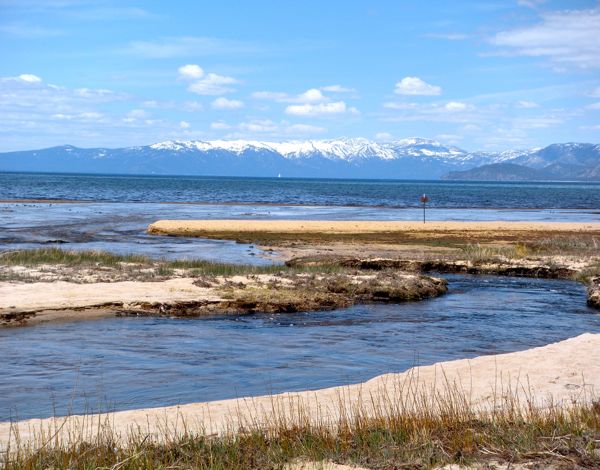
Trout Creek is flowing into Lake Tahoe -- a rare thing. Photos/Kathryn Reed

Trout Creek is flowing into Lake Tahoe -- a rare thing. Photos/Kathryn Reed

The creek has its own outlet into the lake. Although it is crossable via foot, it might mean getting soaked up to at least one’s knees in some locations.

“It’s nature doing what nature does,” Bruce Eisner of the California Tahoe Conservancy said. The state agency owns the marsh. “It’s fascinating to see nature in action.”

The CTC will continue to let Mother Nature do what she wants. It’s likely in a month the breach will not be evident as the snowmelt decreases and temperatures rise.

This is not the first time a breach has occurred. But it’s also not an annual event.

For now, much of the meadow near the edge of the Al Tahoe neighborhood is more like a marsh. Egrets are swooping low as if fish may be in those waters. Flocks of Canada geese waddle in the muck. Mountain chickadees chatter about cheeseburgers.

Blades of wild grass poke above the water. Reflections of the cloudy unsettled sky are reminders summer has yet to arrive in this part of the state.

But all has not been quiet this spring along the beach. On a couple warm nights South Lake Tahoe police officers have been called out to break up parties. Bonfires have been a problem in the past. Several cigarette butts line the trails in the area. A wildfire is a real concern.

At the May 18 City Council meeting it was agreed the CTC will pay $12,251 to the city for police officers’ overtime to patrol the Upper Truckee Marsh and beach area, as well as Cove East on the other side of the river through June 25. An agreement between the city and CTC was entered into in July 2009 for police to patrol the areas at a cost of not more than $20,000. The extra money is to fill out the current contract.

The CTC is in the process of crafting a draft environmental impact report regarding restoration of the Upper Truckee marsh. It will come out this year. It was delayed for several months because the bond freeze by the state prevented money from flowing to the CTC to fund the creation of the document.

“We have an obligation to protect habitat. That is our overriding concern,” said Ray Lacey, CTC deputy director. “The CTC is closely monitoring the use patterns. It’s likely in the future there will be different recommendation to tailor some of those patterns.”

The agency is worried about dogs off leash, more so in the wetlands than on the beach. Residents have become reluctant to frequent the beach when young people are partying there.

Wildlife habitat as well as recreation concerns are things the CTC staff and ultimately the board will have to balance.

Public input will be sought by the CTC as it moves forward with plans.

ngg_shortcode_2_placeholder


Divided South Lake council threatens Ski Run BID future

ski runBy Kathryn Reed

Nearly one-third of the money it takes to maintain Ski Run Boulevard’s landscaping and bike trail is in jeopardy of disappearing.

Every year the business improvement district that includes more than 70 businesses and property owners in this area of South Lake Tahoe must come before the City Council to renew the BID. On Tuesday it was not approved. Neither was it denied.

Councilmen Jerry Birdwell and Hal Cole recused themselves because of, respectively, owning property on the street and nearby. Because the matter involves money it necessitates the remaining three to vote in unison for the BID to go forward.

Councilman Bill Crawford abstained. Abstaining is allowed without cause or reason needing to be given.

“I am not opposed to what is going on at Ski Run. But over the years all kinds of public money was spent there,” Crawford told Lake Tahoe News after the meeting. “No one bothered to talk to me about why I abstained two weeks ago so I don’t know what silly game they are playing. I think we can get out of the business of having to dicker with this group every year.”

The vote Crawford referenced was when the council voted to have it on this week’s agenda, which was not a monetary issue.

It was agreed Tuesday that the issue would be brought up at the next council meeting – June 1.

Brian Des Rochers and Barbara Tenney, both board members of the Ski Run BID, spoke at the meeting. They have a commitment from Crawford to sit down in the coming days to get his view on the matter.

“It wasn’t quite what we anticipated. It definitely was shocking,” Des Rochers said of the vote after the meeting.

Nonetheless, Des Rochers said the businesses would continue with the On the Run theme, events like Saturday’s cleanup day, the June 5 bike festival and parade, and the third Thursday night of the month for live music starting June 17.

The reality is the money allocated to the BID that is threatened was for landscape maintenance, not for marketing and events.

If the allocation is not approved by the council, that body will have to decide if finding the money in the general fund to maintain Ski Run, partial funding or letting it turn into something like the weeds along Linear Park on Highway 50 will be the option. (The latter keeps happening even though the now defunct Core 24 Charities helped get a water line put in by Tahoe Meadows for irrigation and gave the city $20,000 to beautify the area, which hasn’t happened.)

Redevelopment money ($5,000 this fiscal year) has been used to pay for a consultant to run meetings, fly her in and put her up in a hotel. It’s not known why one of the lodging facilities on the boulevard didn’t offer a free room. Money also went to pay for meeting spaces – all were on the boulevard.

“(Redevelopment funds) can’t pay for ongoing maintenance, but they can be used to help stimulate new business development,” explained Gene Palazzo, who heads the city’s Redevelopment Agency. “They need some seed money to get things going. Redevelopment can help with that.”

The BID has requested another $5,000 for this fiscal year that would be spent on nonprofit incorporation fees, a website and newsletter startup costs. Because those dollars were wrapped into Tuesday’s entire BID proposal, they will not be forthcoming at this point.

The city’s Parks and Recreation Department oversee maintenance of the boulevard between Highway 50 and Pioneer Trail. (The marina side is not in the BID.)

Parks Director Gary Moore said for fiscal year 2010-11 it is projected to cost $29,900 to maintain that stretch of the city.

The money would go to:

• $11,800 – landscaping. This includes fixing sprinklers, mowing, edging, replacing dead trees or trimming broken limbs.

• $5,300 – water. There is a meter on each end of the boulevard.

• $4,600 – electricity. There are 80 light standards. (With LED lights being provided by a state grant, that cost is likely to come down in future years.)

• $4,000 – bike trail maintenance. One mile of pavement is on each side of the road.

• $4,200 – light maintenance. More than 20 bulbs are replaced each year, and ballasts need repair.

The money would come from:

• $11,300 – BID. The property owners pay $2 per linear foot of frontage on Ski Run. Businesses are assessed a percentage of their gross income. All of this is collected in July via business license renewals.

• $10,000 – Measure S. Each mile of bike trail receives $5,000 for maintenance. An exception by Measure S overseers allows this money to be used on lighting issues with the theory being the bike trail is used at night by cyclists.

• $8,600 – Parks and Recreation general fund.

The BID collected $10,500 for the 2009-10 fiscal year that ends Sept. 30. This means the maintenance for the boulevard should not be in jeopardy this summer. But it’s not known for certain.

Finance Director Christine Vuletich said in an email response to a phone message that she could answer questions today about the issue – but that didn’t work for Lake Tahoe News’ deadline.

The question to her would have been: With the money collected based on a July 1-June 30 fiscal year per business license fees and the city on an Oct. 1-Sept. 30 fiscal year, is the money collected for the BID divided between two fiscal years or used solely in what would be an upcoming fiscal year?

The money collected for and by the BID members is essentially a self-tax. That is why Mayor Kathay Lovell does not understand Crawford’s reluctance to continue on with the 7-year-old BID.

“To me it’s a no-brainer. It doesn’t cost us anything,” Lovell said.

No one in the BID’s jurisdiction protested the assessment.

It’s possible the BID members could collect the fee themselves. But the money would not have to go to landscaping. They could use it all on marketing, promotions and/or events.

This means the city would still be left with the decision as to what to do about landscaping on Ski Run Boulevard. When the California Tahoe Conservancy put up $1.5 million for the bike trail, lights, curb and gutter the deal was the city would maintain it all. This means with a BID the people on the street pay for it and without a BID it will most likely come out of the general fund – which means other locations in the city could see fewer dollars.


Nearly 80 apply to be South Lake Tahoe city manager

slt logo

Publisher’s note: Updated May 18 at 9pm.

By Kathryn Reed

About 80 people are interested in being the next city manager of South Lake Tahoe.

The deadline to apply was May 17, though resumes will be accepted by consultant Bob Murray and Associates if they are postmarked by that date.

Bob Murray would not say how many people he intends to refer to the City Council to interview.

“The only comment I’m going to have for the press is the number of candidates and I should have the accurate count (Wednesday),” he told Lake Tahoe News on Tuesday.

In the extremely brief and somewhat terse conversation, Murray said as of Sunday he had 64 applications. “I will not identify if there are local candidates. That is privileged information,” the consultant quipped.

“Privileged” is an interesting response considering his fee comes from taxpayer money and the person to be hired will be working for the taxpayers at their expense.

This isn’t the first time Murray has concealed information from the public in relation to hiring a city manager. In 2002, he was hired as the headhunter when Dave Childs resigned.

Members of the community were chosen by city officials to interview a few of the candidates in what amounted to a closed session. When Dave Jinkens was chosen these people knew before the name was released to the public. What influence they may have had in the decision and who exactly they were remains a well kept secret.

Murray was also the consultant paid with taxpayer money after Kerry Miller resigned. He found Childs.

Transparency has been an often-used word at City Hall this year. With the history of this consultant, the view is already murky.

In April the council voted 3-2 to hire Murray again, this time for no more than $15,000.

Mayor Kathay Lovell said she expects Murray to whittle the list to a dozen or so candidates. She said the final applicant number Murray told her is likely to be near 80.

On the other end of the spectrum is Councilman Jerry Birdwell who would like to look over all the resumes.

Lovell voted for Murray, Birdwell did not.

Lovell said a community panel would be assembled to give input into the process. How that will work has not been determined.

Current City Manager Jinkens told the council early this year he would be leaving when his contract expires in August. He started with the city in 2002.

Susan Wood contributed to this story.