July 4 can mean freedom to litter Lake Tahoe beaches

By Stephen Ward

Pristine might have been the last word to use to describe the beaches of Lake Tahoe early this morning.

Thanks to a group of volunteers on the South Shore, most people will never know what the shoreline looked like after people left behind their trash from the Fourth’s festivities.

With the South Shore’s population more than doubling for the holiday weekend, the impact on the environment is noticeable, as is people’s reluctance to be responsible for themselves. Instead of using trash receptacles, they left their trash and other items on the beach.

A trash collected from South Tahoe beaches on a previous July 5. Photo/Kenny Curtzwiler

Trash collected from South Tahoe beaches on a previous July 5. Photo/Kenny Curtzwiler

This is the 11th year Kenny Curtzwiler, owner of K&K Services, has rallied his staff together to clean the majority of El Dorado Beach, along with Regan Beach and the walkways surrounding Highway 50.

“One day I walked over to El Dorado Beach and noticed it was wrecked, and I decided to start cleaning up,” Meyers resident Curtzwiler said. “I never asked the city for help, I just decided to clean it myself.”

South Lake Tahoe Parks and Recreation Director Gary Moore sang the praises of Curtzwiler, saying the cleanup takes a lot of pressure off his department. Until last year, Curtzwiler had paid the dumping fees.

Curtzwiler and his five employees are sticking to the same regime they have for the past decade, which involves coming to the area with a dump truck and trailer to load all the waste into the beds of the vehicles before taking the collection to South Tahoe Refuse. Curtzwiler estimates approximately 50 yards of trash are accumulated each year.

He is starting the work this morning at 6 on the lake side of Highway 50 across from Aloha Ice Cream, they work their way east and anticipate being done by 10:30am. Curtzwiler says volunteers are welcome.

According to Curtzwiler, the majority of trash found at the sites is broken chairs, empty beer bottles and wet clothes.

Clean Tahoe crews will also be out today. The nonprofit that picks up trash in the public right-of-way in the El Dorado County portion of the basin was preparing to spend the majority of today restoring the facilities tarnished by tourists.

“We have two trucks we use to pick up trash from the public walking areas,” said Ellen Nunes, who runs Clean Tahoe.

Clean Tahoe has set its focus on cleaning the public parameters, and believes a few hours will be needed in order to fully regenerate the grounds.

The U.S. Forest Service owns Nevada, Kiva, Pope and Baldwin beaches on the South Shore. Because phone calls were not returned, it’s not known what their plan of action is for the debris left behind form Fourth of July revelers.

While many organizations anticipate a substantial amount of garbage left behind, some resorts don’t consider cleaning up after the holiday a grueling endeavor.

Austin Sass, spokesman at Zephyr Cove Resort, anticipates the Zephyr Cove beach to be back to normal within two to three hours, and says the time it takes to restore the property isn’t different than any other weekend.

“We get our entire staff out there and pick up trash until the beach is clean again,” Sass said.

As for harmful materials, Sass is steadfast in ensuring the property will not be threatened by the use of fireworks or glass beverages.

“We have recycle bins at the front of all entrances to the beach,” Sass said. “And you can’t even see the fireworks from our beach since we’re a cove, so we close before the show even gets started.”

Though jurisdictions have fines for littering, with resources on the Fourth devoted elsewhere, it is impossible to enforce such laws.


Snow-covered trail thwarts ascent of Mount Rose

By Kathryn Reed

INCLINE VILLAGE — Sometimes a hike becomes all about the journey and not the destination.

This happens when the trail is no longer visible and bushwhacking seems like a better option than going up over the rocky terrain to avoid the thicket.

Hiking Mount Rose seemed like a good idea when we started on a recent Monday. What a way to welcome summer – summit a 10,776-foot peak. We never made it.

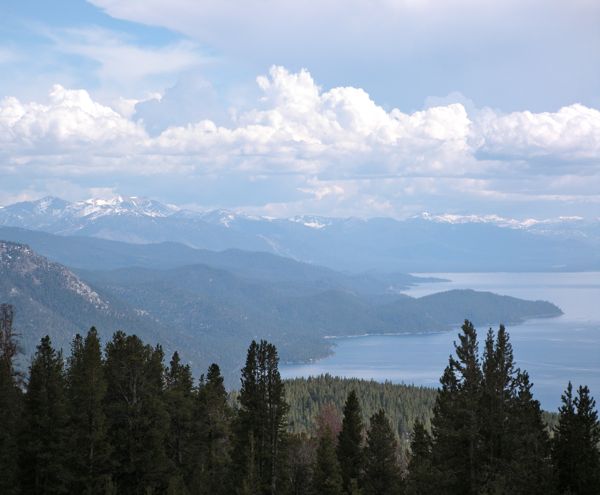
Lake Tahoe from the Mount Rose trail on June 21. Photos/Kathryn Reed

Lake Tahoe from the Mount Rose trail on June 21. Photos/Kathryn Reed

Sue, who has done the hike before without snow, says the views from the top are spectacular. On clear days Mount Shasta can be seen. I can only imagine.

I can attest for some wonderful vistas of Lake Tahoe and the Carson City area from various vantage points. One day maybe I’ll know what Sue is talking about.

One day we might actually finish a hike. That might occur if we would stay at a lower elevation.

The trail is accessible from a few spots off the Mount Rose Highway. The easiest to find is at the summit where there is a large parking lot. We opted to start down a little farther, closer to the lake, and across from the meadow on the other side of the highway.

Here a woman who works for the U.S. Forest Service and UC Davis told us what markers to look for to get to the summit. She was on her way to a research area where she and others are studying the impact beetles are having on trees in the region.

Sauntering along the vehicle-width dirt trail it wasn’t long before patches of snow covered much of the path. Out came the poles – a must-have this time of year to balance along the slick, uneven surface.

This early section is part of the Tahoe Rim Trial. We chose not to attempt the 38-mile jaunt to Tahoe City through the Humboldt-Toiyabe National Forest.

Near a pond, which is partially frozen now, is where the right turn to Mount Rose is. Going straight continues on the TRT, with Relay Peak not far away.

We descend into a meadow – slowly and carefully. Divots in the snow are making the walk tricky. Running water is melting the snow in places, creating streams in what seem to be random locations.

Eyes are carefully scanning and ears listening for rushing water to ensure I’m not walking over a covered stream. Another good use of the poles – to test the sturdiness of the snow covered water.

Mount Rose is in the distance. But even on the longest day of the year it doesn’t seem like we’ll make it there and back since we got a late start. Still, we continue on.

The ski resort by the same name is to the right and actually on the other side of the highway.

Uneven rocks are less stable under our boots than the uneven snow. We’re not having fun and nerves are getting frayed.

It’s time to turn around without reaching our destination.

Meandering up the rocks to avoid the wall of bushes seems more daunting than plowing through the thicket. My bruised, scratched, bloody legs are hoping not to do that again any time soon.

Sue survives to say, “I could be in an ad for REI” as she looks at her filthy pants, with not even a slight rip in them.

I want to be an ad for Hot Springs Spas in my backyard soothing my aches.

We carry on in silence. Up the snowy hill we go. Coming to the point where we make a left back along the main trail is a welcome sight. At this point I’m having dreams of hot chocolate (remember it’s the first day of summer) because my feet are so cold. My boots and socks are soaked. Thank goodness we turned around.

Then Lake Tahoe comes into view. A sight I never get tired of. Seeing it from a new perch suddenly makes the cold dissipate just a bit and a smile crosses my face.

Maybe it wasn’t such a bad way to spend a day away from the office.

ngg_shortcode_0_placeholder (Click on photos to enlarge them.)


Homeowners rally to fight Homewood development

By Austin Fay

HOMEWOOD — Something has to be done in regards to the proposed Homewood Mountain Resort development. That was the overriding sentiment of Friday’s meeting of the Friends of the West Shore, a nonprofit organization aiming to provide a community voice to Homewood’s development plans.

Water usage, the height of the new lodge (which will almost be twice as high as the 32-foot-high existing north lodge), traffic and whether or not the new Homewood development fits into everyone’s view of the West Shore were issues that brought people to the edge of their seats.

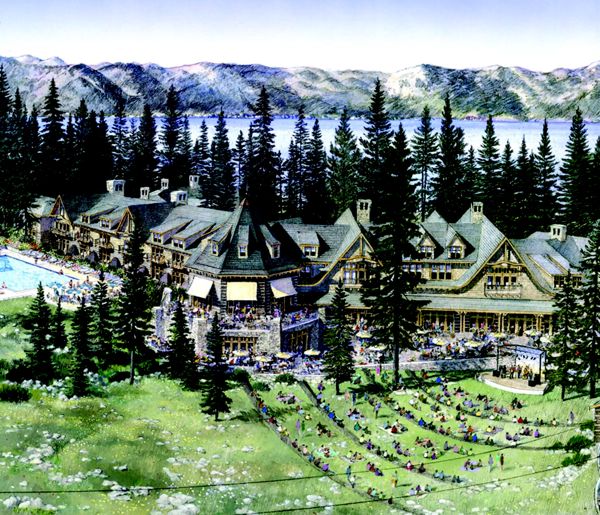
A rendering of what Homewood's owners would like to build.

A rendering of what Homewood's owners would like to build.

This group of homeowners aims to incorporate environment, community and economic sustainability into what JMA Ventures of San Francisco wants to do. JMA bought the resort a few years ago and also now owns Alpine Meadows Ski Resort.

Currently, Homewood’s population is just less than 370 full-time residents, with about 1,000 second homeowners. The expansion proposal would almost double the town’s population. The mountain is about 1,100 acres, including the base area.

The large elements of the 316 mixed-unit proposed plan will consist of a 75-room five-star boutique hotel, 40 condominium residences in the north base, 99 condominiums at the south base, 13 on-site residences for staff, 30 penthouse units, 36 residential condominiums with 20 lock-out units so the condo owner can rent the space, 16 townhomes, grocery store, a full-service restaurant, spa, fitness facility and up to 25,000 square feet of retail space.

Gold-level LEED certification will be sought from the U.S. Green Building Council.

Also, the Madden and Ellis chairlifts will be replaced with high-speed quads, but the total skiable terrain of Homewood will remain unchanged.

Also, the Madden and Ellis chairlifts will be replaced with high-speed quads. The total skiable terrain of Homewood will remain unchanged.

Homewood Mountain Resort’s master plan is here.

Thirty community members gathered at the Rideout Community Center on the West Shore on July 2 to talk about what the developer wants to do. According to the group’s handouts, Friends of the West Shore’s goal “is to have the Homewood Mountain Resort development reflect and enhance the rustic quality and scale of surrounding community, historical buildings both past and present, and protect our natural resources.”

The group also believes the developer’s plans are too big and “the current HMR proposal will negatively change the character of the West Shore forever.”

When asked by Roger Kahn, a small business owner, how many were year-round West Shore residents, nine of the 30 raised a hand.

When asked if their financial wellbeing was dependent on the West Shore, five people raised a hand, including David Tirman, executive vice president with JMA Ventures. Tirman was there to field questions about the proposed development.

“Currently, the revenues are not covering the costs of (Homewood’s) operation,” Tirman said of the reason for the development.

But that isn’t good enough for some of the residents.

“We need to be alert on this issue, we can’t just close our eyes and say, ‘we can remain fine on this issue because Dave’s (Tirman) such a great guy and wouldn’t do anything wrong’,” Susan Gearhart, president of FOWS said. “But every issue on deck is a viable issue, the economics are a viable issue, the community is a very viable issue.”

Tom Rosenberg, a homeowner on the West Shore for 25 years, is writing an opinion piece for the July 4 Sacramento Bee discussing how “the leadership of the TRPA has lost its sense of direction … and the way the Homewood project has been presented is very questionable.”

These are sentiments the group shares. Rosenberg is a writer who has taken an interest in FOWS, but is not a member.

“We’re not a five-star mountain, we’re never going to be a five-star mountain,” Claudia Williams, a Homewood resident, said after the meeting.

Rob Weston, a small business owner on the West Shore, put an emphasis on economic sustainability at the meeting.

“We have to remember what’s being proposed is a year-round resort — 100 year-round jobs on the West Shore,” Weston said.

He said most of the people at the meeting were NIMBYs (not in my backyard) and CAVE (citizens against virtually everything) because they are against development in Lake Tahoe.

The environmental impact report for the project is expected sometime in September. The public will have a chance to formally comment at that time.

The project is subject to Tahoe Regional Planning Agency and Placer County oversight. Tirman expects to break ground in 2012 if permits are in hand, building ordinances are complied with, there’s a buoyant economy, and no unforeseen obstacles.

The next meeting of Friends of the West Shore is at 10am July 24 at Tahoe City Public Utility District building at 330 Fairway Drive in Tahoe City. Residents of the West Shore will be able to ask questions and speak directly with TRPA representatives.


Upper Truckee River users fail to practice ‘leave no trace’

By Austin Fay

On a four-hour hike from Lake Tahoe Golf Course to where the Upper Truckee River ducks under Highway 50, Lake Tahoe News spotted three Coors Light cans, 10 empty bottles, two red plastic cups, one-and-a-half pairs of shoes, a black overturned grill, 14 golf balls outside the course, as well as a cigarette box and other micro-trash along the sweeping riverbanks.

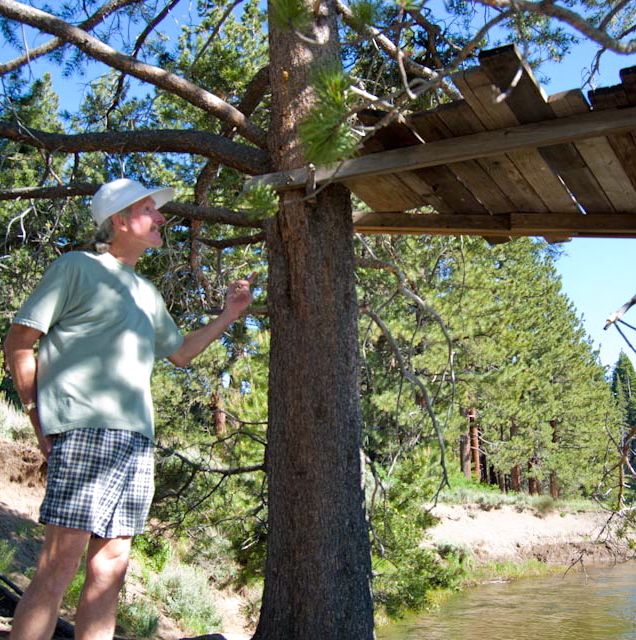
A sort of tree-house platform was also found built into an overhanging tree midway through the Upper Truckee’s journey around the east side of the airport on California Tahoe Conservancy land.

Weaving and meandering through lush meadows, with quaking aspens and willows drooping and sliding into the chilly winding waters, the Upper Truckee River eventually empties into Lake Tahoe.

Steve Ashcroft of South Tahoe checks out the treehouse on the Upper Truckee River's edge. Photos/Austin Fay

Steve Ashcraft of South Tahoe checks out the treehouse on the Upper Truckee River's edge. Photos/Austin Fay

Beyond being  an eyesore, garbage can also end up in the lake. With much of the river being a wildlife corridor, what humans leave behind is never good for animals.

In addition to the walking, bicycling and hiking trails that stretch through the river’s floodplain, kayaking, rafting or just floating makes the river a popular recreation destination.

Much of the trash was found at the river entrance near the intersection of Elks Club Road and Highway 50.

Since May 3, the Tahoe Flea Market has been every Sunday in the parking lot near the most popular entrance point to the river for recreationists. According to Bruce Eisner, acquisitions manager for the California Tahoe Conservancy, the flea market’s participants are responsible for the condition of the parking lot.

Many locals don’t want to see the natural beauty of the land depreciated. Steve Ashcraft, a 31-year South Tahoe resident, walks his dogs up and down the Upper Truckee River several times a week and values the shared land and its single-track trails.

“I see a couple soda cans here, some clothes there, a raft here and that’s with light usage (of the river). How bad is it going be on a long 4th of July weekend?” Ashcraft wonders. “It’s just an ongoing thing.”

Ashcraft also has a problem with CTC’s way of doing things.

“I’m just surprised with the millions and millions they budget for realigning the river and all those cans and bottles are sent out into the lake,” he said.

Of the 63 tributaries of Lake Tahoe, the Upper Truckee River watershed makes up 18 percent of the total watershed drainage into the lake.

Danny Cohen, a one-year South Lake Tahoe resident looking a little sunburned as he took his cooler and rafts out of the river Wednesday night, has floated a section of the river at least 20 times in the last 30 days.

“For the most part it’s pretty clean right now, but the river’s been flowing pretty strong,” Cohen said. He and the three friends he was with reported seeing a few golf balls and a stranded paddle during their float.

“Compared to the rest of California, it’s not that much trash,” said Joy Eichnerlynch, a four-year South Lake Tahoe resident.

Eichnerlynch was out for a sunset stroll with her husband, Walter, and their two wet dogs, Jesse and Gregor, on June 30. They live near F Street and think the litter is worse there than the Upper Truckee because of a nearby sledding hill.

ngg_shortcode_1_placeholder (Click on photo to enlarge.)


Tahoe City woman attempting to make swimming history

By Patricia Yollin

Karen Rogers is one of the few females in the world who covets the physique of a well-blubbered walrus. That’s because she’ll be in the ocean at least 15 hours, if all goes well, when she tries on Friday to become the first woman to swim from the Farallon Islands to San Francisco’s Aquatic Park — a distance of more than 30 miles in treacherous, bone-chilling water.

“This is something I’ve thought about for many, many years,” said the 43-year-old Rogers, who has lived in Tahoe City 20 years. “It’s just a feeling I get when I’m in the water. I don’t really believe I belong on land. I don’t feel very evolved.”

Karen Rogers of Tahoe City is going to swim to the Farallon Islands on July 2. Photos provided by Karen Rogers

Karen Rogers of Tahoe City is going to swim from the Farallon Islands to San Francisco on July 2. Photos provided by Karen Rogers

Over the decades, at least eight people have attempted to swim from the Farallones to the California mainland. Only Stuart Evans and Ted Erikson succeeded. A six-person relay ended on June 19 when one member of the Night Train Swimmers got hypothermia.

It took Evans 13 hours and 46 minutes to swim from the Farallon Islands to Bolinas Point in August 1967. The following month Erikson spent 14 hours and 38 minutes in the water, ending his swim below the center span of the Golden Gate Bridge. His two previous efforts had failed.

He said water temperatures dropped as he approached the bay during his first aborted attempt. He became disoriented and was pulled out of the water.

“The nurse on board could not find a pulse, so I was reported dead. I was deep into hypothermia and really not in contact with the world,” recalled Erikson, 82, of Chicago. “And we had two shark encounters, driven off or killed with a very serious .357 Magnum. My second attempt was halted by long, high swells that made me so seasick that I threw up feedings and became too weak to continue.”

Rogers said her coldest swim so far occurred in 41-degree Lake Tahoe water on Inauguration Day 2009. The duration of a later 21.5-mile effort traversing the length of the lake: 10 hours and 50 minutes.

“I decided it was time to wash away everything and start new, so I went down to the lake,” said Rogers, who has two sons, 16 and 18. She grew up in the Bay Area, in Orinda, and belongs to the South End Rowing Club in San Francisco. She is self-employed, specializing in restaurant accounting. Soon, she’d like to start a program to get teenage girls into the open water.

In May, Rogers swam 23 miles from the Golden Gate Bridge to the San Mateo Bridge in seven hours and 21 minutes. The Farallones swim, however, is the most ambitious she’s attempted. She’ll start around 2 or 3am, touch the island if the waves don’t knock her around — “it’s not really a great place to be bleeding” — and contend with water in the low 50s for much of her journey.

“This is probably the most challenging swim that’s ever been done,” said Chris “El Sharko” Blakeslee, 60, who crossed the English Channel in 2004 and, as Rogers’ team leader, is the only person authorized to end her attempt. “But she has a body type conducive to cold-water swimming, she’s older — you need to have that mental ability to gauge yourself — she has stamina, and she’s very focused. All those things together make her an ideal candidate.”

He conceded the undertaking would seem deranged to most people. Even at the South End Rowing Club, he said, some members consider it a little extreme.

“But I think it’s a noble goal,” said Blakeslee, who will keep a close eye on Rogers’ stroke count and look for sudden drops that could signal trouble.

The challenges, as Rogers sees it, include cold water, the sheer duration of the swim, strong winds, high waves, fog, tides, the seasickness that’s plagued her recently in the ocean and various forms of sea life.

“The great white sharks are still on vacation in Hawaii, or are on their way back,” she said. “But there may be a couple renegade ones. I’ve been rammed by sea lions before, and they’ve given me a pretty good charley horse. And if I were to swim into a jellyfish bloom, it wreaks havoc on your nervous system.”

But Rogers is ready. To get in shape physically, she has relied on running, mountain biking, Pilates, yoga, stretching and swimming in pools and San Francisco Bay. She also has tried to add an extra layer of insulation to her 5-foot-7 frame, eating everything from avocados to coconut ice cream with guava syrup. She currently weighs 172 pounds.

To prepare mentally, she uses visualization techniques. Once she stared at a painting of Bolinas Ridge all day. And she frequently gazes at a wall full of maps.

“Every day I sit next to the creek by my house,” Rogers said. “I just think about my swim and all the things that could happen and how I’m going to remedy those situations when I’m in the water. But my favorite part of marathon swimming, really, is not thinking about anything: the disassociation in the water for many hours. You just hear the water going past your head.”

Rogers compared the experience to a working meditation — and one that’s crucial in the ocean.

“You can get a lot of wind and chop in the bay, but you can always see land,” she said. “Out in the open ocean, you don’t have that. You have to work through it within yourself. I really like that. I just think sometimes I’m missing a dorsal fin to guide me a little bit.”

She’ll wear only a bathing suit, cap, goggles and earplugs, according to English Channel federation rules, and be accompanied by a large fishing boat, a 62-foot-sailboat and a crew of 17, including five kayakers — they’ll take turns navigating and providing liquid feedings every half-hour from the end of a line. She is paying for the $10,000 Farallones venture with her savings and private donations.

Bob Roper, the 71-year-old head of logistics for the team, has belonged to the South End Rowing Club for 42 years and still holds the record for the fastest swim from San Francisco to Marin County under the Golden Gate Bridge. He knows, better than most, what Rogers is facing.

“This is a huge, huge attempt,” he said. “It’s not going to be a walk in the park. It’s much better to go in warmer water a little later in the year, but by then the men in the gray flannel suits will be back. But even when the sharks return, it doesn’t mean a swimmer will be on their menu.”

Walt Schneebeli, 84-year-old historian of the Dolphin Club, the South End’s longtime rival, said, “It’s a very difficult thing to do. Our best swimmer has never tried to do this. The hardest part will be the last part. You get swept here and there.”

Frequently, Rogers is asked if she’s planning to tackle the English Channel. The answer is always no.

“I can’t quite get my head out of California,” she said. “I’m just a hometown girl who doesn’t really want to travel too far to have a challenging experience. There’s so much great open-water swimming right here. I really can’t even think past that.”

Patricia Yollin is a freelance writer based in the Bay Area.

ngg_shortcode_2_placeholder (Click on photo to enlarge)


80mph car chase through South Tahoe ends in meadow

By Kathryn Reed

A Ford Mustang GT went airborne as it careened over a fence at the Upper Truckee Meadow after the driver led officers through the streets of South Lake Tahoe at speeds that reached 80mph. The vehicle stopped about a quarter mile in and then the man and woman unknowingly ran right to waiting officers.

The 4pm June 29 incident started with a report of a kidnapping about 3am June 27. The 32-year-old South Lake Tahoe female victim was not physically hurt and was released. It is believed she and the suspect were acquaintances.

Christopher Wadstein was arrested on two felony charges and a parole warrant on June. 29. Photo/Taylor Flynn/Mountain News

Christopher Wadstein was arrested on two felonies and a parole warrant June 29. Photo/Taylor Flynn/Mountain News

The investigation of that crime came up with leads that Christopher Wadstein, 21, of South Lake Tahoe might be the perpetrator. For the past 24 hours local officers have been tracking the parolee.

“He was mobile when we found him,” South Tahoe police Lt. David Stevenson said. “We attempted to stop him at Black Bart and Pioneer Trail. That’s where the chase started.”

Officers chased the suspect through the Sierra Tract, across Highway 50 where at the end of Creekwood Drive the vehicle plowed through the short wood fence leading to the California Tahoe Conservancy meadow.

“This guy was going 60mph. There was no hesitation,” said Curt Murtha, 25, who from his porch saw the chase go into the meadow.

Other witnesses said officers were no more than 30 seconds behind him as they all wound up in the meadow. No skid marks are visible where the vehicles flew around the corner from Springwood to Creekside.

A roofer on Creekside said it was quite a scene to watch.

Other said it was like something out of “Dukes of Hazard.”

Officers were scouring the meadow for anything the suspects may have tossed from the convertible. With Wadstein being called armed and dangerous, they were looking for a 9mm handgun he may have had on him. None was found.

With sweat beads forming on his bald head, the guy complained of chest pain as he sat in the back of the patrol vehicle. He vacillated about wanting to go to Barton Memorial Hospital. Paramedics eventually took the heavily tattooed Wadstein to the emergency room.

The adrenaline, short sprint and high altitude may have contributed to his chest pain. He was booked into El Dorado County Jail on Tuesday night on a parole warrant, felony kidnapping and felony evasion of officers.

Stevenson didn’t know why California parole officials wanted Wadstein back in custody, nor did he have his list of prior convictions.

Also arrested and booked into the South Lake Tahoe facility was Lacey Almdale, 21, of South Lake Tahoe, for obstructing officers.

El Dorado County sheriff’s deputies, FBI agents, South Lake El Dorado Narcotics Enforcement Team, and El Dorado County probation officers assisted South Tahoe officers.

Dressed all in black, with automatic weapons slung over their shoulder, the SWAT guys were also in facemasks.

“One officer had a gang hit put out on him so we are really concerned for his safety,” acting Chief Martin Hewlett said of the hoods.

Eventually, Emerald Bay Towing showed up to cart the vehicle off. The Mustang does not belong to either of the people arrested. It was not stolen, but officers were still trying to figure out how Wadstein and the vehicle owner are connected.

Officers had gone through some of the contents of the vehicle at the scene. A stack of jeans sat on the back. Next to it was what looked like a small overnight bag, plus a small wooden box with unknown contents.

Stevenson said the vehicle is in custody and will be thoroughly gone over today.

ngg_shortcode_3_placeholder Photos by Taylor Flynn/Mountain News

ngg_shortcode_4_placeholder Photos by Kathryn Reed (Click on photo to enlarge.)


Grand jury buries South Tahoe cemetery with criticism

cemeteryBy Kathryn Reed

A rebuke almost loud enough to wake the dead was issued by the El Dorado County Grand Jury against the Happy Homestead Cemetery District – its board of directors in particular.

In bold the document says, “The HHCD Board of Directors failed to respond to the Grand Jury.”

This civil grand jury, made up of 19 county residents, is tasked with investigating a slew of complaints. Seventeen investigations garnered a report by the 2009-10 El Dorado County Grand Jury. A story about the chaos in South Lake Tahoe can be read here.

Although names are not used in the report, titles are. Usually the person filing the complaint is not identifiable – not so in the case of the cemetery. The report says it was the county’s auditor-controller who had issues with the cemetery on Johnson Boulevard in South Lake Tahoe.

Joe Harn has not paid the bill in question because he doesn’t believe it would be legal to do so.

“The Happy Homestead Cemetery District seems to have an unusually intense desire to make payments to Substitute Personnel,” Harn told Lake Tahoe News. “We’ll continue to do our best to ensure we only make lawful payments for the Happy Homestead Cemetery District.”

A retroactive $2,272 payment to Coco Kelly as owner of Substitute Personnel, who provided a temporary worker to the district, and a latter $3,000 settlement agreement, are the issues.

“According to testimony received, both of the above actions were encouraged by the HHCD legal counsel,” the report says.

Not included in the report is the fact that the board agreed to pay the $3,000 out of the endowment fund.

The grand jury met with the five board members (Joe Tillson, John Poell, Del Laine, John McChesney and Linda Mendizabal) as a group. The district’s attorney, Dennis Crabb, is referenced quite a bit by title.

Neither Tillson, the chairman of the board, nor Crabb returned calls.

“The HHCD position with respect to these issues was received in a letter sent after the Board was interviewed by the Grand Jury. The HHCD letter cites two obscure court precedents in support of the contention that a retroactive pay increase should be permitted and that the settlement agreement should be paid,” the report says.

It goes on to say, “… retroactive claims that increase compensation are considered unconstitutional.”

An April letter signed by the grand jury foreman asked the cemetery board for three documents. The foreman asked to be called if the documents did not exist. No call was made. The board didn’t respond at all to the investigating body’s request.

The grand jury wants the cemetery board to explain by the retroactive pay is not an unconstitutional gift of public funds, prove the settlement agreement is legally justified, and why paying either claim doesn’t violate the state Constitution.

Other items covered in this year’s grand jury report:

• A recommendation for the Board of Supervisors to have all elections vote by mail.

• Extreme criticism of how the Board of Supervisors went about trying to obtain property for an animal shelter on the West Slope.

• A suggestion to review and update the county’s fee waiver policy.

• Have a comprehensive assessment of administrative services in county government.

• Each year both jails are looked at. In South Lake Tahoe, the recommendations are to provide better security and surveillance cameras, and a structural engineer should be called out to look at the cause of leaks. The staff was commended for the variety of programs for inmates and the culinary arts program.

• Having the multitude of special districts create websites so constituents can easily access information. Internet access in the county should be increased. The grand jury found 52 percent of households in the county have good to excellent Internet access; 39 percent have fair to good access; 5 percent have poor to fair access; and 4 percent have no access.


Scarce money taking toll on California State Parks

By Sacramento Bee

The images won’t appear in any California State Parks brochure.

MacKerricher State Park: Fifty elementary-school kids arrive for their annual end-of-year camping trip, only to find the drinking water contaminated.

Mount Tamalpais: A trail near the visitors center greets disabled visitors and families with a 12- to 50-foot sheer drop-off – and no guardrail.

Hearst Castle: The marble Neptune Pool at California’s most famous state park leaks so much that stalactites have formed in a cavity underneath.

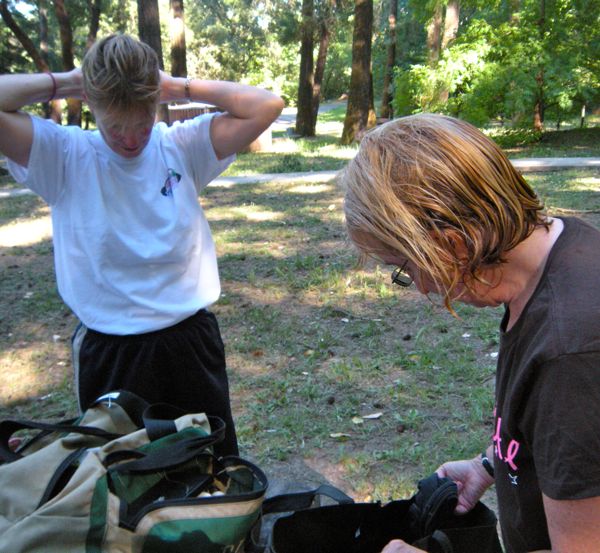
Pam Valentine and Sue Wood found the showers at Bothe State Park in Napa Valley in june to have issues. Photo/Kathryn Reed

Pam Valentine and Sue Wood found the showers at Bothe State Park in Napa Valley in June to have issues. Photo/Kathryn Reed

Look beyond the crashing waves and towering redwoods, and California’s 278 state parks are a tangle of troubles. The nation’s largest state parks system is weighed down by a $1.3 billion maintenance backlog, according to a review of park records by the Sacramento Bee.

Read the whole story


Home tour proves life is thriving in Angora burn area

Publisher’s note: See the Voices section to read about reporter Susan Wood’s experience three years ago covering the Angora Fire.

By Kathryn Reed

Windows to a world that changed their lives are everywhere.

This is one of the common themes of the seven houses on the AAUW’s biennial home tour – openness in design, with natural light filtering in from all corners, and sometimes the ceiling. “From the Ashes” was the appropriate name of Saturday’s event, as all houses and the demonstration garden have been rebuilt because the 2007 Angora Fire reduced the original structures to ash.

These houses represent the 86 that have been completely rebuilt. Fourteen are ready for their final inspection. Another 86 are in some stage of the application or rebuilding process, while 68 of the 254 homeowners who lost their houses are letting their lot sit idle for now.
Driveway paving stones survived the Angora Fire to be used as a patio. Photos/Kathryn Reed

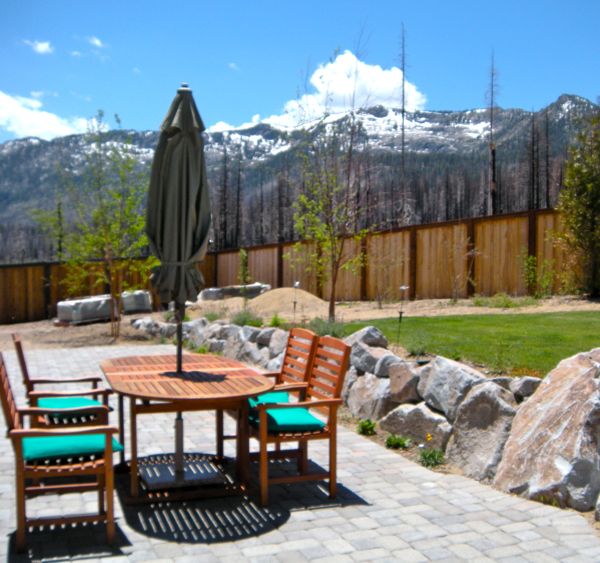
Driveway paving stones survived the Angora Fire to be used as a patio. Photos/Kathryn Reed

Though each of the homes is clearly distinct and reflects the individual owners, a few similarities can be found. Granite is used extensively in many of the homes – from kitchens, to bathrooms, to fireplaces.

Wood floors are everywhere. Plenty of carpet exists, but so do a lot of throw rugs and tile flooring. Some have heated floors.

Islands in the kitchen are almost a given. Some have a utility sink, the gas range, and many have stools to belly up to the counter in what is so often the main congregating area.

Decks and outdoor stairs are made of non-flammable products. Depending on when building permits were filed, wood decking was not permitted based on fire code changes that took effect Jan. 1, 2008.

Wide staircases that would make it easy to haul furniture without marring the walls are the norm.

Master bedrooms mostly come with walk-in closets – some the size of a small bedroom. Master bathrooms accommodate three at once, with the shower, bathtub and toilet (often in a cubbyhole) as separate entities.

Behind the home tour

The American Association of University Women’s South Lake Tahoe chapter has been putting on a home tour for decades. Every two years they try to pick a different area of the South Shore to feature. This year’s tour came three years, and two days after the Angora Fire wiped out a large swath of homes lived in mostly by full-time middle class residents, burning more than 3,100 acres and bringing “defensible space” into the vocabulary of many, and the realization insurance policies should be reviewed annually.

“The focus is on the care, thought and love all the people in the neighborhood put in. Some houses are small, but all contain interesting features,” Kay Henderson, one of the organizers, said.

More of the $25 tickets were sold this year than for some of the more recent tours.

Proceeds from the tour stay in the community to help locals. Scholarships are given to two female graduates of Lake Tahoe Community College to continue their education, with $1,500 being given to each in recent years. The money also pays for two or three middle school girls to go to California’s Tech Trek each summer, which is designed to encourage them to consider careers in science and math.

The homes

Some of the homeowners stayed to greet people. Names of local contractors and businesses that were used were available. Most who rebuilt tried to spend their money locally or regionally.

The Granite Mountain Circle house was a 1974 A-frame the family had lived in since 1991. The design is much more modern and larger by about 500 square feet.

A dumbwaiter carries items from the garage to the kitchen.

Some of the pictures on the walls were saved when the two teenage daughters grabbed what they could in the 15 minutes they had to evacuate.

Designed to be the family gathering spot, the couple never thought twice about rebuilding. It’s where their children and grandchildren can call home. A wrap-around deck gives views of everything but the rawest part of the devastation leading to Angora ridge.

A couple on Mule Deer Circle built their dream home twice. Days before they were to move into the home, it burned to the ground in the Angora Fire. The good thing was their belongings were not inside.

The rebuild allowed them to do some things differently. The master suite is upstairs instead of down, and the spiral staircase – which is a focal point of the main room – is smaller.

A European feel is throughout. Clearly the owners like to cook based on the attention to detail in the kitchen, the appliances and unique hood with its glass and stainless steel design.

High ceilings and large windows offer views of the blackened forest, with trees that are a combo of white and black – signifying just how hot the fire burned in this area.

Norma and Warren Sprague were some of the first people to move back to the burn area – doing so a week before the one-year anniversary of the fire, and months before celebrating their 50th wedding anniversary.

Views from their Lake Tahoe Boulevard house are designed to direct the eye above the burn area.

“I looked at this and it was not the worst thing that could happen to me,” Norma Sprague said of losing everything.

With a smile and laugh, she can talk about her 40-year-old house that needed a lot of work.

Capturing her ancestry, certificates from her Italian parents and grandparents coming to the United States via Ellis Island are in one room.

The single-story home on Pyramid Circle is the most modest of the ones on the tour. A glass display case in the entry has the bottom two shelves filled with items that were retrieved from the rubble. Pottery, a hose sprayer, candleholder and teapot are some of the memorabilia.

Tube or tunnel lights have been installed on the roof to provide sunlight into various rooms. One bedroom looks like a light is on, when in fact it is natural light filtering in from this type of skylight.

Hopefully, the next owners like dogs because a paw print has been designed into the front entry’s rock pattern.

Despite the back yard being the destroyed forest, the owner has chosen an open fence that allows that area to seem larger than it is – though it is already a nice size lot.

Driving up to the house on Snow Mountain Drive the windows are most prominent, then the deck area above the entrance that is like a mini garden this time of year. It’s easy to stop before the front door because a small, covered deck beckons one to sit and enjoy summer in Tahoe.

Angles of the roofline are eye-catching. The nooks of the interior create an architectural design not often found in Tahoe.

A major difference in this home is the kitchen is distinctly separate from the great room.

The master bedroom, bath and office are on the first floor. Upstairs is what could be a mother-in-law unit with efficiency kitchen, bath and bedroom.

On the other end of the second floor is a sewing room that any seamstress, in this case embroiderer, could find inspiration from working in.

With 45 minutes to evacuate, all the pictures in the Mount Olympia Circle home were saved.

As the fire passed by it cooled a bit, with flowers on one side able to be saved. Creating a garden was their first priority – having brought water in to begin the rebirth process.

Looking out the upstairs bedroom windows that front the street a row of green, healthy looking pine trees is in the foreground. Farther up is another row – on the ridge – where the fire stopped.

The family started working on plans to rebuild two weeks after the fire, and moved in in October 2008.

The wood burning fireplace is one of the few in the new homes – most people went with gas. This one can heat the whole house.

Around the corner on this street is a demonstration garden. The lot belonged to Owen Evans. His daughter, Leona Allen, also lost her house in the fire. To honor her father, who has since died, and her mother, Esther, Allen donated this parcel to be a resource for the neighborhood and community at-large.

Jennifer Cressy with the Tahoe Resource Conservation District was giving tours of the lot on Saturday, explaining vegetation that is good for wet soil, infiltration basins, native wildflowers, erosion control techniques and other nuances to landscaping in the mountains.

The garden is still a work in progress, with the hopes of developing a community vegetable and herb garden and other aspects. Volunteers are always needed to help – call (530) 543.1501, ext. 118 for information.

The last house on the tour belongs to Solange Schwalbe, one of the more vocal residents during the community meetings three years ago. On this day she is welcoming everyone to her home, talking about what it was like then compared to today.

A boulder in the back yard was part of the foundation for the old deck. The Willy Jeep survived the fire, while the newer one essentially melted into the heap of debris.

Upstairs is all new, while downstairs is where she spends most of her time. Furniture she picked up from the community center that was set up for Angora survivors fills this living area.

One day she might rent that section out. Upstairs most of the walls are yellow –- inspiration from Miami, with an accent wall in black. It works. The gold Emmy she earned for her sound work on “Black Hawk Down” sits on the mantle above the gas fireplace – a striking contrast to the black wall.

She looks around and tells the visitors, “Nothing here is mine.”

ngg_shortcode_5_placeholder (Click on photos for full size.)


Grand jury chastises South Lake’s council, city manager

slt sealBy Kathryn Reed

Dysfunctional is the overwhelming feeling the El Dorado County Grand Jury has of the city of South Lake Tahoe – primarily the council and city manager.

The seven pages devoted to South Lake Tahoe in the 2009-10 Grand Jury Report that came out this week are scathing.

“Council members and senior staff are unwilling or afraid to address and deal with the existing hostile work environment,” the report says.

“Bickering”, “nitpicking”, “back biting”, “bush league” – those are some of the words and phrases in the report.

This civil grand jury made up of 19 county residents issues a report each June based on its investigations during the past year. This particular report touches on the Brown Act, council behavior, Councilman Bruce Grego’s repayment of an outside legal counsel bill, City Manager Dave Jinken’s behavior, how City Attorney Patrick Enright coached staff to talk to the grand jury, and the general climate of the city.

The panel interviewed at least three council members –Kathay Lovell, Bill Crawford and Hal Cole. Councilman Jerry Birdwell said no one from the grand jury contacted him nor did he contact them. Grego did not return calls to Lake Tahoe News.

Others interviewed by some of the grand jury members or the full panel include this reporter, appointed city staff (the city manager and city attorney are the only ones who fit that category), city employees, and a trainer of municipal officers and employees. It is not known if other media were questioned.

The document, which is a public record but is not currently on the county’s website, rips into how the council works together, or rather, doesn’t work together.

Cole concurred with this assessment, adding that he, too, believes personal agendas take precedence over policy. He hopes three candidates come forward for the November election who will change the makeup of the council so it functions better.

(Lovell is running, Crawford isn’t, Birdwell is weighing his options.)

Cole was also critical of this reporter who has written about actions from closed session. He said that was wrong. One item reported was the vote on what to do with Officer Johnny Poland. Some council members believed that vote needed to be disclosed based on the Brown Act, others disagreed.

One of the recommendations of the grand jury is for the council to adopt a code of conduct and ethics and receive conflict resolution training.

“I do disagree with their thought that the City Council has not had appropriate ethical trainings,” Crawford said. “It’s mandated by law we have an ethics session every two years and we have done that. I think the grand jury is correct, if I read between the lines, that there is a question among the City Council about ethical behavior.”

The grand jury addressed Grego’s reimbursement of nearly $1,000 to have attorney Dennis Crabb handle a potential conflict of interest issue with the Fair Political Practices Commission.

The grand jury wrote, “California State Law clearly states that government contracts for payment may not be backdated. All unusual expenditures should be approved in open session.”

District Attorney Vern Pierson did not return a call asking him if his office would revisit the issue now that the grand jury has weighed in.

The report further states, “Testimony supports that City officers and employees at times operate using accepted historical practices that conflict with official written policy. This has resulted in misunderstandings, contentious City Council meetings, and a public impression that the City’s government operates outside the law. These misconceptions could expose the City to lawsuits.”

It accuses Enright of crossing the line when it came to coaching staff about what to tell the grand jury.

Enright said via email, “… I have barely had a chance to review the report and will need to review it carefully next week before responding.”

The grand jury essentially said the council abdicated its responsibility at crucial times.

“The City Council, when facing controversial issues or after threat of litigation, routinely drops issues, even if addressing the issue would improve the function of government or service to the public,” the report says.

Another issue brought up in the report is all of the couples who work for the city. South Tahoe does not have a nepotism policy. The report shows how staff is afraid to say something about one person for fear of retaliation for being critical of a family member. The report says the city needs to address this issue to create a better work environment.

Jinkens took the brunt of the heat from the grand jury.

“The City Manager, fearing loss of supervisory control of the Finance Director, advised the City Council that the Finance Director would probably file an official complaint against the City Attorney and the City charging them with harassment if the move took place. This statement was viewed by some employees as a threat by the City Manager,” the report says.

One of the confusing things about the report that will make it hard for the public to understand is that just titles are used and not names. With there having been two city attorneys for much of the time of the investigation and different mayors part of the time, it takes knowing a bit of the city’s history to know who is who.

Based on stories written by Lake Tahoe News, the above reference is to when Jacqueline Mittelstadt was city attorney. Mittelstadt did not respond to a request to comment on the report.

When the report takes issue with the mayor not putting something on the agenda, it is Lovell they are talking about.

Other references to Jinkens in the report include, “During a contentious June 30, 2009 City Council meeting it was suggested that the City Manager should resign. Testimony received indicated the City Manger later threatened to file a Workers Compensation claim, hire outside counsel and sue the City.”

It further says, “The City Manager used intimidation to retain control over parts of government.”

Jinkens sent an email to the council, Enright and City Clerk Suzie Alessi on Thursday afternoon that he shared with Lake Tahoe News the next day. It says, “While I do not agree with all of their conclusions and their understanding of the facts in all cases, I understand their right of the Grand Jury to examine the operation of local government and report their findings. My hope is that the very unpleasant experiences of the last year that we have endured will be lessons that will help us all to build a more positive and productive future for the people we serve.”

Jinkens, whose last day is Aug. 7, did not want to talk further about the report. He said he and Enright will create a draft response for the City Council in the next two weeks. The council has 90 days to respond to the report.